Hiroko Kanoh (2026). AI-Supported Mind Mapping for Collaborative Discussion: An Exploratory Qualitative Classroom Study Using Personary. In: Human Interaction and Emerging Technologies (IHIET 2026). AHFE Open Access, vol. 236, pp. 269–278. https://doi.org/10.54941/ahfe1008102
Generative artificial intelligence (AI) is increasingly shaping how university students search for information, write, create, communicate, and solve problems. In higher education, this situation requires not only operational skills for using AI tools, but also broader competencies such as critical evaluation, information literacy, ethical judgment, self-regulation, and collaborative reflection. This study examines a classroom practice using Personary, a digital mind-mapping platform with an optional AI-assisted mode, to explore how university students conceptualize competencies needed in the AI era. The activity was conducted at two Japanese universities. Students received a common instructional presentation on digital safety, misinformation, AI risks and benefits, cognitive bias, and digital well-being. They then discussed the question, “What competencies should university students develop in the AI era?” and created collaborative mind maps using Personary. Student-generated mind maps and written reflections were analyzed through interpretive map analysis and text-mining-assisted qualitative analysis. The results show that students understood AI-era competencies as multidimensional capacities rather than as technical skills alone. Their maps and reflections emphasized critical evaluation of AI-generated information, media and data literacy, autonomous thinking, communication, ethical responsibility, appropriate AI use, and adaptability. Personary supported the externalization and organization of these ideas, while the AI-assisted mode provided additional prompts for expanding selected branches. The study demonstrates how AI-supported mind mapping can function as a reflective learning activity for visualizing, sharing, and reorganizing students’ understanding of AI literacy in higher education.
The rapid development of generative artificial intelligence (AI) has changed the conditions under which university students learn, write, search for information, create materials, and solve problems. AI systems are increasingly embedded in everyday learning environments through conversational agents, translation systems, image generators, automated feedback tools, and AI-supported creative platforms. In response to these changes, some instructors prohibit the use of AI in assignments because of concerns about Received May 24, 2026; Revised June 29, 2026; Accepted July 21, 2026; Available online August 25, 2026
270 Kanoh plagiarism, authorship, and academic integrity. However, a prohibition- oriented response alone does not prepare students to use AI responsibly, critically, and productively. Higher education therefore needs to provide students with opportunities to understand AI, use it reflectively, evaluate its outputs, and consider its ethical and social implications.
Recent studies suggest that the competencies required in the AI era extend beyond simple tool operation. Long and Magerko (2020) define AI literacy as a set of competencies for critically evaluating AI technologies, communicating and collaborating with AI, and using AI effectively in everyday contexts. Ng et al. (2021) conceptualize AI literacy through knowing and understanding AI, using and applying AI, evaluating and creating with AI, and understanding ethical issues. Chiu et al. (2024) further propose a broader AI competency framework that includes technology, impact, ethics, collaboration, and self- reflection. Annapureddy et al. (2025) identify generative AI literacy as a set of competencies including foundational AI knowledge, model capabilities and limitations, prompt engineering, programming, and ethical and legal awareness. These studies indicate that AI literacy should be understood as a multidimensional capacity involving technical understanding, critical evaluation, ethical judgment, collaboration, and reflective use.
In higher education, there is also a need to clarify what students should learn about AI and how such learning should be supported. Memarian and Doleck (2024) note that, although AI in education has received substantial attention, comparatively less work has focused on the pedagogy of AI itself in higher education. Baskara (2025) argues that digital literacy frameworks need to be reconceptualized for the AI era and proposes a framework that includes technical understanding of AI systems, practical implementation skills, critical evaluation abilities, ethical considerations, and adaptability. These frameworks suggest that university students need a connected set of competencies rather than isolated technical skills.
Based on this literature, the competencies required of university students in the AI era can be summarized into six interrelated domains: computational thinking and basic programming; AI literacy, including understanding model capabilities, limitations, and failure modes; data literacy and statistical reasoning; prompt engineering and AI-assisted problem solving; ethical judgment and responsible AI use; and self-regulation, adaptability, and collaborative reflection. Computational thinking provides a foundation for understanding AI-related problem solving, including abstraction, decomposition, and algorithmic thinking (Wing, 2006; Weintrop et al., 2016). Data literacy is also central to AI-era learning because students need to interpret data-based claims and evaluate outputs generated from data-driven systems (Gould, 2017). In addition, recent studies on AI use in learning and creative activities indicate that students need opportunities to use AI tools in guided and responsible ways rather than encounter them only as prohibited technologies (Amsal and Darma Sagita, 2024; Pinontoan et al., 2023).
Ethical and responsible AI use is particularly important because AI use in education involves transparency, bias, fairness, responsibility, academic integrity, and student well-being. Floridi and Cowls (2019) propose principles such as beneficence, non-maleficence, autonomy, justice, and explicability as a basis
AI-Supported Mind Mapping for Collaborative Discussion 271 for responsible AI. Guadu et al. (2026) discuss academic integrity challenges in the age of AI and emphasize the need for AI literacy and institutional strategies in higher education. Wong et al. (2025) also argue that generative AI may either support learning opportunities or deepen educational divides depending on how institutions cultivate students’ AI-related capabilities. Kanoh (2025) similarly emphasizes that generative AI pedagogy should address epistemic injustice and student well-being, suggesting that AI use in education should be guided by transparent, reflective, and ethically grounded practices.
To support these competencies, students need opportunities to externalize their ideas, compare perspectives, and reorganize their understanding through discussion. Mind mapping and concept mapping have long been used to make conceptual relationships visible and support meaningful learning (Nesbit and Adesope, 2006; Davies, 2011). In the context of AI literacy education, AI-supported mind mapping may help students visualize their own ideas, identify relationships among concepts, and expand discussion through selective use of AI-generated suggestions.
The present study examines a classroom practice using Personary, a digital mind-mapping platform with an optional AI-assisted mode. In the activity, university students discuss the question, “What competencies should university students develop in the AI era?” and collaboratively create mind maps to externalize and organize their ideas. The purpose of this study is to examine how students conceptualize AI-era competencies, how these competencies are represented in student-generated mind maps, and how AI-supported mind mapping can scaffold collaborative discussion and reflection in higher education.
METHOD
Research Design This study adopts an exploratory qualitative classroom-study design to examine how university students conceptualize competencies needed in the AI era through collaborative mind mapping, group discussion, and post- activity reflection. The analytical focus is on the externalization of ideas, the visible organization of conceptual relationships, and the meanings students articulate in writing. The activity was implemented at a university in Aichi Prefecture on April 28, 2026, and in the Cyberpsychology course at Yamagata University on May 7, 2026. In the Yamagata University context, post-activity reflections were completed after class as homework.
Educational Contexts The classroom practice takes place in two Japanese higher-education contexts: a guest-teaching setting at a university in Aichi Prefecture and the Cyberpsychology course at Yamagata University. A total of 34 students participated in the activity: 10 students in the Aichi university context and 24 students in the Yamagata University context. In both contexts, students work with the same guiding question and the same instructional slides. The analysis treats the two settings as related implementations of a shared activity design rather than as groups for comparison.
Before the mapping activity, students receive a common instructional presentation on digital safety and the social use of AI. The presentation addresses topics such as personal information leakage, cyberbullying, misinformation, deepfakes, cognitive biases, filter bubbles, click-fix scams, the benefits and risks of AI, inoculation, and digital well-being. It concludes by asking students to consider the question, “What competencies should university students develop in the AI era?” and to organize their ideas through a collaborative mind-mapping activity in Personary.
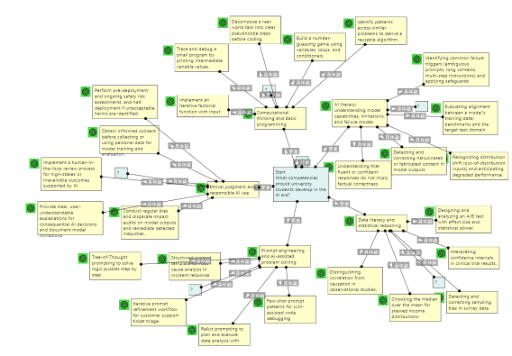
Personary Personary serves as the collaborative digital mind-mapping environment for the activity. The platform supports manual node-and-link construction by users and also provides an AI mode for idea expansion. Students first build an initial map from their own discussion. When a group wants to deepen a branch, elaborate a concept, or develop ideas at a point where discussion slows down, the AI mode can be used to generate candidate branches from the guiding question or from a selected node. The group then reviews, selects, revises, and integrates these suggestions into the evolving map as appropriate. In this design, AI support functions as a resource for idea development within collaborative discussion. Figure 1 shows an AI-assisted reference map generated from the same guiding question to illustrate the idea-expansion function of Personary.
Figure 1: AI-assisted reference map generated in Personary.
Learning Procedure The activity proceeds in six stages. First, students receive the common instructional presentation. Second, the instructor introduces the guiding question, “What competencies should university students develop in the AI era?” Third, students discuss the question in small groups and create an initial map in Personary. Fourth, when necessary, groups use the AI mode to expand branches that call for further idea development. Fifth, groups refine
AI-Supported Mind Mapping for Collaborative Discussion 273 the map by reorganizing nodes, adding links, and integrating viewpoints developed through discussion and, where applicable, AI-assisted expansion. Sixth, students complete a post-activity reflection form and, where available, closed-ended questionnaire items.
Data Sources The study uses student-generated mind maps, post-activity written reflections, and questionnaire responses where available. The mind maps provide visual records of concept selection, branching, and relational organization. The written reflections provide accounts of students’ interpretations of the activity, their views on AI-era competencies, and their perceptions of collaborative discussion. Questionnaire responses provide supplementary descriptive background information for the classroom practice. The common instructional slides document the shared framing of the activity.
Analytical Procedure The analysis combines interpretive analysis of the mind maps with text- mining-assisted qualitative analysis of the written reflections. The map analysis examines central concepts, branching patterns, hierarchical relations, cross- links, and the use of examples or elaborative nodes. The written reflections from the two classroom contexts are combined because the study treats the two contexts as related implementations of the same activity design. KH Coder is used to identify frequently occurring terms, co-occurrence patterns, and recurring expressions, while the classroom context is retained as a descriptive variable for checking contextual differences when necessary. The final interpretation is developed by comparing the visual structures of the maps with thematic patterns identified in the reflections.
Ethical Considerations The study uses anonymized classroom materials. Names and identifying information are removed from maps and written responses before analysis and presentation. Findings are reported at the level of themes, concept structures, and representative patterns in student work.
RESULTS
The analysis of student-generated mind maps and post-activity written reflections showed that students conceptualized competencies needed in the AI era in broad and multidimensional ways. Rather than reducing AI-era competencies to technical operation skills alone, students referred to judgment, information evaluation, autonomy, communication, ethics, and adaptability. Across the data, seven recurring themes were identified: (1) critical evaluation of information and AI outputs, (2) AI literacy and understanding of limitations, (3) data and media literacy, (4) autonomy and self-regulation, (5) communication and collaboration, (6) ethical and responsible AI use, and (7) adaptability and lifelong learning (Table 1).
274 Kanoh Text-mining-assisted analysis of the written reflections supported these thematic findings. After translation into English, the reflections were analyzed in KH Coder, and a co-occurrence network was generated using the Jaccard coefficient with a threshold of 0.70 or higher. The resulting network produced nine subgraphs, with the largest cluster centered on AI, information, use, ability, skill, people, and society. This pattern suggests that students did not discuss AI in isolation, but rather in connection with how it should be used, what kinds of abilities are required, and how AI relates to human judgment and social life.
The AI-focused collocation statistics further clarified this tendency. In the collocation table, the most strongly associated word with AI was use (frequency = 54, collocation score = 44.867), followed by age (27, 13.533), utilize (12, 10.500), information (22, 8.833), ability (32, 8.750), technology (10, 7.117), believe (15, 6.217), answer (12, 6.167), and generate (9, 5.917). These results indicate that students frequently framed AI in terms of use, capability, and the need to evaluate information and answers generated by AI systems. The collocates convenient (15, 5.283), tool (12, 3.533), and appropriately (4, 4.000) also suggest that students tended to regard AI as a useful but carefully managed resource rather than as an unquestioned authority.
The concordance data provide further support for this interpretation. The target word AI appeared 283 times in the concordance output. In these contexts, students repeatedly described AI as a tool that can support writing, data analysis, summarization, and efficiency, while also emphasizing that AI-generated information is not always accurate and should not simply be believed. Several concordance lines linked AI with phrases such as “think for themselves,” “verify the evidence,” “communication skills,” and “combine the use of AI with ideas and judgments that only humans can make.” This suggests that students understood AI use as requiring both practical utilization skills and distinctly human capacities such as critical thinking, interpretation, and collaboration.
The student-generated mind maps showed similar patterns at the level of conceptual structure. Across the eight maps analyzed, students repeatedly organized their ideas around a tension between the usefulness of AI and the need to maintain human agency. On the one hand, AI was associated with efficiency, summarization, information gathering, idea generation, rapid suggestions, and convenience. On the other hand, students also identified risks such as overdependence, reduced thinking ability, misinformation, leakage of information, lack of reliability, and difficulty in assigning responsibility. These maps therefore did not present AI as simply positive or negative; instead, they represented AI as something that must be used selectively, critically, and responsibly.
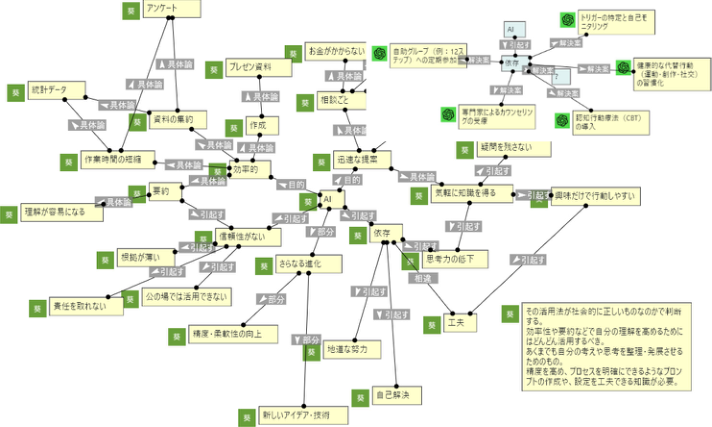
An Example of a student-generated mind map (Figure 2) illustrates this pattern clearly. In that map, the central node “competencies needed in the AI era” was connected to branches such as “problem-solving ability,” “the ability to use AI,” “information selection,” “improved judgment,” “net literacy,” and “the ability to continue learning.” At the same time, the map also included concerns such as “dependence,” “abandoning one’s own thinking,” and “not
AI-Supported Mind Mapping for Collaborative Discussion 275 being deceived by advertisements,” indicating that students linked AI use with both opportunity and caution. Other maps similarly emphasized “thinking for oneself,” “not over-relying on AI,” “checking whether information is true,” and “using AI while preserving human strengths.” Taken together, the maps suggest that students viewed AI-era competencies not as isolated skills but as interconnected capacities that combine information literacy, judgment, self-regulation, and responsible use.
The AI-assisted function of Personary was also useful for extending discussion when a branch required further elaboration. In one case, the branch related to dependence on AI was extracted and expanded separately because direct expansion within the original map was technically difficult. The AI-assisted output suggested additional responses such as identifying triggers and self-monitoring, cultivating healthy alternative habits (e.g., exercise, creative activity, and social interaction), seeking professional counseling, introducing cognitive behavioral therapy (CBT), and establishing periodic digital-detox groups. Although these additions were generated separately from the original map, they demonstrate how AI-assisted expansion can help move discussion from the identification of a problem to consideration of possible responses. Importantly, the AI output functioned as a prompt for further reflection rather than as a replacement for the students’ original conceptual structure.
Table 1: Competency themes identified from mind maps and reflections.
Table available in the original PDF paper.
Theme Description Examples From Maps and Reflections Critical evaluation of information and AI outputs
Evaluating the reliability of AI-generated answers and online information
verifying evidence, checking accuracy, not simply believing AI answers
Understanding AI as a useful but limited tool
AI literacy and understanding of limitations
AI as a tool, AI-generated answers, limitations, hallucination, reliability
Data and media literacy Selecting, interpreting, and evaluating information in digital environments
information selection, media literacy, misinformation, deepfakes, advertisements
Autonomy and self- regulation
Maintaining one’s own thinking and avoiding excessive dependence on AI
thinking for oneself, not over- relying on AI, self-resolution, dependence
Communication and collaboration
Sharing ideas, comparing perspectives, and communicating with others
communication skills, consultation, group discussion, exchanging opinions
Ethical and responsible AI use
Considering responsibility, fairness, appropriate use, and social consequences
Continuing to learn and adapt in response to changing AI technologies
learning continuously, acquiring new knowledge, improving skills, adapting to change
Figure 2: Example of a student-generated mind map with AI-assisted branch expansion.
Overall, the results indicate that students understood competencies needed in the AI era in a broad and reflective manner. Their responses extended beyond technical AI use to include the ability to verify information, think independently, communicate with others, regulate dependence, and use AI ethically and strategically. The combination of mind-map analysis and text- mining-assisted analysis therefore suggests that AI-supported mind mapping can make students’ conceptual structures visible while also providing opportunities to expand and refine discussion through selective AI assistance.
CONCLUSION
This study examined how university students conceptualized competencies needed in the AI era through collaborative mind mapping using Personary. The findings show that students did not understand AI-era competencies merely as technical skills. Rather, they associated them with a broader set of capacities, including critical evaluation of information, understanding of AI’s capabilities and limitations, data and media literacy, autonomy, communication, ethical responsibility, and adaptability.
The student-generated mind maps made these conceptual relationships visible. They showed that students considered AI both as a useful tool for learning, efficiency, idea generation, and information organization, and as a source of risks such as overdependence, misinformation, reduced independent thinking, and unclear responsibility. The written reflections and text-mining- assisted analysis also supported this interpretation, indicating that students frequently discussed AI in relation to use, information, ability, answers, tools, and appropriate judgment.
Personary functioned as a digital environment for externalizing, sharing, and reorganizing students’ ideas. Its AI-assisted mode further provided a way to expand selected branches when additional perspectives were needed. In
AI-Supported Mind Mapping for Collaborative Discussion 277 this activity, AI support did not replace students’ thinking; rather, it served as a resource for extending discussion and encouraging further reflection on the relationship between human judgment and AI use.
This study contributes a qualitative classroom example of how AI-supported mind mapping can be used in higher education to promote reflective AI literacy learning. The findings suggest that collaborative visualization tools can help students articulate not only how AI may be used, but also what kinds of human capacities should be maintained and developed in an AI-mediated society. The study is limited to specific classroom contexts in Japanese higher education, and the findings should be interpreted as exploratory qualitative insights. Future research should examine repeated use of Personary, different discussion themes, and how students revise their maps after interacting with AI-assisted suggestions.
ACKNOWLEDGMENT
The author gratefully acknowledges financial support from the Fuji Seal Foundation.
REFERENCES
Amsal, M.F. and Darma Sagita, D. (2024). “Utilization of Artificial Intelligence (AI) in Learning for College Students”, Pedagogi: Jurnal Ilmu Pendidikan, 24(2). https://doi.org/10.24036/pedagogi.v24i2.2258 Annapureddy, R., Fornaroli, A. and Gatica-Perez, D. (2025). “Generative AI Literacy:
Twelve Defining Competencies”, Digital Government: Research and Practice, 6(1), Article 13. https://doi.org/10.1145/3685680 Baskara, F.R. (2025). “Conceptualizing Digital Literacy for the AI Era: A Framework for Preparing Students in an AI-Driven World”, Data and Metadata, 4, 530. https://doi.org/10.56294/dm2025530 Chiu, T.K.F., Ahmad, Z., Ismailov, M. and Sanusi, I.T. (2024). “What are artificial
intelligence literacy and competency? A comprehensive framework to support them”, Computers and Education Open, 6, 100171. https://doi.org/10.1016/j. caeo.2024.100171 Davies, M. (2011). “Concept mapping, mind mapping and argument mapping: what are the differences and do they matter?”, Higher Education, 62, 279–301. https:// doi.org/10.1007/s10734-010-9387-6 Floridi, L. and Cowls, J. (2019). “A Unified Framework of Five Principles for AI in Society”,
Harvard Data Science Review, 1(1). https://doi.org/10.1162/99608f92.8cd550d1 Gould, R. (2017). “Data Literacy is Statistical Literacy”, Statistics Education Research Journal, 16(1), 22–25. https://doi.org/10.52041/serj.v16i1.209 Guadu, A., Dibekulu, D. and Menberu, A.W. (2026). “Academic integrity in the age of
AI: challenges and strategies for African higher education”, Discover Education, 5, Article 21. https://doi.org/10.1007/s44217-025-01031-2 Higuchi, K. (2016). “A two-step approach to quantitative content analysis: KH Coder tutorial using Anne of Green Gables (Part I)”, Ritsumeikan Social Sciences Review, 52(3), 77–91. Kanoh, H. (2025). “Pedagogy in the age of generative AI: Addressing epistemic
Considerations”, Proceedings of the 2020 CHI Conference on Human Factors in Computing Systems, pp. 1–16. https://doi.org/10.1145/3313831.3376727 Memarian, B. and Doleck, T. (2024). “Teaching and learning artificial intelligence: Insights from the literature”, Education and Information Technologies, 29, 21523–21546. https://doi.org/10.1007/s10639-024-12679-y Nesbit, J.C. and Adesope, O.O. (2006). “Learning with concept and knowledge maps:
A meta-analysis”, Review of Educational Research, 76(3), 413–448. https://doi. org/10.3102/00346543076003413 Ng, D.T.K., Leung, J.K.L., Chu, S.K.W. and Qiao, M.S. (2021). “Conceptualizing AI literacy: An exploratory review”, Computers and Education: Artificial Intelligence, 2, 100041. https://doi.org/10.1016/j.caeai.2021.100041 Pinontoan, N.A., Kristanty, S., Jati, R.P. and Suratno, G. (2023). “Exploring High
School Students’ Potential for Improving Design with Artificial Intelligence”, International Conference on Community Development, 5(1), 658–663. https:// doi.org/10.33068/iccd.v5i1.666 Weintrop, D., Beheshti, E., Horn, M., Orton, K., Jona, K., Trouille, L. and Wilensky, U. (2016). “Defining Computational Thinking for Mathematics and Science Classrooms”, Journal of Science Education and Technology, 25, 127–147. https:// doi.org/10.1007/s10956-015-9581-5 Wing, J.M. (2006). “Computational Thinking”, Communications of the ACM,
49(3), 33–35. https://doi.org/10.1145/1118178.1118215 Wong, W., Aristidou, A. and Scheuermann, K. (2025). “The future of learning or the future of dividing? Exploring the impact of general artificial intelligence on higher education”, Data and Policy. https://doi.org/10.1017/dap.2025.10011
SEARCH THE AHFE DIGITAL BOOKSTORE BY ISBN
Explore the complete digital volume
Human Interaction and Emerging Technologies (IHIET 2026)
Read this individual research paper free through the original publisher, or explore the full digital proceedings book.