Jing Zhang, Mier Zhu (2026). The Effect of the Degree of Multimodal Information Explanation by AI Streamers on Consumers’ Purchase Intention: The Moderating Role of Product Type. In: Human-Computer Interaction & Emerging Technologies. AHFE Open Access, vol. 233, pp. 53–63. https://doi.org/10.54941/ahfe1007503
With the increasing adoption of AI virtual streamers in livestream commerce, product presentations are undergoing a fundamental transformation—from linear, host-led explanations toward interactive, AI-driven formats in which intelligent agents integrate multimodal information and actively scaffold user understanding. While prior research on multimodal communication in livestreaming has largely emphasized presentation formats or the number of modalities employed, it has paid limited attention to the extent to which AI virtual streamers intervene in organizing and explaining information within multimodal environments, and how such explanatory intervention shapes consumer decision-making. Addressing this gap, the present study conceptualizes and examines the degree of multimodal information explanation provided by AI virtual streamers. Drawing on a 2 (product type: utilitarian vs. hedonic) × 3 (degree of multimodal information explanation: low, medium, high) within-subject experimental design, we systematically investigate its effects on consumers’ purchase intention and technology acceptance, as well as the moderating role of product type. The results reveal that higher levels of multimodal information explanation significantly enhance technology acceptance, while their effects on purchase intention are contingent upon product type. Specifically, product type moderates the relationship between explanatory depth and purchase intention, whereas no significant moderating effect is observed along the technology acceptance pathway. By shifting the analytical focus from modality configuration to AI-driven explanatory intervention, this study extends the theoretical framework of multimodal communication in livestream commerce and advances understanding of how explanation depth functions as a critical mechanism in facilitating user cognition and shaping consumption responses. These findings provide actionable implications for optimizing explanation strategies of AI virtual streamers and designing more effective multimodal content in livestreaming contexts.
In recent years, livestream commerce has emerged as a highly interactive form of digital retail, in which product information is embedded in dynamic Received February 3, 2026; Revised April 6, 2026; Accepted April 21, 2026; Available online July 20, 2026
54 Zhang and Zhu consumption contexts through real-time explanations and immersive presentations. With advances in artificial intelligence technologies, AI virtual streamers have increasingly entered livestream commerce settings and begun to assume key functions such as product demonstration, information explanation, and consumer guidance. Compared with human streamers, AI virtual streamers offer notable advantages in content consistency, information structuring, and scalable deployment, making them an emerging focus of livestream commerce research (Gao et al., 2023; Gong et al., 2025).
Livestream commerce is inherently a multimodal information environment, where consumers are simultaneously exposed to verbal explanations, visual demonstrations, and interface cues during decision-making. Prior research has shown that integrating multimodal information can enhance information comprehension and immersive experience, thereby fostering favorable consumer responses (Suneesh et al., 2025; Duan et al., 2025). However, existing studies have primarily focused on modality formats or the number of modalities employed, while paying limited attention to how information is systematically explained and guided for understanding within multimodal environments.
This gap is particularly salient in the context of AI virtual streamers. Unlike human streamers who flexibly adjust explanations based on experience and real-time judgment, AI virtual streamers typically rely on predefined content structures and interaction mechanisms. Consequently, they function not only as information presenters but also as organizers and explainers of multimodal information, and the degree to which they intervene in information structure and explanatory depth may directly shape consumers’ understanding and decision quality. Nevertheless, systematic empirical evidence on the effects of explanation degree in AI-driven multimodal contexts remains scarce.
From the perspective of consumer responses, purchase intention is widely regarded as a core indicator of livestream commerce effectiveness, while technology acceptance reflects users’ overall evaluations of and willingness to adopt AI systems. Prior studies suggest that explanation quality in AI-mediated interactions may simultaneously influence technology acceptance and downstream decision-making (Ebermann et al., 2023; Ma et al., 2025). Yet, how the degree of multimodal information explanation concurrently affects these two outcomes has not been directly examined.
Moreover, product type constitutes an important contextual factor shaping consumers’ information processing strategies. Utilitarian products typically require rational, attribute-based evaluation, whereas hedonic products emphasize experiential and affective responses (Hirschman & Holbrook, 1982; Chen et al., 2024). Whether the effects of multimodal information explanation vary across product types in livestream commerce therefore remains an open question.
Accordingly, the present study examines how different degrees of multimodal information explanation provided by AI virtual streamers influence consumers’ purchase intention and technology acceptance, and further investigates the moderating role of product type. Using a 2 (product type: utilitarian vs. hedonic) × 3 (degree of multimodal information
The Effect of the Degree of Multimodal Information Explanation by AI Streamers 55 explanation: low, medium, high) within-subject experimental design, this research extends existing perspectives on multimodal livestream commerce and offers practical implications for the design of AI virtual streamer explanation strategies.
LITERATURE REVIEW AND HYPOTHESES Multimodal Information Explanation in AI Live Streaming
Livestream commerce is a highly dynamic human–computer interaction context that relies on the coordinated presentation of multimodal information. During livestream viewing, consumers are simultaneously exposed to verbal explanations, visual demonstrations, and interface prompts. Prior research suggests that multimodal integration can reduce cognitive processing costs, enhance immersion, and promote positive consumer responses (Xiao et al., 2025; Duan et al., 2025). However, existing studies have largely conceptualized multimodal information as the parallel presentation of sensory cues, focusing primarily on modality quantity or presentation formats (e.g., text–video combinations), while paying limited attention to how information is systematically organized and guided for understanding within multimodal environments (Zhang & Curley, 2018; Ha & Kim, 2024).
In AI virtual streamer–dominated livestream contexts, information is not merely presented but actively explained through predefined structures and interaction logics. Unlike human streamers’ flexible and experience-based explanations, AI virtual streamers typically organize product information in a structured manner based on scripted content and system design. Consequently, their core role lies in the degree of explanatory intervention regarding information hierarchy, sequencing, and comprehension pathways, which may shape consumers’ perceptions of information clarity and comprehension efficiency.
Consumer Responses: Purchase Intention and Technology Acceptance Technology acceptance reflects users’ overall attitudes toward adopting AI systems. According to the Technology Acceptance Model (TAM), perceived usefulness and perceived ease of use are central determinants of adoption intention (Davis, 1989). Prior studies indicate that clear and well-structured information explanations enhance perceived system comprehensibility and trust, thereby strengthening technology acceptance in AI-mediated interactions (Ebermann et al., 2023).
Within livestream commerce, the degree of multimodal information explanation provided by AI virtual streamers may influence consumer responses through two parallel pathways. By enhancing perceptions of information clarity and system controllability, higher explanatory depth may increase technology acceptance. Simultaneously, by improving product information understanding, it may facilitate purchase decisions made through
56 Zhang and Zhu the system. However, whether explanatory degree exerts consistent effects across these two response pathways remains empirically underexplored.
The Moderating Role of Product Type Product type is a critical contextual variable shaping consumers’ information processing strategies. Prior research distinguishes utilitarian products, which rely on rational and attribute-based evaluation, from hedonic products, which emphasize experiential and affective responses (Hirschman & Holbrook, 1982). In multimodal livestream commerce environments, utilitarian products typically require more systematic and structured information explanations to support rational evaluation. In contrast, for hedonic products, overly structured explanations may attenuate experiential appeal and undermine decision outcomes. Accordingly, the impact of multimodal information explanation on purchase intention is expected to vary as a function of product type.
Research Hypotheses Based on the above literature review, the following hypotheses are proposed:
H1: The degree of multimodal information explanation provided by AI virtual streamers has a significant positive effect on consumers’ technology acceptance. H2: The degree of multimodal information explanation provided by AI
virtual streamers has a significant positive effect on consumers’ purchase intention. H3: Product type moderates the relationship between multimodal information explanation and purchase intention, such that the effect is stronger for utilitarian
EXPERIMENT DESIGN AND METHODOLOGY Participants
Prior to the formal experiment, an a priori power analysis using G*Power (α = 0.05, 1 − β = 0.80, f = 0.25) indicated that a minimum sample size of 21 participants was required for the 2 × 3 within-subject design. To ensure data robustness, 55 participants were recruited.
After excluding seven participants who failed attention checks or misidentified product types, the final sample consisted of 48 valid participants (20 males, 28 females; M_age = 26.4, range = 18–50). All participants had prior livestream commerce experience, provided informed consent, and received monetary compensation.
Experimental Stimuli and Manipulation This study employed a 2 (product type: utilitarian vs. hedonic) × 3 (degree of multimodal information explanation: low, medium, high) within-subject
The Effect of the Degree of Multimodal Information Explanation by AI Streamers 57 experimental design, resulting in six AI virtual streamer–based livestream scenarios simulating typical product explanation settings.
Across all conditions, the AI virtual streamer’s appearance, vocal style, information points, visual design, and livestream duration were held constant, ensuring that observed differences were attributable solely to the degree of multimodal information explanation. In all scenarios, the AI streamer provided verbal explanations alongside physical product demonstrations.
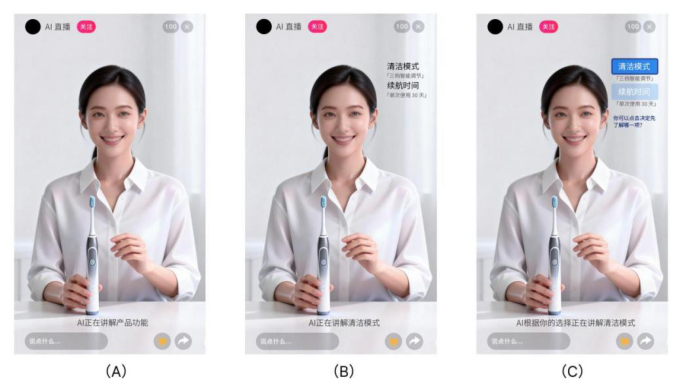
The degree of multimodal information explanation was operationalized as the extent to which the AI virtual streamer intervened in organizing, structuring, and guiding product information within a multimodal environment, rather than as an increase in modality quantity. Under the low- explanation condition, product information was presented linearly without visual enhancement or interactive guidance. Under the medium-explanation condition, key information was structured through visual labels and keyword highlighting. Under the high-explanation condition, viewers could select focal topics through preset options, creating a non-linear explanation pathway. Across all conditions, information content and quantity remained constant, differing only in presentation order, visual reinforcement, and interaction structure.
To examine the moderating role of product type, an intelligent electric toothbrush was selected as the utilitarian product and a sleep-aid aroma diffuser as the hedonic product. Both were based on real commercial items and presented with identical information points across conditions (see Figure 1).
Figure 1: Experimental stimuli illustrating the manipulation of multimodal information explanation degree in AI livestream commerce.
RESULTS
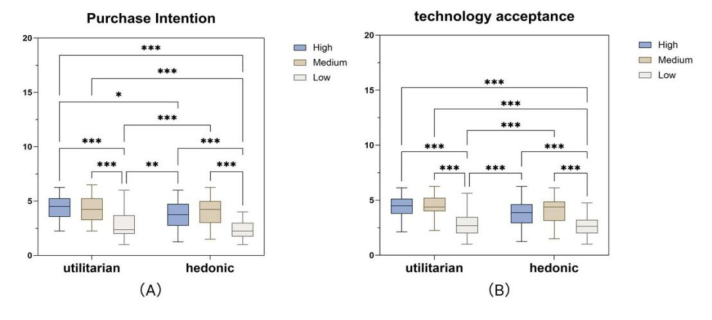
Effects of Multimodal Explanation Degree and Product Type on Purchase Intention A two-way ANOVA was conducted to examine the effects of multimodal information explanation degree and product type on purchase intention. The results revealed a significant main effect of explanation degree, F(2, 282) = 71.05, p < 0.001, and a significant main effect of product type, F(1, 282) = 17.21, p < 0.001, with purchase intention being higher for utilitarian products (M = 3.76) than for hedonic products (M = 3.23). Importantly, the interaction between explanation degree and product type was significant, F(2, 282) = 3.50, p = 0.031. Post hoc comparisons indicated that for utilitarian products, both the medium- and high-explanation conditions led to significantly higher purchase intention than the low-explanation condition (both ps < 0.001), with no significant difference between the medium and high levels. For hedonic products, a similar pattern emerged, whereby both medium and high explanation levels significantly outperformed the low- explanation condition (both ps < 0.001), while their difference was not significant.Cross-product-type comparisons further showed that utilitarian products elicited significantly higher purchase intention than hedonic products under the high-explanation condition only (p < 0.001), whereas no significant product-type differences were observed under the medium or low explanation conditions. These results are illustrated in Figure 2.
Effects of Multimodal Explanation Degree and Product Type on Technology Acceptance A parallel two-way ANOVA was conducted with technology acceptance as the dependent variable. The analysis revealed a significant main effect of multimodal information explanation degree, F(2, 282) = 63.81, p < 0.001, as well as a significant main effect of product type, F(1, 282) = 10.58, p = 0.001, indicating higher overall technology acceptance for utilitarian products (M = 3.92) than for hedonic products (M = 3.51).In contrast to the results for purchase intention, the interaction between explanation degree and product type was not significant, F(2, 282) = 1.17, p = 0.313. Post hoc analyses showed that, for both utilitarian and hedonic products, medium and high explanation levels resulted in significantly higher technology acceptance than the low-explanation condition (all ps < 0.001), while no significant differences were observed between the medium and high levels. Additional comparisons indicated that a significant product-type difference in technology acceptance emerged only under the high-explanation condition (p = 0.026), with no significant differences under the remaining conditions. These results are also presented in Figure 2.
Figure 2: Effects of multimodal information explanation degree and product type on purchase intention and technology acceptance.
DISCUSSION
Key Findings: A Dual-Pathway Perspective This study systematically examines how the degree of multimodal information explanation provided by AI virtual streamers in livestream commerce influences consumers’ technology acceptance and purchase intention. The results demonstrate that multimodal explanation degree exerts significant main effects on both outcome variables; however, its impact patterns differ between technology acceptance and purchase intention, revealing a dual-pathway mechanism through which AI explanation strategies shape consumer responses. This finding is consistent with prior research suggesting that attitudes toward technology adoption and subsequent behavioral responses are not necessarily isomorphic (Davis, 1989; Choung et al., 2023).
At the level of technology acceptance, a higher degree of multimodal information explanation significantly enhances consumers’ overall evaluations of the AI virtual streamer system, and this effect remains stable across product types. Regardless of whether the product is utilitarian or hedonic, when AI streamers provide well-structured and sufficiently elaborated multimodal explanations, users report higher perceived usefulness and perceived ease of use. This result aligns with findings in the human–computer interaction literature, which suggest that clarity in information structure and system interpretability helps reduce cognitive load and facilitates technology adoption (Ebermann et al., 2023; Gibbard et al., 2025). These results indicate that multimodal explanation degree primarily influences technology acceptance by lowering comprehension costs and enhancing perceived system controllability.
In contrast, at the level of purchase intention, multimodal information explanation degree not only shows a significant main effect but also interacts with product type. Specifically, for utilitarian products, a high level of explanation degree produces a stronger positive effect on purchase intention; whereas for hedonic products, a medium level of explanation
60 Zhang and Zhu degree is sufficient to achieve an optimal promotional effect. This pattern echoes established theories in consumer behavior, which posit that utilitarian products rely more heavily on rational, attribute-based information processing, whereas hedonic products emphasize experiential and affective responses (Wang et al., 2022; Chen et al., 2024). Accordingly, an excessively high degree of information structuring in hedonic product contexts may undermine consumers’ immersive experiences, thereby limiting its marginal impact on purchase intention.
Taken together, the influence of multimodal information explanation degree on technology acceptance reflects a relatively stable “system adoption pathway,” whereas its influence on purchase intention represents a context- sensitive “consumption decision pathway.” This dual-pathway pattern provides a more nuanced explanatory framework for understanding the role of AI virtual streamers in livestream commerce.
Theoretical Implications and Contributions This study makes three primary theoretical contributions. First, it advances existing research by moving beyond the traditional view of multimodal information as merely a form of sensory presentation, and instead introduces and empirically validates the concept of multimodal information explanation degree. By highlighting the active role of AI virtual streamers in organizing, filtering, and guiding user understanding within multimodal environments, the findings demonstrate that the degree of explanatory intervention itself constitutes a critical determinant of user responses, rather than a simple additive effect of modality quantity or form.
Second, by distinguishing between technology acceptance and purchase intention as outcome variables, this study uncovers a dual-pathway mechanism through which AI virtual streamer explanation strategies influence consumer responses. On the one hand, multimodal explanation degree consistently enhances users’ acceptance of AI systems by improving perceived interpretability and controllability. On the other hand, its effect on purchase intention is contingent upon consumption context factors such as product type. This distinction directly addresses ongoing discussions in information systems research regarding the divergent mechanisms underlying system adoption versus behavioral outcomes.
Third, by incorporating product type into the research framework on multimodal explanation by AI virtual streamers, this study empirically demonstrates the differentiated effectiveness of explanation strategies under distinct consumption goal orientations. In doing so, it provides empirical evidence for the boundary conditions under which AI-driven explanations shape consumer decision-making, thereby extending current understanding of AI involvement in consumption processes.
Practical Implications and Applications From a practical perspective, this study offers actionable insights for the design of AI virtual streamers in livestream commerce. The findings suggest that multimodal information explanation degree should be treated as a flexible and adjustable design parameter rather than a standardized configuration.
The Effect of the Degree of Multimodal Information Explanation by AI Streamers 61 Specifically, for utilitarian products, a higher degree of explanation facilitates rational comparison and evaluation, thereby improving decision efficiency and purchase likelihood. In contrast, for hedonic products, a medium level of explanation degree strikes a balance between ensuring information comprehension and preserving consumers’ experiential autonomy, avoiding the potential disruption of immersive experiences caused by overly structured information. Furthermore, AI virtual streamer systems can adopt modular designs that enable dynamic adjustment of explanation degree based on product attributes or user needs, thereby simultaneously optimizing system adoption outcomes and commercial conversion effectiveness.
CONCLUSION AND FUTURE RESEARCH This study takes the degree of multimodal information explanation provided by AI virtual streamers in livestream commerce as its central focus and systematically investigates its effects on consumers’ technology acceptance and purchase intention. By manipulating the level of explanatory intervention employed by AI virtual streamers and introducing product type as a key contextual variable, the study reveals differentiated pathways through which AI explanation strategies operate at the levels of system adoption and consumption decision-making. The results indicate that multimodal explanation degree not only exerts a stable positive effect on consumers’ technology acceptance of AI virtual streamer systems, but also demonstrates a product-type–contingent effect on purchase intention. Specifically, a higher level of explanation degree is more effective in facilitating purchase decisions for utilitarian products, whereas a medium level of explanation degree is sufficient to achieve favorable outcomes in hedonic product contexts. These findings suggest that multimodal explanation strategies adopted by AI virtual streamers are not simply a case of “more is better,” but rather should be aligned with consumers’ decision goals and product attributes.
Despite providing initial empirical evidence regarding the explanatory role of AI virtual streamers in multimodal environments, this study is subject to several limitations that point to directions for future research. First, the experimental design relies on a controlled scenario and a single interaction task, which may not fully capture dynamic changes arising from long-term use or repeated exposure to livestream content. Second, the present research focuses on explanation degree as a single design dimension; future studies may extend this framework by examining the joint effects of explanation style, emotional expression, or interaction pacing. In addition, differences in cultural background or users’ prior attitudes toward AI may moderate the effectiveness of explanation strategies and warrant further empirical investigation. Overall, this study highlights the critical question of how AI virtual streamers explain multimodal information, offering a novel analytical perspective for future research in human–computer interaction and intelligent marketing, while also providing actionable guidance for the design of AI streamer explanation strategies in livestream commerce.
REFERENCES
Chen, H., Shao, B., Yang, X., Kang, W., & Fan, W. (2024). Avatars in live streaming commerce: The influence of anthropomorphism on consumers’ willingness to accept virtual live streamers. Computers in Human Behavior, 156, 108216. https://doi.org/10.1016/j.chb.2024.108216 Choung, H., David, P., & Ross, A. (2023). Trust in AI and its role in the acceptance
of AI technologies. International Journal of Human–Computer Interaction, 39(9), 1727–1739. https://doi.org/10.1080/10447318.2022.2050543 Davis, F. D. (1989). Perceived usefulness, perceived ease of use, and user acceptance of information technology. MIS Quarterly, 13(3), 319–340. https://doi. org/10.2307/249008 Dodds, W. B., Monroe, K. B., & Grewal, D. (1991). Effects of price, brand, and store
information on buyers’ product evaluations. Journal of Marketing Research, 28(3), 307–319. https://doi.org/10.1177/002224379102800305 Duan, M., Zhang, Q., Zhang, Y., & Zhang, C. (2025). When emotions don’t match: Effects of multimodal emotional misalignment in virtual streamers on viewer engagement. Information & Management, 62(8), 104222. https://doi. org/10.1016/j.im.2025.104222 Ebermann, C., Selisky, M., & Weibelzahl, S. (2023). Explainable AI: The effect of
contradictory decisions and explanations on users’ acceptance of AI systems. International Journal of Human–Computer Interaction, 39(9), 1807–1826. https://doi.org/10.1080/10447318.2022.2126812 Gao, W., Jiang, N., & Guo, Q. (2023). How do virtual streamers affect purchase intention in the live streaming context? A presence perspective. Journal of Retailing and Consumer Services, 73, 103356. https://doi.org/10.1016/j. jretconser.2023.103356 Gao, W., Jiang, N., & Guo, Q. (2025). How cool virtual streamer influences customer
in live-streaming commerce? An explanation of stereotype content model. Journal of Retailing and Consumer Services, 82, 104139. https://doi.org/10.1016/j. jretconser.2024.104139 Gibbard, K., Gill, H., Powell, D., & Hausdorf, P. A. (2025). Explain it to me like I’m five: Harnessing the power of explanations to increase trust in workplace generative AI. Behaviour & Information Technology, 1–19. https://doi.org/10.10 80/0144929X.2025.2506664 Gong, X., & Sun, P. (2025). Can virtual streamers express emotions? Understanding
the language style of virtual streamers in livestreaming e-commerce. Journal of Retailing and Consumer Services, 82, 104148. https://doi.org/10.1016/j. jretconser.2024.104148 Grant, D. A. (1948). The Latin square principle in the design and analysis of psychological experiments. Psychological Bulletin, 45(5), 427–432. Ha, T., & Kim, S. (2024). Improving trust in AI with mitigating confirmation bias:
Effects of explanation type and debiasing strategy for decision-making with explainable AI. International Journal of Human–Computer Interaction, 40(24), 8562–8573. https://doi.org/10.1080/10447318.2023.2285640 Hirschman, E. C., & Holbrook, M. B. (1982). Hedonic consumption: Emerging concepts, methods and propositions. Journal of Marketing, 46(3), 92–101. https:// doi.org/10.1177/002224298204600314 Liu, H., Zhang, P., Cheng, H., Hasan, N., & Chiong, R. (2025). Impact of AI-generated
virtual streamer interaction on consumer purchase intention: A focus on social presence and perceived value. Journal of Retailing and Consumer Services, 85, 104290. https://doi.org/10.1016/j.jretconser.2025.104290
The Effect of the Degree of Multimodal Information Explanation by AI Streamers 63 Ma, X., Ren, J., Khor, X., Wang, R., Li, T., & Lang, X. (2025). Influencing mechanisms
of live streamer’s language strategies on product sales. Journal of Retailing and Consumer Services, 85, 104291. https://doi.org/10.1016/j.jretconser.2025.104291 Shyamli, S. (2025). Multimodal explainability in child–robot interaction. In Proceedings of the 24th Interaction Design and Children Conference (IDC ’25) (pp. 1199–1202). Association for Computing Machinery. https://doi. org/10.1145/3713043.3731609 Wang, B., Xie, F., Kandampully, J., & Wang, J. (2022). Increase hedonic products
purchase intention through livestreaming: The mediating effects of mental imagery quality and customer trust. Journal of Retailing and Consumer Services, 69, 103109. https://doi.org/10.1016/j.jretconser.2022.103109 Xiao, Q., Huang, W., Qu, L., & Li, X. (2025). The impact of multimodal information features of short sales videos on consumer engagement behavior: A multi-method approach. Journal of Retailing and Consumer Services, 82, 104136. https://doi. org/10.1016/j.jretconser.2024.104136 Zhang, J., & Curley, S. P. (2018). Exploring explanation effects on consumers’
trust in online recommender agents. International Journal of Human–Computer Interaction, 34(5), 421–432. https://doi.org/10.1080/10447318.2017.1357904
Read this individual research paper free through the original publisher, or explore the full digital proceedings book.
ISBN 979-8-950676-09-3
Explore this ISBN in the AHFE Bookstore ↗Listed in the July 2026 bookstore catalogue; search by ISBN to confirm current availability · Digital book purchase optional