With the rapid advancement of artificial intelligence, design education paradigms are in urgent need of a systematic transformation. This study employs a multi-case research methodology to conduct an in-depth analysis of the practical experiences of six world-leading design institutions at the intersection of AI and design. Based on a comparative analysis, this paper constructs a pedagogical framework consisting of five dimensions: curriculum restructuring, interdisciplinary synergy, optimization of teaching and learning modes, the definition of AI ethics and creative boundaries, and infrastructure support. This framework not only identifies innovative paradigms in contemporary design education but also provides actionable strategic pathways for curriculum reform and resource allocation in higher education. Ultimately, this research aims to facilitate the cultivation of design talent that meets the evolving demands of the intelligent era.
Against the backdrop of the rapid development of artificial intelligence (AI), a systematic transformation of design talent cultivation models is required to adapt to new technological environments and competency requirements. Currently, applications of AI in education are primarily concentrated in areas such as adaptive learning systems, intelligent tutoring systems, and educational data mining (Zawacki-Richter et al., 2019). However, relevant research has largely focused on general education or STEM disciplines, leaving a significant gap in the attention paid to professional education contexts. In particular, there is a distinct lack of in-depth discussion regarding creativity- oriented and problem-oriented disciplines, such as design education (Bond, Zawacki-Richter and Nichols, 2019).
Design education is a discipline that relies heavily on creativity, hands-on practice, and contextual understanding. For decades, its core pedagogical models have been built around studio-based learning, project-based learning, and reflective practice (Cross, 2006; Dorst, 2011; Schön, 2017). These approaches emphasize cultivating students’ design thinking and comprehensive skill sets through real-world problem-solving and iterative processes. However, with the rise of new paradigms, such as intelligent design,
data-driven design, and generative design, traditional design education is increasingly struggling to keep pace, revealing significant gaps in both its knowledge structures and its competency goals (Oxman, 2017).
Some researchers have begun to focus on Smart Design Education or AI-enhanced Design Education. These studies suggest that design education must undergo a fundamental shift: moving away from isolated technical skill training toward a composite competency model that integrates computational thinking, data literacy, algorithmic understanding, and ethical awareness (Wang et al., 2024).
Existing literature generally agrees that the intervention of AI is fundamentally reshaping the competency structures of designers. On one hand, generative AI, intelligent modeling, and automated design tools have significantly lowered technical barriers during stages such as concept generation, scheme expansion, and visual presentation. On the other hand, this “deskilling” trend has, paradoxically, placed higher demands on designers’ high-level cognitive abilities, including problem definition, interdisciplinary integration, critical thinking, and value judgment. Furthermore, the evolution of AI has fostered a need for new specialized competencies, such as the understanding of machine language, the debugging and collaboration with large-scale models, and computational thinking. However, most design institutions today still center their curricula on traditional skill training, leaving their cultivation models clearly lagging behind the demands of the intelligent era.
This study aims to explore the pathways for integrating artificial intelligence with design disciplines and to construct corresponding pedagogical models, thereby providing a reference for cultivating design talent that meets contemporary demands. Specifically, this research proposes a theoretical framework for an AI-driven design cultivation model. By delivering transition strategies with practical significance, this study seeks to provide a scientific theoretical foundation and an actionable implementation path for the reform of higher design education in the age of intelligence.
METHODOLOGY
This study employs a case study methodology, an approach well-suited for gaining an in-depth understanding of institutions, practices, and organizational mechanisms within complex social contexts. It is particularly effective at addressing “how” and “why” questions in real-world settings (Yin, 2018). Within the fields of education and design research, case studies are frequently used to analyze curriculum reform, pedagogical innovation, and organizational synergy. They are especially appropriate for investigating emerging phenomena that are still in their developmental stages and lack mature theoretical models.
To explore the systematic transition of design education models in the context of artificial intelligence, this research adopts a multiple-case comparative study design. Six world-leading design institutions were selected as observation subjects, aiming to enhance the explanatory depth and external validity of the findings through comparative analysis. The selection of these
Interdisciplinary Pathways and Pedagogical Models 41 cases followed four primary criteria: Academic reputation, ensuring significant international or domestic scholarly influence in the design field; Depth of practice, requiring sustained exploration and institutionalized practices in the integration of AI and design education; Data accessibility, ensuring that case information (such as syllabi, project descriptions, and related literature) is publicly available for in-depth analysis; and Sample representativeness, covering diverse educational systems and cultural contexts to improve the generalizability and explanatory power of the comparative study. The six selected cases are detailed in Table 1.
Table 1: The selected six cases and characteristics.
Table available in the original PDF paper.
Cases Characteristics MIT Media Lab The MIT Media Lab deeply embeds AI within its design education ecosystem, emphasizing the cultivation of systems thinking and the designer’s capacity for value judgment within AI-driven environments.
Royal College of Art (RCA)
Through specialized tracks such as “AI & Design” and “Information Experience Design”, the RCA systematically advances the integration of AI into design pedagogy. The institution highlights the responsibility and ethical role of design within complex socio- technical systems.
Stanford d.school Stanford systematically introduces generative AI, machine learning, and human-AI collaborative systems into its curriculum through courses and research initiatives like “AI + Design”, “Human-Centered AI”, and “Designing with AI”. The pedagogical model emphasizes problem framing, value judgment, and ethical reflection. By focusing on real- world, complex problem-solving and cross-departmental collaboration, Stanford fosters design leadership within intelligent systems.
Academy of Arts & Design, Tsinghua University
In recent years, Tsinghua has systematically promoted AI integration within information design, intelligent design, and interdisciplinary design. Leveraging the university’s strengths in computer science and automation, the Academy has constructed cross-college collaborative platforms for both teaching and research.
College of Design and Innovation, Tongji University
Tongji University has accumulated extensive pedagogical experience in intelligent interaction design, data visualization, and urban intelligent systems. Its approach situates AI technology within complex social systems to facilitate contextualized design education.
School of Design, Zhejiang University (ZJU)
ZJU has integrated AI into its curriculum through modules such as “Design + AI”, “Information Design and Intelligent Systems”, and “HCI and Intelligent Experience”. Utilizing cross-college joint cultivation mechanisms, the school achieves synergy among faculty from design, computer science, and engineering. Furthermore, the curriculum increasingly addresses AI ethics, data responsibility, and algorithmic bias, emphasizing the balance between technical rationality and social values.
Through a systematic collection and synthesis of academic literature, online interviews, official website data, and existing case studies, this research analyzed six representative higher education institutions at the forefront
of the integration between artificial intelligence and design. While these cases exhibit distinct characteristics in their pedagogical models, curriculum structures, and interdisciplinary pathways, they have all achieved significant success in cultivating “AI + Design” composite talents. The data for these cases were derived from three core categories of materials: Textual Data: Including syllabi and talent cultivation programs from each institution. Practical Materials: Consisting of documentation from representative teaching projects and public case exhibitions. Documentary Archives: Comprising relevant academic papers, educational reform reports, and official policy documents.
RESULTS
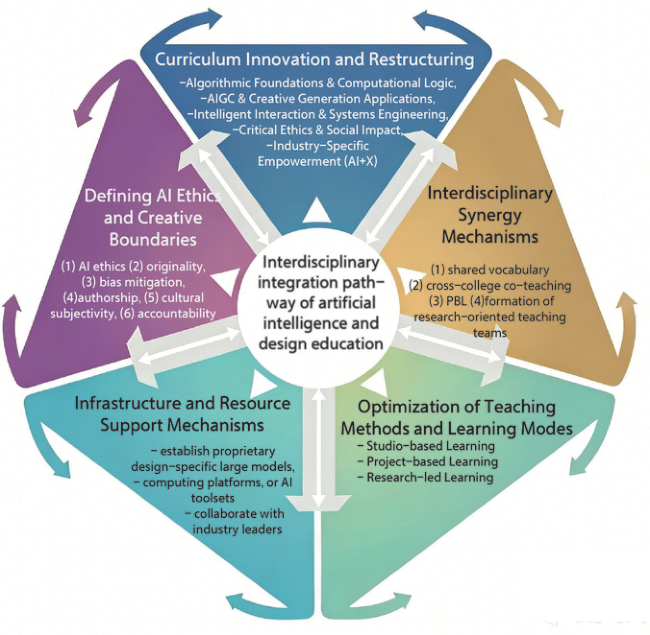
Based on a comparative analysis of these cases, this study establishes a pedagogical framework and pathway for the interdisciplinary integration of artificial intelligence and design, see figure 1. This framework is structured across five key dimensions: Curriculum Innovation and Restructuring: This dimension analyzes how design curricula integrate AI-related content, such as generative design, data-driven design, and computational design. It explores the restructuring of foundational design education and examines whether AI functions as an independent module or as embedded instructional content. Interdisciplinary Synergy Mechanisms: This examines how design disciplines establish collaborative teaching mechanisms with computer science, engineering, and data science. Key elements include the development of a shared vocabulary, cross-college co-teaching, project-based learning (PBL), and the formation of research-oriented teaching teams. Optimization of Teaching Methods and Learning Modes: This involves analyzing how AI technology is embedded into Studio-based Learning and research- led processes. Examples include leveraging generative AI for conceptual ideation or utilizing intelligent systems to support design iteration and real-time feedback. Defining AI Ethics and Creative Boundaries: This focus area observes whether pedagogical practices systematically incorporate discussions on AI ethics, originality, authorship, bias mitigation, cultural subjectivity, and accountability. Such discussions are essential to address the value conflicts and normative controversies sparked by AI’s intervention in the creative process. Infrastructure and Resource Support Mechanisms: This analyzes whether institutions have established proprietary design- specific large models, computing platforms, or AI toolsets. Furthermore, it investigates how colleges collaborate with industry leaders (such as OpenAI, Adobe, Alibaba, and Baidu) to build experimental “industry-academia- research” environments and explores how these ecosystems reciprocally enrich the teaching system.
By constructing this “AI + Design” pedagogical framework, this study seeks to provide design institutions with an actionable reference pathway for curriculum reform and the strategic allocation of teaching resources. Ultimately, this effort aims to drive the transformation of talent cultivation models, ensuring they meet the emerging competency requirements for design practitioners in the age of intelligence.
Interdisciplinary Pathways and Pedagogical Models 43 Curriculum Innovation and Restructuring
Focus & Description Representative Courses
Curriculum Categories
Learning and Intelligent Systems; The Physics of Information Technology;
Intelligent Design;
Algorithmic Foundations & Computational Logic
Introduction to AI; Design Data Analysis; Algorithmic Literacy
Focuses on Design as Computation. Rather than final aesthetics, the emphasis is on data processing, neural network architectures, and writing code to generate design solutions.
How to AI (Almost) Anything; Design + AI;
Prompt Engineering for Designers;
AIGC & Creative Generation Applications
Foundations of Generative AI and Tool Applications; AIGC Immersive Space Experience Workshop; Experimental Design Unit: AI as Medium;
Computer-Aided Industrial Design (CAID)
Focuses on Human-AI Co-creation. Emphasis is placed on prompt engineering, controllable generation via diffusion models (e.g., Stable Diffusion, Midjourney), and the integration of AI into traditional workflows to enhance efficiency and creative divergence.
Tangible Interfaces; Human-Robot Interaction;
Intelligent Interaction & Systems Engineering
Affective Computing and Multimodal Interaction; Introduction to Human-Computer Interaction Design
Designing for Large Language Models;
Focuses on AI in the Physical World. This area investigates sensory hardware, robotic interaction, wearable devices, and how AI responds to human emotions and physical movements.
Intelligent Hardware and Technological Frontiers; Studio: Human-AI Co-creation System Design
Designing AI for Human Flourishing; AI for Social Good;
Critical Ethics & Social Impact
The Ethics of AI in Creative Industries; AI Decoloniality & Indigenous AI;
Design Foresight; Design Thinking and Sustainable Futures
Focuses on the Boundaries of Technology. Discussions center on AI bias, decolonial design, copyright controversies, the identity crisis of the designer, and the impact of AI on social equity.
City Science; AI for Mental Health;
Architectural Design Intelligence;
Industry- Specific Empowerment (AI+X)
AI + Digital Intangible Cultural Heritage Preservation;
Focuses on Vertical Scenarios. This involves the application of AI in specific fields such as urban planning, healthcare, architecture, and the preservation of traditional cultural heritage.
“X + AI” Interdisciplinary Experimental Projects; Intelligent Medical Product Design
Figure 1: A pedagogical framework and pathway for the interdisciplinary integration of artificial intelligence and design.
Interdisciplinary Faculty Synergy and Student Team Configuration Some institutions have adopted an “Antidisciplinary” model, establishing research institutes and laboratories that transcend traditional administrative boundaries to provide interdisciplinary faculty with permanent physical space and institutional support. Under this model, faculty and students are no longer categorized by traditional academic majors; instead, they cluster dynamically around specific courses or research themes. A prime example is the “Healthcare Acceleration: Artificial Intelligence” course at the Stanford d.school. In addition to design faculty, the instructional team incorporates product managers and engineers from Google and Meta, successful healthcare entrepreneurs, and leading venture capitalists. This hybrid teaching model ensures that interdisciplinary synergy is woven into the very DNA of the educational system.
The core of this synergy lies in the construction of a Shared Vocabulary. The success of faculty collaboration depends on the ability to establish a common lexicon that bridges professional thresholds. In cross-disciplinary projects, teams often develop terminology manuals tailored for designers, psychologists, and ethicists to ensure that the technical implementation on the engineering side aligns perfectly with the humanistic intent on the
Interdisciplinary Pathways and Pedagogical Models 45 design side. The fundamental value of this system is its capacity to translate algorithmic performance parameters into interaction logic understandable to designers, thereby eliminating the “Semantic Black Box” often found in interdisciplinary cooperation.
Optimization of Teaching Methods and Learning Modes Studio-based Learning: From “Craft-driven” to “Intentional Co-creation”. In traditional studio education, the dialogue between faculty and students is conducted through physical prototypes or drawings. The intervention of AI transforms this process into Prompt Engineering and the exploration of Latent Space. During the conceptual ideation stage, students are liberated from an obsession with sketching proficiency; instead, they utilize Generative AI to produce a vast array of stylistic variants in an instant, determining creative directions through “curatorial filtering”. In the iteration and feedback process, AI evaluation models provide immediate suggestions based on ergonomics, color balance, or structural stability. This compresses the studio feedback loop from waiting for weekly critiques to minute-level autonomous optimization.
Project-based Learning (PBL): From Single Output to System Integration. AI empowers students to tackle complex, multi-dimensional projects that were previously out of reach under traditional conditions. In PBL, students are no longer confined to product form; they script algorithms to generate structures—such as using AI for topology optimization—to achieve a balance between performance and aesthetics. When facing macro-scale projects like smart cities, students leverage AI for big data mining to pinpoint design entry points from massive operational datasets. In this context, AI is not merely a rendering tool but an intelligent engine that supports early-stage research and decision-making.
Research-led Learning: AI as a Research Medium. Graduate education at top-tier institutions has begun to treat AI as a Research Medium. Faculty guide students to use AI to simulate non-human perceptions (such as bio- perspectives driven by sensor data) and conduct Speculative Design through the heterogeneous outcomes generated by AI. This approach challenges and expands the logic of anthropocentric design.
In conclusion, the role of the teacher has evolved from a technical instructor to a creative facilitator. The pedagogical focus is no longer on the precision of visual representation but on the quality of the student’s inquiry and their capacity for critical evaluation of AI-generated outputs. The center of gravity in learning has undergone a dual shift: front-loading toward Problem Framing and back-loading toward Value Evaluation. This model is constructing a form of Symbiotic Intelligence, a deep integration of human intuition and aesthetic judgment with AI’s computational power and logical prediction.
Defining AI Ethics and Creative Boundaries In the age of artificial intelligence, ethical challenges in design talent cultivation primarily center on the following four dimensions:
Reconstructing Authorship and Originality. To address the ownership controversies surrounding AI-generated content, some institutions have introduced the concept of Post-human Authorship. This pedagogical approach encourages students to reflect on whether the designer’s role has shifted from a primary creator to a prompt specialist. Furthermore, specialized courses explore how to delineate the boundaries of AI intellectual property and evaluate the extent of substantial human contribution within complex design projects.
Identification and Mitigation of Algorithmic Bias. This dimension focuses on aesthetic and social biases inherent in AI generation processes. MIT’s Gender Shades project serves as a classic case study in design ethics, revealing disparities in racial and gender recognition among mainstream models. Conversely, Stanford University’s d.school emphasizes Human- Centered Design. In the course “How can we mitigate bias in AI design”, students analyze real-world cases—such as Google Gemini—to identify how over-representation or under-representation in datasets affects marginalized groups, subsequently developing design strategies that promote diversity and inclusion.
Loss of Cultural Subjectivity and Algorithmic Colonization. Since mainstream generative models (e.g., Midjourney, Stable Diffusion, DALL-E) are largely trained on Western internet data, their inherent visual logic often carries a strong Eurocentric bias. Design education must remain vigilant against this underlying trend toward cultural homogenization, guiding students to protect and strengthen local cultural subjectivity when utilizing AI tools.
Defining Responsibility and the Ownership of Decision-Making Power. When algorithms experience hallucinations or produce erroneous decisions, the pre-definition of the chain of responsibility is critical. Leading institutions have reached a consensus: the algorithmic black box should not serve as a disclaimer for liability. A core task of design research is to develop Explainable Interfaces and Human-override Mechanisms, effectively returning the decision-making power hidden behind algorithms to humans equipped with ethical judgment.
Infrastructure and Resource Support Mechanisms Top-tier design schools are no longer content with simply utilizing commercial software. Instead, they ensure pedagogical foresight by developing proprietary models, constructing computational foundations, and deeply integrating corporate ecosystems.
The MIT Media Lab emphasizes Tool Sovereignty. Rather than merely applying existing AI, research groups such as Future Sketches develop proprietary computational design languages. For instance, they create physics-based generative plugins that transform computing power into a medium for exploring materiality. Furthermore, their High-Performance Computing (HPC) clusters enable students to train private models capable of providing sensory feedback.
Stanford University adopts an Embedded Ecosystem strategy. Leveraging its geographical proximity and talent pipelines with tech giants like OpenAI,
Interdisciplinary Pathways and Pedagogical Models 47 Google, and Adobe, students can directly conduct stress tests on unreleased APIs within their coursework. This deep synergy facilitates a teaching- as-beta-testing environment, ensuring that pedagogical content remains synchronized with the technological frontier.
Chinese institutions focus heavily on underlying support and toolchain construction. Tongji University’s She Ji AI Lab is dedicated to building knowledge graphs and large models tailored specifically to design logic. Meanwhile, Zhejiang University (ZJU) leverages its State Key Lab to provide robust underlying computing power for the design department. ZJU has established an online intelligent design toolchain that modularizes algorithms, allowing students to invoke complex form-generation scripts directly in the cloud.
CONCLUSION AND DISCUSSION This study conducts a comprehensive investigation into the innovative practices of six world-leading design institutions (MIT, Stanford, RCA, Tsinghua, Tongji, and ZJU) amidst the transformative wave of artificial intelligence. Its primary academic contribution lies in the systematic identification and construction of a five-dimensional framework that delineates the state-of- the-art in the AI-Design Intersection.
Curriculum Restructuring: From Embedded to Reconstructed. Design institutions are encouraged to focus on five core domains: Algorithmic Foundations & Computational Logic, AIGC & Creative Applications, Intelligent Interaction & Systems Engineering, Critical Ethics & Social Impact, and Industry-Specific Empowerment (AI+X). In terms of pedagogical form, AI exhibits dual evolutionary paths: Embedded Content: Seamlessly integrated into existing course clusters; and Independent Modules: Systematically reconstructing the very foundation of design education.
Interdisciplinary Synergy: Bridging the Semantic Black Box. By establishing a Shared Vocabulary that encompasses both algorithmic logic and aesthetic intent, institutions effectively eliminate the semantic black box in cross- disciplinary collaboration. The widespread adoption of dual-mentor systems and Project-Based Learning (PBL) across colleges has formed research- oriented teaching teams, achieving a structural coupling between design thinking and data science.
Pedagogical Optimization: Metacognitive Evolution. AI technology is driving a metacognitive evolution in human-AI collaboration. Through the exponential divergence of concepts facilitated by Generative AI and real-time iteration supported by intelligent feedback systems, the learning focus has undergone a dual shift: Front-loading: Moving toward Problem Framing and intentionality. Back-loading: Moving toward Value Evaluation and critical assessment. In this paradigm, learning shifts from mere skill acquisition to high-level intentional control. Research-led modes further encourage students to utilize AI as a medium to explore non-human perspectives and Speculative Design, significantly expanding the cognitive boundaries of the discipline.
Ethics and Boundaries: Values as Design Parameters. Ethical considerations have been transformed into active design parameters. Research highlights
institutional explorations in authorship, originality, and accountability. By integrating issues such as bias mitigation and cultural subjectivity (countering algorithmic colonization), ethics is no longer treated as an abstract norm but is materialized through practical actions like algorithmic auditing and Explainable Interface Design. This proactively addresses the normative controversies triggered by AI’s intervention in the creative process.
Infrastructure and Resource Guarantees. Leading institutions are moving beyond a reliance on general-purpose commercial software by developing proprietary design-specific large models and dedicated computing platforms. By establishing joint laboratories with industry leaders, these schools ensure real-time synchronization between pedagogical content and the technological frontier.
While this study identifies macro-paradigms in the transformation of design education, several limitations remain. The research focuses primarily on curriculum settings and short-term pedagogical outputs. There is a lack of longitudinal tracking regarding the evolution of students’ long-term professional literacy, aesthetic originality, and critical thinking skills following AI intervention. The subjects of this study are exclusively resource-intensive elite institutions. Therefore, the universality and replicability of these conclusions in average art colleges or resource-constrained regions require further validation. Future research will continue to monitor the profound impact of AI on students’ long-term innovative capabilities and high-level cognitive development. Furthermore, we will explore how to construct a global, shared ecosystem for design education models through Open-source Collaboration to bridge the educational and technological divide between institutions.
The theme of this study is highly aligned with the AHFE 2026 “Training, Education, and Learning Sciences” track, which focuses on the applications of artificial intelligence in training and educational sciences. This research aims to provide empirical support for academic dialogues within this field.
ACKNOWLEDGMENT
This research was supported by the Tianjin University of Technology Education Reform Project (Project No.: ZD25-10).
REFERENCE Bond, M., Zawacki-Richter, O. and Nichols, M. (2019) “Revisiting five decades of educational technology research: A content and authorship analysis of the British Journal of Educational Technology,” British Journal of Educational Technology, 50(1), pp. 12–63. Available at: https://doi.org/10.1111/bjet.12730. Cross, N. (2006) Designerly ways of knowing. London: Springer. Dorst, K. (2011) “The core of ‘design thinking’ and its application,” Design Studies,
32(6), pp. 521–532. Available at: https://doi.org/10.1016/j.destud.2011.07.006. Oxman, R. (2017) “Thinking difference: Theories and models of parametric design thinking,” Design Studies, 52, pp. 4–39. Available at: https://doi.org/10.1016/j. destud.2017.06.001.
Interdisciplinary Pathways and Pedagogical Models 49 Schön, D.A. (2017) The Reflective Practitioner: How Professionals Think in Action.
London: Routledge. Available at: https://doi.org/10.4324/9781315237473. Wang, S. et al. (2024) “Artificial intelligence in education: A systematic literature review,” Expert Systems with Applications, 252, p. 124167. Available at: https:// doi.org/10.1016/j.eswa.2024.124167. Yin, R.K. (2018) Case study research and applications: design and methods. Sixth
edition. Los Angeles London New Delhi Singapore Washington DC Melbourne: SAGE. Zawacki-Richter, O. et al. (2019) “Systematic review of research on artificial intelligence applications in higher education – where are the educators?,” International Journal of Educational Technology in Higher Education, 16(1), p. 39. Available at: https://doi.org/10.1186/s41239-019-0171-0.
LISTED IN THE AHFE DIGITAL BOOKSTORE CATALOGUE
Explore the complete digital volume
Training, Education, and Learning Sciences
Read this individual research paper free through the original publisher, or explore the full digital proceedings book.
ISBN 979-8-950676-07-9
Explore this ISBN in the AHFE Bookstore ↗Listed in the July 2026 bookstore catalogue; search by ISBN to confirm current availability · Digital book purchase optional