Xinran Li, Yifan Liu, Haichuan Li, Xiaoxi Cheng (2026). Childcare-Friendly Play Spaces for Parents in Community Parks. In: Human Factors in Architecture, Sustainable Urban Planning and Infrastructure. AHFE Open Access, vol. 229, pp. 69–81. https://doi.org/10.54941/ahfe1007955
Childcare behavior refers to the attention and care provided by caregivers, especially parents, during outdoor activities. Caregivers’ level of engagement and demeanor directly affect children's self-protection, independence, and social skills. This study explores childcare behaviors in community parks, focusing on child safety and development. Using virtual reality (VR) to simulate park environments, we developed a method to quantitatively compare parental care across different site types. Grounded in urban ergonomics, the research analyzed eye-tracking data and survey responses from 28 parents in Beijing to assess how spatial design affects caregiving. Results show that site size influences perceived safety, with areas under 32 meters in diameter providing optimal visibility. Shrubs around 0.9 meters high were rated as the safest boundary type, balancing visibility and containment. This research informs evidence-based park design and enhances urban spatial research by integrating behavioral data with ergonomic principles. While findings offer valuable guidance for child-friendly park planning, the small sample size and use of VR may limit generalizability.
As urbanization accelerates, child-friendly design has become a central concern in urban planning worldwide. In recent years, increasing attention to children has led to the emergence of all-age-friendly communities and child-friendly design as key trends in urban development. Caregiving behaviour refers to the attention and care provided by caregivers, especially parents toward children, particularly during outdoor activities. In this situation, caregivers use visual attention and observation to keep an eye on and address a child’s needs. This behaviour is essential not just for children’s protection, but also for their psychological and social development. The level, demeanour, and disposition of caregivers have a direct impact on children’s self-defence, independence, and social skills (Phua et al., 2020). While community parks are essential for supporting the development of children’s social identities and promoting these developmental processes in community settings, where children engage in daily activities and social interactions (Shen, 2015).
Although research on child-friendly cities has progressed substantially both domestically and internationally, several limitations remain. Existing studies primarily focus on children’s behaviour and development, with
limited attention to interactions between children and their caregivers. Public communal spaces are relatively understudied, and research on childcare behaviour often concentrates on specific settings such as commercial complexes. Moreover, architectural studies on child-friendly environments tend to overlook caregiving aspects, while childcare studies frequently neglect spatial interventions. Addressing these gaps, this study optimizes the experimental design to reduce spatial scale perception bias, distinguishing it from conventional questionnaire-based approaches.
Taking advantage of the ongoing renovation of community parks in Beijing, this study adopts Beijing’s community parks as a representative case. Through a series of controlled experiments and analyses, it aims to demonstrate the validity of this methodological approach and its potential to inform future community park design. Virtual Reality (VR) environments offer key advantages: precise manipulation of spatial variables, enhanced experimental rigor, high replicability, and reduced errors and real-world biases. Under consistent experimental conditions, the study compares the effects of different spatial configurations. By integrating technical methods such as eye-tracking and questionnaires to quantitatively assess caregivers’ psychological states, the research provides a scientific evaluation of caregiving behaviour.
Based on the advantages of VR environments and design objectives, this study is dedicated to developing an experimental framework that is scientific, effective, and repeatable in order to offer solid support for gathering quantitative data and gaining a comprehensive understanding of parental caregiving behaviour.
PARTICIPANTS AND VARIABLES Participants
Children ages 4 to 7 are the focus of this study. Since these children make up a sizable amount of community activities, research on this age group is especially pertinent to spatial interventions in community parks. Furthermore, their greater exposure to risk factors and wider variety of activities offers insightful information for creating successful spatial interventions. Parents have different views on childcare than do grandparents and nannies. In keeping with current caregiving philosophy and demographic features, parents are primary focus on.
Spatial Prototype Refining spatial prototypes enables the abstraction of key spatial features, facilitating the application and generalization of research findings. Field spaces are classified based on site morphology, boundary characteristics, and elevation changes, with detailed descriptions for each type. After selecting the prototypes, relevant parameters were adjusted to reflect the characteristics of Beijing’s parks. By prioritizing feasible spatial interventions while maintaining general applicability to children’s community playgrounds, the selection of experimental variables enhances the study’s practical relevance and transferability.
Childcare-Friendly Play Spaces for Parents in Community Parks 71 Preliminary interviews identified key factors influencing caregivers’ spatial experiences. Drawing on literature reviews and on-site case studies, this study constructs a variable framework for parent–child caregiving research encompassing three components: site, facilities, and environment. The analysis focuses on site-related variables, which are further examined across five dimensions—comfort, safety, convenience, interactivity, and enrichment (Wang et al., 2024)—with safety identified as the primary concern.
Table 1: Key variables in research on parental childcare.
Table available in the original PDF paper.
Elements Criteria Description Site Safety Boundary Safety Buffer distance adjacent to roads, height, and forms of boundaries.
Elevation Elevation differences, elevation value.
Pavement Slip Resistance
The ratio of slip-resistant paved area to the total site area.
Convenience Entrance Marking
Clear directional signs installed at entrances and exits.
Number of barrier-free accesses.
Completeness of Barrier-Free Access Interactivity Spatial Dimension
Spatial Form Spatial Enclosure If the spatial enclosure is reasonable and has avoided visual obstructions
Comfort Pavement Comfort
Types of pavement materials and their impacts on the area.
Number of functional zones.
Richness Function Diversity
Sense of design or uniqueness.
Spatial Playfulness
The safety, interactivity, and overall experience of parent–child activity spaces are strongly influenced by key spatial factors, including scale, elevation differences, boundary forms, site form, and enclosure. Previous studies have examined the effects of three core spatial elements—elevation, form, and enclosure—on childcare. Findings indicate that sites without elevation differences combined with semi-enclosed layouts are more conducive to effective caregiving in play spaces. For school-age children, elevating the edge of caregivers’ areas or activity space boundaries may enhance playability and spatial engagement (Lu, 2021). To provide empirical support for improving child-friendly activity area design, future research will further investigate how the remaining two spatial characteristics influence parent–child caregiving behaviours.
Definition of Space Dimensions and Boundaries We focus on the two key design components that are highly operational and broadly applicable in community children’s playgrounds: site scales and boundary characteristics. These elements are further divided into three experimental variables, each of which has three predetermined groups: site scales, boundary forms, and boundary heights. The study refined the design features of the experimental sites by analysing the current children’s playgrounds in central Beijing in order to identify the precise group settings for these factors.
Site Scales The site scale was selected as the experimental variable. The control group was defined according to prevailing standards and common playground dimensions in Beijing’s community parks, while the other two experimental groups were established based on the typical range of independent mobility for children in the relevant age group. By combining the definition of playground scale, we discovered that previous studies on Beijing’s community parks suggest an average activity space of roughly 0.1 hectares, or 35.7 meters in radius (Fan, 2013). In order to investigate the effects of different geographical scales on caregiving behaviour, our study created three site dimension groups—25, 32, and 40 meters in diameter—taking into account the functional requirements of children’s playgrounds and the necessity for design flexibility (Shen, 2015).
Boundary Forms The variable boundary forms were defined based on a contextual study of existing children’s playgrounds in Beijing. Shrubs, grass slopes, fences, and roads were found to be the most common border types in children’s playgrounds located in Beijing’s community parks. Our study led to the selection of low walls, grass slopes, and shrubs as the experimental groups. Low walls and shrubs serve as impenetrable barriers that successfully define space; low walls can also be used as parents’ seating. On the other hand, grass slopes offer a gentle, movable border that delineates an area while permitting mobility.
Boundary Heights The definition of the boundary height variable was primarily informed by the proportional relationship between the physical stature of adult caregivers and that of children in the relevant age group. The three boundary height groups of 0.4 m, 0.9 m, and 1.4 m were created to satisfy the visual accessibility requirements of community park users. The 0.4 m boundary can be used as a seating space in addition to providing a gentle separation of the kids’ play areas. While giving kids a reasonable sense of containment, the 0.9 m boundary, which is roughly at eye level, guarantees visual accessibility for adults. The 1.4-meter barrier, which is somewhat lower than the eye level of
Childcare-Friendly Play Spaces for Parents in Community Parks 73 an average adult, provides some degree of visual connection while providing partial concealment. Boundaries longer than 1.4 meters were not included in the study because they significantly obstructed view.
METHODOLOGY
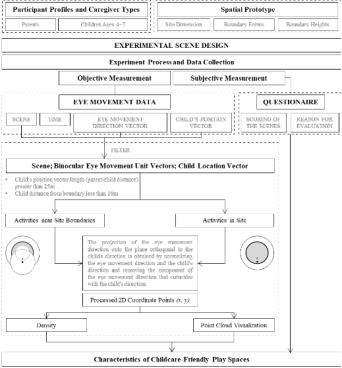
This experiment combines the eye-tracking technology of the HMD virtual reality device, and a subjective questionnaire survey. This allows for a more accurate systematic analysis of visual focus and distance perception. Our study intends to offer a scientific foundation for the best possible community space design by thoroughly examining the distance perception and behavioural patterns of parents and children during the contact process. The general research framework is as Fig. 1.
Figure 1: Methodology.
Measurement of Parents’ Experiences Objective Measurement: Eye-Tracking Technology
In this experiment, eye movement data was used as a key indicator of parental caregiving behaviour.
Compared to other ergonomic data collection techniques, eye-tracking is less intrusive, minimizing the influence of subjective biases and enhancing data accuracy (Gou et al., 2022). Specifically, a more dispersed gaze pattern during caregiving suggests that parents perceive the environment as safe, leading to a more relaxed state with reduced monitoring of their children. Conversely, a highly concentrated gaze on children indicates perceived environmental risks, prompting more focused and continuous monitoring behaviour. This hypothesis was further supported by pre-experimental results and participant interviews, which demonstrated a strong correlation between parental gaze patterns and perceptions of environmental safety.
Subjective Measurement: Questionnaire Surveys However, the objective strategy method has limitations. Although physiological measures provide objective data, their effectiveness in simulating real caregiving behaviour remains to be supplemented. To more accurately capture parents’ psychological and behavioural responses during caregiving by emphasizing subjective assessments to support objective data. Additional questionnaires and interviews were used to assess parents’ experiences in various settings at the end of the experiment.
The questionnaire consisted of two main sections: (1) participant demographics and (2) evaluation of the caregiving environment. The demographic section was designed to control for potential confounding factors, such as the order of scene presentation, participants’ age, child’s age, architectural background, and prior experience with VR technology. Participants were asked to rank and evaluate various situations under a single characteristic in the evaluation section of the caregiving environment. To guarantee multidimensional validation and improve data dependability, these subjective assessments were then contrasted with eye-tracking data.
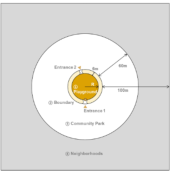
Experimental Scene Design To ensure the applicability of the findings to broader playground design and renovation contexts, the experimental scene was designed as a representative children’s playground within a community park. The master plan follows the typical scale of Chinese community parks—approximately one hectare (Beijing Municipal Government, 2025)—with children’s playgrounds accounting for about 5% of the total area (Feng & Lin, 2004). The playground was designed as a circular space (Area ① in Fig. 2) and equipped with common play facilities, including swings, slides, and climbing frames, as well as seating and fitness equipment to enhance realism. To further reflect real-world conditions, pedestrian density was simulated based on field survey data, ensuring that potential risk distributions in the virtual environment corresponded to actual playground usage patterns. A six-meter-wide isolation boundary was uniformly established around the playground (Area ② in Fig. 2). Surrounding this, a 60-meter-diameter community park area (Area ③ in Fig. 2) simulated adjacent activity spaces and potential hazards, such as cyclists and running pedestrians. The park environment was enclosed by highly visible landscaped green belts, reinforcing the spatial atmosphere. Additionally, peripheral buildings were placed 100 meters from the playground to represent the neighbourhood context (Area ④ in Fig. 2); buildings facing the park were six-story residential structures with a height of 18 meters.
Figure 2: Experimental scene design.
Childcare-Friendly Play Spaces for Parents in Community Parks 75 The child model was based on anthropometric data from the World Health Organization (WHO) and partially independent caregiving conditions, with a height of approximately 100 centimetres (World Health Organization, 2025). Based on the theory of social distance (Hall, 1966), the child’s starting position was set at 3 meters from the participant, with the farthest point located at the entrance on the opposite side of the playground. To further visualize parents’ perceived distance from the child, the child was programmed to run freely throughout the playground.
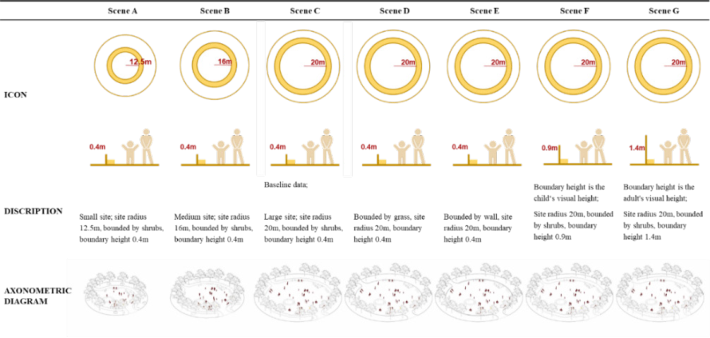
The surrounding environment simulated typical peak-hour pedestrian density and behaviours in community parks. During the experiment, the child interacted with fitness equipment and other individuals, replicating real-life caregiving scenarios and capturing key factors influencing caregivers’ safety perceptions. As illustrated in the figure, each scenario featured a child movement trajectory lasting 120 seconds. Based on pre-experimental validation, seven final experimental scenarios were selected (Fig. 3). To reduce participant fatigue and ensure data reliability, a univariate design was adopted instead of a multivariate crossover design.
Figure 3: Experimental scenarios.
During the experiment, participants remained seated while wearing the VR headset. The experimental environment was developed using architectural modelling software for built assets, while plant elements such as trees, lawns, and shrubs were generated using the SpeedTree plugin. Character animations were sourced from Mixamo, with continuous motion encoding implemented in Unity. The experiment employed the HTC Vive Pro Eye, a high-precision head-mounted display with integrated eye-tracking technology, to ensure accurate recording of participants’ behavioural data and gaze trajectories.
Before conducting the experiment, researchers obtained ethical approval to ensure compliance with ethical standards and legal requirements. Additionally, two rounds of pre-experiments were conducted to refine the experimental design, validate data collection and analysis methods, and optimize key procedural steps.
Data Collection and Processing By measuring the density to which participants concentrated on particular places, the distribution of eye-movement data was utilized to evaluate attention concentration across several experimental circumstances. The child’s movement direction and eye movement direction were standardized in order to systematically gauge their level of attention to the activities of the youngsters. After eliminating the overlapping component, the projection of the eye movement direction onto the plane orthogonal to the child’s direction was computed, enabling an accurate examination of the distribution of attention.
(1)
· g g c c t g g c c
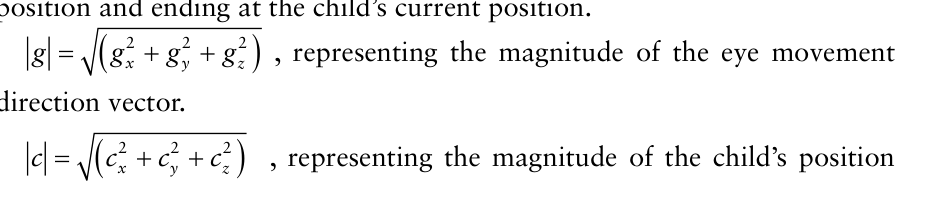
[Equation or mathematical symbol available in the original paper PDF][Equation or mathematical symbol available in the original paper PDF] = − × [Equation or mathematical symbol available in the original paper PDF][Equation or mathematical symbol available in the original paper PDF][Equation or mathematical symbol available in the original paper PDF][Equation or mathematical symbol available in the original paper PDF][Equation or mathematical symbol available in the original paper PDF][Equation or mathematical symbol available in the original paper PDF] g is the eye movement direction vector, defined as the sum of the unit vectors of both eyes’ movement directions.
c is the child’s position vector, originating from the subject’s fixation position and ending at the child’s current position.
Equation reproduced from the original PDF.
t is the projection of the eye movement direction onto the plane orthogonal to the child’s direction.
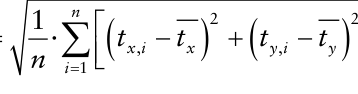
A scatter plot is then used to display this two-dimensional projection. The standard deviation of the projected points, which is a gauge of scenario effectiveness, is used to statistically evaluate attentional focus. The standard deviation σ of attention concentration is calculated using the orthogonal components of t ( , x y t t ).
n
2 2
(2)
1 ·
( ) ( ) σ
Equation available in the original PDF paper.
Equation reproduced from the original PDF.
x i x y i y i
, , 1 x y t t , are the means of t orthogonal components.
For the scene evaluation portion of the questionnaire, if participants perceived no significant differences among the three scenes, each scene was assigned a score of 2. Using this scoring method, the study calculates the average score for each scene to quantitatively compare the advantages and disadvantages of different venues, thereby providing an objective basis for analyzing caregiving needs.
RESULT
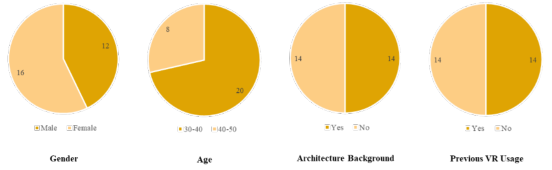
This experiment involved the recruitment of 28 volunteers, 12 of whom were male and 16 of whom were female. Participants were evenly distributed between those with and without an architecture background (1:1), as well as between those who had and had not used VR before.
Figure 4: characteristic of participants.
To account for possible confounding effects and guarantee the accuracy and impartiality of the results, the virtual scenes’ presentation order is counterbalanced.
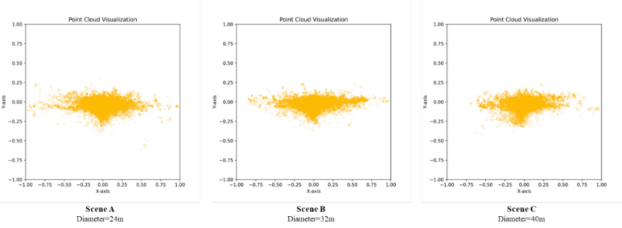
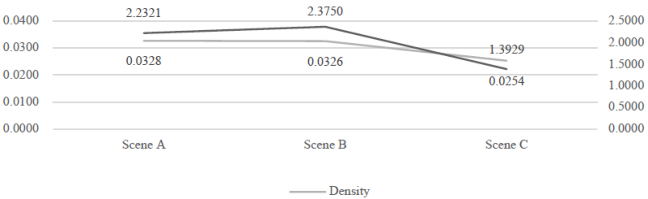
Site Scales In this study, the participants’ ranked average score and density were calculated for the three scenarios, and the results are presented through visualization (Fig. 5 and Fig. 6). This indicates that a site with a diameter of 25 to 32 meters offers an optimal childcare experience, and that a site that is too large can hinder parents’ capacity to provide visual supervision, while other characteristics remain consistent.
Figure 5: Point cloud visualization for different site scales.Figure 6: Density and average score for different site scales.
In terms of site scale, parents evaluated childcare environments based on four key factors: overall size, controllability, safety, and crowd density. Larger play areas provide broader visibility and fewer obstructions but may delay
parental intervention in emergencies due to increased distances. Smaller playgrounds enhance controllability and response speed, yet they can limit children’s movement and increase crowding and conflicts. Medium-sized spaces generally balance freedom and safety and were therefore preferred, while larger spaces were more suitable when parents accompanied older children. Balancing children’s mobility with effective supervision, a diameter of 32 meters appears to offer an optimal compromise between enriched play experiences and safety oversight.
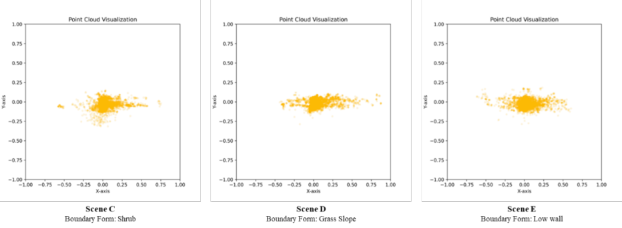
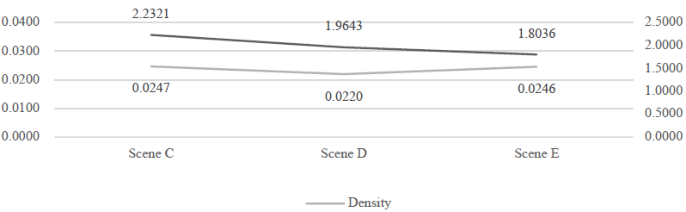
Boundary Forms The participants’ average scores for the three scenario rankings and the processed density data were calculated and visualized in Fig. 7 and Fig. 8. The analysis indicates that children’s proximity to different boundary types influences parental caregiving experiences. Given equal conditions, parents perceived shrubs as providing greater safety for children compared to grassy slopes and fences.
Figure 7: Point cloud visualization for different boundary forms.Figure 8: Density and average score for different boundary forms.
Regarding boundary forms, parents evaluated each type based on perceived safety, controllability, visibility, and children’s interaction with the space. Shrubs were generally considered safe, providing soft enclosure and discouraging children from leaving the play area, though excessive height or density raised concerns about obstructed sightlines and physical risks. Grassy slopes, while attractive to children, lacked clear boundaries and were
Childcare-Friendly Play Spaces for Parents in Community Parks 79 perceived as increasing the risk of unintended wandering. Low walls offered clear delineation and seating for caregivers but posed safety risks due to hard or uneven surfaces. Overall, parents preferred boundary forms that clearly define play areas, minimize injury risk, and maintain open visibility.
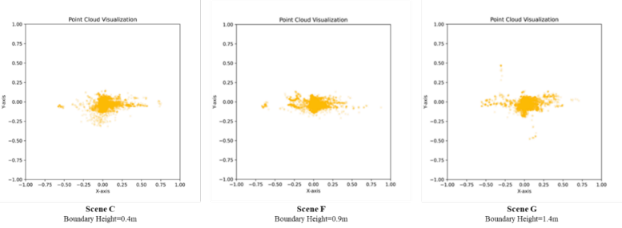
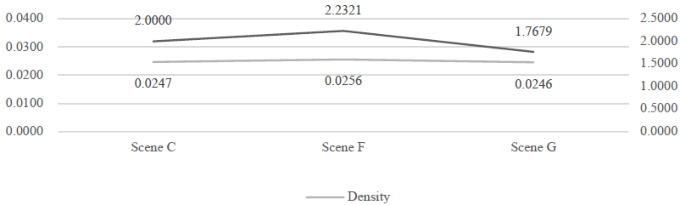
Boundary Heights The average participant scores for the three scenario rankings, along with the calculated density, were analyzed and visualized (Fig. 9 and Fig. 10). The results indicate that, when all other factors remain constant, parental attention to children’s behaviour is more dispersed in sites with medium- height (0.9m) boundary shrubs.
Figure 9: Point cloud visualization for different boundary heights.Figure 10: Density and average score for different boundary heights.
Regarding boundary height, parents evaluated each option based on safety, visibility, sense of enclosure, and spatial openness. A low boundary (0.4 m) provided unobstructed views but failed to prevent children—particularly those aged 4–7—from leaving the area, increasing caregiving difficulty. A medium boundary (0.9 m) was most preferred, as it reduced unintended exits while maintaining broad visibility of both internal and external environments, likely due to the enhanced sense of security it provided. In contrast, a high boundary (1.4 m) created spatial isolation, limiting visual transparency and caregivers’ awareness of external risks, while also posing potential safety hazards. Overall, boundaries between a child’s waist and chest height were considered optimal, balancing physical containment with psychological openness.
DISCUSSION
To enhance the interpretation of the comparative findings across the three variables, the results are further examined in relation to the detailed insights obtained from participant interviews.
The experimental data indicated that parental comfort in supervising children aged 4–7 was highest in the scenario featuring a 32-meter site diameter, shrub boundaries, and a boundary height of 0.9 meters. Furthermore, comparative analysis of the three variables demonstrated that site dimension had a more pronounced impact on parental experience than either boundary form or boundary height, and the parental psychology changes even more. While the former two contributed to nuanced perceptions of control and comfort, larger site scales significantly diminished parental confidence in maintaining adequate supervision. This underscores the importance of appropriately scaled play environments in promoting both child freedom and adult oversight. The consistency between questionnaire scores and eye- movement fixation patterns suggests that the combined method reliably captures parents’ perceptions of childcare safety and spatial usability. The strong alignment of subjective evaluations with objective eye-tracking data supports the methodological validity of this approach.
This study has several limitations that should be addressed in future research. Firstly, parents’ psychological reactions may vary across different spatial contexts. This study focused on familiar, enclosed environments without major external risk factors. In other settings, caregivers’ perceptions of risk and vigilance levels may differ, necessitating targeted investigations across a broader range of environments. Secondly, the current study does not sufficiently explore the interactions and comparative effects among the spatial variables. As a result, the conclusions are context-specific and not directly comparable in absolute terms. Finally, cultural norms and regional differences can significantly influence caregiver perceptions. Future research should include a more diverse sample to identify cross-cultural or universal patterns in spatial safety assessments and caregiving behaviours.
CONCLUSION
This study investigated how different spatial prototypes of community playgrounds influence parents’ safety perceptions. Using a VR environment, eye-tracking data and questionnaire responses were collected from 28 participants to evaluate the effects of three key spatial variables: site scale, boundary form, and boundary height. The results revealed that site scale had the most significant influence on perceived safety. Specifically, play spaces with a diameter of less than 32 meters were considered optimal for keeping children within the range of parental supervision. Regarding boundary forms, shrubs were perceived as the safest option, offering soft visual separation while minimizing the risk of collisions and scratches. For boundary height, a measurement of approximately 0.9 meters was found to be effective—high enough to prevent children from crossing but low enough to maintain clear parental visibility. Overall, environments rated as safer enabled caregivers to monitor children more comfortably, enhancing their experience and sense of ease.
Childcare-Friendly Play Spaces for Parents in Community Parks 81 This study seeks to make several modest contributions to the field: (1) It offers an analysis of caregivers’ evaluation mechanisms for children’ play spaces in community parks, with an emphasis on safety, which may provide useful insights for spatial interventions in public community environments. (2) It attempts to address certain gaps in previous research concerning caregivers’ experiences in community spaces, with the aim of supporting the ongoing development of child-friendly community theory. (3) It explores the potential of eye-tracking technology in the study of childcare behaviour and aims to further the application of informatics technology in quantitative research.
These findings may serve as a preliminary foundation for future investigations into urban ergonomics in community spaces and could contribute to enhancing the capacity of human settlements to better accommodate residents’ needs.
ACKNOWLEDGMENT
The authors would like to express their gratitude to all the participants for their assistance in data collection. We also thank the editor and reviewers for their valuable comments on the revision of this paper.
REFERENCES
Beijing Municipal Government. (2025). Beijing park classification and grading management measures. Retrieved from https://www.beijing.gov.cn/zhengce/ gfxwj/sj/202210/t20221008_2830137.html [Accessed 10 Feb. 2025]. Fan, C. (2013). Study on the Special Layout of Children’s Playgrounds in Beijing
Urban Parks. Northeast Forestry University. Gou, C., Zhuo, Y., Wang, K., & Wang, F. Y. (2022). Research advances and prospects of eye tracking. Acta Automatica Sinica, 48(5), 1173–1192. https://doi. org/10.16383/j.aas.c210514 Hall, E. T. (1966). The Hidden Dimension. Anchor. Lu, X. (2021). Research on community outdoor space based on the behavior of
seniors caring for children (Master’s thesis). South China University of Technology. Mei, Y. (2008). The Design of Enfant Playgrounds—Spontaneous Spaces and Children’s Interactive Enfant Playground (Master’s thesis). Shanghai Jiao Tong University. Phua, D. Y., Kee, M. Z. L., & Meaney, M. J. (2020). Positive Maternal Mental Health,
Parenting, and Child Development. Biological Psychiatry, 87(4), 328–337. Schrom-Feiertag, H., Settgast, V., & Seer, S. (2017). Evaluation of indoor guidance systems using eye tracking in an immersive virtual environment. Spatial Cognition and Computation, 17(1–2), 163–183. Shen, Y. (2015). Study on the Development Characteristics and Re-developing
Direction of Children’s Playing Spaces in High-rise Housing Estates. UNICEF. (2024). Shaping Urbanization for Children. Retrieved from https://www.
unicef.org/reports/shaping-urbanization-children [Accessed 10 Dec. 2024]. Wang, X., Li, X. Y., Jia, S. Y., & Xu, M. Y. (2024). Research on community activity space renewal construction strategy based on the characteristics of children’s outdoor activities. Landscape Architecture, 31(8), 86–94. World Health Organization. (2025). Growth reference data for 5 to 19 years: height-
for-age indicators. Retrieved from https://www.who.int/tools/growth-reference- data-for-5to19-years/indicators/height-for-age [Accessed 10 Feb. 2025].
LISTED IN THE AHFE DIGITAL BOOKSTORE CATALOGUE
Explore the complete digital volume
Human Factors in Architecture, Sustainable Urban Planning and Infrastructure
Read this individual research paper free through the original publisher, or explore the full digital proceedings book.
ISBN 979-8-950676-05-5
Explore this ISBN in the AHFE Bookstore ↗Listed in the July 2026 bookstore catalogue; search by ISBN to confirm current availability · Digital book purchase optional