Katia Pagle, Anna Antonakopoulou, Angelos Amditis (2026). A Taxonomy of Digital Twin Applications for Road Infrastructure Safety: A Human-Factors Perspective. In: Advances in Human Factors of Transportation. AHFE Open Access, vol. 224, pp. 540–549. https://doi.org/10.54941/ahfe1007882
Institute of Communication and Computer Systems (ICCS) of the National Technical, University of Athens (NTUA), I-Sense Group, 9 Iroon Politechniou Str. Zografou, Athens, Greece ↗
Road transport systems are vital socio-technical infrastructures but still account for a large share of fatal and serious injuries worldwide. While vehicle technology and traffic management have improved safety on major roads, urban and secondary roads remain challenging owing to varied infrastructure conditions, mixed traffic, and reliance on human judgment. Improving safety in these areas requires approaches that focus on the interactions between humans, systems, and infrastructure. Digital twins (DTs), recognised as dynamic digital models of physical assets, processes, and conditions, are increasingly used for predictive modelling, simulation, and human-centred decision support in transportation. By integrating diverse data, representing evolving risks, and simulating behavioural responses, DTs offer new pathways to reduce human error, aid decision-making, and improve road asset and safety management. However, the variety of DT architectures, functions, and data capabilities creates challenges for their systematic adoption, evaluation, and human-centred design. This study introduces a taxonomy of digital twin applications for urban and rural road asset and safety management from a human factors perspective, developed within the CAMBER project. The taxonomy organizes DT systems according to four dimensions: functional scope, application scale, architectural layers, and integration level. These dimensions describe how DTs support asset and safety management, assess how road conditions affect advanced driver-assistance systems, scale from individual components to system and process levels, and mediate interactions among human decision-makers, infrastructure, and digital services. Developed through a qualitative, problem-driven design, the taxonomy is based on a structured review of recent literature, analysis of CAMBER pilot requirements and evaluation framework. Through examples and discussion of adoption challenges, this study demonstrates how the taxonomy can guide human-centred design, comparison, and scaling of DT-enabled safety applications on urban and secondary roads.
Road infrastructure is essential for economic and social activities. However, road transport remains a leading cause of fatalities and serious injuries globally, especially on urban and secondary roads. While motorways Received February 6, 2026; Revised April 15, 2026; Accepted May 3, 2026; Available online July 20, 2026
A Taxonomy of Digital Twin Applications for Road Infrastructure Safety 541 have seen significant safety gains, urban and secondary roads face slower progress due to diverse traffic, mixed road users, fragmented governance, and limited resources. Improving safety here requires strategies beyond traditional engineering, focusing on human behaviour, decision-making, and organizational coordination. Digital Twins (DTs) have recently emerged as promising tools to manage this complexity. DTs are not only high-fidelity digital replicas of physical assets but also dynamic, data-driven systems that enable simulation, prediction, and human-centred decision-making throughout the infrastructure lifecycle. Reviews of urban DTs show a trend towards their use as decision-support and governance tools, emphasising usability, interpretability, and organisational integration along with technical performance (El-Agamy et al., 2024; Raes et al., Eds. 2025).
In transportation, DTs integrate diverse data streams, monitor infrastructure and traffic conditions in real time, and simulate behavioural and operational scenarios. These features are crucial for understanding and mitigating human error, supporting safety-critical decisions, and anticipating the effects of infrastructure or operational changes on road users. However, DT implementations vary widely in function, scale, architecture, and integration, complicating systematic adoption and human-centred design.
This study proposes a novel taxonomy of digital twin applications for road infrastructure asset and safety management, uniquely framed from the perspective of human factors. Unlike general DT classifications, this taxonomy explicitly links DT capabilities to human-system interactions, offering a structured framework for designing, comparing, and scaling DT-enabled assets and safety applications on urban and secondary roads.
METHODOLOGY
The taxonomy was developed through a multi-step approach combining a structured literature review and analysis of CAMBER project requirements, employing a qualitative, problem-driven design to ensure that it reflects both current DT practice and the operational realities of urban and secondary road management.
First, a structured review of scientific and grey literature was conducted, focusing on DT concepts, architectures and applications in transportation, asset management and safety, emphasising urban and secondary roads with unique challenges such as heterogeneous traffic and fragmented responsibilities. The key literature on predictive modelling, simulation, decision support, and safety applications was examined.
First, recent peer-reviewed literature on digital twins in transportation, infrastructure management and smart cities was reviewed to identify recurring dimensions related to functionality, application scope, system architecture and integration (Sharma et al., 2022; Vieira et al., 2024; Werbińska-Wojciechowska et al., 2024). Particular attention has been given to studies addressing predictive modelling, simulation, decision support, and safety-related applications (Zio and Miqueles, 2024; Wu et al., 2025).
Second, the operational needs and constraints for safety and asset management on urban and secondary roads were analysed, covering data
availability, monitoring practices, safety indicators, and organisational barriers. Special focus was placed on safety-integrated maintenance, new data sources, digital road environment models, interactions with advanced driver assistance systems (ADAS), and cost-effective safety interventions.
Finally, the taxonomy is applied to CAMBER pilot deployments in urban and secondary road contexts, where different DT configurations will be used to support safety-integrated maintenance and decision-making, providing an empirical basis for assessing the usability and relevance of the taxonomy.
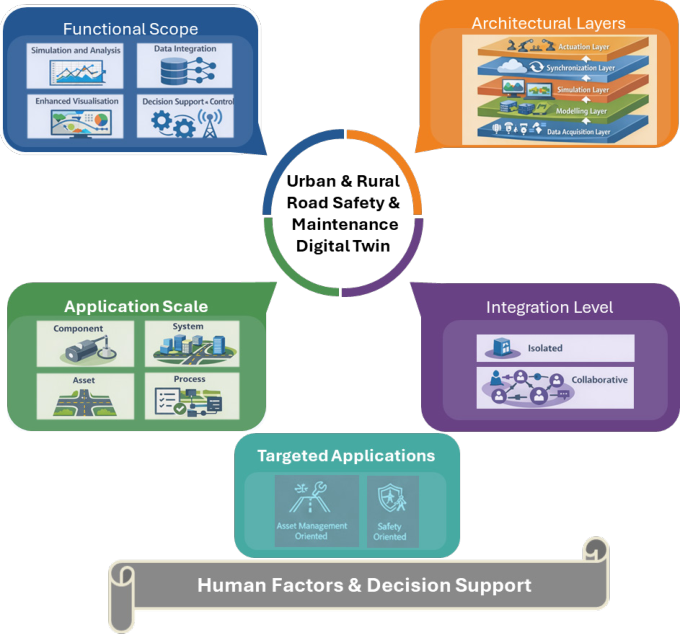
THE TAXONOMY OF DIGITAL TWIN APPLICATIONS The proposed taxonomy structures DT applications for urban and rural road infrastructure along four complementary dimensions that help analyse how DTs support asset management, safety management, and human-centred decision-making.
Functional Scope The functional scope dimension describes the primary purpose of the digital twin, ranging from simulation and analysis, data integration, enhanced visualisation, and decision support and control. For example, simulation and analysis twins may help understand system behaviour under varying conditions, (Kušić et al., 2023); data integration aggregates heterogeneous data to enhance situational awareness for operators and decision-makers (Consilvio et al., 2023; Vieira et al., 2024); visualisation and decision- support twins translate model outputs into user-friendly formats (Ammar et al., 2024); and control oriented twins enable actual operational interventions.
Application Scale The application scale captures the physical and organisational scope of the DT, differentiating between component, asset, system, and process twins. For example, component twins focus on individual elements (such as pavement sections), asset twins integrate multiple components into coherent assets (Mengtian Yin et al., 2025), system twins cover networks or areas (e.g. for traffic and risk analysis) (Kušić et al., 2023), and process twins model organisational workflows (such as maintenance planning or incident response).
Architectural Layers Architectural layers describe the DTs construction and operation layers, including data acquisition, management, modelling, simulation, synchronisation, and actuation. The design choices at each layer affect the transparency, uncertainty representation and cognitive workload. For example, low-cost or crowdsourced data can extend coverage but may increase uncertainty, requiring more human interpretation (Wu et al., 2025).
A Taxonomy of Digital Twin Applications for Road Infrastructure Safety 543 Integration Level
The integration level reflects how the DT interacts with other systems and stakeholders. Isolated twins support single assets or functions, whereas collaborative twins enable information sharing and coordination across domains such as asset management, traffic management, and safety analysis. Higher integration levels support safety management and urban mobility, but may also raise challenges related to governance, interoperability and cybersecurity (Raes et al., 2025).
Figure 1: Proposed digital twin taxonomy for urban and rural road safety and maintenance applications.
APPLICATION TO ROAD INFRASTRUCTURE ASSET AND SAFETY MANAGEMENT Applied to urban and secondary road networks, the taxonomy shows how different DT configurations support specific safety and asset management functions and specific human-system interaction contexts. Asset-oriented DTs would typically focus on infrastructure conditions monitoring, predictive maintenance, and lifecycle optimisation, while safety-oriented DTs emphasise risk detection, scenario simulation, and safety interventions.
The taxonomy also supports the comparison of DT maturity across applications. For instance, component-level twins using low-cost data sources can guide targeted safety interventions on secondary roads, whereas system- or process-level twins are more suitable for integrated urban safety management but require better organisational readiness and data integration.
Table 1 maps service layers to taxonomy dimensions and highlights human factors implications. It illustrates how technical design choices in DT architectures affect human interaction, cognitive workload, and safety- related decision-making. For example:
Data acquisition quality affects situational awareness and trust.
Data integration supports shared mental models among stakeholders, reducing coordination errors.
Simulation enables anticipatory thinking and reduces workload.
Decision-support interfaces impact prioritization and response time, mitigating human error.
Integration with operational processes shapes roles, responsibility, and trust calibration, particularly regarding ADAS/CCAM operations.
This mapping shows that DTs are not neutral information systems; design decisions influence how users perceive risk and act in safety-critical situations. The taxonomy supports (i) early identification of human factor risks and opportunities, and (ii) designers and authorities anticipating how DT configurations affect decision-making and coordination in urban and secondary road contexts.
Table 1: Mapping service layers, taxonomy dimensions and human-factors implications.
Data acquisition (sensors, inspections, crowdsourced and vehicle data)
Data quality, latency and uncertainty directly affect situational awareness and trust; poorly curated data may increase cognitive workload and misinterpretation of risks.
Integration with operational processes (maintenance planning, traffic control, infrastructure support for ADAS/ CCAM)
It shapes role allocation and responsibility boundaries; supports the calibration of automation trust by explicitly stating where infrastructure conditions enable or constrain reliable ADAS/CCAM operation; requires governance to avoid automation bias.
DISCUSSION: HUMAN-FACTORS IMPLICATIONS AND SCALING From a human factors perspective, the taxonomy reveals that increasing DT sophistication reshapes human roles in road safety management. Simulation-focused DTs support anticipatory cognition and learning, while decision-support or control DTs influence judgment, responsibility, and risk automation bias. From a human factors perspective, this highlights how DTs can both support and challenge human performance. Well-designed DTs act as cognitive tools to organise complex information, improve situational awareness, and support anticipatory control. Poorly designed DTs risk increasing workload, obscuring uncertainty, or encouraging biases.
As DTs scale from isolated applications to collaborative systems, challenges related to trust in automation, transparency of model outputs and organisational coordination grow. These findings align with broader evidence that DT adoption depends not only on technical capability, but also on usability, governance and institutional readiness. The hierarchical taxonomy offers a structured framework for classifying DT initiatives and understanding their potential and scaling constraints on urban and secondary roads, which are characterised by fragmented governance, heterogeneous assets and limited resources. In this context, unstructured or technology- driven DT deployments add complexity without proportional safety benefits.
Therefore, the taxonomy can guide practical DT deployment by helping users: (i) identify road assets or processes to monitor or optimise; (ii) define the intended DT functions (simulation, prediction, etc.); (iii) choose application scale (component to process level); (iv) map the required architectural layers
(data, modelling, simulation, actuation); (v) determine the integration level (isolated to collaborative); and (vi) address constraints such as data quality, interoperability, cybersecurity, and cost. This workflow supports transparent trade-offs and reduces misalignments between technological ambitions and organisational capacity, favouring incremental, context-sensitive scaling, over premature system-wide integration.
Technical, operational, and economic barriers remain significant when it comes to DT adoption on urban and secondary roads (Sharma et al., 2022; Wu et al., 2025). Technical issues include data quality gaps, limited standardisation and interoperability challenges. Operational barriers involve skills gaps and resistance to change. Economic barriers include high initial costs and uncertain returns on investment – ROI, particularly for smaller authorities (Oditallah et al., 2025; Yu Yan et al., 2025). Overcoming these requires harmonised frameworks, stronger governance and clear value propositions, beyond mere technological advances.
USING THE TAXONOMY IN PRACTICE AND SCALING DIGITAL TWINS FOR URBAN AND SECONDARY ROADS The proposed taxonomy provides a structured framework for digital twin initiatives that also helps authorities understand the breadth of their potential applications and scaling constraints affecting in urban and secondary roads, which differ from motorways, due to their heterogeneous infrastructure, mixed traffic, fragmented governance and limited resources. In such settings, unstructured or technology-driven DT deployments may risk increasing complexity without proportional safety benefits, underscoring the need for structured frameworks such as the proposed taxonomy.
Road authorities, designers, and project teams can use the taxonomy through the following workflow:
1. Identify road assets, locations or processes to be monitored or optimised, (e.g. intersection safety, pavement maintenance, and incident response). 2. Define digital twin functions (simulation and analysis, data integration, decision support, or visualisation). 3. Choose application scale (component, asset, system or process). 4. Map architectural layers (data acquisition, modelling, simulation, actuation). 5. Determine integration level (isolated or collaborative). 6. Consider constraints and priorities (data quality, interoperability, cybersecurity, organisational capacity and cost).
This approach structures complex design decisions, supports clear trade-offs, and reduces the risks of misalignment between technology and organizational readiness.
Barriers to DT adoption include technical (data gaps, coverage, interoperability, and standardization), operational (skills, governance, roles, and resistance), and economic (investment costs, and uncertain ROI).
A Taxonomy of Digital Twin Applications for Road Infrastructure Safety 547 Addressing these needs requires harmonised frameworks, governance, and clear value communication.
The taxonomy introduced in CAMBER helps anticipate and address adoption challenges by classifying DTs by function, scale, architecture, integration, and applications, supporting context-specific deployment while maintaining comparability. It highlights where scaling constraints may arise and where simpler or phased implementations are better.
In this context, the authors acknowledge that the proposed taxonomy is an initial framework that may evolve considering the results emanating from the CAMBER project, and that the current grounding is specific to urban and rural road infrastructure.
IMPLICATIONS FOR CAMBER IMPLEMENTATION AND EVALUATION Within CAMBER, the taxonomy serves as a unified reference for the coherent design, implementation, and evaluation of DT applications. At the system design level, it guides the definition of DT-ready data requirements, functional categories, and interoperability principles to combine heterogeneous data for asset and safety management goals across the CAMBER pilot sites. Making links between data, architecture, and functions explicit, supports a consistent and transparent system design.
At the solution development level, it guides selecting and differentiating DT configurations across pilot applications, encouraging a mix of component-, asset-, system-, and process-level DTs rather than a single design, thus enabling exploration from predictive maintenance on secondary roads to integrated DTs for urban traffic and automated mobility.
Beyond asset and traffic management, the taxonomy is valuable for assessing how road infrastructure supports or limits advanced driver assistance systems (ADAS) and cooperative, connected and automated mobility (CCAM). Digital twins can represent road geometry, surface conditions, markings, signage, and environmental factors that influence vehicle perception and control, especially on secondary and rural roads with varying infrastructure quality. By linking infrastructure attributes to DT simulation and analysis, the taxonomy aids in the evaluation of infrastructure suitability for ADAS and CCAM, by identifying targeted low-cost interventions that improve both automated system reliability and human driver safety. This human factor’s approach supports the calibration of driver trust and clarifies system limitations without shifting responsibility from infrastructure managers or decision-makers.
From an evaluation perspective, the taxonomy provides a comparative framework to assess DT implementation across sites and use cases, enabling systematic comparison of performance, usability, cost-effectiveness, and scalability, while analysing adoption barriers related to data quality, capacity, and governance. This supports the synthesis of transferable lessons and evidence-based recommendations beyond individual pilot studies.
CONCLUSION
This study presents a taxonomy of digital twin applications for road infrastructure asset and safety management from the perspective of human factors. By structuring the DTs across the functional scope, application scale, architectural layers and integration level, the taxonomy provides a coherent framework for classification, design, comparison and evaluation. Grounded in the recent literature and the CAMBER project, it highlights the opportunities and constraints associated with deploying DTs on urban and secondary roads. By supporting human-centred decision-making and structured scaling, the taxonomy aims to contribute to safer and more resilient road transport systems.
While this taxonomy provides a coherent framework, its current form is foundational and will be further applied and refined through pilot deployments at the five CAMBER pilot sites and simulation-based studies. Future work will also examine its generalisability and how different DT configurations influence human performance, decision quality, and organisational coordination in real-world settings, acknowledging that the current scope is primarily informed by the CAMBER project.
ACKNOWLEDGMENT
The authors acknowledge the contributions of the CAMBER project consortium. This work was supported by the European Union’s Horizon Europe research and innovation programme under Grant Agreement No. 101146800.
REFERENCES
Ammar, A., Maier, F., Pratt, W.S., Richard, E. and Dadi, G. (2024). Practical application of digital twins for transportation asset data management: Case example of a safety hardware asset. Transportation Research Record, 2678(10), 114–130. Consilvio, A., Hernández, J.S., Chen, W., Brilakis, I., Bartoccini, L., Di Gennaro,
F. and van Welie, M. (2023). Towards a digital twin-based intelligent decision support for road maintenance. Transportation Research Procedia, 69, 791–798. El-Agamy, R.F., Sayed, H.A., Al Akhatatneh, A.M., et al. (2024). Comprehensive analysis of digital twins in smart cities: A 4200-paper bibliometric study. Artificial Intelligence Review, 57, 154. Kušić, K., Schumann, R. and Ivanjko, E. (2023). A digital twin in transportation:
Real-time synergy of traffic data streams and simulation for virtualizing motorway dynamics. Advanced Engineering Informatics, 55, 101858. Mengtian Yin, Reja, V.K., Wei, R., Brilakis, I., Sheil, B., Perrotta, F., d’Avigneau, A.M.
and Lu, L. (2025). Exploring the value of digital twins for information management in highway asset maintenance. Developments in the Built Environment, 21, 100614. Oditallah, M., Alam, M., Ekambaram, P. and Ranjha, S. (2025). Review and insights toward cognitive digital twins in pavement assets for construction 5.0. Infrastructures, 10, 64.
A Taxonomy of Digital Twin Applications for Road Infrastructure Safety 549 Raes, L., Ruston McAleer, S., Croket, I., Kogut, P., Brynskov, M. and Lefever, S. (eds.)
(2025). Decide Better: Open and Interoperable Local Digital Twins. Springer, Cham. Sharma, A., Kosasih, E., Zhang, J., Brintrup, A. and Calinescu, A. (2022). Digital twins: State of the art theory and practice, challenges, and open research questions. Journal of Industrial Information Integration, 30, 100383. Vieira, J., Almeida, N.M., Poças Martins, J., Patrício, H. and Morgado, J.G. (2024).
Analysing the value of digital twinning opportunities in infrastructure asset management. Infrastructures, 9, 158. Werbińska-Wojciechowska, S.; Giel, R.; Winiarska, K. (2024). Digital Twin Approach for Operation and Maintenance of Transportation System—Systematic Review. Sensors, 24, 6069 Wu, D., Zheng, A., Yu, W., Cao, H., Ling, Q., Liu, J. and Zhou, D. (2025). Digital twin
technology in transportation infrastructure: A comprehensive survey of current applications, challenges, and future directions. Applied Sciences, 15, 1911. Yu Yan L., Sun, L., Wang, Y. and Zhou, J. (2025). Digital twin enabling technologies for advancing road engineering and lifecycle applications. Engineering, 44, 184–206. Zio, E. and Miqueles, L. (2024). Digital twins in safety analysis, risk assessment and
emergency management. Reliability Engineering & System Safety, 246, 110040.
LISTED IN THE AHFE DIGITAL BOOKSTORE CATALOGUE
Explore the complete digital volume
Advances in Human Factors of Transportation
Read this individual research paper free through the original publisher, or explore the full digital proceedings book.
ISBN 979-8-950676-00-0
Explore this ISBN in the AHFE Bookstore ↗Listed in the July 2026 bookstore catalogue; search by ISBN to confirm current availability · Digital book purchase optional