Ryosuke Sakaguchi, Itsuro Kaneyama, Shogo Takie, Kunio Shirahada (2026). Reconstructing the Authenticity of Wajima Lacquerware in the Disaster Recovery Process. In: The Human Side of Service Engineering. AHFE Open Access, vol. 221, pp. 322–332. https://doi.org/10.54941/ahfe1007736
1 School of Knowledge Science, Social System Management Research Area, Japan Advanced Institute of Science and Technology (JAIST), Nomi, Ishikawa, Japan ↗
The 2024 Noto Peninsula Earthquake devastated Wajima City, forcing the Wajima lacquerware community to redefine its craft’s authenticity amid the crisis. This study investigates how stakeholders negotiate tensions between traditional preservation and disaster recovery imperatives. Using an institutional logics perspective, we identify a three-layered Stratification of Authenticity: (1) the Inviolable Core protecting essential material/procedural integrity, (2) the Negotiable Periphery where standards are reinterpreted, and (3) the Peripheral for market innovation. The findings reveal that a rigid adherence to the Core is not an obstacle to recovery, but rather the essential foundation for reconstructing authenticity in the disaster recovery process. Anchoring identity in strict procedural, material, and institutional standards provides the foundational stability needed to safely explore flexibility in the outer layers. This layered structure allows the integration of external resources without compromising the craft's core identity, demonstrating how core rigidity functions as a vital resource for creative reconstruction in traditional industries.
Research Background The concept of “authenticity” in traditional crafts is often perceived as an immutable quality rooted in history and place. However, external shocks can destabilize the assumptions underlying this authenticity. The Noto Peninsula Earthquake on January 1, 2024, devastated Wajima City, destroying workshops and displacing craftsmen. This existential crisis forced the production community to confront a fundamental question: “What defines Wajima lacquerware when the physical place and traditional processes are disrupted?”
The Structure of Wajima Lacquerware Production The impact of this crisis is deeply rooted in the unique production structure of Wajima lacquerware. Unlike crafts produced by a single artisan, Wajima
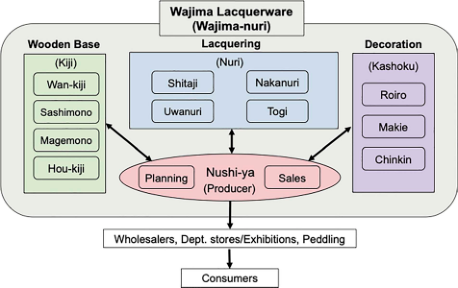
Reconstructing the Authenticity of Wajima Lacquerware in the Disaster Recovery Process 323 lacquerware relies on a complex division of labor coordinated by a Nushi-ya. As shown in Figure 1 (Takie et al., 2026), the Nushi-ya acts as a producer, orchestrating specialized craftsmen across dozens of processes, from base- making (Kiji) and lacquering (Nuri) to decoration (Kashoku) (Takie et al., 2026). This high degree of interdependence means that damage to any single part of the network can paralyze the entire system, making the recovery process deeply complex.
Figure 1: Industrial structure of wajima lacquerware and the role of nushiya (Adapted from Takie et al., 2026 and translated by authors).
Theoretical Gap and Purpose Previous research on Wajima lacquerware has analyzed its resilience from normative and systemic perspectives. Kaneyama et al. (2025) identify that the strict adherence to the 124-step production process is driven by “Cultural Wisdom” and an ethical orientation toward the “common good” (Maxwell, 2007). Similarly, Takie et al. (2026) demonstrate that the local cooperative union engages in “Institutional Work” (Lawrence and Suddaby, 2009) to bridge traditional practices with administrative recovery plans, functioning as a mediator within the service ecosystem.
While these studies elucidate the normative foundations and macro- level systemic responses, there remains a need to investigate the micro-level discursive dynamics. Specifically, it is necessary to understand how individual actors facing survival imperatives subjectively resolve conflicts between the logic of tradition and the logic of economic recovery in their daily practices.
To address this gap, this study adopts the Institutional Logics perspective. We view the post-disaster recovery process as a negotiation between competing institutional orders: the Craft Logic (prioritizing technical adherence), the Place Logic (prioritizing geographic rootedness), and the Market Logic (prioritizing efficiency and survival).
Existing literature often treats these logics as incompatible tradeoffs. However, our analysis of stakeholder narratives reveals a mechanism of “Stratification” (hierarchical ordering). We argue that actors do not simply choose one logic over another but arrange them into a
hierarchy—distinguishing between an inviolable “Core” and a negotiable “Periphery”. This study aims to demonstrate how this stratification allows the community to accommodate necessary changes, such as the acceptance of external human resources or alternative locations, without dismantling the fundamental identity of the craft.
PREVIOUS STUDIES Authenticity
Authenticity is a multi-dimensional construct. Lehman et al. (2019) categorize it into Consistency (internal faithfulness), Conformity (adherence to social norms), and Connection (historical/spatial links). Furthermore, from a Social Constructionist perspective (Kovács, 2019), authenticity is not inherent in the object but is an assessment made by an evaluator. This implies that different evaluators may judge the same object differently based on their underlying logic.
Institutional Complexity and Authenticity Institutional logics are “the socially constructed, historical patterns of material practices, assumptions, values, beliefs, and rules” (Thornton & Ocasio, 1999). Organizations in traditional sectors often face institutional complexity (Greenwood et al., 2011), where they must navigate multiple, often conflicting, societal orders. Existing literature identifies seven ideal- type orders: State, Market, Corporation, Profession, Family, Religion, and Community. A crisis compels stakeholders to decide “what should be changed and what should be preserved.” Based on the above perspective, the following section presents the analytical framework of this study by linking the main representations of authenticity related to Wajima lacquerware with institutional logic.
Analytical Framework To analyze the dynamic negotiation of identity, this study establishes a theoretical baseline by synthesizing recent empirical studies on Wajima lacquerware with the literature on institutional logics. We posit that the definition of “authenticity” in Wajima lacquerware is not monolithic but is contested by four distinct institutional logics, each prescribing different criteria for legitimacy.
To analyze these dynamics, we synthesize recent studies on Wajima lacquerware with institutional logics (see Table 1).
First, Craft Logic emphasizes “processual integrity,” where strict adherence to the 124-step process is not merely technical but “Cultural Wisdom” embedded in the community (Kaneyama et al., 2025). Second, Governance Logic defines authenticity as “institutional certification”; Takie et al. (2026) highlight the Cooperative Union’s role in maintaining order through strict inspection, making compliance synonymous with legitimacy. Third, Place Logic insists on “geographic rootedness,” which Kaneyama et al. (2025)
Reconstructing the Authenticity of Wajima Lacquerware in the Disaster Recovery Process 325 describe as “civic pride” linking the craft inextricably to the land. Finally, Market Logic re-evaluates authenticity based on “economic viability.” As Takie et al. (2026) observe in the push for “Creative Reconstruction,” this logic validates efficiency improvements if they secure the ecosystem’s survival.
Existing literature often treats these logics as incompatible trade-offs. However, our analysis of stakeholder narratives reveals a mechanism of “Stratification” (hierarchical ordering). We argue that actors do not simply choose one logic over another but arrange them into a hierarchy, distinguishing between an inviolable “Core” and a negotiable “Periphery”. This study aims to demonstrate how this stratification allows the community to accommodate necessary changes, such as the acceptance of external human resources or alternative locations, without dismantling the fundamental identity of the craft.
Table 1: The analytical framework of authenticity.
Table available in the original PDF paper.
Authenticity Authenticity Requirement Corresponding Institutional Logic Craft Logic Material & Technological a) Adherence to core processes (124 steps) b) Material requirements (Jinoko, natural lacquer) c) Mechanization is permissible only as auxiliary
support.
Institutional & Regulatory
a) Compliance with institutional standards b) Quality assurance through certification and
Governance Logic inspection c) Maintenance of the legitimacy of the production
area
Place Logic
Place-based & Spiritual
a) Emphasis on “Made in Wajima” b) Emphasis on the localness of the actors (origin, residence) c) Commitment to the cultural identity and civic pride
associated with Wajima
Market Logic
Market & Social Value
a) Accountability and identifiability b) Reducing consumer misunderstanding c) Durability and usability d) Reparability
METHOD
Research Context and Data Collection This study employs a qualitative case study approach (Yin, 2018) to investigate the dynamic negotiation of authenticity in the Wajima lacquerware industry following the 2024 Noto Peninsula Earthquake. The research design and data collection process follow the framework established by Takie et al. (2026) and Kaneyama et al. (2025) focusing on the interactions among diverse stakeholders within the service ecosystem.
Data was collected through semi-structured interviews conducted between April and November 2025. We employed a purposive sampling strategy, starting with key industry leaders (e.g., workshop owners or Nushi-ya) and expanding to craftsmen and industry officials through snowball sampling. The informants were selected to represent a variety of perspectives, ranging from traditionalists to innovators, and including both production managers and technical artisans.
In total, 8 key informants were interviewed (see Table 2). The informants include workshop owners (Nushi-ya), craftsmen (artisans), and industry officials, representing diverse institutional positions ranging from traditional preservation to market-oriented innovation. Each interview lasted between 60 to 120 minutes and was recorded and transcribed with the informants’ consent.
Table 2: List of informants (Adapted from Takie et al., 2026).
Table available in the original PDF paper.
ID Position Date (2025) Location Duration A Nushi-ya (Producer/Coordinator) April 16 Wajima 90 min.
B Nushi-ya (Producer/Coordinator) April 16, June 23 Wajima Total 200 min.
C Artist July 2 Kanazawa 120 min.
D Nushi-ya (Producer/Coordinator) July 31 Kanazawa 120 min.
E Nushi-ya (Producer/Coordinator) August 26 Kanazawa 120 min.
F Nushi-ya (Producer/Coordinator) September 22 Online 60 min.
G Artisan October 6 Wajima 110 min.
H Cooperative Official November 5 Wajima 130 min.
As shown in Table 3, the interview guide was structured not to ask about “authenticity” directly, but to capture the informants’ lived experiences and evolving perspectives following the disaster. The questions covered the immediate experiences of the earthquake, forced relocation, and reflections on pre-disaster sustainability and the specific nature of local collaborative networks. It is important to note that “authenticity negotiation” was not an a priori category set by the researchers. Rather, this theme emerged inductively during the interviews as stakeholders struggled to articulate the boundary between “what must be changed” (Innovation) and “what must be protected” (Tradition) in the face of the crisis.
Table 3: Main Question Items (Adapted from Kaneyama et al., 2025).
Table available in the original PDF paper.
Main Question Items 1 What kind of impact did the earthquake disaster have on your workshop or business?
2 How did you view the sustainability of the Wajima lacquerware industry before the earthquake?
3 If we consider this earthquake disaster as a trigger, what has changed in your activities?
4 What are your thoughts on having been compelled to relocate?
5 What kind of people are the partners you are working with on reconstruction efforts?
(Continued)
Table 3: Continued.
Table available in the original PDF paper.
Main Question Items 6 Do you feel something like a consciousness or temperament unique to this land?
7 Is there anything that hinders your activities? Relationships with the administration, other groups, or individuals...
8 How would you like Wajima to be in the future? What do you want to do from now on? What do you want to preserve? What could you let go of?
9 What is Wajima lacquerware? What is its appeal...
10 Is there anything you would like academia (JAIST) to help you with?
Data Analysis The data analysis followed an abductive process (Dubois and Gadde 2002), moving iteratively between the raw data and the theoretical framework of institutional logics. This approach allowed for the identification of unexpected patterns regarding the spatial and normative organization of authenticity. The analysis proceeded in three primary stages:
First, we performed open coding on the interview transcripts and documents to identify key responses to the 2024 earthquake. Initial codes included strictness of the 124-step process,” and “introduction of new material technology”, etc. These codes were grouped into broader categories based on the specific institutional logics—Craft, Governance, Place, and Market—guiding the stakeholders’ decisions.
Second, we analyzed the degree of “negotiability” within each logic. We observed that while some elements were treated as absolute and immutable, others were subject to practical compromise. This led to the categorization of data into three distinct layers: the Inviolable Core, the Negotiable Periphery, and the Adaptive Zone. This stage moved beyond simple thematic grouping to a structural analysis of how these logics are layered.
Finally, we synthesized these layers into the Three-Layered Structure of Authenticity (Table 4). We specifically focused on the “anchor function” of the core—how the rigidity of technical and institutional standards enables flexibility in the periphery.
RESULTS
Analysis of the qualitative data indicates that authenticity in Wajima lacquerware is managed through a three-layered structure across four institutional logics (Table 4). This stratification allows stakeholders to maintain a stable identity while adapting to the disruptions caused by the 2024 earthquake.
Table 4: The three-layered structure of authenticity.
Table available in the original PDF paper.
Place Logic Market Logic
Layer / Logic Craft Logic Governance Logic Integration External Actors Layer 3: Peripheral (Adaptive) Facilitation of New Initiatives & Sub-brands
Diversification into New Markets & Segments
Expansion to art works and new functional products Negotiation of New Technologies & Materials Re-evaluation of Standards & Criteria Layer 2: Negotiable Periphery (Fluctuating)
Decoupling of Production from Physical Place
Adoption of Efficiency Measures for Scarcity
Institutional Certification
Layer 1: Inviolable Core (Stable)
Essential Material & Procedural Integrity
Preservation of Long-term Brand Reputation
Symbolic Geographic Rootedness & Civic Pride
The Inviolable Core At the base of the hierarchy lies the Inviolable Core, where legitimacy is derived from strict adherence to essential standards. In the Craft Logic, this is manifested as Essential Material and Procedural Integrity. Stakeholders view the 124-step process not as blind tradition but as a technical necessity. Informant C described these steps as “the shortest, most efficient method” derived from centuries of trial and error, emphasizing that strict adherence ensures the product’s usability and durability.
Governance Logic reinforces this through Institutional Certification, maintained by the Cooperative Union to ensure brand quality through strict inspection. This aligns with the “maintenance work” described by Takie et al. (2026), where the union preserves the normative order of the production area.
Similarly, the Place Logic anchors identity in Symbolic Geographic Rootedness, treating the craft as a symbol of regional culture and civic pride. The Market Logic at this level focuses on the Preservation of Long-term Brand Reputation, ensuring the economic foundation of the industry remains uncompromised.
The Negotiable Periphery The second layer consists of a Negotiable Zone where boundaries fluctuate as stakeholders interpret external pressures through their internal norms. This layer represents the tension between the maintenance of tradition and the transformation required for recovery.
In Craft Logic, this involves the Negotiation of New Technologies and Materials. This boundary remains rigid even when facing innovations with recognized utility. While acknowledging technical utility, stakeholders reject non-traditional materials that compromise structural integrity. Informant B
Reconstructing the Authenticity of Wajima Lacquerware in the Disaster Recovery Process 329 argued that 3D-printed substitutes are “the same as plastic” because they lack the essential “bond with the wood” that the traditional process guarantees.
This indicates that the Core is governed by a logic of material adherence, prioritizing the physical integrity of the object over production efficiency. Conversely, tools that do not compromise this integrity have been conditionally accepted as a necessity to ensure industry’s economic survival.
In Place Logic, a similar negotiation led to the Spatial Decoupling of production from the physical location. Due to the destruction of workshops, production outside Wajima was accepted as a temporary measure. Informant A noted that while permanent emigration delegitimizes the craft, maintaining “registration in Wajima” and commuting as an evacuee preserves the necessary institutional link to the region.
Finally, the Market Logic in this layer drives the Adoption of Efficiency Measures for Scarcity. This is framed as a pragmatic response to the acute labor and resource shortages following the disaster, where efficiency is justified to secure artisan wages and stabilize the industry’s “Creative Reconstruction”.
The Peripheral The outermost layer is an Adaptive Zone where stakeholders actively integrated Market Logic to address the industry’s continuity. Unlike the Core, this domain is driven by the requirement to address labor shortages and production efficiency.
First, the chronic labor shortage necessitated a re-evaluation of artisan qualifications. Informant C emphasized that “resolve” and professional commitment have become more critical qualifications than biological origin, justifying the recruitment of external talent.
Second, the requirement for economic continuity justified the adoption of efficiency-enhancing technologies. Informant E observed that historical resistance to tools like the hand-turned wheel has faded, as efficiency is now recognized as essential to “secure artisan wages” and stabilize prices.
Third, stakeholders developed new product lines to address shifting market needs. Informant B proposed a strategy of structural separation, suggesting that innovations should be treated as “distinct from Wajima lacquerware” to enhance their unique value without diluting the core brand.
Summary of Findings: The Anchor Function of the Core The analysis of the three-layered structure reveals a fundamental contrast between the stability of the Inviolable Core (Layer 1) and the fluidity of the Negotiable and Adaptive zones (Layers 2 and 3). While the Core is characterized by strict procedural and institutional consistency across all four logics, the outer layers are characterized by shifting boundaries as stakeholders respond to environmental pressures.
In practice, the boundaries between the Negotiable and Adaptive layers are often blurred. For instance, the integration of external actors (Place Logic in Layer 3) is inextricably linked to the acute labor shortage (Market Logic in Layer 2), and the adoption of efficiency measures frequently occurs within
temporary production sites located outside Wajima. This overlap suggests that the Periphery is not a clearly defined zone that can be managed through fixed rules. Instead, its boundaries shift dynamically depending on the specific resource scarcity and the timing of recovery efforts.
This leads to a critical implication regarding the mechanism of authenticity and resilience. Attempting to rigidly design or control the boundaries of the Negotiable or Adaptive zones is difficult due to their inherent instability. Therefore, the observed strategy among stakeholders is not to manage the fluctuations of the Periphery directly, but to intensify the rigidity of the Inviolable Core. By anchoring the industry’s identity in Layer 1 through procedural and material integrity, stakeholders create a stable foundation that maintains collective legitimacy. This rigid anchoring of the Core allows for necessary innovations and adaptations to emerge in Layers 2 and 3 without the risk of dissolving the craft’s fundamental identity.
DISCUSSION
The Functional Rigidity of the Inviolable Core The primary theoretical implication of this study is that the rigidity of the Inviolable Core (Layer 1) functions as a structural resource for adaptation rather than a barrier to recovery. In the context of the 2024 earthquake, the strict adherence to the Craft Logic—specifically the 124-step process and material adherence—provided the institutional stability required for peripheral changes. This adherence is not merely traditionalism but a form of technical rationality that ensures long-term quality and maintains “Cultural Wisdom” embedded in the community. By anchoring the industry’s identity in this stable center, stakeholders were able to preserve the normative foundations of the regional brand, which in turn granted them the collective legitimacy to negotiate more flexible standards in the outer layers.
Symbolic Re-Anchoring of Place and Community The destruction of physical infrastructure necessitated a fundamental metamorphosis of the Place Logic, shifting authenticity from geographic rootedness to professional commitment. Traditionally, legitimacy was tied to production within the physical city of Wajima. However, the findings reveal a strategic spatial decoupling, where production outside the region was accepted if artisans maintained their institutional registration and a shared intent to recover. This transition suggests that the “spirit” of the craft is not solely bound to physical soil but can be sustained through Social & Institutional networks and commitment-based definitions of belonging. Such re-anchoring allowed the community to integrate external talent and alternative locations—negotiations within the Negotiable Periphery (Layer 2)—without dismantling the fundamental identity of Wajima lacquerware.
Reconstructing the Authenticity of Wajima Lacquerware in the Disaster Recovery Process 331 Strategic Stratification and Emergent Innovation
Finally, the analysis demonstrates that the Periphery (Layers 2 and 3) is a domain of emergent adaptation that cannot be managed through rigid administrative design. The boundaries within these layers are inherently fluid, as seen in the overlap between the acceptance of external artisans (Community Logic) and the pragmatic adoption of efficiency measures (Market Logic) to address labor shortages. Rather than attempting to control these chaotic fluctuations directly, stakeholders employed a strategy of structural separation. By intensifying the clarity of the Core as a “sanctuary” of authenticity, they allowed Market Diversification and novel product applications to emerge naturally in the Adaptive Zone (Layer 3). This stratification ensures that innovation serves the survival of the industry while the essential standards of the craft remain protected from economic or spatial dilution.
CONCLUSION
The 2024 Noto Peninsula Earthquake transformed the authenticity of Wajima lacquerware from an implicit tradition into an object of explicit strategic design. Drawing on the perspective of Institutional Logics, this study elucidated how the intrusion of survival imperatives triggered a community-wide reflexivity. The resulting “Stratification of Authenticity” rigorously protects the Core processes while liberating peripheral practices, demonstrating that strict adherence to tradition and bold market adaptation are not mutually exclusive but mutually reinforcing.
As noted by Kaneyama et al. (2025), the “Cultural Wisdom” of Wajima lacquerware is more than just a preserved tradition, rather it is an active capability used to work for the common good. By redefining the boundaries of their work, Wajima’s stakeholders have shown that resilience comes from the ability to separate what needs to change from what must stay the same. This way of rebuilding identity offers a helpful model for other traditional industries dealing with disaster recovery and long-term survival.
REFERENCES
Dubois, A., Gadde, L.-E. (2002). “Systematic combining: an abductive approach to case research.” Journal of Business Research, vol. 55, no. 7, 553–560. Greenwood, R., Raynard, M., Kodeih, F., Micelotta, E. R., Lounsbury, M. (2011).
“Institutional Complexity and Organizational Responses.” Academy of Management Annals, vol. 5, no. 1, 317–371. Kaneyama, I., Takie, S., Gokon, H., & Shirahada, K. (2025). “Cultural Wisdom in Wajimanuri Lacquerware: A Perspective Toward Creative Revitalization.” The 16th Conference on Transdisciplinary Science and Technology. Kovács, B. (2019). “Authenticity Is in the Eye of the Beholder: The Exploration of
Audiences’ Lay Associations to Authenticity Across Five Domains.” Review of General Psychology, vol. 23, no. 1, 32–59. Lawrence, T. B., Suddaby, R., Leca, B. (2009). “Introduction: theorizing and studying institutional work.” in: Institutional Work: Actors and Agency in Institutional Studies of Organizations, Lawrence, T. B., Suddaby, R., Leca, B. (Eds.). pp. 1–28.
Lehman, D. W., O’Connor, K., Kovács, B., Newman, G. E. (2019). “Authenticity.”
Academy of Management Annals, vol. 13, no. 1, 1–42. Maxwell, N. (2007). From Knowledge to Wisdom: A Revolution for Science and the Humanities. London: Pentire Press. Takie, S., Kaneyama, I., Sakaguchi, R., Gokon, H., & Shirahada, K. (2026). “Service
Ecosystem Design in Traditional Industries: Institutional Work by Cooperative in the Wajimanuri Industry.” The 14th domestic Conference of Society for Serviceology. Thornton, P. H., Ocasio, W. (1999). “Institutional Logics and the Historical Contingency of Power in Organizations: Executive Succession in the Higher Education Publishing Industry, 1958– 1990.” American Journal of Sociology, vol. 105, no. 3, 801–843. Thornton, P. H., Ocasio, W., & Lounsbury, M. (2012). The institutional logics
perspective. Yin, R. K. (2018). Case study research: Design and methods. Newbury Park, California: SAGE Publications.
LISTED IN THE AHFE DIGITAL BOOKSTORE CATALOGUE
Explore the complete digital volume
The Human Side of Service Engineering
Read this individual research paper free through the original publisher, or explore the full digital proceedings book.
ISBN 978-1-964867-97-7
Explore this ISBN in the AHFE Bookstore ↗Listed in the July 2026 bookstore catalogue; search by ISBN to confirm current availability · Digital book purchase optional