Yuko Hirai (2026). Emotional UX Breakdown and Organizational Untangling: Toward Emotional Infrastructure Design. In: Human Factors, Business Management and Society. AHFE Open Access, vol. 215, pp. 353–360. https://doi.org/10.54941/ahfe1007616
Vision-driven organizations rely on abstract purposes to guide action under uncertainty, particularly during second-foundation growth and AI/DX transformation. While such abstraction enables adaptability, it also creates structural ambiguity, often resulting in misalignment between declared vision and everyday practice.This study employs a qualitative action research approach based on long-term participatory engagement in three Japanese organizational contexts.The findings reveal a previously under-theorized mechanism: vision–practice misalignment is informally managed through emotional translation labor. Empathetic professionals translate abstract intent into operational meaning, absorb ambiguity, and maintain psychological safety. This invisible labor functions as an implicit subsystem that stabilizes performance in the short term while concentrating emotional load on specific individuals, increasing vulnerability to burnout and exit.A leadership reflexivity gap is also identified, in which emotional feedback is not effectively integrated into decision-making. Under high-context cultural conditions, this dynamic is amplified as misalignment is internally absorbed rather than explicitly addressed.These dynamics are conceptualized as the Organizational Emotional UX Breakdown Model, reframing emotional load as a hidden system-level constraint. To move from breakdown to structural resolution, the study proposes an Organizational Untangling framework grounded in Human Systems Integration (HSI), which redistributes emotional load through visualization, decision rationale externalization, reflexive feedback loops, and cross-functional integration. AI is positioned as an emotional mediator that supports sense-making and reduces dependency on individual-based emotional processing.By positioning emotional processes as organizational infrastructure, this study extends HSI and offers a design-oriented approach to enhancing organizational resilience.
Vision-driven organizations rely on abstract purposes to guide action under uncertainty. While such abstraction enables adaptability and alignment with broader societal goals, it also creates ambiguity in interpretation and execution. This ambiguity often leads to structural misalignment between vision and everyday practice.
354 Hirai This study addresses the following question: Why do empathetic and highly capable professionals burn out first? Existing literature has examined burnout primarily as an individual psychological phenomenon. However, this research reframes burnout as a systemic outcome resulting from the absence of explicit integration of emotional processes into organizational design.
By focusing on emotional processes as structural elements rather than individual attributes, this study seeks to contribute to bridging gaps between organizational theory, human factors engineering, and leadership studies.
THEORETICAL BACKGROUND Human Factors research emphasizes the integration of human capabilities into system design (Chapanis, 1996). However, emotional processes within organizational systems have remained largely implicit and insufficiently structured, often treated as individual concerns rather than design elements.
Human Systems Integration (HSI) extends this perspective by treating humans as integral system components and aiming to optimize overall system performance (Booher, 2003). Despite this, emotional processes have not been explicitly conceptualized as system-level variables, resulting in hidden workload concentration and unarticulated dependencies within organizational systems.
This gap suggests the need for a systematic and explicit integration of emotional processes within organizational system design.
Organizational learning theory highlights the importance of reflexivity in adaptive systems (Argyris, 1991; Schön, 1983). Reflexivity enables organizations to incorporate feedback from human experience into decision- making processes. However, in complex and rapidly evolving organizational environments, reflexive mechanisms are often structurally constrained, limiting the ability of systems to adapt effectively.
Emotional labor theory provides a foundation for understanding how individuals manage emotions within professional contexts (Hochschild, 1983). While this perspective has primarily focused on individual coping and role performance, it does not fully account for how emotional labor becomes structurally embedded within organizational systems.
Building on these perspectives, this study reconceptualizes emotional processes as system-level phenomena that influence workload distribution, feedback dynamics, and overall system resilience. By integrating emotional processes into the framework of Human Systems Integration, this research positions emotion as a critical design component rather than an implicit byproduct of organizational activity.
METHOD: ACTION RESEARCH This study employs an action research methodology, characterized by iterative cycles of diagnosis, intervention, reflection, and redesign.
The research was conducted across three organizational contexts in Japan: a second-foundation startup, an intrapreneurial unit, and a corporate innovation team.
Emotional UX Breakdown and Organizational Untangling 355 Data collection methods included participant observation, MVV facilitation sessions, cross-functional team design and implementation, and semi-structured interviews. The researcher actively engaged with organizational processes as both observer and intervenor, enabling the integration of practical intervention and analytical reflection.
This positioning reflects the dual role of the researcher in action research as both a participant and a designer of organizational change.
These cycles of diagnosis, intervention, reflection, and redesign were repeated throughout the study, allowing for the progressive refinement of both organizational practices and theoretical insights.
This methodological approach enables the exploration of complex, context-dependent phenomena while simultaneously generating actionable knowledge grounded in real-world organizational dynamics.
FINDINGS The analysis revealed a set of interrelated patterns that collectively describe how emotional processes are informally integrated into organizational systems.
First, emotional translation labor emerged as a critical yet largely invisible function. Empathetic professionals absorbed ambiguity, translated abstract vision into actionable meaning, and maintained psychological safety. This function, while not formally recognized, effectively compensated for gaps in organizational design.
Second, a leadership reflexivity gap was identified. Emotional feedback from the organization rarely returned to leadership decision-making processes, limiting adaptive learning and reducing the system’s capacity to respond to emerging tensions.
Third, a dependency structure centered on a structurally central coordinating role (“No.2”) was observed. This individual functioned as an informal emotional infrastructure, absorbing and redistributing emotional load. This concentration of emotional processing created both short-term stability and long-term structural vulnerability.
Finally, a phase-overlap dynamic was identified, in which organizational disillusionment coincided with individual adaptation challenges. This pattern resembles the transition from a “honeymoon phase” to a “disillusionment phase” observed in disaster psychology, where initial cohesion is followed by a decline in collective morale. This overlap amplified emotional strain and intensified reliance on informal emotional regulation mechanisms.
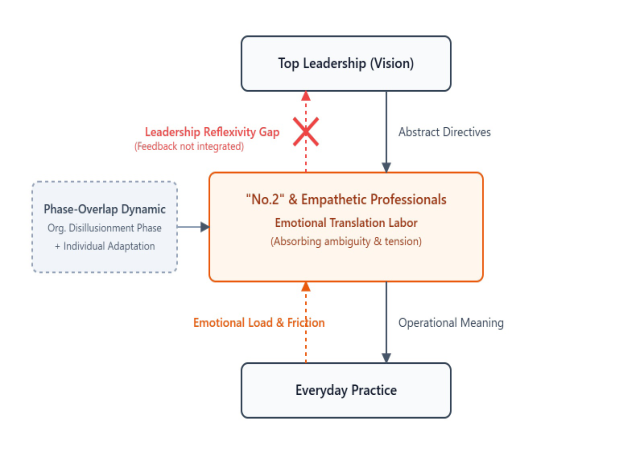
Taken together, these findings indicate that emotional processes are not absent from organizational systems, but rather integrated in implicit and uneven ways, leading to hidden load concentration and reduced system resilience. These findings suggest that emotional processes function as an implicit subsystem within organizational operations. Figure 1 illustrates how this implicit subsystem operates as an informal emotional infrastructure and concentrates emotional load within specific roles.
Figure 1: Informal emotional infrastructure and load concentration mechanism.
Structural misalignment between abstract vision and everyday practice is managed through emotional translation labor, primarily carried by empathetic professionals and a heavily relied-upon “No.2.” A leadership reflexivity gap prevents experiential feedback from reaching top leadership, resulting in the accumulation of emotional load, particularly under phase-overlap dynamics.
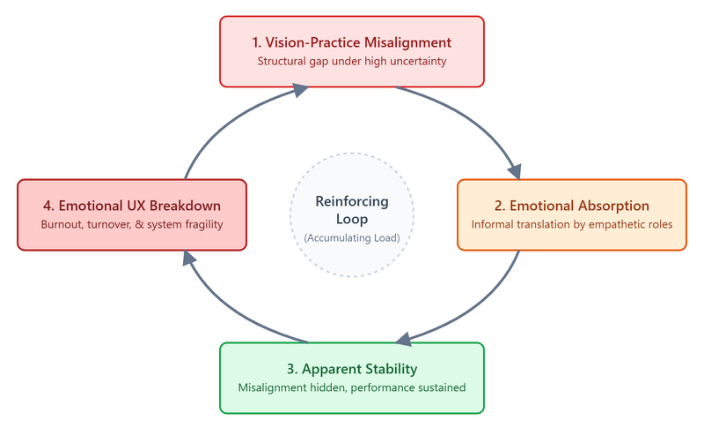
ORGANIZATIONAL EMOTIONAL UX BREAKDOWN MODEL The breakdown process can be structured as a four-phase model consisting of misalignment, emotional absorption, apparent stability, and breakdown.
This model describes a reinforcing loop in which apparent stability suppresses the visibility of misalignment, increasing reliance on emotional absorption. As emotional load accumulates without explicit redistribution, the system becomes progressively dependent on informal mechanisms of emotional regulation.
Over time, this dynamic leads to a degradation of system resilience, as emotional processing is concentrated in specific roles rather than distributed across organizational structures.
This model suggests that emotional load, when left unintegrated, functions as a hidden system-level constraint that shapes organizational performance.
As a result, emotional labor becomes embedded as an implicit subsystem within organizational operations, functioning as an informal operating system that sustains short-term stability while generating long-term structural vulnerability.
The dynamics identified in these findings can be further conceptualized as a systemic breakdown process.
Figure 2 presents this process as a reinforcing loop model.
A reinforcing loop illustrating how vision–practice misalignment drives emotional absorption in specific roles. This informal labor produces apparent stability that conceals underlying misalignment. Over time, the accumulation of unresolved emotional load leads to system degradation, burnout, and reduced organizational resilience.
ORGANIZATIONAL UNTANGLING FRAMEWORK To address the structural dynamics identified in the breakdown model, this study proposes an Organizational Untangling framework as a system-level redesign approach.
The framework consists of four interrelated design principles: emotional load visualization, decision rationale externalization, reflexive feedback loops, and cross-functional integration. These principles are not independent interventions but function collectively to redistribute emotional load and restore feedback visibility within organizational systems.
In the organizational contexts examined in this study, roles and functions were often ambiguous and insufficiently formalized. Conventional functional divisions such as sales, planning, production, and accounting were not clearly separated, resulting in individuals carrying multiple overlapping responsibilities. As a result, diverse contextual information became cognitively entangled within individuals, making it difficult to externalize, structure, and process these complexities independently.
This entanglement generates high cognitive and interpretive demands, requiring individuals to continuously translate between multiple contexts and expectations. Such work is inherently high-skill and high-effort, and tends to be disproportionately carried by empathetic professionals, reinforcing the concentration of emotional load within specific roles.
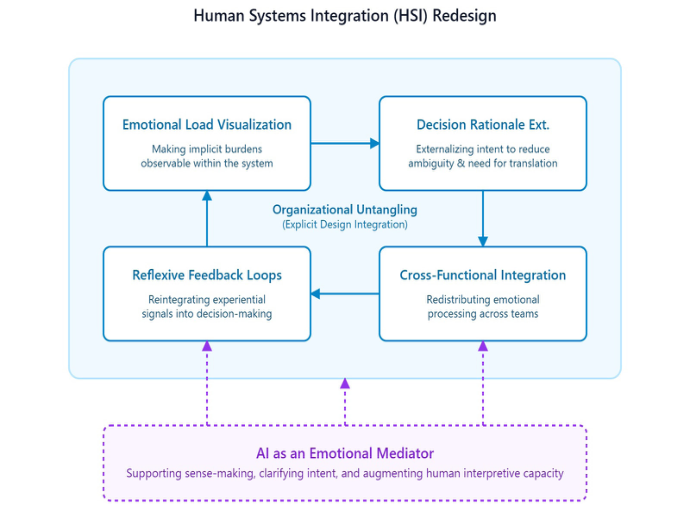
358 Hirai Emotional load visualization makes previously implicit burdens observable, enabling organizations to identify concentration points. Decision rationale externalization reduces ambiguity by making intentions and reasoning processes explicit, thereby decreasing the need for informal emotional translation. Reflexive feedback loops reintegrate experiential signals into decision-making processes, enhancing adaptive capacity. Cross- functional integration redistributes emotional processing across roles and teams, reducing dependency on specific individuals.
From a Human Systems Integration (HSI) perspective, emotional processes are redefined as system-level variables that influence workload distribution, feedback dynamics, and system resilience. Untangling, in this context, represents a deliberate integration process that transforms implicit emotional dependencies into explicit design elements.
Additionally, AI can be conceptualized as an emotional mediator that supports sense-making, clarifies intent, and externalizes reasoning processes. By augmenting human interpretive capacity, AI contributes to the stabilization of feedback loops and reduces the burden of emotional translation within organizational systems.
This reframing shifts emotional processes from informal, person-dependent mechanisms to formally designed system components. This framework suggests that organizational resilience can be enhanced by explicitly designing emotional processes as part of system integration.
To address these structural dynamics, a system-level redesign is required. Figure 3 presents the Organizational Untangling Framework as a Human Systems Integration (HSI)-based intervention model.
Figure 3: Organizational untangling framework based on human systems integration (HSI).
Emotional UX Breakdown and Organizational Untangling 359 This framework replaces implicit emotional dependencies with explicit design principles: Emotional Load Visualization, Decision Rationale Externalization, Reflexive Feedback Loops, and Cross-Functional Integration. Artificial Intelligence is positioned as an emotional mediator, augmenting human interpretive capacity and supporting sense-making within organizational systems.
FUTURE WORK
Future research will focus on operationalizing emotional processes as measurable system-level variables, including constructs such as Emotional Load Concentration Index, Decision Transparency Ratio, and Reflexivity Feedback Density.
We hypothesize that higher emotional load concentration is positively associated with turnover risk and negatively associated with organizational resilience. We further hypothesize that increased decision transparency and reflexivity feedback density mitigate the accumulation of hidden emotional load within organizational systems.
Empirical validation of these hypotheses will contribute to the development of measurable and actionable organizational design principles, enabling the integration of emotional processes into Human Systems Integration (HSI) frameworks.
CONCLUSION
This study demonstrates that emotional UX breakdown is not an individual failure but a structural outcome of non-integrated emotional processes within organizational systems.
By introducing the Organizational Emotional UX Breakdown Model and the Organizational Untangling Framework, this research provides a systematic explanation of how emotional load becomes concentrated and how it can be redistributed through deliberate design interventions.
By reframing emotion as an organizational infrastructure, this study extends Human Systems Integration (HSI) by explicitly positioning emotional processes as system-level variables that influence workload distribution, feedback dynamics, and system resilience.
These findings suggest that integrating emotional processes into system design is not only a matter of human well-being, but also a fundamental requirement for achieving organizational resilience and sustainability.
Ultimately, this research highlights the importance of designing organizations in which emotional processes are not implicitly absorbed by individuals, but explicitly structured as part of system integration within organizational design.
REFERENCES
Argyris, C. (1991). Teaching smart people how to learn. Harvard Business Review, 69(3), pp. 99–109. Booher, H. (2003). Handbook of human systems integration. Hoboken, NJ: Wiley. Booher, H.R. and Minninger, J. (2003). Human systems integration in army systems
acquisition. In: Booher, H. (ed.) Handbook of human systems integration. Hoboken, NJ: Wiley, pp. 663–698. Chapanis, A. (1996). Human factors in systems engineering. New York: Wiley. Folds, D., Gardner, D. and Deal, S. (2008). Building up to the human systems integration demonstration. INCOSE Insight, 11(2), pp. 15–19. Hochschild, A.R. (1983). The managed heart: Commercialization of human feeling.
Berkeley: University of California Press. Schön, D.A. (1983). The reflective practitioner: How professionals think in action.
New York: Basic Books. Sarasvathy, S.D. (2001). Causation and effectuation: Toward a theoretical shift from economic inevitability to entrepreneurial contingency. Academy of Management Review, 26(2), pp. 243–263.
LISTED IN THE AHFE DIGITAL BOOKSTORE CATALOGUE
Explore the complete digital volume
Human Factors, Business Management and Society
Read this individual research paper free through the original publisher, or explore the full digital proceedings book.
ISBN 978-1-964867-91-5
Explore this ISBN in the AHFE Bookstore ↗Listed in the July 2026 bookstore catalogue; search by ISBN to confirm current availability · Digital book purchase optional