Patrick Rebling, Reiner Kriesten, Philipp Nenninger (2025). A Conceptual Framework for AI-based Explainable Driver Behavior in Human-in-the-loop Simulators. In: Human Factors in Design, Engineering, and Computing. AHFE Open Access, vol. 199, pp. 863–873. https://doi.org/10.54941/ahfe1006899
This paper shows a conceptual framework for emulating human driving behavior in driving simulators in a generic and adaptable way. It focuses on concepts a) to explicitly include mixed-traffic scenarios on one side and b) to generalize the driver behavior within the simulation in a way to be able to obtain AI-based behavior clusters which are interpretable to human characteristics and human state expressions. The underlying use-cases, its advantages and the underlying setup are intended to feed autonomous driving algorithms with different kinds of pedestrian behaviors like drunk or tired drivers or cyclists. The necessity of this paper is clear: in recent years, the development of autonomous driving has been accompanied by a series of optimistic assumptions. However, despite significant progress, the road to fully autonomous vehicles capable of seamlessly handling all possible driving situations remains an ongoing challenge. As autonomous technology continues to advance, new and complex challenges are emerging. One of the most prominent challenges is navigating in mixed traffic scenarios, in which the road is shared by different entities, including automated and autonomous vehicles, traditional manually driven cars, as well as vulnerable road users, such as cyclists and pedestrians. Understanding, predicting, and replicating human driving behavior in these complex and dynamic environments has emerged as a central but challenging fact of autonomous driving research. The need to address this challenge is not only rooted in safety concerns, but extends to the broader goals of gaining public acceptance and trust in Artificial Intelligence (AI), particularly in the area of self-driving cars. Even assuming that autonomous driving technology is fully mature today, mixed traffic scenarios are expected to persist for several decades. Today, research efforts which aims to model mixed traffic differs in its approaches. Mathematical, mesoscopic and macroscopic approaches exist on one hand for complete traffic flows and usually possess a high level of abstraction of the simulation environment like weather conditions, texture etc. Other conventional approaches use so-called Human-in-the-Loop (HITL) simulations to study driver behavior under different, but “closed” conditions. For example, Kraus developed a behavioral model for lane-changing maneuvers that focused on different psychological aspects of drivers, including fear and happiness, but it did not consider mixed traffic and it focused on the closed scenario of lane changing, so the purpose of the model is not to generalize driving situations. In our approach to generate generic and adaptable mixed traffic scenarios, clustering techniques are first used to categorize drivers with similar behaviors based on variants like k-means, hierarchical clustering, Density Based Spatial Clustering of Applications with Noise (DBSCAN), and Gaussian Mixture Models (GMMs). These techniques use features such as acceleration, braking, lane-changing behavior, and reaction times to form clusters that represent different driving styles, such as aggressive, cautious, or normal driving and different human states like fatigue. Second, the Explainability of AI-based clustering is not always given but necessary in the automotive industry to specifically train and test autonomous cars with dedicated, usually critical driving situations. Consequently, the mapping of AI clusters to driving types will play a further role in this paper and in our overall conceptual framework for emulating human driving behavior.
The evolution of autonomous driving has led to a paradigm shift in urban mobility, offering significant improvements in safety, efficiency, and accessibility. However, despite remarkable technological advances, fully autonomous vehicles that can interact seamlessly with dynamic, heterogeneous road environments remain a challenge for industry and academia. One central aspect in this field depicts the presence of mixed-traffic scenarios within the upcoming decade(s) (Chu et al., 2024). For the near future, roads will be populated not only with fully automated vehicles (AVs), but also with conventional, manually driven vehicles, as well as vulnerable road users, such as cyclists and pedestrians (He et al., 2025; Witt et al., 2019).
The coexistence of these diverse actors introduces considerable complexity to real-world traffic systems. Human drivers possess a significant heterogeneity in driving styles, risk tolerance, and decision-making, resulting
in a range of behaviors, from aggressive lane changing to cautious yielding. Recent studies demonstrate how behavioral discrepancies between AVs and human-driven vehicles (HDVs) can expose weaknesses in AVs safety strategies, particularly in high-risk areas such as freeway merging zones and intersections (He et al., 2025; Park and Zahabi, 2024). To be more concrete, recent research exposes that AVs, which are programmed to perform conservative maneuvers to maximize safety, may inadvertently cause congestion or hazardous interactions when mixed with assertive HDVs (He et al., 2025).
Consequently, the modeling and understanding of this complexity remains one major research priority. Classic mathematical, mesoscopic, and macroscopic traffic models usually depend on high-level abstractions and ignore detailed driver behaviors and psychological states. While these models are valuable for studying aggregate traffic flows, they lack the granularity which is necessary to emulate individual driver reactions or to train autonomous systems to handle critical situations. To conclude, the primary goal of these models are traffic flow optimizations but not safety and scenario-based (Ulbrich et al., 2015) behavioral driving analysis. Conversely, Human-in-the-Loop (HITL) simulators need to capture rich behavioral data from real drivers responding to simulated environments. These simulators allow researchers to study drivers’ cognition, emotions, and physiological states in various and potentially provocative conditions. However, driver studies are expensive and time-consuming (Driggs-Campbell et al., 2014; Lüken-Winkels, 2024; Meteier et al., 2023).
Current HITL simulation approaches are often closed or scenario-specific. They focus on small, well-defined scenarios with a limited number of objects rather than complex scenarios rich in detailed information. These approaches cannot be generalized to new, unknown scenarios, e.g. (Bagdatli and Dokuz, 2021; Bing et al., 2018; Gu et al., 2017; Xu et al., 2021). This fact limits their ability to adapt to new conditions. These models, which are trained with limited, scenario-based data, have never encountered more complex inputs and thus have not had the chance to adapt to them.
Conversely, explainable AI (XAI) methods and their potential application to behavior clustering in complex, mixed-traffic environments can be investigated. An overview over different XAI approaches for clustering of datasets is given e.g. by Cannone (Cannone, 2020). Here, explainability is often provided by heatmaps or other human-readable data that highlight relevant input data, as well as by human interpretation that these areas truly correlate to the given output class. However, the results by Cannone were not obtained in the context of driving scenarios. In contrast, different research papers (Tselentis and Papadimitriou, 2023; Zhang et al., 2021) investigated clustering algorithms in the context of traffic simulations, however explainability was not in the focus here.
Thus, the challenge to establish frameworks that can identify and explain observed behavioral clusters of drivers remains in combination with modelling of the observed and clustered behavior. This work introduces a conceptual framework that aims to address these challenges by training specific algorithms with interpretable driver characteristics (e.g., fatigue)
A Conceptual Framework for AI-Based Explainable Driver Behavior in Human-in-the-Loop 865
in HITL simulations. The framework provides evidence of explainability through multidimensional heatmaps or correlation techniques.
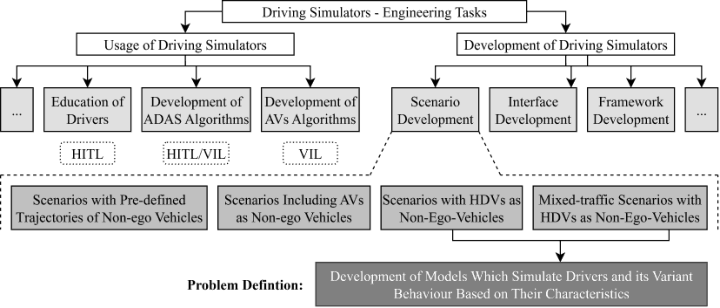
PROBLEM FORMULATION This section clarifies the problem definition underlying our work. According to Figure 1, there are multiple engineering tasks and use cases in the field of driving simulators. One distinction on the usage side of driving simulators can be made based on whether the driving simulator is used for educational purposes or during the development phase of advanced driver assistance systems (ADAS) and AV algorithms, as shown on the left side of Figure 1. ADAS systems often include the driver – at least in critical situations – as part of the overall vehicle system; thus, HITL simulators are used when the driver is part of the reaction chain. In contrast, developing pure AV algorithms does not require a driver; thus, the system under test is set up by the vehicle itself, a process called vehicle-in-the-loop (VIL) testing (Berg et al., 2015).
The development of simulators is another aspect that needs to be completed before usage, as the underlying requirements are based on the intended use. Figure 1 on the right shows some subpackages for this, including scenario development. These scenarios, which serve as input vectors during simulator usage, must be carefully chosen and may include vehicles controlled by humans, as well as other elements, such as bicycles. Our problem definition lies in developing these vehicles within the simulation to behave like human-controlled vehicles. The main requirements for this task are a) explainability of these driver models for safety reasons, b) classification possibilities for their integration and categorization in test cases, and c) generalization aspects to enable the simulation to show a wide, complex range of scenarios.
Figure 1: The problem definition and engineering tasks for driving simulators are divided into usage and development.
STATE-OF-THE-ART There are multiple simulation platforms in the field of ADAS and AVs. Our problem definition is the development of vehicles controlled by human-like drivers in a simulation. This will be achieved by training an AI with data for open datasets and specific driving data captured on a HITL and linking it with knowledge from psychological studies.
Consequently, this chapter introduces the state-of-the-art of psychological research on human driving behavior and technologies for dataset clustering.
Psychological Research on Human Driving Behavior Psychological models of driving behavior emphasize how personality, emotion, cognition, and mental health shape risk and safety (Gianfranchi et al., 2017). Conscientiousness and agreeableness reduce risky driving, while neuroticism and sensation seeking lead to unsafe and aggressive styles (Luo et al., 2023). Emotional states further affect performance: anger and anxiety impair attention and reaction, whereas positive moods have mixed effects (Luo et al., 2023; Öztürk et al., 2024). Models also account for emotional regulation, stress, and cognitive load, with dual-process theories showing that distraction and multitasking increase errors by disrupting controlled hazard responses (Engström, 2011; Wang et al., 2023).
Depression and anxiety are modeled alongside personality and emotion because they increase risk and influence how drivers perceive and manage space and time on the road (Babulal et al., 2024). According to the Driver Risk Field (DRF) theory (Kolekar et al., 2020), drivers act to keep perceived risk below a personal threshold. Dual-process and personality models integrate situational states (e.g., fatigue, mood) with stable traits to predict crashes and violations.
Assessments use tools such as the Driver Behavior Questionnaire (DBQ) (Reason et al., 1990) and the Driving Behavior Survey (DBS) (Clapp et al., 2011), as well as personality and emotion scales (Dula and Ballard, 2003). Other methods include simulator studies, eye tracking, and physiological measurements (Himmels et al., 2025). These methods support risk assessment, licensing, insurance models, and the development of tailored training programs and emotional regulation strategies.
In summary, psychological modelling of driving focuses on explanatory frameworks that use personality, emotion, cognitive load, and mental health to understand and predict driver behavior, with references grounded in validated questionnaires, experimental studies, and contemporary theoretical.
Clustering Mechanisms As autonomous technologies have become more prevalent, the modeling of human driver behavior has evolved from rule-based heuristics to data-driven machine learning paradigms. Advanced clustering algorithms, including k-means (Jin and Han, 2011), hierarchical approaches (Nielsen, 2016), Density-Based Spatial Clustering of Applications with Noise (DBSCAN)
A Conceptual Framework for AI-Based Explainable Driver Behavior in Human-in-the-Loop 867
(Ester et al., 1996), and Gaussian Mixture Models (GMMs), now identify latent driver styles and behavior profiles from large, multimodal datasets (e.g., trajectory, acceleration, control signals, and physiological indicators) (Maruthi and Bilas, 2022; Mobini Seraji et al., 2025; Tselentis and Papadimitriou, 2023; Zhang et al., 2021). These clusters make it possible to classify intricate human behaviors such as risk-taking, distraction, and fatigue but often lack in interpretability and human readability.
Thus, a key contemporary focus is explainability of clustering mechanisms. Classic machine learning models often act as black boxes, creating barriers to regulatory verification, user trust, and engineering integration. XAI tools, such as Local Interpretable Model-agnostic Explanations (LIME) and SHapley Additive exPlanations (SHAP), illuminate the decision boundaries and influential features within data clusters but not in the context of driving behavior. Hence, these tools can be used to bridge the gap between data-driven performance and human interpretability. This is especially important in safety-critical applications, where transparent classification (e.g., distinguishing aggressive from fatigued drivers) fosters confidence and certification.
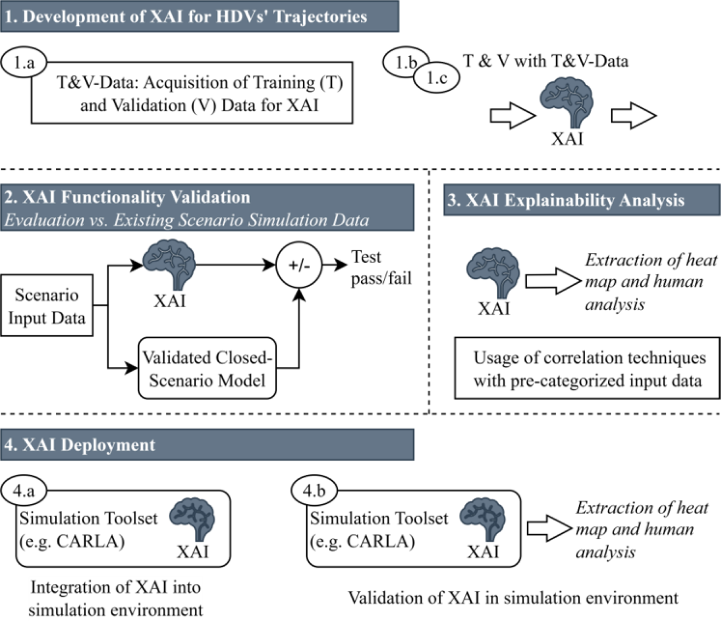
CONCEPTUAL FRAMEWORK Designing an effective and adaptable framework that emulates human driving behavior in HITL simulators requires the integration of multiple interdisciplinary elements spanning artificial intelligence, behavioral science, simulation technology, and automotive engineering. Our proposed conceptual framework focuses on providing a generic, scalable approach to creating interpretable and explainable models of driver behavior in mixed traffic, with the goal of improving training and validation of autonomous driving systems, as shown in Figure 2.
The process commences with Step 1 – the targeted acquisition of comprehensive data for both training and validation purposes (T&V-Data). The T&V-Data are curated to capture realistic driving behaviors and scenarios, ensuring a diverse and representative foundation for model learning. This data encapsulation includes vehicle kinematics, environmental context, and driver intentions, all tailored to train XAI models that predict HDV trajectories with high fidelity.
Once an initial XAI model has been trained, its functionality must be rigorously validated. The validation process (depicted in Step 2) is characterized by the evaluation of XAI outputs against existing scenario simulation data. Specifically, scenario input data are fed into the XAI model, which then produces predictions. These outputs are compared with those from a validated closed-scenario model. An essential aspect of this validation is the pass/fail assessment, determining whether the XAI system meets performance benchmarks set by existing validated models. Iterative feedback is incorporated by going back to Step 1, refining the XAI as necessary until it passes these validation tests.
A fundamental goal of XAI is to provide transparent and interpretable outputs. Step 3 of the process is dedicated to the analysis of the XAI
system’s explainability. One primary approach is the extraction of heat maps, visualizations that highlight regions or features most responsible for the model’s decisions. These heatmaps are then subjected to human analysis, allowing subject matter experts to interpret and confirm the model’s reasoning. Additionally, the methodology incorporates correlation techniques on pre-categorized input data, revealing relationships between input features and model outputs. This dual approach facilitates both quantitative and qualitative evaluations of the XAI’s interpretability, ensuring that its decision-making processes can be understood and trusted by human users.
Figure 2: Framework based on a HITL test bench to realistically model human driving behavior in simulation-based traffic scenarios. The aim is to use real driving data including information about semantical meaning from human drivers to learn their behavior and transfer it into AI-based models in order to subsequently use them in driving simulations for mixed traffic scenarios in a reproducible and interpretable manner.
The final stage involves deployment and continual validation of the XAI system within simulated environments. In Step 4.a, the XAI model is integrated into a simulation toolset, such as CARLA (Dosovitskiy et al., 2017), embedding it within realistic operational scenarios for application of different scenarios within AV testing. Step 4.b then focuses on the
A Conceptual Framework for AI-Based Explainable Driver Behavior in Human-in-the-Loop 869
systematic validation of the XAI within the simulation environment. Here, the XAI continues to generate heat maps which undergo human analysis, ensuring that explainability is maintained as the system encounters diverse and unforeseen scenarios. Furthermore, this information helps the users to identify and test critical scenarios where AVs and the XAI model interact together.
Across each stage, there is a strong emphasis on the feedback loop between validation and refinement. Each test result informs further development, with heat maps and human interpretability analyses guiding targeted improvements. This structured, iterative approach ensures that the resultant XAI system for HDV trajectory prediction is not only high-performing but also robustly explainable, laying the groundwork for trustworthy AI deployment in complex transportation domains.
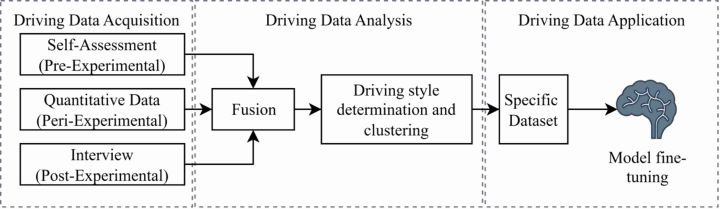
Data Acquisition in Driving Simulators A comprehensive methodology is necessary for studying human driving behavior under different conditions, as shown in Figure 3. This methodology involves conducting a human subject study using driving simulators to capture and analyze driving styles.
The study will use a mixed methods approach, integrating quantitative simulator data with self-report measures to provide a holistic view of driving style. The methodology is divided into several phases: pre-experimental self- assessments, experimental task design (including simulator training), data collection, and post-session evaluation. Participants are recruited to represent a diverse cross-section.
Figure 3: Step 1 (a, b and c) of our approach in detail including pre-, peri- and post- experimental data for model development.
A distinctive feature of our methodology is that the initial development of the driving model is carried out using large-scale open datasets (not shown in Figure). This foundational training equips the model with a broad, generalized ability to understand and replicate standard driving behavior across diverse scenarios. In subsequent steps, the model is fine-tuned with the specific datasets curated from the experimental process, thereby personalizing its performance to reflect individual or group-specific driving patterns.
Prior to the simulator session, participants complete the Multidimensional Driving Style Inventory (MDSI) (Taubman-Ben-Ari et al., 2004) or a similar validated instrument at home, which assesses individual tendencies such as aggressiveness, cautiousness, and anxiety while driving. Simulator training is critical to mitigate learning effects, familiarize participants with simulator controls, and reduce simulator sickness. Each participant takes a preliminary run in the simulator, usually on a straightforward or simplified route, to acclimate to the visual, auditory, and haptic feedback. The duration varies, but typically ranges from 10 to 30 minutes, depending on individual adaptation. After training, participants are surveyed on their comfort and understanding of the simulator interface and vehicle dynamics, and additional training is provided if necessary.
The main experimental session consists of driving tasks designed to produce naturalistic driving behavior. Scenarios include selected situations with varying traffic densities and environmental conditions such as night and rain. Environmental factors such as weather, lighting, and traffic behavior are manipulated to observe their influence on driving style. Each participant completes multiple runs, with conditions counterbalanced to minimize order effects. Runs are separated by short rest periods to reduce fatigue (unless some fatigue is desired) and simulator adaptation bias. Data collection includes objective measures such as vehicle dynamics (speed, acceleration, braking patterns, steering input, lane positioning, and following distance), which are continuously recorded by the simulator’s integrated measurement systems. Subjective measures include post-drive interviews where participants provide qualitative feedback on their experience, perceived realism, and any difficulties encountered. Objective driving metrics are later compared to self-reported driving style scores to examine predictive validity.
The fused dataset including pre-, peri- and post-experimental data undergoes in-depth analysis of the driving data. This is done by using clustering mechanisms together with XAI methods for clusters (as shown in the state-of-the-art chapter) in combination with semantic information from assessments and interviews. This ensures systematic capturing of inter-individual variability and enables downstream creation of specific datasets that reflect particular driver profiles or styles, supporting nuanced modeling efforts.
This methodology provides a robust framework for capturing and analyzing driving style in a simulator environment, combining objective behavioral data with subjective self-reports.
CONCLUSION
This paper presents a conceptual framework for AI-based explainable driver behavior modeling in Human-in-the-Loop simulators. By combining psychological insights, advanced clustering, and explainable AI techniques, the framework addresses the challenges of adaptability, generalization, and transparency in mixed-traffic scenarios. It leverages multi-source driving data to create interpretable and personalized driver models, improving the realism and safety of autonomous driving simulations.
The use of heatmaps and correlation analyses enhances trust and regulatory acceptance by making AI decisions understandable to human
A Conceptual Framework for AI-Based Explainable Driver Behavior in Human-in-the-Loop 871
experts. Integrating the models into simulation environments allows continuous validation and refinement, supporting robust, human-centric autonomous vehicle development.
ACKNOWLEDGMENT
This work was developed in the project KIIWI (reference number: 16DHBKI060) which is funded by the German Federal Ministry of Research, Technology and Space (BMFTR). Special thanks go to SiFaT Roadsafety GmbH for supporting the driving simulators at the Karlsruhe University of Applied Sciences.
REFERENCES
Babulal, G. M., Chen, L., Trani, J.-F., Brown, D. C., Carr, D. B., Ances, B. M., Lenze, E. J., DRIVES Project, 2024. Major Depressive Disorder and Driving Behavior Among Older Adults. JAMA Netw. Open 7, e2452038 https:// doi.org/10.1001/jamanetworkopen.2024.52038. Bagdatli, M. E. C., Dokuz, A. S., 2021. Modeling discretionary lane-changing decisions using an improved fuzzy cognitive map with association rule mining. Transp. Lett. 13, 623–633. https://doi.org/10.1080/19427867.2021.1919469 Berg, G., Nitsch, V., Färber, B., 2015. Vehicle in the Loop, in: Handbook of
Driver Assistance Systems. Springer, Cham, pp. 1–9. https://doi.org/10.1007/ 978–3-319–09840-1_10–1 Bing, Z., Meschede, C., Huang, K., Chen, G., Rohrbein, F., Akl, M., Knoll, A.,
2018. End to End Learning of Spiking Neural Network Based on R-STDP for a Lane Keeping Vehicle, in: 2018 IEEE International Conference on Robotics and Automation (ICRA). Presented at the 2018 IEEE International Conference on Robotics and Automation (ICRA), IEEE, Brisbane, QLD, pp. 4725–4732. https:// doi.org/10.1109/ICRA.2018.8460482 Cannone, M., 2020. Explainable AI for Clustering Algorithms (laurea). Politecnico di Torino. Chu, K.-F., Fan, C., Iida, F., 2024. Navigating Mixed Traffic: Current State and
Future Challenges in Integrating Autonomous and Human-Driven Vehicles, in: 2024 IEEE International Conference on Advanced Robotics and Its Social Impacts (ARSO). Presented at the 2024 IEEE International Conference on Advanced Robotics and Its Social Impacts (ARSO), pp. 241–246. https://doi.org/10.1109/ ARSO60199.2024.10557825 Clapp, J. D., Olsen, S. A., Beck, J. G., Palyo, S. A., Grant, D. M., Gudmundsdottir, B., Marques, L., 2011. The Driving Behavior Survey: Scale construction and validation. J. Anxiety Disord. 25, 96–105. https://doi.org/ 10.1016/j.janxdis.2010.08.008 Dosovitskiy, A., Ros, G., Codevilla, F., Lopez, A., Koltun, V., 2017. CARLA: An Open Urban Driving Simulator, in: Levine, S., Vanhoucke, V., Goldberg, K. (Eds.), Proceedings of the 1st Annual Conference on Robot Learning, Proceedings of Machine Learning Research. PMLR, pp. 1–16. Driggs-Campbell, K., Bellegarda, G., Shia, V., Sastry, S. S., Bajcsy, R., 2014.
Experimental Design for Human-in-the-Loop Driving Simulations. https:// doi.org/10.48550/arXiv.1401.5039
Dula, C. S., Ballard, M. E., 2003. Development and Evaluation of a Measure of Dangerous, Aggressive, Negative Emotional, and Risky Driving1. J. Appl. Soc. Psychol. 33, 263–282. https://doi.org/10.1111/j.1559–1816.2003.tb01896.x Engström, J. A. S., 2011. Understanding attention selection in driving: From limited
capacity to adaptive behaviour. Chalmers University of Technology. Ester, M., Kriegel, H.-P., Sander, J., Xu, X., 1996. A density-based algorithm for discovering clusters in large spatial databases with noise, in: Proceedings of the Second International Conference on Knowledge Discovery and Data Mining, KDD’96. AAAI Press, Portland, Oregon, pp. 226–231. Gianfranchi, E., Tagliabue, M., Spoto, A., Vidotto, G., 2017. Sensation Seeking,
Non-contextual Decision Making, and Driving Abilities As Measured through a Moped Simulator. Front. Psychol. 8. https://doi.org/10.3389/fpsyg.2017.02126 Gu, Y., Hashimoto, Y., Hsu, L.-T., Iryo-Asano, M., Kamijo, S., 2017. Human-like motion planning model for driving in signalized intersections. IATSS Res. 41, 129–139. https://doi.org/10.1016/j.iatssr.2016.11.002 He, Y., Xiang, D., Wang, D., 2025. Traffic safety evaluation of emerging mixed traffic
flow at freeway merging area considering driving behavior. Sci. Rep. 15, 10686. https://doi.org/10.1038/s41598–025-94658-y Himmels, C., Buchner, C., Schmitz, J., Parduzi, A., Riener, A., 2025. Validity of Driver Assistance Systems in Driving Simulators: A Comparative Study of Real-World Driving and Two Simulator Environments. Int. J. Human–Computer Interact. 1–18. https://doi.org/10.1080/10447318.2025.2495120 Jin, X., Han, J., 2011. K-Means Clustering, in: Sammut, C., Webb, G. I. (Eds.),
Encyclopedia of Machine Learning. Springer US, Boston, MA, pp. 563–564. https://doi.org/10.1007/978–0-387–30164-8_425 Kolekar, S., de Winter, J., Abbink, D., 2020. Human-like driving behaviour emerges from a risk-based driver model. Nat. Commun. 11, 4850. https://doi.org/10.1038/ s41467–020-18353–4 Lüken-Winkels, D.-I. J. M. S., Benedikt, 2024. Driving simulator for automotive
development & testing. Fraunhofer IESE. URL https://www.iese.fraunhofer.de/ blog/driving-simulator-virtual-testing/ (accessed 8.18.25). Luo, X., Ge, Y., Qu, W., 2023. The association between the Big Five personality traits and driving behaviors: A systematic review and meta-analysis. Accid. Anal. Prev. 183, 106968. https://doi.org/10.1016/j.aap.2023.106968 Maruthi, P. B., Bilas, P., 2022. Comparative Analysis of K-means and Hierarchical
Clustering in Bigdata Environment, in: 2022 6th International Conference on Computation System and Information Technology for Sustainable Solutions (CSITSS). Presented at the 2022 6th International Conference on Computation System and Information Technology for Sustainable Solutions (CSITSS), IEEE, Bangalore, India, pp. 1–6. https://doi.org/10.1109/CSITSS57437.2022.10026370 Meteier, Q., Capallera, M., de Salis, E., Angelini, L., Carrino, S., Widmer, M., Abou Khaled, O., Mugellini, E., Sonderegger, A., 2023. A dataset on the physiological state and behavior of drivers in conditionally automated driving. Data Brief 47, 109027. https://doi.org/10.1016/j.dib.2023.109027 Mobini Seraji, M. H., Shaffiee Haghshenas, Sami, Shaffiee Haghshenas, Sina,
Simic, V., Pamucar, D., Guido, G., Astarita, V., 2025. A state-of-the-art review on machine learning techniques for driving behavior analysis: Clustering and classification approaches. Complex Intell. Syst. 11, 386. https://doi.org/10.1007/ s40747–025-01988–5
A Conceptual Framework for AI-Based Explainable Driver Behavior in Human-in-the-Loop 873
Nielsen, F., 2016. Hierarchical Clustering, in: Introduction to HPC with MPI for Data Science, Undergraduate Topics in Computer Science. Springer International Publishing, Cham, pp. 195–211. https://doi.org/10.1007/978–3-319–21903-5_8. Öztürk, ˙I., Varankaya, M., Öz, B., 2024. Investigating the Relationship Between
Mood and Driver Behaviors. Eur. J. Psychol. Open. Park, J., Zahabi, M., 2024. A Review of Human Performance Models for Prediction of Driver Behavior and Interactions With In-Vehicle Technology. Hum. Factors J. Hum. Factors Ergon. Soc. 66, 1249–1275. https://doi.org/10.1177/ 00187208221132740 Reason, J., Manstead, A., Stradling, S., Baxter, J., Campbell, K., 1990. Errors and
violations on the roads: a real distinction? Ergonomics 33, 1315–1332. https:// doi.org/10.1080/00140139008925335 Taubman-Ben-Ari, O., Mikulincer, M., Gillath, O., 2004. The multidimensional driving style inventory—scale construct and validation. Accid. Anal. Prev. 36, 323–332. https://doi.org/10.1016/S0001–4575(03)00010–1 Tselentis, D. I., Papadimitriou, E., 2023. Machine learning approaches exploring the
optimal number of driver profiles based on naturalistic driving data. Transp. Res. Interdiscip. Perspect. 21, 100900. https://doi.org/10.1016/j.trip.2023.100900 Ulbrich, S., Menzel, T., Reschka, A., Schuldt, F., Maurer, M., 2015. Defining and Substantiating the Terms Scene, Situation, and Scenario for Automated Driving, in: 2015 IEEE 18th International Conference on Intelligent Transportation Systems. Presented at the 2015 IEEE 18th International Conference on Intelligent Transportation Systems - (ITSC 2015), IEEE, Gran Canaria, Spain, pp. 982–988. https://doi.org/10.1109/ITSC.2015.164 Wang, Q., Zhu, F., Dang, R., Wei, X., Han, G., Huang, J., Hu, B., 2023. An
eye tracking investigation of attention mechanism in driving behavior under emotional issues and cognitive load. Sci. Rep. 13, 16963. https://doi.org/10.1038/ s41598–023-43693–8 Witt, M., Kompaß, K., Wang, L., Kates, R., Mai, M., Prokop, G., 2019. Driver profiling – Data-based identification of driver behavior dimensions and affecting driver characteristics for multi-agent traffic simulation. Transp. Res. Part F Traffic Psychol. Behav. 64, 361–376. https://doi.org/10.1016/j.trf.2019.05.007 Xu, D., Ding, Z., He, X., Zhao, H., Moze, M., Aioun, F., Guillemard, F., 2021.
Learning From Naturalistic Driving Data for Human-Like Autonomous Highway Driving. IEEE Trans. Intell. Transp. Syst. 22, 7341–7354. https://doi.org/10.1109/ TITS.2020.3001131 Zhang, Y., Jin, W., Xiong, Z., Li, Z., Liu, Y., Peng, X., 2021. Demystifying Interactions Between Driving Behaviors and Styles Through Self-clustering Algorithms, in: Krömker, H. (Ed.), HCI in Mobility, Transport, and Automotive Systems. Springer International Publishing, Cham, pp. 335–350. https://doi.org/ 10.1007/978–3-030–78358-7_23
LISTED IN THE AHFE DIGITAL BOOKSTORE CATALOGUE
Explore the complete digital volume
Human Factors in Design, Engineering, and Computing
Read this individual research paper free through the original publisher, or explore the full digital proceedings book.
ISBN 978-1-964867-75-5
Explore this ISBN in the AHFE Bookstore ↗Listed in the July 2026 bookstore catalogue; search by ISBN to confirm current availability · Digital book purchase optional