Hisayuki Kunigita (2025). Analysis of the relationship between interactions by live streamers and viewers and pay-what-you-want donation behavior using LLM. In: Human Factors in Design, Engineering, and Computing. AHFE Open Access, vol. 199, pp. 575–581. https://doi.org/10.54941/ahfe1006869
Since the COVID-19 pandemic, people's activities in the virtual world have continued to expand year by year. At the same time, the number of virtual world service recipients who donate money to service providers as a form of support has also continued to grow. For example, the behavior of viewers donating money to live streamers on social live streaming services is expanding year by year on global services such as Twitch and YouTube in the form of social tipping, redeemable digital gifts, and subscription gifting (e.g., TwitchTracker.com, 2025).Since there is no upper limit on the amount of money that service recipients can give to service providers as support, and they can do so repeatedly, this can be considered a Pay-What-You-Want (PWYW) donation. PWYW donation is done through the chat window on social live streaming services. Therefore, PWYW donation is made as a post in the chat window while voice conversations, chats, and emoji interactions are taking place between the live streamer and viewers.With regard to prior research focusing on voice conversations, chats, and emoji interactions between live streamers and viewers, no analysis related to viewers' behavior of “donating money” to live streamers has been found to the best of my knowledge. For example, Reckenwald analyzed conversations and chats between live streamers and viewers to determine what kind of interactions were taking place and what conversational skills were necessary for live streamers, but did not analyze them in relation to the behavior of “donating money” (Reckenwald, 2018).Therefore, by analyzing data from voice conversations, chats, and emoji interactions between viewers and live streamers regarding PWYW donation behavior, and clarifying how these interactions lead to the behavior of “giving money,” it is considered that we can gain many implications, e.g., for marketing plans or new service designs that contribute to promoting PWYW donation behavior among viewers and enhancing the value of services provided by live streamers.In this study, the author proposes a method of analysis using LLM (Large Language Model) to analyze complex interaction data between live streamers and viewers through multiple means, such as voice conversations, chats, and emojis. In recent years, LLM has become capable of summarizing multiple sources of video, audio, and text. This study uses LLM to summarize the voice conversations, chats, and emoji interactions between the two parties, which have not been done before, and attempts to clarify how these interactions lead to PWYW donation behavior, i.e., the behavior of donating money.This study uses Twitch as a case study and focuses on social tipping and subscription gifting as PWYW donation. Using LLM, the study summarizes actual voice conversations, chats, and emoji interactions between live streamers and viewers, analyzes them, and clarifies how these interactions lead to PWYW donation behavior.ReferencesTwitchTraker.com. 2025. “TWITCH SUBS COUNT & STATS”, TwitchTraker.com.URL: https://twitchtracker.com/subscribersReckenwald, Daniel. 2018. “The Discourse of Online Live Streaming on Twitch: Communication between Conversation and Commentary”, Doctoral dissertation, Hong Kong Polytechnic University, Hong Kong Special Administrative Region.
Since the COVID-19 pandemic, activities in virtual worlds have continued to expand each year. Simultaneously, the number of virtual-world service users who donate money to service providers as a form of support has also increased. For example, the behavior of viewers donating money to streamers on social live-streaming services such as Twitch and YouTube has grown worldwide in the form of social tipping, redeemable digital gifts, and subscription gifting (TwitchTracker, 2025).
Because there is no upper limit on the amount of money that service users can give to service providers as support, and they can do so repeatedly, this can be considered a Pay-What-You-Want (PWYW) donation. PWYW donations are made through chat windows on social live-streaming services. In these cases, a PWYW donation appears as a post in the chat window, while voice conversations, text chats, and emoji interactions simultaneously occur between the live streamer and viewers. These PWYW donation behaviors occur through complex interactions involving voice, text, emojis, and other images between live streamers and viewers, which makes them challenging to analyze. However, in recent years, Large Language Models (LLMs) have become increasingly capable of summarizing information from multiple
sources, such as voice, text, and images, and incorporating LLMs as an analytical method has proven to be a practical approach.
The author aims to gradually adopt and utilize voice, text, emoji, and other image data generated by streamers and viewers to analyze PWYW donation behavior using an LLM. This study proposes a method for analyzing PWYW donation behavior between both parties by combining streamer voice data and PWYW donation post data from viewers’ chat logs with a time-series bubble chart and LLM analysis. The author then used Twitch as a case study, adopting subscription gifting as an indicator of PWYW donation behavior, in which viewers send money to live streamers as a form of support, to verify the effectiveness of the analysis method proposed in this study.
THEORETICAL BACKGROUND Previous studies on PWYW donation behavior have analyzed viewers’ engagement with streamers through qualitative approaches such as surveys. For example, Hilvert-Bruce et al. found that social interaction and a sense of community are significant motivators for becoming subscribers and making donations, based on the Uses and Gratifications Theory (Zorah et al., 2018). However, these studies did not focus on analyzing the direct interactions between live streamers and viewers, including voice conversations, text chats, and emojis.
Previous studies have also analyzed the interactions between live streamers and viewers using discourse analysis and LLM-based approaches. For example, Reckenwald conducted a discourse analysis of interactions between live streamers and viewers for approximately two hours each across six streams, largely by hand (Daniel, 2017). Reckenwald observed not only the voices but also the body movements of live streamers, the text chats of viewers, and even live-streamed game events themselves. This approach allowed him to identify the types of conversations that occurred and the conversational skills required of live streamers. Additionally, in an LLM- based analysis of viewers’ text and emoji chats, a prior study by Hämäläinen et al. clustered chat messages from three streams using an LLM to classify the types of viewers posting them (Mika et al., 2024). However, these studies did not include analyses related to PWYW donation behavior.
This study differs from previous studies by focusing on the interactions related to PWYW donation behavior between live streamers and viewers.
METHOD
TwitchTracker.com, a ranking site based on Twitch streamers’ current active subscriber counts, continuously updates each streamer’s active subscriber and active gifted subscription numbers daily. An active gifted subscription refers to the number of subscription gifts sent by viewers within a month, which serves as an indicator of PWYW donations in this study. This study first focuses on the following streamers to validate a method for analyzing the complex interactions between streamers and viewers related to PWYW donation behavior using time-series bubble charts and an LLM.
Analysis of the Relationship Between Interactions 577
1. English-language streamer 2. Streamer with the highest ratio of active gifted subscriptions to current active subscribers among the top ten streamers Selecting an English-language streamer enhances the LLM’s comprehension accuracy. Choosing from the top 10 streamers by subscriber count is reasonable because streamers with large subscriber bases are likely to have a correspondingly high number of active gifted subscriptions. Additionally, the streamer with the highest ratio of active gifted subscriptions is selected because this makes gifting behavior more clearly observable.
As of July 20, 2025, when data collection for this study began, the streamer who met the above conditions was designated as Streamer A, whose profile is shown below: Streamer A:
- Language: English - Ratio of active gifted subscription to current active subscribers: 89.2% - Top three livestream genres by total hours:
1. Just Chatting 2. IRL (In Real Life) 3. Variety Trends in live-streaming length: Streams ranged from several tens of minutes to over 20 hours, with most lasting approximately two to four hours.
The analysis method was validated as follows. 1) From Streamer A’s archived videos on Twitch.tv (Twitch, 2025), one approximately four-hour video and one approximately two-hour video from the Just Chatting genre were randomly selected. The Just Chatting genre was chosen because it represents the category with Streamer A’s longest live streaming duration. The approximately four-hour video was designated as Video A, and the two-hour video was designated as Video B. An overview of each video is provided below.
Video A -Month livestreamed: September 2025 -Livestream genre: Just Chatting -Duration: 4 hours, 4 minutes, and 34 seconds (4:04:34) Video B: -Month livestreamed: August 2025 -Livestream genre: Just Chatting -Duration: 2 hours, 31 minutes, and 12 seconds (2:31:12)
2) The following data were extracted from each video to create a bubble chart showing the timing and number of subscription gifting events that occurred during each livestream.
a) Used TwitchDownloader (lay295, 2025) to extract chat data, including subscription gifting posts.
578 Kunigita
b) Extracted concurrent viewer count data for the above subscription gifting posts from the selected archived video on TwitchTracker.com.
c) Created a bubble chart with livestream time on the horizontal axis, concurrent viewer count on the vertical axis, and bubble diameter proportional to the number of gifting posts submitted by viewers at one time.
d) Examined the characteristics of the resulting bubble chart.
3) To validate the effectiveness of the analysis method, this study used an LLM to analyze the voice data from Streamer A’s shorter archived video, Video B. The voice data were converted into text using the transcription feature in Microsoft Teams. The resulting text data were then summarized by the LLM and compared with the characteristics of the bubble chart for verification. The LLM used for this analysis was Gemini 2.5 Flash.
FINDINGS
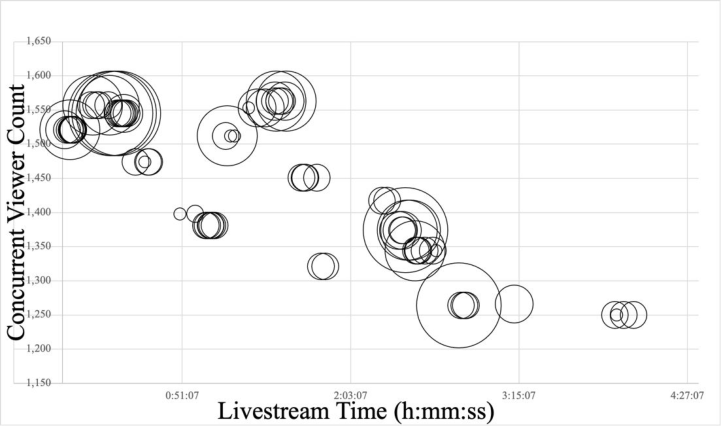
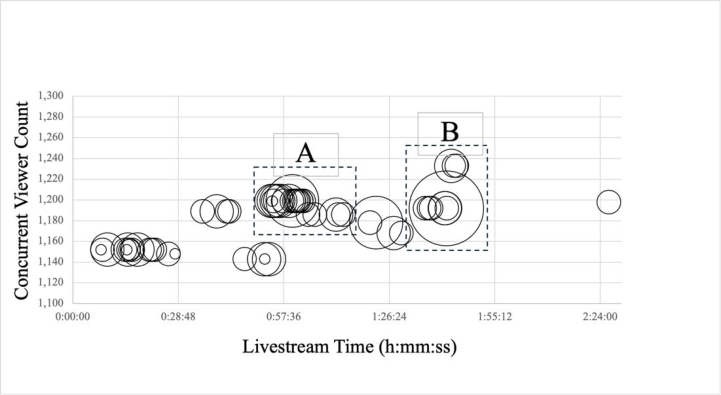
1. Characteristics of the Subscription Gifts Bubble Chart The bubble charts for Videos A and B are shown in Figures 1 and 2, respectively. As mentioned earlier, the horizontal axis represents the livestream time, the vertical axis shows the number of concurrent viewers, and the bubble diameter is proportional to the number of subscription gifts sent by viewers at one time. The minimum number of subscription gifts was one, and the maximum was 50.
Figure 1: Streamer A’s video A time-series subscription gifts bubble chart.
In both charts, the smallest bubble represents one gift, while bubbles increase proportionally in size for 5, 10, and 25 gifts, and the largest bubble represents 50 gifts. On Twitch, one subscription gift was priced at US$5 for Tier 1. Although Tiers 2 and 3 exist, subscription gifting typically occurs at Tier 1. In Streamer A’s community, viewers sometimes made PWYW donations as high as US$250.
Analysis of the Relationship Between Interactions 579
Figure 2: Streamer A’s video B time-series subscription gifts bubble chart.
The bubble charts in Figures 1 and 2 show that once subscription gifting begins, it tends to occur consecutively, with some viewers sending 25 to 50 subscription gifts at one time. This suggests that certain interactions with the streamer may have triggered the PWYW donations. For a period, these donations occurred consecutively, with some viewers making multiple PWYW donations simultaneously. This pattern of PWYW donation behavior was repeated several times during the livestream.
2. Matching PWYW Donation Posts with Streamer Voice Data First, summarizing the overall flow of Video B chronologically using the LLM produced the following results. However, this alone did not reveal where the PWYW donations occurred.
B1: Specific topics and calls to viewers B2: Streamer’s personal events and livestream anniversary B3: Streamer’s TikTok success and livestream anniversary B4: Product purchases on the website and calls to viewers B5: Calls to viewers and message confirmations B6: Streamer’s personal topics and hopes for the future Therefore, focusing on the bubble chart in Figure 2, PWYW donations occurred continuously in both Sections A and B, with a large number of subscription gifts made simultaneously, either 25 or 50 at a time. Section A lasted for approximately 19 minutes, from around 54 minutes into the live stream to 1 hour and 13 minutes, while Section B was concentrated within just 3 minutes, from about 1 hour and 41 minutes to 1 hour and 44 minutes into the live stream. A further summarization of these time transcripts using the LLM produced the following results:
Section A: The streamer mentioned gifts from relatives, and the viewers’ chats became lively.
580 Kunigita
Section B: Interactions occurred regarding the streamer’s streaming anniversary.
From this, it can be inferred that when something pleasant happens to the streamer, or when something pleasant is mentioned, PWYW donations occur consecutively, with many subscription gifts—25 or 50 at a time— taking place. By cross-referencing the bubble chart of PWYW donation posts with the streamer’s LLM-generated voice summaries, this pattern provides valuable clues to the motivation behind PWYW donations.
DISCUSSION
The analysis method proposed in this study revealed the following:
1) Bubble charts enable the visualization of viewer donation behavior over time. This allows for clearer identification of specific moments when interactions between streamers and viewers directly lead to PWYW donation behavior.
2) By summarizing the streamer’s voice data from Sections A and B of the bubble chart in Figure 2, where continuous and numerous PWYW donations occurred, using an LLM, the results showed that PWYW donations tend to occur when something pleasant happens to the streamer or when something pleasant is mentioned. This finding supports the idea that social interaction and a sense of community promote donations, as noted by Hilvert-Brue et al., based on the Uses and Gratifications Theory. In other words, viewers understand through social interaction when something pleasant happens to the streamer or when pleasant things are mentioned, and this sense of community—the desire to belong to that community—is what drives PWYW donation behavior.
Based on the above, this study confirms the effectiveness of using bubble charts and LLMs as an analytical method for examining the complex interactions between viewers and streamers when viewers send money to streamers as support for livestreaming services.
CONCLUSION
This study proposed and verified an analytical method that uses bubble charts and LLMs to analyze the complex interactions between viewers and streamers when viewers send money to a streamer as support during livestreaming, thereby confirming the method’s effectiveness. However, because the case study and verification were based on data from only one streamer, within a single genre and a single livestream, the author plans to continue the research by expanding the dataset for verification and exploring the growing applications of LLM technology, which continues to improve daily.
REFERENCES
Daniel, R., 2017. Toward a transcription and analysis of live streaming on Twitch, Journal of Pragmatics. lay295, 2025. TwitchDownloader. [Online] Available at: https://github.com/lay295/
TwitchDownloader [Accessed September 17 2025].
Analysis of the Relationship Between Interactions 581
Mika, H., Rueter, J. & Alnajjar, K., 2024. Analyzing Pokémon and Mario Streamers’ Twitch Chat with LLM-based User Embeddings, Proceedings of the 4th International Conference on Natural Language Processing for Digital Humanities. Twitch, 2025. Twitch.tv. [Online] Available at: https://www.twitch.tv [Accessed
September 26 2025]. TwitchTracker, 2025. TwitchTracker. [Online] Available at: https://twitchtracker.com [Accessed September 26 2025]. Zorah, H.-B., Neill, J. T., Sjöblom, M. & Hamari, J. J., 2018. Social motivations of
live-streaming viewer engagement on Twitch, Computers in Human Behavior.
LISTED IN THE AHFE DIGITAL BOOKSTORE CATALOGUE
Explore the complete digital volume
Human Factors in Design, Engineering, and Computing
Read this individual research paper free through the original publisher, or explore the full digital proceedings book.
ISBN 978-1-964867-75-5
Explore this ISBN in the AHFE Bookstore ↗Listed in the July 2026 bookstore catalogue; search by ISBN to confirm current availability · Digital book purchase optional