Yasushi Takenaga (2025). Beyond Population Decline: A Dual Tracking Framework of Smartphone GPS and Resident Registry for Disaster Recovery in Coastal Japan. In: Human Factors in Design, Engineering, and Computing. AHFE Open Access, vol. 199, pp. 329–335. https://doi.org/10.54941/ahfe1006845
This study examines post-disaster population dynamics in Wajima City, Ishikawa Prefecture, following the 2024 Noto Peninsula Earthquake. By comparing smartphone-based GPS mobility data and resident migration data from the Basic Resident Registry, we identify a divergence between visitor inflow and sustained resident outflow. A dual tracking approach is introduced, visualizing both trends and their interaction using system thinking and causal loop diagrams (CLDs). Our analysis reveals structural gaps between surface-level recovery and long-term demographic decline. This framework offers a transferable methodology for assessing disaster recovery in coastal regions worldwide.
Natural disasters affect not only physical infrastructure but also human mobility and settlement patterns. Understanding these changes is crucial for formulating effective recovery strategies. However, traditional indicators such as static demographic data and infrastructure restoration rates often fall short in capturing the temporal and spatial realities of human behaviour after disasters.
In recent years, human mobility data obtained from smartphone GPS location information has gained attention as a means of visualizing population movement during crises. These data can provide near-real-time insights into where and how people move and are useful for understanding short-term recovery patterns in tourism, logistics, and relief operations.
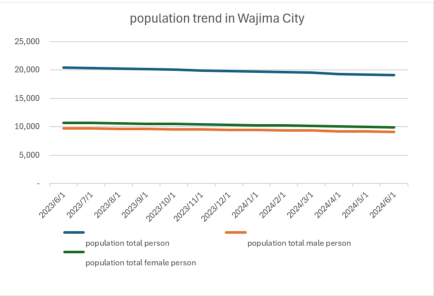
This study focuses on Wajima City, which suffered extensive damage in the 2024 Noto Peninsula Earthquake. GPS-based mobility data indicate that visitor numbers recovered to a certain level shortly after the disaster, likely due to the influx of volunteers and the organization of recovery- related events. In contrast, data from the Basic Resident Registry show a continued outflow of residents and a clear trend of population decline since the earthquake.
This divergence between smartphone-based human mobility and the residential movement captured by official records highlights a critical gap. This study aims to clarify the cause of this discrepancy between “apparent recovery” and “structural outflow” through a cohort analysis of smartphone GPS data. By comparing monthly trends in both GPS and registry data and modelling the structural dynamics using causal loop diagrams (CLDs), the study proposes a model that reveals not only the rebound in activity levels but also long-term shifts in settlement patterns.
RELATED WORK
In the field of disaster recovery research, the importance of quantifying population movement has been increasingly emphasized. Especially, GPS data obtained through smartphones and mobile apps enable high-frequency and high-resolution monitoring of human flows in specific regions and have been used in diverse topics such as tourism behaviours, transportation demand, and evacuation (Tanaka & Sato, 2021; Nakayama, 2020).
However, such mobility data represent the “presence of people who stopped by the area” and do not necessarily reflect permanent residents. Multiple attributes such as temporary workers, tourists, volunteers, and pass- through traffic coexist, making it difficult to distinguish between surface-level vibrancy and actual community repopulation.
In contrast, the Basic Resident Registry tracks residential registrations and provides data on people who have chosen to live in the area. Particularly, the monthly migration reports published by the Ministry of Internal Affairs enable time-series tracking of in-migration and out-migration at the municipality level.
Traditional disaster studies have often focused on shelter congestion or infrastructure damage. Real-time observation frameworks for human movement and demographic structure were limited. Recently, new analytical methods combining big data and administrative statistics have emerged. For example, Tanaka (2022) examined urban-to-urban movement during the COVID-19 pandemic by integrating mobile data and official statistics, showing possibilities for understanding dynamics across normal and emergency periods.
Building on such prior knowledge, this study focuses on the gap between apparent visitor recovery and actual residential decline and explores the causal structure behind this divergence using causal loop diagrams (CLDs).
METHODOLOGY
This study analyses monthly trends from October 2023 to June 2024 in Wajima City using two data sources: Anonymized smartphone GPS data from Adinte Co., Ltd. Monthly residential migration data from the Ministry of Internal Affairs and Communications
The GPS data classify users into cohorts based on visit duration and origin (local vs. non-local). Registry data provide net migration trends and can be used to analysed structural population changes.
Beyond Population Decline: A Dual Tracking Framework of Smartphone GPS 331
We create causal loop diagrams (CLDs) based on system thinking to model feedback relationships between visitor inflows, local economic activity, residential dissatisfaction, and outmigration. These diagrams are used not for quantitative validation, but to visualize the structural characteristics of recovery dynamics.
RESULTS
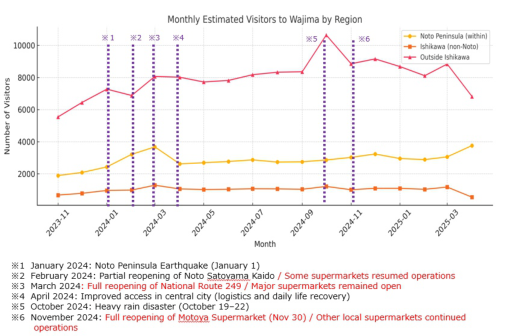
The GPS data show that visitor numbers nearly returned to pre- earthquake levels by March 2024, reflecting the impact of temporary events and support activity. However, the Basic Resident Registry shows a persistent net outflow exceeding 1,000 people over six months.
Figure 1 illustrates this contrast: while mobility appears to recover, the local residential base continues to shrink. This highlights the need for dual indicators in assessing recovery.
Figure 1: Monthly estimated visitors.Figure 2: Population trend (e-Stat Portal (Statistics Bureau of Japan) 2025).
332 Takenaga
DISCUSSION
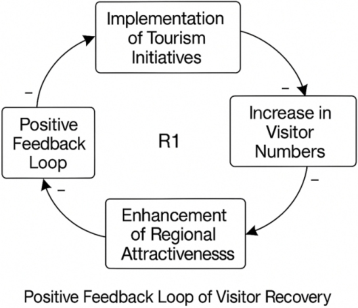
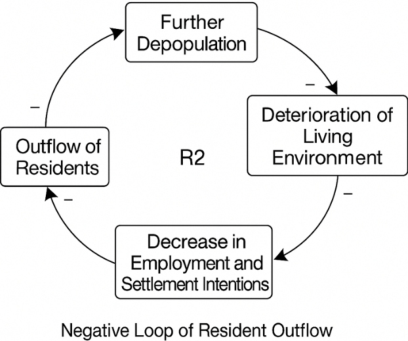
The mismatch between surface activity and structural demographic change presents a critical policy challenge. We identified two major loops using CLDs (see Figures 3, 4):
Figure 3: Positive loop.Figure 4: Negative loop.
A reinforcing loop: external visitor inflow → economic activation →improved attractiveness →more visitors A balancing loop: disaster damage → resident dissatisfaction →outmigration →weakened community functions
These diagrams are not intended to provide quantitatively verified causal relationships but to visualize the structural dynamics of disaster recovery.
Rethinking Recovery Metrics: Policy Implications The findings of this study urge policymakers and disaster recovery planners to critically reassess the indicators they rely on when evaluating post-disaster recovery. While the resurgence in visitor numbers may suggest surface-level
Beyond Population Decline: A Dual Tracking Framework of Smartphone GPS 333
revitalization, our dual-tracking analysis reveals a deeper structural issue: the continued outflow of residents.
Visitor-based metrics, such as those derived from smartphone GPS data, offer real-time visibility into temporary economic and social activity. However, these must be complemented with registry-based data to capture the permanence and sustainability of repopulation. An exclusive focus on short-term vibrancy risks overlooking long-term demographic decline.
We advocate for a shift in policy focus—from promoting immediate footfall to fostering sustainable settlement. Local governments should direct recovery resources not only toward events and tourism but also toward housing The findings of this study underscore the importance of distinguishing between temporary vitality and structural sustainability in post-disaster contexts. While smartphone GPS data revealed a rapid rebound in visitor mobility, Basic Resident Register data demonstrated a persistent population outflow. This divergence indicates that recovery policies focusing solely on mobility-based indicators—such as tourist arrivals or event participation— risk overestimating community resilience.
From an academic perspective, the proposed dual-tracking framework contributes to disaster studies by integrating big-data mobility analytics with official demographic statistics, thereby bridging the gap between short-term behavioral responses and long-term settlement patterns. The use of causal loop diagrams further provides a conceptual lens to capture the nonlinear feedback dynamics that shape recovery trajectories.
Practically, the results highlight that sustainable recovery requires more than economic revitalization driven by external visitors. Ensuring the restoration of core services such as housing, healthcare, and education is essential to halting the resident outflow loop. The framework also offers policymakers a diagnostic tool to identify when apparent recovery may conceal deeper structural decline.
Beyond Japan, this approach holds potential for application in disaster- prone coastal regions worldwide, including Southeast Asia and the Pacific. Comparative studies may enable the development of standardized evaluation metrics, fostering international collaboration in disaster risk reduction and recovery planning.
Broader Implications and Contributions At its core, this study is the first to empirically demonstrate the structural divergence between apparent mobility-based recovery and persistent residential decline in the context of post-disaster recovery.
The findings of this study underscore the importance of distinguishing between temporary vitality and structural sustainability in post-disaster contexts. While smartphone GPS data revealed a rapid rebound in visitor mobility, Basic Resident Register data demonstrated a persistent population outflow. This divergence indicates that recovery policies focusing solely on mobility-based indicators—such as tourist arrivals or event participation— risk overestimating community resilience.
334 Takenaga
From an academic perspective, the proposed dual-tracking framework contributes to disaster studies by integrating big-data mobility analytics with official demographic statistics, thereby bridging the gap between short-term behavioral responses and long-term settlement patterns. The use of causal loop diagrams further provides a conceptual lens to capture the nonlinear feedback dynamics that shape recovery trajectories.
Practically, the results highlight that sustainable recovery requires more than economic revitalization driven by external visitors. Ensuring the restoration of core services such as housing, healthcare, and education is essential to halting the resident outflow loop. The framework also offers policymakers a diagnostic tool to identify when apparent recovery may conceal deeper structural decline.
Beyond Japan, this approach holds potential for application in disaster- prone coastal regions worldwide, including Southeast Asia and the Pacific. Comparative studies may enable the development of standardized evaluation metrics, fostering international collaboration in disaster risk reduction and recovery planning.
Limitations and Future Directions While this study demonstrates the structural divergence between apparent recovery and long-term demographic decline, several limitations should be acknowledged. First, the analysis relied on aggregated smartphone GPS data and resident registry statistics, which limited the granularity of individual- level behavioural interpretation. Second, the causal loop diagrams (CLDs) employed in this study are conceptual in nature and not yet quantitatively validated. Third, the analysis focused on a single case—Wajima City—so caution is needed in generalizing the findings to other contexts.
Future research could address these limitations by incorporating additional data sources, such as surveys, interviews, or economic statistics, to provide a richer picture of recovery dynamics. Quantitative system dynamics modelling may further enhance the explanatory power of CLDs. Comparative studies across multiple disaster-affected regions will also help to identify common structural patterns and region-specific variations. By extending this dual- tracking framework, future work can contribute to developing standardized global indicators for disaster recovery.
CONCLUSION
This study presents a novel framework for post-disaster population analysis by integrating smartphone-based GPS mobility data and official residential migration statistics. In Wajima City, the 2024 earthquake resulted in contrasting patterns—short-term visitor recovery and long-term population outflow.
ACKNOWLEDGMENT
The author would like to thank Adinte Co., Ltd. for providing anonymized smartphone GPS data used in this study. The author also acknowledges the
Beyond Population Decline: A Dual Tracking Framework of Smartphone GPS 335
Japan Advanced Institute of Science and Technology (JAIST) for supporting this research.
REFERENCES
Adinte Inc. (n.d.). AIBeacon Console. Retrieved from https://console.aibeacon.jp/bi/ Login. Adinte Co., Ltd. (2024). Smartphone GPS Panel Data Guide. Asahi Shimbun (2024). “Partial Reopening of Wajima Morning Market Sparks
Hope.” March 10. e-Stat Portal (Statistics Bureau of Japan). (n.d.). Government statistics database. Retrieved from https://www.e-stat.go.jp/stat-search/ files?page=1&layout=datalist. Hokkoku Shimbun (2024). “Continuous Outmigration Hampers Recovery in Wajima.” February 15. Ministry of Internal Affairs and Communications (2024). Resident Migration
Report. Nakayama, K. (2020). Introduction to Location Data Utilization. Nikkei BP. Nikkei (2024). “Temporary Commercial Facilities Open in Wajima Three Months After Quake.” April 5. Tanaka, H. & Sato, K. (2021). GIS Journal on Human Mobility. Tanaka, H. (2022). Pandemic Mobility and Regional Structure. Tokyo Geographical
Society. Yomiuri (2024). “Tourists Return for Recovery Events, But Residents Keep Leaving.”
May 1.
LISTED IN THE AHFE DIGITAL BOOKSTORE CATALOGUE
Explore the complete digital volume
Human Factors in Design, Engineering, and Computing
Read this individual research paper free through the original publisher, or explore the full digital proceedings book.
ISBN 978-1-964867-75-5
Explore this ISBN in the AHFE Bookstore ↗Listed in the July 2026 bookstore catalogue; search by ISBN to confirm current availability · Digital book purchase optional