Joshua Adelabu, Bhushan Lohar, John T Wade, Sean Walker, Carlos Montalvo (2025). Building Blocks for Effective Modeling and Simulation of Systems Lifecycle using an End-to-End Model-Based Systems Engineering Framework. In: Human Factors in Design, Engineering, and Computing. AHFE Open Access, vol. 199, pp. 2406–2416. https://doi.org/10.54941/ahfe1007053
Model-Based Systems Engineering (MBSE) has become a cornerstone of modern Systems Engineering (SE), enabling complex system design, analysis, and lifecycle management through formalized modeling methodologies. The Systems Modeling Language (SysML), as the de facto modeling standard, facilitates system representation but faces challenges in extensibility and adaptability across diverse domains. Existing MBSE frameworks often lack adaptability, constraining cross-domain application, hindering model reuse in industry applications in addition to lack of interfaces from the left side to the right side, resulting in various modelling gaps. This paper presents the conceptual design of an innovative “End-to-End Model-Based Systems Engineering (E2E-MBSE) Framework”, which addresses the persistent challenges in applying existing frameworks across the full system lifecycle. While MBSE is a promising alternative to traditional document-based approaches, its industrial application remains limited by the rigidity and domain-specific nature of current frameworks like DoDAF and TOGAF, which often fail to provide a cohesive approach from a system's inception to its disposal. The proposed E2E-MBSE Framework is architected as a next-generation solution, designed to overcome limitations in Industry 5.0 by offering a structured, model-centric approach to address core challenges like integrating human-centric design, empathic design, promoting sustainability, and enhancing resilience. The framework's core innovation is a modular, pattern-based approach that utilizes a library of reusable and scalable SysML packages. This structure provides a customizable "toolkit" rather than a rigid, monolithic standard, allowing practitioners and researchers to tailor the methodology to specific industry applications or domain-specific needs. Crucially, the framework is predicated on the foundational capabilities of a standalone architecture, with formal semantics and integrated APIs integration providing a technical backbone for developing a "Total System Model" (TSM) that serves as a single source of truth and evolves throughout the system's entire lifespan. This approach fundamentally redefines the relationship with the systems engineering Vee model. Instead of treating Verification and Validation (V&V) as discrete, late-stage activities on the right side of the V, the framework leverages real-time traceability capabilities to embed automated, continuous V&V directly within the modeling process. This creates a living "digital thread" that ensures traceability and consistency from requirements decomposition to system retirement, thereby significantly reducing project risk and enhancing operational efficiency. The research outlines the framework's architecture, its foundational principles, and its potential to revolutionize systems engineering by providing a flexible, scalable, and verifiable methodology for the complex systems of the future.
Building Blocks for Effective Modeling and Simulation of Systems Lifecycle 2407
INTRODUCTION
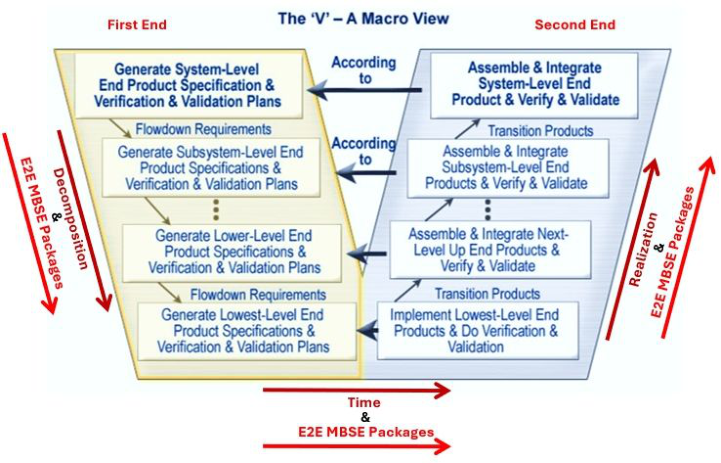
Systems Engineering Vee Model The Systems Engineering Body of Knowledge (SEBoK) defines model as a “physical, mathematical, or otherwise logical representation of a system, entity, phenomenon, or process” (SEBoK, 2024). Systems Engineering (SE) Vee or V model is one of the ways to represent a system lifecycle. The V model is the approach with pre-specified and sequential processes (Fairley et al., 2024). There are several life cycle process models that are categorized into the following three primary categories: (1) primarily pre-specified single-step or multistep, also known as traditional or sequential processes; (2) evolutionary sequential (or the V Model) and (3) evolutionary opportunistic and evolutionary concurrent (or incremental agile)” (Fairley et al., 2024). At a macro level, the SE V generates system-level specifications decomposition and plans for eventual Verification and Validation (V&V). Which advances from the lowest-level implementation to the next-level up, subsequent subsystem-levels, and finally to the system-level for realization, as illustrated in Figure 1 below.
Figure 1: SE V Macro View. (Forsberg et al. 2005, adapted by Prosnick, 2010. Adapted and modified from Coronel Mariño, 2017.)
Model-Based Systems Engineering (MBSE) Model-Based Systems Engineering (MBSE) has become a cornerstone of modern SE, enabling complex system design, analysis, and lifecycle management through standardized modeling methodologies. MBSE is a “formalized application of modeling to support system requirements, design, analysis, verification & validation activities beginning in the conceptual
design phase and continuing throughout development and later life cycle phases” (SEBoK, 2024). When there is a stakeholder requirement for the design of a System of Interest (SoI), MBSE facilitates the modeling and simulation of the system in a digital realm before, during, and as the product (physical or digital) is developed. Traditionally these SoI frequently utilized a document-centric approach prior to MBSE. “The evolution from “document-centric”to “data-centric”and “model-centric”information leveraging structured data and model-based approaches is at the heart of Digital Engineering (DE) transformational efforts underway across industry and government” producing “Authoritative Sources of Truth (ASOTs), and systems-of-systems interoperability” (DiVenti et al., 2023). Nevertheless, “it is noticeable that, there is a lack of a common understanding for how formal analyses for the V&V of systems behaviour, specifically in the early phases of system development, could be placed in an MBSE setting” (Cederbladh et al., 2024).
Problem Statement Organizations and institutions seem to succeed at the left side of the SE V model from requirements development up to integration but struggle to make the successful transition to model-based verification and validation on the right side of the V model in MBSE (Adelabu and Lohar, 2025a). Existing frameworks are fragmented and piecemeal at times. There are V&V efficacy needs with accompanying challenges such as complexity of models, resource constraints, integration issues, tool and methodology gaps, and requirement traceability issues; as a result, research work needs to define new SE and V&V concepts (Laing et al., 2020). “Traditional MBSE approaches are often distributed across multiple stages and tools” resulting in fragmentation of system architecture, physical modeling, and performance optimization, with limited real-time coordination and feedback (Zhang et al., 2025).
Proposed Solution The concept of an E2E-MBSE Framework possesses the potential to solve a host of the aforementioned problems from the lack of an E2E-MBSE Framework, which has led to use of piecemeal frameworks, to the Valley of Death (VoD), traceability, and integration issues. The ability to develop, design, integrate, test, verify, validate, maintain, and plan for the retirement or end-of-life of a system prior to its digital or physical development is of immense value. The transition from document-centric to model-centric offers distinct advantages, including several key benefits such as, “increased data availability, data access equity, data traceability, real-time analytics, batch analytics, and (most importantly) acceleration of the time-to-value and time-to-insights associated with engineering products and analyses” (DiVenti et al., 2023). These engineering products and analyses range from SE artifacts to products produced from SE application, and analyses such as Stakeholder Analysis, Trade Studies Analysis, Functional Analyses, etc. These data must be traceable and offer real-time model representation. “The longer-term benefits of reusability, customization and traceability are
Building Blocks for Effective Modeling and Simulation of Systems Lifecycle 2409
even more promising” (DiVenti et al., 2023), and the realization of those benefits is crucial in providing systems engineers with “vital information when needed to support critical decision-making throughout the entire life cycle” (DiVenti et al., 2023). As a result of the applicability to decision- making throughout the entire SE V and systems lifecycle or life cycle, the E2E- MBSE Framework fits perfectly in enabling such decisions and capitalizing on those needed benefits.
LITERATURE REVIEW
Left to Right Side of SE V and Life Cycle Cost Implications When developing the left side of the V, considerations that should have been modeled from the inception of the system are left out due to omission or lack of knowledge and or awareness (Coronel Mariño, 2017), (Cederbladh et al., 2024). Systems engineers, modelers, and practitioners forget to model things on the left side that are essential for V&V on the right side, and it costs resources (both money and time) to go back and rectify issues and provide new information that should have been captured in the first place (Cederbladh et al., 2024), (Laing et al., 2020).
Lack of End-to-End Framework “There is a gap in the common understanding of where MBSE models end and start, in addition to what can be considered a “good enough” model at various stages of development”(Cederbladh, 2024). “Limited guidance exists for implementing V&V in a model-based environment, particularly for early lifecycle activities” (Mulholland et al., 2025). Frameworks or methodologies concentrate on conceptual and detailed design activities (Delligatti, 2014) (Friedenthal, 2017) (Friedenthal S. M., 2015). Some approaches concentrate on the left portion of the SE V model and offer only minimal advice on how MBSE supports needs, requirements, and system V&V tasks (Wilson-Smith and Kibler, 2016).
Advancement of Rule of Thumb to Principles to Framework A rule of thumb is a guiding principle that informs decision-making, and may, in certain cases, clarify operational mechanisms. Principles offer direction or boundaries for the design and development of systems, ensuring stakeholders’ needs and functions are met within the given context or intended environment. It is important to note, however, that principles alone do not constitute frameworks, and practitioners should recognise the necessity for practical implementation beyond establishing principles. An architectural framework is defined as “Conventions, principles, and practices for the description of architectures established within a specific domain of application and/or community of stakeholders (SEBoK, 2024). In essence, a framework encompasses architectures and provides descriptions of those architectures within its structure. This leads to the question: what precisely is architecture? The definition of architecture varies from an art and practice of designing and building structures, formation, or construction that can
include patterns as the result of a conscious act, a unifying or coherent form or structure, etc. (Lohar, 2022) while an Architectural Description (AD) is work product used to express an architecture (ISO, 2022).
Frameworks can be developed to execute and incorporate SE principles, can have various architectural constructs, and can simultaneously consist of diverse concepts. Concepts like modularity, scalability, integration, and the balance between performance, cost, and risk are guided by SE principles as well as the manufacturability of designed systems due to the migration from mass customization to mass personalization resulting in increased complexity, and as a result need to be guided and gives the rise to modularity or modular design (Roy and Abdul-Nour, 2024). However, principles are not enough for effective design and or understanding of a system. There is a need for a framework that has end-to-end building blocks (Adelabu and Lohar, 2025c).
Existing Frameworks Traditional frameworks below address select components of the SE V model:
1) Federal Enterprise Architecture Framework (FEAF) (TOGAF, 2019) 2) Department of Defense Architectural Framework (DoDAF) (OMG, 2025) 3) The Open Group Architectural Framework (TOGAF) (TOGAF, 2019) 4) ARChitecture Analysis and Design Integrated Approach (ARCADIA) (Voirin, 2025) 5) Unified Architecture Framework (UAF) (OMG, 2025) 6) Mission Architecture Framework (MAF) (NASA, 2021) 7) MOFLT (Cortier et al., 2022) 8) Model Based Mission Assurance (MBMA) in a MBSE Framework (Cornford and Feather, 2016) 9) Modular Open Systems Approach (MOSA) Framework (DoD / DoW, 2020) 10) NASA-STD-7009A Models & Simulations (M&S) Life Cycle (NASA, 2019) 11) Zachman’s Framework, (Uzhakova and Fischer, 2024) etc.
Several of these frameworks are mainly Enterprise Architectural Frameworks (EAF), incorporate certain SE elements, and include model- based components or direct support for MBSE. However, addressing only segments of the SE V significantly lacks a thorough and effective MBSE framework that systems engineers can reliably use throughout the entire SE V process.
Table 1 above shows the low scoring nature of some of the frameworks in domain support and modeling language openness, making them non- versatile.
Building Blocks for Effective Modeling and Simulation of Systems Lifecycle 2411
Table 1: Comparison of selected frameworks (Bankauskaite, 2019).
Table available in the original PDF paper.
EAF / Criteria DoDAF NAF MoDAF UAF FEAF TOGAF Domain Support 1 1 1 3 1 2 Modeling Language Openness 1 1 1 4 1 1 Information Availability 3 2 3 1 1 4 Tool Support 3 3 3 2 2 3 Prevalence by Researchers 4 2 3 1 1 4 TOTAL 1.9 1.6 1.8 2.8 1.2 2.3
Understanding frameworks, architectures, concepts, properties, and other elements of SE is crucial to the development of an E2E-MBSE Framework. The present limitations of existing frameworks can be categorised into three main areas: (i) The presence of fragmented individual frameworks covering certain aspects on the left side of the V, which in some instances, begin at the mid to lower sections of the V, thereby omitting the initial stages necessary for a comprehensive understanding of the system, including its interests, perspectives, stakeholder desires, and related factors (Zhang et al., 2025). (ii) Limited to no framework for the right side of the V (Cederbladh et al. 2024). (iii) There is no established framework to transition from the left to the right side of the V and overcome the VoD. This research seeks to provide the framework to address all three prongs.
EXPERIMENT AND DISCUSSION Rationale for Research Methodology
This research extends comprehensively across the entirety of the V model, both from a framework perspective and throughout the developmental phases of the SoI. After thorough evaluation of the available materials, it became evident that employing a single research methodology would be insufficient to capture, analyze, and develop the foundational building block elements necessary for an “End-to-End Model-Based Systems Engineering (E2E-MBSE) Framework”. As a result, a combination of research methodologies is utilized, infusing strengths, shoring up weaknesses by another method’s strength, and ensuring applicability to a model-based approach.
Research Methodology This research utilizes the Complex Observation Mixed Methods Explication Case Study (COMMECS) design (Adelabu and Lohar, 2025b).
1) Complex or Complexity Theory, because the field of MBSE and SE in general is complex domain; the SoI are complex; complexity addresses complex research questions that require multiple perspectives and methods, 2) Observation, because it entails observation methodologies, 3) Mixed Methods, because it includes both Quantitative & Qualitative methods,
4) Explication or Explication Theory, because traditional MBSE frameworks and the E2E-MBSE Framework are explicated to the SE V model, and 5) Case Study, because the chosen system of interest will be the Proof of Concept (PoC) for the E2E-MBSE Framework.
Research Procedure The proposed COMMECS design for research follows the steps below:
1) Identify common terminologies and architectures across frameworks, 2) Determine which architectures are shared or unique across the frameworks, 3) Define the beginning and end points of the frameworks, 4) Detect gaps between those ends, 5) Propose new architectures and building blocks to address identified gaps, 6) Link all building blocks from one end of the frameworks model to the another.
At first, common terms and structural patterns from different frameworks are mapped out, accounting for variation in terminologies or differences in taxonomies. Next, widely used architectures are analyzed to uncover gaps that need addressing, which resulted in new architectural development to bridge those gaps. The resulting building blocks are then linked together, and this process continues until every essential connection within the E2E-MBSE Framework is completed.
Results
A preliminary outcome of the experiment provides a high-level overview of various established MBSE frameworks and their respective components. These frameworks primarily address elements situated on the left side of the SE V, as illustrated in the table below.
Table 2: Some existing frameworks’ building blocks for SE.
Table available in the original PDF paper.
Building Blocks for Effective Modeling and Simulation of Systems Lifecycle 2413
The common building blocks in each observed framework were color- coded, while uncommon ones were not. When the question is asked to develop a SoI from end-to-end, both recent SE graduates and experienced practitioners face challenges in using these frameworks directly to create a SoI throughout its lifecycle. This highlights the need for an E2E-MBSE Framework to address existing knowledge gaps and viewpoints of the different SE modelers, engineers, architects, and practitioners.
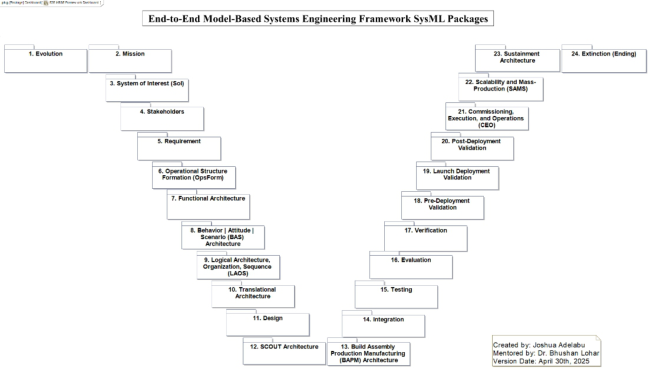
CONCLUSION AND FUTURE WORK This paper presents the conceptual design of an innovative E2E-MBSE Framework, which addresses the persistent challenges in applying existing frameworks across the full system lifecycle. A recent graduate, an emerging system engineer with limited to no experience and a systems engineer with decades of hands-on SE experience (traditional), would be able to use the proposed E2E-MBSE Framework because it not only resolves some of the pain points discussed in this paper but also allows them to communicate their viewpoints for the successful development of SoI. Furthermore, future work will include documentation (a user guide) that walks the user (whether novice in SE or a subject matter expert) through description of each of the proposed 24 building blocks packages and how to utilize them, providing the walkthrough needed for users. Also, a demonstration of the application of each of the 24 proposed building blocks that assists a user from one end of the SE V to the other end for a chosen SoI will depict or show PoC and or application.
Figure 2: End-to-end MBSE framework packages with the 24 building blocks.
The concept of duality in personality, akin to the wave-particle duality in quantum mechanics serves as an additional rationale for adopting the E2E- MBSE Framework, both from the perspective of a recent graduate entering systems engineering domain and that of an experienced industry practitioner.
This duality reflects the fusion of two distinct viewpoints, each informed by firsthand exposure to relevant environments, resulting in motivation applicable to a wide range of users. Accordingly, the authors aim to deliver a solution that meets the needs of both perspectives by ensuring the framework is effective, efficient, and user-friendly.
While MBSE is a promising alternative to traditional document-based approaches, its industrial application remains limited by the rigidity and domain-specific nature of the current frameworks, which often fail to provide a cohesive approach from a system’s inception to its disposal. The proposed E2E-MBSE Framework is architected as a next-generation solution, designed to overcome limitations in Industry 5.0 by offering a structured, model- centric approach to address core challenges like integrating human-centric design, empathic design, promoting sustainability, and enhancing resilience. The framework’s core innovation is a modular, pattern-based approach that utilizes a library of reusable and scalable SysML packages (Lohar, 2022). This structure provides a customizable “toolkit” rather than a rigid, monolithic standard, allowing practitioners and researchers to tailor the methodology to specific industry applications or domain-specific needs. Crucially, the framework is predicated on the foundational capabilities of a standalone architecture, with formal semantics and integrated APIs integration providing a technical backbone for developing a “Total System Model” (TSM) that serves as a single source of truth and evolves throughout the system’s entire lifespan. This approach fundamentally redefines the relationship with the systems engineering V model. Instead of treating V&V as discrete, late- stage activities on the right side of the V, the framework leverages real- time traceability capabilities to embed automated, continuous V&V directly within the modeling process.
This creates a living “digital thread” that ensures traceability and consistency from requirements decomposition to sustainable system retirement, thereby significantly reducing project risk and enhancing operational efficiency. The research outlines the framework’s architecture, its foundational principles, and its potential to revolutionize systems engineering by providing a flexible, scalable, and verifiable methodology for the complex systems of the future. Future work includes analysis of one or more of these 24 building blocks and a SoI for PoC.
REFERENCES
Adelabu, J. and Lohar, B., (2025a). End-to-End (E2E) Model-Based Systems Engineering (MBSE) Framework. Shelby Hall Graduate Research Forum Presentations. 1. https://jagworks.southalabama.edu/ southalabama-shgrf-presents/1. Adelabu, J. and Lohar, B., (2025b). End-to-End (E2E) MBSE Framework. Shelby Hall Graduate Research Forum Posters. 14. https://jagworks.southalabama.edu/ southalabama-shgrf-posters/14. Adelabu, J. and Lohar, B., (2025c). End-to-End (E2E) Model-Based Systems
Engineering (MBSE) Framework for Complex Systems Life Cycle Design. [Online]. Available at: https://doi.org/10.13140/RG.2.2.12639.52648. Bankauskaite, J., (2019). Comparative Analysis of Enterprise Architecture. Kaunas, Lithuania, CEUR-WS.org, pp. 61–64.
Building Blocks for Effective Modeling and Simulation of Systems Lifecycle 2415
Cederbladh, J., (2024). Towards Early Validation and Verification of System Behaviour with Heterogeneous Models in Systems Engineering. In: Licentiate Thesis No. 352. Sweden: Mälardalen University Press. Cederbladh, J., Cicchetti, A., and Suryadevara, J., (2024). Early validation and
verification of system behaviour in model-based systems engineering: A Systematic Literature Review. ACM Transactions on Software Engineering and Methodology, 15 March, 33(3), pp. 1–67. Cornford, S. L. and Feather, M. S., (2016). Model Based Mission Assurance in a Model Based Systems Engineering (MBSE) Framework. NASA Technical Reports Server, 1 August. pp. 1–57. Coronel Mariño, G. G., (2017). SPSYSE-TK: A Methodology for Space Systems
Engineering Based on the Procurement of Turnkey Satellites. Thesis for: MSc. in Space Engineering and Technology/Space Systems of Management and Engineering, 31 March. pp. 1–332. Cortier, A., Magné, J., Marty, J.-L., and Leblond, P., (2022). Model Based Approach for Functional Chain Engineering From System Model to SW Specification. Toulouse (France), European Space Agency (ESA), pp. 1–17. Delligatti, L. S. (2014). SysML distilled: A brief guide to the systems modeling
language. Upper Saddle River, NJ: Addison-Wesley. DiVenti, A., Forsbacka, M., Rainbolt, K., Cornford, S., and Feather, M., (2023).
NASA’s Safety, Reliability, and Mission Assurance Digital Future. Orlando, FL, USA, 2023, IEEE, pp. 1–7. DoD/DoW, (2020). Modular Open Systems Approach (MOSA) Reference Frameworks in Defense Acquisition Programs. Office of the Under Secretary of Defense for Research and Engineering, Director of Defense Research and Engineering for, May. pp. 1–34. Fairley, D., Forsberg, K., Madachy, R., and Marbach, P., (2024). Vee Life Cycle Model. [Online]. Available at: https://sebokwiki.org/wiki/Vee_Life_Cycle_Model. Forsberg, K., Mooz, H., and Cotterman, H. (2005) Visualizing Project Management:
Models and Frameworks for Mastering Complex Systems. 3rd edn. Hoboken, NJ: John Wiley & Sons. Friedenthal, S. M. (2015). A practical guide to SysML: The Systems Modeling Language. 3rd edn. Waltham, MA: Elsevier/Morgan Kaufmann. ISO, (2022). ISO/IEC/IEEE 24765:2017 Systems and software engineering —
Vocabulary. [Online]. Available at: https://www.iso.org/standard/71952.html. Laing, C., David, P., Blanco, E., and Dorel, X., (2020). Questioning integration of verification in model-based systems engineering: An industrial perspective. Computers in Industry, 114, p. 103163. Lohar, B., (2022). Development of New Space Systems Architecture in SYSML Using
Model-Based Pattern Language. Graduate Theses and Dissertations. 75. https:// jagworks.southalabama.edu/theses_diss/75. Mulholland, R., Bentley, C., and Williams, J., (2025). Performing Verification and Validation Activities in a Model-Based Environment. INCOSE International Symposium, 09 October, 35(1), pp. 1912–1939. NASA, (2019). NASA-HDBK-7009A NASA Handbook for Models and Simulations:
An Implementation Guide for NASA-STD-7009A. NASA Technical Handbook, 08 May, NASA-HDBK-7009(A), pp. 1–157. NASA, (2021). NASA-HDBK-1005 NASA Space Mission Architecture Framework (SMAF) Handbook for Uncrewed Space Missions. NASA Technical Handbook, 11 March, NASA-HDBK-1005 (Initial Release), pp. 1–114.
OMG, (2025). Introduction to Unified Architecture Framework® (UAF®). [Online].
Available at: https://www.omg.org/uaf/. Prosnick, L. (2010) Systems Engineering Vee Model. [Online] NASA. Available at: https://ntrs.nasa.gov/citations/20100036752. Roy, M.-A. and Abdul-Nour, G. (2024) Integrating modular design concepts
for enhanced efficiency in digital and Sustainable Manufacturing: A literature review, Applied Sciences, 14(11), p. 4539. doi: 10.3390/app14114539. SEBoK, (2024). The Guide to the Systems Engineering Body of Knowledge (SEBoK), v. 2.12. N. Hutchison (ed.) Hoboken, NJ: The Trustees of the Stevens Institute of Technology. Accessed [date you accessed it]. Available at: https://sebokwi ki.org/ wiki/Guide_to_the_Systems_Engineering_Body_of_Knowledge_ (SEBoK). TOGAF, (2019). The TOGAF® Standard. [Online] Available at: https://www.open
group.org/togaf. Uzhakova, N. and Fischer, S., (2024). Data-Driven Enterprise Architecture for Pharmaceutical R&D. Digital, 22 April, 4(2), pp. 333–371. Voirin, J. L., (2025). Arcadia Reference Documents Online documents by the
author of the method. [Online] Available at: https://mbse-capella.org/arcadia- reference.html. Wilson-Smith, M. and Kibler, A., (2016). A truly testing experience - how Model Based Systems Engineering can help to ensure that you build the right product and build the product right. INCOSE International Symposium, 26(1), pp. 1331–1346. Zhang, L., Chen, Z., Laili, Y., Ren, L., Deen, M. J., Cai, W., Zhang, Y., Zeng, Y.,
and Gu, P., (2025). MBSE 2.0: Toward More Integrated, Comprehensive, and Intelligent MBSE. MDPI, 13(7), p. 584.
LISTED IN THE AHFE DIGITAL BOOKSTORE CATALOGUE
Explore the complete digital volume
Human Factors in Design, Engineering, and Computing
Read this individual research paper free through the original publisher, or explore the full digital proceedings book.
ISBN 978-1-964867-75-5
Explore this ISBN in the AHFE Bookstore ↗Listed in the July 2026 bookstore catalogue; search by ISBN to confirm current availability · Digital book purchase optional