Kimberly Harry, Safa Elkefi (2025). Educational Interventions for Rural Maternity Care: Provider Perspectives on Patient Education Materials and Communication Strategies. In: Human Factors in Design, Engineering, and Computing. AHFE Open Access, vol. 199, pp. 2395–2405. https://doi.org/10.54941/ahfe1007052
Effective patient education is critical for improving maternity health outcomes, particularly in rural areas where access to care is limited. This study examines healthcare providers' perspectives on current educational tools and strategies for maternity care in upstate rural New York. We conducted a semi-structured focus group with 13 healthcare professionals (i.e., directors, professors/researchers, clinical managers/leaders, and associates) in rural New York to understand the educational needs, barriers, and opportunities for improving patient education in rural maternity care. The focus group was conducted via Zoom, and the entire session was recorded and subsequently transcribed using the Otter.ai transcription tool. Two independent reviewers analyzed the transcripts, and any discrepancies were resolved through consensus. The thematic analysis approach used was deductive, and guided emergent themes aligned to the categories of CONTENT, FORMAT, and DELIVERY MODE. Our analysis revealed significant patient education and communication challenges associated with traditional educational approaches, highlighting the need for more patient-centered and tailored educational materials. Overall, the findings underscore the need for greater support for rural maternal care leaders and practitioners to deliver more contextually and culturally appropriate, patient-centered educational materials in rural settings. Implementing targeted interventions that provide accurate, applicable, easily-accessible, inclusive, and user-friendly digital educational resources on maternal care is essential to effectively support this patient population.
To provide adequate maternal care, mothers need access to relevant knowledge on newborn health and best care practices. Health literacy research demonstrates that effective patient education materials must be culturally appropriate, accessible, and aligned with patients’ actual information needs (Kilfoyle et al., 2016). Bhutta et al. (2005) highlight female education interventions as one of the key levers for improving maternal healthcare and perinatal and neonatal health outcomes in developing
communities. In rural Bangladesh communities, focused care during pregnancy, labor, delivery, and the postpartum period was highlighted as a critical value-added requirement (Syed et al., 2006). Regarding women’s knowledge of neonatal care, El-Salam et al. (2019) and Syan et al. (2021) found, in a survey study, that mothers’ knowledge of newborn health improved significantly following the implementation of educational programs in maternal healthcare. A notable observation is that rural maternal care populations often require more educational interventions to achieve “positive results” (Herval et al., 2019, p. 5). Conversely, Abd Allah et al. (2023) found that inadequate healthcare provision to new mothers can encourage them to rely on informal networks, such as family and friends, for postnatal care education. Therefore, pregnant women should receive adequate information from maternity nurses on pregnancy, labor, and postpartum care throughout the prenatal phase. Health education and training play a critical role in improving women’s knowledge and care practices throughout all phases of pregnancy (Abd Allah et al., 2023).
The use of various types of digital communication media for maternal health education is well established. Common digital communication media include mobile health apps, social media, websites, instant messaging, text messaging, eBooks, online video conferencing, and multimedia (Mulyani et al., 2024). Modern instructional materials should include well-organized, impactful videos (such as those using 3D visualizations and animations) that can be viewed by patients at health centers and hospitals, via home- based media (such as television, computers, and other multimedia platforms), and via mobile devices (such as YouTube). Naeeni et al. (2016) note that a combination of face-to-face education and internet-based instruction can be quite effective. In remote rural settings, however, it is important to recognize that both educational methods and communication strategies can pose challenges due to limited internet connectivity, transportation barriers, and specific cultural contexts. These factors must be appropriately addressed to best serve rural patients.
Despite the growing body of literature on maternal health education, there remains a gap in understanding the perspectives of healthcare providers working directly in rural maternity care settings. Providers’ insights are essential for identifying what educational content is most needed, which modern formats are most effective (such as digital and multimedia content or mobile accessible materials), and which modes of communication (such as social media platforms, mobile apps, and other innovations) are most appropriate for reaching rural maternal populations. This study endeavors to systematically capture these provider perspectives, thereby informing the development of more effective, contextually appropriate maternal health education interventions for rural communities.
The remainder of this paper presents the methodology applied (the qualitative approach used) and the results (the findings on emergent themes, supported by participant quotes). The discussion section then extensively examines these themes in the context of existing literature and their practical implications. Finally, the paper addresses the study’s limitations and future research directions, and concludes with key takeaways.
Educational Interventions for Rural Maternity Care 2397
METHODS
The study employed a qualitative research approach, conducting a focus group to gather in-depth insights into the challenges and educational material needs related to rural maternal healthcare. The focus group was conducted virtually via Zoom, facilitating participation from various clinical leaders and providers in rural maternal healthcare. The entire session, which lasted approximately forty minutes, was digitally recorded and subsequently transcribed verbatim using the Otter.ai transcription tool. The analytical framework for this study was a deductive thematic analysis, guided by a priori categories directly relevant to the objectives of identifying CONTENT, FORMAT, and DELIVERY MODE of educational materials. This structured approach enabled the identification of emergent themes within predefined categories. To ensure the rigor and reliability of the qualitative data analysis, two independent researchers carefully analyzed the transcripts. Any discrepancies in coding or interpretation were systematically resolved through a collaborative, iterative consensus process involving detailed discussion and resolution of findings until agreement was reached. The following section presents the detailed results.
RESULTS
This section outlines the emergent themes and corresponding direct quotations that align with the deductive categories of CONTENT, FORMAT, and DELIVERY MODE. These themes emerged through a collaborative synthesis process conducted by the research team. There were five distinct themes in the CONTENT category, three unique themes in the FORMAT category, and four primary themes in the DELIVERY MODE category. The findings are presented as follows: Content: Educational Priorities and Information Needs
Core Educational Topics Providers identified specific content areas where patients most frequently sought information, revealing priority topics for educational materials: “Gender is big… We get a lot of questions about exercise and nutrition…but definitely signs of labor and delivery. I would say, ultrasound findings. So we get a lot of questions about that.” [Provider 6]
Timing and Early Pregnancy Education Providers emphasized pregnancy as the optimal window for educational interventions, particularly early pregnancy: “But if we had to pick from our list that we have here, I think, during pregnancies. You can educate everything during that time as well. [Provider 5] “If we can really focus on during pregnancy, we can avoid some of the complications potentially. And once they go into labor, they’re a captive audience... if we can get them early in the pregnancy, and have some way to hook them, and educate and support, we could potentially see better outcomes.” [Provider 4]
2398 Harry and ElKefi
Age-Specific and Parity-Based Content Needs Providers highlighted the need for tailored content based on maternal age and previous pregnancy experience. For teenage mothers, educational content often failed to resonate: “I feel like we’ve had a lot of 15-16-year-olds lately that you ask these questions, and they just are like looking at you dumbfounded like this. And so you’re trying to, so I’m asking it in this way, like try to bring it down to their level more, and they still kind of look at you like, I don’t want you to help me like, I’m not going to answer you because I don’t want your assistance. And I feel like they get more offended by it.” [Provider 5]
For multiparous mothers, different content challenges emerged: “Do you tell the 12th time mom, anything new? Or are we challenging our staff to try to respond to different needs? I mean, having 12 mouths to feed is a lot different than the first one. How do we support that?” [Provider 4]
Accuracy and Misinformation Concerns Providers expressed significant concern about patients accessing unvetted information from unreliable sources: “They rely a lot on the internet. Whatever social media. Instagram, whoever they follow on Instagram.” [Provider 3]
“The Dr. Google app is up and running.” [Provider 8] “Whoever the latest influencer is.” [Provider 6]
Multilingual Content Requirements The growing diversity of the patient population necessitated multilingual educational materials: “We’re getting more Hispanic patients. So having the translator is like good for people. And getting handouts translated into Spanish. Making sure that they are available is important... The more that you know, they can hear their language. So I think we’re, we’re trying to make sure that we have everything in their language.” [Provider 6]
Format: From Traditional to Digital Educational Materials Limitations of Traditional Printed Materials Providers consistently reported that traditional printed materials were ineffective:
“We give them a lot of written materials. They don’t necessarily read all of it. It’s a lot of good information we use. Maybe it’s too much. I don’t know but I do think something through social media format would be good.” [Provider 3]
Educational Interventions for Rural Maternity Care 2399
Moreover, evidence of immediate disposal was particularly concerning: “They don’t verbalize that [about not wanting handouts].” [Provider 3]
“But they will throw them in the trash and move on.” [Provider 5]
Digital and Multimedia Solutions Providers strongly advocated for digital formats, particularly QR codes linking to multimedia content: “I think, you know, with the QR code, QR Codes with links to YouTube videos or education stuff. You know, everything’s got to be in a 32-second download.” [Provider 7]
“That’s why we’re giving out the QR Code instead of the booklet, whatever we can.” [Provider 3]
Mobile-Accessible Content The success of one particular tool, a magnetized card with a QR code having the maternity health contact information, demonstrated the effectiveness of providing patients with a persistent physical visual cue with digital access: “The one thing they will, that they do use is the magnet with maternity’s number. That they keep.” [Provider 6]
“It’s a magnet with the QR Code.” [Provider 3] The persistent visibility was key to its success:
“I feel like this is in everybody’s day. All the time, and if they can have it in front of like, if they can have it and just sit there and do it... Myself, I found it was nice, if you saw it is like it’s on there. I’m reading it there like I’m not even. It’s just, it’s there and that’s where you look for everything.” [Provider 5] Delivery Mode: Meeting Patients Where They Are
Social Media Platform Integration Providers recognized the necessity of delivering education through platforms patients already use: “I think social media is a good way to go. I think we give them a lot of written materials. They don’t know that they all necessarily read all of it.” [Provider 3]
The influence of social media on patient information-seeking was undeniable: “It’s hard, it’s very hard now. With especially younger.” [Providers 3]
Mobile Applications for Health Education Providers noted the widespread adoption of pregnancy-related mobile applications:
2400 Harry and ElKefi
“There’s so many apps out there now. And you know, and a lot of them use it and understand it.” [Provider 6] Commercial applications were already supporting this educational role:
“And the Gerber company has a whole campaign... Pampers.” [Provider 6] “Yes, Pampers… Pampers.com.” [Provider 3]
Push Notification Systems Automated, regular content delivery through push notifications was identified as a promising approach: “One of the insurance companies, a while back, offered, like a program that they could enroll in with offering, but they were, you know, you’d get, like, weekly blurbs, or, you know, the stuff that you should be looking at. It was pushed to the moms that participated. So it was constant, you know, on their phone information.” [Provider 7]
Meeting Diverse Population Needs Providers emphasized that delivery modes must accommodate varying levels of engagement and support systems, particularly for young mothers: “A lot of times I don’t feel like we get those questions from them or trying to like prompt these questions. But I feel like a lot of them have like their mother figure with like their words... I think that’s where they’re getting, like their help in that resource.” [Provider 5]
Our analysis revealed significant patient education and communication challenges associated with traditional educational approaches, highlighting the urgent need for more patient-centered, tailored educational materials specifically designed for rural maternal healthcare contexts. Overall, the findings indicate the need to support rural maternal patients by providing targeted, inclusive, and relevant content expeditiously, in an easily accessible and engaging format. Addressing the need requires developing inclusive, relevant health communication materials that are easy to understand and applicable to individuals’ lived experiences (Sampson et al., 2022). The following section provides a deeper discussion of the emergent themes.
DISCUSSION
This section elaborates on the main findings and themes that emerged from the research, along with their implications.
The Digital-Physical Divide in Patient Education Our findings reveal a critical disconnect between traditional educational methods and patient engagement in rural maternity care. The widespread disposal of printed materials contrasts sharply with the success of the magnetized QR code card, which persists in patients’ environments while providing digital access. This success suggests that effective educational tools must combine physical persistence with dynamic digital content, bridging traditional and modern approaches. The dominance of social media and internet sources in patient information-seeking presents both challenges
Educational Interventions for Rural Maternity Care 2401
and opportunities (Zhu et al., 2019; Lee et al., 2022). While providers expressed concern about misinformation from “Dr. Google”and social media influencers, these platforms represent where patients actively engage with health information. Healthcare systems should establish an authoritative presence on these platforms rather than competing with them (Gatewood et al., 2019; Balogun et al., 2023).
Content and Format Alignment The content priorities identified: gender determination, nutrition, ultrasound interpretation, and labor signs, reflecting patients’ immediate concerns rather than comprehensive curricula. This gap between provider-determined priorities and patient-expressed needs may explain poor engagement with current materials. The frequent questions about ultrasound findings suggest patients need accessible, visual explanations they can review independently. Herval et al. (2019), in a thematic analysis of the literature on maternal health education strategies, identified breastfeeding, nutrition, and birth as the primary recurring topics of interest to patients. This aligns with the findings on mothers’ educational interests, specifically nutrition and monitoring birth- related development using ultrasound technology. The shift from print to digital formats reflects fundamental changes in information consumption patterns (Zhu et al., 2019; Lee et al., 2022). Providers noted that patients “rely a lot on the internet” and actively use pregnancy apps from commercial entities (Lee et al., 2022). However, digital transformation must address rural connectivity challenges through hybrid approaches combining offline- accessible content with online resources (Bailey et al., 2021; Rahman et al., 2023).
Tailoring Delivery to Diverse Populations The stark differences between teenage and multiparous mothers’ educational needs demand personalized approaches. Young mothers’ resistance to traditional education, often feeling “offended” by current methods, suggests the need for age-appropriate and family-inclusive strategies that engage support networks (Lagan et al., 2021). For experienced mothers, the challenge shifts to updating knowledge and addressing changing circumstances. In addition, the growing Hispanic population requires culturally adapted content beyond simple translation. Push notification systems that deliver regular, relevant content, acknowledge the cognitive load pregnant woman face and their preference for education delivered directly to them, rather than active information seeking (Sayakhot and Carolan-Olah, 2016).
Implications for Practice These findings suggest several key design principles for effective rural maternity education. First, there is a need for Persistent visibility through tools that remain in patients’ daily environments. Second, providers need to prioritize Digital-first approaches while maintaining alternatives for limited digital access. Third, Social media integration is imperative to provide relevant and accurate content where patients already engage. Fourth, a Push-based automated delivery approach would enable consistent, regular
2402 Harry and ElKefi
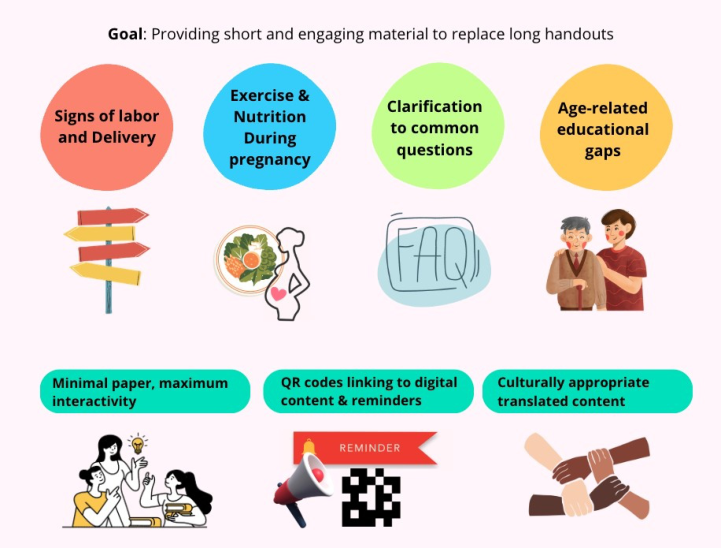
content distribution. Fifth, Multilingual, culturally adapted materials are essential to support diverse care populations. Lastly, Age-appropriate design, particularly for teenage mothers, would best support their learning and ensure their well-being and the well-being of their babies. Healthcare systems must recognize that effective digital education requires ongoing investment in content creation, platform maintenance, and engagement monitoring. It is not a one-time resource development but requires a sustainable infrastructure. The success of commercial pregnancy apps suggests potential benefits from partnerships with established platforms rather than creating competing systems. Figure 1 below illustrates the key educational content areas identified by providers and the recommended design principles for addressing these needs through digital educational tools.
Figure 1: Framework for digital maternal education content and delivery. The top row shows the four primary content areas most frequently requested by patients. The bottom row displays the three key design principles for effective educational delivery in rural maternity care settings (authors’ own work).
Limitations and Future Directions The study’s focus on provider perspectives, while valuable, excludes direct patient voices. In addition, the single-site nature limits generalizability, though the identified challenges are likely to resonate across rural settings. Future research should incorporate diverse perspectives (i.e., patients and caregivers) on the phenomenon to foster a more comprehensive understanding. Furthermore, future studies should evaluate the impact of digital interventions on health literacy and clinical outcomes, develop
Educational Interventions for Rural Maternity Care 2403
strategies to ensure equitable access across the digital divide, and create culturally adaptive content that maintains medical accuracy.
CONCLUSION
Overall, the findings from this study underscore the need for greater support for rural maternal care leaders and practitioners to deliver more contextually and culturally appropriate, patient-centered educational materials in rural settings. Our investigation, focusing on healthcare providers’ perspectives in upstate rural New York, revealed critical insights into the needs, barriers, and opportunities for enhancing patient education and communication in maternity care. Implementing targeted and user-friendly digital educational resources on maternal care is essential to effectively support this population. This can be achieved by integrating more technology-driven solutions, such as mobile health applications, to enhance accessibility and quality of care, especially in areas with limited medical resources, ultimately improving maternity health outcomes in rural areas (Igwama et al., 2024). Such resources can better bridge existing gaps in service provision and empower women in rural areas to better manage their health throughout pregnancy, labor, birth, and the postpartum period (Paz-Pascual et al., 2019).
ACKNOWLEDGMENT
The authors would like to thank the clinical leaders and providers in upstate rural New York who participated in the study for their valuable time and feedback.
REFERENCES
Abd Allah, R.A.E., Mohamed, H.A.E. and Kamel, H.H. (2023) ‘Impact of health educational program for pregnant women on their selected postpartum and newborn care’, Minia Scientific Nursing Journal, 13(1), pp. 18–26. Bailey, S.C., O’Conor, R., Bojarski, E.A., Mullen, R.J., Patzer, R.E. and Wolf, M.S.
(2021) ‘Rural health literacy and digital access disparities: Challenges for online patient education’, Journal of Health Communication, 26(6), pp. 420–428. Balogun, B.A., Hogden, A., Kemp, N., Yang, L. and Agaliotis, M. (2023) ‘Public health agencies’ use of social media for communication during pandemics: A scoping review of the literature’, Osong Public Health and Research Perspectives, 14(4), pp.235–251. doi: https://doi.org/10.24171/j.phrp.2023.0095. Bhutta, Z.A., Darmstadt, G.L., Hasan, B.S. and Haws, R.A. (2005) ‘Community-
based interventions for improving perinatal and neonatal health outcomes in developing countries: A review of the evidence’, Pediatrics, 115(Supplement_2), pp. 519–617. El-Salam, A.A.A., Eldeeb, A.M.E. and Saleh, A.S.E.M. (2019) ‘Effect of Instructional Program on Primipara Mothers’ Knowledge Regarding Neonatal Care’, American Journal of Nursing Research, 7(3), pp. 256–261. Gatewood, J., Monks, S.L., Singletary, C.R., Vidrascu, E. and Moore, J.B. (2019)
‘Social Media in Public Health: Strategies to Distill, Package, and Disseminate Public Health Research’, Journal of Public Health Management and Practice, 26(5), pp.489–492. doi: https://doi.org/10.1097/phh.0000000000001096.
2404 Harry and ElKefi
Henriksson, P., Migueles, J.H., Söderström, E., Sandborg, J., Maddison, R. and Löf, M. (2022). ‘User engagement in relation to effectiveness of a digital lifestyle intervention (the HealthyMoms app) in pregnancy’, Scientific Reports, 12(1), p.13793. doi: https://doi.org/10.1038/s41598-022-17554-9. Herval, Á.M., Oliveira, D.P.D., Gomes, V.E. and Vargas, A.M.D. (2019) ‘Health
education strategies targeting maternal and child health: A scoping review of educational methodologies’, Medicine, 98(26), p. e16174. Igwama, G.T., Nwankwo, E.I., Emeihe, E.V. and Ajegbile, M.D. (2024) ‘Enhancing maternal and child health in rural areas through AI and mobile health solutions’, International Journal of Biology and Pharmacy Research Updates, 4(1), p. 35. doi: 10.53430/ijbpru.2024.4.1.0028. Kilfoyle, K.A., Vitko, M., O’Conor, R. and Bailey, S.C. (2016) ‘Health literacy and
women’s reproductive health: A systematic review’, Journal of Women’s Health, 25(12), pp. 1237–1255. doi: 10.1089/jwh.2016.5810. Lagan, B.M., McCauley, M. and Shannon, M. (2021) âŁ˜Maternity education for young mothers: Addressing changing learning preferences through digital engagement’, Midwifery, 92, 102869. https://doi.org/10.1016/j.midw.2020.102869. Lee, J.Y., Kim, K.M. and Oh, K. (2022) “What topics are women interested in during pregnancy: Use of social media for pregnancy-related health information’, BMC Pregnancy and Childbirth, 22, p. 648. doi: 10.1186/s12884-022-04842-5. Lee, V.V., Vijayakumar, S., Ng, W.Y., Lau, N.Y., Leong, Q.Y., Ooi, D.S.Q., Su, L.L., Lee, Y.S., Chan, S.Y., Blasiak, A. and Ho, D. (2023). ‘Personalization and localization as key expectations of digital health intervention in women pre- to post-pregnancy’, npj Digital Medicine, 6(1), pp.1–10. doi: https://doi.org/10.1038/s41746-023-00924-6. Mulyani, E.Y., Rakhmawati, T., Damayanti, S. and Sumaedi, S. (2024) ‘Digital
Communication media and maternal health education: Integration of bibliometric analysis, methodological analysis, and meta-synthesis’, Digital Health, 10, p. 20552076241304819. Naeeni, M.R., Lotfi, R., Farid, M. and Tizvir, A. (2016) ‘Can the modern methods of education be a good alternative for the traditional method in educating pregnant mothers?’, Strides in Development of Medical Education, 13(1), pp. 87–93. doi: 10.5812/sdme.20474. Paz-Pascual, C., Artieta-Pinedo, I. and Grandes, G. (2019) ‘Consensus on priorities in
maternal education: results of Delphi and nominal group technique approaches’, BMC Pregnancy and Childbirth, 19(1). doi: 10.1186/s12884-019-2382-8. Rahman, M.M., Islam, M.R. and Ahmed, S. (2023) ‘Bridging the digital divide in rural health: Lessons from hybrid telehealth models’, BMC Health Services Research, 23, p. 512. Sampson, M., Xu, W. and Prabhu, S.M. (2022) ‘Tailoring Perinatal Health
Communication: Centering the Voices of Mothers at Risk for Maternal Mortality and Morbidity’, International Journal of Environmental Research and Public Health, 20(1), p. 186. doi: 10.3390/ijerph20010186. Sayakhot, P. and Carolan-Olah, M. (2016) ‘Internet use by pregnant women seeking pregnancy-related information: A systematic review’, BMC Pregnancy and Childbirth, 16(1), 65. https://doi.org/10.1186/s12884-016-0856-5. Syan, S.A.E., Samuel, V.M., Llaguno, M.B.B. and Abdalla, S.S. (2021) ‘Effect of
Instructional Guidelines on Mothers’ Knowledge and Practice regarding Neonatal Care’, Egyptian Journal of Health Care, 12(3), pp. 64–73.
Educational Interventions for Rural Maternity Care 2405
Syed, U., Asiruddin, S., Helal, M.S., Mannan, I.I. and Murray, J. (2006) ‘Immediate and early postnatal care for mothers and newborns in rural Bangladesh’, Journal of Health, Population, and Nutrition, 24(4), p. 508. Zhu, C., Sun, M. and Yan, D. (2019) ‘Pregnancy-related information seeking and
sharing in the social media era: A mixed-methods study’, Journal of Medical Internet Research, 21(12), p. e13694.
LISTED IN THE AHFE DIGITAL BOOKSTORE CATALOGUE
Explore the complete digital volume
Human Factors in Design, Engineering, and Computing
Read this individual research paper free through the original publisher, or explore the full digital proceedings book.
ISBN 978-1-964867-75-5
Explore this ISBN in the AHFE Bookstore ↗Listed in the July 2026 bookstore catalogue; search by ISBN to confirm current availability · Digital book purchase optional