Friedrich Wintzer, Günther Schuh, Seth Schmitz, Annkristin Hermann (2025). Enabling Circular Production: Digital Business Infrastructure Adaptations. In: Human Factors in Design, Engineering, and Computing. AHFE Open Access, vol. 199, pp. 1982–1991. https://doi.org/10.54941/ahfe1007009
In the context of rising material costs and more stringent sustainability regulations, manufacturing companies are compelled to adopt circular value-creation models and decouple their resource consumption from the creation of high-quality products. This transition to a circular production is facilitated by R-strategies, such as Remanufacturing and Reassembly. However, the successful implementation of these strategies necessitates targeted set-up and adjustment of business infrastructures – e.g., process-related, digital, physical and logistical. In order to assist companies in the transition towards circular production, it is key to provide practical guidance for the restructuring of their infrastructures. This paper examines the digital business infrastructural changes necessary for circular production in manufacturing. A systematic literature review consolidates extant research on necessary and enabling digital business infrastructures, placing it in a shared context for restructuring. The identified findings are analyzed for their impact on a company's ability to implement circular production, mapping out key restructuring needs. To conclude, the paper emphasizes the significance of integrating digital business infrastructural restructuring into a comprehensive business transformation towards circular production.
In view of the global scarcity of resources, the volatility of raw material prices, and the increasing uncertainties of supply chains, manufacturing companies are coming to recognise the imperative of transitioning from linear production models to circular value creation for the purpose of ensuring long-term economic viability (Upadhayay and Alqassimi, 2018). As a viable pathway in this shift, Circular Production (CP), aligned with the principles of the circular economy (CE), systematically reintegrates products and components into the production cycle to create new or higher-value products (Ellen MacArthur Foundation, 2013). A successful implementation of this approach not only delivers significant environmental benefits but also unlocks substantial economic potential (Lieder and Rashid, 2016). By reducing resource consumption, companies can lower production costs, enhance resilience against market fluctuations, and decrease dependence
Enabling Circular Production: Digital Business Infrastructure Adaptations 1983
on unpredictable raw material availability and global supply chains (Ellen MacArthur Foundation, 2013).
Despite these potential advantages, the adoption of CP remains slow. Only a small number of companies have successfully implemented circular models, largely due to various challenges (Kirchherr et al., 2017). While external factors such as regulatory requirements and customer expectations often dominate discussions, internal adjustments within companies are equally critical (Ghisellini et al., 2016). A key transformation aspect is the adaptation of business infrastructure, including technological, physical, and system infrastructure. Without suitable conditions in production, logistics, and material flow management, an effective CP cannot be realized (Tanveer et al., 2023). In particular, the digital business infrastructure (DBI) of manufacturing companies plays a central role in enabling transparent resource flow management, improved product traceability, and the implementation of circular business models (Okorie et al., 2018). Although such transformations require significant investment and involve risks, they are essential for establishing CP (Egala et al., 2024). To provide companies with a structured approach to this transition, a systematic analysis of required adjustments is necessary. Therefore, the key research question is: Which digital business infrastructures are essential for successfully implementing Circular Production in manufacturing companies?
Following an introduction to fundamental concepts, a Systematic Literature Review (SLR) is conducted to identify relevant approaches from existing research. These findings are then combined and structured into a model for corporate DBI, highlighting key adaptation areas for manufacturing companies. Finally, the results are analyzed, practical implications discussed, and research gaps identified.
THEORETICAL BASICS The following section examines the two thematic foundations, CP and DBI, in order to set the focus for the SLR.
Circular Production The CE aims to establish regenerative industrial systems that prioritize the minimization of resource input and waste output by slowing down, narrowing, and closing material flows (Kraft et al., 2022). This is achieved through the systematic reintegration of products into value creation at the conclusion of their life cycle. To enable such circularity, a set of approaches - commonly referred to as R-strategies - has been developed (Urbinati et al., 2017). For manufacturing companies, strategies such as refurbishment, remanufacturing, and reassembly are of particular relevance, as they allow the creation of high-quality products that can compete with newly manufactured goods (Steinhilper 1998). In this study, these strategies are collectively referred to as CP, focusing specifically on the reintegration of returned products or components into industrial production processes. The central objective of CP lies in the consistent closure of both material and product loops within the production environment. This contribution
exclusively examines production-related approaches that align with this definition of CP. Political or societal aspects associated with CE are beyond the scope of this paper.
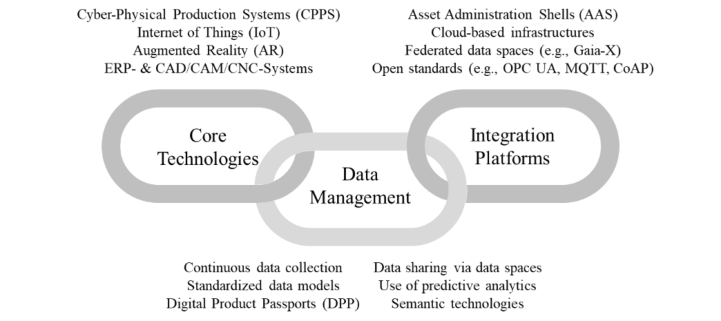
Digital Business Infrastructures DBI in manufacturing companies comprises the foundational technological, data-related, and systemic elements required to implement and interconnect digital processes, systems, and business models (Schuh et al., 2020). As the technical backbone of digitalization, they support both the automation and integration of operational processes as well as the collection, processing, and utilization of data across the industrial value chain. These infrastructures can be categorized into three core components:First, core technologies such as Enterprise Resource Planning (ERP) systems, Computer-Aided Design (CAD) / Computer-Aided Manufacturing (CAM) / Computerized Numerical Control (CNC) applications, cyber-physical production systems (CPPS), augmented reality solutions, and intelligent machine connectivity within Connected Factory and Internet of Things (IoT) frameworks (Bley and Leyh, 2016). Second, data management, enabled by digital information systems, Asset Administration Shells, data spaces, and advanced analytics, particularly in the context of predictive analysis (Ehemann et al., 2021). Third, integration platforms, which ensure connectivity between heterogeneous systems through digital integration mechanisms, adaptable IT architectures, decentralized production approaches, and federated data ecosystems like Gaia-X (Göckel and Müller, 2020).
The DBI not only provide technical capabilities but also drive strategic and organizational transformation (Steier et al., 2022). They facilitate the formation of new value creation networks, support decentralized structures, require new skill sets, and foster interdisciplinary collaboration (Steier et al., 2022) - making them highly relevant for the shift from linear to CP models. CP, in turn, places specific demands on DBI (European Comission 29.06.2022). It requires the integration of reverse material flows, lifecycle-based data models, interoperable platforms, and data-driven decision-making tools.
SYSTEMATIC LITERATURE REVIEW The literature review methodology follows the four-phase framework proposed by Liberati et al. (2009). In the identification phase, relevant publications were retrieved from selected academic databases. The screening phase focused on removing duplicates. During the eligibility phase, publications were filtered using predefined inclusion and exclusion criteria. In the final suitability phase, the remaining literature was manually assessed with the support of the ASReview tool, which applies active learning to rank and prioritize publications based on their relevance. The model is iteratively refined through researcher feedback (van de Schoot et al., 2021). Validated sources were documented in the final inclusion step. The database selection included Science Direct, Scopus, Taylor and Francis, Web of Science, chosen for their broad coverage of relevant English and German publications. The
Enabling Circular Production: Digital Business Infrastructure Adaptations 1985
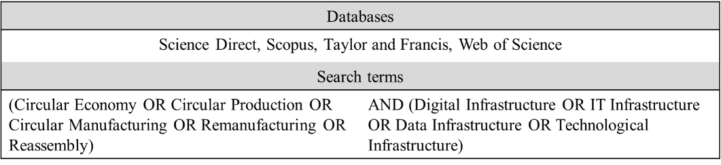
applied search string (see Figure 1) targeted literature on "Digital Business Infrastructures for circular production" by combining two keyword clusters: the strategic target state represented by CP, and the corresponding research objective focused on DBI. This approach aimed to maximize the retrieval of thematically relevant literature.
Figure 1: Search string for the systematic literature search.
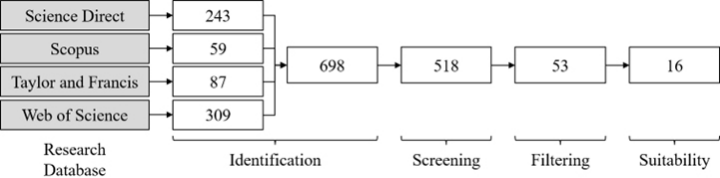
Figure 2 presents the outcomes of the applied four-phase research methodology. Out of a total of 698 records identified via the composite search strategy, 16 publications were ultimately included in the analysis. As part of the systematic literature review, only articles published in English or German were considered, while duplicates were excluded during the initial screening stage. Additionally, only studies published up to and including March 2025 within the specified databases were considered.
Figure 2: Number of identified articles in the systematic literature research.
RESULTS
To address the research question outlined in the INTRODUCTION, the selected literature was systematically analyzed and organized along the three components of DBI: core technologies, data management, and integration platforms (see Digital Business Infrastructures). The following sections synthesize the central findings within each domain, highlighting representative examples from the reviewed literature. Due to page limitations, not all identified contributions can be explored in detail; instead, emphasis is placed on particularly prominent or recurrent approaches.
Findings on Core Technologies for Circular Production Core technologies form the foundation of DBI in manufacturing and are essential for implementing circular production models. Among them, Cyber-Physical Production Systems are considered critical. Chi et al. (2023), Alshammari et al. (2025), Patyal et al. (2022), and Tanveer et al. (2023) describe how CPPS integrate physical and digital processes, enabling real-time monitoring, process optimization, and predictive maintenance. These capabilities directly contribute to resource efficiency and lifecycle transparency—particularly in recycling, remanufacturing, and disassembly. IoT technologies further support these efforts by enabling sensor-based connectivity and data exchange across systems. As highlighted by Tanveer et al. (2023), Machado et al. (2019), Nobre and Tavares (2023), and Gheorghe (2024), IoT Technologies enable improved lifecycle management and the reuse of products and components. Augmented Reality (AR) technologies, as noted by Chi et al. (2023) and Machado et al. (2019), provide visual and interactive support for tasks such as maintenance and disassembly, enhancing operational safety and promoting design for circularity. Complementary systems such as ERP (Bag et al., 2020) and CAD/CAM/CNC applications (Chi et al., 2023; Alshammari et al., 2025; Patyal et al., 2022; Machado et al., 2019) also support circular strategies— for instance, through enabling additive manufacturing or flexible spare part production when integrated into digital environments. Together, these technologies form the technical core of circular manufacturing systems.
Findings on Data Management for Circular Production Data management has been identified as playing a pivotal role in enabling CP by providing the informational basis for lifecycle-oriented decision- making. Tanveer et al. (2023), Machado et al. (2019), Gheorghe (2024), and Timperi et al. (2024) emphasize the importance of continuous data collection and integration via IoT-supported systems. These allow real- time monitoring of material composition, usage, and condition over the product lifecycle. Brasche et al. (2023) and Pourjafarian et al. (2023) highlight the relevance of standardized digital representations, such as Asset Administration Shells (AAS), which structure information exchange across stakeholders and serve as a basis for Digital Product Passports (DPP) that track materials and products throughout their lifecycle. Data spaces, such as those initiated by Gaia-X, are also emphasized by Brasche et al. (2023) as key infrastructures for secure and federated data sharing across organizations. Furthermore, Tanveer et al. (2023), Machado et al. (2019), Timperi et al. (2024), and Asif et al. (2018) point to the potential of advanced analytics – especially predictive approaches – to forecast failures, optimize maintenance timing, and extend product life. Kurteva et al. (2024) stress that semantic technologies, including ontologies and knowledge graphs, enhance interoperability and knowledge exchange by standardizing data and enriching it with context. Collectively, these elements form a robust data management foundation for circular value creation.
Enabling Circular Production: Digital Business Infrastructure Adaptations 1987
Findings on Integration Platforms for Circular Production Integration platforms ensure system-wide connectivity and interoperability across the circular value chain. Timperi et al. (2024) highlight how AAS and DPP enable structured information exchange through standardized, reusable asset data models. Brasche et al. (2023) emphasize the role of cloud- based infrastructures in enabling collaborative digital twin management and ensuring scalable computing resources. Gaia-X, as outlined by Brasche et al. (2023), provides a trusted framework for federated data spaces and secure data exchange based on common governance standards. Gheorghe (2024) underlines the importance of IT/OT convergence for real-time integration between shop floor and enterprise systems – essential for predictive maintenance, smart loops, and service-oriented models. Asif et al. (2018) expand on platform functionalities, including IoT-based data collection, asset tracking, and condition monitoring. Semantic technologies further support these efforts by improving interoperability, as noted by Asif et al. (2018). To ensure compatibility with key Industry 4.0 technologies like CPPS, IoT, cloud manufacturing, and big data analytics, Tanveer et al. (2023) and Machado et al. (2019) emphasize the need for horizontal and vertical system integration. Finally, Gheorghe (2024) points to open standards such as Open Platform Communications Unified Architecture (OPC UA), Message Queuing Telemetry Transport (MQTT), and Constrained Application Protocol (CoAP) as crucial for vendor-independent connectivity. In sum, integration platforms represent the digital backbone that enables transparency, collaboration, and coordinated decision-making across circular production networks
DISCUSSION
The analysis of the identified literature confirms the central role of infrastructure in enabling CP.The DBI is seen as a key enabler of transparency, data availability, and lifecycle-oriented management. Figure 3 summarizes the key elements of DBI for CP.
A first critical observation concerns the limited specificity with which core technologies are addressed in the reviewed literature. ERP systems, apart from Bag et al. (2020), receive little attention, despite providers like SAP actively developing circular solutions (Galer, 2022). IoT technologies are also only superficially discussed. This reduces the practical applicability of the findings for businesses – although such product-specific focus consequently is not included in the scope of product-neutral academic research.
A significant limitation in the literature lies in its fragmented perspective on the development of DBI. While individual components – such as Asset Administration Shells, cloud systems, or data platforms – are often examined in detail, their integration into coherent and adaptive infrastructure strategies remains largely underexplored. DBI are frequently considered in isolation, and only a few contributions adopt a systemic view that takes into account the interdependencies between technologies, operational processes, and organizational structures. Moreover, there is limited discussion on how these elements interact with business models or align with the operational realities
of firms. This lack of integration is particularly problematic in transitional contexts, where hybrid or evolving systems require DBI that are not only technologically robust but also flexibly embedded in broader transformation strategies.
Figure 3: Visualization of the BPI components for CP.
Building such integrated DBI presents considerable challenges for companies. These include ensuring cross-functional coordination, harmonizing data standards across organizational boundaries, and integrating legacy systems with emerging digital solutions. In addition, the absence of clear governance frameworks and limited platform interoperability can hinder seamless data exchange along the value chain. Overcoming these barriers demands not only technological innovation but also organizational change capacity, strategic alignment, and stakeholder engagement – dimensions that are often underestimated in the current academic discourse.
CONCLUSION AND RESEARCH OUTLOOK Adapting DBI for CP is necessary across Core Technologies, Data Management, and Integration Platforms, underscoring both the complexity of CP and the transformative demands on manufacturing companies. The findings provide initial guidance for assessing DBI transformation needs and planning targeted development paths. However, effective transformation requires more than DBI alone: physical, financial, and organizational infrastructures are also critical. Given the complexity and interdependencies, a holistic approach integrating all infrastructures is essential. Future research should develop integrated frameworks that address these interconnections and support cross-functional implementation in practice.
REFERENCES
Alshammari, Serhan Shaman/Ani, Uchenna Daniel/Sarfraz, Shoaib/Okorie, Okechukwu/Salonitis, Konstantinos (2025). Digital Capability as an Enabler of Circular Economy in Saudi Arabia’s Manufacturing Sector.
Enabling Circular Production: Digital Business Infrastructure Adaptations 1989
Asif, Farazee M. A./Roci, Malvina/Lieder, Michael/Rashid, Amir/Štimulak, Mitja/ Halvordsson, Erik/Bruijckere, Ruud (2018). A practical ICT framework for transition to circular manufacturing systems. Procedia CIRP 72, 598–602. https:// doi.org/10.1016/j.procir.2018.03.311 Bag, Surajit/Dhamija, Pavitra/Gupta, Shivam/Sivarajah, Uthayasankar (2020).
Examining the role of procurement 4.0 towards remanufacturing operations and circular economy. Production Planning & Control (16), 1368–1383. https:// doi.org/10.1080/09537287.2020.1817602 Bley, Katja/Leyh, Christian (2016). Status Quo der Digitalisierung deutscher Industrieunternehmen - Eine Studie ausgewählter Unternehmen. In: Volker Nissen/Dirk Stelzer/Steffen Straßburger et al. (Eds.). Multikonferenz Wirtschaftsinformatik (MKWI) 2016. Technische Universität Ilmenau, 09. - 11. März 2016. Ilmenau, Universitätsverlag Ilmenau, 1651–1662. Brasche, Götz Philip/Eichinger, Josef/Grotepass, Juergen (2023). The Role of Digital
Twins for Trusted Networks in the “Production as a Service” Paradigm. In: Noel Crespi (Ed.). The Digital Twin. Cham, Springer International Publishing AG, 181–203. Chi, Ziyuan/Liu, Zhen/Wang, Fenghong/Osmani, Mohamed (2023). Driving Circular Economy through Digital Technologies: Current Research Status and Future Directions. Sustainability 15 (24) 2023. Egala, Sulemana B./Amoah, John/Bashiru Jibril, Abdul/Opoku, Robert/Bruce, Emmanuel (2024). Digital transformation in an emerging economy: exploring organizational drivers. Cogent Social Sciences 10 (1). https://doi.org/10.1080/ 23311886.2024.2302217 Ehemann, Tobias/Tafvizi Zavareh, Mona/Göbel, Jens C./Dupont, Stephanie/ Zink, Klaus J./Siedler, Carina/Aurich, Jan C. (2021). Mit dem InAsPro- Transformationskonzept die Digitalisierung planen. In: Wilhelm Bauer/Susanne Mütze-Niewöhner/Sascha Stowasser et al. (Eds.). Arbeit in der digitalisierten Welt. Berlin, Heidelberg, Springer Berlin Heidelberg, 205–222. Ellen MacArthur Foundation (Ed.) (2013). Towards the circular economy. Vol. 1:
an economic and business rationale for an accelerated transition. Available online at https://www.ellenmacarthurfoundation.org/towards-the-circular-economy-vol- 1-an-economic-and-business-rationale-for-an. European Comission (2022). Twinning the green and digital transitions in the new geopolitical context. 2022 Strategic Foresight Report. Brüssel. Available online at https://eur-lex.europa.eu/legal-content/EN/TXT/?uri=CELEX:52022DC0289. Göckel, Nicole/Müller, Patrick (2020). Entwicklung und Betrieb Digitaler Zwillinge.
Zeitschrift für wirtschaftlichen Fabrikbetrieb 115 (s1), 7–10. https://doi.org/ 10.3139/104.112321 Galer, Susan (2022). Can Remanufacturing Build the Industrial-Sized Circular Economy? Available online at https://news.sap.com/2022/12/remanufacturing- build-industrial-circular-economy/. Gheorghe, Sorin-Daniel (2024). A Review of the Information Technology and
Operational Technology Convergence Using Internet of Things within the Circular Economy. Proceedings of the International Conference on Business Excellence 18 (1) 2024. Ghisellini, Patrizia/Cialani, Catia/Ulgiati, Sergio (2016). A review on circular economy: the expected transition to a balanced interplay of environmental and economic systems. Journal of Cleaner Production 114, 11–32. https://doi.org/ 10.1016/j.jclepro.2015.09.007
Kirchherr, Julian/Reike, Denise/Hekkert, Marko (2017). Conceptualizing the circular economy: An analysis of 114 definitions. Resources, Conservation and Recycling 127, 221–232. https://doi.org/10.1016/j.resconrec.2017.09.005 Kraft, Michael Hans Gino/Christ, Oliver/Scherer, Lukas Andreas (2022). Management der Kreislaufwirtschaft. Positionierung und Gestaltung zirkulärer Unternehmen. Wiesbaden/Heidelberg, Springer Gabler. Kurteva, Anelia/McMahon, Kathleen/Bozzon, Alessandro/Balkenende, Ruud (2024).
Semantic Web and its role in facilitating ICT data sharing for the circular economy: An ontology survey. Semantic Web 15 (5) 2024. Liberati, Alessandro/Altman, Douglas G./Tetzlaff, Jennifer/Mulrow, Cynthia/ Gøtzsche, Peter C./Ioannidis, John P. A./Clarke, Mike/Devereaux, P. J./Kleijnen, Jos/Moher, David (2009). The PRISMA statement for reporting systematic reviews and meta-analyses of studies that evaluate health care interventions: explanation and elaboration. PLoS medicine 6 (7), e1000100. https://doi.org/ 10.1371/journal.pmed.1000100 Lieder, Michael/Rashid, Amir (2016). Towards circular economy implementation: a comprehensive review in context of manufacturing industry. Journal of Cleaner Production 115, 36–51. https://doi.org/10.1016/j.jclepro.2015.12.042 Machado, Carla Gonçalves/Winroth, Mats Peter/Da Ribeiro Silva, Elias Hans Dener
(2019). Sustainable manufacturing in Industry 4.0: an emerging research agenda. International Journal of Production Research (5), 1462–1484. https://doi.org/ 10.1080/00207543.2019.1652777 Nobre, Gustavo Cattelan/Tavares, Elaine (2023). The role of Industry 4.0 technologies in the transition to a circular economy: A practice perspective. Sustainability: Science, Practice and Policy 19 (1, 2289260), 1–18. https://doi.org/ 10.1080/15487733.2023.2289260 Okorie, Okechukwu/Salonitis, Konstantinos/Charnley, Fiona/Moreno, Mariale/ Turner, Christopher/Tiwari, Ashutosh (2018). Digitisation and the Circular Economy: A Review of Current Research and Future Trends. Energies 11 (11), 3009. https://doi.org/10.3390/en11113009 Patyal, Vishal Singh/Sarma, P. R. S./Modgil, Sachin/Nag, Tirthankar/Dennehy,
Denis (2022). Mapping the links between Industry 4.0, circular economy and sustainability: A systematic literature review. Journal of Enterprise Information Management 35 (1) 2022. Pourjafarian, Monireh/Plociennik, Christiane/Rimaz, Mohammad Hossein/Stein, Peter/Vogelgesang, Malte/Li, Chanchan/Knetsch, Svenja/Bergweiler, Simon/ Ruskowski, Martin (2023). A Multi-Stakeholder Digital Product Passport Based on the Asset Administration Shell. Schuh, Günther/Anderl, Reiner/Dumitrescu, Roman/Krüger, Antonio/Hompel, Michael ten (2020). Industrie 4.0 Maturity Index. Managing the Digital Transformation of Companies – UPDATE 2020. acatech STUDY. Available online at https://en.acatech.de/publication/industrie-4–0-maturity-index-update-2020/. Steier, Gwen/Schäfer, Louis/Moser, Simon/Kandler, Magnus/Lanza, Gisela (2022). Digitale Transformation in global produzierenden Unternehmen/Digital Transformation in global manufacturing companies. wt Werkstattstechnik online 112 (05), 314–319. https://doi.org/10.37544/1436–4980-2022–05-44 Steinhilper, Rolf (1998). Remanufacturing. The ultimate form of recycling. Stuttgart,
Fraunhofer-IRB-Verl. Tanveer, Umair/Kremantzis, Marios Dominikos/Roussinos, Nikos/Ishaq, Shamaila/ Kyrgiakos, Leonidas Sotirios/Vlontzos, George (2023). A fuzzy TOPSIS model for selecting digital technologies in circular supply chains. Supply Chain Analytics 4, 100038. https://doi.org/10.1016/j.sca.2023.100038
Enabling Circular Production: Digital Business Infrastructure Adaptations 1991
Timperi, Mira/Kokkonen, Kirsi/Hannola, Lea (2024). Digital twins for environmentally sustainable and circular manufacturing sector: Visions from industry professionals. Production & Manufacturing Research 12 (1), 2428249 https://doi.org/10.1080/21693277.2024.2428249 Upadhayay, Sugam/Alqassimi, Omaima (2018). Transition from Linear to Circular Economy. Westcliff International Journal of Applied Research 2 (2), 62–74. https://doi.org/10.47670/wuwijar201822oasu Urbinati, Andrea/Chiaroni, Davide/Chiesa, Vittorio (2017). Towards a new taxonomy of circular economy business models. Journal of Cleaner Production 168, 487–498. https://doi.org/10.1016/j.jclepro.2017.09.047 van de Schoot, Rens/Bruin, Jonathan de/Schram, Raoul/Zahedi, Parisa/Boer, Jan de/Weijdema, Felix/Kramer, Bianca/Huijts, Martijn/Hoogerwerf, Maarten/ Ferdinands, Gerbrich/Harkema, Albert/Willemsen, Joukje/Ma, Yongchao/Fang, Qixiang/Hindriks, Sybren/Tummers, Lars/Oberski, Daniel L. (2021). An open source machine learning framework for efficient and transparent systematic reviews. Nature Machine Intelligence 3 (2), 125–133. https://doi.org/10.1038/ s42256–020-00287–7
LISTED IN THE AHFE DIGITAL BOOKSTORE CATALOGUE
Explore the complete digital volume
Human Factors in Design, Engineering, and Computing
Read this individual research paper free through the original publisher, or explore the full digital proceedings book.
ISBN 978-1-964867-75-5
Explore this ISBN in the AHFE Bookstore ↗Listed in the July 2026 bookstore catalogue; search by ISBN to confirm current availability · Digital book purchase optional