Gulshan Kumar Yadav, Prateek Singh, Titas Bhattacharjee, Atasi Mohanty (2025). Corporate Social Responsibility of Indian Small Businesses: A Post-Mandate Analysis. In: Human Factors in Design, Engineering, and Computing. AHFE Open Access, vol. 199, pp. 1933–1940. https://doi.org/10.54941/ahfe1007004
What drives Indian small businesses to embrace Corporate Social Responsibility (CSR)—genuine commitment or mere compliance? To address this question, this study analyses CSR engagement post-mandate under the Companies Act, 2013, categorizing businesses into high, moderate, and low spenders. The analysis integrates Carroll's Pyramid of CSR, Stakeholder Theory, and Institutional Theory to examine strategic motivations and implementation patterns. Using secondary data and KMeans clustering, the study highlights significant sectoral and regional disparities in CSR spending. While businesses allocate resources towards key developmental areas, some societal and environmental priorities receive relatively limited attention. The distribution of CSR resources also exhibits regional disparities, with economically developed areas benefiting from higher allocations, while less developed regions receive relatively lower support. Findings suggest that institutional pressures—coercive (regulatory), mimetic (industry trends), and normative (stakeholder expectations)—influence CSR decision-making. The study offers recommendations to enhance CSR’s developmental impact and strengthen corporate accountability for equitable social investment.
CSR has evolved from a voluntary, profit-driven endeavour to a comprehensive socio-economic obligation, demonstrating its growing significance in modern society (Bashir, 2024). Globally, Fortune 500 firms spend more than $20 billion per year to CSR (ESADE Business School, 2022), demonstrating its ability to transform the socio-economic landscape. However, a fundamental question arises: do such attempts actually address systemic issues, or are they merely compliance exercises?
This question is especially relevant in India, which made history as the first country to require CSR under the Companies Act of 2013. While this legislation has increased corporate involvement in social activities, the
consequences, particularly among small businesses, remain unknown. Small enterprises, which are frequently strongly rooted in their communities, play an important role in grassroots development. Yet, their contributions to CSR have received limited academic attention.
The research aims to address this gap by posing three key questions:
1. Does the mandated CSR approach encourage genuine corporate commitment or surface-level compliance among Indian small businesses? 2. How do institutional and normative pressures shape CSR decision- making among Indian small businesses? 3. What implementation challenges do Indian small businesses face in executing CSR effectively, and how do their execution strategies impact developmental outcomes?
This study develops a comprehensive framework by integrating Carroll’s Pyramid of CSR, Stakeholder Theory, and Institutional Theory to analyse CSR practices in Indian small businesses. By highlighting corporate responsibility, stakeholder engagement, and institutional influences, it bridges conceptual gaps and offers insights to enhance CSR’s developmental impact under the Companies Act of 2013.
LITERATURE REVIEW
CSR has been widely studied in both global and Indian contexts, with scholars such as Kumar (2017) and Devi (2014) emphasizing its role in enhancing business performance and reputation. However, these works largely rely on qualitative or case-based methods, limiting their ability to identify broader patterns. For instance, Kumar (2017) draws on anecdotal evidence to highlight CSR’s benefits, while Sharma et al. (2020) focus on qualitative outcomes without robust statistical backing, leaving questions on the overall effectiveness of CSR programs. Similarly, reliance on voluntary disclosures often results in bias and inconsistencies.
In the Indian context, research also shows methodological and conceptual gaps. Pradhan (2016) examines CSR within business strategies but overlooks the Companies Act of 2013 mandate, while Oberoi (2018) stresses strategic alignment but fails to capture compliance-driven realities in small firms. Sectoral and regional disparities noted by Chen et al. (2020) remain insufficiently analysed, creating further blind spots. Furthermore, contradictions persist in scholarship as Farhan (2024) views CSR as shallow, driven by compliance, whereas Bansal et al. (2021) underline its transformative potential for socio-economic development, underscoring the need for further nuanced analysis.
Addressing these gaps, the present study adopts a quantitative approach using KMeans clustering to classify CSR initiatives, supported by secondary data from the National CSR Portal. By analysing sectoral allocations, geographic imbalances, and implementation methods, this research provides more comprehensive and impartial findings. Distinct from prior studies, it integrates Carroll’s Pyramid of CSR, Stakeholder Theory, and Institutional Theory to construct a holistic framework for understanding CSR practices among Indian small businesses post the Companies Act of 2013.
Corporate Social Responsibility of Indian Small Businesses: A Post-Mandate Analysis 1935
In summary, this study addresses critical gaps in the literature by:
1. Examining the context of Indian small businesses, which has received little attention. 2. Providing data-driven insights by going beyond qualitative analysis.
THEORETICAL FRAMEWORK This study examines CSR practices of Indian businesses after the Companies Act 2013 through an integrated framework combining Carroll’s Pyramid, Stakeholder Theory, and Institutional Theory. Carroll’s framework highlights how firms comply with legal and philanthropic responsibilities, with clustering into high, moderate, and low spenders used to assess their strategic priorities and levels of engagement.
Stakeholder Theory is applied to evaluate the allocation of CSR funds across mandated sectors, reflecting how businesses align with community and government needs while employees remain excluded as direct beneficiaries. This perspective emphasizes the role of CSR in fulfilling the broader mandate of societal welfare.
Institutional Theory explains how coercive, normative, and mimetic pressures influence corporate behaviour under the mandated CSR regime. By integrating all three frameworks, the study captures business obligations, stakeholder alignment, and external influences, providing a coherent view of how small firms navigate CSR in India.
METHODOLOGY
The study uses a methodological approach, to analyse CSR practices using an integrated framework.
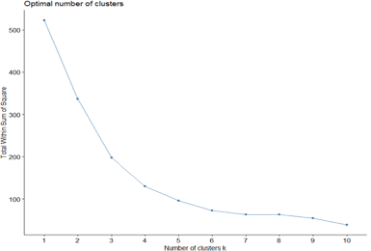
1. Data Source: CSR data (2013–2020) was collected from the National CSR Portal, covering 173 BSE-listed small-cap firms with consistent reporting to ensure reliability. 2. Data Preparation: Incomplete entries were excluded, outliers treated via the IQR method, and Z-score normalization applied to CSR expenditure, project count, and average spending for accuracy. 3. Clustering Method: KMeans clustering was employed for its simplicity and efficiency (Raykov et al., 2016; Murtagh & Contreas, 2017), classifying firms by key CSR attributes. 4. Cluster Optimization: The elbow method using WCSS determined three optimal clusters (k = 3) for this study. 5. KMeans Workflow: The algorithm initializes centroids, assigns points using Euclidean distance, updates centroids as cluster means, and iterates until convergence.
Optimal Number of Clusters
1. The elbow method, based on plotting the within-cluster sum of squares WCSS against the number of clusters, identifies the optimal clustering point where the curve bends. This analysis reveals three groups of companies: Cluster 1 (High Spenders) with large expenditures and many
projects, Cluster 2 (Moderate Spenders) with balanced spending and project counts, and Cluster 3 (Low Spenders) with minimal investment and limited project involvement.
The clusters’ characteristics are summarized in the table below:
Intermediate Visualizations Intermediate steps of the methodology are visualized for clarity and transparency:
Elbow Method Plot: A line graph depicting WCSS against the number of clusters was included to illustrate the choice of k = 3 (Figure 1).
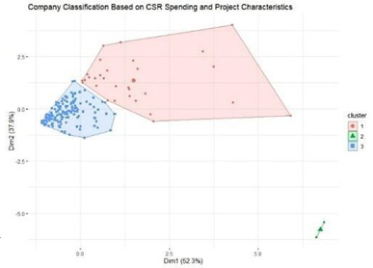
Figure 1: Optimal number of cluster.Figure 2: Cluster visualisation.
Corporate Social Responsibility of Indian Small Businesses: A Post-Mandate Analysis 1937
Cluster Visualization: Scatter plots with data points color-coded by cluster highlighted the grouping of companies based on CSR characteristics (Figure 2).
KMeans clustering with preprocessing reveals CSR spending patterns, with Figure 2 showing Dim1 (52.3%) distinguishing heavy from minimal spenders and Dim2 (37.9%) capturing project diversity.
RESULTS AND ANALYSIS The analysis of CSR investment patterns, based on the outlined methodology, identifies three distinct clusters among Indian small-cap businesses, with results categorized and discussed according to these clusters.
CSR Investment Levels and Strategies Across Clusters
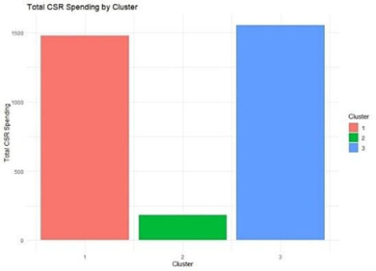
Figure 3 shows high spenders with |1,479 crores in CSR, demonstrating broad societal focus through strong compliance and proactive philanthropic contributions.
Figure 3: Total CSR spending by cluster.
Moderate spenders invest |182 crore with cautious compliance, while low spenders allocate |1,555 crore to localized projects lacking systemic reach, reflecting diverse CSR strategies shaped by community ties and capacity.
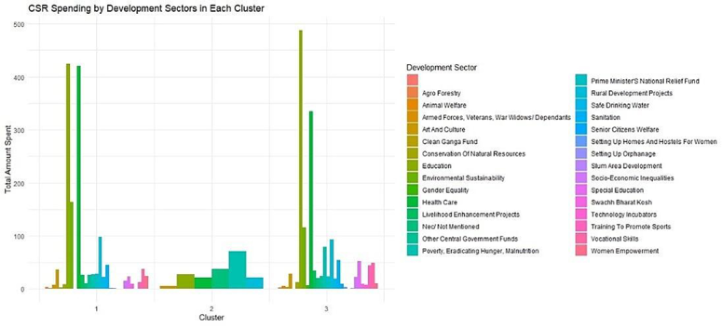
Sectoral Priorities and Allocation Patterns Fig. 4 shows small businesses prioritizing healthcare (|424.86 crore) and education (|421.09 crore), while areas like gender equality (<|50 crore) and environmental sustainability (|163.33 crore) remain underfunded, reflecting missed opportunities for inclusive growth.
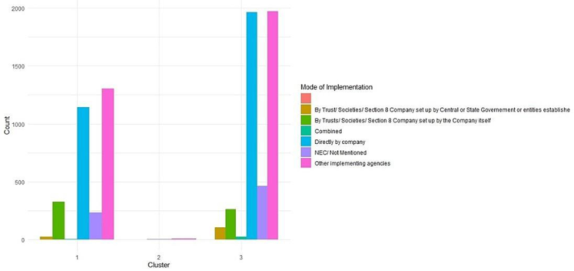
The “Not Specified” category poses a major challenge, with 464 cases among low spenders and 235 among high spenders (Fig. 4), as it obscures sectoral priorities and risks overshadowing critical underfunded areas like gender equality and environmental sustainability, which already receive disproportionately less support compared to healthcare and education.
Figure 4: Total CSR spending by cluster.
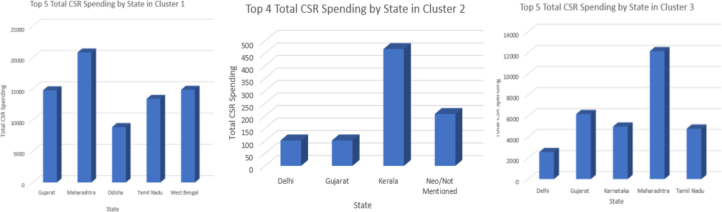
Geographical Imbalances in CSR Practices Fig. 5 shows Maharashtra receiving the highest CSR funds (|20,962 crore), driven by its economic hub status and corporate preference for proximity and convenience.
Figure 5: CSR beneficiary states by cluster.
Despite pressing needs, North-Eastern states receive minimal CSR funds (Appendix), reflecting convenience-driven allocations, focus on measurable sectors, and lack of incentives. This imbalance aligns with Institutional Theory, where coercive compliance coexists with mimetic and normative pressures favouring developed states and visible sectors.
Implementation Strategies The findings show varied CSR execution strategies, with high spenders (Fig. 6) combining in-house projects (1,141) and collaborations (1,304) to balance control with external expertise for wider impact.
Low spenders rely on third-party organizations due to limited capacity, meeting compliance but risking accountability gaps, while contrasting patterns show high spenders’ strategic flexibility versus resource-driven constraints of low spenders.
Corporate Social Responsibility of Indian Small Businesses: A Post-Mandate Analysis 1939
Figure 6: Mode of implementation by cluster.
CONCLUSION
This study examines CSR practices of Indian small businesses under the Companies Act 2013 through Carroll’s Pyramid, Stakeholder Theory, and Institutional Theory, showing that regulatory, stakeholder, and institutional pressures drive engagement. Firms cluster into high, moderate, and low spenders with distinct strategies, focusing on healthcare and education while underfunding gender equality and sustainability. Regional imbalances favour Maharashtra over the North-East, and differing implementation models expose governance gaps, underscoring the need for stronger policies to ensure inclusivity, transparency, and equity.
ACKNOWLEDGMENT
The authors would like to acknowledge the support of Rajendra Mishra School of Engineering Entrepreneurship and Rekhi Centre of Excellence for the Science of Happiness at IIT Kharagpur for providing research facilities. Finally, we are grateful to our colleagues and reviewers for their valuable comments and suggestions.
APPENDIX
REFERENCES
Bansal, S., Garg, I., & Sharma, G. D. (2021). Socially responsible investment in India: An integrated approach. Resources Policy, 73, 102148. https://doi.org/10.1016/j. resourpol.2021.102148 Bashir, R. (2024). The evolving landscape of CSR in contemporary business practices.
Journal of Business Ethics and Corporate Responsibility, 45(2), 123–135. Chen, Z., Li, L., & Hong, B. (2020). The effect of mandatory CSR disclosure on firm profitability: Evidence from China. Journal of Business Ethics, 162(2), 389–411. Devi, S. U. (2014). Corporate social responsibility initiatives of Indian companies: A
study. International Journal of Management and Social Sciences Research, 3(6), 81–87. ESADE Business School. (2022, December 1). The end of CSR as we know it and the rise of businesses with a conscience. Forbes. https: //www.forbes.com/sites/esade/2022/12/01/the-end-of-csr-as-we-know-it-and -the-rise-of-businesses-with-a-conscience/ Farhan, H. (2024). Analysing the impact of mandatory CSR on Indian companies: A data- driven approach. Corporate Governance: The International Journal of Business in Society, 24(1), 12–26. Kumar, K. (2017). Corporate social responsibility: A case study of Tata Group.
Journal of Business Ethics and Corporate Responsibility, 20(2), 101–110. Murtagh, F., & Contreras, P. (2017). Algorithms for hierarchical clustering: an overview, II. Wiley Interdisciplinary Reviews: Data Mining and Knowledge Discovery, 7(6), e1219. Oberoi, R. (2018). Institutionalizing CSR: The role of regulation and corporate
governance. Journal of Business Ethics, 150(2), 509–525. Pradhan, S. (2016). Corporate social responsibility in India: A study of select organizations. Journal of Business Ethics, 15(3), 78–89. Raykov, Y. P., Boukouvalas, A., Baig, F., & Little, M. A. (2016). What to do when
K-means clustering fails: a simple yet principled alternative algorithm. PloS one, 11(9), e0162259. Sharma, A., Sharma, S., & Kaushik, K. (2020). CSR and financial performance: A study of Indian firms. Journal of Corporate Finance, 22(4), 345–360.
LISTED IN THE AHFE DIGITAL BOOKSTORE CATALOGUE
Explore the complete digital volume
Human Factors in Design, Engineering, and Computing
Read this individual research paper free through the original publisher, or explore the full digital proceedings book.
ISBN 978-1-964867-75-5
Explore this ISBN in the AHFE Bookstore ↗Listed in the July 2026 bookstore catalogue; search by ISBN to confirm current availability · Digital book purchase optional