Luca Lanz, Eva Maria Knoch, Matthias Vollat, Albert Albers (2025). Investigation of research gaps and needs with regard to the use of model-based systems engineering for the development of barrier-free vehicles. In: Human Systems Engineering and Design (IHSED2025): Future Trends and Applications. AHFE Open Access, vol. 198, pp. 418–428. https://doi.org/10.54941/ahfe1006795
Systems Engineering (SE) and in particular Model-Based Systems Engineering (MBSE) are disciplines that are particularly suitable for the development of complex systems. MBSE is therefore often used for developments in the fields of vehicle technology and mobility systems, as these systems are highly complex. In these areas, there is a clear trend in research and development towards innovative and sustainable public mobility systems. For this purpose, vehicles are being developed that are specially adapted for use in the respective mobility systems and are designed to meet the needs of customers. An important feature of vehicles used in such a mobility system, which is intended for the general public, is that the vehicles should be as accessible and barrier-free as possible.The integration of systems that can be used for the barrier-free design of vehicles is also characterised by a high degree of complexity. This is due to the very different requirements that different types of mobility restrictions entail, the technical design of the systems themselves, the interaction of the individual systems and the limitations imposed by the vehicles in terms of payload and installation space. By adding the high degree of complexity of the vehicles themselves, an accessible or barrier-free vehicle therefore represents a system with a high degree of complexity. However, the integration of accessibility elements into an existing vehicle is also associated with a high degree of complexity for the reasons mentioned above.Due to the complexity associated with the barrier-free vehicle system, the use of MBSE to develop vehicles that are as barrier-free as possible seems very sensible. Due to the relatively large proportion of people with mobility impairments, ethical aspects and the legal framework in various countries that prioritise inclusion, the topic of barrier-free mobility is also highly relevant. For these reasons, a closer look at the use of MBSE for the development of accessible vehicles is justified. For the reasons explained above, this article will first analyse the extent to which MBSE is already being used for the development of accessible vehicles. In particular, the methods and tools of MBSE that have been designed specifically for the development of accessible vehicles or that support them are analysed. For this purpose, a systematic literature review is carried out, which shows that there are large research gaps with regard to the use of MBSE for the development of barrier-free vehicles. The next step of the article examines and justifies why there is a need to close the identified research gaps, so that a need for research is identified. Furthermore, the article looks at which approaches exist in the literature that could be used to design MBSE methods and tools that address the development of accessible vehicles. This step also includes an analysis that identifies the gaps and needs in the area of tools for the development of accessible vehicles beyond the MBSE.
Transport is important for everyone to live a fulfilling life and it plays a role in various aspects of daily life (Bezyak et al., 2017). Improved accessibility of transport systems can provide advantages for people with disabilities as they have a greater geographical reach, which can, for example, improve access to jobs, healthcare, educational facilities and social networks (Federing and Lewis, 2017). On the other hand a gap in the access to transport leads to social exclusion (Kamruzzaman et al., 2016). There are various laws and regulations with different geographical scopes that deal with rights related to inclusive mobility, barrier-free transport systems and similar issues (Federing and Lewis, 2017). Table 1 below shows examples of political and legal frameworks in Germany, that are relevant for the inclusion of people with mobility impairments and work towards this. The contents shown in the
Investigation of Research Gaps and Needs With Regard to the Use of Model-Based Systems 419
table make clear that there are legal foundations in Germany that require the inclusion of people in the context of mobility. It also demonstrates that such regulations also exist for the scope of the European Union.
Table 1: relevant laws regarding the inclusion of people with impaired mobility in Germany.
Table available in the original PDF paper.
Law/Act/Source Relevant Content Law for the Federal Republic of Germany (abbr., Ger.: GG) Article 3(3) states that “no person shall be disfavoured because of disability” Social Code - Book IX - Rehabilitation and Participation of Disabled Persons (abbr., Ger.: SGB IX)
Regulates services for people with disabilities in the context of mobility regarding their rehabilitation and participation (e. g. §1, §83).
German Act on Equal Opportunities for Persons with Disabilities (abbr., Ger.: BGG)
Aims to “eliminate discrimination against people with disabilities […]”. §8 obliges federal public bodies to make their services barrier-free. This also includes means of transport in local public transport, insofar as these are the responsibility of the federal government.
General Equal Treatment Act (abbr., Ger.: AGG)
Aims to eliminate disadvantages based on different reasons, including disadvantages based on disabilities (§1) and prohibits discrimination based on disability (§7).
European Accessibility Act (EAA) – Directive (EU) 2019/882 & The Accessibility Reinforcement Act (abbr., Ger.: BFSG)
Member States (including Germany) must ensure barrier-free access to all products and services covered by the Directive ((EU) 2019/882) and placed on the market or provided after June 28, 2025. This explicitly includes various passenger transport services, such as bus, rail, waterway, urban/suburban, and regional transport services. The BFSG serves to implement Directive (EU) 2019/882 and the EAA in Germany.
In the last decades, the number of publications on accessibility issues in general has increased significantly (as of 2019) (Yuji et al., 2020). Some of the work in that field deals with barrier-free or accessible design in connection with people with mobility impairments. A study by Sammer et al., states that more people feel restricted in their mobility than those who are normally considered as restricted and disabled. According to the authors, more than one third of the Austrian population is considered to have impaired mobility (Sammer et al., 2012). In addition the Road and Transportation Research Association in Germany assumes that also one-third of the German population has mobility restrictions in the broad sense (FGSV, 2011). In general, various causes and types of mobility impairments can
be identified. One categorisation that is used in the literature and covers a broad spectrum of mobility impairments is the one of Sammer et al., At the first level, the authors distinguish between the following categories: Physical or sensory disability; Lack of language skills or impaired; Living in rural area without own car; Mobility-impaired family; Age; At risk of poverty (Sammer et al., 2012). By getting from point A to point B, people with mobility impairments are potentially confronted with different barriers (Neven and Ectors, 2023; Sammer et al., 2012). Various individual and context-related factors influence the mobility options of people with special mobility needs (Wu et al., 2017). The individual barriers that people with mobility impairments experience when travelling are related to different aspects and objects of the journey (Załuska et al., 2022). One aspect of mobility that is often addressed in the context of barrier-free or accessible design for people with impaired mobility (and especially people with disabilities) is the transport of people in terms of the use of transport systems or vehicles (Załuska et al., 2022; Prerowsky et al., 2022). People with mobility impairments have special requirements and needs when it comes to the design of transport systems or vehicles. The respective needs differ depending on the exact individual mobility impairment (Sze and Christensen, 2017; Lindner, 2021; Park and Chowdhury, 2018; Bezyak et al., 2017; Dicianno et al., 2021). However, the requirements and personalisation needs of different types of disabilities are often disregarded in the literature (Bastola et al., 2025). In this paper, the focus within barrier-free and accessible mobility is on the development, design and usability of vehicles.
To summarize, accessibility of mobility systems and the inclusion of people with mobility restrictions, as shown above, are important and partly mandatory for ethical and legal reasons. However, there are various gaps in the realisation of barrier-free and accessible mobility that need to be closed, e.g. one in three people with an impairment sometimes do not dare to travel independently (Bolz et al., 2022). Since it is often difficult for people with mobility impairments to reach their destinations, researchers and authorities are forced to investigate the role of transportation as an enabling factor for people with mobility impairments (Márquez et al., 2019).
REASONS FOR THE USE OF MODEL-BASED SYSTEMS ENGINEERING (MBSE) IN THE AREA UNDER CONSIDERATION The introduction describes the importance and necessity of barrier-free and accessible vehicle design. In the further course of this paper, initially the extent to which model-based systems engineering (MBSE) is currently being used to develop or design such vehicles is examined. For this purpose, a literature analysis is carried out. To justify such an investigation, this section first explains the reasons for using MBSE in the development of barrier-free and accessible vehicles.
The International Council on Systems Engineering (INCOSE) describes MBSE as “the formalized application of modelling to support system requirements, design, analysis, verification and validation activities beginning in the conceptual design phase and continuing throughout development and
Investigation of Research Gaps and Needs With Regard to the Use of Model-Based Systems 421
later life cycle phases” (International Council on Systems Engineering, 2007). One goal of MBSE can be seen in the documentation of the results of various development activities in a central, common system model and in enabling context-specific views (Huth and Vietor, 2020). MBSE improves the completeness, consistency and communication of requirements and thus the efficiency of the development of complex systems (Carroll and Malins, 2016). Due to its advantages, MBSE is widely accepted in the development of complex systems (Maschotta et al., 2013). The following points outline which characteristics of barrier-free vehicles indicate, that the use of MBSE is potentially suitable and advantageous for their development:
Barrier-free vehicles as complex systems: Vehicles themselves, and especially modern vehicles, are explicitly described in the literature as complex systems (Kriebel et al., 2017; Angermeier and Eichler 2016; Stabili et al., García-Urbieta et al., 2020). Also the development of modern vehicles is becoming more and more complex and involves various innovations (Athanasas and Dear, 2004). Barrier-free vehicles can therefore generally be regarded as a complex overall System (of Systems). In addition, different subsystems and technologies are currently or prospectively relevant for the barrier-free and accessible design and use of vehicles, which are themselves characterised by a certain degree of complexity. Examples of this are lifts for people in wheelchairs or systems with Human-Machine Interfaces (Wirtz et al., 2024; Meinhardt et al., 2025). Furthermore, the use of autonomous vehicles for the realisation of barrier-free mobility is being discussed and researched (Golbabaei et al., 2024; Bayless and Davidson, 2019). Because, as mentioned above, MBSE offers advantages in the development of complex systems, it seems to be advantageous for the development of barrier-free vehicles.
Variety and diversity of requirements: As mentioned in the introduction, the needs of people with mobility impairments differ depending on the individual type of the impairment. Some sources show that the requirements and needs of people with mobility impairments with regard to the design of vehicles also vary depending on the type of mobility impairment (Lindner, 2021; Boenke et al., 2017; Böckler and Musialik, 2022). In addition, a large number of different requirements can be identified that are relevant for the barrier-free design of vehicles (Böckler and Musialik, 2022). The requirements are aimed at different features of vehicles, such as the size of different vehicle dimensions (Böckler and Musialik, 2022; Klinich et al., 2022b), the senses used to convey information (Böckler and Musialik, 2022; Meinhardt et al., 2025), the presence and design of entry aids such as ramps or lifts (Böckler and Musialik, 2022; Boenke et al., 2017), the used principle of steering and vehicle control, (Kim, 2016; Kato et al., 2013) or the used seat belt or fastening systems (van Roosmalen et al., 2002; Klinich et al., 2022a). Due to this diversity and individuality of the requirements in combination with the advantages of MBSE in dealing with requirements explained above, the use of MBSE in the area under consideration also seems potentially useful.
Interdisciplinarity: Systems engineering is a multidisciplinary approach (Friedenthal et al., 2012) and MBSE can improve communication and synchronisation across organisations and disciplines (Borky and Bradley, 2019). As outlined in the previous point, the barrier-free design of vehicles encompasses various features. These can be assigned to different domains and disciplines, and some of them are themselves interdisciplinary products.
Early stage: According to the model of System Generation Engineering (SGE), the early stage is a stage in the development process of a new generation, that starts with the initiation of a project and ends with an evaluation of a product specification (Albers et al., 2017). The use of MBSE in the early stage of product development can realise benefits for the development of complex systems (Vizitiu et al., 2025). Thus, the application of MBSE could help to integrate barrier-free Design in the early phase of vehicle development. Further information on the scope of product development itself is provided by the integrated Product engineering Model (iPeM) (Albers et al., 2016).
General advantages: Various other advantages of MBSE are described in the literature. These could also benefit the development or implementation of barrier-free vehicles. Examples of such advantages include the reduction of risks (e.g. in requirements analysis, design, integration or testing), the improvement of repeatability and reproducibility and the improvement of quality, completeness and correctness (Borky and Bradley, 2019).
RESEARCH DESIGN (REVIEW) To identify research gaps and needs regarding the use of MBSE for the development or design of barrier-free vehicles, a literature review was conducted. For this purpose, “Google Scholar” was used to search for relevant articles by using two different combinations of keywords as a search string. The research was conducted between mid-February and end of May 2025. The two search strings used are shown in Table 2.
Table 2: Relevant laws regarding the inclusion of people with impaired mobility in Germany.
Table available in the original PDF paper.
Combination of Keywords
Search string 1 (“barrier-free” OR “barrier free” OR disabled OR impaired) AND (vehicle OR car OR bus) AND (“mbse” OR “model based systems engineering” OR “model-based systems engineering”) AND (“systems engineering” OR “meta-model” OR “meta model” OR “methodology” OR “method” OR “approach”) AND (development OR design OR construction OR modeling) Continued
Investigation of Research Gaps and Needs With Regard to the Use of Model-Based Systems 423
Table 2: Continued
Table available in the original PDF paper.
Combination of Keywords
Search string 2 (“barrier-free” OR “barrier free” OR disabled OR disability OR impaired OR impairment OR handicapped OR handicap) AND (vehicle OR car OR bus) AND (“advanced systems engineering” OR “mbse” OR “model based systems engineering” OR “model-based systems engineering”) AND (“meta-model” OR “meta model” OR “methodology” OR “method” OR “approach”)
In the next step, the contributions identified using the search strings were reviewed, filtered, and at least evaluated based on their content and relevance to the use of MBSE in the field of barrier-free vehicles. The exact procedure within the evaluation is explained in more detail in the results (see next section).
RESULTS
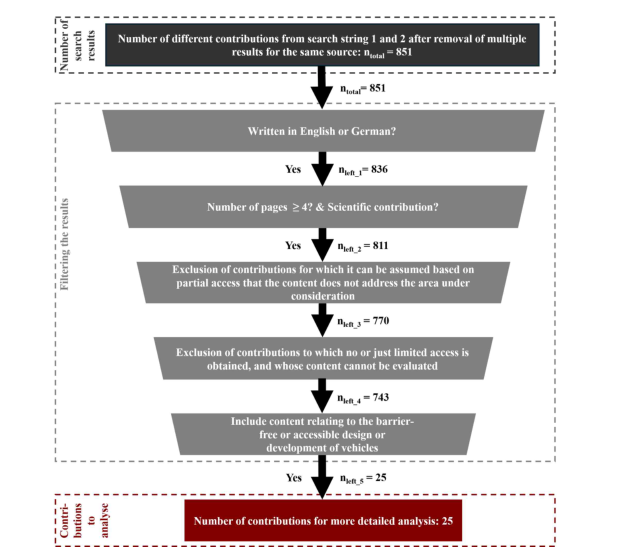
In a first step, the contributions identified by applying the search strings were analysed using various filters. The aim was to identify contributions with content that is in principle relevant to the area under consideration. The exact process of filtering and initial analysis is illustrated in Figure 1.
Figure 1: Process of filtering and analysing to identify relevant contributions.
Number of search results: As Figure 1 indicates, first multiple mentions of contributions within one search string, as well as multiple mentions of contributions due to the intersection of the two search strings, are corrected. In this way the number of different contributions is determined.
Filtering the results: As the first filter shows (see Figure 1), contributions that are not written in English or German are excluded. Furthermore, contributions that are fewer than four pages long and non-scientific works are not analysed. The reason for this is that short articles often do not represent a meaningful treatment of a topic and non-scientific contributions are regarded as irrelevant for the review. In addition, articles were excluded if it was not possible to obtain full access, but it could be concluded with sufficient certainty from partial access that their content was not related to the field under consideration. As Figure 1 shows, it was not possible to obtain full access to 27 other contributions for which no sufficient partial access could be found to conclusively evaluate their content. Statements about research gaps that are made in the further course are therefore subject to the restriction that the field of observation is reduced by ∼3 % of the contributions for which the statements cannot be made valid. In a final step, it is checked whether the contributions address or mention the barrier-free design of vehicles.
Contributions to analyse: By applying the filters, the sum of the contributions to be analysed in more detail consists of the contributions that deal with the topics of barrier-free or accessible design or development and refer to vehicles. As Figure 1 shows, only 25 contributions are assigned to this category. These 25 contributions are analysed in more detail for content that is relevant within the area under consideration. Table 3 provides an overview of which of the analysed articles address different types of relevant content within the area under consideration.
Table 3: Number of contributions that contain different relevant contents.
Table available in the original PDF paper.
Source(s)
Characteristic: Contributions that containing … Number of Contributions 6 [a] - [f] … a reference to MBSE in the context of barrier-free or accessible design or development of vehicles
1 [a]
… a process, or method/methodology that is related to the barrier-free or accessible design or development of vehicles
2 [a]; [b]
… a meta-model, model or diagrams on a meta level that is related to the barrier-free or accessible design or development of vehicles
1 [b]
… other MBSE-tool that is related to the barrier-free or accessible design or development of vehicles Legend: [a] (Ertener et al., 2023); [b] (Angeleska et al., 2022); [c] (Schäfer et al., 2017); [d] (Carré, 2019); [e] (Fadaie, 2019); [f] (Li, 2018)
As Table 3 shows, the conducted literature search only identified a few articles that deal with the barrier-free design of vehicles using MBSE. Thereby MBSE is only used in six contributions. In addition, the sources [c] – [f]
Investigation of Research Gaps and Needs With Regard to the Use of Model-Based Systems 425
do not go into more detail about barrier-free or accessible design in the application of the MBSE, but merely note that autonomous driving, which is addressed in more detail in the article, brings advantages for inclusive mobility. Furthermore, even if the sources [a] and [b] contain diagrams on a meta-level in connection with the inclusive design of vehicles, neither of the two articles presents a meta-model that directly describes such a barrier-free or accessible vehicle. Source [a] show that the MBSE approach the authors demonstrated allows the inclusion of requirements of persons with mobility impairments. However, the inclusive perspective is only taken up in the context of an application example and the approach itself is not specifically designed for inclusive solutions. The tool categorised in Table 3 as “other MBSE-tool” is a platform for the human-centred, ergonomic and inclusive design of automated vehicle interiors.
CONCLUSION
The review conducted as part of this paper identified only a few contributions that use MBSE in the context of inclusive vehicle design. Based on the review, a meta-model that represents a barrier-free or accessible vehicle, or that can be used to develop such a vehicle, represents a research gap. Furthermore, just a very limited number of tools, processes and methods/methodologies in the context of MBSE could be identified that deal with the development or design of such vehicles. In addition, no contribution could be identified that presents a MBSE-approach or -tool that considers the specific requirements of people with different mobility impairments within the scope of consideration. Having such an approach or a tool also seems to be very useful. This can be explained by the fact that there is limited knowledge of how precisely the needs of disabled people are defined and incorporated into the design and development for the accessible environment (Rahman and Ohmori, 2014) but people with disabilities are diverse groups that require accessible and usable solutions to be tailored for them (Dicianno et al., 2021). Based on the relevance of inclusive mobility and the advantages of MBSE outlined above, there is a potential need to close the identified research gaps and conduct further research on the nearly not addressed research topics. For example, the creation of a meta-model of a vehicle that focuses on accessibility and is supported by a methodology and/or a tool that helps to capture the requirements of different users with mobility impairments, and to take them into account when designing the vehicle, could potentially add value in the field of inclusive mobility.
ACKNOWLEDGMENT
This paper was created in the “Country 2 City - Bridge” project of the “German Center for Future Mobility”, which is funded by the German Federal Ministry of Transport.
REFERENCES
Albers, A.; Rapp, S.; Birk, C.; Bursac, N. (2017): Die Frühe Phase der PGE – Produktgenerationsentwicklung. In Stuttgarter Symposium für Produkten- twicklung 2017. Albers, A.; Reiss, N.; Bursac, N.; Richter, T. (2016): iPeM – Integrated Product Engineering Model in Context of Product Generation Engineering. In Procedia CIRP 50, pp. 100–105. Angeleska, E.; Sidorenko, M.; Sidorenko, S.; Pretto, P. (2022): Inclusive autonomous
vehicle interior design (IAVID) platform. In P. Di Bucchianico (Ed.): Design for Inclusion. Proceedings of 13th AHFE International Conference on Design for Inclusion, vol. 45, pp. 54–62. Angermeier, D.; Eichler, J. (2016): Risk-driven Security Engineering in the Automotive Domain. Embedded Security in Cars (escar). Athanasas, K.; Dear, I. (2004): Validation of Complex Vehicle Systems of Prototype Vehicles. In IEEE Transactions on Vehicular Technology 53 (6), pp. 1835–1846. Bastola, A.; Wang, H.; Boroujeni, S. P. H.; Brinkley, J.; Moshayedi, A. J.; Razi,
A. (2025): Driving Toward Inclusion: A Systematic Review of AI-Powered Accessibility Enhancements for People With Disability in Autonomous Vehicles. In IEEE Access 13. Bayless, S. H.; Davidson, S. (2019): Driverless Cars and Accessibility. Designing the Future of Transporation for People with Disabilities. Bezyak, J. L.; Sabella, S. A.; Gattis, R. H. (2017): Public Transportation: An
Investigation of Barriers for People With Disabilities. In Journal of Disability Policy Studies 28 (1), pp. 52–60. Böckler, L.; Musialik, R. (2022): Handlungsempfehlungen zur barrierefreien Nutzbarkeit von autonom fahrenden Straßenfahrzeugen im ÖPNV. In Journal für Mobilität und Verkehr 2022 (12), pp. 24–35. Boenke, D.; Grossmann, H.; Nass, J.; Schäfer, M. (2017): Handbuch Barrierefreiheit im Fernbuslinienverkehr. Bolz, C.; Tobies, M.; Thönnes, L.; Ullrich, N.; Sandner, S.; Bruger, C. (2022):
Inklusionsbarometer Mobilität 2022. Borky, J. M.; Bradley, T. H. (2019): Effective model-based systems engineering.
Cham: Springer. Carré, M. (2019): Autonomic Framework for Safety Management in the Autonomous Vehicle. Diss. Université de Pau et des Pays de l’Adour. Carroll, E. R.; Malins, R. J. (2016): Systematic Literature Review: How is Model- Based Systems Engineering Justified? Sandia National Laboratories. Dicianno, B. E.; Sivakanthan, S.; Sundaram, S. A.; Satpute, S.; Kulich, H.; Powers, E.
et al., (2021): Systematic review: Automated vehicles and services for people with disabilities. In Neuroscience letters 761, 136103. Ertener, T.; Raulf, C.; Schmidt, D. N. (2023): System of Systems Based Approach for the Development of Autonomous Ride-Pooling Vehicles. In A. C. Kulzer, H. Reuss, A. Wagner (Eds.): 23. Internationales Stuttgarter Symposium. Wiesbaden: Springer Fachmedien Wiesbaden (Proceedings), pp. 22–35. Fadaie, J. G. (2019): The State of Modeling, Simulation, and Data Utilization within
Industry. An Autonomous Vehicles Perspective. Federing, D.; Lewis, D. (2017): Towards a framework for identifying and measuring the benefits of accessibility. International Transport Forum Discussion Paper, No. 2017–03.
Investigation of Research Gaps and Needs With Regard to the Use of Model-Based Systems 427
FGSV (2011): Forschungsgesellschaft für Straßen- und Verkehrswesen e. V., Übersicht mobilitätseingeschränkter Menschen. Available online at https:// www.forschungsinformationssystem.de/servlet/is/30223/, checked on 7/21/2025. Friedenthal, S.; Moore, A.; Steiner, R. (2012): A practical guide to SysML. The systems modeling language. [2nd ed. ]: Elsevier professional. García-Urbieta, J.; Palomar, D. J.; Marijuan, M.; Rodríguez, B. (2020): Multibody
System Dynamics Simulation for Automotive Cyber-Physical Test Benches. The 6th Joint International Conference on Multibody System Dynamics and The 10th Asian Conference on Multibody System Dynamics. Golbabaei, F.; Dwyer, J.; Gomez, R.; Peterson, A.; Cocks, K.; Bubke, A.; Paz, A. (2024): Enabling mobility and inclusion: Designing accessible autonomous vehicles for people with disabilities. In Cities 154, 105333. Huth, T.; Vietor, T. (2020): Systems Engineering in der Produktentwicklung:
Verständnis, Theorie und Praxis aus ingenieurswissenschaftlicher Sicht. In Gr Interakt Org 51, pp. 125–130. International Council on Systems Engineering (2007): Systems Engineering Vision 2020. Available online at https://sdincose.org/wp-content/uploads/2011/ 12/SEVision2020_20071003_v2_03.pdf, checked on 7/21/2025. Kamruzzaman, Md.; Yigitcanlar, T.; Yang, J.; Mohamed, M. A. (2016): Measures of Transport-Related Social Exclusion: A Critical Review of the Literature. In Sustainability 8 (7). Kato, H.; Hasegawa, S.; Oshinoya, Y. (2013): Steer-by-Wire System for an
Ultra-Compact Electric Vehicle - Fundamental Considerations on Changing the Reaction Force of the Steering Wheel -. In Proc. Schl. Eng. Tokai Univ., Ser. E 38, pp. 67–73. Kim, Y. (2016): Driving Performance of Adaptive Driving Controls using Drive-by- Wire Technology for People with Disabilities. In Journal of the Ergonomics Society of Korea 35 (1), pp. 11–27. Klinich, K. D.; Manary, M. A.; Orton, N R.; Boyle, K. J.; Hu, J. (2022a): A Literature
Review of Wheelchair Transportation Safety Relevant to Automated Vehicles. In International Journal of Environmental Research and Public Health 19 (3). Klinich, K. D.; Orton, N. R.; Manary, M. A. (2022b): Design Gui for Accessible Automated Vehicles: Mobility Focus. Kriebel, S.; Moyses, V.; Strobl, G.; Richenhagen, J.; Orth, P.; Pischinger, S.
et al., (2017): The Next Generation of BMW’s Electrified Powertrains: Providing Software Features Quickly by Model-Based System Design. 26th Aachen Colloquium Automobile and Engine Technology 2017. Li, L. (2018): Safe and secure model-driven design for embedded systems. Diss.
Université Paris-Saclay. Lindner, C. (2021): Potenziale autonomer Fahrzeuge zur Erweiterung der Mobilität von Bewegungs- und Wahrnehmungsbehinderten: eine Studie im Untersuchungsraum Aachen. Diss. Márquez, L.; Poveda, J. C.; Vega, L. A. (2019): Factors affecting personal autonomy and perceived accessibility of people with mobility impairments in an urban transportation choice context. In Journal of Transport & Health 14, 100583. Maschotta, R.; Jager, S.; Jungebloud, T.; Zimmermann, A. (2013): A framework
for agile development of simulation-based system design tools. In: 2013 IEEE International Systems Conference (SysCon), pp. 861–866.
Meinhardt, L.; Weilke, L. M.; Elhaidary, M.; Abel, J. von; Fink, P. D. S.; Rietzler, M.
et al., (2025): Light My Way: Developing and Exploring a Multimodal Interface to Assist People With Visual Impairments to Exit Highly Automated Vehicles. In N. Yamashita, V. Evers, K. Yatani, X. Ding, B. Lee, M. Chetty, P. Toups-Dugas (Eds.): Proceedings of the 2025 CHI Conference on Human Factors in Computing Systems. Yokohama Japan. New York, USA, pp. 1–20. Neven, A.; Ectors, W. (2023): “I am dependent on others to get there”: Mobility barriers and solutions for societal participation by persons with disabilities. In Travel Behaviour and Society 30, pp. 302–311. Park, J.; Chowdhury, S. (2018): Investigating the barriers in a typical journey by
public transport users with disabilities. In Journal of Transport & Health 10, pp. 361–368. Prerowsky, L.; Weiss, H.; Benesch, E.; Brunner, J.; Fasching, P.; Helmwein, T. et al., (2022): Barrierefreiheit und Verkehr - Beispiele aus der Praxis. Wien. Rahman, Md. M.; Ohmori, N. (2014): Barrier-Free Design for Unhindered Access
for Pedestrian and Public Transportation: A Case Study on Dhaka City. In Journal of Modern Science and Technology 2 (2), pp. 19–35. Sammer, G.; Uhlmann, T.; Unbehaun, W.; Millonig, A.; Mandl, B.; Dangschat, J.; Mayr, R. (2012): Identification of Mobility-Impaired Persons and Analysis of Their Travel Behavior and Needs. In Transportation Research Record: Journal of the Transportation Research Board 2320 (1), pp. 46–54. Schäfer, F.; Kriesten, R.; Chrenko, D.; Gechter, F. (2017): No need to learn
from each other? - Potentials of Knowledge Modeling in Autonomous Vehicle Systems Engineering. International Conference on Engineering, Technology and Innovation (ICE/ITMC), pp. 462–468. Stabili, D.; Ferretti, L.; Marchetti, M.: Analyses of Secure Automotive Communication Protocols and Their Impact on Vehicles Life-Cycle. In: 2018 IEEE International Conference on Smart Computing, pp. 452–457. Sze, N. N.; Christensen, K. M. (2017): Access to urban transportation system for individuals with disabilities. In IATSS Research 41 (2), pp. 66–73. van Roosmalen, L.; Bertocci, G. E.; Hobson, D. A.; Karg, P. (2002): Preliminary
evaluation of wheelchair occupant restraint system usage in motor vehicles. In Journal of Rehabilitation Research and Development 39 (1), pp. 83–93. Vizitiu, C.; Dinculescu, A. C.; Marin, M. G.; Nistorescu, A. I.; Dominey, K. A.; Kristály, D. M. (2025): Optimizing early-stage efficiency in complex system development via model-based systems engineering (MBSE) and concurrent engineering (CE) integration. In Res Eng Design 36, 12. Wirtz, L.; Sever, E.; Eckstein, L. (2024): Adaptive Human-Machine Interfaces
and Inclusivity in the Automotive Field: A Review. In Accessibility, Assistive Technology and Digital Environments 121, pp. 46–60. Wu, C.; Li, J.; Li, X. (2017): Using community planning method to improve effect of urban barrier-free transportation system. In Transportation Research Procedia 25. Yuji, S.; Simon, B.; Chao, S.; Peng, J. (2020): A literature review on accessibility using
bibliometric analysis techniques. In Journal of Transport Geography 87, 102810. Załuska, U.; Kwiatkowska-Ciotucha, D.; Grze´skowiak, A. (2022): Travelling from Perspective of Persons with Disability: Results of an International Survey. In International journal of environmental research and public health 19 (17).
LISTED IN THE AHFE DIGITAL BOOKSTORE CATALOGUE
Explore the complete digital volume
Human Systems Engineering and Design (IHSED2025): Future Trends and Applications
Read this individual research paper free through the original publisher, or explore the full digital proceedings book.
ISBN 978-1-964867-74-8
Explore this ISBN in the AHFE Bookstore ↗Listed in the July 2026 bookstore catalogue; search by ISBN to confirm current availability · Digital book purchase optional