Thomas Mokadim, Franck Geffard, Aurore Lomet, Bruno Watier (2025). Machine Learning for User-Dependent Ankle Joint Torque Estimation: An Application of XGBoost. In: Human Interaction and Emerging Technologies (IHIET 2025). AHFE Open Access, vol. 197, pp. 78–87. https://doi.org/10.54941/ahfe1006701
Powered exoskeletons are increasingly studied to reduce walking effort. Providing optimal assistance requires user gait data, particularly ankle joint torque, which must be estimated despite available sensor measurements. While precomputed estimations exist for target populations, personalized estimation is preferable. Traditional musculoskeletal models are used, but recent approaches leverage Machine Learning (ML) regressions, such as support vector machines (SVM) or Deep Learning (DL) Recurrent Neural Networks (RNN) such as LSTM-based tools. These models need extensive, high-quality data, outsourced from various sensor types for accurate and robust estimations. Studies show that ankle dynamics vary significantly, closely linked to walking speed and user anthropometrics.We utilize a dataset of 138 healthy individuals, which includes EMG, kinematic, and dynamic leg joint data, as well as walking speed (0.97–1.59 m/s), height (1.68 ± 0.10 m), weight (74 ± 15 kg), age (21–86 years), and sex (65M/73F). By employing the XGBoost ML tool, we propose that an ankle joint torque estimator that integrates angular ankle position, walking speed, and anthropometric data can achieve accurate, robust predictions without the need for muscular data. Predictions are validated against unseen torque trajectories, and the performances of the estimator are compared to recent studies on lower limb joint torque estimation.Bootstrap evaluation of the estimators compared to the calculated dynamic data shows a correlation coefficient R² = 0.981 ± 0.051 (p<0.05) and an RMSE mean square error of 0.070 ± 0.008 Nm/kg (p<0.05). Among all data characteristics, angular position (71%), stride percentage (18%), age (2.7%), walking speed (1.7%), and height (1.2%) had the greatest impact on predictions.These results acknowledge the conclusions of previous work on the non-necessity of EMG data and qualify the contribution of other previous work of taking into account the subject's walking speed and anthropomorphic data with gait kinematic and dynamic data. What's more, these results, based on a more representative and homogeneous dataset than some previous work, suggest that there may be informative redundancies between these anthropomorphic features that the model could ignore to be leaner.In the end, this joint torque estimator integrating gait speed and the subject's anthropomorphic data while dispensing with EMG data, yields customized results that are sufficiently accurate and robust to be used in ankle exoskeleton controllers to help to achieve better gait assistance than average profiles with a few mechanical sensors.
Exoskeletons are increasingly explored in scientific research as a means to support humans in tasks that place significant constraints on the body. Among the exoskeleton solutions on the market exist passive exoskeletons capable of storing potential energy to be released later during the task, as exemplified by the exoskeleton from Laevo (Laevo Exoskeletons). There are also active exoskeletons equipped with actuators that generate assistance on demand, such as the HAL exoskeleton from CYBERDYNE (CYBERDYNE). In the case of active exoskeletons, a torque controller is necessary to provide the appropriate level of assistance to the user’s effort. For this purpose, the force control loop needs to understand the kinematic, kinetic, and dynamic aspects of the interaction between the subject, the assistive device, and their interactions with the environment (Molinaro et al., 2020; Siu et al., 2020; Bishe et al., 2021; Zhang et al., 2022).
Machine Learning for User-Dependent Ankle Joint Torque Estimation 79
position sensors, inertial measurement units to infer kinetic data, pressure sensor-instrumented insoles to infer dynamic data, and even EMG sensors to estimate task dynamics from muscle contraction data. Regarding the acquisition of dynamic data, the implementation of mechanical sensors such as load cells or pressure sensors can sometimes require laborious calibration and difficult implementation. Similarly, EMG sensors tend to provide fluctuating information depending on temperature, humidity, or perspiration and have poor mechanical resistance to wear and repositioning during use, as explained by (Parri et al., 2017; Bishe et al., 2021).
Therefore, certain dynamic quantities of the user need to be estimated, such as the torque exerted around a joint during a task. Conventional joint torque estimation methods employ physical approaches based on musculoskeletal models (Winter, 2009). These models remain a reference in many situations when the model is correctly calibrated to the studied subject and provided with sufficient data. However, some tasks require models with complex interactions that are not easily modeled to provide accurate joint torque estimates. Statistical and machine learning approaches have been introduced to address the limitations of musculoskeletal models, particularly for tasks involving nonlinear and complex user–environment interactions. Deep learning architectures such as Long-Short Term Memory (LSTM)(Moreira et al., 2021; Zhang et al., 2022), Convolutional Neural Networks (CNN)(Wang et al., 2023), or Feed Forward Neural Networks (FFNN) (Mundt et al., 2020; Zhang et al., 2021) have shown promising results in joint torque estimation. However, these models require large, diverse datasets and well-instrumented experimental setups, which makes their implementation time-consuming and costly.
When studying gait, especially at the ankle joint, the nonlinear relationship between kinematics and joint torque is amplified by inter- individual differences in morphology and walking speed (Frigo, Crenna and Jensen, 1996; Horst et al., 2019; Van Criekinge et al., 2023). In this context, the recent studies of (Molinaro et al., 2020; Wang et al., 2020; Bhakta et al., 2021), have explored the use of tree-based regression methods such as XGBoost to estimate joint torques from reduced sensor configurations. XGBoost combines strong predictive performance with compatibility for post hoc interpretability using tools such as Shapley values. These properties make the model suitable for embedded applications and for learning from a limited number of subjects. The present work investigates the use of XGBoost to estimate ankle joint torque based on mechanical sensors, average walking speed, and anthropometric characteristics—without relying on EMG signals, in order to simplify hardware integration in wearable systems.
METHODS
Dataset This work relied on a 138-able-bodied gait dataset from (Van Criekinge et al., 2023). One can go over the complete data acquisition protocol in the original article for further details. The data acquisition protocol involved recording each subject’s weight, height, leg length, age, and gender. Participants were instructed to walk at their spontaneous speed onto an instrumented pathway
with force plates. Gait data was captured with a Vicon camera system once the usual walking speed was achieved, with at least 6 recordings, half starting with the right foot contacting force plates. The gait data were processed in Vicon Nexus software for automatic gait event labeling and joint kinematics and kinetics computation using a dynamic model adjusted to each subject’s dimensions. Table 1 below shows the statistical distribution of the dataset subject pool.
Table 1: Characteristics of Van Criekinge et al. dataset (138 able-bodied adults).
Table available in the original PDF paper.
Body Mass Height (m) Body Mass
Leg Length
Age (Years) Gender (Male/Female) (kg)
Index (m) Mean (SD) 51 (20) 65/73 74 (15) 1.684 (0.103) 26 (4) 0.899 (0.061) Min - Max 21 – 86 - 48 – 157 1.420 – 1.920 18 – 47 0.660 – 1.070
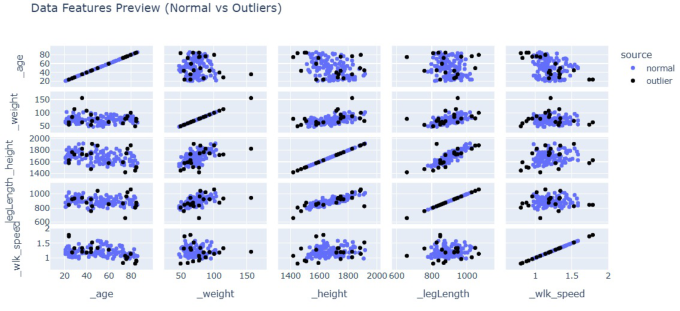
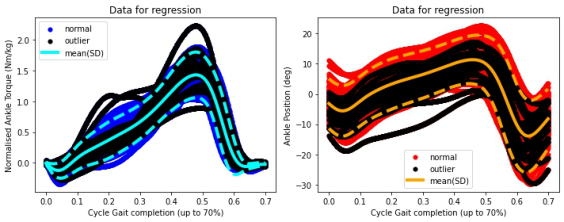
Data Pre-Processing The database includes the following features for each subject: subject ID, age, gender, weight, height, average leg length, average walking speed, ankle position, and ankle torque normalized by weight over time. Additionally, a value ranging from 0 to 1 was added to each row, representing the percentage of gait cycle completion to maintain the history during training. Subject IDs are sorted from the oldest subject to the younger one. A visualization of the data features was made to assess the feature distribution across subjects. Figure 1.a displays some of the distribution of the above-mentioned features. Figure 1.b summarizes all subjects’ gait profiles respectively to the ankle torque and position mean (SD) values. Both visualizations allowed us to identify 20 out of 138 subjects as outliers due to their weight, height, leg length, walking speed, or gait profile being significantly different from the majority of the data, and these subjects were excluded from the study. Analysis of the joint torques showed that some recordings contained noise or force plate recording errors. Specifically, at the end of the foot swing phase, a torque spike significantly greater than 0.05 Nm/kg could be observed. To avoid biasing the algorithm’s training, we hypothesized that the desired estimated torque value between the toe-off event and the next initial contact should be zero. Therefore, each subject’s data was truncated to 70% of the gait cycle, slightly beyond the average time at which toe-off occurs across all subjects, only focusing on the gait stance phase.
Torque Estimator Training and Testing The algorithm used to estimate joint torque from the aforementioned joint position, anthropometric data, and gait completion range was based on the Extreme Gradient Boosting tool XGBoost (Chen and Guestrin, 2016). This machine learning method has demonstrated strong performance in various regression problems, including joint torque estimations for knee and hip joints. The subjects’ data pool was randomly divided into 70% training, 17% test, and 13% validation subsets. Subsequently, the GridSearch function was used to search for the optimal configuration of XGBoost hyperparameters on the training data based on a given search grid.
Machine Learning for User-Dependent Ankle Joint Torque Estimation 81
Figure 1. a: Partial data features distribution visualization. Blue dots display remaining subjects for this work. Black dots identify subjects as outliers due to abnormal, much different features values or abnormal gait pattern in Figure 1.b.Figure 1. b: All 138 subjects ankle positions and normalized torques across stance phase (here, up to 70% of gait cycle). Average profiles are displayed in full lines, standard deviation boundaries are displayed in dashed lines. Outlier profiles are displayed in black lines due to abnormal gait pattern or anthropometric feature values showed in Figure 1.a.
The grid search parameters are described in Table 2. The result of the hyperparameter search minimizing the RMSE on the training dataset yields a number of trees n = 50, a maximum tree depth d = 8, and a learning rate η = 0.085. The hyperparameters λ = 1 and γ = 0 remained unchanged at default values.
Table 2: Hyperparameters search grid setup.
Table available in the original PDF paper.
Hyperparameter Minimum/Step/Maximum Values n: Number of regression trees 20/10/150 d: Maximum tree depth 5/1/9 η: Learning Rate 0.04/0.005/0.1
Torque Estimator Evaluation To evaluate the robustness and generalization of the estimation tool, two evaluation phases are conducted. The first phase consists of a bootstrap procedure with 100 iterations on the training dataset in order to estimate a 95% confidence interval for the model predictions and test the robustness of
the training on a test subset. The second phase corresponds to the validation step, which evaluates the model’s ability to generalize to unseen subjects using the validation dataset. Each joint torque prediction is filtered using a fourth-order zero-delay low-pass Butterworth filter with a cutoff frequency of 20 Hz. To assess the forecasting accuracy and temporal coherence of the model, the RMSE, the subject weight-normalized nRMSE, the coefficient of determination (R2 score), and the Dynamic Time Warping (DTW) distance are computed between the estimated and calculated torques for all test subjects. The DTW distance assesses the temporal alignment and potential phase shift between the estimated and reference torque profiles. Since this unitless metric captures both amplitude and phase discrepancies, values below the empirically defined threshold of six are interpreted as indicating limited divergence from the subject’s reference torque. To interpret the contribution of each input variable to the model’s predictions, the average Shapley value is computed for each feature across all validation samples. This index provides a consistent, model-agnostic estimate of the influence of each variable, by accounting for its marginal effect across all possible feature combinations.
Finally, the RMSE, nRMSE, and R2 score metrics are compared with those reported in previous studies involving machine learning or deep learning models designed to estimate joint torques in healthy subjects. Only studies conducted under similar walking conditions—specifically, constant-speed walking on flat ground—are considered for comparison.
RESULTS
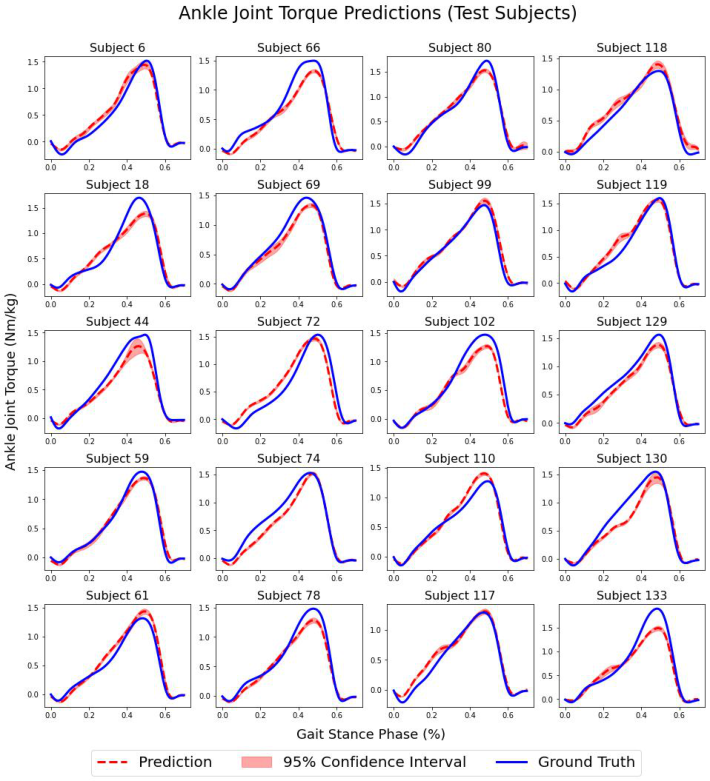
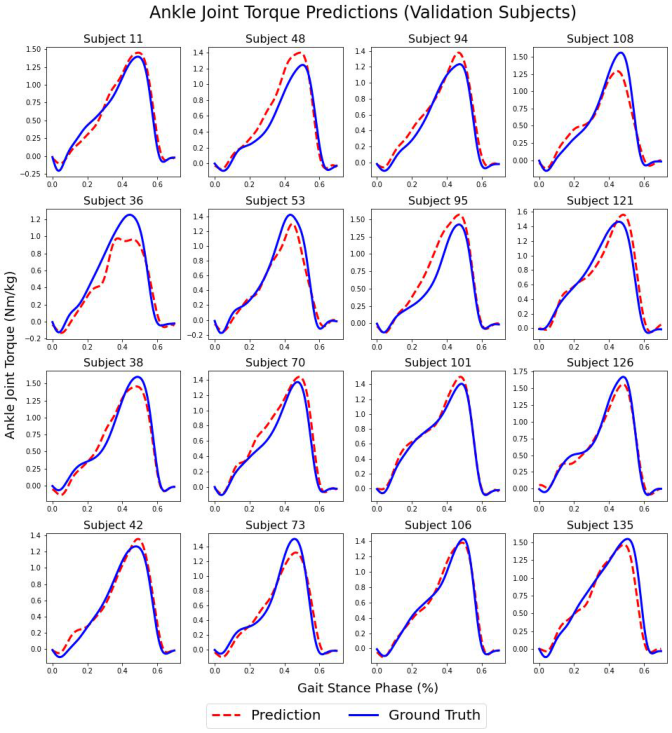
The results of the first evaluation phase of the joint torque estimator, using bootstrapping of the training data and model as described previously, were displayed in Figure 2. The average estimation for each subject in the test dataset was shown as a red dashed line, along with the associated 95% confidence interval. The mean ± SD performance metrics are as follows: the average RMSE error was 0.13 ± 0.001 Nm/kg. Compared to the torque data variation in the whole dataset of 0.081 Nm/kg, this RMSE mean value is of the same order of magnitude. The nRMSE error was 9.29 ± 7.27 %. The model reaches a coefficient of determination of R2=0.94± 0.001, which reflects its ability to explain most of the variance in the reference torque. The DTW distance has a mean value of 12.25 ±0.791. This result confirms that, on average, the estimated torque profiles remain temporally consistent with the reference, although substantial variability is observed across test subjects. Results of the second evaluation phase conducted on the unknown validation subjects’ data were displayed in Figure 3, where the performance indices were slightly better than those obtained previously. The model exhibited an average RMSE error of 0.115 Nm/kg, an nRMSE error of 8.10%, an R2 coefficient of 0.951, and an average DTW distance across all subjects of 16.63 ± 15.03. A quarter of the estimated torques had a DTW distance below six. The calculation of the average Shapley values for each feature of the data yields the following values sorted by decreasing values: Stride Completion: 0.266, Ankle Joint Position: 0.250, Walking Speed: 0.021, Leg
Machine Learning for User-Dependent Ankle Joint Torque Estimation 83
Length: 0.011, Height: 0.010, Body Mass: 0.009, Age: 0.034, Sex: 0.001. On one hand, those values allow considering the stride completion, ankle joint position, and walking speed were the first, second, and fourth most affecting features from model inputs. This means that high-quality joint position data as well as computing online the stride completion should be provided to this estimator once implemented into wearable systems, to output similar quality subject-tailored estimations. On the other hand, providing the subject sex has no significant effect on the estimations and should not be considered as a relevant data feature for further implementation.
Figure 2: Ankle joint torque estimation of test subjects (n = 20). Dashed red lines display the XGBoost estimations. Blurred red areas represent the confidence interval (p < 0.05). Blue plain lines display the reference torques computed from inverse dynamics.Figure 3: Ankle joint torque estimation of validation subjects (n = 16). Dashed red lines display the XGBoost estimation. Blue plain lines display the ground truth computed torques.
DISCUSSION
The present work aimed at implementing an XGBoost-based ankle joint torque estimator, to provide an embedded system a subject-tailored joint torque feedback. The results obtained in this study reinforce those of previous works on the development of lower limb joint torque estimators. The metrics used to estimate the performance of this estimator are compared with other studies presented in Table 3. The average error in ankle joint torque estimation (RMSE = 0.115 Nm/kg, nRMSE = 8.1%) is in the same order of magnitude of estimation error values obtained by (Zhang et al., 2022) (0.14 Nm/kg) and (Molinaro et al., 2020) (0.093 Nm/kg), the latter of which used the same XGBoost estimation approach. This difference primarily arises from the nature of the estimated joint torque. Indeed, the dynamic fluctuation of the hip during walking is less pronounced than that of the ankle (Frigo, Crenna and Jensen, 1996) and is thus less subject to intense variations across a given population. Nevertheless, this torque RMSE
Machine Learning for User-Dependent Ankle Joint Torque Estimation 85
value is within the acceptable range of the dataset ankle torque variation (SD of ankle torque = 0.081 Nm/kg). The notable contribution of this study lies in the use of an effective regression method on complex data with a dataset representing a sample of significant size and diversity (see Table 1) to develop a joint torque estimator personalized to each individual’s morphology, yielding robust results. In the previously cited studies in Table 3, the authors attempted to infer models using a few subjects (respectively, (Zhang et al., 2022): 8 subjects, (Moreira et al., 2021): 13 subjects, (Molinaro et al., 2020): 5 subjects), which also limits the range of subjects of different age and morphology. However, the performance achieved by (Mundt et al., 2020) on a set of 85 subjects is remarkable, but the lack of specification of the subjects’ anthropomorphic characteristics does not allow for determining whether these results can be extended to an entire population.
Beyond the high performance observed in the presented and compared results, the design of explainable machine learning models remains a priority, as emphasized by (Horst et al., 2019). Unlike some of the methods referenced in Table 3, the use of XGBoost offers both competitive predictive performance and compatibility with robust post hoc interpretability techniques such as Shapley values, which allow for a detailed analysis of feature contributions. In this work, Shapley values are computed for each feature in the dataset. This analysis reveals that walking speed is the third most impactful variable influencing torque prediction, with a greater influence than anthropometric features. This observation aligns with the conclusions of (Moreira et al., 2021) who followed a similar approach, and echoes earlier findings by (Frigo, Crenna and Jensen, 1996) on the role of walking speed in ankle torque estimation. Conversely, features such as age and sex show minimal impact on torque prediction, confirming the observations made by (Crenna and Frigo, 2011).
While the present study demonstrates performance comparable to recent works, it is currently limited to level-ground walking data. Previous works such as those by (Molinaro et al., 2020) and (Zhang et al., 2022) include several locomotion modes. Notably, (Molinaro et al., 2020) highlighted the potential of XGBoost in handling multiple locomotion modes without the need for prior classification—a strategy that contrasts with approaches like (Wang et al., 2020), which rely on predefined identification. Nevertheless, the datasets used in those works included fewer participants than those of (Van Criekinge et al., 2023), allowing this work to present more representative estimations. The lack of locomotion modes could be addressed with the suggested data from (Scherpereel et al., 2023) in future works.
Table 3: Metrics and estimation comparison between this work and other previous joint torque estimation related works.
Molinaro et al., 2020 5 Hip XGBoost 0.093 - - This work 118 Ankle XGBoost 0.115 8.1 0.951
CONCLUSION
This study presents a method for estimating ankle joint torque based on information obtainable solely from position sensors, as well as the subject’s anthropomorphic characteristics. The use of a sufficiently large and diverse gait dataset has enabled the achievement of more generalizable results than those in recent state-of-the-art studies while demonstrating similar performance. This XGBoost-based ankle joint torque estimator could be extended to other joints and ambulatory modes without major algorithmic modifications, allowing for implementation in embedded systems requiring joint torque feedbacks such as power assistive devices.
REFERENCES
Bhakta, K. et al. (2021) ‘Evaluation of Continuous Walking Speed Determination Algorithms and Embedded Sensors for a Powered Knee & Ankle Prosthesis’, IEEE Robotics and Automation Letters, 6(3), pp. 4820–4826. Available at: https:// doi.org/10.1109/LRA.2021.3068711. Bishe, S. S. P. A. et al. (2021) ‘Adaptive Ankle Exoskeleton Control: Validation Across Diverse Walking Conditions’, IEEE Transactions on Medical Robotics and Bionics, 3(3), pp. 801–812. Available at: https://doi.org/10.1109/ TMRB.2021.3091519. Chen, T. and Guestrin, C. (2016) ‘XGBoost: A Scalable Tree Boosting System’, in
Proceedings of the 22nd ACM SIGKDD International Conference on Knowledge Discovery and Data Mining. New York, NY, USA: Association for Computing Machinery (KDD ‘16), pp. 785–794. Available at: https://doi.org/10.1145/ 2939672.2939785. Crenna, P. and Frigo, C. (2011) ‘Dynamics of the ankle joint analyzed through moment–angle loops during human walking: Gender and age effects’, Human Movement Science, 30(6), pp. 1185–1198. Available at: https://doi.org/10.1016/ j.humov.2011.02.009. CYBERDYNE. Available at: http://www.cyberdyne.jp/ (Accessed: 12 March 2025). Frigo, C., Crenna, P. and Jensen, L. M. (1996) ‘Moment-angle relationship at
lower limb joints during human walking at different velocities’, Journal of Electromyography and Kinesiology, 6(3), pp. 177–190. Available at: https:// doi.org/10.1016/1050-6411(96)00030-2. Horst, F. et al. (2019) ‘Explaining the unique nature of individual gait patterns with deep learning’, Scientific Reports, 9, p. 2391. Available at: https://doi.org/ 10.1038/s41598-019-38748-8. Laevo Exoskeletons. Available at: https://www.laevo-exoskeletons.com (Accessed: 6
February 2024). Molinaro, D. D. et al. (2020) ‘Biological Hip Torque Estimation using a Robotic Hip Exoskeleton’, in 2020 8th IEEE RAS/EMBS International Conference for Biomedical Robotics and Biomechatronics (BioRob). 2020 8th IEEE RAS/EMBS International Conference for Biomedical Robotics and Biomechatronics (BioRob), pp. 791–796. Available at: https://doi.org/10.1109/ BioRob49111.2020.9224334.
Machine Learning for User-Dependent Ankle Joint Torque Estimation 87
Moreira, L. et al. (2021) ‘Kinematics, Speed, and Anthropometry-Based Ankle Joint Torque Estimation: A Deep Learning Regression Approach’, Machines, 9(8), p. 154. Available at: https://doi.org/10.3390/machines9080154. Mundt, M. et al. (2020) ‘Prediction of lower limb joint angles and moments
during gait using artificial neural networks’, Medical & Biological Engineering & Computing, 58(1), pp. 211–225. Available at: https://doi.org/10.1007/s11517- 019-02061-3. Parri, A. et al. (2017) ‘Real-Time Hybrid Locomotion Mode Recognition for Lower Limb Wearable Robots’, IEEE/ASME Transactions on Mechatronics, 22(6), pp. 2480–2491. Available at: https://doi.org/10.1109/TMECH.2017.2755048. Scherpereel, K. et al. (2023) ‘A human lower-limb biomechanics and wearable
sensors dataset during cyclic and non-cyclic activities’, Scientific Data, 10, p. 924. Available at: https://doi.org/10.1038/s41597-023-02840-6. Siu, H. C. et al. (2020) ‘Ankle torque estimation during locomotion from surface electromyography and accelerometry’, in 2020 8th IEEE RAS/ EMBS International Conference for Biomedical Robotics and Biomechatronics (BioRob). 2020 8th IEEE RAS/EMBS International Conference for Biomedical Robotics and Biomechatronics (BioRob), pp. 80–87. Available at: https://doi.org/ 10.1109/BioRob49111.2020.9224286. Van Criekinge, T. et al. (2023) ‘A full-body motion capture gait dataset of 138 ablebodied adults across the life span and 50 stroke survivors’, Scientific Data, 10(1), p. 852. Available at: https://doi.org/10.1038/s41597-023-02767-y. Wang, C. et al. (2020) ‘Real-Time Estimation of Knee Adduction Moment for Gait
Retraining in Patients With Knee Osteoarthritis’, IEEE Transactions on Neural Systems and Rehabilitation Engineering, 28(4), pp. 888–894. Available at: https:// doi.org/10.1109/TNSRE.2020.2978537. Wang, H. et al. (2023) ‘Subject-Independent Ankle Joint Power Estimation with Two IMUs During Flat and Inclined Walking’, in 2023 IEEE 19th International Conference on Body Sensor Networks (BSN). pp. 1–4. Available at: https:// doi.org/10.1109/BSN58485.2023.10331015. Winter, D. A. (2009) Biomechanics and Motor Control of Human Movement. John
Wiley & Sons. Zhang, L. et al. (2021) ‘Ankle Joint Torque Estimation Using an EMG-Driven Neuromusculoskeletal Model and an Artificial Neural Network Model’, IEEE Transactions on Automation Science and Engineering, 18(2), pp. 564–573. Available at: https://doi.org/10.1109/TASE.2020.3033664. Zhang, L. et al. (2022) ‘Lower-Limb Joint Torque Prediction Using LSTM Neural
Networks and Transfer Learning’, IEEE Transactions on Neural Systems and Rehabilitation Engineering, 30, pp. 600–609. Available at: https://doi.org/ 10.1109/TNSRE.2022.3156786.
LISTED IN THE AHFE DIGITAL BOOKSTORE CATALOGUE
Explore the complete digital volume
Human Interaction and Emerging Technologies (IHIET 2025)
Read this individual research paper free through the original publisher, or explore the full digital proceedings book.
ISBN 978-1-964867-73-1
Explore this ISBN in the AHFE Bookstore ↗Listed in the July 2026 bookstore catalogue; search by ISBN to confirm current availability · Digital book purchase optional