Sergio Staab, Nadia Günter, Vincent Abt, Johannes Luderschmidt, Ludger Martin (2025). The early detection of pressure ulcers, an optimized movement monitoring through machine learning and wearable sensor technology. In: Human Interaction and Emerging Technologies (IHIET 2025). AHFE Open Access, vol. 197, pp. 272–282. https://doi.org/10.54941/ahfe1006720
This study investigates how machine-assisted motion analysis can contribute to the prevention of pressure ulcers in bedridden patients.Pressure ulcers, also known as bedsores, develop due to prolonged pressure on the skin and underlying tissues, which impairs blood circulation. Without sufficient movement and regular repositioning, affected areas may no longer receive adequate oxygen and nutrients, ultimately leading to tissue damage and open wounds. Immobile patients are particularly at risk, as their prolonged inactivity significantly increases the likelihood of developing pressure ulcers. The early detection of critical movement patterns is therefore essential to initiate preventive measures such as repositioning or targeted positioning strategies in a timely manner. The objective of this study is to define a movement threshold using machine learning algorithms that distinguishes between insufficient, adequate, and excessive movement. Both continuous and interval-based classification methods are employed to identify patterns associated with an increased risk of pressure ulcers. Additionally, skin temperature variations are incorporated into the analysis, as they may indicate reduced blood circulation—an important early warning sign for pressure ulcer formation. To capture movement data, the Pixel Watch 3 is used as a wearable sensor technology. The smartwatch is attached to the patient's body to enable a more precise detection of movement patterns. Various positions are tested to determine which placement provides the most reliable sensor data regarding patient mobility and positional changes. This analysis aims to identify the optimal smartwatch placement for achieving the most accurate classification results. Several sensors are utilized, including an accelerometer to measure movement intensity, a gyroscope to detect rotations, a posture sensor to track positional changes, a skin temperature sensor to assess blood circulation variations, and a heart rate sensor to capture physiological responses. The smartwatch is tested in three positions: chest, abdomen, and ankle. A total of 10 participants are included in the study. Five micro-movements have been identified, and for each of these movements, 20 labels are generated per participant, each lasting 10 seconds. The data collection is conducted at a sampling rate of 20 Hz. This results in a total of 14 (sensors) * 10 (participants) * 20 Hz (sampling rate) * 10 seconds (label duration) * 20 labels (number of labels) * 5 movements (micro-movements) * 3 positions (chest, abdomen, ankle) = 8,400,000 data records.The collected movement data is used to develop a machine-learning model that detects movement deficiencies at an early stage and automatically alerts caregivers before critical situations arise. The model distinguishes between sufficient, insufficient, and excessive movement, enabling targeted interventions. The study results demonstrate that the Pixel Watch 3 can be utilized as a precise monitoring tool, allowing for continuous movement tracking. Such a system could significantly contribute to reducing the workload of healthcare professionals by facilitating targeted interventions while simultaneously improving the quality of patient care. This study provides a vital foundation for the future development of intelligent care systems that not only optimize pressure ulcer prevention but also enhance the efficiency and accuracy of nursing documentation through wearable sensor technologies and machine learning. Furthermore, the system is tested in an experimental setting to evaluate its practicality and effectiveness. The goal is to obtain a realistic assessment of how well the model can be integrated into real-world nursing practice and to determine what adjustments are necessary for its optimal implementation within existing care structures.
The most recent report on pressure ulcer prevention by the Institute for Quality Assurance and Transparency in Healthcare (IQTIG, 2024) reveals that 67,636 hospital-acquired pressure ulcers were documented in Germany in 2023, accounting for 0.4367% of all inpatients. Alarmingly, nearly 50% of those affected were over 80 years old. These figures highlight the ongoing challenge of pressure ulcers in the German healthcare system, especially
The Early Detection of Pressure Ulcers, an Optimized Movement Monitoring 273
among elderly and immobile patients (Tomova-Simitchieva et al., 2019). Despite preventive measures, pressure ulcers remain a significant issue due to their association with longer hospital stays, increased healthcare costs, and decreased quality of life, indicating an urgent need for innovative prevention strategies.
Recent advancements in sensor technology and machine learning provide new opportunities for automated movement pattern analysis. Smartwatches with integrated motion sensors are a promising technology for continuous monitoring of micro-movements. Intelligent analysis of sensor data could help identify individual movement patterns and alert nursing staff in real-time if insufficient self-mobilization is detected.
This study explores the use of smartwatches to detect micro-movements in the context of pressure ulcer prevention, aiming to reliably determine an optimal movement threshold for bedridden patients using machine learning methods. The study investigates whether and to what extent a commercially available smartwatch with integrated motion sensors can reliably detect and classify subtle movement patterns. It specifically examines which of five predefined movements can be detected with the highest accuracy and at which body location (abdomen, chest, ankle). Furthermore, it evaluates which sensor placements yield the most accurate data for detecting micro- movements and which algorithms are best suited for classifying such movements reliably.
To address these questions, an experimental approach is used, where the Google Pixel Watch 3 is attached to three different body locations to record targeted movements of test subjects. The resulting sensor data is analyzed with various machine learning methods to develop a classification model for micro-movements. This analysis aims to offer a solid understanding of how an optimal movement threshold can be defined to support effective pressure ulcer prevention.
The long-term goal of this research is to develop an automated alert system for nursing professionals that provides early warnings about insufficient movement, reducing the risk of pressure ulcer development. Such a system could improve care quality, reduce the workload of nursing staff, and sustainably enhance the quality of life for immobile patients.
Additionally, this work seeks to contribute to the broader discourse on digital health by demonstrating how consumer-grade wearable devices can be repurposed for clinical applications. The integration of such technologies into routine patient care could lead to scalable and cost-effective solutions for long-standing problems in hospital environments. Moreover, by leveraging real-time data processing and adaptive machine learning models, it becomes possible to create dynamic feedback systems that adjust to individual patient needs. This personalization aspect is particularly important in geriatric care, where standardized interventions often fail to accommodate the complexity of individual health conditions. Ultimately, the insights gained from this study may serve as a foundation for future interdisciplinary research at the intersection of healthcare, data science, and wearable computing.
This thesis includes the following sections: Related Work reviews research on pressure ulcer prevention, wearables for activity recognition, and machine
learning for sensor data analysis. Project Structure outlines the project, classification model, and machine learning tools. Activity Recognition describes the methodology, classification process, and experimental setup. Evaluation presents the experimental results on micro-movement detection. Finally, Conclusion summarizes key findings and discusses future developments and applications.
RELATED WORK
This section reviews related work on pressure ulcer prevention, human activity recognition, and wearable technologies, focusing on both traditional nursing interventions and technological approaches to analyzing physical inactivity. Special attention is given to recent advances in sensor-based monitoring with smartwatches and machine learning methods like Long Short-Term Memory (LSTM) models, which form the basis of this study on smartwatch-based micro-movement detection for early pressure ulcer prevention. According to the German Network for Quality Development in Nursing (DNQP) (Niemann et al., 2017), a pressure ulcer is defined as a localized injury to the skin and/or underlying tissue, usually over a bony prominence, caused by sustained pressure or shear. Pressure ulcers remain a major healthcare challenge. A systematic review by Tomova-Simitchieva et al. reported a prevalence of 2% to 5% in long-term care and at least 2% in hospitals in Germany, stressing the need for improved prevention (Tomova-Simitchieva et al., 2019). Common strategies include repositioning, pressure-relieving mattresses, and physical movement (Santamaria et al., 2018), with high-quality mattresses significantly reducing risk (McInnes et al., 2015) and regular skin inspections playing a crucial role (Niemann et al., 2017). Schröder & Kottner also emphasized micro-movements as an innovative preventive concept to distribute pressure more evenly (Schröder & Kottner, 2011).
Technological approaches for early detection of inactivity are increasingly explored, with Human Activity Recognition (HAR) systems gaining importance in healthcare (Döbel et al., 2018). Smartwatches equipped with motion sensors, combined with machine learning methods like LSTM, allow real-time monitoring and targeted interventions to prevent pressure ulcers (Gefen et al., 2020).
Sridharan et al. developed a beacon-based system achieving 85% classification accuracy in home care, while this study deliberately focuses on smartwatch-integrated sensors for location-independent detection (Sridharan et al., 2020). Nurwulan & Selemaj investigated machine learning algorithms for classifying deliberate daily activities, finding Random Forest (RF) most accurate; in contrast, the present study targets involuntary micro-movements (Nurwulan & Selemaj, 2020). Bed-based systems like DIY PressMat (Matthies et al., 2021) and RFID-based bed-exit detection (Wickramasinghe & Ranasinghe, 2017) showed limitations in detecting subtle movements. Similarly, Sutton-Charani et al. used mattress pressure sensors to analyze micro-movements, but their method relied only on static pressure data (Sutton-Charani et al., 2022).
The Early Detection of Pressure Ulcers, an Optimized Movement Monitoring 275
Overall, the reviewed studies underline the potential of smartwatches to advance healthcare through the sophisticated classification of human activities, offering new opportunities for individualized, technology- supported care.
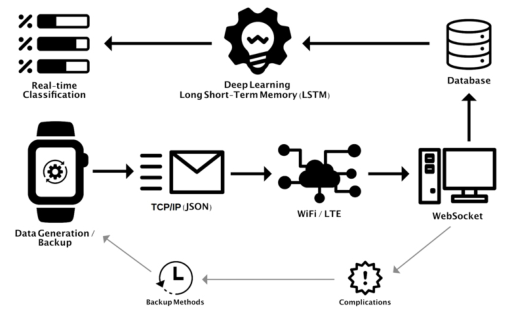
PROJECT STRUCTURE To illustrate the prototype, this chapter is structured into two main components: data aggregation and machine learning tools. The former involves the collection, labeling, and visualization of motion data using the activity recognition classifier. The machine learning tools serve the purposes of processing, training, and evaluating algorithms. Figure 1 illustrates the system architecture, depicting the entire data flow – from generation and aggregation to visualization and classification. The foundation is the activity recognition classifier described by Staab, which enables efficient data acquisition, visualization, and labeling through a seamless communication interface between the smartwatch and the web server (Staab et al., 2024). Data transmission is carried out in real time via WebSockets, as outlined by Ogundeyi and Yinka-Banjo (Ogundeyi & Yinka-Banjo, 2019). The data collected on the smartwatch are transmitted to a website via a TCP/IP connection using a NodeJS WebSocket, where they are immediately processed, displayed, and analyzed.
Figure 1: Overview of the system architecture.
The activity recognition system visualizes sensor data in real time and enables the creation and management of activity labels. It displays the connected smartwatches and ensures that data is transmitted at specified intervals. Before data collection begins, the smartwatches undergo a calibration process to standardize the initial position. All collected data is transmitted and stored in real time in a MySQL database. The collected sensor data includes three-dimensional motion data (x-, y-, and z-axes) from accelerometer, gyroscope, gravity, and orientation sensors, supplemented by heart rate data and acoustic measurements (decibels and magnitude). This
comprehensive suite of sensors facilitates a detailed analysis and comparative evaluation of the performance of different smartwatch models.
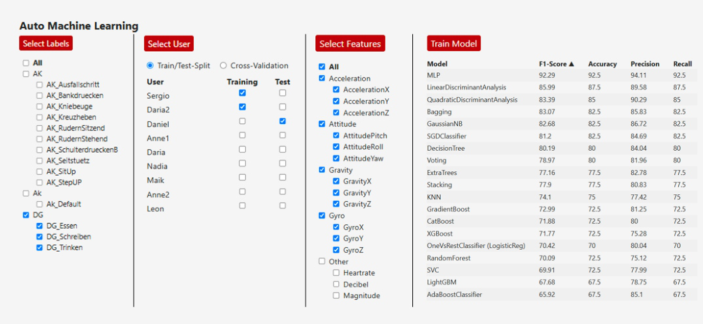
For the analysis, two specialized tools are used: an AutoML training tool and an LSTM training tool. Both tools offer flexible configuration options for experimental setups and provide a robust assessment of the algorithms employed, ensuring thorough evaluation and optimization. Figure 2 illustrates these machine learning tools and the available options for configuring experimental parameters, including the selection of sensors, algorithms, and evaluation methods.
To automate the modeling and analysis of sensor-based activity data, a comprehensive machine learning training tool has been developed, which integrates both classical ML algorithms and LSTM models. The user interface allows for a structured execution of training and evaluation processes. Initially, activities to be classified, such as pelvic tilt, foot movement, hip rotation, torso tilt, and shoulder swing, are selected, followed by the choice of users for training and test data. Users can further decide between a training/test split or cross-validation. Subsequently, relevant sensor features, including acceleration data, gyroscope data, gravity data, heart rate, or audio data, are selected. Afterward, various models are trained and evaluated, with results visualized immediately after model execution. Standardized performance metrics like accuracy, precision, recall, and F1- score are presented to assess model quality. A wide range of algorithms is used, including MLP, support vector machines (SVC), decision trees, random forests, k-nearest neighbors (k-NN), gradient boosting, XGBoost, LightGBM, and specialized methods like LSTM models to capture temporal dependencies in sensor data.
Figure 2: Auto-ML training tool for model execution and evaluation.
For the LSTM models, hyperparameters such as window size (default: 120 data points) and number of epochs (default: 40) are configurable.
Through its modular structure and real-time processing, the tool provides a powerful environment for evaluating and optimizing the sensor
The Early Detection of Pressure Ulcers, an Optimized Movement Monitoring 277
performance of the Google Pixel Watch 3 across various smartwatch models. It offers a solid foundation for the automated detection of physical activities, contributing to the increased efficiency of wearable technologies in healthcare, particularly in the context of relieving caregiving tasks.
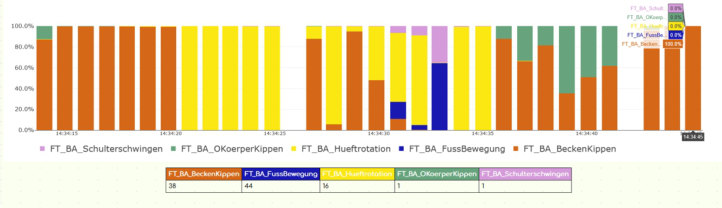
Figure 3 shows a bar chart generated by the LSTM model to visualize the classification probabilities of activities in a caregiving context, based on real- time data from the Google Pixel Watch. The Y-axis represents the probability, and the X-axis represents the classification time. Each activity is represented by a specific color. Since probabilities for all four classes are calculated per classification, the total always sums to 100%. This visualization allows caregivers to gain near real-time insight into the recognized activity of their patients.
Figure 3: Example of a chart generated by the LSTM system to display the classification probabilities of caregiving activities.
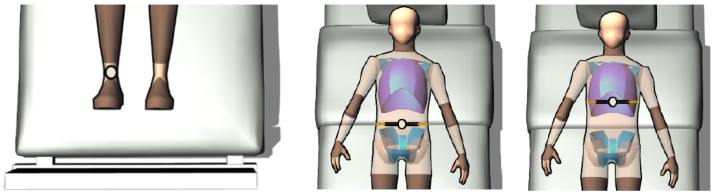
ACTIVITY RECOGNITION The data collection was carried out using the Google Pixel Watch 3, which continuously records motion signals at a sampling rate of 20 Hz. A total of ten participants took part in the experiment. The smartwatch was attached to three different body locations. It was placed on the right ankle (Figure 4, left), on the abdomen at the level of the navel (Figure 4, center), and on the chest, just below the breast (Figure 4 right).
Figure 4: Smartwatch positioning.
According to Staab et al., the smartwatch is equipped with several sensors that enable precise motion capture (Staab et al., 2024). For the tests, an
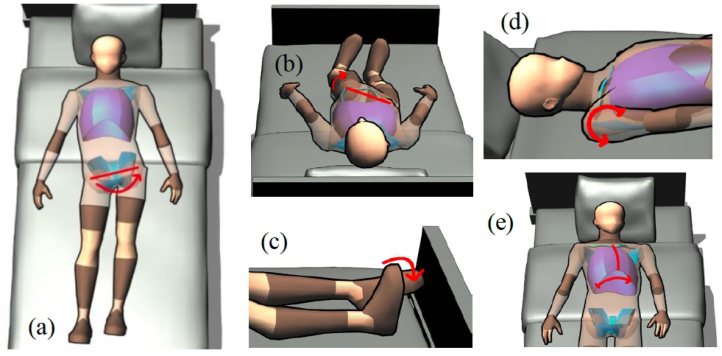
accelerometer, gyroscope, gravity sensor, orientation sensor, and a magnitude sensor were used, with data recorded at a sampling rate of 20 Hz. Each sensor provided three-dimensional motion data along the x-, y-, and z-axes, resulting in twelve features, plus an additional magnitude value, leading to a total of thirteen measured values per sample. Each of the ten participants performed five different micro-movements at three body locations – chest, abdomen, and ankle – while lying supine on a hospital bed to simulate typical pressure redistributions. For every movement, 200 data points were recorded over a period of ten seconds. Thus, for one movement at one body location, 14 features multiplied by 200 data points resulted in 2,800 data points. Considering five movements per location, this yielded 14,000 data points. As each movement was repeated twenty times for robustness, the total amount of data per body location for each participant was 280,000 data points. Since measurements were performed at three different body locations, this led to 840,000 data points per participant. With a total of ten participants, the complete dataset comprised 8,400,000 data points. In addition to active movement phases, periods of complete immobility were recorded to serve as a baseline for detecting subtle differences in movement patterns. The movements investigated included hip rotation, pelvic tilting, foot movement, shoulder swinging, and torso tilting. These activities aimed to relieve pressure from particularly vulnerable areas such as the sacrum, coccyx, heels, and shoulders, following pressure-relieving strategies described by Schröder & Kottner and recommended by the Institute for Quality Assurance and Transparency in Healthcare (IQTIG) (Schröder & Kottner, 2011) (IQTIG, 2024). Figure 5 illustrates the performed micro-movements: (a) Hip Rotation, (b) Pelvic Tilting, (c) Foot Movement, (d) Shoulder Swinging, and (e) Torso Tilting.
The Early Detection of Pressure Ulcers, an Optimized Movement Monitoring 279
EVALUATION The evaluation investigates the ability to distinguish identical movements at different body locations and to separate movement from non-movement. The findings show that LSTM models are particularly effective in recognizing movements like pelvic tilting and torso tilting across various sensor positions, although recognition accuracy is strongly influenced by body location, sensor type, and the algorithm used. Classification accuracy serves as the primary performance metric, indicating the proportion of correctly recognized activities. While LSTM achieves the highest overall accuracy, other algorithms like CatBoost perform better for specific movements, such as foot movement. The results, presented in Table 1, show that LSTM achieves the highest accuracy for movements like pelvic tilting and upper body tilting, reaching 88.86% and 86.26%, particularly when sensors are positioned at the chest. However, no single algorithm performs optimally across all activities. CatBoost, for example, detects foot movements with 70% accuracy, outperforming LSTM, which reaches only 35.82%. Other algorithms, such as GaussianNB and QDA, show lower performance for hip rotation (39.50%) and upper body tilting (52.78%), respectively. These findings underline the challenge of differentiating subtle movements, particularly for complex or less pronounced activities.
Movements originating from the core, like pelvic tilting, hip rotation, and upper body tilting, are generally distinguishable across different body locations, especially with sensors on the abdomen, chest, and ankle. In contrast, foot movements and shoulder swinging achieve lower classification rates, and movement detection at the ankle proves less reliable, likely due to signal similarities near the body’s center and the difficulty in capturing fine limb movements. Overall, the study highlights that sensor placement, algorithm selection, and sensor types significantly impact recognition accuracy. While LSTM models demonstrate strong potential, optimizing sensor configurations remains essential for reliably detecting more difficult movements. Future research should therefore focus on exploring alternative sensor setups and algorithmic adaptations.
Table 1: Prediction accuracy of individual models per movement and body location – based on combined sensor data from all positions, averaged.
The analysis of the LSTM model’s ability to distinguish movement from non-movement, based on separate models for each movement at three body locations, shows that sensor combinations using gyroscope and accelerometer data achieved the highest classification accuracy. At the ankle, for instance, configuration K18 reached an accuracy of 79.34%. In contrast, standalone sensors, such as the magnitude sensor, resulted in significantly lower accuracies. The results presented in Table 2 confirm that LSTM models can reliably differentiate between movement and rest phases when suitable sensor combinations are used, particularly in the chest region, where classification accuracy exceeded 99%. An exception is shoulder swinging, which was detected with a comparatively lower accuracy of 82.82% in the chest area.
Table 2: Accuracy of movement vs. non-movement by body location.
The abdominal region also shows high accuracy levels, but detection performance declines significantly for foot movements, with accuracy dropping to 64.55%. This indicates that lower limb movements are harder to detect from this location. Sensors placed at the ankle deliver very strong results, comparable to those in the chest region. Notably, the detection rates for hip rotation and foot movement are near perfect, achieving 99.92% and 99.76% accuracy, respectively. The evaluation shows that the LSTM model reliably distinguishes between movement and rest states, particularly for core body activities such as pelvic tilting, hip rotation, and upper body tilting. The highest classification accuracies are achieved with sensors placed in the chest region, while movement detection of the lower extremities, especially from the abdominal region, proves less reliable. Overall, the results confirm the potential of the LSTM model for precise activity recognition, emphasizing the critical role of sensor placement in model performance. The analysis further highlights that LSTM models achieve consistently high classification accuracy, particularly for central movement patterns, when sensors are positioned around the body’s core.
However, accuracy varies depending on the body location and specific movements. The differentiation between movement and non-movement is especially reliable for activities initiated from the body’s center. These findings emphasize the importance of targeted, body-location-specific sensor placement to optimize recognition performance, particularly for movements that are more difficult to detect.
The Early Detection of Pressure Ulcers, an Optimized Movement Monitoring 281
CONCLUSION
This study demonstrates the significant potential of machine learning algorithms, particularly LSTM models, in reliably detecting micro- movements for pressure ulcer prevention. The results show that LSTM can distinguish between movement and non-movement with over 99% accuracy, marking a key step toward an automated alert system for pressure ulcer prevention. However, variations in accuracy were observed depending on the body location, sensor combination, and algorithm used. Movements from the body’s core, such as pelvic tilting, upper body tilting, and hip rotation, were recognized more reliably than movements of the extremities, especially at the ankle. The chest region yielded the best results for LSTM, while CatBoost outperformed LSTM in recognizing foot movements. These findings highlight the importance of selecting appropriate sensor positions and types for accurate movement detection.
For practical applications, a movement recognition system must not only detect motion but also assess offloading of high-risk body areas. The system must be adaptable to individual movement patterns and high-risk areas for personalized pressure ulcer prevention. The study lays the foundation for intelligent, wearable systems that provide continuous, automated monitoring of movements, which could reduce pressure ulcer risk, ease caregiver burden, and support tailored prophylactic strategies. This represents a promising step toward more effective and patient-centered pressure ulcer prevention.
REFERENCES
Döbel, I., Leis, M., Vogelsang, M. M., Neustroev, D., Petzka, H., Rüping, S., Voss, A., Wegele, M., Welz, J. (2018). Maschinelles Lernen – Kompetenzen, Anwendungen und Forschungsbedarf. Gefen, A., Creehan, S., Black, J. (2020). “Critical biomechanical and clinical insights
concerning tissue protection when positioning patients in the operating room: A scoping review”, International Wound Journal, 17(5), pp. 1405–1423. IQTIG – Institut für Qualitätssicherung und Transparenz im Gesundheitswesen.
(2024). Bundesauswertung Dekubitusprophylaxe Erfassungsjahr 2023. Website: https://www.iqtig.org/veroeffentlichungen/bundesauswertung/. Matthies, D. J., Khamis, M., Bulling, A. (2021). “DIY-PressMat: A do-it-yourself pressure sensing mat for posture and activity recognition”, Proceedings of the ACM on Interactive, Mobile, Wearable and Ubiquitous Technologies, 5(3), pp. 1–27. https://doi.org/10.1145/3453892.3454001 McInnes, E., Jammali-Blasi, A., Bell-Syer, S. E., Dumville, J. C., Middleton,
V., Cullum, N. (2015). “Support surfaces for pressure ulcer prevention”, Cochrane Database of Systematic Reviews, 2015(9). https://doi.org/10.1002/ 14651858. CD001735.pub5 Niemann, L.-M., Blumenberg, P., Strupeit, S., Haller, N., Büscher, A., Krebs, M., Lübben, A., Marquard, S., Stehling, H. (2017). Anhang zur Literaturstudie zum Expertenstandard Pflege von Menschen mit chronischen Wunden (2. Aktualisierung). Deutsches Netzwerk für Qualitätsentwicklung in der Pflege (DNQP), Hochschule Osnabrück. Website: https://www.dnqp.de. Nurwulan, N. R., Selamaj, G. (2020). “Random Forest for human daily activity
recognition”, Journal of Physics: Conference Series, 1655, 012087. https:// doi.org/10.1088/1742-6596/1655/1/012087
Ogundeyi, K. E., Yinka-Banjo, C. (2019). “Websocket in real time application”, Nigerian Journal of Technology, 38(4), p. 1010. https://doi.org/10.4314/ njt.v38i4.26 Santamaria, N., Gerdtz, M., Kapp, S., Wilson, L., Gefen, A. (2018). “A randomised
controlled trial of the clinical effectiveness of multi-layer silicone foam dressings for the prevention of pressure injuries in high-risk aged care residents: The Border III Trial”, International Wound Journal, 15(3), pp. 482–490. Schröder, G., Kottner, J. (2011). Dekubitus und Dekubitusprophylaxe. Stuttgart: Georg Thieme Verlag. Sridharan, M., Bigham, J., Campbell, P. M., Phillips, C., Bodanese, E. (2020).
“Inferring micro-activities using wearable sensing for ADL recognition of home- care patients”, IEEE Journal of Biomedical and Health Informatics, 24(3), pp. 747–759. https://doi.org/10.1109/JBHI.2019.2918718 Staab, S. (2024). Entwicklung von Klassifizierungsverfahren zur automatisierten Dokumentation von Alltagsaktivitäten. Wiesbaden: Hochschulbibliothek RheinMain. Website: https://hlbrm.pur.hebis.de/xmlui/handle/1234-56789/155. Sutton-Charani, N., Faux, F., Delignières, D., Fagard, W., Dupeyron, A., Nourrisson, M. (2022). “Evidential filtering and spatio-temporal gradient for micro-movements analysis in the context of bedsores prevention”, in: BELIEF 2022: Advances in Belief Functions, Le Hégarat-Mascle, S. et al. (Eds.), pp. 297–306, Springer. https://doi.org/10.1007/978-3-031-17801-6_28 Tomova-Simitchieva, T., Akdeniz, M., Peytavi, U. B., Lahmann, N., Kottner, J.
(2019). “Die Epidemiologie des Dekubitus in Deutschland: Eine systematische Übersicht”, Das Gesundheitswesen, 81(06), pp. 505–512. https://doi.org/ 10.1055/s-0043-122069 Wickramasinghe, A., Ranasinghe, D. C. (2017). “Sequence learning with passive RFID sensors for real-time bed-egress recognition in older people”, IEEE Journal of Biomedical and Health Informatics, 21(4), pp. 918–928.
LISTED IN THE AHFE DIGITAL BOOKSTORE CATALOGUE
Explore the complete digital volume
Human Interaction and Emerging Technologies (IHIET 2025)
Read this individual research paper free through the original publisher, or explore the full digital proceedings book.
ISBN 978-1-964867-73-1
Explore this ISBN in the AHFE Bookstore ↗Listed in the July 2026 bookstore catalogue; search by ISBN to confirm current availability · Digital book purchase optional