Benjamin Botha, Lizette De Wet (2025). Experiences of Nursing Students from Using an Omnidirectional Pad vs Touch Controllers to Navigate a Virtual Clinical Simulation. In: Human Interaction and Emerging Technologies (IHIET 2025). AHFE Open Access, vol. 197, pp. 251–261. https://doi.org/10.54941/ahfe1006718
While immersive virtual reality has improved over the years, researchers are still seeking to create more realistic experiences for healthcare and nursing students' education to enable better immersive experiences. Methods: Forty-six undergraduate nursing students were exposed to a foreign body object scenario. The students' experiences were gathered using observations and retrospective think-aloud. The qualitative data was also quantitatively summarised based on the issues (negative findings) and findings (positive findings). Results: While the touch controllers seemed superior in almost all themes identified, the cybersickness category was much higher than for the omnidirectional pad. There were also controversial experiences between students for both navigation techniques.Conclusion: While the omnidirectional pad had more issues than the touch controllers, students found it fascinating, and it seemed to have a lower onset of cybersickness than the touch controllers. Students did, however indicate that the Omnidirectional pad might need improvement to become more realistic as it still did not feel completely realistic.
Nursing education has advanced a lot in recent years, with the incorporation of task trainers and human patient simulators that can mimic real-life situations and train students in a safe and risk-free way where they can learn from mistakes, hence reducing patient risk (Botha, de Wet and Botma, 2021; Liu et al., 2023). While advances in technology are to thank for this, obtaining access to expensive equipment remains a dream for many nursing institutions, especially in low-income countries (Botha, Hugo-van Dyk and Nyoni, 2023). In response to the expensive nature of human patient simulators, researchers have sought to provide more equitable and affordable access to training opportunities using more modern extended reality technologies, like immersive virtual reality, where a user is immersed in a virtually generated environment (VE) using a head-mounted display (Botha, de Wet and Botma, 2021; Liu et al., 2023). The goal eventually becomes
to provide the most realistic experience possible when students use virtual clinical simulation (VCS), but to do this, a more reliable method of navigation is needed so students can feel more immersed in the simulation (Javaid et al., 2024). Due to the increased popularity of VCS, especially within health sciences education, different navigation techniques and the user’s experiences of them should be explored to provide a more accessible, safer and realistic VCS experience. This paper aims to convey nursing students’ experiences at a higher education institution in South Africa while navigating a VCS using two different immersive VCS navigational techniques (omnidirectional pad (ODP) vs touch controllers) to determine whether the ODP could be a viable option for navigating VCS.
REALATED WORK While nursing students have not yet been specifically targeted using an ODP as a navigation method, the ODP has been used in other settings within the field of healthcare. One study found that the ODP could be a useful tool to rehabilitate patients, however, the study was conducted on healthy patients, and value was still seen in the use of the ODP (Soon et al., 2023). Another study focused on using an ODP to support frail and aging adults with physical and mobile impairments. The study indicated that it could be a suitable method to increase physical activity while providing a safer platform for the physical activity (Bradwell et al., 2024). Even in gaming, the ODP has been referred to as a tool to enhance the gaming experience (Wehden et al., 2021). While research has been done on the use of an ODP in different fields, it has not yet been incorporated in a study focusing on nursing students and their experiences of the technology in a nursing training context. Therefore, the researchers attempted to determine whether an ODP (compared to touch controllers) could assist nursing students to participate in immersive VCS while providing a more realistic navigational experience compared to that of the touch controllers.
METHODS AND MATERIALS To determine the experiences, an explorative study was conducted by collecting and thematically analysing the Qualitative data obtained from observations and the retrospective think-aloud technique. Data was analysed thematically, and appropriate themes were identified and categorized accordingly.
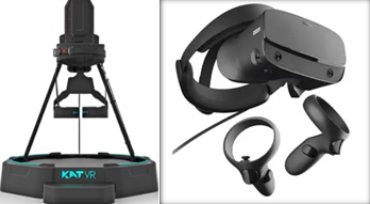
Hardware Along with the data collection tools, a variation of hardware was needed. The chosen consumer ODP was a KatWalktm Mini (see Figure 1 - left) as it was the only one available for shipping to South Africa at the time.
The HMD that was used in combination with the chosen ODP, was the Oculus Rift S (see Fig. 1 - right), which is the improved version of the Oculus Rift. The reason for using the Oculus Rift S was that the researchers
Experiences of Nursing Students From Using an Omnidirectional Pad 253
were already in possession of this hardware component. To make sure the participants did not get tangled in the cables, a VR-suspending pulley system was mounted in the room that held the cables away from the participant while also allowing freedom of movement. Even though this brought about a cost saving, it nevertheless had all the required functionality for this research. The ODP and HMD were used in conjunction with a VR-capable computer with a total of 32 gigabytes of RAM, a Core i7 10th generation processor, a solid- state hybrid drive, and an NVidia GeForce RTX 2070 graphics card, which is in line with the recommended requirement for a VR-capable computer.
Figure 1: KatWalktm mini (image used from KatWalk) and Oculus Rift S (used from Oculus).
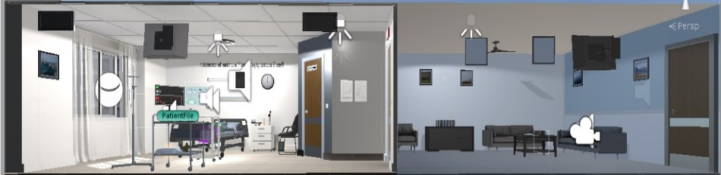
Software To integrate the ODP with the original virtual environment (VE), software was needed. For this purpose, Unity 2020 was selected to integrate the ODP as a navigation technique. The VE (Fig. 2) consisted of two rooms, the first being a lounge (on the right) where the participant is first immersed when entering the VE. The lounge contained the briefing and the objectives that the participant had to read before proceeding through the door giving access to the ward. After the participant entered through the door, they were in the ward (Fig. 2 - on the left) where the patient was present, along with various tools needed to perform the scenario. These tools consisted of a stethoscope to listen to heart and lung sounds, a bed controller, a blood gas analyser, a chest X-ray, an oxygen mask with a control panel, vital signs monitor, and an intercom to contact the attending physician.
Figure 2: VE used for testing.
The VE allowed the participants to perform a foreign body object simulation scenario. During the scenario, the patient coughed regularly. The participants could interact with the patient, read the patient file, interpret
254 Botha and de Wet
the chest x-ray, listen to the heart and lung sounds, and request the blood gas results to determine the best course of action to manage the patient. Once a diagnosis was made, the participant could use the oxygen therapy control panel in the room, along with the bed controls, to assist the patient. If the patient’s condition did not significantly improve, they had to contact the physician.
Population and Sampling The target population was nursing students at a South African tertiary institution who had the theoretical knowledge and skills to manage a patient with a lodged foreign body object in the airway. Data was collected from 46 undergraduate nursing students in their 3rd year of study, who were conveniently sampled. Those who suffered from epilepsy were excluded from the study due to the warnings in immersive VR headsets that the refresh rate might induce an epileptic attack.
Data Collection Multiple dates were made available from which participants could choose. The participants booked in groups of two per session (based on availability rather than randomly) to allow flexibility and more participants to join. Counterbalancing (Allen, 2017) was introduced as a measure to limit learnability or favour towards one navigational technique (Budiu, 2018). With each test, the initial navigation technique was alternated. In this way, not all participants were exposed to the same navigational technique first (23 started with the ODP and 23 with the touch controllers). Participants had to sign an informed consent form and were also asked to refrain from wearing dresses and flip-flops or sandals (as it made walking and strapping in on the ODP difficult). All participants were given the same task sets to complete in the VCS:
Task Set One: – Walk towards the door of the ward and open the door. – Wash your hands in the basin. – Navigate to the left side of the patient. – Apply the oxygen mask, set the flow to 40% and the flow rate to 10 L/min.
Task Set Two: – Navigate to the bathroom. – Open the bathroom door. – Flush the toilet. – Wash your hands.
Task Set Three: – Navigate to the right side of the patient. – Elevate the patient’s bed to semi-fowlers using the bed controls. – Navigate back to the room that you started in and face the door.
Experiences of Nursing Students From Using an Omnidirectional Pad 255
The researchers demonstrated the navigation techniques. Participant One then started by navigating the VCS using the assigned navigation technique. Once Participant One completed the tasks on the assigned navigation technique, they had to complete the retrospective think-aloud form and respond to verbal cues from the facilitator. Participant Two then started to complete the tasks above by navigating using the assigned navigation technique. With the first rotation completed, the two participants had to switch navigation techniques (touch controllers and the ODP), and the whole process was repeated. The researchers noted observations during the entire session. This included possible cues that could be used for the retrospective think-aloud technique (where the researchers would ask about the participant’s usability test experiences after the conclusion of the session).
Data Analysis The data was categorized by identifying common themes in the data, also known as qualitative content analysis (Castleberry and Nolen, 2018). The process involved first compiling all the qualitative data per participant, using a sheet to observations, retrospective think-aloud and comments. The second step was to disassemble the qualitative data by identifying overarching themes, and in line with user experience studies (Albert and Tullis, 2023), we decided on two overarching themes (usability issues and usability findings). For both themes, data was by navigation methods and only compared at the end. All negative comments or problems were classified as usability issues, while more positive statements or compliments were categorised as usability findings.
Once the main themes were set out, sub-themes were identified using synonyms or similar statements and observations. The next step was to reassemble the data and map qualitative data to the identified themes or create a new theme if needed. All statements were then interpreted, first based on the overarching theme and per navigation method, after which comparisons were drawn between the subthemes. Subthemes for each navigation technique were also quantified using the number of occurrences and compared to each other in chart form to assist in providing an overview of usability issues and usability findings.
RESULTS AND DISCUSSION
Qualitative Data: Observations, Comments and Retrospective Think-Aloud Due to the large amount of qualitative data, only extracts are presented in the text. The complete set of comments, observations and retrospective feedback can be viewed at https://doi.org/10.38140/ufs.23541411.v1.
Qualitative Data: Touch Controllers For the touch controllers, the biggest issues that were identified were control and increased CS symptoms. The control issues were related to not being able to reach the toilet easily or open the tap in the VE. One participant indicated,
256 Botha and de Wet
“I was a little bit struggling to flush the toilet. I don’t know if it was me or the controller.” There were also issues related to walking, as participants wanted to physically walk about, but could not, thus frustrating some of them.
As for the increased CS symptoms, many participants commented on the effect of the touch controllers on their CS symptoms. This indicated that the touch controllers did cause high CS levels, for example, one participant said: “The only time I felt nausea and felt dizzy as well was when I was using the controller to walk but overall, I enjoyed the experience.” There was one participant who failed all the tasks due to not being able to continue because of experiencing extremely high levels of CS symptoms. It strengthened the fact that CS is a very complex issue that is not necessarily experienced in the same way by different people (Botha and De wet, 2024). For the final three sub-themes, there were only a few observations or comments, with none of the issues causing task failure, and these were increased learning curve, less enjoyable and natural movements.
After the usability issues were identified, the same procedure was followed to categorize positive usability findings into sub-themes. These ‘finding’ themes constituted control, enjoyment, lower learning curve, responsiveness, and ease of use, visually appealing, reduces CS symptoms, realism and finally, future use while also highlighting the associated number of comments/ob- servations, as well as an extract of participant comments.
Participants enjoyed using the touch controllers, one participant stated: “This was a positive and educational experience so far.” Participants also felt that the touch controllers were fast, responsive, and easy to use, for example, “This navigation technique was very fun and easy to use. I enjoyed the experience.” Participants indicated that they felt in control when using the touch controllers (“I could walk a lot faster with this method. It also took less physical power which I think could be useful for people with difficulties completing physical tasks”), which contradicted most participants who felt that their control over the avatar and VE could be improved.
Some participants also indicated that the touch controllers were easier to use than the ODP, with some stating it was mainly because of the similarities to PlayStation controllers, for example, “This method was much quicker. This is most probably because I am very familiar with joysticks.” This could be due to an increased learning curve for the ODP, as well as the familiarity of the touch controllers and their resemblance to modern console controllers such as the Xbox or PlayStation.
Other findings were that participants found the navigation and VE to be realistic and visually appealing. However, they focused on the VE in most cases rather than the controllers. Some participants indicated that the touch controllers decreased their CS, while some saw a future for the use of these technologies in clinical training and practice.
Qualitative Data: ODP In total, seven sub-themes were identified for usability issues, namely control, increased CS symptoms, increased learning curve, less enjoyable, hardware/software issues, physical excretion, and natural movements. It
Experiences of Nursing Students From Using an Omnidirectional Pad 257
became clear that the biggest issue for the participants with the ODP was that of control. One participant indicated, “The movement like walking was very difficult and the rotation movement was a bit fast and made me feel like I was off balance.” Participants struggled to move backwards, reach the toilet, or accurately predict the depth of the VE and the items in the VE.
The second biggest issue was the learning curve of the ODP, for example, one participant mentioned: “This was definitely more challenging than I thought it would be.” The other usability issues of the ODP were increased CS symptoms, Hardware/software issues, natural movements, physical exertion, and less enjoyment. When considering the sub-themes of the usability findings, some participants really enjoyed using the ODP, for example one participant indicated that: “It is so much fun and people should really get to open themselves up to this kind of environment especially for learning purposes because it is such an enlightening and quite awesome experience.” Participants also found it to be responsive and easy to use (“I loved using this navigation technique because I find it easy to use and interesting. The view seemed to be real and fantastic. Rotating around feels good. I think it is a good method to use”).
Even though some participants focused on the VE rather than the navigation techniques in question, there were still numerous positive findings related to the ODP as a navigation technique for VCS. Some participants indicated that they felt more in control when using the ODP (“Being able to turn with my entire body and would like I would do rather than using the buttons to change my directions”), with less CS symptoms (“Being able to complete the task without feeling nausea or vomiting; however I was feeling dizzy during and after the task”). This contradicted the control and increased CS symptoms’ sub-theme discussed earlier as usability issues. Again, as with the touch controllers, the contradictions support the fact that CS is complex and not the same for every person. Some participants also saw a future for ODP technology in clinical training and practice.
The other finding was related to the visually appealing method of navigation. A participant also emphasized the fact that using the ODP felt like a safe method of navigating a VCS (“The fact knowing, I was in a safe space where I could do something without possibly causing harm to a patient. I also found it comforting that I could walk without fear of falling due to instability”). The ODP did provide evidence towards becoming a model of interacting in VCS for nursing students. However, when considering all the issues and findings, more research and development are needed to improve the technology to make that happen.
Qualitative Data: Touch Controllers vs ODP The sub-themes identified for both the issues and findings are shown in Table 1 and Table 2.
258 Botha and de Wet
Table 1: Usability issues for touch controllers’ vs ODP.
Table available in the original PDF paper.
Themes Touch Controllers Omnidirectional Pad (ODP)
Usability Issues
Percentage (%) vs Other ODP
Number of Comment/ Observations
Percentage (%) vs Other Touch Controller Issues
Number of Comment/ Observations or Findings Issues or Findings Control 26 45.61 34 47.22 Increased CS Symptoms 25 43.86 8 11.11 Increased Learning Curve 3 5.26 16 22.22 Less Enjoyable 2 3.51 1 1.39 Hardware/Software Issues 0 0.00 2 2.78 Physical Excretion 0 0.00 2 2.78 Natural Movements 1 1.75 9 12.50
These subthemes in Table 1 and Table 2 related to each navigation technique, along with the number of comments or observations that supported the sub-themes, were concatenated per main theme (usability issues and findings). Many sub-themes overlapped and for those that did not overlap, the alternative navigation technique was allocated a zero.
Table 2: Usability findings for touch controllers’ vs ODP.
Table available in the original PDF paper.
Themes Touch Controllers Omnidirectional Pad (ODP)
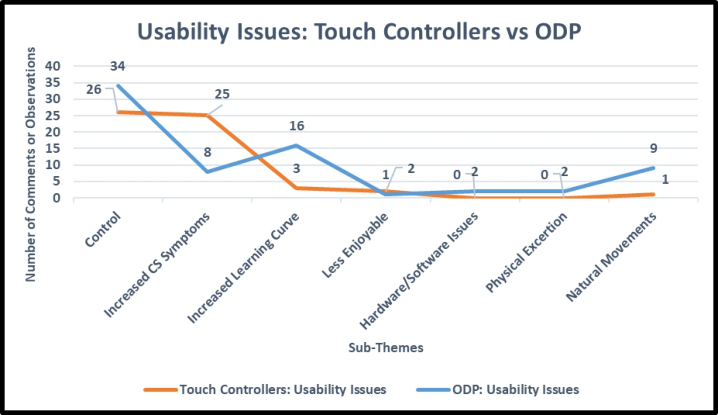
From Figure 3, it is evident that the ODP had more control issues and a significantly higher learning curve than the touch controllers. The touch controllers, again, had a much higher value linked to an increased CS. The ODP, although thought to be more natural, was not as natural as walking in real life, and participants suggested that it should be brought more in line with a treadmill than a pad.
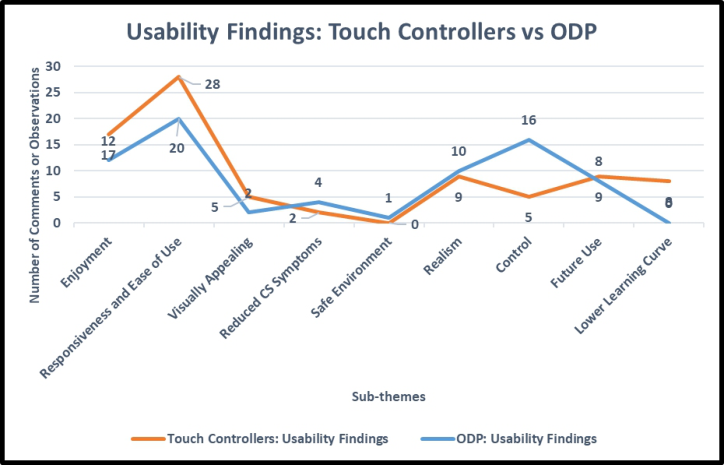
For physical exertion and hardware/software issues, there was no counterpart for the touch controllers, as participants did not have to physically walk during the navigation, and no errors were incurred. A possible reason for the hardware/software errors could be linked to the API software or the steam VR, which had to be used to use the ODP. As for the usability findings of the two navigation techniques (Figure 4), both methods were enjoyable, while the touch controllers were seen as more responsive and easier to use than the ODP. The rest of the sub-themes were relatively closely matched. The ODP was considered safer, which could be due to the
Experiences of Nursing Students From Using an Omnidirectional Pad 259
participants being strapped in and feeling more secure than with the touch controllers.
Figure 3: Usability issues: touch controllers vs ODP.Figure 4: Usability issues: touch controllers vs ODP.
Taking all the above into consideration, the touch controllers remained a superior model of interaction for immersive VCS. However, the ODP showed potential to outshine the touch controllers as the technology improves in future, and if participants could be properly trained on the use of ODP
260 Botha and de Wet
technology. As far as the usability issues go, each navigation technique had its flaws.
CONCLUSION
After determining the students’ experiences and considering the number of occurring comments within the themes, it seems that the touch controllers lead more students to experience CS and that the use of the ODP might reduce CS and lead to a more accessible navigation platform for nursing education. This is, however, offset by the fact that some students did not find the experience very realistic and struggled to use the ODP, while the touch controllers were easier to use, according to students’ comments and observations.
A larger and more inclusive sample size might provide additional insights. The study only focused on nursing students, of which most had little to no gaming experience with either consoles or PC gaming. A possible consideration for future research could be to determine the effects of CS on avid gamers vs non-gamers. Other medical-related professions (other than Nursing) could also be included in future testing.
The fact that the ODP did not appear to be as usable as the touch controllers but still seemed to limit CS onset in more participants could be investigated in future research, as well as how the ODP can be improved as a model of interaction
REFERENCES
Albert, B. and Tullis, T. (2023) Measuring the User Experience: Collecting, Analyzing and Presenting UX Metrics. 3rd edn. Cambridge: Morgan Kaufmann. Allen, M. (2017) The SAGE Encyclopedia of Communication Research Methods,
The Charleston Advisor. 2455 Teller Road, Thousand Oaks California 91320: SAGE Publications, Inc. Available at: https://doi.org/10.4135/9781483381411. Botha, B. S., Hugo-van Dyk, L. and Nyoni, C. N. (2023) ‘Simulating infection prevention and control through virtual reality: A vehicle for equity, diversity, and inclusivity in Africa’, Frontiers in Education, 8(October). Available at: https:// doi.org/10.3389/feduc.2023.1214321. Botha, B. S. and De wet, L. (2024) ‘CyPVICS: A framework to prevent or minimise
cybersickness in immersive virtual clinical simulation’, Heliyon, 10(8), p. e29595. Available at: https://doi.org/10.1016/j.heliyon.2024.e29595. Botha, B. S., de Wet, L. and Botma, Y. (2021) ‘Undergraduate Nursing Student Experiences in Using Immersive Virtual Reality to Manage a Patient With a Foreign Object in the Right Lung’, Clinical Simulation in Nursing, 56, pp. 76–83. Available at: https://doi.org/10.1016/j.ecns.2020.10.008. Bradwell, H. et al. (2024) ‘Implementation of Virtual Reality Motivated Physical
Activity via Omnidirectional Treadmill in a Supported Living Facility for Older Adults: A Mixed-Methods Evaluation: Virtual reality to motivate physical activity for older adults’, in Conference on Human Factors in Computing Systems - Proceedings. Association for Computing Machinery. Available at: https://doi.org/ 10.1145/3613904.3642281. Budiu, R. (2018) Between-Subjects vs. Within-Subjects Study Design, Nielsen Norman Group. Available at: https://www.nngroup.com/articles/between-within- subjects (Accessed: 15 May 2023).
Experiences of Nursing Students From Using an Omnidirectional Pad 261
Castleberry, A. and Nolen, A. (2018) ‘Thematic analysis of qualitative research data: Is it as easy as it sounds?’, Currents in Pharmacy Teaching and Learning. Elsevier Inc., pp. 807–815. Available at: https://doi.org/10.1016/j.cptl.2018.03.019. Javaid, M. et al. (2024) ‘Role of virtual reality in advancing education with
sustainability and identification of Additive Manufacturing as its cost-effective enabler’, Sustainable Futures. Elsevier Ltd. Available at: https://doi.org/10.1016/ j.sftr.2024.100324. Liu, K. et al. (2023) ‘Effectiveness of virtual reality in nursing education: A systematic review and meta-analysis’, BMC Medical Education, 23(1). Available at: https:// doi.org/10.1186/s12909-023-04662-x. Soon, B. et al. (2023) ‘Potential of the omnidirectional walking platform with
virtual reality as a rehabilitation tool’, Journal of Rehabilitation and Assistive Technologies Engineering, 10, p. 205566832311615. Available at: https://doi.org/ 10.1177/20556683231161574. Wehden, L. O. et al. (2021) ‘The slippery path to total presence: How omnidirectional virtual reality treadmills influence the gaming experience’, Media and Communication, 9(1), pp. 5–16. Available at: https://doi.org/10.17645/ MAC. V9I1.3170.
LISTED IN THE AHFE DIGITAL BOOKSTORE CATALOGUE
Explore the complete digital volume
Human Interaction and Emerging Technologies (IHIET 2025)
Read this individual research paper free through the original publisher, or explore the full digital proceedings book.
ISBN 978-1-964867-73-1
Explore this ISBN in the AHFE Bookstore ↗Listed in the July 2026 bookstore catalogue; search by ISBN to confirm current availability · Digital book purchase optional