Yuki Aoki (2025). Development of Color Universal Design Education System. In: Human Factors and Systems Interaction. AHFE Open Access, vol. 192, pp. 40–49. https://doi.org/10.54941/ahfe1006626
Color is one of the most important elements in design. From an educational standpoint, while teaching and communicating with people who have different types of color vision wherein colors are difficult to distinguish is possible, no systematic educational method that allows them to experience such colors firsthand currently exists. Despite the fact that color is a crucial factor in design activities, individuals with different color vision face unique challenges that must be considered. Color vision is categorized into five main types, which include the typical vision and other types such as P-type and D-type. For example, individuals with certain types of color vision may struggle to distinguish commonly used colors like red and green.The concept of Color Universal Design (CUD) aims to create color schemes that can be used seamlessly by individuals with different types of color vision. Many related studies present considerations for designing with accessibility in mind, and these principles are widely applied in the field of design. For instance, selecting appropriate colors, adjusting contrast levels, and incorporating non-color-based design elements such as shapes are essential. This kind of practice is typically taught through in-house workshops and on-the-job training. However, the current study argues that to design effectively for individuals with different types of color vision, to experience their perspective as closely as possible is crucial. Furthermore, gaining such realistic experiences can foster greater awareness and understanding.This research systematizes the concept of CUD into a structured body of knowledge that facilitates understanding and practical application and develops educational tools. Specifically, a tool and framework utilizing cards with colors that are difficult to distinguish were developed along with a workshop design that employs glasses simulating different types of color vision. By using physical cards rather than solely relying on digital displays, this approach broadens the scope of educational and experiential opportunities.A testing workshop with collaborators was also included. During the workshop, participants were interviewed to identify issues and systemic shortcomings. Based on these findings, an ideal educational framework was proposed and key considerations for CUD-focused color education outlined. These insights are intended to inform future educational efforts for individuals with diverse types of color vision. This study assessed the educational effectiveness of the tools and methods.The ultimate goal is to create a tool that students and designers can use to apply CUD knowledge in their future design practices.
Development of a Color Universal Design Education System 41
INTRODUCTION
Inclusive design is important for creating easy-to-use designs for different situation (Microsoft Design, 2016). Society emphasizes tailoring responses to the diverse characteristics and situations of different people; similarly, there is a diversity of color perceptions (The Genetics Society Of Japan, 2017), which must be considered in design. One way of doing this is via the concept of color universal design (CUD).
There are five main types of color blindness (Color Universal Design Organization). Besides normal color vision, P-type and D-type color blindness exists, which leads to difficulty distinguishing between red and green or between commonly used colors. This varies across countries and regions. However, in Japan, approximately 1 in 20 men have color vision that is not normal. The concept of CUD aims to create color schemes that can be easily used by people with different color visions. In addition, the Japanese Color Certification Test includes a UC class level specific to CUD (Japan Color Research Institute, 2022), demonstrating the importance of CUD education. This theme is commonly explored in color-related research. Investigations into graph design (Tanaka, 2016) and research on art education addressing color vision diversity (Muratani, 2024) interest in CUD.
Color is often addressed in design education. In this context, the concept of CUD and how to respond to it is taught. However, providing hands- on education within the limited period of university education is difficult. Having previously worked as a designer, the author experienced difficulty in designing according to CUD. Therefore, he considered developing a system to provide hands-on CUD education.
Purpose of This Study This study aimed to develop a tool to be used in education by systematizing the concept of CUD into a form that can be understood and put into practice. Specifically, I developed a tool and framework that uses cards with hard- to-distinguish colors and designed a workshop that uses glasses that allow people to experience different color visions. The use of cards can help in designing work that can not only be displayed but also experienced; therefore, I believe that the range of educational and experiential situations can be expanded.
Pre-Experimentation As a preliminary experiment, I conducted a trial using a prototype with four students, who were aware that they were beginners in CUD and had normal color vision. The participants were third- and fourth-year students in the Department of Design Science at the Chiba Institute of Technology. All participants had heard of CUD and were so-called beginners in CUD. I conducted the experiment for 120 minutes with the 4 students on October 18, 2024 (Table 1). The experimental environment was designed to prevent the effects of direct sunlight by drawing the window blinds. In addition, the tables were placed
42 Aoki
near fluorescent lights. For the indoor lighting, the illuminance of each seat was measured immediately before the experiment using an illuminance meter to ensure that the lighting was sufficient for general design work, with an illuminance of approximately 900 lux.
Table 1: Time table of the pre-experimentation.
Table available in the original PDF paper.
Time Table Minutes Thema 14:00–14:20 20 Explanation, consent form 14:20–14:30 10 Pre-survey 14:30–14:50 20 Work 1: Arrange the cards on a color wheel 14:50–15:00 10 Work 2: Differences due to the combinations
of text and background colors 15:00–15:15 15 Work 3: IDEA (group) 15:15–15:25 10 Post-survey 15:25–16:00 35 Discussion
Prototype The prototype used 24 color cards printed on thick paper using an inkjet printer. Although the colors could not be reproduced accurately, two people with normal color vision who were involved in the design confirmed that the colors could be distinguished under standard lighting conditions (PANTONE 5 Light Booth D50). A preliminary experiment was conducted to confirm the flow of the experiment and identify any issues.
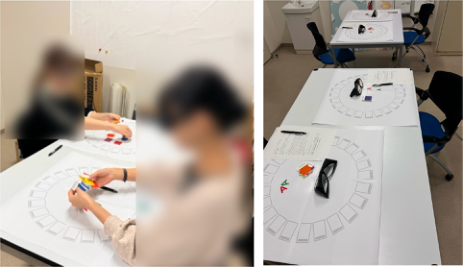
Two varieties of glasses (P-type and D-type) named Variantor (Itoh Optical Industrial Co., Ltd.), that allow one to experience P-type and D-type vision were used. The glasses were put on and taken off according to instructions (Figure 1).
Figure 1: Scenes from the preliminary experiment.
Results of the Preliminary Experiments In Work 1, the cards were arranged on the color wheel without wearing glasses, and all participants completed the task in approximately one minute with correct answers. Subsequently, they wore either P-type or D-type glasses
Development of a Color Universal Design Education System 43
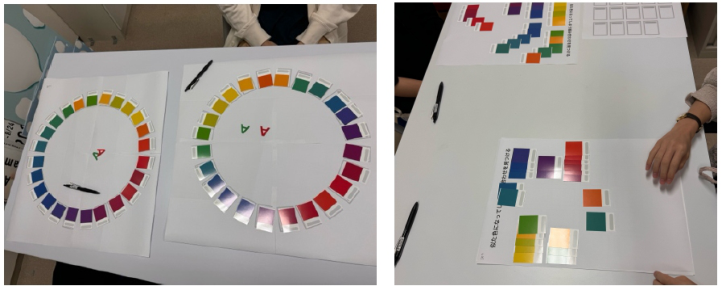
and performed the task in the same situation as a person with different color vision. Consequently, none of the participants were able to arrange the cards on the color wheel when wearing the glasses of a person with different color vision, and they experienced more difficulty in distinguishing colors than usual (Figure 2).
Figure 2: Color wheel while wearing glasses and the grouping of colors.
In Work 2, the participants used text cards to group the colors that they felt were similar, overlapping with the cards used in the first part of the experiment. Consequently, the participants identified several different ways of grouping the colors, which took longer than the 10 minutes that had been allocated for the discussion. Some participants began to experience eye fatigue after wearing glasses; therefore, it was necessary to consider ways to shorten the experiment duration (Figure 2).
Finally, in Work 3, all four participants worked together to identify ideas for the types of design solutions they could come up with as designers. This task aimed to use discussions to help develop ideas and create a synergistic effect. Consequently, many comments were made about the overall impressions of the work, which differed from the aim of the experiment.
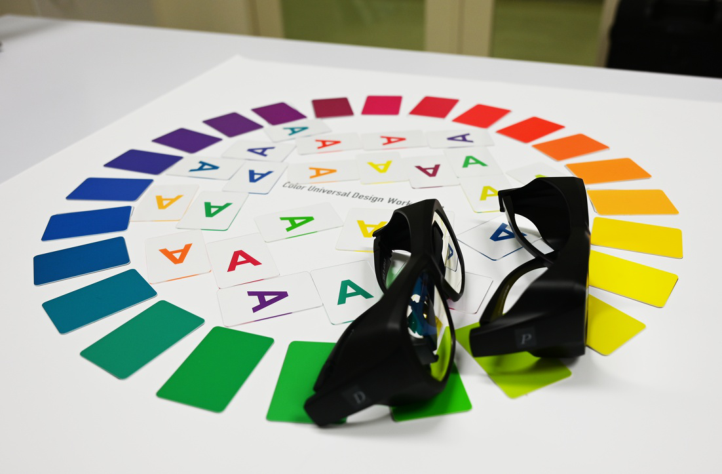
Improvements to Tools and Work The cards used in the actual performance were created by adjusting the colors through mutual communication with a mockup production company. The colors were reproduced by painting on acrylic boards using V1-24 (Practical Color Coordinate System New Color Card 199a). Regarding the color tones, two people involved in the design with normal color vision compared the color cards with a light booth that could embody a standard light source and confirmed that the colors were reproduced without any problems (Figure 3).
The most crucial improvement to the work was the reduction in the time spent wearing glasses. In the previous experiment, some participants experienced eye fatigue after wearing the glasses for a long duration; therefore, in this experiment, I changed the content and reduced the time spent wearing the glasses. In the previous experiment, the text cards and
44 Aoki
background color cards were frequently placed on top of one another without a purpose. In this experiment, I reduced the time by clarifying this purpose. Subsequently, in the thinking-about-solutions stage for Work 3, I changed group work to individual work to prevent the discussion from going off- topic, encourage the participants to think for themselves, and to help them clarify their insights.
Figure 3: Tool set.
Experiment (Workshop) Overview The experimental environment was designed with the same considerations as those used in the preliminary experiment. The experiment was adjusted based on the results of the preliminary experiment to reduce the required duration (Table 2).
Work 1 was conducted in the same manner as the preliminary experiment, with the participants arranging the color wheels. They performed the task once without glasses and twice with glasses (in the order P-type →D-type or D-type →P-type). When wearing the barrier glasses, it became difficult to correctly arrange the hue circle, and the participants experienced difficulty in differentiating between colors that were difficult to distinguish.
Table 2: Time table of the experimentation.
Table available in the original PDF paper.
Time Table min 10:00-10:10 10 Explanation, consent form 10:10-10:20 10 Pre-survey
Continued
Development of a Color Universal Design Education System 45
Table 2: Continued Time Table min
Table available in the original PDF paper.
10:20-10:30 10 Work 1:Arrange the cards on a color wheel 10:30-10:45 15 Work 2:Differences due to the combinations of text and background colors 10:45-11:00 15 Work 3:IDEA (individual) 11:00-11:10 10 Post-survey
Work 2 was conducted with the specific aim of reducing eye fatigue caused by over-considering the combinations of background colors. The first was a combination of energetic colors, and the second was a combination of refreshing colors. The participants created these combinations by combining text cards and background cards without wearing glasses; subsequently, they wore the glasses and explored the differences in impressions.
For Work 3, I conducted a brainstorming session on the potential considerations for design as an individual task.
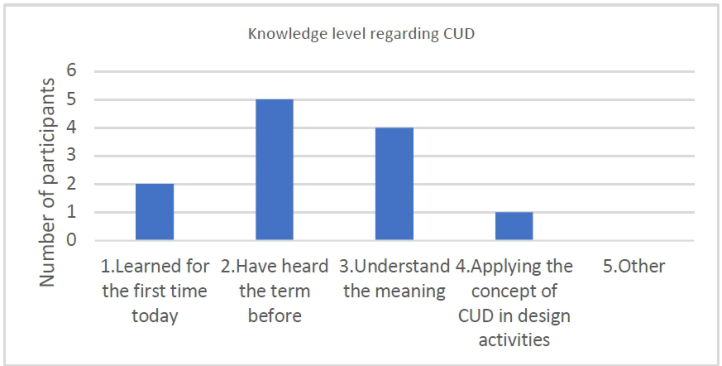
The participants in this experiment were 11 students who were aware that they were beginners in CUD and had normal color vision. The students were third- and fourth-year students from the Department of Design Science at the Chiba Institute of Technology. More than half of the students had a basic understanding of CUD and had heard the term before (Figure 4). This experiment was conducted over five sessions in January 2025.
Figure 4: Knowledge level regarding color universal design.
RESULTS
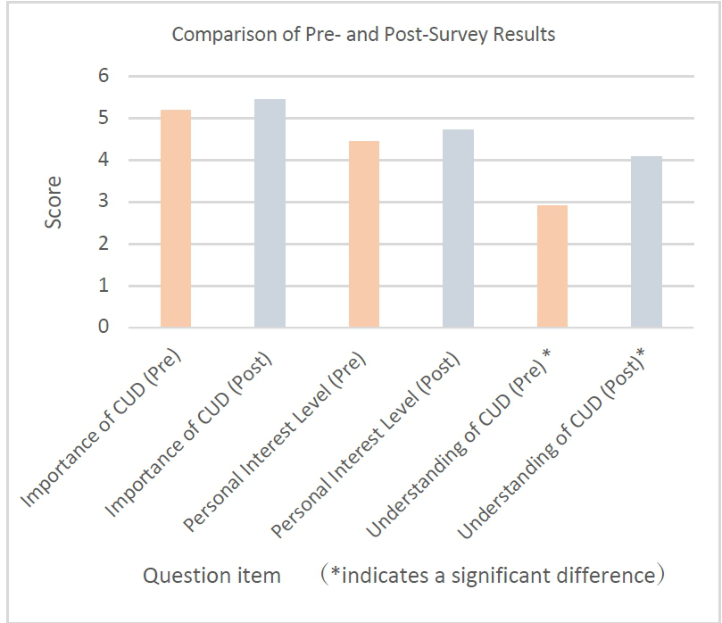
The same questions were asked in the pre- and post-questionnaires from three perspectives of the experiment (Figure 5). The results were compared and analyzed using a t-test for each perspective to assess significant differences. No significant differences were observed in the perceived importance of CUD
46 Aoki
or personal commitment to CUD. Regarding the importance of CUD, 4 out of 11 participants reported an increased sense of importance after experiencing CUD. This may be attributed to the fact that many participants already considered CUD highly important prior to the workshop.
Figure 5: Comparison of pre- and post-survey results.
In contrast, a significant improvement in understanding of CUD was observed before and after the experiment. This result indicates that the activities effectively contributed to participants’ comprehension of CUD.
In addition, participant comments indicated strong engagement, with several expressing curiosity about the challenges faced in daily life. Some comments also described the experience as enjoyable and valuable for design practice. These findings suggest that the workshop provided meaningful value to the participants. Furthermore, several participants reported perceiving more difficulties in color discrimination than expected. This indicates that the workshop emphasized the importance of experiencing these challenges firsthand, rather than merely acquiring knowledge about them.
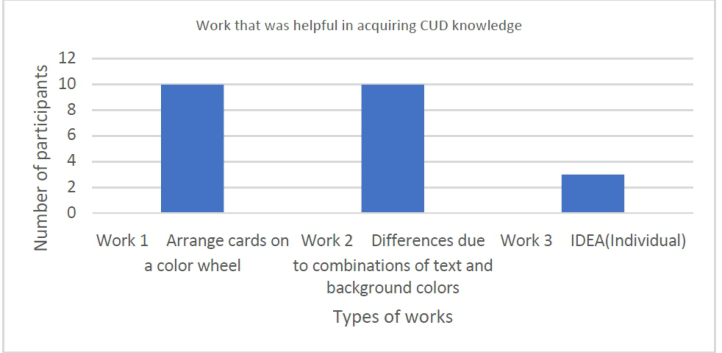
Regarding the outcomes of each activity, many participants identified Works 1 and 2 as particularly useful for acquiring knowledge related to CUD (Figure 6).
Development of a Color Universal Design Education System 47
Figure 6: Work that was helpful in acquiring color universal design knowledge.
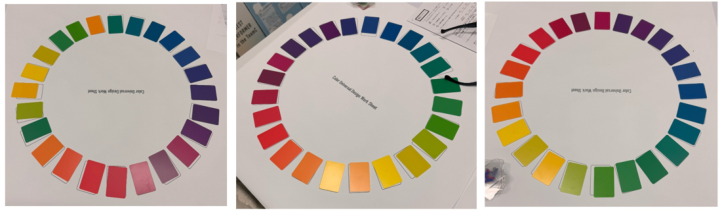
Many participants commented that Work 1 enabled them to experience how certain colors become difficult or impossible to distinguish when creating a color wheel while wearing the glasses (Figure 7).
Figure 7: Color wheel after wearing glasses.
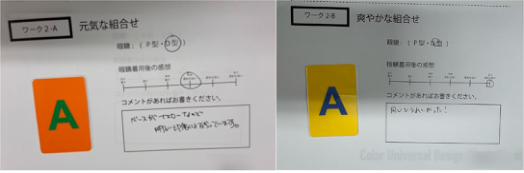
Regarding Work 2, many participants explored how the appearance of text-background color combinations varied depending on the pairing. They observed whether the impressions produced by their selected combinations changed across different types of color vision and thereby expanded their understanding of Color Universal Design (Figure 8).
Figure 8: Work 2.
48 Aoki
CONCLUSION
Throughout the workshop, participants were able to deepen their understanding of Color Universal Design (CUD) through hands-on experience. Practical activities contributed to this improved understanding. However, due to time constraints and the nature of the workshop, no topics introducing new knowledge were included. As noted in participant feedback, follow-up sessions such as reflective discussions and supplementary lectures are necessary to further deepen understanding.
In addition, Work 2 explored the differences in visual impressions based on combinations of text and background colors. Many students expressed interest in how certain color combinations influenced perception and in identifying combinations that maintained consistent impressions across different types of color vision. Although these insights increased engagement with the topic, they could not be fully reflected within the scope of the activity.
While this study facilitated better understanding of CUD through experiential learning, several challenges remain. Since the activities required the use of a Variantor, scalability to larger groups of students is limited. Developing a method that does not rely on wearing such devices will be necessary for broader implementation.
Improvements are also needed regarding the usability of the cards and sheets developed for the workshop. Currently, the cards tend to adhere to the sheet and are difficult to flip; placing a felt layer underneath the sheet could resolve this issue.
Given the high level of student interest in the impact of color combinations on perception, further activities will be developed to deepen exploration of this theme. Structuring the learning stages and processes related to CUD, including color combinations, remains an area for future work. Continued refinement of the educational framework is planned to enhance the effectiveness of CUD instruction.
ACKNOWLEDGMENT
This work was supported by JSPS KAKENHI (Grant-in-Aid for Research Activity Start-up), with the grant number 23K18948.
REFERENCES
Color Universal Design Organization (February 14, 2025) “Nomenclature of color vision” CUDO Website: https://cudo.jp/?page_id=84. Itoh Optical Industrial Co., Ltd. “Variantor” : https://www.variantor.com/jp/. Japan Color Research Institute, Okajima, K. (2022). Advance forward True Colors.”
Test in color coordination Official Text UC Class”. Microsoft Design (2016) “Inclusive” Microsoft Website : https:// inclusive.microsoft.design/tools-and-activities/Inclusive101Guidebook.pdf. Muratani, T. Chikara, R. Sunaga, M. (2024) “Study on Constructing the Color Education Basis on the Color Vision Diversity: Suggesting the Subjects for the Investigation by Assessing the Actual Situations of Art Classes Through Questionnaire Survey”, Color Science Association of Japan, Color Science Research, 2024, Vol. 2, No. 2, pp. 55–68.
Development of a Color Universal Design Education System 49
Tanaka, S. Kobayashi, M. Miwa, Y. (2016) “Visual Chart Design by Japanese Researchers and Engineers”, Japanese Society for the Science of Design, Bulletin of JSSD Vol. 63, No. 6, 2017, pp. 47–56. The Genetics Society Of Japan (September 11, 2017) “About the revision of genetic terminology”, The Genetics Society Of Japan Website: https://gsj3.org/wordpress_v2/wp-content/themes/gsj3/assets/docs/pdf/ revisionterm_20170911.pdf.
LISTED IN THE AHFE DIGITAL BOOKSTORE CATALOGUE
Explore the complete digital volume
Human Factors and Systems Interaction
Read this individual research paper free through the original publisher, or explore the full digital proceedings book.
ISBN 978-1-964867-68-7
Explore this ISBN in the AHFE Bookstore ↗Listed in the July 2026 bookstore catalogue; search by ISBN to confirm current availability · Digital book purchase optional