Laura Mancuso, Chiara Tancredi, Roberta Presta (2025). Designing the interaction with Intelligent Decision Support Systems in Control Rooms: Challenges, Strategies, and Insights for Railway Applications. In: Advances in Human Factors of Transportation. AHFE Open Access, vol. 186, pp. 511–520. https://doi.org/10.54941/ahfe1006541
Control rooms are critical environments for monitoring and managing complex socio-technical systems across industries such as transportation, energy, and public safety. Decision Support Systems (DSS) play a pivotal role in assisting operators by processing vast amounts of data, streamlining decision-making processes, and reducing response times. The integration of AI into DSS, creating Intelligent DSS, introduces new challenges, particularly regarding explainability and trustworthiness. Operators must not only interpret complex AI-driven recommendations but also rely on them in high-stakes, time-critical scenarios. For instance, intelligent alarm management systems in railway control rooms are designed to help operators prioritize, filter, and manage alarm floods, reducing cognitive overload. However, their effectiveness heavily depends on aligning with operators' cognitive needs, maintaining situational awareness, and fostering trust in automated recommendations. This context presents new significant challenges for designing effective interactions between control room systems and operators, that differently for the back-end AI-based DSS solutions, remain less clearly defined. This gap complicates the development of clear strategies for ergonomic interaction design and their subsequent assessment. This study addresses these challenges through a systematic literature review, focusing on works within the domains of human factors and ergonomics. The review explores the following research questions: What are the main ergonomic issues identified in the current state of the art regarding operator interaction with Intelligent DSS in control rooms? What are the key interaction strategies proposed to address these issues, and what performance indicators have been identified? Performance indicators are defined operationally and accompanied by detailed methodologies for their calculation, ensuring their applicability to other design projects. These indicators include measures encompassing both objective and subjective aspects, related to situational awareness metrics, and trust in AI systems. By synthesizing research perspectives and providing actionable guidelines, this study offers a foundational reference for ergonomic design efforts in control room environments. It seeks to overcome current limitations and advance the development of safer, more efficient, and operator-friendly systems, with a particular focus on railway applications.
In complex, safety-critical settings like railway control rooms, Intelligent Decision Support Systems (IDSS) assist human operators by monitoring conditions, diagnosing anomalies, anticipating developments, and providing proactive recommendations during both routine and critical events (Jang and Koo, 2024). To be effective, these systems must keep the human-in-the-loop (Abbas et al., 2024), support situational awareness (Marot et al., 2022), align with users’ mental models (Salfinger et al., 2014), and foster trust in human–AI relationships (Bek-Pedersen et al., 2019). Although automation can reduce workload, it may also increase dependency and reduce operator preparedness in failures (Bainbridge, 1983). The Levels of Automation (LoA) framework illustrates these trade-offs: higher LoA reduce workload but risk
disengagement, while lower LoA support awareness at the cost of increased cognitive demand (Abbas et al., 2024; Schilling et al., 2024). In this context, trust is crucial, enhanced by transparent and clear system reasoning (Marot et al., 2022), and undermined by poor explainability or opaque logic (Abbas et al., 2024; Mietkiewicz and Madsen, 2023; Amazu et al., 2024b). Systems offering interpretable, actionable insights foster greater operator confidence (Schilling et al., 2024; Jang and Koo, 2024). Explainability is thus not a mere technical add-on but a critical enabler of both situational awareness and effective decision-making, especially under pressure (Marot et al., 2022; Amazu et al., 2024a). Poorly designed systems risk delays, uncertainty, and disruption of essential human–machine synergy in emergencies (Hofinger et al., 2011). The remainder of this article is structured as follows: the Methodology section details the systematic review process; Results highlight key findings on situational awareness, trust, and explainability; Discussion outlines current gaps and future ergonomic design directions; and the Conclusion summarizes contributions and implications for railway control room applications.
METHODOLOGY
This study employs a systematic literature review (SLR) to investigate the design of interaction between operators and AI-based Decision Support Systems (DSS) in control room settings, following PRISMA guidelines for transparency and replicability (Tugwell and Tovey, 2021). The final search was conducted on May 13, 2025, across Scopus, ACM Digital Library, IEEE Xplore, and ScienceDirect, using the keywords “control room”, “decision support system”, and “artificial intelligence”, along with common variants. Each database was queried with tailored strategies to ensure broad yet consistent coverage: Scopus (titles, abstracts, keywords; excluding conference reviews), IEEE Xplore (all metadata), ACM DL (full- text, excluding abstracts and work in progress), and ScienceDirect (aligned with Scopus, with manual cross-checks). Studies were included only if they addressed operator interaction with DSS, with a focus on design, cognitive, or ergonomic aspects. Works limited to system architecture or algorithmic development—without human factors considerations—were excluded. The screening was independently performed by the first and third authors, with full-text checks in case of ambiguity. Discrepancies were resolved through discussion to ensure rigorous inclusion decisions.
The selection process began with an abstract screening, carried out independently by the first and the third authors. In cases of ambiguity, the full text of the article was jointly reviewed. Any disagreement between reviewers was resolved through a consensus discussion, ensuring a rigorous and transparent inclusion/exclusion decision for each contribution.
RESULTS
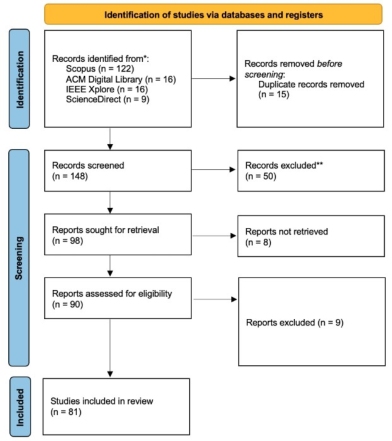
The literature search retrieved 163 records from Scopus (n = 122), ACM Digital Library (n = 16), IEEE Xplore (n = 16), and ScienceDirect (n = 9).
Designing the Interaction With Intelligent Decision Support Systems in Control Rooms 513
After removing 15 duplicates, 148 records were screened by title and abstract, leading to the exclusion of 50 that did not meet inclusion criteria. Of the remaining 98, 8 full texts remained inaccessible, despite attempts made through institutional access and direct contact with the authors via ResearchGate. Ultimately, 90 full texts were assessed, and 9 more were excluded for lacking relevance to human–DSS interaction or ergonomic aspects. The final review included 81 studies, as shown in the PRISMA diagram (Figure 1). Most contributions were conference papers (n = 50) and journal articles (n = 28), with two reviews and one book chapter. Some journals, such as Advances in Intelligent Systems and Decision Support Systems, appeared multiple times. The publications span from the late 1980s to 2025, with a significant increase in the last decade: 43 of 81 studies (53%) were published between 2015 and 2025, reflecting rising interest in AI-based DSS and human–system interaction in control rooms. This review focuses on these 43 recent studies, considered most representative of current challenges and technologies. A thematic analysis examined whether each study addressed explainability, trust, or situational awareness. While 27 papers mentioned at least one of these dimensions, 2 did so only superficially. Thus, 25 studies were included in the in-depth analysis (Table 1).
Figure 1: PRISMA 2020 flow diagram illustrating the study selection process.
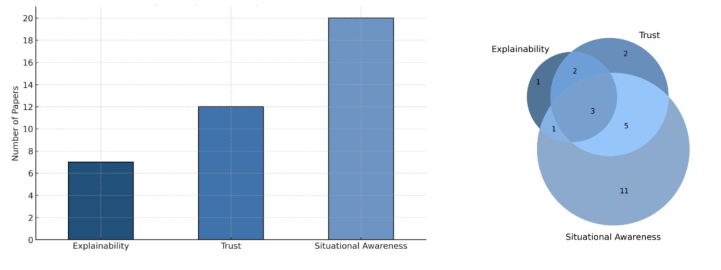
A detailed analysis assessed thematic depth and overlap. As shown in the bar chart (Figure 2, left), situational awareness was the most addressed (20 papers), followed by trust (12) and explainability (7). This indicates that, although all three are relevant, situational awareness currently dominates the discourse on AI–human interaction in control rooms. The Venn diagram (Figure 2, right) illustrates limited conceptual integration: only 3 studies addressed all three dimensions simultaneously (Abbas et al., 2024; Amazu et al., 2024a; Sobrie and Verschelde, 2024). Overlaps were found between
explainability and trust (2 papers) (Jang and Koo, 2024; Hanna et al., 2020), trust and situational awareness (5 papers) (Bek-Pedersen et al., 2019; Marot et al., 2022; Mietkiewicz et al., 2024; Schilling et al., 2024; Mietkiewicz and Madsen, 2023), and explainability and situational awareness (1 paper) (Costa and Hirata, 2025). Notably, 11 papers focused exclusively on situational awareness, underscoring the tendency to treat these themes in isolation (Djeachandrane et al., 2022; Chen et al., 2017; De Oliveira et al., 2023; Domova et al., 2019; Kirchhu¨bel et al., 2019; Nystad et al., 2021; Prostejovsky et al., 2019; Rybak et al., 2017; Symeonidis et al., 2021; Wolf et al., 2025; Zaher et al., 2016).
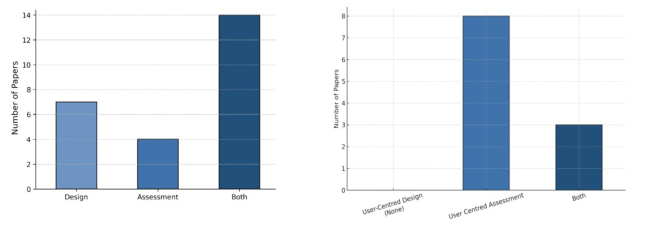
Figure 2: Distribution of the 25 papers addressing at least one of the key human- centered concepts: situational awareness (n = 20), trust (n = 12), and explainability (n = 7). On the left, each bar shows the total number of papers per concept, regardless of overlap. On the right, the Venn diagram illustrates thematic intersections: only 3 papers addressed all three dimensions.Figure 3: Distribution of the 25 reviewed studies by type of study (left) and user involvement (right).
To clarify the methodological orientation of the 25 selected papers, we analyzed both the study type (design, assessment, or both) and the extent of user involvement. As shown in Figure 3 (left), 14 studies included both
Designing the Interaction With Intelligent Decision Support Systems in Control Rooms 515
design and assessment phases, 7 focused solely on design, and 4 reported only assessment activities.
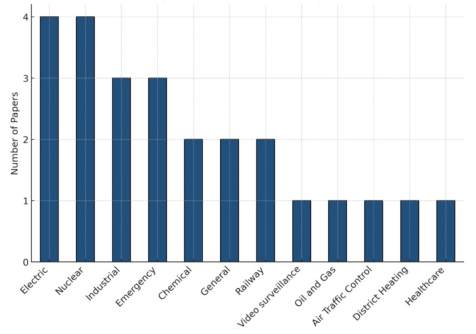
Figure 4: Application domains of the 25 reviewed papers.
User involvement, as shown in Figure 3 (right), reveals that 8 papers adopted a user-centered assessment approach, while 3 papers incorporated both user-centered design and assessment. No paper was classified as adopting a user-centered design approach only.
We also categorized the application domains (Figure 4). The most represented were electric power and nuclear sectors (4 papers each), followed by industrial and emergency response (3 each), and chemical, railway, and general control environments (2 each). Less frequent but notable domains included video surveillance, oil and gas, air traffic control, district heating, and healthcare, with one study each.
Explainability Among the 25 selected studies, 7 explicitly addressed explainability as a key element in the design or evaluation of AI-based Decision Support Systems (DSS) for control room environments (Table 1). Explainability is increasingly recognized as a crucial requirement to ensure that human operators can understand the rationale behind system outputs, thus enabling more informed and confident decision-making (Marot et al., 2022). Several studies embed explainability into system architecture through design-oriented strategies. Approaches include Dynamic Influence Diagrams (DID) for transparent reasoning visualization (Abbas et al., 2024), Goal-Directed Task Analysis (GDTA) combined with cognitive models for interpretable logic even post-reinforcement learning (Costa and Hirata, 2025), and declarative programming techniques such as Answer Set Programming (ASP) to generate human-readable, logic-based explanations (Hanna et al., 2020). These methods treat explainability as a structural, not superficial, system feature. Assessment of explainability is both subjective and technical. User-facing questionnaires gauge perceived clarity (e.g., “How would you rate the level of
explainability?”) (Amazu et al., 2024a; Abbas et al., 2024), while explainable AI tools like SHAP provide post hoc insights into feature importance (Sobrie and Verschelde, 2024; Caruso et al., 2023). Interviews further explore the relevance of explanations and their effect on trust and understanding (Sobrie and Verschelde, 2024).
Table 1: Reviewed studies addressing situational awareness, trust, or explainability, sorted by publication year.
Table available in the original PDF paper.
Reference Domain SA Trust Exp Wolf et al. (2025) Healthcare X - - Costa and Hirata (2025) General X - X Abbas et al. (2024) Chemical X X X Mietkiewicz et al. (2024) Industrial X X - Amazu et al. (2024a) Industrial X X X Sobrie and Verschelde (2024) Railway X X X Schilling et al. (2024) Emergency X X - Jang and Koo (2024) Nuclear - X X De Oliveira et al. (2023) Air Traffic Control X - - Mietkiewicz and Madsen (2023) Chemical X X - Caruso et al. (2023) Emergency - - X Marot et al. (2022) Electric X X - Djeachandrane et al. (2022) Video Surveillance X - - Hanna et al. (2021) Nuclear - X X Nystad et al. (2021) Nuclear X - - Symeonidis et al. (2021) Emergency X - - Hanna et al. (2020) Nuclear - X - Domova et al. (2019) District Heating X - - Kirchhu¨bel et al. (2019) Industrial X - - Prostejovsky et al. (2019) Electric X - - Bek-Pedersen et al. (2019) Oil & Gas X X - Wood et al. (2018) Railway - X - Chen et al. (2017) Electric X - - Rybak et al. (2017) General X - - Zaher et al. (2016) Electric X - -
Trust Among the 25 selected studies, 12 explicitly addressed trust as a key element in the design or evaluation of AI-based Decision Support Systems (DSS) for control room environments (Table 1). Trust enables operators to rely on system recommendations, particularly under time pressure or uncertainty. As highlighted by Marot et al. (2022), building trust in intelligent systems requires a combination of transparency, reliability, and consistently accurate performance. Several studies highlight the importance of transparent design in reinforcing trust. Clearly articulated system logic enhances user confidence (Bek-Pedersen et al., 2019), while Answer Set Programming (ASP), also used for explainability, supports verifiability and human oversight by enabling users to audit the system’s reasoning (Hanna et al., 2020; 2021). Additional strategies include ontology-based communication frameworks and adaptive
Designing the Interaction With Intelligent Decision Support Systems in Control Rooms 517
interfaces that promote transparency while adapting to operator needs (Marot et al., 2022). Participatory design, where users help shape system logic and interfaces, further strengthens trust (Mietkiewicz et al., 2024; Wood et al., 2018). Low trust correlates with a preference for lower automation levels, highlighting the need for AI systems to align with human expectations (Schilling et al., 2024). Consequently, explainability, perceived accuracy, and justification mechanisms are not just beneficial but essential to building and maintaining trust (Sobrie and Verschelde, 2024). Trust is typically assessed through user questionnaires and interviews. Examples include prompts such as “Level of trust for the AI suggestion” (Abbas et al., 2024) and “How high is your trust in the decisions suggested by the recommendation system?” (Amazu et al., 2024a), which capture both emotional and cognitive dimensions of trust. Complementary qualitative interviews explore broader perceptions like fairness, reliability, and transparency, providing deeper insight into how trust evolves throughout system use (Sobrie and Verschelde, 2024).
Situational Awareness Among the 25 selected studies, 20 explicitly addressed situational awareness (SA) as a key element in the design or evaluation of AI-based Decision Support Systems (DSS) for control room environments (Table 1). SA is a critical factor in control room operations, especially in safety-critical domains where rapid and accurate decisions must be made. It is commonly defined as the perception of environmental elements within a specific time and space, the comprehension of their significance, and the projection of their future status (Zaher et al., 2016; Nystad et al., 2021). Design approaches to enhance situational awareness (SA) often combine technical mechanisms with user-centered strategies. Technically, systems employ cognitive models (Costa and Hirata, 2025; Djeachandrane et al., 2022), functional and causal modeling for system predictability (Bek-Pedersen et al., 2019; Kirchhu¨bel et al., 2019), and techniques such as semantic integration (Symeonidis et al., 2021), predictive automation, and logic-based control systems (De Oliveira et al., 2023; Hanna et al., 2021) to align system behavior with operators’ mental models. Visualization tools and real-time interfaces—like dashboards with embedded decision support and personalized feedback—aid dynamic decision-making by reducing complexity and cognitive load (Chen et al., 2017; Domova et al., 2019; Marot et al., 2022; Sobrie and Verschelde, 2024). From the user side, studies highlight the importance of operator- centered requirements (Zaher et al., 2016) and collaborative decision-making support (Wolf et al., 2025). Maintaining human-in-the-loop is seen as essential to prevent loss of SA due to over-automation (Schilling et al., 2024). Some systems even integrate personalized explanations and peer-comparison views to reinforce cognitive alignment (Sobrie and Verschelde, 2024). This synergy between system intelligence and human-centered design supports SA across its core dimensions: perception, comprehension, and projection. SA is assessed through both subjective and objective methods. Common subjective tools include SART and SPAM for perceived awareness (Abbas et al., 2024;
Amazu et al., 2024a; Mietkiewicz et al., 2024), and task-specific instruments like IPAQ and SACRI for Level 1 SA (Nystad et al., 2021). Objectively, studies use eye-tracking (gaze, saccades, pupil size) and physiological measures (e.g., EDA, heart rate, temperature) to infer real-time cognitive states (Amazu et al., 2024a). Emotion-based stress proxies also serve as indirect indicators under load (Rybak et al., 2017). Post-scenario interviews complement these methods by capturing retrospective understanding, often improved by effective visual and decision-support design (Nystad et al., 2021).
DISCUSSION
The findings highlight a growing interest in human-centered concepts (explainability, trust, and situational awareness) in the design of AI-based DSS in control rooms. Yet, their integration remains uneven. Situational awareness is the most frequently addressed, reflecting control environments’ demands; design approaches are often mature but vary in personalization and collaboration features. Trust is commonly referenced but seldom measured rigorously, with few studies linking it to verifiability or human-in-the- loop methods. Explainability is technically advanced but inconsistently applied, often limited to post hoc tools or superficial user feedback. Only a minority of studies combine design and evaluation phases or involve users throughout, exposing a gap between human-AI collaboration goals and practice. Applications remain concentrated in high-risk sectors (e.g., energy), with limited exploration in emerging domains like healthcare. Overall, the field lacks integrated frameworks connecting system architecture, cognitive support, and empirical validation. Future work should prioritize longitudinal evaluation, user co-design, and socio-technical alignment.
CONCLUSION
This review reveals a critical gap in the human-centered validation of AI-based Decision Support Systems for control rooms. Most studies prioritize conceptual frameworks and technical design over empirical evaluations involving operators, limiting insights into real-world usability and performance. Situational awareness emerges as the most addressed factor, reinforcing its centrality in operator decision-making. In contrast, explainability remains underexplored from the user’s perspective, and trust— though frequently cited—is seldom assessed with rigor. While the electric and nuclear sectors show greater user involvement, the railway domain still lags behind calling for cross-domain adoption of best practices. Future research should advance explainability and trust, promote design-evaluation integration, and ensure consistent operator participation across all phases of system development.
REFERENCES
Abbas, A. N., Amazu, C. W., Mietkiewicz, J., Briwa, H., Perez, A. A., Baldissone, G., Demichela, M., Chasparis, G. C., Kelleher, J. D., and Leva, M. C. (2024). Analyzing operator states and the impact of AI-enhanced decision support in control rooms: A human-in-the-loop specialized reinforcement learning framework for intervention strategies. International Journal of Human– Computer Interaction, pages 1–35.
Designing the Interaction With Intelligent Decision Support Systems in Control Rooms 519
Amazu, C. W., Mietkiewicz, J., Abbas, A. N., Briwa, H., Alonso-Perez, A., Baldissone, G., Fissore, D., Demichela, M., and Leva, M. C. (2024a). Exploring the influence of human system interfaces: Introducing support tools and an experimental study. International Journal of Human–Computer Interaction, pages 1–18. Amazu, C. W., Mietkiewicz, J., Abbas, A. N., Briwa, H., Perez, A. A., Baldissone, G.,
Demichela, M., Fissore, D., Madsen, A. L., and Leva, M. C. (2024b). Experiment data: Human-in-the-loop decision support in process control rooms. Data in Brief, 53:110170. Bainbridge, L. (1983). Ironies of automation. In Analysis, design and evaluation of man–machine systems, pages 129–135. Elsevier. Bek-Pedersen, E., Lind, M., and Asheim, B. A. (2019). Ai based real-time decision
making. In Abu Dhabi International Petroleum Exhibition and Conference, page D022S152R001. SPE. Caruso, C. M., Soda, P., Giammichele, C., Rotilio, F., and Sicilia, R. (2023). A cascade of learners for firemen’emergency events classification. IEEE Access, 11:122399– 122410. Chen, M., Catterson, V., Syed, M., Mcarthur, S., Burt, G., Marinelli, M.,
Prostejovsky, A. M., and Heussen, K. (2017). Supporting control room operators in highly automated future power networks. CIRED 24, 2017(1):1492–1495. Costa, R. D. and Hirata, C. M. (2025). Reinforcement learning applied to a situation awareness decision-making model. Information Sciences, page 121928. De Oliveira, ‘I. R., Ayhan, S., Biglin, M., Costas, P., and Neto, E. C. P. (2023). Reroute
prediction service. In 2023 IEEE/AIAA 42nd Digital Avionics Systems Conference (DASC), pages 1–8. IEEE. Djeachandrane, A., Hoceini, S., Delmas, S., Duquerrois, J.-M., Dubois, A., and Mellouk, A. (2022). Deep rl-based abnormal behavior detection and prevention in network video surveillance. In GLOBECOM 2022–2022 IEEE Global Communications Conference, pages 3635–3640. IEEE. Domova, V., Aranda Munõz, A., Vaara, E., and Edoff, P. (2019). Feel the water:
Expressing physicality of district heating processes in functional overview displays. In Proceedings of the 2019 ACM International Conference on Interactive Surfaces and Spaces, pages 229–240. Hanna, B., Son, T. C., and Dinh, N. (2021). AI-guided reasoning-based operator support system for the nuclear power plant management. Annals of Nuclear Energy, 154:108079. Hanna, B. N., Son, T. C., and Dinh, N. T. (2020). Benchmarking an AI-guided
reasoning-based operator support system on the three mile island accident scenario. In International Conference on Nuclear Engineering, Volume 83778, page V002T08A037. American Society of Mechanical Engineers. Hofinger, G., Zinke, R., and Ku¨nzer, L. (2011). Psychological requirements for crisis and emergency decision-support systems for public transport control centers. In ISCRAM. Jang, G.-S. and Koo, S. R. (2024). Design challenges and response plans for intelligent
decision support systems for korean nuclear power plants under normal and abnormal conditions. Progress in Nuclear Energy, 177:105442. Kirchhu¨bel, D., Lind, M., and Ravn, O. (2019). Toward comprehensive decision support using multilevel flow modeling. IFAC-PapersOnLine, 52(11):31–36. Marot, A., Kelly, A., Naglic, M., Barbesant, V., Cremer, J., Stefanov, A., and
Viebahn, J. (2022). Perspectives on future power system control centers for energy transition. Journal of Modern Power Systems and Clean Energy, 10(2):328–344.
Mietkiewicz, J., Abbas, A. N., Amazu, C. W., Baldissone, G., Madsen, A. L., Demichela, M., and Leva, M. C. (2024). Enhancing control room operator decision making. Processes, 12(2):328. Mietkiewicz, J. and Madsen, A. L. (2023). Enhancing control room operator
decision making: an application of dynamic influence diagrams in formaldehyde manufacturing. In European Conference on Symbolic and Quantitative Approaches with Uncertainty, pages 15–26. Springer. Nystad, E., Kaarstad, M., Nihlwing, C., and McDonald, R. (2021). Tablet- based functionalities to support control room operators when process information becomes unreliable or after control room abandonment. In Advances in Artificial Intelligence, Software and Systems Engineering: Proceedings of the AHFE 2020 Virtual Conferences on Software and Systems Engineering, and Artificial Intelligence and Social Computing, July 16–20, 2020, USA, pages 558–565. Springer. Prostejovsky, A. M., Brosinsky, C., Heussen, K., Westermann, D., Kreusel, J., and
Marinelli, M. (2019). The future role of human operators in highly automated electric power systems. Electric Power Systems Research, 175:105883. Rybak, N., Hassall, M., Parsa, K., and Angus, D. J. (2017). New real-time methods for operator situational awareness retrieval and higher process safety in the control room. In 2017 IEEE International Systems Engineering Symposium (ISSE), pages 1–7. IEEE. Salfinger, A., Neidhart, D., Retschitzegger, W., Schwinger, W., and Mitsch, S. (2014).
Sem 2 suite—towards a tool suite for supporting knowledge management in situation awareness systems. In Proceedings of the 2014 IEEE 15th International Conference on Information Reuse and Integration (IEEE IRI 2014), pages 351–360. IEEE. Schilling, T., Mu¨ller, R., Ellwart, T., and Antoni, C. H. (2024). Context-dependent preferences for a decision support system’s level of automation. Computers in Human Behavior Reports, 13:100350. Sobrie, L. and Verschelde, M. (2024). Real-time decision support for human–
machine interaction in digital railway control rooms. Decision Support Systems, 181:114216. Symeonidis, S., Diplaris, S., Heise, N., Pistola, T., Tsanousa, A., Tzanetis, G., Batziou, E., Stentoumis, C., Kalisperakis, I., Freitag, S., et al. (2021). xr4drama: Enhancing situation awareness using immersive (XR) technologies. In 2021 IEEE International Conference on Intelligent Reality (ICIR), pages 1–8. IEEE. Tugwell, P. and Tovey, D. (2021). Prisma 2020. Wolf, S., Grundgeiger, T., Zähringer, R., Shishkova, L., Maas, F., Dilling, C.,
and Happel, O. (2025). How a clinical decision support system changed the diagnosis process: Insights from an experimental mixed-method study in a full- scale anesthesiology simulation. In Proceedings of the 2025 CHI Conference on Human Factors in Computing Systems, pages 1–23. Wood, D., Stasko, T., Tarte, L., Jefferson, D., and Reddy, A. (2018). A real-time service management decision support system for train dispatching at new york city transit. Transportation Research Record, 2672(8):327–338. Zaher, A., Catterson, V. M., Syed, M. H., McArthur, S. D., Burt, G. M., Chen, M.,
Marinelli, M., and Prostejovsky, A. (2016). Enhanced situational awareness and decision support for operators of future distributed power network architectures. In 2016 IEEE PES Innovative Smart Grid Technologies Conference Europe (ISGT-Europe), pages 1–6. IEEE.
LISTED IN THE AHFE DIGITAL BOOKSTORE CATALOGUE
Explore the complete digital volume
Advances in Human Factors of Transportation
Read this individual research paper free through the original publisher, or explore the full digital proceedings book.
ISBN 978-1-964867-62-5
Explore this ISBN in the AHFE Bookstore ↗Listed in the July 2026 bookstore catalogue; search by ISBN to confirm current availability · Digital book purchase optional