Thalmo Coelho, Antonio Xavier, Norma Pinto, Kazuo Hatakeyama (2025). Ergonomic Analysis of drilling hammers in granite mining. In: Physical Ergonomics and Human Factors. AHFE Open Access, vol. 185, pp. 49–58. https://doi.org/10.54941/ahfe1006463
The ergonomic risks of workers' activity, known as hammering, in the rock drill that uses pneumatic tools with drilling bits in granite mining, are a matter of concern. The hammers' activity demands excellent physical effort with transport and handling the heavy rigs with drilling bits varying from 0.40 m to 6.40 m long, weighing up to 24.250 kg. It intends to identify the main postures adopted by the hammers during their eight-hour daily shifts. Using WinOWAS, the severity of acquired posture is assessed in the execution of labor activity. Handling heavy tools, inappropriate postures, drilling activities, and cutting granite blocks while standing can develop musculoskeletal lesions in workers. Postural correction is necessary and indicates the urgency of new studies and technologies for pneumatic drilling rigs.
The ergonomic risks of workers’ activity, known as hammers, in the rock drill that uses pneumatic hammers with drilling bits in granite mining, are a matter of concern. The present survey aims to observe activities and postures, identify the incidence of postural disorders in professional hammers, relate them to movements and postures adopted during their practical activities in the work routine, and analyze and record the data.
Author Iida (2015) mentioned an assessment of different postures made in two evaluations, using a four-point scale, with the following extremes: normal posture without discomfort and harmful effect to the health, and a terrible posture, which causes discomfort quickly and can cause disease. According to Rabelo et al. (2002), skeletal muscle injuries (SMI) are pathologies related to the exposure to risk factors in the workplace of biomechanical origin and/or psychosocial responses to the overuse of musculoskeletal structures.
Furthermore, Santos (2002) states that workers who perform activities in uncomfortable positions or are bothersome and prolonged can undergo circulatory changes, muscle cramps, and fatigue. According to Du and Weerdmeester (2004), the study of biomechanics can be estimated as the
muscle tension and knuckles during a posture or a movement. Extended periods with the body tilted should be avoided because there is tension in the lower part of the trunk, where pain arises. The continuous tension of specific muscles of the body causes localized muscle fatigue.
Characterization of Granite Mining Granite mining starts with cleaning the site and removing organic materials and loose rocks. After washing, the granite is mined, and economically viable bulk material is removed. Several methods are applied to develop the extraction process. The deposit is subdivided into several extraction squares, forming a horizontal plan called a bench. The benches obeyed a hierarchical and logical sequence by drilling to get boards of specific measures on demand. The cuts by the diamond wire and holes are drilled on the top of the massif using pneumatic hammers. In these holes, wedges are placed interspersed and hammered on them to separate the boards, and hammers do all this work.
According to Cavalcanti (2001), in quarries or extraction companies, workers may perform the functions of hammer drill operator, fireman, diamond wire operator, maneuverer, foreman, and supervisor. Hammer drillers perform various activities in the quarry. They are responsible for cleaning the quarry and removing imperfections from the rocks to transform the previously uneven terrain into a smooth platform or board. They then drill the board with the hammer drill to allow the installation of the diamond wire device rods and assist in extracting the blocks. When performing this function, workers are always in direct contact with the dust and noise emitted by the hammer drill. The quarry worker is responsible for using explosives. He is the one who detonates or sets fire to the quarry. His job is to detonate areas in the shape of a rectangle on the board, forming spaces or trenches, necessary to begin extracting the blocks and to explode rocks and blocks that are unnecessary for the rest of the process. In this role, there is a constant risk of death and serious accidents, since the worker deals directly with dangerous explosives, which are specific to the extraction work.
After the hammer drillers have adequately prepared the ground, the wire drillers install the rods, assemble the diamond wire device, and join the wire to cut the rock, which will be cut in a few hours, horizontally and vertically, forming a rectangular block completely detached from the rest of the board. The wire drillers also must deal with the noise and dust, especially with the risk of the diamond wire breaking and violently hitting their bodies, due to the proximity they must maintain to perform the cut correctly. After this operation, the hammer drillers make some holes on top of the block so that the operators can place the steel mesh, which will be connected to the main cable of the spear.
The Hammer’s Activity The activity of the hammers is composed of several stages: drill the rock, plumb check, and square the direction of holes up to 6.40 m deep. Do the maintenance of pneumatic rigs, change the tools, set the wedges in the holes to
Ergonomic Analysis of Drilling Hammers in Granite Mining 51
separate boards from the massif, knock the wedges with a hammer, sharpen the tools with diamond tips, and so on.
The work demands excellent physical effort with the transport and handling of the heavy rigs with drilling bits varying from 0.40 m to 6.40 m long, weighing up to 24.250 kg. It intends to identify the main postures of the hammers during the eight-hour daily work shift. In addition to the usual risk of accidents inherent in the profession, it exposes workers to dust, noise, vibration, muscle fatigue, and climate changes, as they work directly under the intense sun or rain. There is also the real risk of being hit at any moment by pieces of rock from explosions caused by dynamite, which occur daily at any time in their company and neighboring quarries. In addition to the work of quarry employees, some people who work without an employment contract with the company are called marred stone workers. These workers earn or buy defective blocks removed from the quarry since they do not have good commercial value. They then blow the block into smaller parts and manually break the stones with the marron, a heavy sledgehammer weighing approximately 10 kg.
The Injury Prevention The risk factors associated with the mining sector are of several types such as contact with dust, noise, vibrations, ultraviolet radiation, thermal discomfort, chrono-disruption, maintenance of forced postures, risk of collapse, handling loads, falling objects, using machinery, falling from the same level and a height, as well as trapping or crushing, mentioned by Santos and Almeida (2016).
As for the risks to individuals whose workplace has stone cladding, particularly granite, there is an increase in the level of indoor radiation if there is no adequate level of ventilation. Most workers in this sector are unaware of the importance or intensity of some risks, so they sometimes disregard some collective and/or individual protection measures.
Another health risk factor is exposure to crystalline silica dust from the mining industry, which is called silicosis. It is classified into three types of silicosis. Chronic silicosis can occur after 10 years of exposure to crystalline silica. Accelerated silicosis develops five to ten years after high exposure to silica dust. Symptoms include severe shortness of breath, weakness, and weight loss. Acute silicosis develops a few weeks to a few years after exposure to very high concentrations of silica dust, causing disabling shortness of breath, weakness, and weight loss. Acute silicosis often leads to death.
Preventing silicosis in the natural stone industry, particularly in those facilities that cut granite, slate, or other materials containing quartz, must be a team effort. The primary focus is to show owners, managers, and workers in the natural stone industry how to prevent silicosis in the workplace, thereby preventing disability and death. Ownership and management are responsible for providing the necessary systems that rid the air of crystalline silica, along with the personal protection equipment for the people who operate the cutting and forming machinery in the shop and perform hand- finishing operations. Likewise, the workers operating the equipment have an
obligation, for their safety, to use these devices to their fullest. In a perfect world, the secret to eliminating silicosis as a threat would be to eliminate the unseen crystalline silica dust (FACE, 2009).
Preventing accidents in loading, transporting, and unloading must be considered carefully. The boom is a winch, capable of supporting tons and hoisting blocks of granite or marble, from the extraction site to the company’s storage location, from where the trucks will leave to transport the block to the sawmills, where the block will finally begin to be processed. Therefore, the shunters are responsible for maneuvering, one of the riskiest operations in the quarry, because the boom needs to lift blocks that could cause accidents if they come loose from the steel cable, break, or fall on the quarry workers. The foremen and supervisors must inspect all these stages of production.
Loading and unloading stone slabs already processed must be handled carefully. Taking off from containers, storing them in slab-racking systems, moving and handling stone slabs with equipment, and loading stone slabs onto trucks can be dangerous. Stone slabs are loaded onto a flatbed truck with mechanical equipment such as a powered industrial truck with a boom or an overhead crane. The flatbed trucks may have A-Frame supports or pole-racking systems to secure the slabs for transport. Employees loading stone slabs are exposed to caught-by, struck-by, and/or crushed-by hazards (OSHA, 2008). Employers handling and storing slabs must prevent caught- by, struck-by, and/or crushed-by hazards in their workplace. The following are general recommendations:
1. Pre-plan work to identify the hazards, safe work practices, and the equipment used to perform the job safely. 2. Develop and implement safe stone slab handling procedures for transporting, loading, and unloading slabs from containers and storage areas. 3. Provide mechanical handling equipment appropriate to the task. 4. Inspect material handling equipment before use to ensure it is in good condition. Defective equipment must be immediately reported and repaired or replaced before use. 5. Instruct and train employees on the proper material handling procedures. 6. Ensure that employees follow safe stone slab-handling procedures.
To prevent injuries while working with granite (FACE, 2009):
A job hazard analysis should be conducted daily. A job site hazard assessment should be performed before work commences, including hazard awareness and appropriate control measures.
Employees should be trained in proper material handling procedures and transporting granite slabs. A standard operating procedure (SOP) must be developed to transport and retrieve granite slabs. The SOP needs to address receiving and retrieval, appropriate slab cart or rack type for typical sizes and weights of granite slabs, slab rack storage, and avoidance of transport hazards such as lack of support pins, individual compartments, etc. Material handling equipment with the proper attachments, such as gantry cranes or forklifts, can be used to
Ergonomic Analysis of Drilling Hammers in Granite Mining 53
lift and move slabs. Never stand under or next to slabs that are being moved. Never manually support large stone slabs.
Use slab carts or racks to transport granite slabs and tie downs to secure the granite slabs to the forklift. Registered professional engineers should design slab carts to account for anticipated load capacities, slab sizes, slab quantities to be transported, and for transfer by forklift. Slab racks could be designed with fixed support pins and individual compartments for each slab. Employers should also ensure that the slab racks are used according to manufacturers’ specifications.
Work should only be performed when the general contractor has a competent person on the job site. According to CFR 1926.32(f), a competent person is defined as “one who is capable of identifying existing and predictable hazards in the surroundings or working conditions which are unsanitary, hazardous, or dangerous to employees, and who is authorized to take prompt corrective measures to eliminate them”.
METHODOLOGY
The survey used qualitative and quantitative procedures, with structured interviews, in-site photos, and motion pictures of the workers’ activities. The qualitative nature involved the application of individual forms and structured interviews to collect postural information about hammers and the shift manager. The hammer’s postural work was photographed for analysis to cross the data from interviews with observation at the workstations.
The survey’s quantitative character utilizes WinOWAS, the system developed by three Finnish researchers, Karku, Kansi, and Kuorinka (1977). OWAS was coupled with the form of survey type and the diagram of sore regions proposed by Corlett and Manenica (1995) for checking musculoskeletal complaints.
The firm chose the case study due to its accessibility and commitment to open doors for the survey and accept suggestions for improvements. Adequately attend to the requirements of NR-21 and NR-22 related to the open work established by Ordinance 3214/78 of the Ministry of Labor and Employment.
THE SURVEY The survey was carried out in the granite deposits region’s family firm, as Schneider (2006) mentioned, located about 200 km from Vitoria, the capital of Espirito Santo. The firm started the business in 1997 with five employees. Presently has 50 employees, among them 12 professional hammers in the mining.
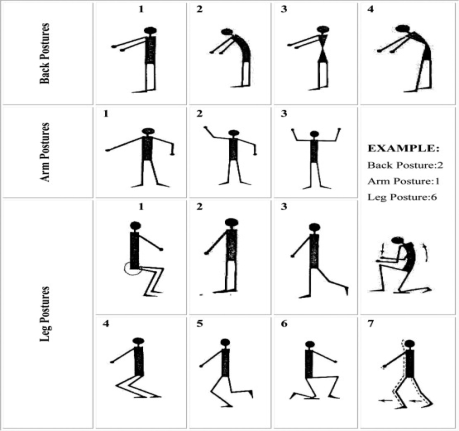
In the OWAS system, to record the posture, each posture is described in a code of six digits, representing back positions, arms, and legs, respectively, as mentioned by Karku, Kansi, and Kuorinka (1977). The postures described in the OWAS method are shown in Figure 1.
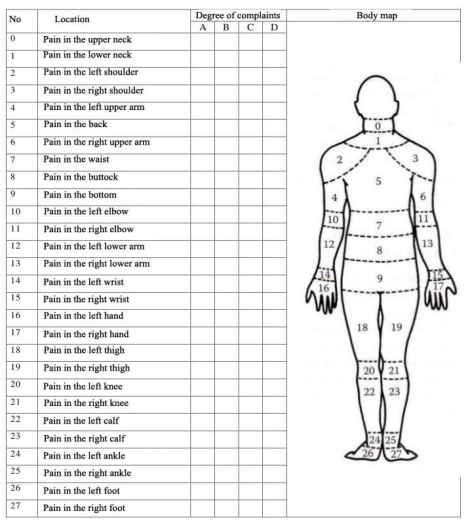
Figure 1: Posture representing back positions, arms, and legs. Source: Karku, Kansi, and Kuorinka (1977).Figure 2: Diagram to indicate the pain caused by posture problems (source: Corlett and Manenica (1995)).
A questionnaire form was used during the survey, and workers answered directly to the surveyor. The professional data was filled out and marked in the diagram based on Corlett and Manenica’s (1995) parts that feel the pain.
Ergonomic Analysis of Drilling Hammers in Granite Mining 55
A diagram proposed by Corlett and Manenica (1995) dividing the human body into several segments facilitates the location of areas where workers feel pain, as shown in Figure 2. Equipped with this diagram, the surveyor interviewed each worker at the end of the work shift, asking them to point out the regions where they felt pain.
Then, they are asked to evaluate subjectively the degree of discomfort they feel in each segment indicated in the diagram. The discomfort index is classified into eight levels, varying from zero to highly comfortable up to level seven to extremely uncomfortable, marked linearly from left to right. WinOWAS showed a valuable tool in identifying problems in the work situation with handling and charge transport, as were the hammers surveyed.
RESULTS
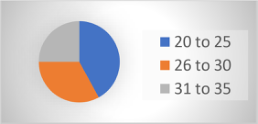
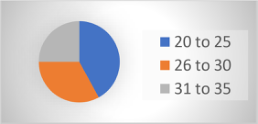
The age range of workers was between 20 to 35 years. 42% are in the age range of 20 to 25, 33% are 26 to 30, and 25% are 31 to 35, as shown in Figure 3. The daily work shift is from 07:00 to 17:30 h, with an intermediate break for lunch and snacks.
Figure 3: Age range of workers (source: Authors).
Monday is the weekday on which 70% of workers feel less willing to work, whereas 30% feel less willing on Friday, as shown in Figure 4. On Friday, workers stopped drilling at 16:00 to gather tools and put the rig in the shed.
Figure 4: Day of the week with less disposition to work (source: Authors).
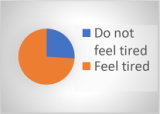
Physical fatigue, 74% of workers feel tired at the end of the work shift, whereas 26% do not feel tired, as shown in Figure 5.
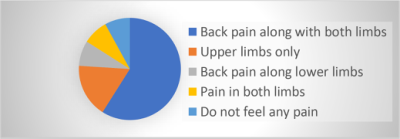
As for the location of pain, 59% feel lower back pain and upper and lower limbs. 17% feel pain only in the upper limbs. 8% feel back pain along with lower limbs. 8% feel pain in both limbs, whereas 8% do not, as shown in Figure 6.
Furthermore, 75% have complained of calf pain. Regarding the pain somewhere in the body, 92% answered that feeling.
Figure 5: The Period when hammers feel tired. Source: Authors.Figure 6: Location of the pain in the back, limbs, and intersections. Source: Authors.
Postural Analysis The results of this survey identified the incidence of posture disorders related to the movements and postures adopted during labor activities. According to the analysis method, the survey concluded that the hammer is exposed to a degree of postural embarrassment, which would classify it as a profession that needs postural corrections as soon as possible.
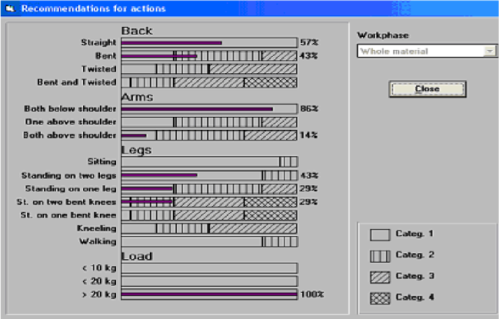
DISCUSSIONS Because of the results obtained, note that the activity demands the back force in the lumbar region throughout the workday, which is in category 2, where future fixes are needed. Respect for arms is in category 1, where there is no need for corrective measures. Respect for legs is in category 2, where future corrections are needed. Because of the results obtained, the hammers surveyed fall into category 3, and their postures need correction as soon as possible. The worker’s postural analysis during the work shift is shown in Figure 7.
Figure 7: Results of the postural analysis of the hammer during the work shift.
Ergonomic Analysis of Drilling Hammers in Granite Mining 57
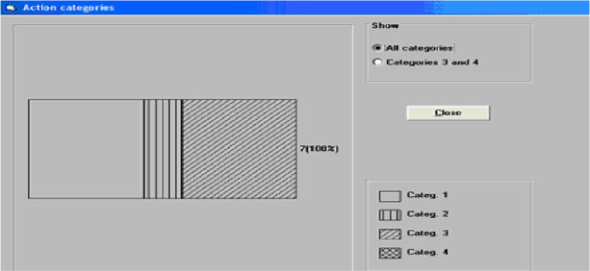
The hammer’s activities classification is shown in Figure 8.
Figure 8: Classification of activities according to category WinOWAS.
The company’s workers surveyed were between 20 and 35 years old. Among them, 75% are in the age range of 20 to 30. Physical tiredness and muscle fatigue affect workers daily at the end of the workday. Thus, the activity of loading the granite blocks on the lorry in the morning is advised when you are more rested and without muscle fatigue. The worst day to load the truck is Monday afternoon.
During the observations of the activities, no workers felt only low back or lower limb pain. 84% felt some pain in the upper limbs, demonstrating that the activity of hammers requires great physical effort, exposing them to ergonomic risks and possible musculoskeletal disorders. A postural correction is necessary to indicate the urgency of further studies and the development of new technology applicable to pneumatic hammers. Also, the granite extraction process reduces or eliminates dust, noise, and vibration to minimize the efforts that hammers are subjected to. A difficult interpretation for entrepreneurs, shift managers of the mining industry, and even some engineers and technicians of workplace safety will be to understand when the result of WinOWAS refers to the categories as the postural answer. Category 2 means future fixes are needed. Category 3 means corrections are required as soon as possible. How do we measure, stipulate, and define “future” and “as soon as possible”?
CONCLUSION
The hammer workers in the company surveyed had an age range between 20 to 35 years. Physical tiredness and muscle fatigue attack workers daily at the end of the workday. Thus, the activity of loading blocks in the morning is advised when workers are more rested and without muscle fatigue. Handling heavy tools, inappropriate postures, drilling activities, and cutting granite blocks while standing can develop musculoskeletal lesions in workers. Postural correction is necessary and indicates the urgency of new studies and technologies of pneumatic drilling rigs to minimize efforts during the workday.
REFERENCES
Cavalcanti, R. de A. (2001). Analysis of workplace safety in the marble and granite sector of Espirito Santo: Proposal of actions to reduce the rate of workplace accidents. Dissertation (MSc. in Executive). 123 pages. Getulio Vargas Foundation, Vitoria, ES. Corlett, E. N., Manenica, I. (1995). The evaluation of posture and its effects. In J. R.
Wilson & E. N. London, Taylor & Francis. Du, J., Weerdmeester, B. (2004). Practical ergonomics. Edgard Blücher Ltda, Sao Paulo. FACE. (2009). Workers were killed while working with granite. KY Fatality
Assessment & Control Evaluation (FACE) Program, Volume 7, Issue 3, October 2009. Kentucky Injury Prevention and Research Center (KIPRC), 333 Waller Ave., Suite 206, Lexington. Iida, Itiro. (2015). Ergonomics – Project and production. Edgard Blücher Ltda, Sao Paulo. Karku, O., Kansi, P., Kuorinka, I.(1977). OWAS – Ovako Working Posture Analyzing System. Tampere University of Technology – Tampere, Finland. Retrieved in: <www.turva.me.tut.fi/owas >. Accessed on June 14, 2006. MLE: NR – 21. (1978). Openwork. Ordinance n
3214/1978, Ministry of Labor and
Employment, Brazil. MLE: NR – 22. (1978). Safety and occupational health in mining. Ordinance n
3214/1978, Ministry of Labor and Employment, Brazil. Natural Stone Institute. (2020) Silicosis: An industry guide to awareness and
prevention. Technical Module, Oberlin, Ohio, USA. OSHA. (2008). Hazards of Transporting, Unloading, Storing, and Handling Granite, Marble, and Stone Slabs. Health and Safety Information Bulletins. SHIB 08-12- 2008, USA. Rebelo, R., Santos, R., Lourenco, L. (2002). Ergonomic study in the automobile
industry: Identification and hierarchy of the risk factors and elaboration of recommendations in the assembly line of the front suspension. In: XII Brazilian Congress of Ergonomics, ABERGO. Annals. Recife, PE, Brazil. Santos, H. H. (2002). Ergonomic analysis of the work of the tire repairers of Joao Pessoa: Relation between the postural stress and the muscular requirement in the lumbar region. Dissertation (MSc. in Production Engineering). CT/Federal University of Paraiba, Brazil. Santos, M, Almeida, A. (2016). The main occupational risks and risk factors are
occupational diseases, and protective measures for contact with granite and marble are recommended. Online Portuguese Journal of Occupational Health, March 17, 2016.
LISTED IN THE AHFE DIGITAL BOOKSTORE CATALOGUE
Explore the complete digital volume
Physical Ergonomics and Human Factors
Read this individual research paper free through the original publisher, or explore the full digital proceedings book.
ISBN 978-1-964867-61-8
Explore this ISBN in the AHFE Bookstore ↗Listed in the July 2026 bookstore catalogue; search by ISBN to confirm current availability · Digital book purchase optional