Hirotaka Aoki, Koji Morishita, Takanori Urano, Tomohiro Adachi, Mai Kinoshita, Atsushi Kudo (2025). Elicitation of risk perception strategies in emergency rooms based on KYT technique and eye tracking stimulated retrospections. In: Healthcare and Medical Devices. AHFE Open Access, vol. 171, pp. 69–80. https://doi.org/10.54941/ahfe1006192
In the present paper, we aim at eliciting risk perception strategies from medical doctors and nurses in emergency rooms (ERs). In the research processes, a series of cognitive task analyses including an effective debriefing procedure aided by eye movement recordings as well as eye movement data interpretation scheme are developed to identify individual risk perception strategy and its characteristics. To uncover the cognitive processes performed to find risks/hazards in an ER, we adopt KYT (KIKEN YOCHI Training, hazard prediction training in English) technique. In this technique, examples of various photos found in an ER (e.g., photos in which doctors are caring a patient moved by an ambulance) are shown to a medical staff. By seeing the photos, he/she is asked to explain what are risks, hazards, and potential issues. We record his/her eye movements to analyze his/her risk perception processes. In addition, we use the data as cues to verbalize his/her cognitive processes to obtain elaborated information regarding hidden cognitive processes.A series of KYT-styled experiments in which 15 medical doctors majoring in emergency and critical care medicine and 14 nurses participated were carried out. Six photos were shown to each participant. The photos were taken at ER/ICU in Tokyo Medical and Dental University Hospital. The participant was asked to see the photo based on the assumption that he/she see it in his/her daily working conditions, and what he/she would do in the given situations. Additionally, we asked him/her whether he/she found something relating to hazards/risk. During seeing photos, the participant’s eye movements were recorded. Immediately afterwards, an interview where eye tracking recordings were used as cues to verbalize the participant’s implicit cognitive/perceptional processes during seeing was conducted.Based on the verbal protocols obtained in the interview session, each participant’s cognitive/perceptual processes were carefully traced. In addition, the areas/objects to which most of attention (i.e., more than 80% of time spent) were paid in photos were clearly identified for each participant. From these results, we could find that the exist clear difference between doctors and nurses in risk perception strategies. Medical doctors tended to focus their attention mainly on information sources related to a patient’s vital signs. Nurses, on the other hand, seemed to pay their attention not only to vital signs, but also to information sources related to patient’s mental situation (e.g., a patient’s face to know his/her hidden needs) and other medical staffs to know the status of workloads. Based on all results as well as implications obtained, we discuss insights relating to effective medical care teams composed by doctors, nurses, and other co-medical staffs.
In emergency rooms (ERs), various kinds of patients in severe conditions who need appropriate primary care come without any prior appointment. From patient safety point of view, one of the most critical clinical processes of medical staffs in ERs (e.g., doctors, nurses, co-medicals and so on) is to detect symptoms that may relate to potential risks/hazards to prevent severe incidents/accidents. These processes should be performed very rapidly. The detecting processes can be characterized as mixture of intuitive and analytical processes. In some cases, the former process (i.e., intuitive process) seems to be a key factor to enhance the level of safety since this enables us to perform quick counteractions to potential risks/hazards. However, it is usually difficult to analyze the detecting processes including intuitive processes since they are automated and performed unconsciously.
In the present paper, we apply a combinatorial approach in which both of effective debriefing procedure aided by eye movement recordings and
eye movement data interpretation scheme are used to elicitations of risk perception strategies in ERs. This is because it has been suggested that eye movement recordings have a great potential ability for analyzing human perceptual/cognitive processes that are performed automatically such as skill- and rule-based behaviors (e.g., Rasmussen, 1986). The underlying idea of the methodology used for the elicitation of inner strategies in medical domain here is based on the authors prior research (Aoki et al., 2023).
The objective of the present paper is to elicit individual risk perception strategy of medical staffs in ERs, and to clarify its characteristics. To emulate real conditions found in ERs, we adopt simplified Kiken Yochi Training (KYT). The original version of KYT or hazard prediction training is a method that was developed in Japan (e.g., Ito et al., 2014) KYT is a practice on identifications of potential hazards in photos/illustrations of specified workplaces and group discussions about hazardous factors found (e.g., Ji, 2014). Through the training sessions including discussions, it can be expected that participants identify and understand types of potential hazards/risks in the specified workplace, and determine action plans rapidly and appropriately. In the present study, we adopt a simplified procedure of KYT to replicate the real working condition.
SIMPLIFIED KYT-STYLED EXPERIMENT Participant
Fifteen doctors majoring in emergency and critical care medicine and fourteen nurses participated in our experiment. The fifteen doctors included two groups of eleven specialists and four residents. The mean year of experience of doctor in specialist groups was 14.4, and its range were from 7 to 26 years. The fourteen nurses included three groups of three experts, five senior and six junior nurses. The mean year and its range of experience were 23.3 (21-27), 13.2 (7-17) and 3.3 (2-6) for expert, senior and junior nurses, respectively. Expert and senior nurses having approximately 7 year of more experience could take roles of “leaders” who are responsible for the nurses’ tasks at ER/ICU in the hospital.
Ethics approval was granted by the Shibaura Institute of Technology Review Board (24-010) and the Institute of Science Tokyo Review Board (2023227 and M2023-216) All participants were provided written informed consent prior to the experiment.
Table 1: Photos used in the experiment.
Table available in the original PDF paper.
Photo ID Scene Depicted Salient Risks/Hazards Predicted by Authors
1 An aged male patient who is
An unusually equipped tube.
Inappropriate restraint.
mechanically ventilated is lying in a bed in an ICU room. He is under restraint.
Continued
Elicitation of Risk Perception Strategies in Emergency Rooms Based on KYT Technique 71
Table 1: Continued Photo ID Scene Depicted Salient Risks/Hazards
Table available in the original PDF paper.
Predicted by Authors
2 An aged male patient’s position is
Accidental decannulation.
changed by two nurses in an ICU room. H is mechanically ventilated.
membrane oxygenation (ECMO) in a bed is moved by doctors and a clinical engineer.
5 A group of doctors and nurses are
High workload and time-pressure caused by a patient’s severe condition.
performing an emergency surgery (operation for a thoracotomy) in an ER.
6 A room for initial care is shown. N/A
Photos Exposed Six photos taken in the ER/ICU at the hospital were shown to participants. In four out of five photos, a patient in various conditions are depicted. The last photo showed a scene of the room for primary care. The scenes shown in the photos are summarized in Table 2.
Task The experimental task was to determine what should do in the situation shown in four photos (i.e., Photos 1 to 5). Each participant was asked to assume that he/she came to the scene in daily working conditions. He/she was asked to decide what he/she should do (e.g., try to communicate with a patient immediately) at the given situations. Additionally, a participant was asked to give his/her recognitions about the followings: how much he/she should do the action decided in two levels (necessary and only when available) and what potential risks/hazards were found. As for photo 6, a participant was asked to assume that he/she was waiting for a patient who would come by an ambulance. He/she was asked to check whether all the medical equipment/devices are set or not.
Procedure Upon arrival at our experimental site, each participant was briefed on the overall objective of the experiment, the tasks to be conducted, debriefing procedures in which eye tracking data are used as cues and calibration procedure of the eye tracker (Tobii X-3 120, Sweden). Before starting experimental task sessions, a participant completed one practice circuit using a typical example of an illustration. This illustration (not a photo) showed a scene in which an aged female inpatient was having a dose of her medicine by herself in a bed. After carrying out calibration for the eye tracking system,
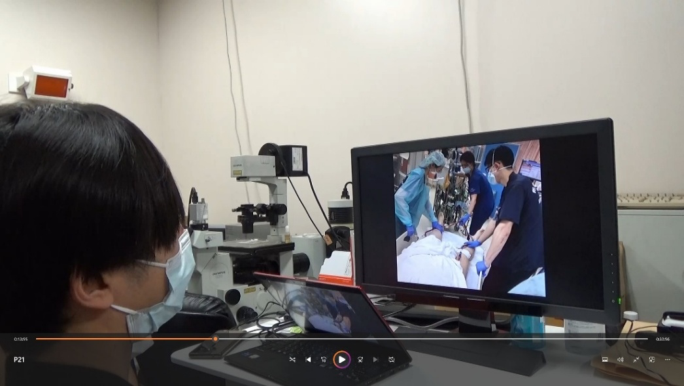
experimental tasks using six photos were started. After seeing each one of photos 1-5, a participant verbally reported his/her action decided very briefly. After seeing photo 6, he/she reported whether the room shown was available or not for initial care. Eye tracking data during all the task were recorded. The experimental environment is shown in Figure 1.
Figure 1: Experimental environment (photo 4).
After the experimental task, a debriefing session in which eye tracking data were shown to the participant started. In the debriefing session, eye tracking data recorded while seeing photos were shown to each participant. With the participant’s own eye tracking data, a series of questions were given to the participant in a semi-structured interview style. The questions were developed to elicit risk perception strategies. The question categories and their typical question items are summarized in Table 2.
Table 2: Question categories and their example question items.
Table available in the original PDF paper.
Category Cognitive Aspects to be
Example Question Items
Elucidated Risks/hazards that should
Did you find some risk/hazard which
Risk/hazard perceived
be solved.
should be counteracted immediately? Risks/hazards that are
Did you find something that may be a
counteracted appropriately.
risk/hazard but was counteracted appropriately? Action Planned actions that
Considering the situation shown, did
he/she would take in the give situation.
you have something you’d like to do immediately? What did you like to do? How much do you think it was necessary to do so? (only if the answer to the above-mentioned question is yes) Continued
Elicitation of Risk Perception Strategies in Emergency Rooms Based on KYT Technique 73
Table 2: Continued Category Cognitive Aspects to be
Table available in the original PDF paper.
Example Question Items
Elucidated First impression and its
What was your first impression? Did
Situation awareness
reason
you feel that the scene involved something problematic or not? Areas attended first In what part did you see first? What part attracted your attention first? etc. First impression and its
You mentioned that your first
reason
impression was positive/negative, why? Areas to which much
Were there any area to which you paid much attention?
attention are paid intentionally Holistic perception
Throughout observing the situation,
strategy
what were your key objectives? Others Lessons learnt by seeing
Did you find something from your own
own eye tracking data
eye tracking data?
RESULT
Risks/Hazards Detected Among photos 1-6, photo 1 shows a typical scene found frequently. The photo shows a scene where a mechanically ventilated patient is lying under restraint condition in an ICU room. In this paper, we focus on the photo. Before analyzing data, we performed preliminary risks/hazards detection with the following two experts: A professor of acute critical care and disaster medicine (second author) and a head nurse of the trauma and acute critical care medical center (fifth author). The two experts carefully examined the photo individually, and identified possible risks/hazards found in the scene. They included not only the potential risks/hazards, but those which seemed very scarce. Additionally, each of experts gave a rating to each risk/hazard as very important, important or trivial/not-likely from their perspectives of a skilled medical doctor and nurse.
Table 3 shows the potential risks/hazards identified by the two experts and the percentages of participants (doctors and nurses except two experts) who mentioned the corresponding risk/hazard in their first impression. In this analysis, the risk/hazard mentioned in the beginning part of the interview is focused. The data does not mean that the participants missed the risk/hazard in the experiment. In the following interview sessions, additional risks/hazards were mentioned by most of the participants. We are discussing what risk/hazard was pointed out by participants first.
As shown in the table, twenty-four risks/hazards were identified by the experts. The potential risks/hazards are classified into four groups. The
risks/hazards that are recognized as very important ones by both experts are classified into the first group. The risks/hazards that are recognized as very important only by only the expert doctor (Professor in medicine) are classified into the second group, and those that are recognized as very important only by the expert nurse are classified into the third group. The rest are classified into the fourth group.
Notable tendencies could be found in the table. It seems that the accidental decatheteraization of tracheotomy tube is a key risk/hazard perceived by both of doctors and nurses. Considering the facts that the number of risks/hazards that are not mentioned by doctors in the first impression is higher than those by nurses, we may be able to say that the doctors tended to focus on a little specific risks/hazards (i.e., medical treatment related risks/hazards). Nurses, on the other hand, may tend to focus on medical treatment related risks/hazards and environment-related ones (e.g., uncomfortable posture of a patient).
Table 3: Percentages of participants who mentioned potential risks/hazards in their first impressions.
Table available in the original PDF paper.
Group Potential Risk/Hazard Participant Dr Ns
The level of vital sign may be
20.0% 11.1%
abnormal
1. Very important from both of doctors’ and nurses’ point of view
The ventilator shows an
30.0% 22.2%
abnormal value Accidental decatheterization
60.0% 88.9%
of tracheotomy tube Accidental decatheterization
0% 11.1%
of drain Cuff pressure tube may be
0% 11.1%
damaged Thrombus in legs 30.0% 0% Accidental disconnection of
4. Others Asphyxia 10.0% 0% Unnecessary tubes on the
10.0% 22.2%
ground Untidy drain 0% 11.1% Difficulty of communication
0% 11.1%
with the patient Difficulty of immediate
10.0% 0%
actions Patient’s privacy 0% 0% Risk of hypothermia 0% 0%
Attentional Allocation Strategies Elucidated by Eye Tracking Data In the analysis of tendencies of attention allocation during observing the situation shown in the photo, total fixation durations for areas of interest (e.g., a patient and objects found in the scene) were calculated. Table 4 shows the cumulative percentages of the total fixation duration for each area of interests for each participant group. The areas are listed in the order of duration of fixations for each group. From the percentage, we identified areas contributing to approximately 80% of total fixation duration. Such areas can be characterized as areas including “key information” since each participant group paid most of their attention to the specific area as an overall trend. The areas characterized as “key information” for each participant group are italicized in Table 4.
The table seems to show differences caused by participants’ background and their experience very clearly. Doctors showed relatively lower numbers of key information compared to nurses. This implies that nurses paid attention to the much more widely compared to doctors. In doctors, specialists who have enough knowledge and experience paid attention more widely than residents. This can be interpreted that the novice focused on only very limited areas which were directly connected with critical information.
It may be conjectured that the clear tendency found here is attributed the same cause discussed in Table 3. Doctors may observe medical treatment related areas mainly, and nurses may observe both of medical treatment related areas and environment-related areas. This seems to indicate the importance and effectiveness of a team of doctors and nurses for efficient and safe operations in a hospital.
Continued
leg) 52.4%
monitor 56.8%
pressure) 63.3%
sphygmomanometer 66.4%
(cuff pressure) 67.3%
tube 68.1%
55.6% Cables of a
monitor 32.5% Bed side guard 47.8%
leg) 45.0% Vital sign
humidifying
device
monitor 39.5% Vital sign
leg) 58.9% IV drip 52.0% Tubes (cuff
(cuff pressure) 60.7% Bed side guard 54.1% Oxygen cylinder 64.8%
81.4% Right toes 86.9% Mittens 68.6% Left toes 61.8% Right toes 68.4%
Table 4: Continued
Table available in the original PDF paper.
Dr. Ns.
Left toes 80.7% Mittens 86.9% Heating and
Tubes (cuff
pressure) 81.0% Cables of a
Retraining band 81.2% Oxygen cylinder 86.9% Right toes 67.3% Cables of a
sphygmomanometer 81.3% Tubes 86.9% Retraining band 68.1% Foot pump (right
cables of a
leg) 81.4% Retraining band 86.9% Cables of a
Foot pump (right
Heating and
humidifying
device
Mittens 81.4% Left toes 86.9% Left toes 68.7% Oxygen cylinder 62.1% Left toes 68.4%
Risk Perception Strategies Interpreted by Eye Tracking Stimulated Retrospections In this section, possible strategies taken when observing the scene in Photo 1 are focused. By classifying the comments obtained in the eye tracking stimulated retrospections, the strategies attributed to each participant group were elicited inductively. Table 5 shows the preliminary results of strategies inferred and their corresponding comments.
Table 5: Strategies inferred by comments obtained in retrospections stimulate by eye tracking data.
Table available in the original PDF paper.
Participant Group Example Comments Obtained by the Eye Typical Strategy Tracking Stimulated Retrospections Inferred Preliminarily
Taking very
Dr Specialist The breathing tube was the most salient at
rational/logical routine processes at any moment from effective medical treatment point of view
the very beginning of observation. I always check the vital sign monitor, ventilator, nutrient etc. that are directly connected to some medical device. I tend not to see the retaining bands first. I check the situation of IV drips. Additionally, I always pay attention to the face of patient because it gives much information. In this case, I felt that the patient’s arousal level seems a bit low. Also I see the bed side guard which is my routine.
Examining specific
Resident I cannot see the waveforms from vital sign.
I check a power supply tap only when it is needed. For example, when an echo is used. I don’t pay attention to the cables of a sphygmomanometer because it is most likely that they work well without problems. I didn’t mention about the ventilator because I felt that it worked well.
information mostly in event-driven style or those which are directly related to the patient’s condition in general Ns Expert I always look at a patient’ face and a
Taking very ventilator first because I know that they are very important. I don’t change how to observe a patient depending on how much I know him/her. I check the power supply tap because this may interrupt for us.
rational/logical routine processes at any moment from effective medical treatment and nursing point of view Continued
Elicitation of Risk Perception Strategies in Emergency Rooms Based on KYT Technique 79
Table 5: Continued Participant Group Example Comments Obtained by the Eye
Table available in the original PDF paper.
Typical Strategy
Tracking Stimulated Retrospections
Inferred Preliminarily
Senior I always glance at a patient’s face.
Taking Only when I have a patient whom I’m responsible for, I check the oxygen cylinder very carefully in my bedside rounds. I always check the patient’s clothes to find issues relating to posture.
Examining specific
rational/logical routine processes at any moment from effective medical treatment and nursing point of view, the process may differ depending on individuals Junior I know that the nutrient has a critical risk information mostly in event-driven style or those which are directly related to the patient’s condition in general of pulmonary aspiration. Only when I have a patient whom I’m responsible for, I check the oxygen cylinder very carefully in my first bedside rounds. I see a patient’s face first because we nurses have to communicate with a patient when entering an in-patient room.
The strategies inferred seem to be relating to the experience/expertise of the participants. As found in the table, the way of observation seems more systematic and sophisticated along with the level of expertise. The doctors/nurses having sufficient experience and knowledge seem to have very stable cognitive routines in their observations. In resident and junior nurses, their observation processes seem to be driven by events, or they follow basic knowledge related to patient safety.
CONCLUSION
This paper shows characteristics of observation strategies in ERs emulated by a simplified KYT technique. The strategies were elicited by combinations of eye tracking data analysis and retrospections stimulated by eye tracking data. We carried out a series of experiments in which doctors and nurses performed risk perceptions, and identified the tendencies of visual attention allocations, key information and possible strategies during observations for each participant group. In our plan, we will continue analyzing all data (i.e., photos) obtained in the experiment. We will identify the attention allocation processes and strategies taken for other scenes, and their relations with the levels of performance and effectiveness. In addition, we plan to deploy our approach to educational tools, especially for novice doctors and nurses, to avoid overlooking.
ACKNOWLEDGMENT
This research was supported by the Tokyo Institute of Technology-Tokyo Medical and Dental University joint research fund and the Shibaura Institute of Technology research fund. We would like to acknowledge doctors and nurses at the trauma and acute critical care medical center, Institute of Science Tokyo Hospital for their participation in our research.
REFERENCES
Aoki, H. Morishita, K. Takahashi, M. Machida, R. Kudo, A. Kishino, M. Shirai, T.
(2023) “Expertise Analysis in Chest X-Rays Diagnosis based on Eye Tracking Stimulated Retrospections: Effective Diagnosis Strategies in Medical Checkup Condition”, proceedings of the Twenty-Fifth International Conference on Human Computer Interaction, Copenhagen, Denmark. Ito, K. Taguchi, H. Fujinami, K. (2014). Posing Questions during Experimental Operations for Safety Training in University Chemistry Experiments, International Journal of Multimedia and Ubiquitous Engineering Volume 9, No. 3. Ji, H. J. (2014). A Study on Safety Culture Construction for Coal Mine, Applied
Mechanics and Materials Volumes 644–650. Rasmussen, J. (1986). Information processing and human-machine interaction: An approach to cognitive engineering, New York: Elsevier.
LISTED IN THE AHFE DIGITAL BOOKSTORE CATALOGUE
Explore the complete digital volume
Healthcare and Medical Devices
Read this individual research paper free through the original publisher, or explore the full digital proceedings book.
ISBN 978-1-964867-47-2
Explore this ISBN in the AHFE Bookstore ↗Listed in the July 2026 bookstore catalogue; search by ISBN to confirm current availability · Digital book purchase optional