Annika Reinersmann, Mario Heinz-jakobs, Eckard Bicker, Carsten Röcker (2025). How to implement digital Assistive Technology Systems on the Labour Market for Persons with Disability. In: Design for Inclusion. AHFE Open Access, vol. 169, pp. 38–47. https://doi.org/10.54941/ahfe1006152
Digital Assistive Technology can foster the inclusion of persons with disability on the job market tremendously. At present however, its potential to increase their employability as partial solution to the current skills shortage remains untapped. The lack of knowledge around the applicability of digital AT in various industrial sectors and its usability for different types of disability or employer’s demands obstructs its further dissemination into the labour markets. More feasibility studies are needed exploring drivers of a successful implementation of digital AT in different industrial sectors and different needs of employees and employers on the non- sheltered job market. In this paper, we report preliminary results of an (ongoing) two-phase study on implementing digital AT in different industry sectors with employees with different types of disabilities. The preliminary findings from a thorough digitisation potential analysis reveal valuable insights on the requirements for the implementation of digital ATs.
Digital Assistive Technologies (digital AT) are key to promoting the social inclusion and rights of persons with disabilities (PwD) (Smith et al., 2022). Unlike earlier technologies, digital AT enable new ways of accessing society and pursuing activities independently. This enhances PwD’s ability to participate equally in society and compete in the open labour market (Bratan et al., 2020; Smith et al., 2022). However, its availability and usability for this group lag behind (Aleksandrova & Nenakhova, 2019; Chudel-Linden et al., 2019; Vassilakopoulou & Hustad, 2023). Given the United Nations Convention on Rights for Persons with Disabilities (UN- CRPD) and national accessibility laws (e.g., the European Accessibility Act), what obstacles hinder the full implementation of digital AT for PwD? Common barriers include insufficient technological infrastructure, inadequate allocation programs,
How to Implement Digital Assistive Technology Systems on the Labour Market 39
accessibility issues, and resistance to digital transformation, including digital illiteracy (Digital Directions, 2023). However, these challenges apply broadly and are not exclusive to PwD. A major issue in the digital disability divide (United Nations, 2021) is the lack of involvement of PwD in the development, testing, and implementation of digital AT (Henni et al., 2022; Neal et al., 2022; Vassilakopoulou & Hustad, 2023). Current processes primarily engage individuals with less severe disabilities who can provide active feedback (Manzoor & Vimarlund, 2018), yet this group does not represent the full spectrum of disabilities and needs (Neal et al., 2022).
As a result, available digital AT often fails to meet the situational needs of users fully (Manzoor & Vimarlund, 2018; Henni et al., 2022; Neal et al., 2022). Few implementation studies assess prototypes in real- life conditions, often due to funding gaps or a lack of willing test sites. Consequently, little is known about the socio-technological requirements for developing truly usable digital AT (Schnasse et al., 2021; Nierling et al., 2021). While digital AT implementation must consider interactions between humans, technology, and organizational structures, awareness of these complexities remains limited in the context of inclusion (Boger et al., 2017; Vassilakopoulou & Hustad, 2023). Additionally, digital literacy and acceptance among both users and those who provide training or personal assistance must be considered, yet this aspect is often overlooked (Schnasse et al., 2021; Nierling et al., 2021; Bratan et al., 2022). These challenges are particularly pronounced in the labor market. Despite digital AT’s potential to improve employability and address skill shortages, it is rarely utilized for workplace modifications. In the rapidly evolving digital labor market, this further reduces PwD’s job opportunities (Aleksandrova & Nenakhova, 2019; Jetha et al., 2023). Few studies have tested digital AT in work settings (Mark et al., 2021), and concerns about representativeness and transferability limit their applicability to non-sheltered workplaces. As a result, the feasibility of implementing digital AT in the open labor market remains uncertain, further widening the digital disability gap (Tsatsou, 2020; Jetha et al., 2023). More research is needed to investigate digital AT’s full potential. Feasibility studies should identify prerequisites for successful implementation in inclusive work environments. These studies must address PwD’s assistive needs, employer expectations regarding economic viability, and the varied levels of digitization and technological infrastructure in the labor market.
In this paper, we present preliminary results of an initial study focusing on the implementation of digital AT in different industry sectors with participants representing various disabilities. The project involved technical implementation by a development partner and scientific evaluation by a research institution and federal disability welfare institute. While this approach addresses some research limitations (e.g., non-sheltered work settings and diverse disability types), it does not claim exhaustive transferability or generalizability. However, our preliminary findings contribute to understanding the factors driving digital AT’s applicability in the open labor market.
RELATED WORK
In this section, we provide a brief overview of Germany’s regulatory framework regarding disability employment and labour market integration structures1 as well as the body of research on digital AT within the work context.
Inclusive Work Germany’s UN-CRPD implementation law, the Bundesteilhabegesetz (BTHG), ensures autonomous, equal participation in all areas of life (Chudel-Linden et al., 2019; Bratan et al., 2020). In line with Article §27 of the UN-CRPD, Persons with Disability (PwD) seeking paid work are supported through various policies, programs, and (wage) subsidies. Employers who do not include PwD must compensate through levies. Like other European labor markets, Germany offers disability employment programs, including supported work and vocational training in both open and sheltered settings. Sheltered workshops2 provide high levels of care and accommodate individuals with severe impairments. Recently, more individuals with psycho-social disabilities have entered this system. In contrast, the open labor market demands higher performance but offers better wages. Various government programs, subsidies, and policies support PwD in gaining or retaining employment (see (Mallender et al., 2015) for details). Germany’s labor market complies with Article §27 of the UN- CRPD, but the two systems have limited permeability. Exiting the sheltered labor system is difficult, with low transition rates and concerns about its segregating effect ref. With limited access to the open labor market and rapid digital transformation, digital AT could help prevent further exclusion of PwD. Recognizing digital AT’s importance, sheltered workshops were early adopters in testing it.
Assistance Systems Developing usable digital AT that support PwD on the labour market has been a research topic for over a decade, albeit less fast-forwarding then the parallel movement on developing usable digital AT for non-disabled users (Blattgerste et al., 2019; Mark et al., 2019). This currently available digital assistive technology for PwD developed and evaluated different visualization and interaction technologies (Funk et al., 2015), different presentation types for instructive and feedback information (Kosch et al., 2016), and the application of gamification approaches (Korn et al., 2015; Grund et al., 2020) to increase work motivation. Unfortunately, this research focuses on manufacturing sector (packaging and assembly) as main industrial employment sector for PwD, typically persons with intellectual disability. These studies show positive impact on work performance, operationalised as reduced count of error and increases in work pace (Mark et al., 2019). What is more, there is little resistance to the digitisation of their work, and PwD
1For more information see: (Bratan et al., 2020; OECD, 2022) 2See for more information on sheltered workshops also: (EASPD, 2022)
How to Implement Digital Assistive Technology Systems on the Labour Market 41
generally indicate a high level of acceptance towards digital AT (Heinz et al., 2022). However, the generalisability of these findings is confined to the above described industrial sector, sheltered work settings and non- representative disability types. Moreover, the digital AT is static to the workplace and non- adaptive to a persons’ special-need profile (Funk et al., 2015; Kosch et al., 2017). Only few studies so far have focused on designing adaptive assistance systems that gear to the individual’s capacities and special needs for assistance at work (Heinz et al., 2021; Oestreich et al., 2022; Peltokorpi et al., 2023). In addition, these systems have been evaluated in sheltered workshops of the labour market only. Thus, although previous work indicates that assistance systems generally have a high potential to support PwD at work, this research is limited. It remains to be open whether these findings are applicable to other industrical sectores of the open-labour market and usable for different types of disability and employer expectations.
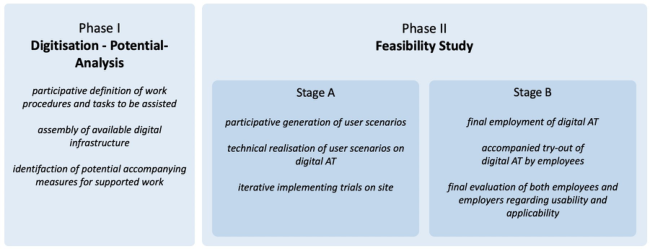
Study Overview In this section, we explain the methodological design and the objectives of the field study. We planned a two-staged methodological scheme (see Figure 1) on the preposition that the tested digital AT system would not necessarily provide additional beneficial assistance to every workplace and not every company would be sufficiently equipped with the prerequisites necessary to equip the workplace with a digital AT tool. Therefore, the two independent phases were designed so that interested companies could either traverse through both or participate in the first phase only. This first phase, henceforth referred to as the Digitisation Potential Analysis, was obligatory for all participating companies since it aimed at analysing the degree of available digital infrastructure and ‘digitisation’ of task demands (see also hypotheses). Those companies deemed suitable to field-test the digital AT system were offered a scientifically guided implementation that constituted the second phase of the project, henceforth referred to as the Feasibility Study.
Figure 1: Overview of the two project phases and the activities carried out within each phase respectively.
The following sections focus exclusively on the implementation and results of the first phase. The results of the second phase, however, will be part of a future publication.
Phase I: Digitisation Potential Analysis The Digitisation Potential Analysis was conducted on the assumption that (1) participating companies would vary in their degree of digitisation, ranging below average (based on the index for digitisation for small and medium- sized enterprises in Germany (Bundesnetzagentur, 2023)), (2) their degree of available digital infrastructure would vary depending on the sector of industry, and (3) the degree of beneficial assistance for a given task would vary (i.e. not every task may be easier to perform with digital assistance).
Procedures Phase 1 was carried out in seven inclusive enterprises (BAG IF, 2019) (see Table 1 for more information on the different sectors and detailed work characteristics). This phase was conducted by members of the engineering team of the digital AT and staff of the supra-local disability employment provider to ensure that possible necessary accompanying measures would be identified and subsequently installed. Information on the infrastructure of the inclusion company, the workforce and work settings as well as task demands and expectations was collected through qualitative interviews with employees, foremen and supervisors. Additionally, the degree of digitisation was determined on a set of predefined criteria that were assessed in every single inclusion company. These criteria comprised the available hard- and software onsite, and the degree to which digital technology was used to perform daily routines. The scores were rated on a 5-point scale between a low (one) and a high (five) degree of digitization. Finally, possible areas of work that would benefit from digital assistance were determined by all involved partners. These tasks could include both new chores and already assisted chores. All assembled information was then analyzed regarding the implementation feasibility of the digital AT systems. If deemed feasible, the companies were offered participation in the Feasibility Study (Phase 2).
RESULTS
The results of the Digitization Potential Analysis are summarized in Table 1. They show that six out of seven companies provided adequate infrastructure to implement the system (contrary to our hypothesis of a low degree of digitisation at participating companies). In these companies, work processes were deemed to benefit from digital support, resulting in a high degree of applicability of the digital AT. The seventh company, a orthopedic manufacturing inclusion company was digitised to such a degree that installing the digital AT system would not have added a beneficiary surplus. For the six other companies, the analysis further identified a varying range of skills and competencies to be supported and associated functions required for the implementation of the digital AT (see Table 1).
How to Implement Digital Assistive Technology Systems on the Labour Market 43
Required Functions
instructions,
Commnuication aids
instructions,
Commnuication aids,
Documentation
Documentation
Personalized
Instructions, Checklists,
Documentation
Personalized
Instructions, Checklists,
Documentation,
Communication Aids
Instructions,
Documentation
Work efficiency Checklists,
Work efficiency,
Motivation
Quality awareness,
Motivation
Motivation Personalized
Competencies to be
Supported
Motivation Personalized
Motivation Personalized
Degree of
Digitisation Potential Skills and Employees With
a Disability
Employees Number of
170 72 low (2) ✓ Autonomy,
Landscaping,
Agricultural
business
Landscaping 35 15 low (2) ✓ Autonomy,
Table 1. Overview of the companies with the assessments of the degree of digitisation and the potential for the second phase carried out as part of
Table available in the original PDF paper.
the digitisation potential analysis, as well as the skills and competencies identified to be supported and the associated functions required for the
assistance system.
Company Sector Number of
1 Gardening &
2 Gardening &
3 Hotel 24 10 medium (3) ✓ Quality awareness,
4 Hotel 24 6 medium (3) ✓ Quality awareness,
5 Cleaning service 63 27 medium (3) ✓ Autonomy,
6 Electrical recycling 15 10 high (4) ✓ Autonomy,
7 Manufacturing 53 6 high (5) × - -
CONCLUSION
The results of the Digitization Potential Analysis from the first phase of the study indicate varying levels of digitization among the participating inclusive companies across different sectors. Despite these differences, six out of seven companies demonstrate potential for participation in the second phase of the study. Participation was deemed unnecessary for the seventh company due to its already high level of digitization and the fact that its employees with disabilities had exclusively motor disabilities, which did not require additional digital assistance. These findings underscore the broad potential for implementing digital ATs across companies with diverse sectoral backgrounds and digitization levels. Furthermore, the analysis highlights that digital ATs should primarily support key skills and competencies such as autonomy, motivation, work efficiency, and quality awareness among PwD. To effectively address these needs, the core functionalities of digital ATs should include personalized instructions, checklists, documentation tools, and communication aids. These technologies can play a crucial role in enhancing workplace participation, improving task execution, and fostering greater independence for PwD.
The results provide important insights for the implementation of digital AT in the second phase of the study and beyond, for the general implementation of digital AT in the open labor market.
LIMITATIONS As is the case with every empirical study, this project too, has limitations. For one, the number of testing companies was smaller than initially calculated upon. Albeit recruiting efforts were geared towards the entire open labour market in Westphalia, only eight companies applied for participation, seven of which explicitly embrace inclusion of PwD3. Nevertheless, inclusive enterprises in Germany represent a wide variety of sectors and employ a heterogeneous scope of disability types and severity. This meets some of the transferability limitations of the commonly conducted field-tests, which are predominantly carried out in sheltered work settings with persons with intellectual disability in the manufacturing sector. Nevertheless, this study shows that networking structures between industrial partners of digital AT, welfare institutions and employer federations or trade associations need to expand and inform that digital AT is available, cost-effective and usable. Not least to strengthen the inclusive labour market but also to meet its current skills shortage.
SUMMARY & OUTLOOK This 2-phased field-study is - to our knowledge - among the first to explore the prerequisites that underlie a feasible implementation of digital AT in companies of the open labour market. Although there is a growing number of studies that test digital AT for working PwD, the transferability of
3See also: (BAG IF, 2019)
How to Implement Digital Assistive Technology Systems on the Labour Market 45
these findings is confined to sheltered work settings. However, to learn about factors that drive a successful implementation on the open labour market, field - studies need to be conducted within non-sheltered, diverse working contexts. Our results contribute to the current body of knowledge by identifying necessary basic requirements for a successful implementation process on - site and characteristics of a usable digital AT. Future research should clarify socio-technical aspects involved in the use of digital AT at the work place and its impact on work performance. The here described methodological set-up, Instruments and interim results provides a blueprints upon which future, larger - scaled studies can build upon, to clarify these knowledge gaps.
ACKNOWLEDGMENT
The empirical work reported in this paper was funded by the “Inclusion Office Work” of the “Regional Association of Westphalia-Lippe (LWL)” as part of the project “OmniAssist”. Parts of the underlying technical infrastructure were developed within the project “AI-supported assistance to promote decentralized inclusion”, which is funded by the German Federal Ministry of Education and Research (BMBF) under grand number 13FH560KB0.
REFERENCES
Aleksandrova, O., Nenakhova, Y. (2019). Accessibility of assistive technologies as a factor in the successful realization of the labor potential of persons with disabilities: Russia’s experience. Societies, 9(4), 70. BAG IF. (2019). Submission by Bundesarbeitsgemeinschaft Inklusionsfirmen (BAG
IF) for the general discussion on the right of persons with disabilities to work and employment (Art. 27 CRPD) organized by OHCHR. Blattgerste, J., Renner, P., Pfeiffer, T. (2019, June). Augmented reality action assistance and learning for cognitively impaired people: A systematic literature review. In Proceedings of the 12th ACM International Conference on PErvasive Technologies Related to Assistive Environments (pp. 270–279). Boger, J., Jackson, P., Mulvenna, M., Sixsmith, J., Sixsmith, A., Mihailidis, A.,
Kontos, P., Miller Polgar, J., Grigorovich, A., Martin, S. (2017). Principles for fostering the transdisciplinary development of assistive technologies. Disability and Rehabilitation: Assistive Technology, 12(5), 480–490. Bratan, T., Fischer, P., Maia, M., Aschmann, V. (2020). Implementation of the UN Convention on the Rights of Persons with Disabilities: A comparison of four European countries with regards to assistive technologies. Societies, 10(4), 74. Bundesnetzagentur (2023). Digitalisierung im Mittelstand in Zahlen. https:// www.bundesnetzagentur.de/DE/Fachthemen/Digitalisierung/Mittel- stand/ Kennzahlen/start.html Chudel-Linden, V., Czikl, R., Schmidt, B. (2019). Disability-inclusive employment promotion: Lessons learned from five GIZ projects. Project Report Gesellschaft fu¨r Internationale Zusammenarbeit (GIZ). Digital Directions. (2023). What are the main barriers to digital transformation?
https://digitaldirections.com/barriers-digital-transformation EASPD. (2022). Fostering employment through sheltered workshops: Reality, trends and next steps.
Funk, M., Bächler, A., Bächler, L., Korn, O., Krieger, C., Heidenreich, T., Schmidt, A. (2015, July). Comparing projected in-situ feedback at the manual assembly workplace with impaired workers. In Proceedings of the 8th ACM International Conference on PErvasive Technologies Related to Assistive Environments (pp. 1–8). Funk, M., Dingler, T., Cooper, J., Schmidt, A. (2015, September). Stop helping me-
I’m bored! Why assembly assistance needs to be adaptive. In Adjunct proceedings of the 2015 ACM international joint conference on pervasive and ubiquitous computing and proceedings of the 2015 ACM international symposium on wearable computers (pp. 1269–1273). Grund, J., Umfahrer, M., Buchweitz, L., Gay, J., Theil, A., Korn, O. (2020). A gamified and adaptive learning system for neurodivergent workers in electronic assembling tasks. In Proceedings of Mensch und Computer 2020 (pp. 491–494). Heinz, M., Bu¨ttner, S., Jenderny, S., Röcker, C. (2021). Dynamic task allocation based
on individual abilities-experiences from developing and operating an inclusive assembly line for workers with and without disabilities. Proceedings of the ACM on Human-Computer Interaction, 5(EICS), 1–19. Heinz-Jakobs, M., Große-Coosmann, A., Röcker, C. (2022, September). Promoting Inclusive Work with Digital Assistance Systems: Experiences of Cognitively Disabled Workers with In-Situ Assembly Support. In 2022 IEEE Global Humanitarian Technology Conference (GHTC) (pp. 377–384). IEEE. Henni, S. H., Maurud, S., Fuglerud, K. S., Moen, A. (2022). The experiences, needs
and barriers of people with impairments related to usability and accessibility of digital health solutions, levels of involvement in the design process and strategies for participatory and universal design: A scoping review. BMC public health, 22(1), 35. Jetha, A., Bonaccio, S., Shamaee, A., Banks, C. G., Bu¨ltmann, U., Smith, P. M.,...
Gignac, M. A. (2023). Divided in a digital economy: Understanding disability employment inequities stemming from the application of advanced workplace technologies. SSM-Qualitative Research in Health, 3, 100293. Korn, O., Funk, M., Schmidt, A. (2015, June). Towards a gamification of industrial production: A comparative study in sheltered work environments. In Proceedings of the 7th ACM SIGCHI symposium on engineering interactive computing systems (pp. 84–93). Kosch, T., Abdelrahman, Y., Funk, M., Schmidt, A. (2017, September). One
size does not fit all: Challenges of providing interactive worker assistance in industrial settings. In Proceedings of the 2017 ACM International Joint Conference on Pervasive and Ubiquitous Computing and Proceedings of the 2017 ACM International Symposium on Wearable Computers (pp. 1006–1011). Kosch, T., Kettner, R., Funk, M., Schmidt, A. (2016, October). Comparing tactile, auditory, and visual assembly error-feedback for workers with cognitive impairments. In Proceedings of the 18th international ACM SIGACCESS conference on computers and accessibility (pp. 53–60). Mallender, J., Liger, Q., Tierney, R., Beresford, D., Eager, J., Speckesser, S., Nafilyan,
V. (2014). Reasonable accommodation and sheltered workshops for people with disabilities: Costs and returns of investments. Manzoor, M., Vimarlund, V. (2018). Digital technologies for social inclusion of individuals with disabilities. Health and technology, 8(5), 377–390. Mark, B. G., Hofmayer, S., Rauch, E., Matt, D. T. (2019). Inclusion of workers with
disabilities in production 4.0: Legal foundations in Europe and potentials through worker assistance systems. Sustainability, 11(21), 5978.
How to Implement Digital Assistive Technology Systems on the Labour Market 47
Mark, B. G., Rauch, E., Matt, D. T. (2021). Worker assistance systems in manufacturing: A review of the state of the art and future directions. Journal of Manufacturing Systems, 59, 228–250. Neal, D., Engelsma, T., Tan, J., Craven, M. P., Marcilly, R., Peute, L., Dening, T.,
Jaspers, M., Dro¨s, R.-M. (2022). Limitations of the new ISO standard for health and wellness apps. The Lancet Digital Health, 4(2), e80–e82. Nierling, L., Maia, M. (2020). Assistive technologies: Social barriers and sociotechnical pathways. Societies, 10(2), 41. Nierling, L., Maia, M., Bratan, T. (2021, January). Technological or social drivers for
a transformation towards an inclusive society? The role of Assistive Technologies for people with disabilities. In Gesellschaftliche Transformationen (pp. 381–394). Nomos Verlagsgesellschaft mbH Co. KG. OECD. (2022). Disability, work and inclusion (p. 269). https://doi.org/10.1787/ 1eaa5e9c-en. Retrieved from https://www.oecd- ilibrary.org/content/publication/ 1eaa5e9c-en. Oestreich, H., Heinz-Jakobs, M., Sehr, P., Wrede, S. (2022). Human- centered
adaptive assistance systems for the shop floor. In Human-Technology Interaction: Shaping the Future of Industrial User Interfaces (pp. 83–125). Cham: Springer International Publishing. Peltokorpi, J., Hoedt, S., Colman, T., Rutten, K., Aghezzaf, E. H., Cottyn, J. (2023).
Manual assembly learning, disability, and instructions: An industrial experiment. International Journal of Production Research, 61(22), 7903–7921. Schnasse, F., Menzefricke, J. S., Dumitrescu, R. (2021, April). Identification of sociotechnical risks and their correlations in the context of digital transformation for the manufacturing sector. In 2021 IEEE 8th International Conference on Industrial Engineering and Applications (ICIEA) (pp. 159–166). IEEE. Smith, E. M., Huff, S., Wescott, H., Daniel, R., Ebuenyi, I. D., O’Donnell, J., Maalim,
M., Zhang, W., Khasnabis, C., MacLachlan, M. (2024). Assistive technologies are central to the realization of the Convention on the Rights of Persons with Disabilities. Disability and Rehabilitation: Assistive Technology, 19(2), 486–491. Tsatsou, P. (2020). Digital inclusion of people with disabilities: A qualitative study of intra-disability diversity in the digital realm. Behaviour Information Technology, 39(9), 995–1010. United Nations. (2021). Overcoming the digital divide to ensure disability inclusiveness. https://social.desa.un.org/issues/disability/news/overcoming- the- digital-divide-to-ensure-disability-inclusiveness Vassilakopoulou, P., Hustad, E. (2023). Bridging digital divides: A literature review
and research agenda for information systems research. Information Systems Frontiers, 25(3), 955–969.
LISTED IN THE AHFE DIGITAL BOOKSTORE CATALOGUE
Explore the complete digital volume
Design for Inclusion
Read this individual research paper free through the original publisher, or explore the full digital proceedings book.
ISBN 978-1-964867-45-8
Explore this ISBN in the AHFE Bookstore ↗Listed in the July 2026 bookstore catalogue; search by ISBN to confirm current availability · Digital book purchase optional