Daniel Ullrich, Andreas Butz, Kaja Lena Isaksen, Sarah Diefenbach (2025). Reducing the cognitive load among teachers in hybrid lectures by a representation of remote students through a physical avatar in the classroom. In: Accessibility, Assistive Technology and Digital Environments. AHFE Open Access, vol. 162, pp. 37–49. https://doi.org/10.54941/ahfe1006011
A necessity during the COVID-19 pandemic, hybrid teaching, has remained a common format in universities. Typically, a synchronous live session is joined by students either in the physical classroom or via a remote option with interaction through textual chat. While hybrid formats have many advantages in terms of inclusivity and sustainability, research also reveals numerous impairments of wellbeing and educational quality, such as the added cognitive load of the instructor, perceived differences in social presence between the two student groups (on-site and remote), and limited interaction opportunities for remote students. To address such difficulties, we explore the concept "Fernstudent". A physical avatar represents remote students collectively in the classroom, creating a communication channel based on the same modalities as for on-site communication. A field test of the prototype in two classes showed promising results. Compared to the standard option (Jitsi), the social presence of remote students was perceived higher with the Fernstudent and the interaction between teacher and remote students more similar to that with on-site students. Remote students’ intention for active participation became comparable to that of on-site students. Limitations, planned further developments, and general implications for hybrid teaching and digitalization in the school and workplace are discussed.
The necessity for physical distancing during the COVID-19 pandemic has accelerated the introduction of digital teaching in schools and universities, which demonstrated opportunities and difficulties of online education. Now that regular on-site teaching is generally possible again, it is of high interest to identify which aspects of digital teaching would be worthwhile to continue in the post-pandemic age, and how digital resources might be put to best use.
In this context, hybrid teaching, i.e., combined on-site and remote lectures, has become a more and more common format in universities. While the term is not used consistently, and has been applied to describe different ways of integrating technology in education (e.g., Linder, 2017; Sing et al., 2012; Wu et al., 2021), most researchers use the term to refer to a combination of on-site and digital teaching in a synchronous live-session, where one part of the students joins the lecture in the physical classroom and another part follows the lecture via video and audio channels using an online platform (e.g., Zoom, Jitsi), with the opportunity to pose questions or comments via textual or voice chat. Ulla and Perales (2022, p. 2) refer to hybrid teaching as “an approach to teaching that not only integrates technology in the teaching process but also combines students who are inside a physical classroom and students from online”. From the teacher’s perspective, hybrid teaching creates a dual audience; the physically present onsite students and the remote students, each with specific options of interaction. While many public universities introduced the first offers of hybrid teaching during the pandemic out of necessity, students have come to appreciate the flexibility to join lectures without spatial constraints. The same is true in many other settings, such as business meetings, club meetings or parent meetings for kindergarten, where hybrid options are increasingly available. Providing a hybrid option has become a sign of an inclusive, modern, digital society where it is no longer acceptable that participation is limited to those who are able to attend physically.
In sum, hybrid teaching needs to address the needs and interaction qualities of three individual groups (i.e., instructors, on-site students, and remote students), but in current approaches at least one of these groups is still underserved (e.g., Gamage et al., 2022; Ma et al., 2023). So far, experiences with hybrid teaching reveal two central, partly connected challenges: (1) the cognitive demands and attentional requirements for instructors are significant. (2) the split audience and insufficient blending of the two contexts, which often results in a lacking social presence and feelings of exclusion on the side of the remote students.
For the instructors, teaching simultaneously face-to-face and digitally, requires new cognitive and social skills. Instructors must monitor in parallel both on-site students in the lecture hall and remote students online. Usually, the latter are only visible on the laptop or computer screen which the teacher also uses for presentation slides, resulting in conflicts between the different applications. Besides any challenges arising from the practical handling of the technology, the reduction of implicit, non-verbal communication in teaching remote students through a digital channel necessitates adjustments in teaching style. More specifically, the distant situation and lacking feedback from the students makes it more difficult to capture and maintain students’ attention, ascertain their learning progress, and expectations and information needs to be stated more clearly (e.g., Huizinga et al., 2022; Gamage et al., 2023; Lorenzo-Lledo et al., 2021). In this, a particular challenge of hybrid teaching is the split audience, where the two student groups, those in the lecture hall and those participating remotely, have very different contexts and participation options. Studies show that even instructors who seek to
Reducing the Cognitive Load Among Teachers in Hybrid Lectures by a Representation 39
distribute their attention equally tend to focus on the larger group of students (Huizinga et al., 2022), and an actual “blending” of the physical and digital classroom does not occur. While the focus of interaction typically remains in the physical classroom, remote students become less engaged and less “present” which often leads to the inadvertent marginalisation of the remote students. In this sense, hybrid teaching seems less inclusive than regular digital teaching, since it divides the audience into two groups and (unintentionally or intentionally) introduces a hierarchy of attention, where one group is left out.
Accordingly, reports on students’ experiences in online or remote classes show that there is less interaction with the teaching staff and other students, and a decrease in motivation, accompanied by increased feelings of loneliness and isolation (Lorenzo-Ledo et al., 2021). On the educational side, lesser engagement in discussions is connected to less active learning opportunities, and less practice of critical thinking and the ability to debate (Gamage et al., 2023). Therefore, (1) to reduce the cognitive load on the part of the instructor and (2) to reduce the differences in social presence and interaction opportunities between remote and physically present students are the primary objectives for the improvement of hybrid teaching. From an experiential and performance perspective, the outcome of this improvement would provide better learning conditions on the basis of more intense connections between all three groups involved. Given these objectives, it needs new creative concepts how to exploit the advantages of hybrid teaching while minimizing the disadvantages.
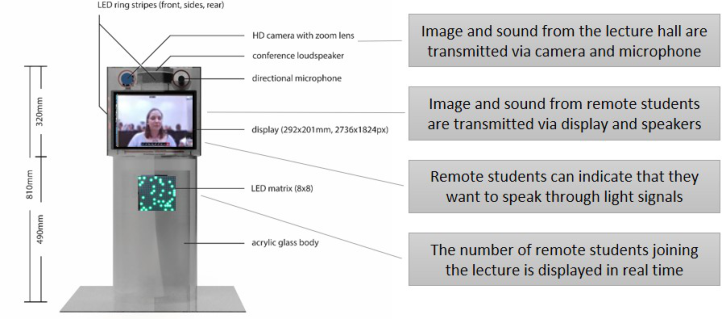
THE FERNSTUDENT As one possible solution towards these goals, our research explores the concept of the so-called “Fernstudent” (German compound word, originally referring to students at a remote university). The basic idea of the concept is an avatar which physically represents the remote students in the lecture hall and serves as the communication channel between remote and on-site based on the same modalities as used in on-site communication. From a technical perspective, the key features are: A physical avatar with a physical presence representing the remote students, “sitting”in the lecture hall side by side with the on-site students. Image and sound from the lecture hall are transmitted via camera and microphone. Image and sound from remote students are transmitted into the lecture hall via display and speakers. Remote students can indicate that they want to speak through light signals. The number of remote students represented by the avatar is displayed in real time, here realized via a LED matrix. Existing software (e.g., Zoom, Jitsi) is a good starting point, because it includes the basic functionalities, is familiar to all potential participants and also simplifies the comparison between the two modes (regular hybrid teaching vs. Fernstudent). Figure 1 shows the set-up of hardware components (for a more detailed description see Ullrich et al., 2024).
Figure 1: Set-up of hardware components.
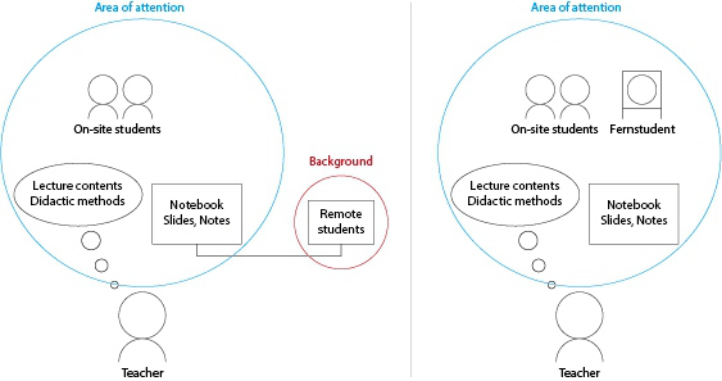
With these features, the concept of the Fernstudent addresses the main identified challenges of hybrid teaching mentioned above. (1) It reduces the cognitive demands for the teaching person by limiting the focus of attention to one spot and modality. Signals from the remote students become visible at the same space as those from the on-site students and thereby frees up the instructor’s attention capacities for lecture content and interaction quality. (2) It enhances the presence of remote students by a physical, anthropomorphic representation and places both student groups on a more equal level (in visibility, modality, and opportunities for social interaction). Figure 2 illustrates the concept and compares teachers’ area of attention in usual hybrid lectures (left) and Fernstudent lectures (right).
Figure 2: Teachers’ area of attention in usual hybrid (left) and Fernstudent lectures (right).
Reducing the Cognitive Load Among Teachers in Hybrid Lectures by a Representation 41
In this, the Fernstudent also shows parallels to the idea of Telepresence robots (TPRs). A TPR usually represents one remote person, often displayed on a screen, and who can manipulate the robot and its camera to control what they see (https://telepresencerobots.com). The concept of the Fernstudent adapts the TPR idea to the typical university setting. Rather than representing each student with a separate entity, one device collectively represents all remote students. Not only is it more practicable and affordable than using separate devices for each student, it is also more flexible and better suited to the fluctuating attendance in many lectures, which is a distinct difference to the mandatory attendance in primary and secondary education. In the following sections, we report about a first field exploration of the Fernstudent based on a functional prototype, highlighting the concept’s potential and limitations as well as more general recommendations for hybrid teaching.
METHODS
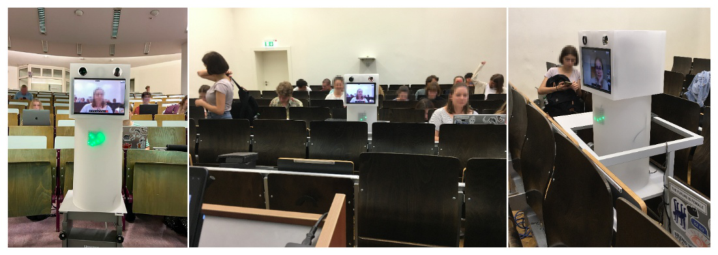
The field test was mainly explorative and aimed to test the general potential of the concept and its effect on the interaction in the classroom, which we surveyed by a post-lecture survey. In particular, we were interested in the students’ mutual perceptions of social presence, their own activity and participation in the lecture as well as their judgment of the Fernstudent prototype, including technical and experiential aspects. Moreover, as a means of comparison, we also surveyed students’ experiences in hybrid teaching in the regular setting, where the remote students follow the lecture via an online platform (here: Jitsi), with the opportunity to pose questions or comments via textual or voice chat. Figure 3 shows the functional prototype of the Fernstudent in the lecture hall.
Figure 3: Functional prototype of the Fernstudent in the lecture hall during the field test.
Study Design and Participants Our field test comprised two different lectures with the option of remote attendance (hybrid option) in the summer semester 2023. Lecture 1 was a bachelor’s course on market and consumer psychology, lecture 2 was a master’s course on user experience. During the first part of the semester,
the option for remote participation was realized via an established meeting software, i.e., Jitsi; during the second part of the semester the Fernstudent replaced the software. Students were free to decide whether they joined the lecture in presence or remotely.
After each lecture session, both groups of students, remote and on-site, were asked to complete a survey to describe their interaction experience and impressions of the utilized hybrid teaching technology by a combination of quantitative and qualitative measures. This results in a 2×2-factorial quasi-experimental design, with the factors participation mode (on-site vs. remote) and technology (Fernstudent vs. Jitsi). The study was approved by the institutional review board of the faculty for mathematics, computer science and statistics. The experiment was performed in accordance with the APA (American Psychological Association) ethical guidelines for research with human subjects. Informed consent was collected from all participants. Students identifiable on the images agreed to the publication of the images in an online open access publication. The participation was anonymous, voluntary and not incentivised. We allowed for missing data in single items, but excluded datasets of students with missing data of more than 20% of the quantitative measures. This resulted in a final sample of 249 student evaluations, thereof 86 from remote students and 163 from onsite students. The students’ age ranged from 19 to 36 years (M = 22.00, SD = 2.69) and 140 of them reported as female, 83 reported as male, 2 reported as diverse, and 24 did not report their gender.
Measures Perceptions of presence and interaction in the classroom. Perceptions of the other students’ presence in the classroom were assessed by an adapted form of the social presence scale, originally developed to assess presence perceptions in virtual reality environments (Makransky et al., 2017). In this context, for instance, high social presence refers to a sense of coexistence and not being aware of the artificiality of social interaction (e.g., “I felt like I was in the presence of another person in the virtual environment”, “The people in the virtual environment appeared to be sentient (conscious and alive) to me”). In the present study we applied three items referring to the presence of remote students (“The remote students…”) and three items referring to that of the on-site students (e.g., “The on-site students … appeared to be sentient (conscious and alive) to me”). Items were assessed on a seven-point Likert scale (1 = not agree at all, 7 = fully agree) and scale values were calculated by averaging the corresponding items. Internal consistency was acceptable for both scales (presence remote students: C alpha = .69, presence on-site students: C alpha = .83). Furthermore, one item assessed the perceived similarity of the interaction between teacher and remote students and the interaction between teacher and on-site students (“How comparable was the interaction between teacher and remote students to the traditional on- site interaction?”) from the on-site students’ perspective. Judgments were assessed on a seven-point Likert scale (1 = different, 7 = identical).
Reducing the Cognitive Load Among Teachers in Hybrid Lectures by a Representation 43
Hand-raising behaviour. As a measure of active participation in the discussion, one item assessed the concrete hand-raising behaviour in today’s session (“Did you raise your hand today?”) and one item assessed general hand-raising intentions (“I can imagine raising my hand…”). The latter part of the item was adjusted to the individual participation mode (“…on-site”vs. “…using the Fernstudent” vs. “…using the Jitsi hand raise feature”). Hand- raising intention was assessed on a seven-point Likert scale (1 = not agree at all, 7 = fully agree).
Specific evaluations of the Fernstudent. A final subset of questions captured specific evaluations of the Fernstudent, only answered by participants in the respective Fernstudent sessions. One question asked for the comparability of the Fernstudent’s features and on-site students (“How do you evaluate the Fernstudent’s features in comparison to an on-site student?”) which was rated on a seven-point Likert scale (1 = different, 7 = identical). Open questions referred to whether students would wish for any additional features (and if yes, which ones) and the overall experience of the Fernstudent (“Overall, how did you experience the Fernstudent’s presence?”). The qualitative answers to open questions were categorized by two raters, with good interrater reliability (ICC = .90).
Statistical Analysis The statistical software IBM SPSS statistics version 29 was used to perform all statistical analyses. Exploratory analysis was performed by descriptive statistics. Differences between remote versus on-site students depending on the used technology (Fernstudent vs. Jitsi) were analysed by two- way ANOVAs. Violations of normal distribution for single measures and unequal cell sizes resulting from the quasi-experimental field design were accepted given the empirical evidence to the robustness of the analysis of variance (e.g., Blanca et al., 2017; Schmider et al., 2010). Mean differences applicable only in one subgroup of participation mode were analysed by two-sided t-tests. Differences in group frequencies of binary variables were analysed by Chi-square tests. The level of statistical significance was set as p < .05 and Bonferroni correction was used to account for multiple comparisons. Effect sizes (Eta squared η2, Cohen’s d, Phi ϕ) are reported where applicable. The dataset is available via the university open data repository, https://doi.org/10.5282/ubm/data.418.
RESULTS
Perceptions of Presence and Interaction in the Classroom Two two-way ANOVAs with the factors technology (Fernstudent, Jitsi) and participation mode (on-site, remote) and the social presence scores for remote and on-site students as dependent variables explored perceptions of presence for the different settings. Regarding the perceived presence of the on-site students, a significant effect of participation mode (F(1, 239) = 137.59, p < .001, η2 = .37) showed higher scores when one’s own participation
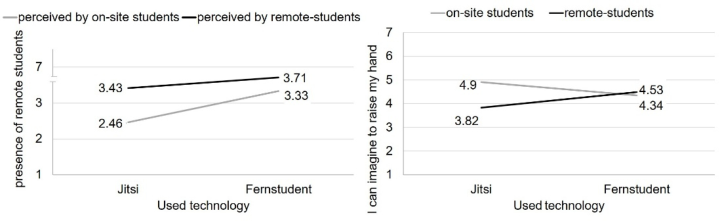
mode was on-site (M = 5.67, SD = 1.41) compared to when it was remote (M = 3.38, SD = 1.32). A parallel significant effect was found regarding the perceived presence of the remote-students (F(1, 242) = 13.57, p < .001, η2 = .05), where presence scores were higher when one’s own participation mode was remote (M = 3.53, SD = 1.45) compared to on-site (M = 2.80, SD = 1.30). This is in line with the intuitive assumption that for either participation mode, students are more aware of students participating in the same mode. In addition, regarding the perceived presence of the remote- students, a significant effect of technology (F(1, 242) = 9.79, p = .002, η2 = .04) showed higher presence for the Fernstudent sessions (M = 3.45, SD = 1.39) compared to the Jitsi sessions (M = 2.81, SD = 1.34). Hence, as intended in the design, the Fernstudent could elevate the experienced level of presence of remote students in the eyes of both on-site and remote students compared to traditional hybrid technology. Figure 4a further illustrates this effect, showing the presence scores for the remote students from the perspective of both other remote students and on-site students for the two technologies (Fernstudent vs. Jitsi). While in the Jitsi sessions the remote students are more present for the other remote students than for the on-site students, the gap between the two groups’ perceptions becomes smaller for the Fernstudent sessions. Furthermore, on-site students rated the perceived similarity of the interaction between teacher and remote students, and teacher and on-site students as more identical for the Fernstudent sessions (M = 3.89, SD = 1.82), compared to the Jitsi sessions (M = 2.97, SD = 1.80, t(160) = 3.15, p = .02, d = 1.81). In sum, while classmates in the same participation mode still appear as more present than those in the alternative mode, technology can have a significant effect in enhancing the presence of remote students.
Hand-Raising Behaviour Students’ self-reports on hand-raising behaviour showed a generally more active participation of on-site students (29% reported to have raised their hand in today’s session) compared to remote students (9% hand raises, χ2 (1) = 13.11, p < .001, ϕ = .23). The general ratio of participation was also somewhat higher in Fernstudent sessions (29% reported to have raised their hand in today’s session) compared to Jitsi sessions (19%), but not statistically significant (χ2 (1) = 3.37, p = .067, ϕ = .12). Regarding hand-raising intention for future sessions, a two-way ANOVA with the factors technology (Fernstudent, Jitsi) and participation mode (on-site, remote) revealed a significant interaction effect (F(1, 245) = 4.69, p < .031, η2 = .02). It showed that while for the Jitsi sessions, hand raising intentions of on-site students (M = 4.90, SD = 2.15) were higher than for remote students (M= 3.82, SD = 1.91), whereas in the Fernstudent sessions, the intention to actively participate in discussions in the classroom was on a similar level among on-site students (M = 4.34, SD = 2.30) and remote students (M = 4.53, SD = 1.91). Figure 4b shows mean values of hand-raising intentions of on-site and remote students for Jitsi and Fernstudent sessions.
Reducing the Cognitive Load Among Teachers in Hybrid Lectures by a Representation 45
Figure 4: a) Perceived presence of the remote students from the perspective of on-site and remote students and b) hand-raising intentions of on-site and remote students for Jitsi and Fernstudent sessions in Jitsi and Fernstudent sessions.
Specific Evaluations of the Fernstudent The evaluation of the Fernstudent’s features in comparison to an on-site student was rated in the medium scale range (M = 3.37, SD = 1.54), indicating that students saw the Fernstudent as neither totally different nor totally identical to the on-site students. There was no significant difference between the evaluation of remote students (M = 3.25, SD = 1.70) and on-site students (M = 3.41, SD = 1.51, t(73) = 0.36, p = .721). Overall, 19% of the students in the Fernstudent sessions wished for additional features of the Fernstudent, whereby this percentage was higher among the remote students (36%) compared to the on-site students (14%). For example, several students wished for a poll feature, which allows a quick representation of the sum of hand raises on-site and remote regarding a particular question raised in context of the lecture (e.g., “How many of you have already heard of …?”). Other mentions rather referred to the improvement of existing features such as a better microphone (to more effectively avoid background noise when the teacher is not speaking).
Regarding the experience of the Fernstudent’s presence in the lecture hall, the majority of students (59%) described it as rather neutral and reported that it did not have any specific positive or negative effects for them. Examples of mentions were “Its presence was not disturbing or positive. Quite neutral” or “After a short time you become used to it and it becomes part of the usual environment”. 30% experienced the Fernstudent’s presence as positive, some of them referring to the positive experience of its reactions (e.g., “An agreeable presence”, or “Interesting. I liked how it started glowing when one of the remote students wanted to say something”). 11% mentioned negative aspects, such as distraction (e.g., “A bit unusual and distracting in the beginning. Then it became in large part normal that it was there”) or had wished for more interaction (“A bit disappointing. It didn’t do much. I would have liked more interaction with the prototype”).
DISCUSSION
We set out to explore new concepts for the successful integration of digital elements in education in the case of hybrid teaching. Driven by the desire
to offer an improved option for remote participation (for those who were prevented from joining the on-site lecture for any number of reasons) that would put remote students on a more equal footing with the on-site students in terms of participation, we developed the concept of the Fernstudent. Its features address the main challenges identified in previous experiences with hybrid teaching: increased cognitive burdens for the instructor and the division of the student audience into actually present, active participants (on-site) and practically invisible, passive consumers (remote).
The first field test with a functional prototype showed that, compared to the standard hybrid option based on the Jitsi software, the Fernstudent produced some positive changes. For example, the perceived social presence of the remote students became higher with the Fernstudent compared to Jitsi, and the interaction between teacher and remote students was perceived as more similar to that between teacher and on-site students. The Fernstudent further reduced the participation gap between on-site and remote students as remote students reported a higher intention for active participation (raising their hand) in Fernstudent sessions compared to Jitsi, reaching a level comparable to that of the on-site students.
As with all first tests, there are a number of limitations to be addressed in future studies. Firstly, a main limitation of the present test is the quasi- experimental field setting, where subjects “self-assigned” themselves to the different test conditions, and no “randomized treatment”. The approach of integrating the Fernstudent into a regular, ongoing lecture, with no changed rules for participation, i.e., students were free to decide whether they joined the lecture on-site or remotely (or whether they joined at all), and voluntary completion of the post-lecture promotes a high external validity but low internal validity and a limited basis for statistical interpretations. Moreover, our experiences with the Fernstudent are, so far, limited to a small, specific sample from one university. We aim for future tests of the Fernstudent beyond our own university, which will also explore the effect of systematic variations in the Fernstudent’s features or design factors, the relevance of context and demographic factors such as lecture content, number of students, teaching style, etc. Moreover, we are planning more specific evaluations and longitudinal studies that explore dynamics over time (e.g., integration of remote students in discussions, performance measures) and underlying psychological mechanisms. For example, this could refer to a deeper exploration of motivations to join the lecture on-site or remotely or relatedness as a possible mediator of learning success. Also, while the here presented data focuses on the students’ perspective, this has to be complemented by the teachers’ perspective, in order to cover the experiences and needs of all relevant person groups in hybrid teaching. As a first approach to the teachers’ perspective, we conducted retrospective interviews with the teachers involved in the here described field test about their experiences with the Fernstudent (Ullrich et al., 2023). Their reports were generally positive, emphasizing the stress reduction and increased sense of competence, the natural and pleasant social interaction with the remote students, and experiencing both student groups more like one category. However, these findings should be backed up and complemented by quantitative data. Hence,
Reducing the Cognitive Load Among Teachers in Hybrid Lectures by a Representation 47
in currently ongoing studies a larger sample of teachers and students are confronted with the concept of the Fernstudent and different design variants.
Regarding further developments of the Fernstudent concept and prototype, the planned next steps address two major issues. First, improving the practical handling and mobility of the prototype for easier removal between lecture rooms or even universities and other institutions (possibly producing a greater number for parallel applications). Second, a stronger integration of the remote students’ perspective into the concept through features that strengthen their awareness of their social presence in the classroom. For example, one of the teachers involved in the field test suggested a “fly-in”- feature, similar to computer games that often begin with a perspective flight where you see yourself/your avatar from above and then you fly into the body. Such a feature might be built in when a remote student dials into the meeting, showing the lecture hall and those in physical attendance before flying into the robot and changing to the normal view which shows the presentation slides and the lecturer. Another suggestion was to show a seating plan of the lecture hall (similar to when choosing a seat in a theatre), where the remote students see how they/the Fernstudent is positioned among the on-site students.
Finally, the present research also provides more general implications for hybrid teaching and digitalization in the school and workplace. It emphasises the importance of a close alignment of technical and experiential perspective as well as the consideration of social dynamics. The example of hybrid teaching shows, that it is a highly challenging task to design the digital opportunities in such a way that a positive integrating vision (here: a joint participation of students from anywhere, united in following the same lecture but from different places) is realized. As revealed in the research literature on hybrid teaching, the format comes with numerous difficulties, resulting in impairments of wellbeing and educational quality (e.g., Huizinga et al., 2022; Gamage et al., 2023; Lorenzo-Lledo et al., 2021). Possibly unintended, both parties (remote and on-site) contribute to a growing distance and imbalance in the level of interaction for the two settings. The remote students reduce their active participation in the lecture and often engage in other activities while listening (Lorenzo-Ledo et al., 2021), while the teachers most often focus their attention on the on-site students and probably reduce their attention to the remote students even more if questions or comments from them are rare (Huizinga et al., 2022). This tendency of lacking interaction and mutual awareness between the two settings can lead to a point where remote students no longer feel as part of the group. They become casual consumers instead of active participants - while teachers lose their engagement to care for a group that they experience as unmotivated and potentially ungrateful, to the point of relief if there are no more attempts of participation they have to handle.
At least in parts, this downward spiral is fuelled by the common technical environment in hybrid teaching, such as the differing opportunities for joining conversation and discussion for on-site and remote students, and the high demands of attention for the teachers to perceive and handle remote students’ participation attempts. Problems such as a growing feeling of
psychological distance and alienation between digitally connected interaction partners are not limited to the context of hybrid teaching at school or university. For example, there is a long tradition of research on telework, where numerous studies identified problems regarding wellbeing and social qualities, such as team spirit, pleasure, and work satisfaction (e.g., Baruch, 2000; Mann & Holdsworth, 2003; Sardeshmukh et al., 2012). Moreover, this research showed that many of these problems are related to technical barriers preventing social cues and even to misunderstandings and social conflicts arising from to a lack of agreement about adequate behaviour and social norms in tele- or hybrid environments (e.g., Diefenbach, 2023). Thus, the question of enhanced presence and better conditions for connection and interaction quality between physically distant individuals is relevant far beyond the university context.
CONCLUSION
The example of the Fernstudent is one way how innovative technology can contribute to positive experiences in digital hybrid teaching environments. But most importantly, implementing new technology must be the second step after first identifying the challenges and needs of the target groups and the relevant psychological dynamics. Following a user-centred design process, the technical solution can be tailored to meet such needs more adequately - rather than creating new problems. We hope to further develop and disseminate the concept so more teachers and students can profit from it, and we are confident that it will inspire similar research in other contexts to provide more technical opportunities that humans experience as worthwhile.
REFERENCES
Baruch, Y. (2000). Teleworking: Benefits and pitfalls as perceived by professionals and managers. New technology, work and employment, 15(1), 34–49. Blanca Mena, M. J., Alarcón Postigo, R., Arnau Gras, J., Bono Cabré, R., &
Bendayan, R. Non-normal data: Is ANOVA still a valid option?. Psicothema 29(4), 552–557 (2017). Diefenbach, S. (2023). Social norms in digital spaces: Conflict reports and implications for technology design in the teleworking context. Zeitschrift für Arbeitswissenschaft, 77(1), 56–77. Fredricks, J. A., Blumenfeld, P. C., & Paris, A. H. (2004). School Engagement: Potential of the Concept, State of the Evidence. Review of Educational Research, 74(1), 59–109. https://doi.org/10.3102/ 00346543074001059 Gamage, K. A., Jeyachandran, K., Dehideniya, S. C., Lambert, C. G., & Rennie, A. E.
(2023). Online and Hybrid Teaching Effects on Graduate Attributes: Opportunity or Cause for Concern?. Education Sciences, 13(2), 221. Garrison, D. R. (2016). E-learning in the 21st century: A community of inquiry framework for research and practice. Taylor & Francis. Henderson, M., Selwyn, N., & Aston, R. (2017). What works and why? Student
perceptions of ‘useful’ digital technology in university teaching and learning. Studies in higher education, 42(8), 1567–1579.
Reducing the Cognitive Load Among Teachers in Hybrid Lectures by a Representation 49
Huizinga, T., Lohuis, A., Zwerver-Bergman, J., & van der Meer, R. (2022). Student and teacher perceptions of community of inquiry in hybrid virtual classrooms. Heliyon, 8(12). Linder, K. E. (2017). Fundamentals of hybrid teaching and learning. New directions
for teaching and learning, 2017(149), 11–18. Lizenberger, K. (2023). Explorative Interviews. Retrieved from https://boldcollective .de/explorative-interviews/ (last access 15/08/2023). Lorenzo-Lledó, A., Lledó, A., Gilabert-Cerdá, A., & Lorenzo, G. (2021). The
pedagogical model of hybrid teaching: Difficulties of university students in the context of COVID-19. European Journal of Investigation in Health, Psychology and Education, 11(4), 1320–1332. Ma, S., Hu, Q., Chen, Y., Zhao, Z., & Li, H. (2023). Social Bots that Bring a Strong Presence to Remote Participants in Hybrid Meetings. In Companion of the 2023 ACM/IEEE International Conference on Human-Robot Interaction (pp. 853–856). https://doi.org/10.1145/3568294.3580200 Makransky, G., Lilleholt, L., & Aaby, A. (2017). Development and validation of the
Multimodal Presence Scale for virtual reality environments: A confirmatory factor analysis and item response theory approach. Computers in Human Behavior, 72, 276–285. Mann, S., & Holdsworth, L. (2003). The psychological impact of teleworking: stress, emotions and health. New Technology, Work and Employment, 18(3), 196–211. Moore, M. G. (1993). Theory of transactional distance. Theoretical principles of
distance education, 1, 22–38. Sardeshmukh, S. R., Sharma, D., & Golden, T. D. (2012). Impact of telework on exhaustion and job engagement: A job demands and job resources model. New Technology, Work and Employment, 27(3), 193–207. Schmider, E., Ziegler, M., Danay, E., Beyer, L., & Bühner, M. Is it really robust?
Reinvestigating the robustness of ANOVA against violations of the normal distribution assumption. Methodology: European Journal of Research Methods for the Behavioral and Social Sciences 6(4), 147–151 (2010). Singh, J., Steele, K., & Singh, L. (2021). Combining the best of online and faceto-face learning: Hybrid and blended learning approach for COVID-19, post vaccine, & post-pandemic world. Journal of Educational Technology Systems, 50(2), 140–171. Ullrich, D., Butz, A. & Diefenbach, S. (2023). The Fernstudent. The “Fernstudent”.
Enhancing the potential of hybrid teaching based on user-centered design. In Proceedings of the 20th International Conference on Cognition and Exploratory Learning in Digital Age (CELDA 2023). Ullrich, D., Butz, A., & Diefenbach, S. (2024). The Fernstudent. A User-Centered Design Case Study on Improvements of Hybrid Teaching Through A Physical Avatar in the Classroom. Fernstudent Case Study. In Proceedings of the 2024 CHI Conference on Human Factors in Computing Systems, Article No.: 534, doi: 10.1145/3613905.3637144. Wu, G., Zheng, J., & Zhai, J. (2021). Individualized learning evaluation model
based on hybrid teaching. The International Journal of Electrical Engineering & Education, 0020720920983999.
LISTED IN THE AHFE DIGITAL BOOKSTORE CATALOGUE
Explore the complete digital volume
Accessibility, Assistive Technology and Digital Environments
Read this individual research paper free through the original publisher, or explore the full digital proceedings book.
ISBN 978-1-964867-38-0
Explore this ISBN in the AHFE Bookstore ↗Listed in the July 2026 bookstore catalogue; search by ISBN to confirm current availability · Digital book purchase optional