Gustavo Simas Da Silva, Vânia Ribas Ulbricht (2024). Design Feeling: a symmathetic approach for design processes. In: Usability and User Experience. AHFE Open Access, vol. 156, pp. 181–190. https://doi.org/10.54941/ahfe1005428
Exploring the evolution of design from creating tangible products to orchestrating intangible experiences and socio-technical systems, we introduce "Design Feeling" (DF) as a novel approach for design processes, transcending the problem-solving goal by integrating emotional resonance, intuition and symmathesy. While Design Thinking has historically emphasized a problem-solution approach focusing on user-centered problem-solving, DF advocates for a systems feeling that addresses complex, interconnected challenges through participatory design, empathy, intentionality and political engagement. This shift requires a new kind of designer, one who acts as a facilitator of community interaction and a steward of ecological health, aiming to create solutions that are both resonant with users and responsible to the broader ecosystem, being a “cautious Prometheus” as well. We highlight the need for a critical reevaluation of design practices to ensure they contribute to sustainable and equitable progress, proposing a movement towards a design philosophy that harmonizes technical skills with emotional and relational understanding.
Design has journeyed through a profound evolution from its early days of crafting tangible artifacts to orchestrating intangible experiences and strate- gies. This transition reflects a broader understanding of the impact design has on the way we live, work, and interact.
As we face more interconnected networks of issues, the challenges we face— “wicked problems”—become harder to define and resolve. These problems, characterized by their complexity, interdependencies, and shifting parameters, resist the straightforward problem-solving approaches of tradi- tional design (Melles et al., 2011). The limitations of such methodologies become apparent when solutions fail to adapt to (or choose to not address directly) the intricate realities of societal, environmental, and systemic issues. The pair Problem-Solution, often used in some design approaches, lacks emo- tional depth and usually maintains a linear path to the learning and creative process, neglecting the nuanced dynamics of human experience. The role of designer itself has shifted from a purely commercial focus to encompassing a broader concern for the future, actively engaging with sustainability and driving social change through innovative and responsible design practices (Vassão, 2017).
To more effectively address these challenges, ecological approaches that prioritize an understanding of contexts and ecosystems can be utilized. Integrating feeling, embodied thinking, and community engagement (partic- ipatory design) enhances the design process, ensuring solutions are resonant and sustainable (Harsaae et al., 2022).
With systems thinking (and feeling), we aim to address an approach that values feelings, mutual learning, emergence and participation in the design process. By weaving these elements together, we initiate a discussion to bridge the gaps identified in approaches like Design Thinking (DT) and to develop a framework that draws attention to the socio-technical dimension.
This new approach seeks to balance the technical aspects of systems design with the human-centered insights that arise from deep engagement with the emotional and relational contexts of the users. In doing so, it endeavors to create more sustainable solutions that are truly responsive to ecological needs. This work represents a step towards conceptualizing a Design Feeling (DF) approach that not only addresses the shortcomings of DT but also enriches the practice by integrating empathy and systemic awareness into every phase of the design process.
INTO INTANGIBLES AND SOCIO TECHNICAL DIMENSION: THE EVOLUTION OF DESIGN Design has evolved significantly over the years, in recent times having approaches for solving complex (wicked) problems and leaning towards sustainability (Jelena & Sidorenko, 2022).
Initially, design was synonymous with the industrial arts, with a strong emphasis on form, function, and aesthetics. It was a field rooted in the mate- rial world, focusing on the creation of products, from everyday household items to vehicles and buildings. Designers like Ray and Charles Eames and Dieter Rams set benchmarks for good design principles that were heavily based on the physical and tactile qualities of objects, addressing the direct needs of users (Petts, 2019).
As society shifted towards a knowledge-based and service-driven economy, the role of design expanded: it began to envelop the creation of systems and experiences, recognizing that the value offered by a product was not solely in its physical form, but in the user’s interaction with it (Garvey & Drazin, 2016). This led to the emergence of fields like Service Design and Experience Design. Approaches like these became important resources, highlighting the need for a systemic need to design services and experiences that prioritize user needs and contexts.
The advent of the digital age accelerated this transition. Interaction Design, for example, focusing on the user’s experience with digital interfaces, empha- sizes usability and user-centric principles. With the rise of the internet and mobile technology, the importance of designing intuitive and seamless digital experiences became paramount.
Participatory design has also played a significant role in reshaping design practices, with efforts to reimagine design processes for enhanced collabo- ration and innovation (Bannon et al., 2018). Works by Ezio Manzini, for
Design Feeling: A Symmathetic Approach for Design Processes 183
instance, emphasize the value of participatory design for social innovation and sustainability, advocating for design strategies that engage communities directly and foster a co-creation environment (Manzini, 2015).
From these developments, Design Thinking also arose, a method that applies the designer’s sensibility and tools to problem-solving beyond tra- ditional design boundaries. It has become a strategic tool in business and innovation, popularized by thought leaders. DT reframed design as a process for innovation, applicable to a wide range of challenges, including organiza- tional change, education, and public policy. It values empathy, collaboration, and iteration, focusing on human-centered design (HCD) principles that can be applied to both tangible and intangible problems.
One of the key principles common to many Design Thinking approaches is the iterative process involving observation, framing, imagining, and mak- ing, which allows for continuous refinement and innovation (Thompson & Schonthal, 2020). DT is not limited to traditional design fields but has also found applications in various domains such as R&D, where it drives success- ful innovation by incorporating user needs early in the design process (Lim et al., 2022).
This notion maps back to “The Science of the Artificial” (Simon, 1980), being further explored by Robert McKim in “Experiences in Visual Think- ing”. It was popularized by professor Rolf Faste and embraced within the business sphere by the co-founder of the design firm IDEO and profes- sor at Stanford, David M. Kelley. DT has evolved beyond a mere industry term into a significant, multidisciplinary approach. Today, it stirs consid- erable interest across academic and business sectors, sparking discussions and events dedicated to understanding and applying its principles in various contexts.
However, although Design Thinking has garnered acclaim for its user- centered approach and innovative problem-solving capabilities, it also faces considerable criticism (Verganti et al., 2021; Candi et al., 2023; Kimbell, 2020). It often oversimplifies complex issues and might overlook the deep expertise needed for specific challenges. Critics argue that its focus on rapid iteration can lead to underdeveloped outcomes and that its user-centric nature might ignore other critical aspects like sustainability and systemic impacts, also lacking the “feeling” aspect throughout the process. These criticisms suggest that Design Thinking should be “rethinked” and applied within a broader, more critical framework that integrates other lenses to enhance its effectiveness.
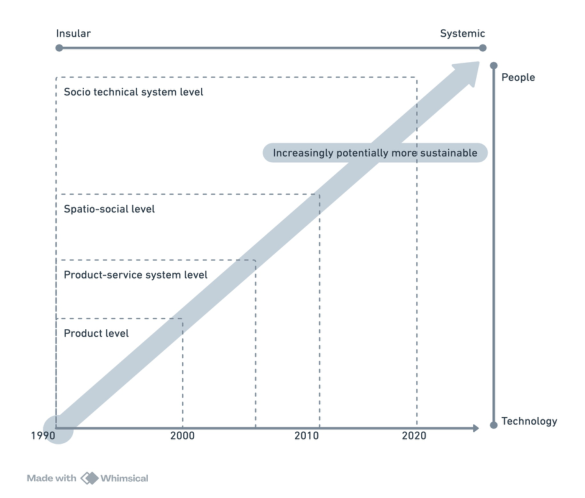
To rethink the current facets of a thing, it is essential to grasp its histor- ical dynamics and the systems it is inserted. Understanding the functional structure of design history has been a key aspect, with research focusing on methods to describe design intent effectively (Jiang & Li, 2016). There- fore, the Design for Sustainability Evolutionary Framework, by Ceschin and Gaziulusoy (2016), as presented in Figure 1, showcases the mentioned evo- lution of design from a technology-centric, insular approach in the 1990s to a systemic, people-focused perspective in recent years.
184 da Silva and Ulbricht
Figure 1: Design for sustainability evolutionary framework (adapted from Ceschin & Gaziulusoy, 2016).
Initially focused on the product level, design approaches have expanded to include service systems, considering how products are used within larger service networks. By the 2000s, design began to integrate social and spatial contexts, understanding that products and services operate within complex societal frameworks. Today’s design emphasizes socio-technical systems, bal- ancing technology with human and environmental needs to foster sustainable outcomes. This shift reflects a broader understanding of the interconnected nature of design, people, and the planet, striving for systemic solutions that support sustainability.
SYSTEMS COMPLEXITY, SYMMATHESY AND DESIGN PHILOSOPHY Symmathesy, derived from the Greek words for “together” and “learning”, refers to the contextual and mutual learning through interaction within a system (Bateson, 2015). This concept aligns closely with systems thinking, where we analyse and synthesize on the way that a system’s constituent parts interrelate and how systems work over time and within the context of larger systems.
The relationship between design and symmathesy can be traced back to the pioneering works of thinkers like Buckminster Fuller and Donella Meadows, who emphasized the importance of understanding the interconnectedness and complex feedback loops within systems (Weig, 2023). Principles that mold the idea of comprehensive anticipatory design, and build an alert for designers about leveraging systems thinking for complex problem-solving.
Design Feeling: A Symmathetic Approach for Design Processes 185
In fact, a design process is a learning process. For instance, the DT iterative process—empathize, define, ideate, prototype, and test—is a learning journey not just for the designers, but for the entire system involved. This relation- ship and metaview is found in cybernetics, which articulates how an entity shapes and is shaped by the systems it interacts with, forming a reciprocal relationship where the system and the entities of the system learn and evolve together (Bateson, 2021).
The wider focus on socio technical dimensions has shifted design from static insulated solutions to fostering environments for ongoing adaptation and learning. Participatory design involves community members directly, ensuring sustainable and adaptable solutions. This approach blurs traditional boundaries between designer, user, and environment, promoting a collabo- rative and integrative approach to creation, which challenges conventional design roles, advocating for designers to act as facilitators of deep dialogue and interaction. By leveraging community collective intelligence and creativ- ity, this produces solutions that highlight the importance of mutual learning and continuous design evolution within ecosystems.
Nonetheless, the concept of “wholeness” in systems can be tricky when dealing with intersubjectivity. In increasingly fragmented environments lead- ing to distrust in large systems, designers are exploring ways to foster this sense of collective “wholeness” without enforcing a singular worldview.
Cheryl Hsu (2021) leverages philosophical insights and engages with emerging relational practices like Collective Presencing and People Need Peo- ple (PNP) Warm Data Labs to explore designing symbiotic systems. These practices, while acknowledging the complexity and humility required in their approach, aim to cultivate a shared vision and spur collective action. Therefore a transversal design approach: something that utilizes the creative tensions between diverse perspectives to glimpse a collective “wholeness” (transversal wholeness).
The transversal wholeness is defined by five key principles that guide our understanding of its elusive nature. First, it is ineffable and ephemeral, highlighting its intangible and transient characteristics. Second, wholeness is always in a state of becoming, continuously evolving and never fully com- plete. Third, it can only be glimpsed through the particular instances that provide specific insights into the larger entity. Fourth, wholeness is something to be felt and sensed, rather than explicitly defined and mapped, emphasiz- ing feeling over analytical delineation. Finally, it is transcontextual, existing across and informed by multiple contexts. This approach is not about resolv- ing tensions to achieve consensus but about transforming these tensions into moments of collective insight and alignment, emphasizing the creative and participatory potential of design in navigating the complexities of systemic challenges (Hsu, 2021).
DESIGN FEELING AS AN ECOLOGICAL APPROACH The notion of design as a cultural interpreter is giving way to a more demo- cratic and inclusive practice. As articulated by scholars like Verganti (2023), who explores the role of design in creating meaningful interactions, the focus is shifting from the designer as the central agent to a broader participatory
186 da Silva and Ulbricht
framework. This is where metadesign comes into play, focusing on designing the context and dealing with ecosystems where solutions reside, rather than designing the solutions themselves.
In particular, the metadesign concept, which frames design as an activ- ity encompassing the facilitation and design of context, challenges designers to think beyond individual products or services (Wood, 2022). This idea is rooted in the recognition of intentionality and that design’s impact extends into the socio-cultural and political scenario.
Embedding feeling in the design process also brings the importance of being critical and not merely succumbing to the systems of oppression influ- ences. Critiques, such as those by Kimbell (2020) and Latour’s “cautious prometheus” (2008), express the necessity of maintaining a reflective stance that questions established norms and practices. Ergo, we have design prac- tices that acknowledge its socio-political dimensions and its potential to perpetuate or challenge prevailing power structures.
The critique of the traditional role of the designer and the shift towards a participatory and systems-oriented approach is echoed in the design man- ifesto by Di Dio and colleagues (2024). They underscore the necessity for designers to transcend their traditional boundaries and engage in the co- creation of socio-technical systems. Also, it highlighted the growing impor- tance of cross-disciplinary collaboration and the breakdown of silos between personal and professional creative endeavors.
Having these elements, we can draw defining aspects of DF. A compared view, presented in Table 1, about some Design Thinking and Design Feel- ing aspects, shows their differences and similarities in focus, methodology, outcomes, and underlying theories.
Table 1. Comparison between design thinking and design feeling aspects.
Table available in the original PDF paper.
Aspect Design Thinking Design Feeling Focus Solving specific problems through a user-centered approach.
Adapted to what emerges, incorporates systems thinking, participatory design, and metadesign
Creation through emergence, emotional resonance and intersubjective understanding Fundamental pair Problem-Solution Emergence-Intention Method Follows a structured process: empathize, define, ideate, prototype, test.
Aims at finding feasible and viable solutions to defined problems.
Outcome Orientation
Designer as a participatory facilitator and systems feeler
Aims at creating what are emotionally resonant and sustainable, focusing on ecological and social implications. Designer role Designer as a problem solver and prototyper Engages users continuously in a co-creative process, emphasizing mutual learning and shared experiences.
User Engagement Involves users primarily for feedback and insights during the empathize and test phases.
Tools and Techniques
Double diamond, personas, journey maps, brainstorming, and prototyping.
Tools that facilitate deep dialogue, reflection, and shared understanding, Warm Data Labs, story maps, systems mapping and liberating structures. Theoretical Base Rooted in cognitive science and business management theories.
Typically focuses on local and direct impacts of solutions.
Draws from theories in cybernetics, ecology, anthropology, and complex systems theory. Impact Consideration
Considers long-term, systemic impacts including environmental, cultural, and social dimensions. Intentionality Problem-solving is generally driven by client or market needs.
Usually neutral, focusing on innovation within given systems
Explicitly addresses and challenges existing power dynamics and aims
Driven by a commitment to ethical considerations, self-knowledge, sustainability, and community or ecosystem well-being. Political Engagement
Design Feeling: A Symmathetic Approach for Design Processes 187
Through a literature review, Kimbell (2020) draws that DT can be under- stood and utilized in various ways, each characterized by distinct frameworks and focus areas. Firstly, as a cognitive style, design thinking is explored through the lens of individual designers, particularly experts in the field, emphasizing design ability as a form of intelligence, reflecting on action and abductive thinking. The nature of design problems, according to this view, is that they are ill-structured and that problems and solutions co-evolve.
In contrast, as a general theory of design, the focus shifts to viewing design as a discipline with no specific subject matter of its own. This perspective addresses how design tames wicked problems, emphasizing the integrative and complex nature of design challenges.
Lastly, when considered as an organizational resource, DT targets busi- nesses and organizations in need of innovation. Here, the discussion is on how design thinking functions within various contexts, from healthcare to ensuring access to clean water, for example. In this scenario, key con- cepts include visualization, prototyping, empathy, integrative thinking, and abductive thinking, drawing attention to organizational problems as design problems. The sites of design expertise and activity here are not limited to traditional design disciplines but include any organizational context where innovation is required.
Regarding emotional response, DT does, indeed, engage with feelings, particularly through the empathy phase where understanding and empathiz- ing with user experiences are fundamental for crafting effective solutions. Empathy aids in grasping user feelings, integrating these insights into design decisions to enhance the affective impact of products or interactions—a key factor across domains such as game design and healthcare services (Köppen & Meinel, 2014; Pichlmair & Johansen, 2022).
However, feelings are not the primary focus of DT; they are a component of the broader process oriented towards problem-solving. In contrast, DF expands on this by embedding a deep understanding of emotions within the entire design process. But it does not limit to this: it advocates for a more comprehensive design philosophy that integrates intentionality, emergence, community engagement, sustainability, and political engagement. Warm Data Labs, Transition Design (Irwin et al., 2022) and HCD projects are some examples of actions that put in practice DF for new creations. This frame- work not only includes emotional insights but also commits to collective intelligence and co-creation, adopting a long-term impact of design decisions, when necessary.
CONCLUSION
Today, design is recognized not only for its ability to create beautiful and functional products but also for its strategic value in addressing complex challenges in a socio-technical dimension. It plays a vital role in shaping intangibles such as corporate identity, brand experience, and organizational culture. Design has transcended its material origins to become a fundamental approach to managing intangibility in an increasingly complex and inter- connected world, being at the forefront of driving innovation, shaping user
188 da Silva and Ulbricht
experiences, and crafting strategies that address systems needs. As design embraces this broader mandate, it must do so with a critical eye, ensuring that it serves as a force for sustainable and equitable progress, rather than an enabler of the status quo.
In practice, design informed by systems thinking and symmathesy can lead to sustainable and adaptive solutions. Through the Design Feeling approach, designers engage deeply with the nuances of ecological and social intercon- nections, going beyond the traditional problem-solving pair, and being able to focus on fostering resilient, thriving communities with intentionality through design processes that are inherently inclusive and participatory. DF empha- sizes emotional intelligence and the feeling of complex, living systems, which enables agents to create solutions that may not only meet immediate needs but also anticipate and adapt to future challenges. It involves not only intel- lectual activity, but also the “bodying” (Weig, 2023), recognizing the body not just as a biological entity but as deeply embedded in ecological contexts, thereby enhancing the relational and systemic approach required.
The symmathesy in DF aligns with the “transversal wholeness” (Hsu, 2021), which challenges the conventional need to fully understand and map out systems, suggesting instead that wholeness is something to be experienced and felt through specific, contextual interactions.
In line with these ideas, the Manifesto for Design Education (Di Dio et al., 2024) argues for a design ethos that elevates the well-being of marginalized communities and the environment, acknowledging the broad socio-environmental impact of every design decision. Through a systemic and regenerative approach, the manifesto encourages designers to adopt systems thinking, looking beyond aesthetics and functionality to create solutions that are regenerative by nature. This can be achieved through transdisciplinary action, collaboration with experts from fields like ecology and sociology and attention to global sustainability goals, such as the United Nations’ Sustain- able Development Goals. This view positions design as a critical, integrative practice capable of driving change.
Design Feeling is not inherently contradictory to Design Thinking; the goal is no to reinforce a cartesian dualism of thinking/feeling; rather, they both can be complementary. Future research may explore implications, correlations with other approaches (Transition Design, HCD, etc.), bring case studies and draw recommendations of practical applications of Design Feeling in different contexts.
ACKNOWLEDGMENT
This work was carried out with the support of the Coordination for the Improvement of Higher Education Personnel (CAPES) - Brazil (Funding Code 001).
REFERENCES
Bannon, L. J., Bardzell, J., & Bødker, S. (2018). Reimagining participatory design.
Design Feeling: A Symmathetic Approach for Design Processes 189
Bateson, N. (2015). Symmathesy--A Word in Progress. In Proceedings of the 59th Annual Meeting of the ISSS-2015 Berlin, Germany (Vol. 1, No. 1). Bateson, N. (2021). Aphanipoiesis. In Journal of the International Society for the
Systems Sciences, Proceedings of the 64th Annual Meeting of the ISSS, Virtual (Vol. 1, No. 1). Candi, M., Dell’Era, C., Magistretti, S., Scott, K., & Verganti, R. (2023). Re-thinking design thinking: the transformative role of design thinking in new product devel- opment. The PDMA Handbook of Innovation and New Product Development, 445. Ceschin, F., & Gaziulusoy, I. (2016). Evolution of design for sustainability: From
product design to design for system innovations and transitions. Design studies, 47, 118–163. Di Dio, S., Russo, D., Monterosso, F., & Inzerillo, B. (2024). Designing the Future: A Manifesto for Design Education. AHFE International, 119, 725–735. Garvey, P. & Drazin, A. (2016). Design dispersed: design history, design practice and
anthropology. Journal of Design History, 29(1), 1–7. https://doi.org/10.1093/jdh/ epv054 Harsaae, M. P., Østergaard, T., & Bang, A. L. (2022). Systems thinking and Interdisciplinarity in disciplinary design education. In DS 117: Proceedings of the 24th International Conference on Engineering and Product Design Education (E&PDE 2022), London South Bank University in London, UK. 8th–9th September 2022. Hsu, C. (2021). Transversal Design. Playing with Tensions, 469. Irwin, T., Tonkinwise, C., & Kossoff, G. (2022). Transition design: An educa-
tional framework for advancing the study and design of sustainable transitions. Cuadernos del Centro de Estudios en Diseño y Comunicación. Ensayos, (105), 31–72. Jelena, D. and Sidorenko, S. (2022). Design thinking as an approach for sustainability. How Product and Manufacturing Design Enable Sustainable Companies and Societies. https://doi.org/10.35199/norddesign2022.46 Jiang, S. and Li, J. (2016). Research of the effectual action unit–based inverse
method for solving the functional structure of design history. Advances in Mechanical Engineering, 8(8), 168781401666380. https://doi.org/10.1177/ 1687814016663805 Kimbell, L. (2020). Rethinking design thinking. Annual Review of Policy Design, 8(1), 1–20. Köppen, E., & Meinel, C. (2014). Empathy via design thinking: creation of sense and
knowledge. In Design thinking research: Building innovators (pp. 15–28). Cham: Springer International Publishing. Latour, B. (2008). A cautious prometheus?: A few steps toward a philosophy of design (with special attention to Peter Sloterdijk). Lim, S., Kim, M., & Sawng, Y. (2022). Design thinking for public r&d: Focus on
r&d performance at public research institutes. Sustainability, 14(13), 7765. https: //doi.org/10.3390/su14137765 Manzini, E. (2015). Design, when everybody designs: An introduction to design for social innovation. MIT press. Melles, G., de Vere, I., & Misic, V. (2011). Socially responsible design: Think-
ing beyond the triple bottom line to socially responsive and sustainable product design. CoDesign, 7(3–4), 143–154. Otto, T., & Smith, R. C. (2020). Design anthropology: A distinct style of knowing.
In Design Anthropology (pp. 1–29). Routledge.
190 da Silva and Ulbricht
Petts, J. (2019). Function and flourishing: Good design and aesthetic lives. The Journal of Aesthetic Education, 53(2), 1–18. Pichlmair, M. and Johansen, M. (2022). Designing game feel: a survey. IEEE Trans-
actions on Games, 14(2), 138–152. https://doi.org/10.1109/tg.2021.3072241 Simon, H. A. (1980). Cognitive science: The newest science of the artificial. Cognitive science, 4(1), 33–46 Thompson, L. and Schonthal, D. (2020). The social psychology of design think-
ing. California Management Review, 62(2), 84–99. https://doi.org/10.1177/ 0008125619897636 Vassão, C. A. (2017). Design and Politics: Metadesign for social change. Strategic Design Research Journal, 10(2). Verganti, R., Dell’Era, C., & Swan, K. S. (2021). Design thinking: Critical anal-
ysis and future evolution. Journal of Product Innovation Management, 38(6), 603–622. Weig, D. (2023). Interdisciplinary education against eco-anxiety: Learning how to know about bodying, fascias, and ecological embeddedness. In Handbook of Sus- tainability Science in the Future: Policies, Technologies and Education by 2050 (pp. 1–14). Cham: Springer International Publishing. Wood, J. (Ed.). (2022). Metadesigning designing in the Anthropocene. Taylor &
Francis.
LISTED IN THE AHFE DIGITAL BOOKSTORE CATALOGUE
Explore the complete digital volume
Usability and User Experience
Read this individual research paper free through the original publisher, or explore the full digital proceedings book.
ISBN 978-1-964867-32-8
Explore this ISBN in the AHFE Bookstore ↗Listed in the July 2026 bookstore catalogue; search by ISBN to confirm current availability · Digital book purchase optional