Anja Koonen, Theresa Joerißen, Nina Collienne, Esther Borowski, Ingrid Isenhardt (2024). Human Factors in Technology and Knowledge Transfer: A Qualification Concept of the WIN:A Project for Effective Personal and Medial Transfer Structures. In: Human Factors and Systems Interaction. AHFE Open Access, vol. 154, pp. 189–198. https://doi.org/10.54941/ahfe1005366
Labour research continuously develops new findings on the design of work. It also aims at translat-ing research results into practical products such as guidelines, checklists or implementation tools. These products can support small and medium-sized enterprises (SMEs) in overcoming current challenges such as the skills shortage, digital transformation or the energy and climate crisis while ensuring good working conditions. But recent scientific contributions show that there is still an ex-isting transfer gap (for an overview, see Borowski et. al. 2023). Research findings and products from the field of ergonomics are often unknown in business practices. Links to „everyday business“ in SMEs and intermediary organisations (e.g. consultants or associations) are not evident or are hindered by difficulties in translating these findings and products into the respective application context.Due to limited time and personnel resources, SMEs often do not have the necessary means to thoroughly search for labour science and ergonomics insights or products and to check their rele-vance and practical suitability. At the same time, intermediaries also have major gaps in their knowledge, even though considering labour research topics to be highly relevant for their work and aspiring to have more customised tools (Cernavin, Joerißen 2022). Thus, how can research findings be processed more effectively and disseminated more successful-ly? What could be suitable concepts for relevant stakeholders (scientists, works councils, SMEs and intermediaries) to enable them to use the (technical resp. medial) products and results from labour research effectively? In order to answer these research questions, there is ongoing investigation in the project WIN:A (Knowledge and Innovation Network for Labour Research). This investigation aims at deducing and suggesting different instruments for effective knowledge transfer, including a qualification concept differentiated by target groups and a software platform – the “Transfer-Plattform – „’Management – Arbeit – Forschung’“ – with a network and topic graph as well as a mixed methods toolbox. In order to manifest the importance of labour science results and findings to SMEs and intermediar-ies, the stakeholders need to be qualified to use the products prepared by WIN:A in their daily work. For this purpose, a training module will be designed that will be integrated into the existing qualification structures of intermediary organisations. Due to specific needs according to the re-spective group of stakeholders, it is necessary to understand their requirements towards those training module as a qualification measure. In order for it to be easily accessible and comprehensi-ble for the target group, their semantics have to be met on the one hand. On the other hand, it is considered useful to provide the possibility for interaction and participation as it is assumed foster learning and knowledge transfer. As a basis for this qualification, a training guide („Qualifizierung Arbeitsforschung“) is being developed together with intermediary organisations that will also be accessible to further stakeholders. Initial insights into the training module will be presented in the paper available. Sources:Borowski, E.; Cernavin, O.; Hees, F.; Joerißen, T. (Hrsg) (2023): Erfolgreicher Transfer in der Arbeits-gestaltung - Wie Dienstleistungen zur präventiven Arbeitsgestaltung und Ergebnisse der Arbeitsfor-schung die Akteure in den Unternehmen wirkungsvoll erreichen. Münster, New York: Waxmann Verlag (erscheint Ende 2023)Cernavin, Joerißen (2022): Arbeitsforschung in der KMU-Praxis - Untersuchungsergebnisse zum Transfer von Kompetenzzentren Arbeitsforschung in der Region, Stiftung Mittelstand Gesellschaft Verantwortung, Schriftenreihe 1 8/2022.
The digital transformation is having a major impact on how we will live and work in the future. There is hardly a field of activity that is not affected by the digital transformation or can do without the support of smart digital tech- nologies. As a result, the distribution of tasks between humans and machines must be rethought and redesigned so that new technologies provide the best possible support for people and adapt to their needs. However, it is not only the collaboration between employees and machines that is changing; there are also new requirements in terms of leadership, organisation, corporate
culture, training, health and safety and data protection (BMBF, 2019). This is where the field of labour research comes into play.
The results and products of labour research (e.g. guidelines for human- centred introduction and implementation of digitalisation concepts, (virtual) trainings for the maintenance of machine tools or the presentation/descrip- tion of use cases) are more relevant than ever for the productive, humane and environmentally friendly design of work and the economy. Among others they strengthen the ability to act and the resilience of companies and stake- holders in the world of work. The challenges of artificial intelligence, skills and labour shortages or the need for sustainable action and the corresponding use of resources can thus be successfully shaped and used as an opportunity. However, SMEs in particular have limited or no success in transferring these results into their day-to-day business activities (Borowski, Cernavin, Hees, Joerißen, 2023).
Labour research continuously develops new findings on the design of work. It also aims at translating research results into practical products such as guidelines, checklists or implementation tools. These products can support small and medium-sized enterprises (SMEs) in overcoming current challenges such as the skills shortage, digital transformation or the energy and climate crisis while ensuring good working conditions. But recent scientific contri- butions show that there is still an existing transfer gap (for an overview, see Borowski et al., 2023).
Due to limited time and personnel resources, SMEs often do not have the necessary means to thoroughly search for labour science and ergonomics insights or products and to check their relevance and practical suitability. At the same time, intermediaries also have major gaps in their knowledge, even though considering labour research topics to be highly relevant for their work and aspiring to have more customised tools (Cernavin, Joerißen, 2022). In the survey conducted by the Offensive Mittelstand in 2022, 59% of the interviewed intermediaries/consultants (n = 135) stated that they had good to extensive knowledge of labour research. Which in principle is a good quote. However, it is in the areas of artificial intelligence (AI) and corporate envi- ronmental protection that the majority of respondents show the greatest, in some cases considerable, knowledge deficits. Those consultants who believe that they have too little knowledge of labour research cite three main reasons for their lack of knowledge: (1) no access to the results of labour research, (2) lack of suitable information materials and (3) their limited time budget (Cernavin, Joerißen, 2022). Intermediaries or consultants see themselves as mediators in the complex systemic transfer process between universities and SMEs in the regions. Therefore, as an aid to better integrating the results of labour research into their counselling activities intermediaries would like the following (Cernavin, Joerißen, 2022).
Brief, comprehensible information on relevant results of labour research,
a media overview (platform) where topics/information can be found,
recommendations for action and tips for transferring the content from labour research to their work,
information on how they can use the product in their counselling work.
Human Factors in Technology and Knowledge Transfer 191
Thus one has to ask, how can research findings be processed more effec- tively and disseminated more successfully? What could be suitable concepts for relevant stakeholders (scientists, works councils, SMEs and intermedi- aries) to enable them to use the (technical resp. medial) products and results from labour research effectively?
QUALIFICATION CONCEPT AND BACKGROUND OF THE WIN:A PROJECT Since 2020, the Federal Ministry of Education and Research (BMBF) has been funding regional competence centres for labour research (ReKodA) through- out Germany. The aim of the programme is to investigate the potential of new technologies, especially AI, to shape the working environment, to accompany the digital transformation and to support the transfer of research findings into corporate practice (BMBF, 2019). In order to support the ReKodA in their work, the BMBF-funded joint project WIN:A accompanies the transfer pro- cess of the research results as a meta-project and develops participatory and medial transfer structures in order to implement the products of the compe- tence centres and the results of labour research sustainably into the structures of SMEs.
In order to answer the research questions, there is ongoing research in the project WIN:A. This research aims at deducing and suggesting different instruments for effective structures of knowledge transfer, including qualifi- cation concepts differentiated by target groups and a software platform – the “Transfer Platform – ‘Management – Labour – Research1’” – with a network and topic graph as well as target group-specific mixed methods toolboxes. In this context, the Human Centred Design as a human-centred approach was and is used in the development phase of the WIN:A products in terms of personal and medial transfer structures.
Human centred design is a development and design process in which peo- ple, their needs and requirements are at the centre of design and development (Miaskiewicz, Kozar, 2011). Such an approach ensures a deeper understand- ing of the users and all the factors that influence their use of a system or product. User involvement ensures that the system is suitable both for the intended purpose and for the environment in which it is used (Abras et al., 2004). In the context of WIN:A a user is a member of the aforementioned stakeholders or target groups.
In view of the changes in the world of work described above and the fast pace of the markets, which require products and technologies to be adapted quickly, companies are increasingly making targeted use of external sources of knowledge (Icks, 2023). These are primarily customer or supplier relation- ships, co-operations with other companies and information from associations and social partners. In the past, research institutions and universities played a comparatively minor role as a source of ideas or knowledge supplier for SMEs in the context of research collaborations. This has changed in the meantime,
1Transfer-Plattform – Management – Arbeit – Forschung
with SMEs using science as a source of knowledge and insight much more frequently than before (Icks, 2023).
Digitalisation not only creates new products and production processes, but also improves communication options (e.g. video calls, virtual collab- oration, sharing of data and information) and creates more transparency between players (Icks, 2023). Cooperation between universities and com- panies plays a key role in the development of innovations and increasing the competitiveness of companies. By pooling the strengths of both sides, innova- tive solutions for practical problems can be developed together. In addition, the collaboration enables the rapid and effective implementation of research results in marketable products, services and processes, which can contribute to the economic development of companies and regions (Eck, Borowski, Hees, 2023).
According to Icks, decisive obstacles in the interaction between universities and SMEs continue to be the lack of knowledge about university programmes for knowledge transfer and the different language used by academics and practitioners, which makes smooth communication and interaction difficult. SMEs are limited in their financial and human resources. They do not have Research & Development departments or institutionalised procedures to gen- erate external knowledge. Furthermore, the relevant knowledge in SMEs is often tied to individual persons. Valuable experience, expertise and customer knowledge are often anchored in the minds of a small number of experts. The organisation of knowledge, such as the identification, collection and evalua- tion of useful external sources of knowledge, is comparatively rare in these companies (Icks, 2023).
This is why the impact-orientated transfer of knowledge to companies and society as a whole forms a third pillar in terms of areas of responsibility of universities alongside research and teaching. Intermediary organisations and institutions play a decisive role in transfer processes by acting as intermedi- aries between science and practice and by providing information, advice and networking services they assist in the transfer of knowledge and technologies. Intermediaries, such as trade unions, chambers or technology advice centres, have a broad network of partners from business, politics and society that they can specifically involve in the transfer process (Eck, Borowski, Hees, 2023). The involvement of intermediary institutions in the transfer process therefore represents a strategic measure from the perspective of universities in order to successfully transfer their research results and innovations into application and thereby make a contribution to economic development (Leisten, 2012).
In order to manifest the importance of labour science results and findings to SMEs and to expand cooperation between universities and companies, the stakeholders (scientific actors, intermediaries, works councils and SMEs) need to be qualified to use the products prepared by WIN:A in their daily work. For this purpose, target group-specific qualification concepts as well as tools and methods will be developed that will be integrated into the exist- ing qualification structures of e.g. intermediary organisations and scientific actors. Due to specific needs according to the respective group of stakehold- ers, it is necessary to understand their requirements towards those formats as
Human Factors in Technology and Knowledge Transfer 193
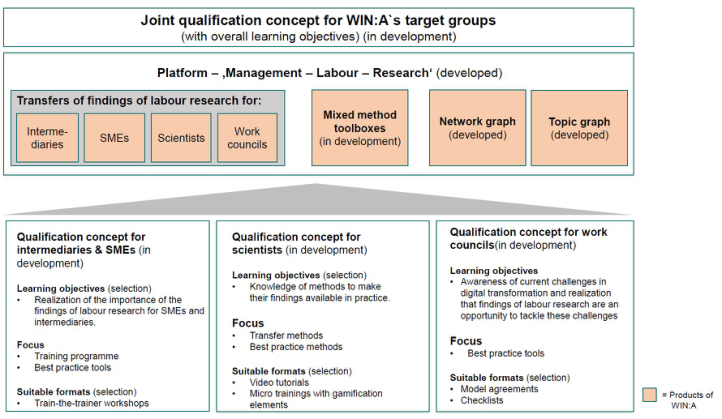
a qualification measure. For an overview of the overall qualification concept of WIN:A (see Figure 1).
Figure 1: Overview of the overall qualification concept and products of WIN:A.
The overview shows the learning objectives and formats of the individual qualification concepts. In this paper, the qualifications of intermediaries and scientists are described in more detail in the following sections.
In order for the different formats to be easily accessible and comprehen- sible for the target groups, their semantics have to be met on the one hand. On the other hand, it is considered useful to provide the possibility for inter- action and participation as it is assumed to foster learning and knowledge transfer.
Platform ‘Management – Labour – Research’ To support the transfer of relevant research findings (such as guidelines, checklists, or implementation tools) to SMEs, WIN:A has developed a software platform, the “Transfer Platform – ‘Management – Labour – Research”’ – with network and topic graphs and target group-specific mixed methods toolboxes.
The network and topic graphs aims to make existing transfer relationships between the competence centres and their partners as well as identified sub- ject areas and research priorities within and outside the competence centre networks transparent, visible, usable and accessible. Further analyses (e.g. density, centrality, cliques, communities) can also be used to identify key stakeholders, activities, subject areas and subgroups. On this basis, initial recommendations for further cooperation and transfer opportunities can be made in a targeted manner at this stage.
Over the course of the project, the agile, expandable transfer platform will serve on the one hand as a central collection point for the content, methods
and concepts developed in the project. On the other hand, the transfer plat- form serves to make the resulting content continuously available to a wide range of operational, intermediary and public stakeholders, even beyond the project. Target group-specific content is prepared with the results of labour research, thus creating a transfer space for the target groups of managers, works councils, consultants and intermediary organisations, which can also be used for the products and services of the ReKodA.
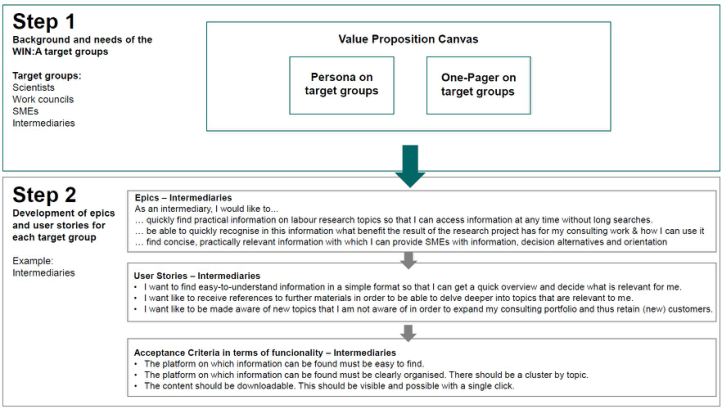
To ensure that the platform is used by the target groups of intermediaries, SMEs, works councils and scientists in the sense of a targeted knowledge transfer, the functionality requirements of the target groups when using the platform was placed at the centre of the platform development at the start of the project as part of different method workshops:
1. Design Thinking Workshop and Value Proposition Canvas to create personas and one pager of the respective target group. 2. Development of epics and user stories.
These methods were already implemented through various workshops with the WIN:A project partners at the beginning of the project and have enabled a structured approach to the individual requirements and needs of the target groups and thus laid the foundation for a human-centred develop- ment of the platform from the perspective of the respective target group (see Figure 2).
Figure 2: Human-centred development of the platform using the example of intermediaries.
The platform not only enables a target group-specific presentation of labour research products, such as guidelines, self-checks or best-practice collections of use cases, but is also part of the qualification concept as an example of best practice. Together with the qualification concepts (see
Human Factors in Technology and Knowledge Transfer 195
following section), this platform with its described sections show, how effec- tive transfer structures differentiated by target groups will help, to process research findings more effectively and disseminate them more successfully.
Qualification Concepts for Intermediary Organisations and Scientific Actors In addition to the Transfer Platform – ‘Management – Labour – Research’ qualification concepts are being developed by WIN:A. These concepts address first and foremost intermediary organisations, e.g social partners, insurance carriers, occupational and industrial unions, government facilities, chambers and guilds or research facilities and scientific actors. In Germany, the Offensive Mittelstand (OM) brings together about 300 of intermediary organisations which employ about 200.000 consultants in different fields of work who interact with SMEs every day. This is why the partners of the OM are one of the main target groups of one the qualification concept, since they already established trustful relationships to SMEs and thus can be seen as a major multiplier regarding the transfer of relevant findings and developments of labour research.
Part of the qualification concept for intermediary organisations is the development of a training guideline which specifies the learning objectives of the qualification.
Main learning goals for the target group of ‘intermediaries’ are:
Realization of the importance of the findings of labour research for SMEs and intermediaries.
Awareness of their current challenges in the digital transformation and realization that the findings of labour research are an opportunity to tackle these challenges.
Getting to know the term “knowledge transfer” in context of WIN:A and realizing the accompanying chances and opportunities.
Learning where and how they can find results of labour research – this includes the usage of the Plattform ‘Management – Labour – Research’ to their interest (see above).
Getting to know the results / products (e. g. guidelines, checklists, or implementation tools) of the ReKodA and WIN:A.
Being able to use the acquired knowledge in SMEs and to communicate the value and the features of the products to their clients.
Being enabled to pass the acquired knowledge to colleagues and SMEs.
In order to communicate the learning objectives and thus reach the aims of the concept, an agenda for the qualification, in form of a workshop, has been developed. The qualification takes 2,5 hours and will mostly be held online. A maximum of 15 participants has been decided to ensure the high quality and the possibility of exchange of experiences. This target group of WIN:A should not only be qualified themselves, but should also be put in a position to qualify actors in their respective peer groups themselves in line with a train-the-trainer approach.
For example, intermediary partners who have undergone the qualification process, serve as multiplier who can then qualify their stakeholders or SMEs – e.g. a national chamber can qualify regional chambers, regional chambers can qualify their colleagues or the SMEs directly.
In terms of quality assurance and to further adapt the mentioned quali- fication/workshop to the needs of the target group, pilot seminars will be conducted in the near future with partners of the Offensive Mittelstand. Due to the high level of trust, the feedback is therefore supposed to be honest and constructive. Even in the ongoing phase of qualification, adaptations can still be made, in order to improve the qualification.
In consideration of their organisational and cultural background, the par- ticipants will receive an overview of labour research and its fields of work (e.g. corporate culture, leadership or safety) as well as the findings gener- ated from it. Furthermore, it is important to demonstrate the applicability and potential benefits of these findings for SMEs and why a group-specific approach is actually needed or how to design it in terms of approach and format.
The WIN:A project follows its own argumentation of addressing specific target groups and also develops a qualification concept for scientific actors. This target group is one of the key players when it comes to developing findings in labour research. However, scientists are faced with the task of proactively communicating their knowledge to SMEs and increasingly need transfer competences in order to be able to actively transfer their design knowledge to SMEs themselves. In practice, however, the transfer of the results of labour research has been organised too little and by too few players in a sustainable manner. There is a clear deficit in the well-founded, continu- ous transfer of knowledge after the end of labour research projects (Cernavin, Goschin, 2023).
In order to tackle these challenges, the Laboratory for Machine Tools and Production Engineering (WZL) of RWTH Aachen University, as the lead part- ner in WIN:A, has extensive knowledge in the implementation of innovative and efficient formats in terms of sustainable and responsible teaching. In this context, the Engineers without Borders Challenge and experience with the realization of gamification and mixed-reality-training units for teachers can be mentioned as examples. The former enables teaching and learning scenar- ios that address technological expertise as well as critical awareness of one’s own actions and social responsibility. Concrete application scenarios exem- plify how the Engineers without Borders Challenge enables “teaching with added value” (Kreutzer, Frye, Bitter-Krahe, Isenhardt, 2020).
The latter can be used to make courses and (self-)learning processes more motivating, appealing and tangible. The aim of gamification is not (only) to entertain, but also to support the achievement learning objectives (Schiffeler, Borowski, Isenhardt, 2020).
Lessons Learned will be incorporated into the development of the WIN:A qualification concept for scientific actors.
The main learning objectives for the target group ‘scientist’ include the following points:
Human Factors in Technology and Knowledge Transfer 197
Knowledge of methods to make their findings available in practice.
Ability to translate findings into the language(s) of different target groups.
Knowledge of the needs of their target groups.
Ability to design research to meet the needs of their target groups.
These objectives will be reflected in the selection of topics for the quali- fication programme (e.g. “target group-adaptive writing and presentation”, “From data to knowledge” or “Difference between transfer from & to sci- ence”), as part of microtrainings, workshops with gamification elements and flipped classroom units with learning videos.
Main goals of the qualifications are to narrow the aforementioned transfer gap and to create effective as well as sustainable personal transfer struc- tures which enable SMEs and their supporters to benefit from the findings of labour research.
For this purpose, target group-specific mixed methods toolboxes will be part of the WIN:A qualification concepts and will be accessible via the Plat- form ‘Management – Labour – Research’ in the form of suitable tools and methods such as, train-the-trainer workshops, didactical concepts, checklists and workshop recordings, to further close the aforementioned transfer gap between research findings and practice.
CONCLUSION
The lack of awareness among SMEs and intermediaries regarding labour research insights continues to be a significant hurdle. A target group-oriented approach and human-centred orientation of products are critical points when it comes to closing the aforementioned transfer gap between labour research and practice.
Therefore, WIN:A focuses on effective knowledge transfer structures and tools to empower scientists, works councils, SMEs, and intermediaries, foster- ing a deeper understanding of labour science results and to demonstrate their added value for practice. Specific qualification for intermediary organisa- tions, scientific actors, SMEs and work councils, as part of effective personal transfer structures, is important to bridge the gap. Supplemented by media transfer structures, such as the mentioned transfer platform with its mixed method tool boxes, the project pursues a holistic, human-centred approach to knowledge transfer.
Some of the media transfer structures have already been developed accord- ing to a human-centred approach. One example is the platform described above, which has been published for around six months. Even if not all of the functions of the platform have been developed yet (see Figure 1), the number of clicks so far shows a promising development.
Still, an evaluation of the WIN:A products by the target groups, as intended in the process of Human Centred Design, has yet to take place.
In the long run, the WIN:A project strives to enhance the impact of labour research on the challenges faced by SMEs through innovative and accessible knowledge transfer mechanisms.
ACKNOWLEDGMENT
The joint project WIN:A (02L19C020 ff.) is funded by the Federal Min- istry of Education and Research as part of the funding measure “Regional Competence Centres for Labour Research” and supervised by the Project Management Agency Karlsruhe (PTKA). The responsibility for this article lies with the authors.
REFERENCES
Abras, C., Maloney-Krichmar, D. & Preece, J. (2004). User-Centered Design. In W. Bainbridge (Hrsg.), Encyclopedia of Human-Computer Interaction. Sage Publications. pp. 445–456. Borowski, E.; Cernavin, O.; Hees, F.; Joerißen, T., ed. (2023). Erfolgreicher
Transfer in der Arbeitsgestaltung - Wie Dienstleistungen zur präventiven Arbeits- gestaltung und Ergebnisse der Arbeitsforschung die Akteure in den Unternehmen wirkungsvoll erreichen. Münster, New York: Waxmann Verlag. Bundesministerium für Bildung und Forschung (2019) Bekanntmachung - Richtlinie zur Förderung von Zuwendungen für den Forschungsschwerpunkt “Zukunft der Arbeit: Regionale Kompetenzzentren der Arbeitsforschung” im Rahmen des FuE-Programms “Zukunft der Arbeit”. https://www.bmbf.de/bmbf/shareddoc s/bekanntmachungen/de/2019/03/2380_bekanntmachung.html. Zugegriffen: 04. September 2023. Cernavin, O., Goschin, K. (2023). Transferkompetenzen Arbeitsforschung. Die
Grundkompetenzen für einen wirkungsvollen Transfer der Ergebnisse der Arbeits- forschung, in: Erfolgreicher Transfer in der Arbeitsgestaltung - Wie Dienstleistun- gen zur präventiven Arbeitsgestaltung und Ergebnisse der Arbeitsforschung die Akteure in den Unternehmen wirkungsvoll erreichen, Borowski, E.; Cernavin, O.; Hees, F.; Joerißen, T. (Ed.). pp. 153–172. Cernavin, O., Joerißen, T. (2022). Arbeitsforschung in der KMU-Praxis - Untersuchungsergebnisse zum Transfer von Kompetenzzentren Arbeitsforschung in der Region, Stiftung Mittelstand Gesellschaft Verantwortung, Schriftenreihe 1 8/2022. Eck, C., Borowski, E., Hees, F. (2023). Transferakteure – eine strukturelle Über-
sicht, in: Erfolgreicher Transfer in der Arbeitsgestaltung - Wie Dienstleistungen zur präventiven Arbeitsgestaltung und Ergebnisse der Arbeitsforschung die Akteure in den Unternehmen wirkungsvoll erreichen, Borowski, E.; Cernavin, O.; Hees, F.; Joerißen, T. (Ed.). pp. 137–152. Icks, A. (2023). Wissenstransfer in kleinen und mittleren Unternehmen (KMU), in: Erfolgreicher Transfer in der Arbeitsgestaltung - Wie Dienstleistungen zur präventiven Arbeitsgestaltung und Ergebnisse der Arbeitsforschung die Akteure in den Unternehmen wirkungsvoll erreichen, Borowski, E.; Cernavin, O.; Hees, F.; Joerißen, T. (Ed.). pp. 75–82. Kreutzer, D., Frye, S., Bitter-Krahe, J., Isenhardt, I. (2020). Lehre mit Mehrw-
ert – Die Ingenieure ohne Grenzen Challenge, in: Lehren und Lernen in den Ingenieurswissenschaften, Isenhardt, I. et. al. (Ed.). pp. 219–232. Leisten, I. (2012). Transfer Engineering in transdiziplinären Forschungsprojekten.
Norderstedt: Books on Demand. Miaskiewicz, T. & Kozar, K. (2011). Personas and user-centered design: How can personas benefit product design processes? Design studies, 32(5), pp. 417–430. Schiffeler, N., Borowski, E., Isenhardt, I. (2020). Gamification und Mixed-Reality-
Training für Lehrende – mehr als nur spielen, in: Lehren und Lernen in den Ingenieurswissenschaften, Isenhardt, I. et al. (Ed.). pp. 253–276.
LISTED IN THE AHFE DIGITAL BOOKSTORE CATALOGUE
Explore the complete digital volume
Human Factors and Systems Interaction
Read this individual research paper free through the original publisher, or explore the full digital proceedings book.
ISBN 978-1-964867-30-4
Explore this ISBN in the AHFE Bookstore ↗Listed in the July 2026 bookstore catalogue; search by ISBN to confirm current availability · Digital book purchase optional