Markus Sihvonen (2024). Hybrid Intelligent in Logistic System for Recycling Centre. In: Advances in Human Factors of Transportation. AHFE Open Access, vol. 148, pp. 598–603. https://doi.org/10.54941/ahfe1005251
A realization of intelligent logistic system for a recycling center requires utilization of very latest information and communication technologies. Therefore, versatile technology framework and adapting data-driven solutions to optimize collection, transportation, and processing of recyclable materials is needed. The key components in building the technology framework for enabling intelligent, intelligent logistic recycling service are robust communication platform, reliable vehicle and asset tracking system and AI (Artificial Intelligent) enabled data analysis and management platform. The communication platform facilitates collaboration between stakeholders including recycling company, transportation company, waste management company and local government. Its purpose is to improve information flow and coordination between stakeholders. The vehicle and asset tracking system provides means to monitor and manage various assets and fleet of vehicles operating in the recycling area, which can be fully autonomous or driven by professional drivers. The data provided by the vehicle and asset tracking system must be acquired, analyzed and used for decision making efficiently in real time. The data analysis and management platform store all the data needed for operating intelligent logistic service of a recycling center. It utilizes existing IoT (Internet of Things) technologies and the communication platform. AI solutions are used for analyzing the collected data for further use to provide services for the users of the system. The research question is to how to design Hybrid Intelligent (HI) logistic system for recycling center in MORE industrial park that enables 24/7 autonomous recycling service for companies? The recycling center’s autonomous service is aimed for companies that have need to store larger quantities of various materials for recycling and further use in future. The key requirements from a client’s point of view are 24/7 access to recycling area, safe and secure material storage facility and efficient operations in recycling area. Safety, security and reliability of services in recycling center are particularly important when the center’s operating personnel are not present and available. This is also primary concern for the recycling center operator. The asset and vehicle tracking system must monitor and manage all vehicles in the recycling area regardless who is driving it, human or AI. Therefore, the system must consider human input and learn to manage autonomous traffic to provide support for human activities in the recycling area. The paper proposes a design solution for a smart autonomous recycling service that utilize HI logistic system.
Hybrid Intelligent in Logistic System for Recycling Centre 599
INTRODUCTION
The MORE industrial park’s recycling center’s 24/7 use it yourself autonomous service is aimed for companies that have need to store larger quantities of various materials for recycling and further use in future. The key requirements from a client’s point of view are 24/7 access to recycling area, safe and secure material storage facility and efficient operations in recycling area. Safety, security and reliability of services in recycling center are partic- ularly important when the center’s operating personnel are not present and available. This is also primary concern for the recycling center operator. The asset and vehicle tracking system must monitor and manage all vehicles and assets in the recycling area regardless who is driving or using them, human or AI. Therefore, the system must consider human input and learn to manage autonomous traffic to provide support for human activities in the recycling area.
Obvious benefits are increased efficiency, lower of the operations and dramatically enhanced customer service. A 24/7 a round-the-clock auto- matic operations lower operating expenses due to a need of very minimally required personnel that only intervene in system’s error situations. All this leads to increased productivity of a recycling plant. Also, safety is enhanced by reducing human involvement in potentially hazardous environment.
Unfortunately, initial investment costs for needed technology solutions can be relatively high such as acquiring autonomous vehicles. Some of the needed technology investments can be allocated practically for all recycling area operations such as communication infrastructure. Some challenges are related to the needed custom-made AI and machine learning algorithms required to ensure safe and efficient automated recycling operations. They can be very expensive and initial solutions most likely will need further enhancements. Also new technology solutions will need continuous updates maintenance.
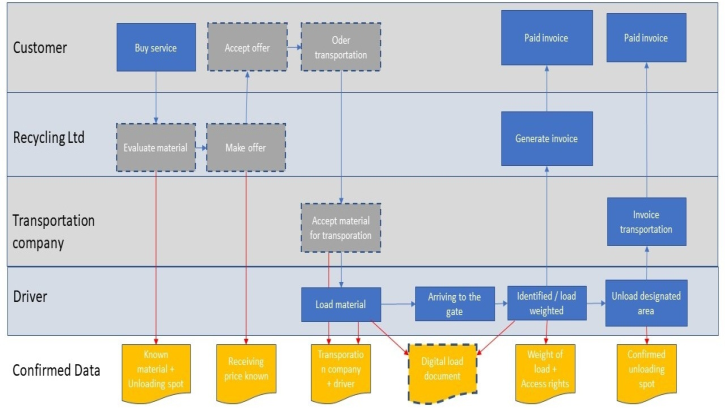
SYSTEM REQUIREMENTS The most attractive feature in the autonomous logistic system for the recy- cling centre is 24/7 services availability for clients. A demand for the service at late evening or very early morning hours do exist but it is not high enough to justify human service operators’ presence. This is true also for weekends and holidays. Therefore, from the recycling centre’s perspective the service must be fully capable automated operations. The Figure 1 describes all stages for a customer in a service process from buying a service, unloading materials and completing the transaction in paid invoice.
A customer should be able to buy a requested service from the internet at any time without any human assistance. Therefore, the recycling centre must offer web store with AI assistant to provide ordering service to customers. At this point a customer must indicate type and quantity of material to be transported to the recycling centre. A customer must be securely identified and a need for service in calendar days is estimated by a customer. Based on a given data, the system will generate offer for the customer for acceptance as indicated in the Figure 1.
600 Sihvonen
Once a customer’s contract has been fully completed, a customer must make transportation agreement on the agreed material with any suitable transportation company. Once a customer has secured transportation agree- ment, a transportation company information is added to the system by a customer. The required information is license numbers of all trucks to be used for transporting the agreed material in the contract and names and mobile phone numbers of all possible drivers for these trucks. This information is used for grant access rights for drivers and trucks to the recycling area, when they arrive to the gate of the recycling centre. At the gate also weight of the load is measured as well as composition of the material is evaluated against the agreed contract by the system. Based on the collected data at the gate, the digital load document is created by the system and sent to all required parties. This data is also used ultimately to generate invoice based on agreed invoicing interval. After cess to the area is granted, the system guides a driver inside recycling centre to the correct unload zone for the material and moni- tors unloading process. Information of unloading the material is available for the customer and transportation company and it may be also used as basis for the transportation company to invoice the customer.
Figure 1: The state diagram.
SYSTEM ARCHITECTURE A communication platform facilitates collaboration between stakeholders in MORE industrial park’s recycling centre including recycling company, transportation company, waste management company and local govern- ment. Its purpose is to improve information flow and coordination between these stakeholders. Therefore, a multimodal communication infrastruc- ture solution should be in place to ensure high quality service for all parties.
Hybrid Intelligent in Logistic System for Recycling Centre 601
The back bone of the communication infrastructure is optical fiber with equipped with an uninterruptible power supply (UPS) solution for the net- work equipment. The 4G and 5G cellular mobile networks are complement- ing optical fiber but they do not offer extra robustness since cellular mobile networks require optical fiber to function. Instead, it provides flexibility for installing multiple data collection devices to the premises. Also, network tech- nology designed particularly for IoT devices that builds on existing network infrastructure is needed. The LTE-M full fill that specific requirement and it is also a LPWAN (Low-power wide-area network) solution. It is built on top of 4G LTE cellular network and it is specifically meant for to be used by IoT applications. It has high data rates all the way up to 1Mbs, which enables variety of mobility use cases. Particularly, it is very good for mobility use cases that require real-time or near-real-time data transfer capa- bilities. It also has encryption capabilities, authentication function to secure data and prevent unauthorized access to the system (Sihvonen and Takala, 2023). Only on top of the robust communication platform, it is possible to build a reliable vehicle and asset tracking system. Vehicles and assets are possible to be track via active or passive system. An active asset management system is capable of real-time monitoring and tracking of assets or vehicles through devices that have their own power source, own communication means and they actively transmit data to the communication platform. Example of such a device is dedicated GPS tracker or mobile phone that has application that communicates with the platform. Active tracking systems are particularly useful in scenarios where assets or vehicles are need to be tracked over long distances or in real-time (Khalid and Ejaz, 2022).
A passive asset or vehicle tracking system utilizes solutions that are not attached necessary to tracked asset or vehicle. The required data for the passive system can be collected via multiple IoT sensors installed into the premises. The collected data needs to be analysed, usually via AI solution, to draw any conclusions about geological positions of the assets or vehicles. Another possibility is to utilise passive RFID (Radio Frequency Identifi- cation) solution where IoT sensors do not have an internal power source to operate. Instead, they actively transmit data when external source ini- tiates a communication. Passive IoT sensors are usually cheaper, their life span is often multiple years and they can be very small in size (Wei et al., 2013). All collected tracking and mobility data from the recycling area must be stored and analysed. Therefore, that platform must function as data repos- itory. It must have needed interfaces to utilise all available AI enabled data analysis services. Based on the data and its analysis, required services for parties involved in recycle centre’s operations are provided. The vehicle and asset tracking system provides means to monitor and manage various assets and fleet of vehicles operating in the recycling area, which can be fully autonomous or driven by professional drivers. The data provided by the vehi- cle and asset tracking system must be acquired, analysed and used for decision making efficiently in real time.
602 Sihvonen
A HYBRID INTELLIGENCE A hybrid intelligent generally refers to a system or a solution that utilises var- ious types of AI techniques to achieve the best possible result. By combining various AI techniques, aim is to utilise strengths of individual AI techniques while overcoming their individual weaknesses. The goal is to make a system that is more efficient, accurate, and robust than a system that is based on a single AI technique. Benefits of utilising various AI technologies that can be easily achieved are enhanced operational efficiencies, savings, better customer satisfaction and easier adaptation of sustainable principles and practices to logistic operations (Khayyam et al., 2020). Examples of AI enhance customer services are dynamic pricing schemes and automated 24/7 chat bot services.
A hybrid AI in logistics intends to optimize and even revolutionize sup- ply chain for all industry segments. This includes solutions for complex modern transportation system challenges such as transportation efficiency, safety, accessibility and sustainability. A demand forecasting helps in inven- tory management by avoiding stockouts and overstock situations. Traffic management and prediction solutions can manage automated warehouse operations, including controlling automated vehicles and robots. Delivery routes can be optimized based on multiple factors such as efficiency, fuel consumption and in human driver case driving regulations. Hybrid AI solu- tion can factor in multiple external conditions such as local weather and weather forecast, fuelling stations’ locations and predicted traffic patterns. These capabilities enable dynamic route planning and therefore avoid poten- tial congestions and bottlenecks on route. At the global scope Hybrid AI can factor in additional meaning full variable to the logistic panning such as geopolitical events, market trends and suppliers’ reliability (Zhao et al., 2015). These benefits achieved via hybrid AI system, can be used managing logistic operations of the recycling centre 24/7 for the benefit of its clients.
Autonomous Vehicles (AVs), that are practically AI managed robots, utilise data from multiple sensors that are analysed various decision-making algo- rithms. This enables AVs to navigate complex environments safely and efficiently. Predictive maintenance solutions guarantee operational robust- ness of AVs as well as transportation infrastructure utilised by multiple types of logistic robots and AVs. A great concern of automated transportation sys- tems is to guarantee safety of Vulnerable Road Users (VRUs). Aim is to better understand and predict pedestrian, cyclist and motorcyclist movements in order to avoid collisions. Therefore, particularly safety systems will utilise hybrid AI to identify high-risk areas and enable preventive measures for accidents in the recycling centre.
CONCLUSION
The utilization of autonomous 24/7 services including autonomous vehicles in recycling processes enable a significant progress in efficiency and effec- tiveness recycling operations. This is achieved via advanced technologies such as artificial intelligence, sophisticated sensors and human to AI interac- tion. Since human decision making and actions will be part of the recycling operations at least for next decade, hybrid intelligent recycling operations
Hybrid Intelligent in Logistic System for Recycling Centre 603
must consider vulnerable parties in the system. Therefore, the research ques- tion, how to design Hybrid Intelligent (HI) logistic system for recycling centre in MORE industrial park that enables 24/7 autonomous recycling service for companies, must also consider safety of vulnerable parties, us humans, in the system.
Fast communication infrastructure with in the recycling facility enhances greatly safety of the area. This is because, AI that monitors safety of the area requires real time data for efficient operations. Fast moving autonomous vehicles and drones should have 5G or Wi-Fi 7 (Wi-Fi certified 7) capabili- ties. AI must also have capabilities to recognize reliably humans operating in the area either via passive or active tracking system. This is the case for all equipment in the area as well. Optical fibre solution for stationary equipment is optimal due its robustness. For non-critical safety data collection any com- mercial IoT network solution would be sufficient. It would be cost effective to use IoT solution that utilizes existing communication network infrastructure such as 4G or 5G cellular network (Gosh et al., 2015).
The autonomous recycling centre’s system architecture must support third- party services and provide interface for data exchange between other third- party systems. This feature is essential creating the ecosystem needed for recycling operations. The functioning business ecosystem ultimately enables round-the-clock recycling operations and as a result it dramatic increase in productivity of the recycling plant.
REFERENCES
Ghosh. A, Maeder. A, Baker. M, Chandramouli. D, “5G Evolution: A View on 5G Cellular Technology Beyond 3GPP Release 15,” in IEEE Access, vol. 7, pp. 127639–127651, 2019, doi: 10.1109/ACCESS.2019.2939938. Khayyam, H. et al., “A Novel Hybrid Machine Learning Algorithm for Limited and
Big Data Modeling with Application in Industry 4.0,” in IEEE Access, vol. 8, pp. 111381–111393, 2020, doi: 10.1109/ACCESS.2020.2999898. Reda Khalid, Waleed Ejaz, “Internet of Things-based On-demand Rental Asset Tracking and Monitoring System”, 2022 5th International Conference on Infor- mation and Computer Technologies (ICICT), pp. 84–89, 2022. Sihvonen. M., Takala H., (2023, October 2–4). A zero-emission solution for a smart
mobility hub. 10th International Conference on Energy and Sustainability, Lisbon, Portugal, October 2–4, 2023. Wei. Z, Zhang. Y, Yang. J, “Confidential assets management system based on RFID and cloud computing”, 2013 3rd International Conference on Consumer Electronics Communications and Networks, pp. 198–196, 2013. Wi-Fi certified 7. https://www.wi-fi.org/discover-wi-fi/wi-fi-certified-7 Zhao. Z, Ding. W, Wang. J, Han. Y, “A Hybrid Processing System for Large-
Scale Traffic Sensor Data,” in IEEE Access, vol. 3, pp. 2341–2351, 2015, doi: 10.1109/ACCESS.2015.2500258.
LISTED IN THE AHFE DIGITAL BOOKSTORE CATALOGUE
Explore the complete digital volume
Advances in Human Factors of Transportation
Read this individual research paper free through the original publisher, or explore the full digital proceedings book.
ISBN 978-1-964867-24-3
Explore this ISBN in the AHFE Bookstore ↗Listed in the July 2026 bookstore catalogue; search by ISBN to confirm current availability · Digital book purchase optional