Peter Starchon, Milos Hitka, Milos Gejdos, Andrej Miklosik (2024). Evolving Anthropometric Traits of Slovak Consumers and Their Impact on Furniture and Furniture Marketing. In: Human Factors, Business Management and Society. AHFE Open Access, vol. 135, pp. 198–208. https://doi.org/10.54941/ahfe1004946
The current development of anthropometric data in the Slovak population, noticeable in the area of increasing average height and weight, is expected to have an impact on furniture production and furniture marketing. This contribution is based on selected changes in anthropometric characteristics of the Slovak population between 1993 and 2023, recorded on a sample of more than 15,000 respondents—university students in Slovakia. The paper itself directly derives from the identified changes, with the aim of providing an overview of the current consumer demands for furniture industry products and their expectations regarding furniture marketing, primarily in the area of beds, mattresses, and chairs made of wood, based on the results of primary research. The research methodology was based on a combination of qualitative and quantitative research. The primary quantitative research was conducted through an online questionnaire survey with a sample of 1000 respondents at the turn of 2022 and 2023 (with a follow-up currently underway in late 2023/early 2024), and qualitative research using focus group interviews was conducted in December 2023 with a total of 18 participants.Even though the current results indicate that consumers are generally satisfied with the furniture product portfolio, considering the global trend of increasing obesity in the population, it is meaningful to invest in the development of furniture with higher load capacity. The most significant gap in the market was identified in the product categories of chairs and office chairs. Another product category is represented by beds, which, while available in the desired quality, face challenges with higher prices and a limited range. Additionally, the lack of a range of wooden bed slats that have durability was observed. Also due to the increasing average weight as well as height of consumers, changes in standardised bed sizes and weight limits are required. In the case of mattresses, the market offer fully reflects consumer expectations, considering both the increasing average weight and height. Concerning furniture marketing, increased attention from sellers should focus on enhancing transparency and providing information about the weight capacity of furniture, material structure, durability, and the possibility to try out furniture in person. Negative consumer experiences in furniture purchases have been noted in relation to the knowledge and advisory capabilities of salespersons in assisting with furniture selection. This research was supported by the project APVV-20-0004 The Effect of an Increase in the Anthropometric Measurements of the Slovak Population on the Functional Properties of Furniture and the Business Processes.
Evolving Anthropometric Traits of Slovak Consumers and Their Impact 199
INTRODUCTION
Bariatric furniture is suggested for highly obese individuals. It requires specialised comfort for users. This furniture can be made of a variety of materials; mostly, it is made of metal. Considering the need for sustainability and carbon footprint reduction, using natural materials for manufacturing is advisable. Wood, a unique organic material with broad applicability in interior design, is a functional, practical, and decorative material Kaplan (1995); Salingaros (2015). Incorporating wood and its elements into homes, workplaces, as well as medical and hospital facilities positively impacts the physical and mental health of the users of this furniture. It positively affects users’ physical and psychological health (Kotrady et al., 2019). The mean height of individuals in developed nations has risen in recent years (Sedmak & Hitka, 2004). Numerous studies have delved into quantifying this shift. According to (Hauspie et al., 1997), in the last decades of the 20th cen- tury, the average height in Southern and Eastern Europe increased by 3 cm per decade. The increase in height observed today is primarily attributed to advancements in socioeconomic conditions, as noted by Styne and McHenry (Styne & McHenry, 1993). Concurrently, global concerns about obesity are escalating. Humanity is also experiencing an increase in weight, with the prevalence of obesity doubling since 1980, as reported by Fox (Fox, 2017). While comprehensive data on the average weight trends across countries are scarce, available studies on obesity and BMI suggest a likely increase. Obe- sity has emerged as a significant global health issue, with the number of obese individuals surging by nearly 300% since 1975 (World Health Organization, 2021). Changes in height and weight necessitate corresponding furniture design adjustments, as Langova et al. (2019) and Mokdad and Al-Ansari (2009) emphasised.
This paper aims to define the interaction of the evolving anthropomet- ric dimensions of Slovak consumers and furniture production for bariatric respondents in the context of furniture sales marketing.
MATERIAL AND METHODS The evolution in people’s physical attributes necessitates a corresponding adaptation in furniture design to cater to the preferences of contemporary consumers (Langova et al., 2019; Lizbetin, 2018). The research illustrates the significance of certain anthropometry-based ergonomics principles in the realm of sustainable design (Nadadur & Parkinson, 2013). Beds and mattresses, being integral components of furniture design, require special attention as they must align with the varying height and weight of users to ensure comfort and a restful night’s sleep. Despite this crucial considera- tion, the current standards outlined in the European Union EN 12520 (CEN, 2015) primarily employ a weight threshold of 110 kg to evaluate the strength, durability, and safety of household furniture (Furnitest, 2022). Notably, while some researchers concentrate on examining the impact of anthropo- metric data on mattress design (Shore et al., 2019), investigations exploring the repercussions of increased consumer weight and size on mattress design remain noticeably absent.
The global prevalence of obesity is increasing. All higher-income countries have higher levels of overweight and obesity (NCD Risk Factor Collabora- tion). The rising prevalence of overweight and obesity puts a financial burden on the economy of each country. Obesity is defined by the World Health Organization (WHO) as a disease that affects socioeconomic status. Dee et al. (2014) concluded that there is a gradient between increasing BMI and direct healthcare costs and indirect costs due to reduced productivity and early pre- mature mortality. According to the World Health Organization (2020), 650 million adults worldwide were obese in 2016 (body mass index BMI of at least 30 kg/m2), with trends increasing (World Health Organization, 2020). Bariatric furniture needs to meet increased weight-bearing requirements com- pared to standard furniture. It must have sturdy and strong frames that are made to support responders with high weight. Bariatric furniture is designed for large people, including overweight and obese people (Wiggermann et al., 2017). Considering the long-term secular trend of the Slovak population observed in the works (Hitka, Gejdos, 2022, Hitka et al., 2023), it is possible to state the need to produce hubs for bariatric respondents.
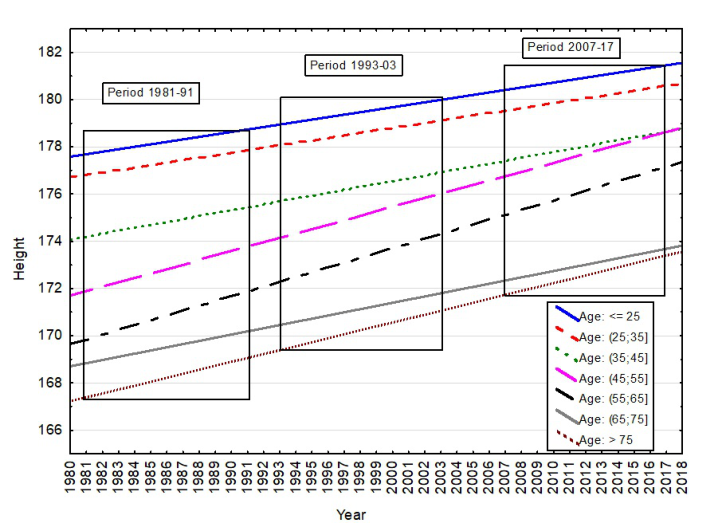
Figure 1: Secular height trends men in different age categories and their impacts on height size in selected time periods (rectangles display the three compared periods, the displayed trends for this period were obtained by backward extrapolation of linear models parametrised on measurements from 1993–2017) (Hitka et al., 2018).
Evolving Anthropometric Traits of Slovak Consumers and Their Impact 201
Table 1. Secular trends in height (authors’ compilation).
Table available in the original PDF paper.
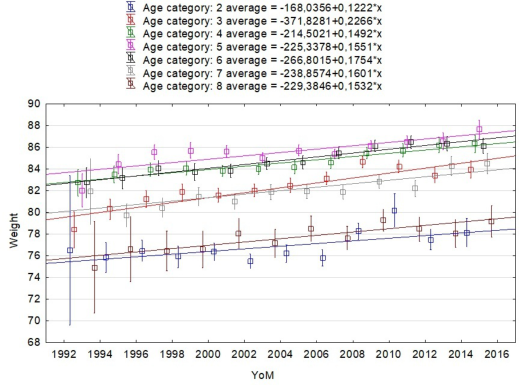
Age Linear Regression Model Overall Significance Category Slope St.error p-Level F p-Level
Due to the analysis of the bariatric population of Slovakia without gender distinction, data on the weight of bariatric respondents in healthcare facilities
were collected between 2020 and 2024. Weight, height, waist, hip and sit- ting width values were collected. Subsequently, BMI values were defined. Descriptive statistics are presented in Table 3.
Table 3. Descriptive statistics of bariatric respondents in Slovakia (own research).
FURNITURE AVAILABILITY FOR ABOVE AVERAGE HEIGHT OR WEIGHT INDIVIDUALS Consumers frequently aim to strike a balance between comfort and support, recognising that individual preferences can vary significantly, as highlighted by Chotimah et al. (2019). Appreciating these subtleties is essential for fur- niture manufacturers, enabling them to craft products that accommodate diverse consumer preferences, as emphasised by Dautovich et al. (2022). The functions of smart furniture should prioritise convenience and the ability to adjust to individual anthropometrics and kinesiology, considering factors such as age and safety (Papadopoulos et al., 2016). The design and manufac- turing of furniture construction in Slovakia often overlook overweight users (Reh et al., 2019, Louˇcanová et al., 2022). This oversight extends beyond simply ensuring furniture durability, particularly concerning beds and mat- tresses, as it can impact sleep quality and, consequently, overall quality of life (Zhang et al., 2021).
The research of Miklosik et al. (2022). investigated whether Slovak con- sumers, especially those who are taller or heavier, can readily find and obtain suitable mattresses. Their study involved analysing the product offerings of mattress retailers in Slovakia to assess whether they align with the require- ments of the present population and include products suitable for individuals with larger body sizes. Most retailers (70%) exclusively offer mattresses with a standard length of 200 cm. However, for taller individuals, this length may not be adequate (Miklosik et al., 2022). 87% of retailers provide at least one
Evolving Anthropometric Traits of Slovak Consumers and Their Impact 203
mattress option suitable for users weighing 120 kg. For customers weighing 130 kg, a good selection is still available, with 83% of retailers offering mat- tresses that accommodate their weight. Additionally, mattresses designed for customers weighing 140 kg can be found at 73% of retailers, while those catering to individuals weighing 150 kg are available at 67% of retailers (Miklosik et al., 2022).
The research conducted by Hitka et al. (2024) examined consumer per- spectives and attitudes towards the availability of beds and mattresses, focusing on two key aspects: length and weight capacity. The findings confirm that, generally, consumers are satisfied with the range of furniture products on offer, especially when it comes to beds and mattresses. Additionally, their study revealed that individuals with above-average height and weight advo- cate for and require adjustments to the standardised sizes and weight limits of beds Hitka et al. (2024).
RESULTS AND DISCUSSION
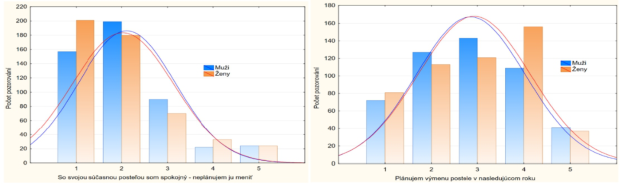
The sample of respondents was presented with a total of 28 questions. Pri- ority was given to analysing responses related to the subject of interest, specifically concerning the necessity for expanding standard bed dimensions and load capacity. Questions pertaining to the need for beds and their dimen- sions were prioritized for analysis. Figure 3 shows the evaluation of the survey on whether customers plan to replace their beds shortly. The response categories were graded into five levels (1 - completely agree, 2 - rather agree, 3-rather disagree, 4 - completely disagree and 5 - don’t know the answer). The sample of respondents was stratified by gender. The research results clearly show that most respondents are not planning to replace their bed furniture soon and are satisfied with it. Approximately 8% of the respondents could not comment on this question. The research also shows that men are slightly more likely to change their bed furniture shortly.
Figure 4 also assesses respondents’ satisfaction with their current bed fur- niture’s dimensions and load capacity. Most are satisfied with the current dimensions and load capacity and plan to keep their bed the same due to these parameters. Approximately 4% of respondents were again unable to com- ment on the question. Again, men expressed dissatisfaction with the survey’s current dimensions and willingness to change.
Figure 3: Evaluation of customer research plan with bed furniture change (1-totally agree, 2-somewhat agree, 3-somewhat disagree, 4-totally disagree, 5-do not know how to answer).Figure 4: Evaluation of the survey on the adequacy of the dimensions and load capacity of the current beds of each respondent (1-totally agree, 2-somewhat agree, 3-somewhat disagree, 4-totally disagree, 5-do not know how to answer).
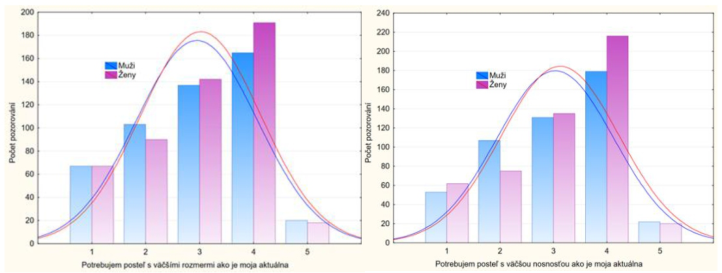
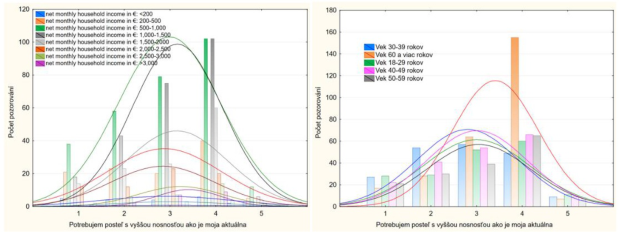
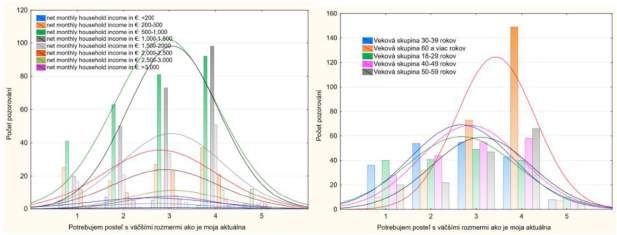
It is also interesting to evaluate customer satisfaction with the load capacity and dimensions of bed furniture depending on the respondents’ net household income and age groups (Figures 5 and 6).
Figure 5: Evaluation of the research on customers’ satisfaction with the carrying capac- ity of bed furniture by net household income and age group (1-totally agree, 2-totally agree, 3-totally disagree, 4-totally disagree, 5-do not know how to answer).Figure 6: Evaluation of the research on customer satisfaction with bed furniture dimen- sions by net household income and age group (1-totally agree, 2-tend to agree, 3-tend to disagree, 4-totally disagree, 5-do not know how to answer).
Evolving Anthropometric Traits of Slovak Consumers and Their Impact 205
Satisfaction with the current carrying capacity of owned bed furniture is overwhelmingly expressed by all income groups. The need for a higher load capacity is most frequently expressed by respondents whose net household income is between 500–1500 €. These two groups also dominate in satis- faction with the current load capacity. Interestingly, even households with a net income above €3000 are more likely to be satisfied with their current beds, both in terms of load capacity and dimensions. Satisfaction with both the load capacity and dimensions of current bed furniture is more likely to be expressed by the higher age groups. The need for beds with higher load capac- ity and dimensions is expressed more by the 18–29 and 30–39 age groups. The 40–49 age group is more likely to express satisfaction with the current situation in moderate proportions.
The findings presented in the paper shed light on the evolving anthropo- metric parameters of the Slovak population and, notably, how these changes influence consumer preferences and behaviour. It is confirmed that, over- all, consumers express satisfaction with the range of bed furniture products available, including specific beds offered. This aligns with the conclusions drawn in Miklosik et al.’s study (2022), which highlighted the presence of beds and mattresses tailored for taller and heavier individuals in the Slovak e-commerce market.
The results indicate that as height increases, there is a growing endorse- ment for two propositions: i) The need to modify currently standardised furniture dimensions; ii) The suggestion to increase the standard bed length from 200 cm.
Despite consumer preferences not aligning with these propositions, they find support in the analysis of the evolving anthropometric dimensions of the adult population. This supports the call by academics and practitioners for changes to EN 12520:2015 to use weights above 110 kg when assessing the strength, durability and safety of domestic furniture (Furnitest, 2022).
Our study has several implications. The theoretical implications have been demonstrated by either confirming or extending the results of several research studies. There are managerial implications for furniture manufacturers and furniture retailers who can understand the differences in Slovak consumers’ attitudes towards specific furniture parameters concerning their gender, edu- cation and anthropometric parameters and thus adapt their product portfolio to current consumer preferences. Finally, there are implications for poli- cymakers from our study, particularly the recommendation to increase the weight limit set for home furniture testing in the current European standard EN 12520:2015.
CONCLUSION
The right furniture dramatically impacts the quality of life of its users. At the same time, it significantly contributes to a person’s psychological and phys- ical well-being. Bed and seating furniture play an important role in human life. Whether it is a bed in the bedroom or the children’s room where we go to sleep every night, or whether it is a chaise lounge or a sofa in the living room or other types of bed furniture, they are all there for us to recharge
our batteries and indulge in some much-needed rest. Also, a comfortable and safe chair impacts a person’s work performance. Therefore, it is necessary to keep a strict eye on the safety, strength, and design characteristics so that the functionality of the furniture contributes to comfort through proper shaping and other features and not the other way around.
ACKNOWLEDGMENT
APVV-20-0004 The effect of an increase in the anthropometric measure- ments of the Slovak population on the functional properties of furniture and the business processes, KEGA 012UCM 4/2022 Human Resources Manage- ment in a Digital World – A Bilingual (Slovak-English) Course Book with E-learning Modules based on Multimedia Content, APVV-22-0001 Opti- mization of main health and safety risks in the use of forest biomass for energy purposes and KEGA 004TU Z-4/2023 Innovative methods for assessing the quality potential of forest stands.
REFERENCES
CEN. (2015). EN 12520:2015 - Furniture - Strength, durability and safety - Requirements for domestic seating. Brussels: CEN-CENELEC Management Centre. Available at: https://standards.iteh.ai/catalog/standards/cen/8129f489-0b1b-48c 1-bb30-08b7997e42da/en-12520-2015. Chotimah, C., Baktiono, A., & Damayanti, E. (2019). Analysis of customer satisfac-
tion of Kingkoil mattress products based on customer perception using importance performance analysis (IPA). Journal of World Conference, Volume 1, No. 2, pp. 189–199. Dautovich, N. D., Dzierzewski, J. M., & MacPherson, A. (2022). Bedroom environment and sleep health. In: Foundations of Sleep Health, pp. 239–264. Dee, A., Kearns, K., O’Neill, C., Sharp, L., Staines, A., O’Dwyer, V., Fitzgerald, S., &
Perry, I. J. (2014). The direct and indirect costs of both overweight and obesity: a systematic review. BMC Research Notes, Volume 7, No. 1, 242. Available at: https://doi.org/10.1186/1756-0500-7-242. Fox, M. (2017). The whole world is getting fatter, study finds. NBC News. Available at: https://www.nbcnews.com/health/health-news/whole-world-getting-fatte r-study-finds-n771176. Furnitest. (2022). EN 16139:2013. Available at: https://furnitest.com/testing/furnit
ure-testing/standards/en-16139-2013-en-161392013ac2013/. Hauspie, R. C., Vercauteren, M., & Susanne, C. (1997). Secular changes in growth and maturation: An update. Acta Paediatrica, 86 (S423), pp. 20–27. Hitka, M., Gejdoš, M. (2023). Secular trend of stature height and body weight and
body mass index of the Slovak population in the years 1965–2022 - observational study. Anthropologie: International Journal of Human Diversity and Evolution, Volume 61, No. 2, pp. 191–201. Hitka, M., Miklošík, A., Gejdoš, M., & Štarchoˇn, P. (2024). Insights into consumer preferences and purchasing behaviour for wooden bed furniture in Slovakia. Journal of Retailing and Consumer Services, Volume 76. Available at: https: //doi.org/10.1016/j.jretconser.2023.103613. Hitka, M., Naˇd, M., Langová, N., Gejdoš, M., Lizoˇnová, D., Sydor, M. (2023).
Designing chairs for users with high body weight. BioResources, Volume 18, No. 3, pp. 5309–5324.
Evolving Anthropometric Traits of Slovak Consumers and Their Impact 207
Hitka, M., Sedmák, R., Jošˇcák, P., Ližbetinová, L. (2018). Positive secular trend in Slovak population urges on updates of functional dimensions of furniture. Sus- tainability, Volume 10, No. 10, 3474. Available at: https://doi.org/10.3390/su 10103474. Kaplan, S. (1995). The restorative benefits of nature: Toward an integrative frame-
work. Journal of Environmental Psychology, Volume 15, No. 3, pp. 169–182. Available at: https://doi.org/10.1016/0272-4944(95)90001-2 Kotradyová, V., Vavrinský, E., Kaliˇnáková, B., Petro, D., Jansáková, K., Boleš, M., & Svobodová, H. (2019). Wood and its impact on humans and environment qual- ity in health care facilities. International Journal of Environmental Research and Public Health, Volume 16, No. 18, 3496. Available at: https://doi.org/10.3390/ij erph16183496. Langova, N., Reh, R., Igaz, R., Kristak, L., Hitka, M., & Joscak, P. (2019). Con-
struction of wood-based lamella for increased load on seating furniture. Forests, Volume 10, No. 6. Available at: https://doi.org/10.3390/f10060525. Lizbetin, J. (2018). Decision-making processes in introducing RFID technology in manufacturing company. Nase More, Volume 65, No. 4, pp. 289–292. Louˇcanová, E., Olšiaková, M., Paluš, H. (2022). Perception of supplied furni-
ture and its innovation by Slovak customers. Acta Facultatis Xylologiae Zvolen, Volume 64, No. 1, pp. 113–121. doi: 10.17423/afx.2022.64.1.10. Miklosik, A., Starchon, P., Kocisova, L., & Hitka, M. (2022). Anthropometric data importance in furniture design and marketing. Agriculture & Forestry, Volume 68, No. 3, pp. 277–284. Mokdad, M., & Al-Ansari, M. (2009). Anthropometrics for the design of Bahraini
school furniture. International Journal of Industrial Ergonomics, Volume 39, No. 5, pp. 728–735. Available at: https://doi.org/10.1016/j.ergon.2009.02.006. Nadadur, G., & Parkinson, M. B. (2013). The role of anthropometry in designing for sustainability. Ergonomics, Volume 56, No. 3, pp. 422–439. Available at: https: //doi.org/10.1080/00140139.2012.718801. NCD Risk Factor Collaboration (NCD-RisC). (2019). Rising rural body-mass
index is the main driver of the global obesity epidemic in adults. Nature, 569, pp. 260–264. Available at: https://doi.org/10.1038/s41586-019-1171-x Papadopoulos, I., Trigkas, M., Karagouni, G., Papadopoulou, A., Moraiti, V., Tripolitsioti, A., & Platogianni, E. (2016). Market potential and determinants for eco-smart furniture attending consumers of the third age. Competitiveness Review, Volume 26 No. 5, pp. 559–574. Available at: https://doi.org/10.1108/CR -06-2015-0058. Reh, R., Kristak, L., Hitka, M., Langova, N., Joscak, P., & Cambal, M. (2019).
Analysis to improve the strength of beds due to the excess weight of users in Slo- vakia. Sustainability, Volume 11, No. 3. Available at: https://doi.org/10.3390/su 11030624. Salingaros, N. A. (2015). Biophilia and healing environments: Healthy principles for designing the built world. New York: Terrapin Bright Green, LLC. Available at: https://www.terrapinbrightgreen.com/wp-content/uploads/2015/10/Biophilia- Healing-Environments-Salingaros-p.pdf. Sedmak, R., & Hitka, M. (2004). Analysis of changes in anthropometric data of adult
population in Slovakia. In: Proceedings of the International Scientific Conference Management of Human Potential in an Organisation; Zvolen. Shore, H., Richards, J., & Chohan, A. (2019). Determining the ideal mattress firmness based on anthropometric measurements. Sleep Medicine, 64, 350.
Styne, D. M., & McHenry, H. (1993). The evolution of stature in humans. Hormone Research in Paediatrics, Volume 39, (Suppl. 3), pp. 3–6. Available at: https://doi. org/10.1159/000182777. Wiggermann, N. (2017). Effect of a powered drive on pushing and pulling forces
when transporting bariatric hospital beds. Applied Ergonomics, Volume 58, pp. 59–65. doi: 10.1016/j.apergo.2016.05.015. World Health Organization. (2021). Obesity and overweight. Zhang, Z., Jin, X., Wan, Z., Zhu, M., & Wu, S. (2021). A feasibility study on smart mattresses to improve sleep quality. Journal of Healthcare Engineering, 2021, Article ID 6127894. Available at: https://doi.org/10.1155/2021/6127894.
LISTED IN THE AHFE DIGITAL BOOKSTORE CATALOGUE
Explore the complete digital volume
Human Factors, Business Management and Society
Read this individual research paper free through the original publisher, or explore the full digital proceedings book.
ISBN 978-1-964867-11-3
Explore this ISBN in the AHFE Bookstore ↗Listed in the July 2026 bookstore catalogue; search by ISBN to confirm current availability · Digital book purchase optional