Xiaoli Fan, Hua Guo, Feng Wu (2024). Assessment of Elderly oriented assistive devices. In: Human Factors in Aging and Special Needs. AHFE Open Access, vol. 133, pp. 148–156. https://doi.org/10.54941/ahfe1004903
With the advancement of technology and the improvement of medical conditions, people around the world are living longer. Meanwhile, low fertility rates have reduced the proportion of young workers. These two factors together are driving the global trend of rapid population aging. The United Nations announced that the world's population has reached 8 billion on November 15, 2022, with 761 million people aged 65 and over, and this number will increase to 1.6 billion by 2050, with the population aged 80 and over growing faster. The global pension crisis is gradually entering the outbreak period, and the aging population makes countries all over the world face severe challenges of pension. In this context, countries around the world are trying to find strategies to cope with aging. China's 14th Five-Year Plan proposes to develop the silver economy and promote the vigorous development of the elderly products industry. At present, China's pension industry is still in its infancy, lack of perfect industry standards, market norms, evaluation systems and industry regulators, on the market for pension products and functions of many, fast update speed, some enterprises emphasis on publicity light research, products in the practical and safety aspects of the greater hidden dangers. Therefore, it is of great significance to actively carry out elderly-oriented assessment of elderly products. Based on the safety, usability and comfort of the products, this paper mainly focuses on the "elderly", concentrate on studying the physiological and psychological characteristics of the elderly, such as their perceptual ability, operational ability and cognitive ability, and establishes an elderly-oriented evaluation index system for assistive devices. This paper mainly focuses on the "elderly", revolves around the physical, physiological and psychological characteristics of the elderly such as the perception, operation and cognitive ability, and takes the safety, usability, comfort and affectivity as the purpose, and constructs a comprehensive, multi-level and multi-dimensional evaluation index system for the assistive devices for the elderly. The rollator was studied as a typical category of assistive devices for the elderly, and 6 corresponding products were randomly selected for the elderly-oriented assessment. By analyzing the functional characteristics and specific use situation of these rollators, the interaction process between the elderly and the rollators was analyzed, the typical task profile was extracted and the experimental task was designed. By screening 10 target elderly users for the usability test and user experience of the rollators, the interactive behavior and subjective experience results of the elderly in the process of using the product were collected and analyzed, based on which the elderly-oriented assessment of the product was studied effectively. Meanwhile the typical problems during the interaction were recorded and analyzed, based on which the optimization suggestions for the ergonomic design of the rollator category were suggested. The current research plays an important role in promoting the improvement of the quality of pension products and the optimization of service standards, which can effectively protect the personal health and safety of the elderly using pension products.
With the advancement of technology and the improvement of medical condi- tions, people around the world are living longer. Meanwhile, low fertility rates have reduced the proportion of young workers. These two factors together are driving the global trend of rapid population aging. The United Nations announced that the world’s population has reached 8 billion on November 15, 2022, with 761 million people aged 65 and over, and this number will increase to 1.6 billion by 2050, with the population aged 80 and over growing faster. The global pension crisis is gradually entering the out- break period, and the aging population makes countries all over the world face severe challenges of pension. In this context, countries around the world are trying to find strategies to cope with aging. China’s 14th Five-Year Plan proposes to develop the silver economy and promote the vigorous develop- ment of the elderly products industry. At present, China’s pension industry is still in its infancy, lack of perfect industry standards, market norms, eval- uation systems and industry regulators, on the market for pension products and functions of many, fast update speed, some enterprises emphasis on pub- licity light research, products in the practical and safety aspects of the greater
Elderly-Oriented Assessment of Assistive Devices for the Elderly 149
hidden dangers. Therefore, it is of great significance to actively carry out elderly-oriented assessment of elderly products.
This paper mainly focuses on the “elderly”, revolves around the phys- ical, physiological and psychological characteristics of the elderly such as the perception, operation and cognitive ability, and takes the safety, usabil- ity, comfort and affectivity as the purpose, and constructs a comprehensive, multi-level and multi-dimensional evaluation index system for the assistive devices for the elderly. The rollator was studied as a typical category of assis- tive devices for the elderly, and 6 corresponding products were randomly selected for the elderly-oriented assessment. By analyzing the functional char- acteristics and specific use situation of these rollators, the interaction process between the elderly and the rollators was analyzed, the typical task profile was extracted and the experimental task was designed. By screening 10 tar- get elderly users for the usability test and user experience of the rollators, the interactive behavior and subjective experience results of the elderly in the process of using the product were collected and analyzed, based on which the elderly-oriented assessment of the product was studied effectively. Mean- while the typical problems during the interaction were recorded and analyzed, based on which the optimization suggestions for the ergonomic design of the rollator category were suggested. The current research plays an important role in promoting the improvement of the quality of pension products and the optimization of service standards, which can effectively protect the personal health and safety of the elderly using pension products.
METHOD
Feature of the Elderly With the increase of age, the body function, organ function and sensory cog- nitive ability of the elderly are gradually declining. It is mainly reflected in the perceptual system, musculoskeletal system, cognitive system and emo- tional system. Studies on the sensory system of the elderly have found that the degenerative changes in vision and hearing of the elderly over 60 years old are particularly prominent, which seriously affect the acquisition of informa- tion (Wu, 2018; Zheng, 2014). The visual degenerative changes of the elderly are mainly reflected in: reduced light and dark discrimination, smaller field of vision, weakened depth of field, decreased ability to distinguish colors, object or image recognition, in addition, many elderly people also have cataracts, glaucoma, retinal arteriosclerosis, optic nerve atrophy and other common eye diseases, thus making the elderly’s visual perception ability decline. Accord- ing to the Analysis Report of the Fourth Family Health Inquiry Survey of the China Health Service Survey in 2008 by the Statistical Information Cen- ter of the Ministry of Health of China, 29.3% of the elderly have hearing loss, 7.3% of the elderly have difficulty hearing clearly, and 22.0% of the elderly need someone to raise their voice to hear. Moreover, the hearing level of rural elderly people is slightly higher than that of urban elderly people (Statistical Information Center of the Ministry of Health, 2008). With the growth of age, the internal functions of the elderly gradually decline and the bones and muscles atrophy, which is specifically manifested in the weakening of the limbs, the gradual inflexibility of the hands and feet, and the reduction of the range of motion of the joints, resulting in slow movement, alertness
and endurance (Chen and Chen, 2019; Jiao and Li, 2021). In addition, in addition to the physiologic larger fingers of the elderly, the deterioration of physical functions causes the decline in control ability, arteriosclerosis, paral- ysis tremor, Parkinson’s and other diseases lead to hand shaking, making the elderly unable to rollatorry out accurate and complex gestures. For the cog- nitive system, physiological changes in the brain can lead to memory loss in the elderly, with decreased ability to remember both transient and short-term memories. At the same time, the nerve conduction speed is also significantly decreased compared with that in the young age, resulting in slow movement and poor reaction ability in the elderly (Niu, 2019). In addition, changes in physical function and posture make the elderly have psychological changes to themselves, such as lack of confidence, especially concerned about others’ evaluation of themselves, driven by self-esteem and extremely eager to oth- ers’ praise of themselves. The huge gap brought by the two causes the elderly to reduce psychological security, weaken the ability to adapt, and appear a sense of loss, loneliness and emptiness. Therefore, compared with other age groups, the elderly group is more eager to get care and recognition from the family and society.
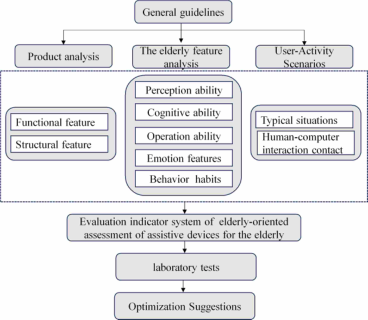
Elderly-Oriented Assessment Thread The evaluation of assistive device for the elderly is mainly carried out from three aspects: product analysis, elderly characteristics analysis and user- activity scenarios analysis, as shown in Fig. 1. Among them, product analysis mainly includes functional feature and structural feature analysis. The elderly feature analysis mainly focuses on the elderly’s perception ability, cognitive ability, operation ability, emotion characteristics and behavior habits, and user-activity scenarios, such as typical situations and human-computer inter- action contact, on this basis, the appropriate aging evaluation index system is built. Then the evaluation method of user experience is used to evaluate the aging dimensions of specific products such as safety, comfort, usability and affectivity, and optimization suggestions are put forward from the perspective of human factors and ergonomics.
Figure 1: Elderly-oriented assessment thread.
Elderly-Oriented Assessment of Assistive Devices for the Elderly 151
Rollator Assessment as Example Assessment Index System In order to better understand the aging suitability assessment of rollator, this paper takes rollator as an example, focuses on safety, ease of use, comfort, emotion and comprehensiveness according to the functional and structural characteristics of rollator, physical characteristics of target users and specific use situations, and establishes an evaluation index system on this basis, as shown in Table 1.
Table 1. Elderly-oriented assessment index system.
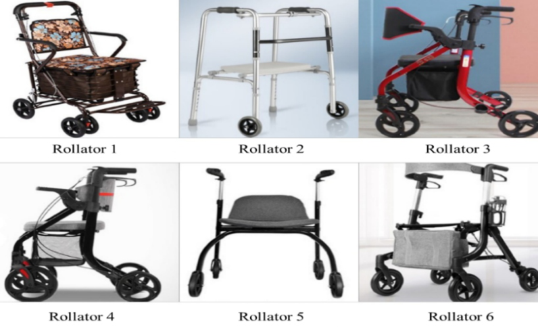
Test Object As shown in Fig. 2, six typical elderly rollators on the market were randomly selected, the brand and model characteristics were hidden, and the price dis- tribution ranged from 200 RMB to 2500 RMB, respectively: rollator 1 (299 RMB), rollator 2 (239 RMB), rollator 3 (1180 RMB), rollator 4 (1280 RMB), rollator 5 (2180 RMB) and rollator 6 (1480 RMB).
Figure 2: Six typical elderly rollators.
Test Subject 10 target users were screened, ranging in age from 60 to 80 years old, with slight limb dysfunction, but basically able to take rollator of themselves. In addition, there is no intellectual, mental illness, clear thinking and normal expression ability.
Experimental Design The experimental evaluation was carried out in an outdoor community envi- ronment, and typical experimental tasks were set according to the typical use environment of the rollators, as shown in Table 2. After performing the experimental task, each 2ed-level indicator was scored according to the eval- uation index system in Table 1. The scoring criteria were 1 (unsatisfactory), 2 (less satisfied), 3 (general), 4 (more satisfied) and 5 (satisfied).
Table 2. Experimental task.
Table available in the original PDF paper.
Task: If your legs and feet are not convenient, you want to walk around the community with the help of a rollator. Requirements: 1. Please fold/unfold the rollator, and then use the rollator to advance a certain distance in four different road conditions, such as uneven walking path, uphill and downhill, such as cement/floor, brick and tile; 2. In the downhill process, open the brake function according to the requirements of the main test; 3. Feel a little tired in the middle, then lock the wheel, rest on the wheel for a while, and then get up and fold the wheel.
RESULTS AND ANALYSIS Safety
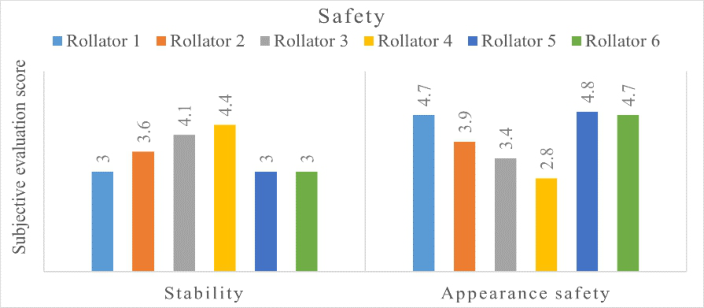
The safety results were shown in Fig. 3. For the stability, rollator 1, rolla- tor 3, rollator 4 in the use of the scooter stability is good, rollator 5, rollator 6 stability is poor, after analysis of the first three products of the net weight is larger, and the net weight of the latter two is smaller, and strong flexi- bility, brake braking (small friction) is poor, The elderly subjects generally reported that the rollator had a sense of drift, poor restraint and easy sliding during use, and a low sense of security. The appearance safety of rollator 5 and rollator 6 is better, which is because the appearance design of the two products is simple, the surface of the product is polished smooth, no winding sense (brake internal wiring), and no redundant structural design; Rollator 3, rollator 4 appearance safety is poor, mainly because the brake outside the line, easy to cause the elderly stumble, while the handrail structure design is complex, does not meet the ergonomics, easy to cause the elderly arm bump.
Elderly-Oriented Assessment of Assistive Devices for the Elderly 153
Figure 3: Safety results.
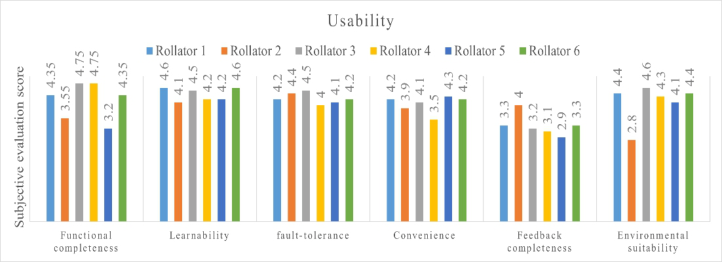
Usability The safety results were shown in Fig. 4. Rollator 1, rollator 3, and rollator 4 have high user satisfaction in the functional completeness of the product. In addition to the function of walking aid, it also has good functions such as storage, nursing implementation, rest, etc., to meet the various needs of elderly users in outdoor activities. Due to the relatively simple function and interactive interface of the driving aid products, the six products generally have a high degree of learnability and fault tolerance satisfaction, and there is no cognitive difficulty, and the inclusiveness of the products is strong in the operation process. The satisfaction of operation convenience of rolla- tor 2 and rollator 4 is poor, mainly because it is difficult for the elderly to press the hidden button of rollator 2 bracket when folding, and the elderly need to squat and press hard during the installation of the seat plate, so the convenience is poor. When the rollator 4 uses the handbrake to change the rollator from the parking state to the driving state, the handbrake wrench reacts too fast, and the structural design problems are easy to spring. Rol- lator 3, rollator 4, rollator 5, rollator 6 all use the brake wrench to pull down to a certain extent to complete the parking function, but the elderly feel that the wrench range (press distance) is longer during use, and the feed- back sound or touch is weak, on the one hand, there are concerns about the wrench, on the other hand, it will mislead the elderly to think that the parking has been completed when the rollator is not braking, sitting on it, so that the rollator slides and leads to the risk of falling. The environmental applicability of rollator 2 is the worst, and elderly users generally reflect that this rollator is only suitable for indoor use, especially for the use of groups with poor limbs or in the rehabilitation stage, and has good stability, but it is not suitable for use in various outdoor environments because of its poor flexibility.
Figure 4: Usability results.
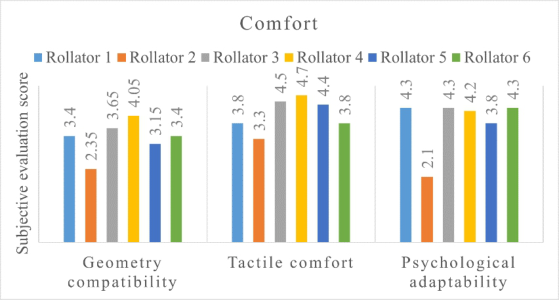
Comfort The comfort results were shown in Fig. 5. Rollator 2, rollator 5 and rollator 6 have the worst satisfaction with geometric comfort. For rollator 2, when the user is sitting, there is a railing to the waist, plus the small size of the seat plate, the actual effective sitting size of the elderly users is far less than the comfort size range, so the experience is poor; for rollator 5, the backrest is too small, resulting in insufficient support for the user’s back; for rollator 6, the cushion size is too small for most users, and the comfort is poor. The tactile comfort of rollator 2 is poor, because it is an aluminum alloy product without any package, the touch is cold, and the seat plate is a plastic product, which is hard; the cushion of rollator 6 is too thin, and the elderly users generally feel poor pressure comfort and no sense of security. Considering the appearance, colour design, texture and psychological coordination of the user, rollator 1 has been widely liked by the elderly users. The appearance of the shopping cart is a good care for the elderly’s psychological resistance to aging, and the flower pattern, non-slip wear-resistant and strong and durable Oxford cloth texture make the car more grounded, warm and practical, which well caters to the aesthetics of the majority of the elderly. The design of rollator 5 was the least satisfactory.
Figure 5: Comfort results.
Elderly-Oriented Assessment of Assistive Devices for the Elderly 155
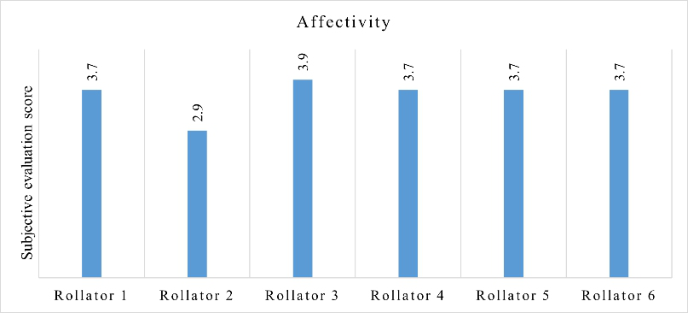
Affectivity The affectivity results were shown in Fig. 6. Considering the psychologi- cal feelings of elderly users such as equality, independence, and respect, the grounded and shopping cart-like design of rollator 1 mobility assistance vehi- cle well meets the psychological needs of the elderly. The design of rollator 2 makes elderly users feel cold, disability, and pain, lacking a sense of warmth and comfort.
Figure 6: Affectivity results.
CONCLUSION
Through the statistics and analysis of the above 6 rollators in terms of safety, usability, comfort, and affectivity indicators, we can roughly obtain the pur- chasing criteria for rollator, so as to provide some guidance and suggestions for elderly consumers. In terms of safety, priority should be given to walk- ing aids with a larger net weight, simple body design, and smooth surface, and the best brake system is double brake line one brake (inside line). In terms of ease of usability, the function procedures of walking aids should be comprehensive and complete, the logo should be easy to understand and remember, the operation should be simple and easy to start, and have a cer- tain fault tolerance, and can be combined into a multi-functional system. In terms of comfort, the design of walking aids should match the size of the human body, the material should be comfortable, with good air permeability and appropriate hardness, and the appearance and color of the vehicle should be beautiful and fashionable, giving people a positive psychological feeling. In terms of affectivity, rollator should enhance the design of humanistic care, weaken the rigid label, and give the elderly the psychological feeling of being respected.
ACKNOWLEDGMENT
his research was funded by National Natural Science Fund (82102176) named ‘Research on VR Evoked Emotion Recognition Method Based on Multimodal Physiological Signal Fusion’.
REFERENCES
Chen, G., Chen, X. J. (2019). Research on “suitable for aging” design of smart home products, Technology Innovation and Application Volume 24. Jiao, L. M., Li, H. W. (2021). Research on the application of intelligent technol-
ogy in the aging scenario of home appliances, Appliance Science & Technology Conference 2012. Niu, H. (2019). Aging adaptive design of intelligent TV hardware and software interface based on attention capture, Nanjing University of Science and Technology. Statistical Information Center of the Ministry of Health. (2008). Report on the anal-
ysis of the fourth Family Health inquiry survey of China Health Service Survey in 2008. Website in https://www.doc88.com/p-7903358562324.html. Wu, Q. (2018). Plant landscape design of nursing institution based on physiological and psychological characteristics and needs of the elderly, Southeast University. Zheng, C. Y. (2014). Product operation feedback mechanism based on sensorial
characteristics of the elderly, Journal of machine design Volume 1, No. 31.
LISTED IN THE AHFE DIGITAL BOOKSTORE CATALOGUE
Explore the complete digital volume
Human Factors in Aging and Special Needs
Read this individual research paper free through the original publisher, or explore the full digital proceedings book.
ISBN 978-1-964867-09-0
Explore this ISBN in the AHFE Bookstore ↗Listed in the July 2026 bookstore catalogue; search by ISBN to confirm current availability · Digital book purchase optional