Enrique Javier Martinez Delgado, Jose Alonso Dena Aguilar, Victor Manuel Velasco Gallardo, Edgar Zacarias Moreno, Ludovico Hernandez Aguilar, Luis Enrique Hernandez De La Rosa (2024). Development of an electric wheelchair for the mobility of people with chronic reduced mobility. In: Healthcare and Medical Devices. AHFE Open Access, vol. 130, pp. 219–231. https://doi.org/10.54941/ahfe1004856
Having a patient who is unable to move on his own generates stress on his family, since this type of disease has repercussions on the economic and emotional stability of both the patient and the people who assist him. The present work is a proposed solution for the development of low-cost national technology with high social impact, which was initially designed for the care of a 6-year-old patient with Arthrogryposis Multiplex Congenita, resident of the Pabellón de Arteaga, Aguascalientes, Mexico. The patient has suffered from this disease since birth, which prevents him from performing daily activities and, above all, from moving around on his own. Therefore, an electric wheelchair was designed and built to lighten or reduce the work of carrying and transporting the patient and to reduce or avoid possible injuries to the patient, as well as to the people assisting him. Designs of the device were elaborated in Solidworks® according to the dimensions of the ISO 2570-255 standard. The control system was designed as open loop control and programmed in Phyton language. The chassis and support structure were constructed from readily available materials of proven strength and is equipped with a swivel caster base. For the semi-automation and control system, a mechatronic system was built based on an Arduino® Nano data acquisition board connected to various electronic or electric-electronic modular elements. Design and construction of product allows an adequate transport and displacement of people of any age, weight and gender due to statistical analysis developed and applied determined that having several person conditions o characteristics made not significant difference. Additionally, majority perception of people that operated the chair indicated that it was comfortable, that they felt safe using it and also it was easy to operate the EWC. Nevertheless, as a future work, improvements must be done to have a better safety system and stop control system. Once the development of the electric wheelchair was completed, it was donated to the disabled child for routine use and operation, contributing to improve his quality of life.
Disability is defined as generic way as a limitation or impairment to perform activities that affects the quality of life and the interactions with people in various aspects like health, personal and environmental, where physical lim- itations and other types of disabilities are considered (González et al., 2006). Additionally, an illness can cause disability and, according to the severity of the condition, the patient has to depend on caregivers who force both to suffer affectations in personal life and their family to carry out their daily activities (Moreno et al., 2004). Regarding to congenital arthrogryposis multiplex, it is a disease that appears in the prenatal period and presents symptoms at birth time, causing motor disability due to this disease is characterized for produce physical limitations at movement, these limitations are due to the presence of muscle contractures in various parts of the body and join stiff- ness (Bonilla-Musoles et al., 2002; Pila-Pérez et al., 2010; Pozo-González and Barbán-Fernández, 2010; Guzmán-López et al., 2019). Existing rehabili- tative treatments for congenital arthrogryposis multiplex help to compensate the motor deficit, one of them is the use of electric wheelchairs (EWC) for movement in cases where body extremities are not very functional (de-León- Ojeda et al., 2009) or there are treatments with the simply purpose to serve as support to achieve walking autonomy for long distances (Forin, 2010). For this reason, several studies have been reported on the development or use of EWC with several technical characteristics as assistive devices for autonomous walking. Pearlman et al. (2008) Design and build a low cost EWC with 1300, 570 and 890 millimeters of measure and a capacity of max- imum speed of 1.65 m/s. Yokota et al. (2008) report an EWC prototype with an interface based on human body movements. Stenberg et al. (2014) present a study where they collect the experiences of patients with diseases such as muscular atrophy, spinal cord injury, rheumatoid arthritis or multiple scle- rosis, which obligates them to use an EWC for mobility. Chien et al. (2014) report the design and construction of an EWC with the feature of having an auxiliary solar power supply to increase travel autonomy. Swapna et al. (2016) present a proposed EWC for people with physical disabilities with the ability to convert it into a stretcher, and having a global positioning system for caregiver support when the patient moves autonomously. Sutradhar et al. (2017) describe the design and build of a low cost EWC with dimensions of 500,450 y 900 millimeters including an automatic control system. Thong- pance and Chotikunan (2023) show a design and build of an EWC with dimensions of 1100, 560 and 890 millimeters constructed with mechanical wheels that have movement on any direction assisted with a manual control Joystick type. This research work presents the design and construction of an electric wheelchair for people with motor disabilities caused by a disease such as congenital arthrogryposis multiplex. A prototype was manufactured under a conventional EWC design for use it as an assistive device capable of helping to increase the patient’s autonomy of movement. In addition, a bib- liography revision of the regulations applicable to the prototype developed, and performance and satisfaction tests of the EWC obtained were also car- ried out, considering an adaptation of the methodologies reported by Tatano and Revellini (2023), Yuviler-Gavish et al. (2023) and Koyama et al. (2023).
Development of an Electric Wheelchair for the Mobility of People 221
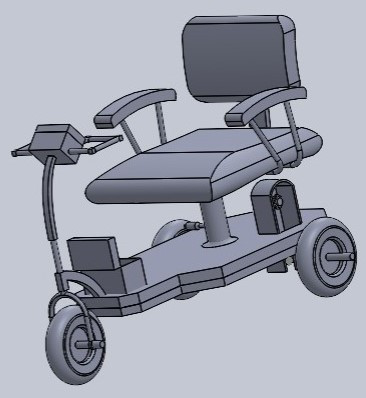
ELECTRIC WHEELCHAIR (EWC) DESIGN For the development of 3D CAD mechanical designs of the EWC, Solidworks® software was used in order to define dimensions, materials and operations. The prototype design was defined under a conventional EWC configuration with a single-seater scooter type tricycle architecture and con- sisting of (1) total dimensions 1100×715 × 900 mm; (2) a support structure (chassis) measuring 850 × 550 × 200 millimeters (mm) with a grill-type frame covered by an 18-gauge steel plate and covered by an anti-skid dia- mond PVC rug. The selected dimensions allow the EWC to enter through any conventional door. Chassis serves as a support base for the chair, trac- tion system, power supply box, rear and front 12” anti-tip tires, and steering wheel; (3) prototype has a 450 × 500 × 500 mm swivel chair with 3” thick foam padded seat and backrest, armrests, and seat belt. The chair has a fixed height of 380 mm from the base of the chassis to the bottom of the seat; (4) a 1000 mm height canteen type steering wheel with handles and control knobs for forward and reverse travel and enough space for mounting the ignition control box and potentiometer for travel speed regulation; (5) has a rear trac- tion system by power transmission by gear and chain installed in the rear part of the chassis considering a 160 × 160 × 350 mm compartment. The speed reached by the prototype is a maximum of 10 km/h (2.7 m/s); (6) a step-type compartment measuring 350 × 200 × 200 × 200 mm to house the power supplies; and (7) a control box measuring 150 × 120 × 120 mm to house the mechatronic system to control the speed and advance of the EWC. The control box was installed on the steering wheel. Figure 1 shows the isometric design of the complete equipment. The design shows the structural geometry of the equipment.
Figure 1: Isometric design of the electric wheelchair (source: own).
ELECTRIC WHEELCHAIR (EWC) MANUFACTURING For the manufacture of the EWC, cutting, welding and turning technolo- gies were used, among others, as well as the use of 3D printing. Machines used where LINCOLN ELECTRIC 4400 plasma cutter, DMTG CKE 6150Z CNC lathe, horizontal band saw, LINCOLN ELECTRIC micro wire welding machine, among others. The materials used are listed in Table 1.
Table 1. Description of prototype manufacturing materials (source: own).
Table available in the original PDF paper.
Section Description Remarks MIG welding was used for joining the parts under a grill type configuration Chassis Supporting structure made of 1” ASTM A500 structural steel profile, 18-gauge steel sheet and non-skid rug
Wheels Rubber, pressure free 12” Anti-roll, 2 rear and 1 front, 1” pivot shaft Chair Office type, ergonomic with armrests and adjustable backrest, 120 kg capacity
Fixed height, swivel, blue fabric, 3” thick high density quilted padding (30 kg/m3), with easy click safety belt Power supplies box Housing box made of 18-gauge steel sheet. Housing for 2 rechargeable batteries 12V 35A connected in series Traction system Power transmission by gear and chain activated by a DC 24V geared motor
Geared motor drive shaft coupled to a 60B12 2” sprocket and shaft of the tires coupled to a 60B12 1” sprocket, 60” chain pitch. Steering wheel Canteen type steering wheel Printed with 3D ABS material
In closed communication with control box Control box Rectangular, provided with miscellaneous switches for power, ignition, speed control, and interface
The chair was fixed at the center of gravity of the base of the chassis, trying to maintain its rotating function, but keeping the seat height con- stant. Due to the tricycle type configuration of the prototype, the steering wheel was installed at the front of the chassis so that the mobility of the handlebar anti-tip rim wouldn’t make contact with the chassis. A step-type storage box was placed behind the steering wheel to house the power supplies used by the prototype. A traction box for housing the DC power motor and mechanical gearing was installed at the rear of the chassis and under the seat. This location allowed additional stability to the prototype and provided the rear traction of the electric wheelchair-seat. Controls of the prototype were enabled on the steering wheel for forward or reverse operation directly by the user. In addition, the design and manufacture of prototype allows it to be manually operated through the control box button panel of the steering
Development of an Electric Wheelchair for the Mobility of People 223
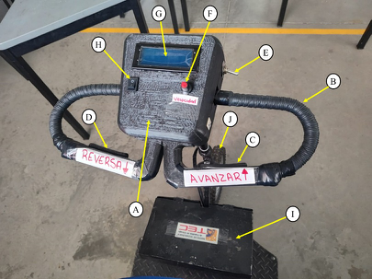
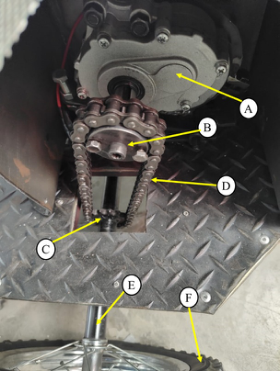
wheel controls. Figure 2 shows a view of the control system (steering wheel and control box). Figure 3 shows the traction system of the prototype.
Figure 2: Steering Wheel and control traction box of the electric wheelchair (source: own). (A) control box, (B) steering wheel, (C) forward motion control, (D) back- ward motion control, (E) power switch, (F) speed regulation potentiometer, (G) LCD-interface display, (H) on/off button, (I) power supply box, (J) front anti-tip rim.Figure 3: Traction system of the electric wheelchair (source: own). (A) DC 24V geared motor, (B) 2” drive shaft sprocket, (C) 1” working shaft sprocket, (D) 60 pitch chain, (E) rear tire working shaft, (F) left rear anti-tip tire.
SEMI-AUTOMATIC CONTROL SYSTEM In order to facilitate the mobility operation of the EWC by user with chronic motor disability and without dependence on a caregiver, a semi-automatic mobility system was designed and built to be operated manually with the simple activation of forward (right control) and backward (left control) movement controls. For this purpose, a mechatronic control system was designed and built to generate the clockwise (forward) or counterclockwise (backward) rotation signal of the DC 24V geared motor of the traction sys- tem. The mechatronic system is composed of (1) an Arduino® Nano data
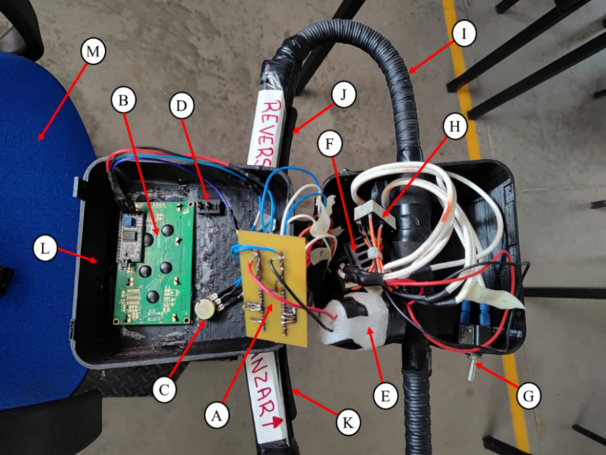
acquisition board mounted on a PCB and programmed in Phyton language with an open loop control system algorithm (not presented) for the mobility control of the prototype; (2) 9V battery for power supply of the Arduino® Nano; (3) I2C 1602 5V LCD display for system interface; (4) 10K poten- tiometer as the knob for speed adjustment of the prototype; (5) 125V 6A button switch for the electric wheelchair-saddle ignition; (6) 125V 4A rat-tail switch for current opening or closing; (7) BTS7960 45V 43A H-bridge motor drive for geared motor control; and (8) 12V 40A universal relay pair for circuit opening or closing. Figure 4 shows the proposed mechatronic system.
Figure 4: Mechatronic system (source: own). A) Back view of PCB board with the Arduino® Nano soldered on its front face, B) I2C 1602 LCD display, C) 10K potentiome- ter, D) on/off switch, (E) 9V battery, (F) BTS7960 driver, (G) toggle switch, (H) 12V relay, (I) steering wheel, (J) left control button backwards, (K) right control button forwards, (L) control box and (M) seat.
OPERATING OF THE ELECTRIC WHEELCHAIR (EWC)
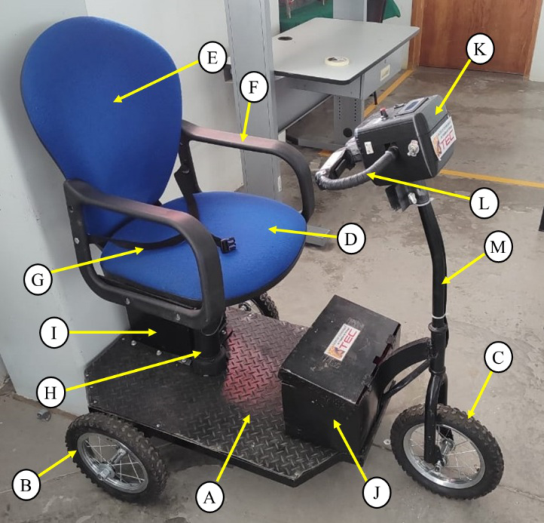
Figure 5 shows the completed electric wheelchair. An experimental design and satisfaction surveys were used to validate functionality of developed electric wheelchair. To do so, were adapted methodologies reported by Tatano and Revellini (2023), Yuviler-Gavish et al. (2023) and Koyama et al. (2023). In particular, the work reported by Yuviler-Gavish et al. (2023) was used as a guide in order to analyze the perception of the operator (power wheelchair user during operation) by means of satisfaction surveys. The questionnaire used is presented in Appendix 1. The work of Koyama et al. (2023) was employed to plot a test ride path with 90
turns included, as well as apply a statistical analysis of variance (ANOVA) with 95% confidence. The study by Tatano and Revellini (2023) made possible to consider a course with an obstacle of defined dimensions.
Development of an Electric Wheelchair for the Mobility of People 225
Figure 5: Electric wheelchair completed (source: own). (A) Chassis, (B) rear anti-tip rim, (C) front anti-tip rim, (D) seat, (E) backrest, (F) armrest, (G) seat belt, (H) seat base mast, (I) traction system box, (J) power supply box, (K) control box, (L) steering wheel, (M) steering wheel mast.
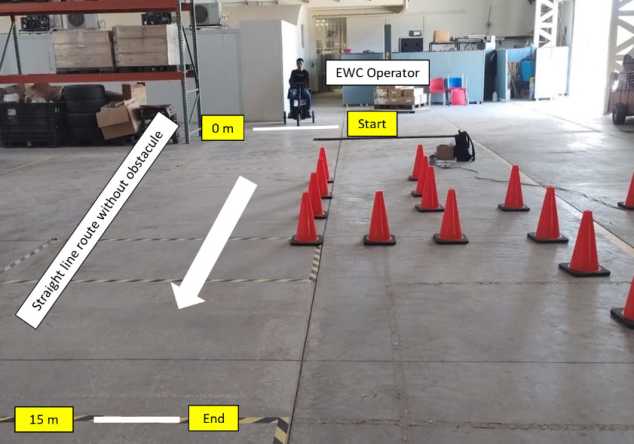
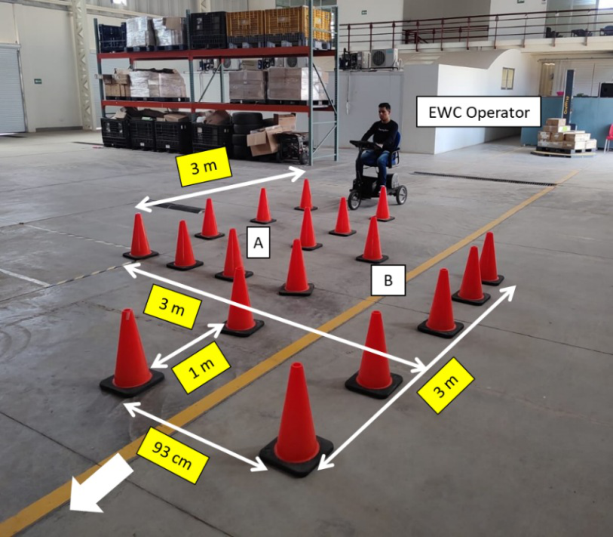
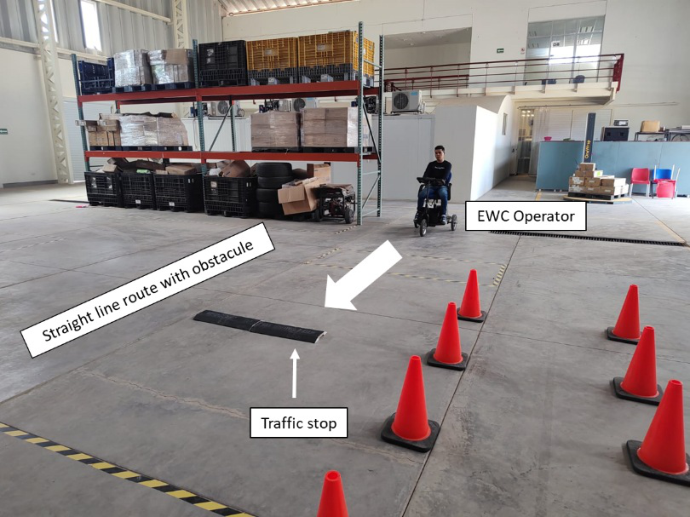
A design of random complete blocks (DRCB) reported by Gutiérrez-Pulido and De la Vara-Salazar (2008) was used to found if functionality of the electric wheelchair developed depends of conduction abilities of driver and depends on route type. Indirect results obtained allow define that chair design is adequate to accomplish the purpose of transport the final user. For this pur- pose, 3 types of routes were established: (1) Course A.- total route of 15 m in a straight line without obstacles, (2) Course B.- total route of 9 m with 2 90
turns included and (3) Course C.- total route of 15 m in a straight line with an intermediate obstacle. Courses were defined as the main factor (treatments) and the operators as the block factor (blocks). The run time (s) of each operator was set as the response variable. All tests were conducted indoors. Fifteen operators (8 males and 7 females) were selected with weights between 50 and 105 kg, ages between 20 and 23 years, and none with any disability. Prior to the tests, all the operators were instructed on how to oper- ate the EWC (start and stop), as well as the particular conditions of each course. Each operator performed each run-in triplicate and the average times were used for ANOVA. However, the speed for all tests (irrespective of the course and type of operator) was set at 3.6 km/h (1.0 m/s) to exclude the speed variation factor in the statistical analysis. Two 610 × 240 × 35 mm transit stops (with a base of less than 130 mm and 32
slope raps) were used each. Figures 6, 7 and 8 show the established courses.
Figure 6: Course A layout. Course had a linear distance of 15 m. Front Wheel was aligned to start line.Figure 7: Course B layout. Course had a length of 9 meters, with a 93 centimeters pad. Route had two 90◦turns [one to left (A) other to right (B)]. Traffic signals were used (located with a one-meter distance between them) to limit the route. Front Wheel was aligned to start line.
Development of an Electric Wheelchair for the Mobility of People 227
Figure 8: Course C layout. Course had a length in line of 15 meters, with an obstacle (traffic stop) at the middle. Front wheel was aligned to start line.
Table 2 shows the average times obtained by each user in each Route run. For each operator, the average times of the response variables obtained are recorded. Table 3 shows the ANOVA of the DRCB design obtained in Minitab 19 Statistical Software. The F-Critical value was obtained from the- oretical F-distribution tables for 0.05 distribution. In Table 4, the Tukey pairwise comparisons oriented to the runs are observed. The values were also obtained by Minitab 19 Statistical Software with grouping of the information by the Tukey method for 95% confidence
Table 2. Average of response variables obtained (source: own).
Course N Mean Grouping C 15 15.653 A A 15 14.927 A B 15 10.707 B
Means that do not share a letter are significantly different
Considering stablished factors and analyzing ANOVA results, it is deter- mined that the route type affects response variable, meanwhile operator type is not significantly a parameter that affects. Therefore, it is concluded that design and manufacturing of the EWC proposed is adequate to make the function for transfer of people, due to resulted adequate to be operated for any type of operator. Nevertheless, EWC must be analyzed with the objec- tive type of people in order to complete the statistical study proposed and be able to detect opportunity areas for a new EWC design. On the other hand, the perception of the operators is detailed in Table 5. Fifty percent of the operators indicated that the EWC was comfortable, while the rest said it was partially uncomfortable or uncomfortable. This is attributed to the fact that the chair was designed for infants under 12 years of age. Seventy percent of the operators felt safe riding in the EWC and the rest felt partially safe. The above perception is consistent with the type of stop system, as this was the most common difficulty encountered when riding in the EWC. All the oper- ators are very confident and trustful of the EWC’s operability, as they found the transit on the roads to be pleasant and functional. Finally, the operators considered the EWC to be moderately safe and very safe since it includes a seat belt (which could be better designed) and the travel speed was low (which could be increased to save travel time).
Table 5. Comfort, safety and trust levels of the EWC (source: own).
Table available in the original PDF paper.
Comfort Level % Safety Level % Trust Level %
0
1 – Very uncomfortable 0 1 – Very unsafe 0 1 – Do not trust to a great extent
Development of an Electric Wheelchair for the Mobility of People 229
In another context, the design and manufacture of the EWC was performed according to the ISO 2570–255 standard since the dimensions of the proto- type (1100 × 710 × 800 mm) fit within the overall dimensions specified by the standard (1200 × 700 × 1090 mm). However, the final prototype obtained was not validated under ISO 7176 standards (future work).
CONCLUSION
The design and construction of an electric wheelchair with automatic mobil- ity system was achieved according ISO 2570-255, developed with a manual control system based on Arduino® Nano and easy click controls placed on the steering wheel. The EWC was adequate for the transport and mobility of people due to the statistical analysis applied, although it determined that the type of route does affect the transfer of people (mobility times), also indi- cated that the type of operator is not significantly different, so the design and construction of the EWC was relevant and can be used by any person regard- less of their weight, gender and age. On the other hand, the perception of the use of the EWC indicated that 50% of the operators considered the chair comfortable, 70% of the operators felt safe during the transfer and 100% of the operators had great confidence in the operability of the chair. The survey also established areas for improvement of the prototype, such as installing a better safety system (belt) and smoothing the equipment stop system. As future work, a new version of the electric wheelchair will be developed with improved ergonomic and safety standards, as well as full compliance with ISO 2570–255 and ISO 7176 standards. Future work includes improving the wiring functionality of the mechatronic system, adding a braking system as a safety measure and using controller electronic cards with greater processing capacity for better time response in the operation of the prototype.
SUPPLEMENTARY INFORMATION The prototype was designed for the care of a child patient with congenital multiple arthrogryposis, and can also be used for young adults and adoles- cents with chronic motor disabilities. This is due to the proposed design where the chair and chassis are strong enough to support a weight of up to 120 kg, also the maximum speed of 10 km/h of the equipment can be performed transporting a person in a safe, comfortably and ergonomically way, and without the need of a caregiver. The prototype was donated to a child patient with congenital arthrogryposis multiplex, habitant of the Municipality of Pabellon de Arteaga, Aguascalientes, Mexico. Following electronic address shows the electric wheelchair put into operation by the end user of the pro- totype: https://www.facebook.com/watch/?v=678472197435164 (December 2023). A video demonstrating the EWC movements is available at the link https://youtu.be/fcqiD6bebUw.
APPENDIX 1. SATISFACTION SURVEY - QUESTIONS A. What is your comfort level with your EWC?
1 – Very uncomfortable
2 – Uncomfortable 3 – Partially uncomfortable 4 – Comfortable 5 – Very comfortable B. Do you feel safe riding your wheelchair?
1 – Very unsafe 2 – Unsafe 3 – Partially safe 4 – Safe 5 – Very safe C. What difficulties do you face in wheelchair mobility? D. What is your level of trust in your wheelchair?
1 – Do not trust to a great extent 2 – Do not trust 3 – Partially trust 4 – Trust 5 – Highly trust E. How would you rate the system’s safety level? F. How does it feel to travel on the roads in a wheelchair?
1 – Not at all safe 2 – Safe 3 – Very safe
ACKNOWLEDGMENT
Authors are grateful for financial and academic support of Tecnológico Nacional de México (TecNM) Campus Instituto Tecnológico de Pabellón de Arteaga for the realization of this research. Enrique Javier Martínez-Delgado would particularly like to thank for the financial support received by Instituto de Ciencia y Tecnologia del Estado de Aguascalientes (INCyTEA) through the Project INCyTEA-FEIT-P2-037: “Vehículo automático para pacientes dis- capacitados con artrogriposis múltiple congénita”. Jose Alonso Dena-Aguilar thanks CONAHCYT for the Grants EPM call 2021-ID 1086950, EPM call 2022(1)-ID 2708283_continuity and EPM call 2022(1)_renewall 2023 that allowed him to participate in the authorship of this paper. Special thanks to Eduardo Rodriguez Herrera, Kevin de Jesus Cabrera Elizondo, Juan de Dios Galaviz Santillan, Carlos Andres Bustos Nieves, and Octavio Rodriguez Salazar for their technical assistance in the development of this project.
REFERENCES
Bonilla-Musoles, F., Machado, L., Bailao, L. A., Osborne, N., García-Galiana, S., Bailao, T. C. R. S., Blanes, J., Rizzi, M. C., and Raga, F. (2002). Artrogriposis múltiple congénita (contracturas congénitas múltiples): revisión. Progresos de Obstetricia y Ginecología, Volume 45, No. 4, pp. 150–156. https://doi.org/10.1016/S0304-5013(02)75753-1 Chien, C.-S., Huang, T-.-Y., Liao, T.-Y., Kuo, T.-Y., and Lee, T.-M. (2014). Design
and development of solar power-assisted manual/electric wheelchair. Journal of Rehabilitation Research & Development, Volume 51, No. 9, pp. 1411–1426. de-León-Ojeda, N., Estevez-Pereda, A., Hernández-Tápanes, S., Estevez-Pereda, A., and González-Méndez, B. (2009). Genetic approach related to rehabilitation therapy of arthrogryposis. Revista Cubana de Medicina Física y Rehabilitación, Volume 1, No. 1, pp. 38–51.
Development of an Electric Wheelchair for the Mobility of People 231
Forin, V. (2010). Artrogriposis. EMC-Aparato locomotor, Volume 43, No. 2, pp. 1–9. https://doi.org/10.1016/S1286-935X (10)70878-9 González, S., Tello, J., Silva, P., Lüders, C., Butelmann, S., Fristch, R., Solar, F., Rigo-
Righi, C., and David, P. (2012). Quality of life in motor-handicapped patients according to socio-demographic factors and mental health. Revista Chilena de Neuro-Psiquiatría, Volume 50, No. 1, pp. 23–34. Gutiérrez-Pulido, H., and De la Vara-Salazar, R. (2008). Análisis y diseño de experimentos. (2nd edition). Mc Graw-Hill Interamericana. Guzmán-López, A., Treviño-Montemayor, O. R., Soria-López, J. A., Saldivar-
Rodríguez, D., and López-Rodríguez, J. C. (2019). Clinical treatment and outcome of a patient with arthrogryposis multiplex congenita. Ginecología y Obstreticia de México, Volume 87, No. 4, pp. 253–256. Koyama, S., Tatemoto, T., Kumazawa, N., Tanabe, S., Nakagawa, Y., and Otaka, Y. (2023). The effect of differences in powered wheelchair joystick shape on sub- jective and objective operability. Applied Ergonomics, Volume 107, p. 103920. doi: https://doi.org/10.1016/j.apergo.2022.103920. Moreno, M. E., Náder, A., and L.-de Mesa, C. (2004). The relation between the char-
acteristics of the family caretakers of disable patients and the perception of their current state of health. Avances en Enfermería, Volume XXII, No. 1, pp. 27–38. Pearlman, J., Cooper, R., Chhabra, H. S., and Jefferds, A. (2009). Design, development and testing of a low-cost electric powered wheelchair for India. Dis- ability and Rehabilitation: Assistive Technology, Volume 4, No. 1, pp. 42–57. doi: 10.1080/17483100802338440. Pila-Pérez, R., Pila-Peláez, R., Riverón-Núñez, A., Holguín-Prieto, V. A, and Campos-
Batueca, R. (2010). Arthrogryposis multiplex congenita: presentation of two cases. Revista Archivo Médico de Camagüey, Volume 14, No. 4. Pozo-González, A., and Barbán-Fernández, L. (2010). Congenital multiple arthrogryposis: a case presentation. Revista Archivo Médico de Camagüey, Volume 14, No. 6, pp. 1–6. Yokota, S., Ohyama, Y., Hashimoto, H., and She, J.-H. (2008). The electric
wheelchair controlled by human body motion - Design of the prototype and basic experiment -, RO-MAN 2008 - The 17th IEEE International Symposium on Robot and Human Interactive Communication, Munich, Germany, pp. 303–308, doi: 10.1109/ROMAN.2008.4600683. Stenberg, G., Henje, C., Levi, R., and Lindstrom, M. (2014). Living with an electric wheelchair-the user perspective. Disability and Rehabilitation Assistive Technology, Early Online, pp. 1–10. doi: 10.3109/17483107.2014.968811. Sutradhar, A., Sunny, M. S. H., Mandal, M., and Ahmed, R. (2017). Design
and construction of an automatic electric wheelchair: An economic approach for Bangladesh. 2017 3rd International Conference on Electrical Informa- tion and Communication Technology (EICT), Khulna, Bangladesh, pp. 1–5. doi: 10.1109/EICT.2017.8275159. Swapna, P., Sharmila, B., and Dharshan, Y. (2016). Electric wheelchair for physical challenged. International Research Journal of Engineering and Technology, Volume 3, No. 5, pp. 1090–1094. Tatano, V., and Revellini, R. (2023). An alternative system to improve accessibil-
ity for wheelchair users: The stepped ramp. Applied Ergonomics, Volume 108, pp. 103938. doi: https://doi.org/10.1016/j.apergo.2022.103938. Thongpance, N., and Chotikunnan, P. (2023). Design and Construction of Electric Wheelchair with Mecanum Wheel. Journal of Robotics and Control (JRC), Volume 4, No. 1, pp. 71–82. doi: https://doi.org/10.18196/jrc.v4i1.17095. Yuviler-Gavish, N., Weiss, A., Ben-Hanan, U., and Madar, M. (2023). Wheelchair
users’ perceptions of a system enabling them to traverse rough terrain controlling their own wheelchair. Applied Ergonomics, Volume 106, pp. 103866, doi: https: //doi.org/10.1016/j.apergo.2022.103866.
LISTED IN THE AHFE DIGITAL BOOKSTORE CATALOGUE
Explore the complete digital volume
Healthcare and Medical Devices
Read this individual research paper free through the original publisher, or explore the full digital proceedings book.
ISBN 978-1-964867-06-9
Explore this ISBN in the AHFE Bookstore ↗Listed in the July 2026 bookstore catalogue; search by ISBN to confirm current availability · Digital book purchase optional