Jose Alonso Dena Aguilar, Enrique Javier Martinez Delgado, Victor Manuel Velasco Gallardo, Edgar Zacarias Moreno, Ludovico Hernandez Aguilar, Ruth Elizabeth Martinez Escobedo (2024). Development of a semi-automatic patient lift vehicle for bedridden or wheelchair-bound persons with reduced mobility. In: Healthcare and Medical Devices. AHFE Open Access, vol. 130, pp. 193–204. https://doi.org/10.54941/ahfe1004853
Users with motor disabilities who are bedridden or in wheelchairs depend on the assistance of third parties to perform routine mobility movements through transport and/or transfer actions. This generates physical wear and tear on the assistant and the risk of injury or lumbar disease that may even lead him/her to stop assisting the patient. This article presents the development of a low-cost semi-automatic patient lift vehicle for bedridden or wheelchair-bound people with reduced mobility. The equipment was designed and built using specialized manufacturing techniques and mechatronic methodologies to provide operational stability and mechanical control of the equipment's linear travel and lifting movements. The designs of the equipment were obtained using Solidworks®. The semi-automatic patient lift vehicle support structure was manufactured based on dimensions declared on ISO 10535 standard and using readily available materials of proven resistance, considering a mobile structure composed of a wheeled base, a mast and an ergonomic pendant were attached to several stability points. A mechatronic remote-control system was developed using an Arduino® UNO electronic board with its respective programming platform. The remote-control interface was developed using the App Inventor® application and by means of a mobile device the up and down control of the patients in the proposed prototype was achieved. Design and prototype construction allows and adequate lifting and transport of patients with no difference on age, height, weight and gender due to the statistical analysis applied determined that design of semi-automatic patient lift vehicle is adequate to accomplish the purpose of patient lifting indistinctly of weight, height and route type. Nevertheless, improvements must be done as a future work in order to have a better prototype considering the handling of the caregiver person for the operation. The semi-automatic patient lift vehicle was put into operation directly in public social assistance centers (DIF Municipal and Centro de Atención Múltiple VIII) located in Pabellón de Arteaga City, Aguascalientes, Mexico.
Motor disability is generally manifested as a limitation in moving, climbing or descending that includes a total or partial decrease in mobility characterized by a total or partial difficulty of motor skills of the body (Peñaloza-Gómez et al., 2022). In Mexico, in 2010, 5.1% of the national population had some type of disability, mainly on people of 85 years old or older, where 58.3% of them had a motor disability (Bonilla-Muñoz and Torices-Rodarte, 2019). In this context, at America, the population of adults over 60 years of age is growing at an annual rate of 3% to 5%, having in this population age range a higher probability of developing chronic diseases that are one of the causes for motor disability (Dueñas et al., 2006). In this scenario, adults over 50 years of age with motor disabilities acquired in different stages of their lives, need a series of attentions and care associated with dependence of people or caregivers, in order to be able to deal with their conditions and daily life activ- ities (Venturiello, 2014). A caregiver is a person who assists a patient with a disability by providing informal and unpaid cares, in 80% of the cases, it is a family member or close friend of the affected person, being mainly women who assume first role of caregiver (Argimon et al., 2003; Mboungou- Hechevarría et al., 2018). Caregiver attends physical and emotional needs of the person with motor disabilities, both at home and outside home, never- theless, this role leads to stress situations and burdens that increase the risk of suffering physical, social, emotional and other problems as well (Moreno et al., 2004; Marco et al., 2010; Navarrete-Llamuca and Taipe-Berronez, 2023). That’s why has been used to develop assistive devices that allow people with disabilities to perform their daily activities with greater independence. In this context, a patient lift vehicle (with a weight between 110 kg and 160 kg) is the ideal system (although high cost) to move or sit with minor effort patients with disabilities, due to the system bases its function on up and down patient in a controlled manner, because this equipment have a steel chassis that have wheels, hangers and fastening chains, and have also a lift sys- tem that could be manual or electrical (Sánchez-Zaplana and Buj-Fernández, 1991). Although there are several options on market, several brands and types of lifting systems for people like, MediCare Mexico, OrtoWeb Medical, Hergom Medical, among others, their availability and cost make these don’t be an accessible option for must of people with the need of one of these sys- tems. It is therefore, that have been presented various studies, designs and construction of patient lift vehicle for patient move or elevation with the pur- pose of have more options, improve functionality or reduce costs of these devices. Just for mention some of them, Astudillo-Flores (2019) reports an academic work of design and construction of a mobile crane to transport patient, being this of easy maintenance, ergonomic, and easy assembly and disassembly, although costs were similar to market prices. Avilez-Arévalo and Fajardo-Sigua (2019) develop an academic project of design and construction of a mobile crane to transport people where they integrate an electromechan- ical lifting device to up and down the patients, having cost similar to market prices. Cox-Lozada (2021) describes an academic study of design and con- struction of a lifting system geriatric crane type for move people under REBA method for evaluate ergonomic risk, he also includes a semi-automatic lift system. Morales-Pérez et al. (2022) present several proposals for mechanical
Development of a Semi-Automatic Patient Lift Vehicle for Bedridden 195
lifting devices, which are a lower cost alternative but comply with the ISO 10535 standard. Chung-Luna (2021) shows an academic project on a pro- posal for the design of a mobile crane for transferring patients with motor disabilities with a control system based on electronic cards and with costs similar to those of the market. Martínez-Delgado et al. (2022) describe the design of a device for transferring patients with motor disabilities based on a patient lift vehicle model. where its cost is relatively lower tan market prices for be based on a manual operation with winch system for lifting. This paper presents the design and construction of a semi-automatic patient lift vehi- cle (PLV) for bedridden or wheelchair-bound people with motor disabilities, manufactured under a conventional PLV design for use as an assistive device capable of helping to reduce physical risks on caregivers during the atten- tion, specially for loading the patients for moving them for daily care. The semi-automatic PLV has the novelty of being remotely operated by means of a mobile device to up and down the patient.
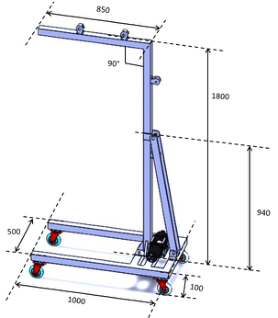
3D MECHANICAL DESIGN For the development of 3D CAD mechanical designs of a semi-automatic PLV, SolidWorks® software was used in order to define the dimensions, material and operation. Prototype design was defined under a conventional PLV archi- tecture consisting of a support structure (chassis) with (1) a wheeled base with dimensions 1000 × 500 x 100 millimeters (mm) to be able to enter under a bed or resting chair, also through any conventional door, as well as to serve for supporting base for the power motor of the semi-automatic lifting system, (2) prototype has a main vertical mast of 1800 mm long with an 90
attached arm of 850 mm long and 2 reinforced beams 940 mm long to help support the load (weight of a disabled person) to which the prototype will be sub- jected. Additionally, the mast has a support plate for the mechatronic control system of the semi-automatic hoisting system, and (3) an ergonomic pendant with stability points to hold the lifting harness. Figure 1 shows the isometric design of prototype chassis without the ergonomic pendant harness. Design shows the basic structure of the semi-automatic PLV.
Figure 1: Isometric design of the PLV chassis (source: own).
MATERIALS AND MANUFACTURING TECHNIQUES USED For the construction of the PLV, advanced manufacturing techniques of cut- ting, welding, turning, drilling, painting, among others, were applied, as well as the use of specialized of CNC machinery such as LINCOLN ELECTRIC 4400 plasma cutter, DMTG CKE 6150Z CNC lathe, horizontal band saw, LICOLN ELECTRIC micro-wire welding machine and bench drill. Table 1 describes materials used for the various sections of the prototype. For the lifting system, a set of safety guides composed of 2 double wheel pulley and 3 pulleys with bearings were installed on the mast and arm of the PLV to guide the winch cable and distribute the weight of the patient during its mobil- ity. Additionally, the design and manufacturing of prototype allows it to be set into operation through semi-automatic via remote control through the mobile application created for this study.
Table 1. Description of prototype manufacturing materials (source: own).
Table available in the original PDF paper.
Section Description Remarks MIG welding was used for joining the parts Supporting structure made of 2” ASTM A500 structural steel profile Base, mast, arm and beam reinforcement
Linear scroll wheels
H Model
4” red polyurethane slice 4 swivel casters with a load capacity of 40 kg each Ergonomic pendant
Support structure made of 1” ASTM A500 structural steel profile with 4 stability points Harness Blue raincoat with rigid tape reinforcement at edges and safety straps
One-piece one-size-fits-all seating position practical for caregivers Semi-automatic lifting system
Winch type, consisting of a DC electric motor with a hook and cable clamp, driven by a safety guide system based on double pulleys with bearings
Weston model 00990 electric winch with 900 kg capacity at 12V, 2 double wheel pulley and 3 pulleys with bearings, LTH model CTX4L-BS motorcycle gel battery Semi-automatic control box
Rectangular structure made of standard steel sheet
Mechatronic remote control system housing
SEMI-AUTOMATIC CONTROL SYSTEM In order to facilitate the operation of the PLV, a semi-automatic lifting sys- tem was designed and constructed using a Weston model 00990 12V electric winch with 900 kg load capacity hook and cable, which is powered by an LTH model CTX4L-BS motorcycle gel battery. The on/off control of the winch was set for automatic operation. In automatic mode, using the free App Inventor®, a Bluetooth remote interface was designed with an easy interface for user, to up, down, and stop the ergonomic pendant. As safety
Development of a Semi-Automatic Patient Lift Vehicle for Bedridden 197
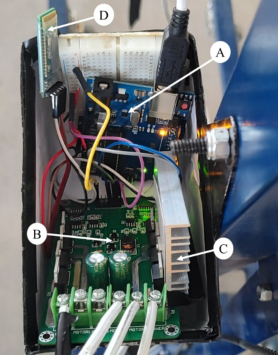
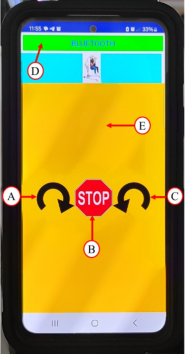
measures, there is a manual safety button (stop) and lever limit switch with 10t85 roller to stops the winch from turning on when moving up or down. Mechatronic control system was built using an Arduino® UNO board con- nected to a EB0048720 3-36V 15A PWM DC motor drive provided with heat dissipator and a Bluetooth HC-06 module. Figure 2 shows the con- structed mechatronic arrangement. The control algorithm (not presented) was designed in the Arduino® board with the remote application designed in App Inventor®, the operation of the PLV was enabled with the means of a mobile device in a simple way. Figure 3 shows the proposed remote interface where 3 buttons can be observed to up, down and stop the lifting of patient with this prototype.
Figure 2: Mechatronic system (source: own). A) Arduino® UNO electronic board, B) EB0048720 driver, C) heat dissipator, D) HC-06 Bluetooth module.Figure 3: Remote interface of prototype control (source: own). A) Button for moving up, B) stop button, C) button for moving down, D) bluetooth signal activated, E) remote interface IDE design.
MANUFACTURE AND OPERATION
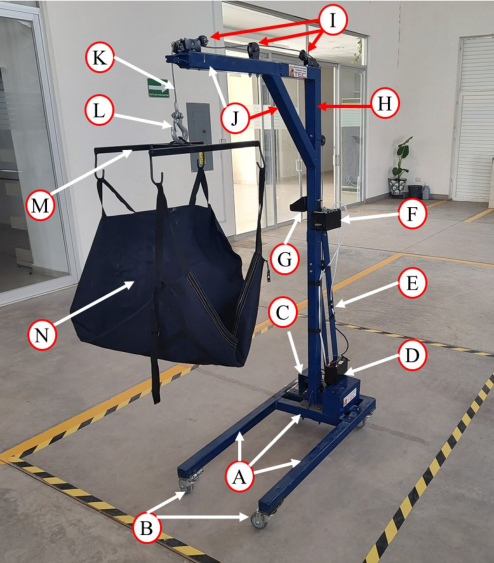
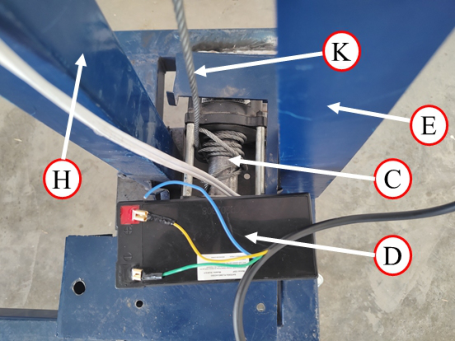
Figure 4 shows the completed semi-automatic PLV manufactured. Figure 5 shows a close-up of the electric winch area.
Figure 4: Completed PLV (source: own). A) Base, B) wheel, C) electric Winch, D) battery, E) reinforced beam, F) mechatronic semi-automatic control box, G) cell phone holder box, H) mast, I) double wheel pulley and pulleys with bearings, J) arm, K) cable clamp, L) hook clamp, M) ergonomic pendant, and N) harness.Figure 5: Close-up of electric winch zone (source: own). C) Electric Winch, D) battery, E) reinforced beam, H) mast, and K) cable clamp.
Development of a Semi-Automatic Patient Lift Vehicle for Bedridden 199
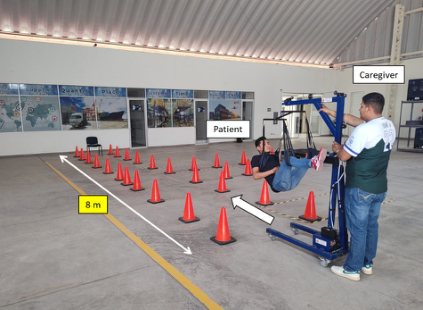
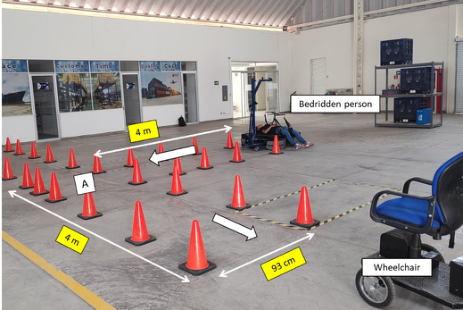
An experimental design was used to validate the functionality of the semi- automatic PLV obtained for lifting and transferring patients. For this purpose, a completely randomized block design (CRBD) reported by Gutiérrez-Pulido and De la Vara-Salazar (2008) was used to determine whether the operability of the semi-automatic PLV for lifting and transferring patients is dependent on the anthropometric measurements (weight and height) of the patients or on the type of course. The results obtained indirectly allowed to define that the design of the semi-automatic PLV is adequate to perform the purpose of lifting and transferring the patient regardless of their weight and height and the type of course. For this purpose, two types of courses were estab- lished: (1) Course A.- 8 m total course in a straight line without obstacles and (2) Course B.- 8 m total course with one 90
turn to the left included. The courses were defined as the principal factor (treatments) and the patients as the block factor (blocks). The time (s) of stroke performed by the caregiver [simulating a transfer of a patient from one point (bed) to another (chair)] according to each patient was set as the response variable. All tests were performed indoors. Ten patients were selected (5 men and 5 women) with weights between 45 and 110 kg, heights between 1.45 and 1.85 m and none with any disability. A single caregiver (male, 22 years old, weigh 105 kg and height 1.82 m) was selected for all the tests. The caregiver performed the A course straight ahead and B course in a mixed manner (first section in reverse, reverse turn and second section straight ahead). All the courses were per- formed by the caregiver at the same cadence (not quantified), but depending on the patient, more transfer time was consumed by the natural maneuvering of the semi-automatic PLV and where it was observed that patients of lower weight and height allowed an almost straight route, while patients of greater weight and height caused slight zigzagging that had to be corrected before continuing the course, which is why more transfer time was consumed. For all the tests, a 3-piece harness (2 for the legs and 1 for the torso) created for this study (not shown) was used. Prior to the tests, the caregiver and all the patients were instructed on how to operate (up, down, and stop) the semi- automatic PLV, as well as the particular conditions of each course. For each patient, each proof was performed in triplicate and the average times were used for ANOVA. Figures 6 and 7 shows the established courses. The times of up or down the patient were not used in the statistical analysis performed. However, on average, the action of lifting the patient (from a lying position in bed to the transport height) consumes an operation time of 18 seconds of the lifting system of the semi-automatic PLV. The action of down the patient (to a sitting position) was not counted. Additionally, and as a demonstra- tion, the stability of the semi-automatic PLV was observed in non-flat terrain (results not presented) where, in general, it was observed that the prototype can move linearly with difficulties, in reverse and according to the type of rough terrain; however, the equipment did not present any fall or effort that would have compromised the properties of the prototype.
Table 2 shows the average times obtained by each patient in each proof. For each patient, the average times of the response variables obtained are registered. Table 3 shows the ANOVA of the CRBD design obtained in
Minitab 19 Statistical Software. The F-Critical value was obtained from theo- retical F-distribution tables for 0.05 distribution. In Table 4 and 5, the Tukey pairwise comparisons oriented to the courses and patients are observed, respectively. The values were also obtained by Minitab 19 Statistical Software with grouping of the information by the Tukey method for 95% confidence.
Figure 6: Course A layout. Course has a linear distance of 8 meters. Front wheel was aligned to start line.Figure 7: Course B layout. Course had a length of 8 meters by 93 centimeters wide. Course had a 90◦turn [to left (A)]. Were used traffic signs (located 1 meter separated between them) in order to limit the course. Rear Wheel was aligned to start line of course.Table 2. Response variables average obtained (source: own).
Patient N Mean Grouping 10 2 35.25 A 7 2 34.85 A B 1 2 33.5 A B C 3 2 33.0 A B C D 6 2 32.4 B C D 5 2 31.9 C D E 2 2 31.65 C D E 4 2 31.55 C D E 8 2 30.5 D E 9 2 29.7 E
Means that do not share a letter are significantly different
Considering the established factors and analyzing the ANOVA results, it is established that the type of route and the type of patient (weight and height) affect the response variable. In particular, patients 9 and 10 show be signifi- cantly different, which is consistent with the results obtained, since they were the patients with the lowest weight and height (patient 9) and the highest weight and height (patient 10), and where less and more effort, respectively, was invested by the caregiver to transfer the patient. Therefore, it can be concluded that the design and manufacture of the semi-automatic PLV is ade- quate to be able to perform the function of lifting and transporting people, since it is suitable for performing these functions regardless of the anthropo- metric measurements of the patient or the type of flat course to be performed. Nevertheless, the operation of the semi-automatic PLV with the target sector of the project should be analyzed to complete the proposed statistical study and, if necessary, to detect areas of improvement for a new prototype design. In addition to the above, the use of the equipment with different caregivers should be analyzed to also rule out this variable according to the strength and cadence that the caregiver may use during the patient transfer movement (future work).
In another context, the design and construction of the semi-automatic PLV was performed according to ISO 10535 standard since the dimensions of the prototype (1000 × 500 × 1800 mm) match the overall dimensions specified by the standard (1100×650-840×1850 mm). However, the prototype must be evaluated according to the other requirements of the ISO 10535 standard for the adequate clinical validation of these type of devices (future work).
CONCLUSION
It was achieved the design and construction of a semi-automatic patient lift vehicle for lifting patients with motor disabilities bedridden or in wheelchairs according to the dimensions specified in the ISO 10535. The semi-automatic PLV was developed with a remote up and down control system through a mobile interface and by means of a mechatronic system based on an Arduino® UNO and Bluetooth connectivity. The semi-automatic PLV was suitable for lifting and transporting people because the statistical analysis applied, although it was determined that both the type of course and the type of patient (anthropometric measurements) does affect the transfer of people (mobility times), both the design and manufacture of the semi-automatic PLV was relevant and can be used by any person regardless of their weight, height, gender and age. Future work includes developing a new version of the semi- automatic PLV with improved ergonomic and safety standards, as well as full compliance with the ISO 10535 standard. Future work also includes improv- ing the wiring functionality of the mechatronic system and using controller electronic cards with greater processing capacity for better time response in the operation of the prototype. In addition, as a future work will be stablished more experimental designs to have a relation between caregiver abilities regarding to proposed prototype functionality.
SUPPLEMENTARY INFORMATION The semi-automatic patient lift vehicle obtained was donated to governmen- tal agencies dedicated to the care of people with motor disabilities such as DIF Municipal and Centro de Atención Múltiple VIII located in the Municipality of Pabellon de Arteaga, Aguascalientes, Mexico. At https://www.tecnm.mx/? vista=noticia&id=2820 can be consulted other donations of PLVs with man- ual lifting system, predecessors of the present work and made in 2022 year. A video demonstrating a semi-automatic PLV movement is available at the link https://youtu.be/clTUO2PaatQ.
ACKNOWLEDGMENT
Authors are grateful for financial and academic support of Tecnológico Nacional de México (TecNM) Campus Instituto Tecnológico de Pabellón de Arteaga for the realization of this research. Enrique Javier Martínez-Delgado would particularly like to thank for the financial support received by TecNM through the Project 12774.21-P: “Vehículo-grúa para desplazamiento de dis- capacitados motrices” (Call for participation for technological development and innovation projects 2021 of TecNM). Jose Alonso Dena-Aguilar thanks
Development of a Semi-Automatic Patient Lift Vehicle for Bedridden 203
CONAHCYT for the Grants EPM call 2021-ID 1086950, EPM call 2022(1)- ID 2708283_continuity and EPM call 2022(1) renewall 2023 that allowed him to participate in the authorship of this paper. Special thanks to Eduardo Rodriguez Herrera, Kevin de Jesus Cabrera Elizondo, Juan de Dios Galaviz Santillan, Carlos Andres Bustos Nieves, and Octavio Rodriguez Salazar for their technical assistance in the development of this project.
REFERENCES
Argimon, J. M., Limón, E., and Abós, T. (2003). Sobrecarga y calidad de vida de los cuidadores informales de pacientes discapacitados. Atención primaria, Volume 32 No. 2, pp. 84–85. Astudillo-Flores, M. I. (2019). Diseño, construcción e implementación de una grúa
móvil para el transporte de pacientes con discapacidad en actividades de rehabil- itación [Tesis de Licenciatura, Universidad Politécnica Salesiana]. https://dspace.u ps.edu.ec/handle/123456789/17165 Avilez-Arévalo and Fajardo-Sigua (2019). Diseño, construcción e implementación de una grúa móvil para el transporte de personas con discapacidad [Tesis de Licenciatura, Universidad Politécnica Salesiana]. Bonilla-Muñoz, M. P., and Torices-Rodarte, I. (2019). Qualitive study of disability
in Mexico: a family perspective. https://generaconocimiento.segob.gob.mx/biblio teca/estudio-cualitativo-de-la-discapacidad-en-mexico-una-perspectiva-familiar Chung-Luna, Y. Y. (2022). Diseño de una grúa móvil para el traslado de pacientes con discapacidad motriz del área de traumatología del Hospital Nacional Almanzor Aguinaga Asenjo [Tesis de Licenciatura, Universidad Católica Santo Toribio de Mogrovejo]. https://hdl.handle.net/20.500.12423/5446 Cox-Lozada, M. F. (2021). Diseño, construcción de un elevador tipo grúa geriátrica
para el traslado de personas con dependencia funcional dentro de las instalaciones del centro de atención integral para el adulto mayor del Cantón Patate [Tesis de Licenciatura, Universidad Técnica de Ambato]. https://repositorio.uta.edu.ec/jsp ui/handle/123456789/32136 Dueñas, E., Martínez, M. A., Morales, B., Muñoz, C., Viáfara, A. S., and Herrera, J. A. (2006). Síndrome del cuidador de adultos mayores discapacitados y sus implicaciones psicosociales. Colombia Médica, Volume 37 No. 2, pp. 31–38. Gutiérrez-Pulido, H., and De la Vara-Salazar, R. (2008). Análisis y diseño de
experimentos. (2nd edition). Mc Graw-Hill Interamericana. Hergom Medical. Grúas hidráulicas. https://hergom-medical.com/collections/gruas -hidraulicas Marco, E., Duarte, E., Santos, J.-F., Aguirrezabal, A., Morales, A., Belmonte, R.,
Muniesa, J. M., Tejero, M., and Escalada, F. (2010). Deterioro de la calidad de vida en cuidadores familiares de pacientes con discapacidad por ictus: una entidad a considerar. Revista de Calidad Asistencial, Volume 25, No. 6, pp. 356–364. https://doi.org/10.1016/j.cali.2010.06.003 Martínez-Delgado, J. E., Zacarías-Moreno, E., Velasco-Gallardo, V. M., Dena- Aguilar, J. A., and Hernández-Aguilar, L. (2022). Mobility-Impaired patient lifter vehicle. Revista Ciencia & Tecnología, Volume 22, No. 34, pp. 9–17. Mboungou-Hecheverría., Y, Semino-García, L. E., Coronados-Valladares, Y., and
Ruiz-Crespo, D. M. (2018). Main caregivers emotional states and burden of Ictus handicapped patient. Revista Cubana de Medicina Física y Rehabilitación, Volume 10, No. 3, pp. 1–11.
MediCare México. Grúas de pacientes. https://medicare.mx/categoria-producto/cam as-y-accesorios-hospitalarios/grua-para-pacientes Morales-Pérez, L., Caro-Cabeza, J., Amador-Cáceres, B., and García-Caicedo, J.
(2022). Design of a mechanical device for the transfer of patients with motor disabilities. Revista UIS Ingenierías, Volume 21, No. 1, pp. 1–14. https://doi.org/ 10.18273/revuin.v21n1-2022001 Moreno, M. E., Náder, A., and L.-de Mesa, C. (2004). The relation between the characteristics of the family caretakers of disable patients and the perception of their current state of health. Avances en enfermería, Volume XXII, No. 1, pp. 27–38. Navarrete-Llamuca, A. E., and Taipe-Berronez, A. A. (2023). Overload of the pri-
mary caregiver of patients with physical disabilities. Salud ConCiencia, Volume 2, No. 2, pp. e–14. https://doi.org/10.55204/scc.v2i2.e14 Peñaloza-Gómez, R., Santillana-Limón, Z., Méndez-Sánchez, M. D. P., and Saldaña- Castillo, J. J. (2022). Labour discrimination in people with motor disability in Mexico. VERTIENTES Revista Especializada en Ciencias de la Salud, Volume 25, No. 1–2, pp. 39–49. OrtoWeb Medical. Grúas de traslado. https://www.ortoweb.com/gruas-de-traslado-
para-domicilio Sánchez-Zaplana, I., and Buj-Fernández, A. (1991). Movilización mecánica de pacientes (grúas). ROL. Revista Española de Enfermería, Volume XIV, No. 152, pp. 71–74. https://hdl.handle.net/2445/128683 Venturiello, M. P. (2014). Adults with motor disabilities and their families: home
organization, the affections and work. Revista Española de Discapacidad, Volume 2, No. 2, pp. 103–120.
LISTED IN THE AHFE DIGITAL BOOKSTORE CATALOGUE
Explore the complete digital volume
Healthcare and Medical Devices
Read this individual research paper free through the original publisher, or explore the full digital proceedings book.
ISBN 978-1-964867-06-9
Explore this ISBN in the AHFE Bookstore ↗Listed in the July 2026 bookstore catalogue; search by ISBN to confirm current availability · Digital book purchase optional