Bijan Aryana, Anna-lisa Osvalder, Jonas Borell (2024). Design Strategies to Reduce Personal Protective Equipment Noncompliance. In: Ergonomics In Design. AHFE Open Access, vol. 129, pp. 57–66. https://doi.org/10.54941/ahfe1004811
Personal Protective Equipment (PPE) noncompliance has been addressed through various lenses. In current literature, there is a greater focus on improving training and safety culture. Improving PPE design to persuade PPE compliance is less explored, especially in sectors beyond healthcare. This study investigates the reasons behind PPE noncompliance across construction, maritime, and chimney sweeping sectors. The results are then used to develop a set of design strategies for PPE manufacturers, as an alternative to merely addressing changes in training, work culture, or organizational procedures. Due to the heterogeneous nature of the sectors, participants, and work environments studied, the study builds upon a wide range of qualitative and quantitative data collection methods and corresponding analysis approaches, with a greater emphasis on in-depth qualitative studies. The results were synthesized using an integrated synthesis method, which formed the basis for design strategies addressing multiple aspects of designing PPE, including but not limited to testing PPE in real settings and length of use, testing the simultaneous use of various PPEs, and assessing guessability.
This study aims to address the critical issue of Personal Protective Equip- ment (PPE) noncompliance, or in other words, the insufficient use and non-adherence to PPE across various industries. Despite the vital role of PPE in ensuring workers safety, compliance by users often encounters challenges. While training, increasing awareness, improving safety culture, and enhanc- ing safety procedures and rules may impact PPE use, the potential of design to improve compliance is less explored. The research intends to understand the reasons underlying PPE noncompliance among users, which may include aspects of non-use or inappropriate use such as comfort, perceived neces- sity, and workplace culture. By identifying these factors, the study aims to formulate design strategies that could enhance PPE usage and adherence, ulti- mately improving safety and minimizing injury risks in the workplace. The core research questions include: RQ1 – Why is PPE not used, or not properly used, and what are the reasons for this? RQ2 – Considering the reasons for non-use or inappropriate use, how can manufacturers’ design strategies for
personal protective equipment be tailored to encourage increased usage and compliance in various work environments?
The study employs a comprehensive and multifaceted methodology to investigate the use and non-use of PPE in three high-risk, male-dominated industries: construction, maritime, and chimney sweeping. To achieve a thor- ough understanding of the subject, the study utilizes several approaches for data collection. These approaches include literature reviews to gain insights into existing knowledge in the field of PPE usage; user studies for testing and evaluating PPE usage; web surveys for data triangulation and gaining understanding from a broader range of participants; and field observations and interviews at construction sites, on ships, and during chimney sweeping activities to gain an in-depth understanding of the contexts of use. An inte- grated synthesis method is used to identify the most common reasons behind PPE non-compliance across all sectors, as well as to propose correspond- ing design strategies for PPE manufacturers, which can directly or indirectly address those reasons.
BACKGROUND
The impact of PPE on occupational safety and health is a topic of interest in various sectors. Safety culture or attitudes towards safety and risk-taking play a significant role in the degree of PPE usage (Wadsworth and Smith, 2009). The design of PPE is also a critical factor affecting its use, as optimal use of PPE in real-world contexts can be challenging (Reddy et al., 2019). Such challenges are more apparent in certain sectors, particularly in the healthcare sector where the COVID-19 pandemic has increased the focus on specific aspects of use connected to the design of PPE, such as donning and doffing (Machry et al., 2022; McCarthy et al., 2020; Janson et al., 2022). It also emphasized potential barriers to using PPE, such as its negative impact on communication and common misconceptions about its use. These miscon- ceptions include the belief that PPE negatively affects attention (Kienbacher et al., 2022). Similar patterns can be observed in studies conducted in the construction (Sehsah et al., 2020) and shipping industries (Devereux and Wadsworth, 2023) due to the incorrect use of protective equipment. Despite the different nature of using PPE in various sectors, current literature sug- gests that effective PPE design, along with organizational culture and training, are important to prevent accidents during use and to increase adherence to protocols for PPE use (Reddy et al., 2019; Ammad et al., 2021). The liter- ature recommends solutions for improving safety culture, for example, by providing assessment instruments (van Nunen et al., 2022), evidence-based training and guidance (Guan et al., 2019), and more recently, using digital tools for detecting inappropriate use (Cabrejos and Roman-Gonzalez, 2023) and simulation-based training (Greaves et al., 2023). However, knowledge about PPE design principles that can lead to increased persuasion and appro- priate use is still underdeveloped (Brisbine et al., 2022). This is evident in sectors like healthcare, where studies suggest clear links between poor PPE design and difficulty of use, which may lead to inappropriate use or non-use (Lee et al., 2021; Chamorro-Koc et al., 2022).
Design Strategies to Reduce Personal Protective Equipment Noncompliance 59
To address the gap in research and practice, this study aims to reveal design strategies for PPE that result in appropriate use as well as reduce non-use in some less explored sectors.
METHOD
Due to the nature of the research questions, gaining a better understanding of user behaviour in relation to PPE use was necessary. Therefore, qualitative methods were the core part of this research, complemented by quantitative methods where needed. Given the diversity of industries, the study required adaptation to different contexts and work environments, as well as to vari- ous participants and regulations. This adaptation meant that data collection in each sector had its unique characteristics. The researchers conducted inter- views, surveys, and user studies with participants in construction, maritime, and chimney sweeping industries to understand PPE usage. These methods aimed to gather both subjective perspectives and objective data on PPE usage, attitudes towards safety, and the cultural factors influencing the adoption of and adherence to safety protocols. The approach was interdisciplinary, involving experts from ergonomics, design, psychology, and human fac- tors engineering to comprehensively analyse the factors affecting PPE usage. Given the diversity of study settings, some data collection activities were con- ducted in parallel. The PPEs studied across sectors included helmets, hearing protection, protective glasses, respiratory protective equipment, gloves, safety harnesses, and fire and chemical protection coveralls. Notably, the study of coveralls and life jackets was exclusive to the maritime sector. A detailed description of the data collection methods across different industries can be found in Table 1.
Table 1. Summary of methods used.
Table available in the original PDF paper.
Participants Notes
Method Number of Participants Literature study using an exploratory method NA NA The review was conducted on existing research regarding PPE usage and compliance across various industries. This review was based on peer-reviewed journal articles. Interviews and observations, construction sector
13 Workers, safety officers Web survey, construction sector
350 Construction workers In-depth interviews, construction sector
11 Construction workers
10 Construction workers
In-depth interviews were conducted using a semi-structured interview guide. This guide included both predetermined questions and the flexibility for spontaneous ones. Interviews and focus group, winter climate PPE use, construction sector
Investigating using PPE in cold weather, with a focus on thermal comfort.
(Continued)
Table 1. Continued
Table available in the original PDF paper.
Participants Notes
Method Number of Participants
66 Seafarers
Interviews PPE use in shipping work complemented with a diary study
46 Chimney sweepers
Survey and interviews, chimney sweeping User study: PPE usability tests 13 Multiple industries
For data analysis, different approaches were chosen according to the type of data collected. Overall, qualitative analysis was the dominant method, while quantitative analysis was utilized mainly for surveys. Table 2 presents the data analysis approach for each method of data collection.
Table 2. Data analysis approach across different methods.
Table available in the original PDF paper.
Method Data Analysis Approach Literature study Exploratory literature review Interviews and observations, construction sector Qualitative content analysis to identify themes and patterns regarding attitudes towards PPE and factors influencing safety protocol adherence. Web survey, construction sector
Quantitative analysis using statistical tools to identify patterns in PPE usage, reasons for non-compliance, and correlations between variables. In-depth interviews, construction sector
Thematic analysis to explore in-depth the factors influencing decisions on PPE use, focusing on personal and environmental influences. Interviews and focus group, winter climate PPE use, construction sector Mixed-method analysis combining qualitative insights from interviews with quantitative data from diaries to understand PPE use aboard ships.
Thematic analysis of focus group discussions to understand experiences and perceptions of PPE use in winter conditions. Interviews about PPE use in shipping work complemented with a diary study Survey and interviews, chimney sweeping Mixed-method analysis where quantitative survey results are statistically analysed, and qualitative interview data are thematically analysed to understand PPE usage. User study: PPE usability tests
Usability analysis involving both qualitative feedback from user testing sessions and quantitative assessment of comfort and fit ratings.
To handle these heterogeneous sets of data, an integrative synthesis approach was used by applying the following steps:
Identification of common themes: findings from each method were reviewed to identify common themes, patterns, or insights that emerge across different data sources.
Design Strategies to Reduce Personal Protective Equipment Noncompliance 61
Cross-method validation: using a triangulation approach, findings from different methods were compared to validate the results.
Integration of findings: the findings across methods were integrated to construct a comprehensive understanding of the study’s objectives. As a result, different pieces of data were used to complement and enrich each other.
Development of theoretical insights: based on the integrated findings, the- oretical insights for individual, organizational, and environmental factors influencing PPE compliance were proposed. Such insights contribute to answering RQ1.
Formulation of recommendations: leveraging the synthesized insights, the study formulates practical recommendations in the form of PPE design strategies. This step contributes to the answer of RQ2.
RESULTS
Each part of the study provided insights about PPE compliance and usage in the corresponding sector. Despite unique characteristics, similarities were notable. Below is a summary of key findings from each method:
Literature study: the review identified gaps in existing research regarding PPE usage and highlighted the need for industry-specific studies to bet- ter understand the factors influencing PPE compliance. It established a foundational understanding of the factors influencing PPE use, including cultural, organizational, and individual-level influences.
Interviews and observations in the construction sector: findings revealed that while awareness about the importance of PPE is high, actual usage is influenced by workplace culture, individual perceptions of risk, and the physical comfort and usability of PPE. Workers and safety officers provided insights into the challenges of enforcing and adhering to PPE protocols on construction sites.
Web survey in the construction sector: a discrepancy between the per- ceived importance of PPE and actual usage rates was found. Factors such as discomfort, lack of convenience, and perceived barriers to work performance were mentioned as reasons for non-compliance.
In-depth interviews with construction workers: these interviews offered deeper insights into personal attitudes towards PPE, revealing that deci- sions to use or not use PPE are heavily influenced by peer behaviour, immediate work context, and personal experiences with accidents or near-misses.
Interviews and focus groups on winter climate PPE use among construc- tion workers: additional challenges posed by cold weather were found, i.e., the need for PPE that maintains warmth without compromising mobility or safety. Participants suggested improvements in PPE design for winter use, as well as guidelines on choosing appropriate winter PPE.
Interviews on PPE use in shipping work, complemented with a diary study: unique challenges related to the maritime environment were revealed, such as the need for PPE that accommodates the physical demands of ship work while protecting against specific maritime hazards.
Survey and interviews on chimney sweeping: results indicated a general adherence to PPE usage among chimney sweepers, as the PPE plays a critical role in mitigating health risks inherent in this sector. Solutions such as designing for better fit and comfort, providing regular train- ing, and conducting awareness campaigns to promote compliance were emphasized.
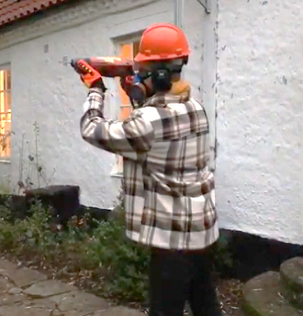
User study on PPE usability tests: the user study highlighted aspects of PPE design not extensively explored in other research, such as evaluating PPE design for realistic durations and in combination with other common PPEs and tools in each sector, as well as guessability. Guessability refers to the intuitive ability of users to understand and correctly use PPE without needing prior detailed instruction or training (Figure 1).
Figure 1: Snapshots from usability test videos, featuring a guessability test of a safety harness (left), and a demonstration of simultaneous use of PPE - including helmets, hearing protection, protective glasses, respiratory protective equipment, gloves - along with a drill, over a specified duration (right).
The integrated synthesis of results highlighted key themes including phys- ical and thermal comfort, knowledge and awareness, workplace culture and peer influence, usability and guessability, combined and simultaneous use of PPEs, and length of use. Regarding reasons behind non-use and inappropri- ate use, cross-method validation shows that findings from different methods often support each other. For instance, the discomfort and usability issues reported in qualitative interviews were supported by quantitative survey data showing high rates of non-compliance due to these factors. Integration of findings showed that some suggestions from participants for solving existing problems might not address the root cause of those problems. For example, usability tests showed that aspects such as guessability, long-term use, and combined and simultaneous use have not been considered in the design of PPE.Therefore, improving workplace culture and awareness through training may not always be the best or only solution for addressing PPE noncom- pliance. This leads to theoretical insights on improving PPE compliance at three levels: individual (e.g., personal comfort), organizational (e.g., work- place culture), and environmental (e.g., the physical work environment).
Design Strategies to Reduce Personal Protective Equipment Noncompliance 63
While literature has focused more on organizational and environmental lev- els, improving PPE design—as the main scope of this study—can enhance the individual level mainly by facilitating appropriate use in an intuitive manner through good design, without solely relying on training.
DISCUSSION AND CONCLUSION The study explored the use and non-use of PPE across construction, maritime, and chimney sweeping sectors. The consistent problem identified by partici- pants across all industries was the lack of proper conditions at the workplace, being the primary reason for the incorrect or non-use of PPE. The user stud- ies, however, showed that some problems can be addressed by improving the design in the first place, before addressing organizational and environmen- tal levels. There were, of course, direct hints at the design of PPE, especially in terms of discomfort, increased strain, and thermal comfort. In relation to RQ1, the main reasons for non-use or inappropriate use of PPE include:
Impact on work performance: PPE serves not only as protection but also impacts the performance of work tasks, potentially making some tasks harder or slower to perform. The necessity of using protective gear under time pressure and stress can lead to incorrect usage or complete avoidance of PPE.
Comfort and fit: the comfort problems were frequently mentioned, includ- ing issues with fit, heat and moisture buildup, and cold exposure during winter, especially when multiple pieces of PPE are used together.
Availability: chimney sweepers and seafarers, particularly those on tempo- rary assignments, have reported a lack of access to PPE. Even when PPE is available, procuring it during emergency situations can pose a challenge, such as during hazardous incidents on ships.
Time and knowledge shortages: the pressure of time constraints and piece- work has been identified as a significant factor contributing to the non-use of PPE. Many tasks do not consider the time required to properly put on and take off PPE. Participants suggested training in the correct use of PPE, including practical exercises. However, usability tests indicated that enhancing guessability could also potentially decrease the time needed for the proper application and removal of PPE.
Attitudes and safety culture: PPE compliance is influenced by workplace culture, attitudes towards safety, and the acceptance of risk. A high level of risk acceptance and the normalization of risk can lead to the neglect of PPE. The findings suggest that working in male-dominated sectors, cou- pled with more years of experience, may contribute to the neglect of PPE. These factors warrant further investigation in future research studies.
Employer’s role: employers play a pivotal role in ensuring the appropriate use of PPE. This includes setting expectations and requirements for its use, providing suitable equipment, and allocating time for its application and maintenance. The characteristics of an organization, such as whether it’s public or private, its size, as well as the sector it operates in, can impact the safety culture.
The design of PPE can directly influence its impact on performance, com- fort, fit, and the time required to put on, take off, and adjust it. Additionally, the design can indirectly affect safety culture, knowledge, and employer deci- sions. An intuitive, guessable, and easy-to-use design can reduce the effort and resources needed for training and overcoming resistance to use. Employ- ers may also consider certain design aspects when purchasing PPE, such as feedback from workers regarding comfort and ease of use. Considering these aspects, and regarding RQ2, PPE manufacturers can apply a range of design strategies for PPE, including:
Testing PPE in real settings: it is essential to test PPE in real settings to ensure adherence to safety standards and effectiveness beyond classi- cal anthropometric design. Real-world testing should consider the actual duration of use, various postures, and tools, expected climate conditions, and the simultaneous use of multiple PPEs. Additionally, tests should include a wide range of users across different genders, ages, and experience levels to account for diverse needs.
Adjustability and size range: most PPE needs to offer a wider range of sizes or greater adjustability. Traditional anthropometric design recommenda- tions may not account for the full spectrum of user needs, especially when tested in controlled settings that might not reveal minor discomforts or the impact of various body dimensions, hair lengths, beards, and piercings on fit.
Aesthetic Experience: the appearance of PPE should be appropriate for the work environment and reflects the professional identity of its users, contributing to a stronger safety culture and reducing resistance to its use.
Material standards: PPE manufacturers must establish standards for the weight and breathability of materials. Testing these materials under expected climate conditions is crucial to assess their durability and effec- tiveness.
Feedback collection: gathering feedback post-use is vital for continuous improvement. Manufacturers and employers should collaborate to col- lect insights on comfort, fit, task interference, performance, and ease of use. Employing participatory design approaches and valuing user feedback are strategies that can help differentiate products in the market and offer a competitive advantage. Employers should also consider this feedback when selecting PPE for purchase.
Intuitive design: the physical design of PPE, including colours, textures, and labels (if necessary), should intuitively guide first-time users on how to put on, take off, and adjust the PPE without requiring additional train- ing or prior experience. Separate instructions should be avoided whenever possible, with all guidance ideally visible on the device. Textual content should be minimized, prioritizing universally understandable visual cues. To do this, manufacturers can draw on existing knowledge of cognitive ergonomics and visual information design to inform design decisions, even if not explicitly tailored to PPE. Recruiting participants for guessability
Design Strategies to Reduce Personal Protective Equipment Noncompliance 65
tests should not be challenging, as these tests do not require prior knowl- edge of the specific type of PPE being tested. It is important to distinguish guessability tests from real-world testing scenarios mentioned earlier.
In line with these design strategies for manufacturers, future research should also focus on the use of PPE in real settings using qualitative methods. This includes ethnographic research across a wider range of industries and users, as well as exploring current procedures and practices of PPE design by manufacturers. This can pave the way for having a closer look at each type of PPE and providing detailed design guidelines. Addressing inclusive and universal design for PPE, especially in industries where certain genders or age ranges are dominant, is another less explored area that warrants further investigation.
ACKNOWLEDGMENT
This study could not have been accomplished without the team effort that went into facilitating and conducting research across various sectors. The authors extend their gratitude to Cecilia Österman, Josefine Landberg, Per Nilsson, Lars-Ola Bligård, Cedrik Sjöholm, Signe Svensson, Linnea Saver, Åsa Vinge Brolin, Jenny Englund Isaksson, Alexandra Rosén, Isabella Rosenquist, Sandra Ohlén, and Hanna Wellander for their invaluable support throughout the study. We also wish to acknowledge AFA Insurance for providing the necessary funding for this research.
REFERENCES
Ammad, S., Alaloul, W. S., Saad, S., and Qureshi, A. H. (2021). Personal protective equipment (PPE) usage in construction projects: A scientometric approach. Journal of Building Engineering, 35, 102086. Brisbine, B. R., Radcliffe, C. R., Jones, M. L. H., Stirling, L., and Coltman, C. E.
(2022). Does the fit of personal protective equipment affect functional perfor- mance? A systematic review across occupational domains. PLOS ONE, 17(11), e0278174. https://doi.org/10.1371/journal.pone.0278174 Cabrejos, J. A. L., and Roman-Gonzalez, A. (2023). Artificial Intelligence System for Detecting the Use of Personal Protective Equipment. International Journal of Advanced Computer Science and Applications, 14(5). Chamorro-Koc, M., Wannenburg, E., and Gomez, R. (2022). Personal Protec-
tive Equipment (PPE): Design for Comfort. Brisbane, QLD: QUT Design Lab. Research Project Report. Devereux, H., and Wadsworth, E. (2023). Barriers to personal protective equipment use among international seafarers: A UK perspective. WMU Journal of Maritime Affairs, 1–16. Greaves, S. W., Alter, S. M., Ahmed, R. A., Hughes, K. E., Doos, D., Clayton, L. M.,
Solano, J. J., Echeverri, S., Shih, R. D., and Hughes, P. G. (2023). A simulation- based PPE orientation training curriculum for novice physicians. Infection Preven- tion in Practice, 5(1), 100265. Guan, L. R., Xian, G. J., Rajendran, S. D., and Wahab, S. N. (2019). A study on the effectiveness of personal protective equipment (PPE) on building construction workers. In E3S Web of Conferences (Vol. 136, p. 04090). EDP Sciences.
Janson, D. J., Clift, B. C., and Dhokia, V. (2022). PPE fit of healthcare workers during the COVID-19 pandemic. Applied Ergonomics, 99, 103610. Kienbacher, C. L., Grafeneder, J., Tscherny, K., Krammel, M., Fuhrmann, V.,
Niederer, M., Neudorfsky, S., Herbich, K., Schreiber, W., Herkner, H., and Roth, D. (2022). The use of personal protection equipment does not nega- tively affect paramedics’ attention and dexterity: A prospective triple-cross over randomized controlled non-inferiority trial. Scandinavian Journal of Trauma, Resuscitation and Emergency Medicine, 30(1), 1–7. Lee, Y. A., Salahuddin, M., Gibson-Young, L., and Oliver, G. D. (2021). Assessing personal protective equipment needs for healthcare workers. Health Science Reports, 4(3), e370. Machry, H., Mati´c, Z., Oh, Y., DuBose, J. R., Morgan, J. S., Love, K. L., Jacob, J. T.,
and Zimring, C. M. (2022). Healthcare design to improve safe doffing of personal protective equipment for care of patients with COVID-19. Infection Control and Hospital Epidemiology, 43(12), 1796–1805. McCarthy, R., Gino, B., d’Entremont, P., Barari, A., and Renouf, T. S. (2020).
The importance of personal protective equipment design and donning and doff- ing technique in mitigating infectious disease spread: A technical report. Cureus, 12(12). Reddy, S. C., Valderrama, A. L., and Kuhar, D. T. (2019). Improving the use of personal protective equipment: Applying lessons learned. Clinical Infectious Diseases, 69(Supplement_3), S165–S170. Sehsah, R., El-Gilany, A. H., and Ibrahim, A. M. (2020). Personal protective equip-
ment (PPE) use and its relation to accidents among construction workers. La Medicina del Lavoro, 111(4), 285. van Nunen, K., Reniers, G., and Ponnet, K. (2022). Measuring safety culture using an integrative approach: The development of a comprehensive conceptual frame- work and an applied safety culture assessment instrument. International Journal of Environmental Research and Public Health, 19(20), 13602. Wadsworth, E., and Smith, A. (2009). Safety culture, advice and performance. Policy
and Practice in Health and Safety, 7(1), 5–31.
LISTED IN THE AHFE DIGITAL BOOKSTORE CATALOGUE
Explore the complete digital volume
Ergonomics In Design
Read this individual research paper free through the original publisher, or explore the full digital proceedings book.
ISBN 978-1-964867-05-2
Explore this ISBN in the AHFE Bookstore ↗Listed in the July 2026 bookstore catalogue; search by ISBN to confirm current availability · Digital book purchase optional