Insufficient sleep quality has significant physical and mental health impacts on humans. However, measuring sleep quality requires a Polysomnography (PSG) test at a clinical site, which requires specialised knowledge. This study used a wireless millimetre-wave, non-contact biophysical information detection sensor to estimate sleep depth. This sensor can obtain body movements and respiratory rates from millimetre-wave fluctuations. We calculated several parameters from the respiration and body movement data obtained from these sensors and applied machine learning to create a model for estimating sleep depth. In addition, we applied the sleep stage probability obtained in advance from the sleep stages of all the experimental subjects using simple PSG as one of the sleep stage estimation parameters. The actual sleep stage was obtained using a simple PSG as a reference for machine learning. The experimental subjects were 15 healthy adults, and measurements were taken over 1–3 nights. Because some of the wireless millimetre-wave sensors did not work correctly and the first night of measurement did not provide normal sleep owing to the first-night effect, we excluded some data. Finally, nine sets of data were used for training. Sleep depth was classified into four stages: waking (W), rem (R), light (L), and deep (D). The sensitivities of this machine-learning model for each sleep depth were 51.1% (W), 27.6% (R), 81.0% (L), and 47.8% (D), and the correct response rates were 73.7% (W), 53.3% (R), 59.8% (L), and 64.3% (D). The overall accuracy is 60.5%. In the future, we will implement hidden Markov state transition probabilities in the state probabilities. In addition, sensors can detect heartbeats to improve the accuracy of sleep-depth estimation.
Sleep relieves fatigue and stress and restores the body and mind. Poor sleep quality and insufficient sleep duration increase mortality risk (Wei Hu et al., 2023). Therefore, it is essential to continuously assess sleep quality and
Non-Contact Sleep Stage Estimation Using Wireless Millimetre-Wave Sensor 345
quantity at home. The quality and quantity of sleep can be assessed using polysomnography (PSG) to determine the sleep stage from the obtained bio- metric information. The sleep stage is expressed by four indicators of sleep state, classified into four categories: wake, light, rapid eye movement (REM), and deep. In clinical sites using PSG data, the sleep stage is determined by measuring Electroencephalography (EEG), oculomotor myoelectric poten- tial, and jaw muscle potential. These highly invasive measurements require physical restraint and electrode use during sleep. Sleep quality needs to be measured continuously and daily; however, this test is challenging to conduct conveniently at home.
Currently, there are technologies for the simple determination of sleep using wearable watches, and their accuracy has been verified by comparison with clinical sleep depth (Evan, 2022). These technologies use acceleration and pulse rates and require a watch to be worn throughout the night (Aakash K, 2022). Another study proposed a method for estimating sleep depth using human videos captured using an infrared camera. However, this method does not include information on the autonomic nervous system, and it is difficult to obtain sufficient accuracy for REM sleep (Kamon et al., 2022). Therefore, we propose a method to accurately estimate the sleep stage using a millimetre- wave sensor to measure respiration information and body movements in an entirely non-contact manner. Placing millimetre-wave sensors under a pillow allows them to measure minute body vibrations. These sensors can collect biological information and are entirely contact-free. This study aimed to cre- ate and evaluate a machine learning model to estimate sleep depth using body movement and respiration information measured by millimetre-wave sensors.
METHOD
The millimetre-wave sensor used in this study was equipped with a trans- mitter and receiver. Millimetre waves were sent to the subject’s body, and the wave receiver detected wave fluctuations caused by breathing and body movements. The data detected by the receiver are a waveform superimposed on the body’s movement and respiration. They were separated using a filter to extract the waveform components of the body’s movement and respiration.
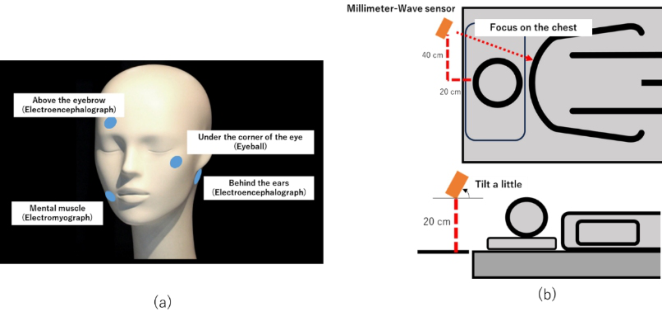
A learning model was created to estimate sleep depth using body move- ment and respiration information measured using millimetre-wave sensors. Measurements were performed using a simple PSG device to obtain correct labels when creating the learning model. Measurements were taken in a sleep laboratory, and the approximate times of falling asleep and sleeping were specified. In this study, only caffeine and alcohol intake, which may inter- fere with sleep, were restricted (Mohammad et al., 2023). No restrictions were imposed on the room temperature during sleep or diet on the day of the experiment. Millimetre-wave sensors (Fingal Link Co., Ltd., Japan) and a simple PSG measuring device ZA-X (Proassist, Ltd., Japan) were used. The simple PSG measurement device used in this study was also used for clinical sleep assessment. This simple PSG-measuring device can determine sleep depth using four electrodes. The positions of the electrodes during the measurements are shown in the diagram (Fig. 1a). A millimetre-wave sensor
was placed at the bedside during the experiment (Fig. 1b). Fifteen healthy adult subjects (age: 34.5 ± 11.5) were measured; each subject was mea- sured for one to three nights, and the total number of data set, correct sleep stage decided by PSG and body movement and respiratory data detected by Millimetre-Wave sensor, was seventeen.
Figure 1: (a) Place of electrode for measuring sleep depth, (b) Millimeter-wave sensor for estimating sleep depth.
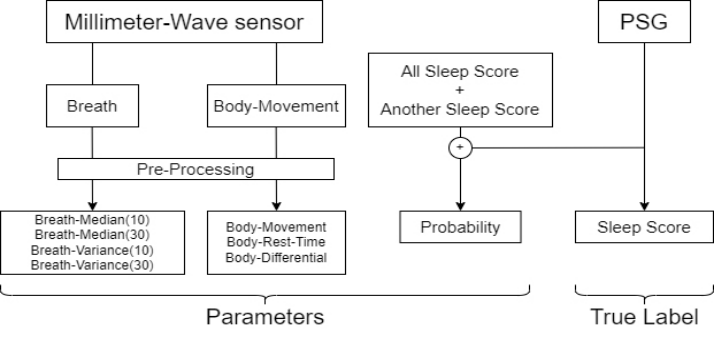
The following section describes the creation of models using machine learning. The calculation of the parameters for model creation is shown in Figure 2.
Figure 2: Flowchart of parameter calculation.
Several features calculated from respiration rates and body movements obtained from millimetre-wave sensors and the probability of sleep depth at each time point were used as parameters for machine learning. The machine learning parameters used are listed in Table 1. The respiratory rate and body
Non-Contact Sleep Stage Estimation Using Wireless Millimetre-Wave Sensor 347
movements were resampled to one epoch for 30 seconds after pre-processing. After resampling for respiratory rate, the median and variance values were extracted at 10 and 30 epochs. The duration of rest and the rate of change in body movements were extracted from the body movements. The rate of change in the body movement was calculated using Equation 1.
Equation reproduced from the original PDF.
bodymove [i] × 100 (1)
Table 1. Features used for sleep depth estimation.
Table available in the original PDF paper.
Feature Description. Unit Breath Median (10, 30) Median value of Breath with intervals 10, 30 Respiratory Rate/epoch Breath Variance (10, 30)
%
Variance value of Breath with intervals 10, 30 Respiratory Rate/epoch Body Movement A measure of how much the body moves Body Differential Variation rate of body movement % Body Rest Time The amount of time the body remains still Epoch W, R, L, D Probability of sleep state (W, R, L, D) at each epoch was calculated from 23 data
In this experiment, sleep data from the first night, when normal sleep was impossible, were excluded. In addition, there were a few cases where the millimetre-wave sensor could not usually measure body movements and res- piration rates owing to environmental influences. Therefore, of the 17 data sets collected, nine were used to train the machine learning.
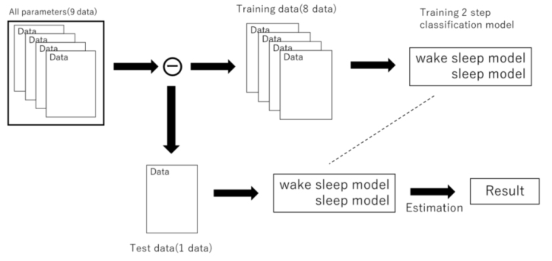
Next, we explain one of the parameters, the probability of sleep depth. The calculated probability of sleep depth at a particular time after the start of sleep was added to the parameter. Machine learning was performed using the calculated parameters and the correct answer labels. The machine learning classification flow is shown in Figure 3. An extra tree classifier was used as the learner. In this study, two models were developed and classified into two stages. In the first stage, the models were classified as awake or sleeping. In the second stage, the data classified as sleep were used to classify the depth of sleep (Light, REM, Deep).
Figure 3: Classification flow.
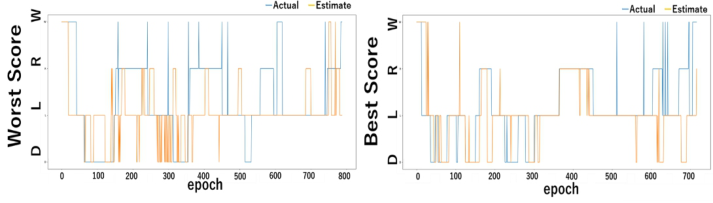
RESULT & DISCUSSION The results of the sleep depth estimation for all subjects combined are listed in Table 2. The overall accuracy of the model is 60.5%. The best result for the individual data per subject was 71.4%. The data with the worst results corresponded to 45.9%. Two examples of the sleep depth estimation results are shown in Figure 4. These two examples were selected as the most and least accurate.
Table 2. Total model results.
Table available in the original PDF paper.
W R L D Sensitivity [%].
W 328 23 287 4 51.1 R 10 459 1128 66 27.6 L 107 338 3028 265 81.0 D 0 41 619 604 47.8 Precision [%] 73.7 53.3 59.8 64.3 60.5
Figure 4: Results of best and worst estimated scores.
Considering each sleep depth separately in the comprehensive model, Wake had a high accuracy of 73.7% and a sensitivity of 51.11%. Sleep- wake is characterised by significant changes in body movement, which are well captured by the millimetre-wave sensor and calculated body movement parameters. The accuracy of REM was 53.3%, with a sensitivity of 27.6%, and most of the data misclassified by REM were classified as Light REM, a condition known as an Autonomic Storm (Patricia T. Becker, 1982). There- fore, adding respiration information provides greater accuracy than body movement-only sleep-depth estimation methods (Kamon et al., 2022). Light had an accuracy of 59.8% and a sensitivity of 81.0%. Influenced by other misclassifications, the sensitivity was high but the accuracy was low; the accu- racy for deep misclassifications was 64.3%, with a sensitivity of 47.8%, and deep misclassifications tended to be misclassified as light. A stable depth was detectable, whereas an unstable depth close to light was classified as light.
The overall accuracy of this study was 60.5% in the present results. This shows that sleep depth can be estimated from respiration and body move- ments using millimetre-wave sensors. Large fluctuations in respiration and body movement characterised the sensor data and parameters with the high- est accuracy. When the sensor data and the parameters of the data with the poorest accuracy were checked, the missing time of the respiration waveform
Non-Contact Sleep Stage Estimation Using Wireless Millimetre-Wave Sensor 349
was long, which may have affected the accuracy. This indicates that, if res- piration information is missing from the sensor data, discrimination is based only on body movements and accuracy is reduced. This method is reliable for estimating the sleep depth. However, to achieve even higher accuracy in sleep depth estimation, the accuracy of the sensor measurements of respi- ration and body movement must also be guaranteed. In addition, Syed et al. (Syed, 2021) concluded that the two most commonly used sensing modalities for sleep measurement devices, other than polysomnography tests, are based on EEG and photoelectric volumetric pulse waves (PPG). Therefore, if heart rate could be measured using this sensor as autonomic information, it would be possible to construct an even more accurate sleep estimation model.
CONCLUSION
A learning model was developed to estimate sleep depth using body move- ment and respiration information measured using millimetre-wave sensors. The results indicate an overall accuracy of 60.5%. Sleep depth can be esti- mated from body movements and respiration information measured using millimetre-wave sensors. Because the sleep cycle can be adequately con- firmed, it was helpful as a hypothetical method of sleep monitoring. For further accuracy, we will consider adding other autonomic information, such as heart rate, as an input parameter.
ACKNOWLEDGMENT
This study was supported by Fingal Link Co., Ltd., Japan.
REFERENCES
Aakash K. Patel; Vamsi Reddy; Karlie R. Shumway; John F. Araujo. (2022), “Physiology, Sleep Stages”, [Internet], Treasure Island (FL). Chinoy ED, Cuellar JA, Jameson JT, Markwald RR. (2022) “Performance of
Four Commercial Wearable Sleep-Tracking Devices Tested Under Unrestricted Conditions at Home in Healthy Young Adults”, Nat Sci Sleep. 2022 Mar 22;14:493–516. Doi: 10.2147/NSS. S348795. PMID: 35345630; PMCID: PMC8957400. Evan D Chinoy, Joseph A Cuellar, Jason T Jameson, 1 and Rachel R Markwald (2022), “Performance of Four Commercial Wearable Sleep-Tracking Devices Tested Under Unrestricted Conditions at Home in Healthy Young Adults”, Nat Sci Sleep. 2022;14:493–516. Doi: 10.2147/NSS. S348795. Masamitsu Kamon, Shima Okada, Masafumi Furuta, Koki Yoshida. (2022)
“Development of a non-contact sleep monitoring system for children”, Front Digit Health. 2022 Aug 8;4:877234. Doi: 10.3389/fdgth.2022.877234. PMID: 36003190; PMCID: PMC9393414. Mohammad Sibai, Timothy A. Roehrs. (2023) “Effects of alcohol, caffeine, and cannabidiol on sleep”, Encyclopedia of Sleep and Circadian Rhythms (Second Edition), pp. 332–339. Patricia T. Becker, Evelyn B. Thoman, E B Thoman (1982), “Intense rapid eye
movements during active sleep: an index of neurobehavioral instability”. Devel- opmental Psychology, Volume 15, Issue 3, pp. 203–210.
Syed Anas Imtiaz (2021), “A Systematic Review of Sensing Technologies for Wearable Sleep Staging”, Sensors, 24;21(5):1562. Doi: 10.3390/s21051562. Wei Hu, Qiang Han, Jiadong Chu, Na Sun, Tongxing Li, Zhaolong Feng, Qida
He, Ze Ma, Yu Wang, Yueping Shen. (2023) “Mechanism of the association between sleep quality and mortality in middle-aged and older adults: a prospec- tive study analysis of the UK Biobank”, Archives of Gerontology and Geriatrics, Volume 113, October 2023, 105051.
LISTED IN THE AHFE DIGITAL BOOKSTORE CATALOGUE
Explore the complete digital volume
Emerging Technologies in Healthcare and Medicine
Read this individual research paper free through the original publisher, or explore the full digital proceedings book.
ISBN 978-1-958651-92-6
Explore this ISBN in the AHFE Bookstore ↗Listed in the July 2026 bookstore catalogue; search by ISBN to confirm current availability · Digital book purchase optional