Kenta Nakayama, Kenji Watanabe (2023). Incident response exercises and methodologies to guide best practices for incident response in healthcare institutions. In: Emerging Technologies in Healthcare and Medicine. AHFE Open Access, vol. 116, pp. 246–253. https://doi.org/10.54941/ahfe1004378
In recent years, the threat of cyberattacks has been increasing annually, necessitating organizations to prioritize security measures. This urgency is particularly critical in healthcare institutions, given their status as crucial infrastructures and the potential risks cyberattacks pose to human lives. However, limited IT investment in healthcare institutions has resulted in inadequate cybersecurity measures and underinvestment in IT infrastructure. Outdated and unsupported operating systems pose significant vulnerabilities, escalating the risk of security incidents. Despite the challenges imposed by limited IT investment, organizations must strive to develop resilience that enables swift recovery in the event of a security incident, even while accepting a certain level of risk. Incident response exercises play a vital role in bolstering this resilience.Previous studies on incident response exercises have employed around 40 action cards to organize organizational processes during incidents. This process aims to enhance organizational resilience by facilitating communication within the organization during exercises. However, the importance of communication, although acknowledged during the exercises, has not been fully incorporated into the content, including the creation of incident response manuals for responders and third-party stakeholders. Moreover, there is a scarcity of research papers discussing best practices for crafting incident response manuals. This paper discusses a framework for creating incident response manuals and a methodology for implementing an improvement cycle through incident response training. The incident response manual references NIST SP800-61 and the U.S. military document "Cyber Incident Handling Program," while the incident response exercises draw from reported security incident cases to consolidate key points. Additionally, for healthcare institutions, notable considerations for incident response manuals will be explored, considering past security incident reports that have occurred in healthcare institutions in the recent couple of years. These infections can result in ransom demands, but there have also been cases of double threats where the ransom is demanded alongside the threat of leaking encrypted information. Management must decide on whether to pay the ransom, considering various factors such as public relations and apologies to individuals whose personal information has been compromised and leaked. Also, since the past incident reports indicate that Business Continuity Planning (BCP), which is used in the event of a natural disaster, was useful in the event of an incident, the Incident Command System and the Regional BCP, which is designed to coordinate with other regional healthcare systems, should be included in the considerations.Furthermore, best practices for security incidents in healthcare institutions will be organized by adopting the format of the Resilience Matrix proposed in Horizon2020. The Resilience Matrix categorizes guidelines for pre-incident preparation, incident awareness and response, and post-incident recovery, focusing on broader categories rather than individual roles or technologies. In this case, the matrix will be tailored to the specific roles of healthcare professionals to facilitate further discussions.
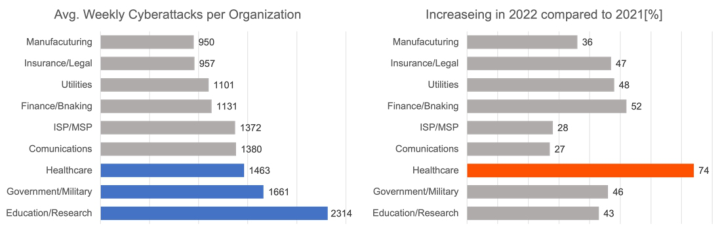
The threat of cyber-attacks has been on the rise in recent years, exposing a wide variety of institutions to attacks. Check Point, a U.S. security vendor, reported that the number of cyber-attacks against organizations per week increased by approximately 38% from 2021 to 2022 (Check Point Research Team, 2023). Figure 1 shows the number of cyber-attacks on organiza- tions by industry, followed by Education/Research, Government/Military, and Healthcare. Among these, cyber-attacks on healthcare increased the most (74%) from 2021 to 2022. This is because the systems of health- care organizations are likely to be relatively more vulnerable than those of organizations with sensitive information, such as Education/Research and Government/Military, despite healthcare-related information containing sensitive information, such as personal disease information. In fact, IT invest- ment in healthcare organizations has been limited. In addition, IT investment in healthcare organizations is limited, and cyber-security measures are inade- quate (Kruse, 2017). As a result, old, unsupported operating systems remain, and their critical vulnerabilities increase the risk of security incidents. How- ever, since the threat of cyber-attacks is increasing every year, organizations
Incident Response Exercises and Methodologies to Guide Best Practices 247
need to accept a certain level of risk with their limited IT investments, while maintaining resilience to enable rapid recovery in the event of a security inci- dent.This paper develops exercises to increase resilience in the event of those incidents and makes recommendations for a series of PDCA cycles.
Figure 1: Avg. weekly cyber attacks per organization (left figure) and increasing rate in 2022 compared to 2021 per organization (right figure) (check point research team, 2023).
Method
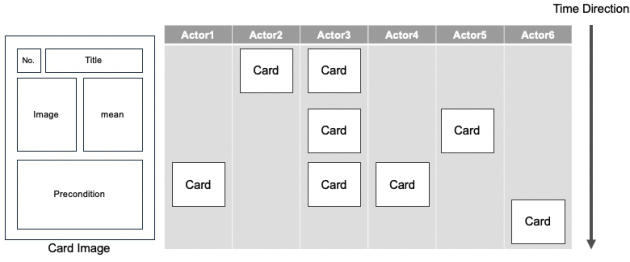
In a previous study, an exercise using about 40 action cards to discuss what information is necessary for information coordination and decision-making against cyber-attacks was recommended, and employees of a critical infras- tructure company actually participated in the exercise (Davaadorj, 2018. Figure 2). A questionnaire survey of the exercise participants revealed pos- itive comments such as satisfaction with the exercise and a reaffirmation of the importance of communication within the organization. Although the exercise was conducted for critical infrastructure companies, it was actually designed to simulate cyber-attacks on a plant for a manufacturing company with a plant. This paper examines incident response exercises for healthcare institutions in the following steps.
Figure 2: Card and placement board images (Davaadorj, 2018).
248 Nakayama and Watanabe
(1) Examine exercise scenarios based on security incident cases - Analyze system failures based on cyber-attacks from cases of system failures at healthcare institutions that occurred and were reported in Japan from 2021 to 2022, and study exercise scenarios. (2) Define a network configuration diagram - Define a hypothetical healthcare institution network for the exercise based on the information listed in (1). (3) Definition of stakeholders of healthcare institutions (exercise partici- pants) - Organize and define healthcare institution personnel and external parties based on NIST SP800-61. (4) Examine response contents and scripts - Define responses in the anticipation, emergency, and recovery phases.
RESULTS
This chapter describes the results of the study according to the four steps introduced in Method.
(1) Examine exercise scenarios based on security incident cases Table 1 lists the system failures of Japanese healthcare institutions reported in 2021-2022. There were a total of 11 cases, 7 of which were caused by unauthorized access and 6 by ransomware infection. Further reading of the 7 cases of unauthorized access reveals that 3 of the cases were caused by intru- sion into the organization’s system through a VPN vulnerability. Although detailed investigation results for the other four cases of unauthorized access have not been made public, it can be inferred from the number of cases and times that the unauthorized access may have been carried out via a VPN vulnerability that was similarly disclosed on the Internet. Therefore, the inci- dent response exercise recommended in this paper is based on the scenario of a ransomware incident in which an organization’s system is infiltrated via an external public VPN, and system information is subsequently encrypted.
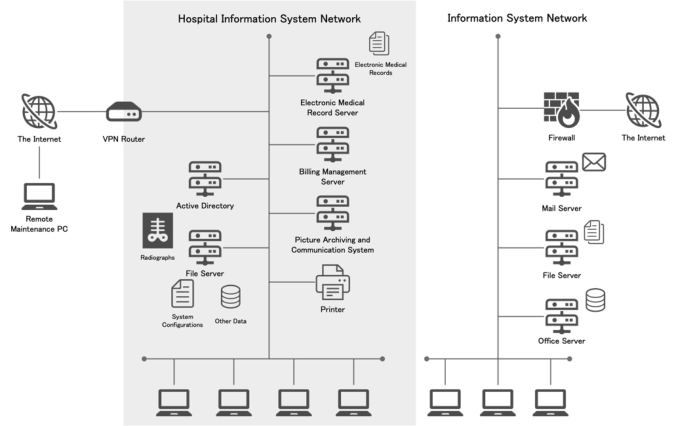
(2) Define a network configuration diagram Ransomware incidents caused system failures, mainly due to the encryption of the electronic medical record system (EMR), which resulted in the sus- pension of medical services. The VPN device that served as the intrusion route was used to maintain the hospital information system (HIS), and such a configuration is considered a typical HIS configuration. Based on these exam- ples, a diagram of the healthcare institution network configuration used in the exercise is shown in Figure 3. HIS network can be maintained via VPN from an external vendor and is logically separated from the adjacent IT net- work. The HIS network has a Picture Archiving and Communication System (PACS) that stores electronic medical records (EMR) and radiographs, and is characterized by a configuration different from that of IT networks.
(3) Definition of stakeholders of healthcare institutions (exercise partici- pants) The parties involved in incident response are organized in Table 2 based on incident cases, reports, and NIST SP 800–61 (Paul, 2012).
Incident Response Exercises and Methodologies to Guide Best Practices 249
Table 1. System failures of healthcare institutions reported in Japan in 2021-2022.
Table available in the original PDF paper.
No. Date Institution Detail Factor Unravel System failure (Tsukasa, 2021)
1 April 6, 2021 KAISEI Hospital, Kagawa
Unauthorized Access
2 May 31, 2021 Higashiosaka City Medical Center, Osaka
System failure (Masahiko, 2021)
3 October 1, 2021 Fuji Hospital, Shizuoka
System failure (Norio, 2021)
Unauthorized Access 4 October 31, 2021 Handa Hospital, Tokushima
Ransomware - Lockbit2.0 (Yasuhi, 2021) Virus System failure (Nikkei, 2022)
Unauthorized Access (via VPN vulnerability) 5 January 14, 2022 Nihon University School of Dentistry Dental Hospital, Tokyo
Ransomware (Masako, 2022)
Unauthorized Access
6 January 12, 2022 Kasugai Rehabilitation Hospital, Aichi
7 April 23, 2022 Aoyama Hospital, Osaka
Ransomware (Kota, 2022)
Unauthorized Access (via VPN vulnerability)
Unauthorized Access 8 June 19, 2022 Naruto Yamakami Hospital, Tokushima
11 December 3, 2022 Kanazawa Nishi Hospital, Ishikawa
Two of the most unique healthcare institutions are the medical department and other healthcare institutions in the same region. What each considers when an incident occurs is as follows.
Medical Department This department includes everything from weekday diagnostics and surgery to emergency outpatient services. When an incident occurs, it is necessary to consider suspending medical treatment, postponing surgery, or transferring the patient to other healthcare institutions.
250 Nakayama and Watanabe
Figure 3: System network configuration for exercise.Table 2. Stakeholders of incident response (bold letters are specific in healthcare institutions).
Table available in the original PDF paper.
Dependencies within Organizations Outside Parties
The Media
Management (Board of Directors)
Low Enforcement
IT Department
Administrative Department
Medical Department
Legal Department
Incident Reporting Organizations e.g. ISACs, other healthcare institutions
Public relations Department
Others e.g. ISP, Software Vendors
Other Healthcare Institutions Need to collaborate with other healthcare institutions in order to transfer patients who require emergency diagnosis or surgery, or to request an ambu- lance to be dispatched to the hospital. In a city with only a limited number of hospitals, it is necessary to take into account coordination in the event of an incident from the perspective of regional medical BCPs (Business Continuity Plan).
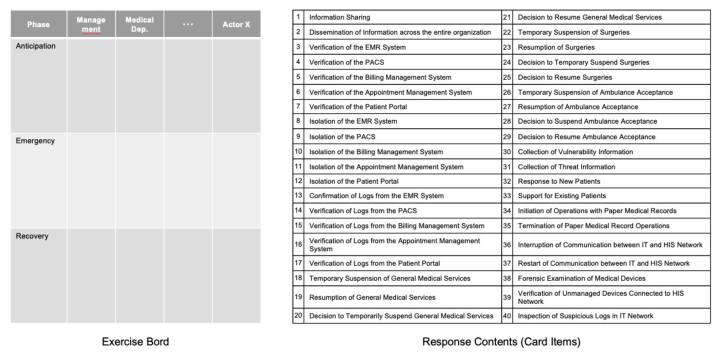
(4) Examine response contents and scripts Response items in the exercise were organized according to the system net- work configuration defined in Figure 3, based on previous research and incident case studies that have been published in detail (Davaadorj, 2018. Yasuhi, 2021. Takeshi, 2022). In addition, the scripts in the exercise were exercise stories (ISO, 2013) to help the participants understand how the
Incident Response Exercises and Methodologies to Guide Best Practices 251
events unfolded during the exercise, and these were examined in the antic- ipation, emergency, and recovery phases. The scripts for each phase are as follows, and the corresponding items are shown in Figure 4, along with an image of the exercise board.
Predictive Phase -Terminal operation of the HIS system deteriorates. -Time-consuming access to the file system on the IT system side. -EMR server freezes.
Emergency Phase -Ransomware threats are found on the printer. -EMR personal information is encrypted.
Recovery Phase -System could be restored using backups. -EMR is restored to normal operation.
Figure 4: Exercise bord (left) and response contents (right).
There is no specification of who is in charge of the items to be handled, and the exercise participants choose the items to be handled and place the cards on the exercise board according to the scripts that are introduced sequen- tially. By discussing in the exercise who will be in charge of the items on the cards, the participants aim to gain an awareness of the current status of the incident response system in their own organizations as well as the roles and functions that are lacking. These exercises are expected to improve the security awareness of participants.
Discussion & Challenge Cycling through the planning, execution, and improvement phases are essen- tial for exercises (ISO, 2013), but this paper is still on the planning stage. The
252 Nakayama and Watanabe
next steps are to conduct exercises in healthcare institutions and incorpo- rate feedback to enhance the exercises. In this exercise, response actions for the anticipation, emergency, and recovery phases are allocated to respective individuals. As these details become refined, the exercise board itself could serve as a quick reference manual. Regarding documentation, as decision- making processes are crucial, a chronological record of discussions during the exercise is required. Quantitative measurements, such as who gave what instructions and when, and the time taken for certain decisions during the exercise would identify bottlenecks in incident response.
In the future, building upon a refined exercise board or manual, abstract- ing the content, and organizing it into a matrix of tasks for each phase and individual could lead to identifying best practices for incident response in healthcare institutions.
CONCLUSION
This paper proposes an incident response exercise based on system failures in healthcare institutions in Japan from 2021 to 2022. The exercise flow should encompass planning, implementation, and subsequent improvement of the exercise itself. However, it is currently stalled in the planning stage. Next work aims to execute this exercise within healthcare institutions and enhance its overall effectiveness.
In the future, creating incident response manuals through exercises, or developing abstracted incident response matrices, could help in identifying best practices for incident response in healthcare institutions.
REFERENCES
Check Point Research Team. (January 5, 2023) Check Point Research Reports a 38% Increase in 2022 Global Cyberattacks. Check Point Website: https://blog.checkpo int.com/2023/01/05/38-increase-in-2022-global-cyberattacks/. Davaadorj, Nyambayar. (2018) Fundamental Study on Security Management Frame-
work for Critical Infrastructures based on Safety-II. Ph.D. thesis. Nagoya Institute of Technology. International Organization for Standardization [ISO]. (2013) ISO22398:2013 Societal security — Guidelines for exercises, Switzerland: ISO. Kaur, H., Alam, M. A., Jameel, R. (2018). A Proposed Solution and Future Direc-
tion for Blockchain-Based Heterogeneous Medicare Data in Cloud Environment. Journal of Medical Systems, 42(8). Kota, Kawano. (April 28, 2022) Unauthorized access to a hospital in Osaka, Japan.
The Asahi Shimbun Website: https://www.asahi.com/articles/ASQ4W71RWQ4W PTIL00J.html. Kruse, C. S., Frederick, B., Jacobson, T., & Monticone, D. K. (2017). Cybersecurity in healthcare: A systematic review of modern threats and trends. Technological Health Care, 25(1), pp. 1–10. doi: 10.3233/THC-161263 Masahiko, Tsutsui. (June 22, 2021) Downing of the Medical Image Reference System
Server (2nd Report). Higashiosaka City Medical Center Website: https://www.hi gashiosaka-mc.jp/news/notice/20210622_notice.html.
Incident Response Exercises and Methodologies to Guide Best Practices 253
Masako, Fukui. (June 19, 2022) Notice of System Failure due to (Suspected) Unauthorized Access. Kasugai Rehabilitation Hospital Website: https://www.kreh.or.jp /2022/01/19/3837/. Naruto Yamakami Hosipital. (June 20, 2022) Damage Caused by Cyber Attacks
(1st Report). Naruto Yamakami Hospital Website: https://kyujinkai-mc.or.jp/inf o/20220620/. Nikkei. (June 19, 2022) Nihon University School of Dentistry Dental Hospital Server infection Temporary suspension of acceptance. NIKKEI Website: https://www.ni kkei.com/article/DGXZQOUE196B20Z10C22A1000000/. Norio, Sonoda. (November 4, 2021) Apology and Notice Regarding System
Failure. Fuji Hospital Website: http://www.yuurinkouseikai.or.jp/info/20211104. asp. Paul, C. Thomas, M. Tim, G. (2012) NIST SP 800–61 Rev.2 Computer Security Incident Handling Guide, U. S.: National Institute of Standards and Technology. Takeshi, Shimazu. (May 23, 2023) Information Security Incident Investigation Com-
mittee Report. Osaka General Medical Center Website: https://www.gh.opho.jp/i mportant/785.html. Tazawa Iin. (November 1, 2022) Problems with Electronic Medical Records. Tazawa Iin Website: http://shinyoukai.or.jp/tazawa-clinic/news/20221101.html. Tsukasa, Fukuya. (April 14, 2021) Inability to view electronic medical records KAI-
from unauthorized access; some electronic medical records cannot be viewed. Nikkei Business Publications, Inc. Website: https://xtech.nikkei.com/atcl/nxt/ne ws/18/14283/?i_cid=nbpnxt_sied_blogcard
LISTED IN THE AHFE DIGITAL BOOKSTORE CATALOGUE
Explore the complete digital volume
Emerging Technologies in Healthcare and Medicine
Read this individual research paper free through the original publisher, or explore the full digital proceedings book.
ISBN 978-1-958651-92-6
Explore this ISBN in the AHFE Bookstore ↗Listed in the July 2026 bookstore catalogue; search by ISBN to confirm current availability · Digital book purchase optional