Alexander Gorovoj, Juergen Mueller (2023). Understanding Challenges and Facilitating Knowledge Transfer for Service Innovation: Insights from a Survey of German Service Companies and a Use Case. In: Application of Emerging Technologies. AHFE Open Access, vol. 115, pp. 224–233. https://doi.org/10.54941/ahfe1004319
Innovation is one of the key elements for entrepreneurial success. Small and medium-sized service companies in particular continually innovate their offerings to remain competitive. To do this, they must constantly keep abreast of trends, the latest technological developments, and scientific methodologies. Due to a shortage of resources, they are often dependent on external support from information service providers. However, this knowledge transfer is subject to hurdles that are specific to small and medium-sized enterprises. This paper examines the knowledge transfer challenges faced by such service organizations. To this end, it first presents the results of a company survey and derives recommendations for information provision. The paper concludes with a practical example of a company using the latest technologies to innovate its service offering and how such information is made available to other companies.
Service engineering encompasses designing, developing, and improving ser- vices to fulfill customer requirements and offer exceptional experiences. With the rapid advancement of emerging technologies such as artificial intelligence, blockchain, mixed reality, and robotics, organizations have unprecedented opportunities to revolutionize service delivery and create innovative business models, as well as overcome structural issues such as shortage of skilled personnel. The use of such technologies offers signifi- cant benefits to companies of all sizes. However, small and medium service businesses often face unique challenges in deploying and leveraging emerging technologies.
In Germany, small and medium service enterprises (SMEs) play a crucial role in driving economic growth and meeting the diverse needs of customers. However, limited resources, budget constraints, and a lack of specialized
Understanding Challenges and Facilitating Knowledge Transfer for Service Innovation 225
expertise often hinder their ability to adopt and implement emerging tech- nologies. The upfront costs associated with technology investments, includ- ing hardware, software, and infrastructure, can be prohibitive for smaller enterprises. Moreover, small and medium service businesses may lack the technical knowledge and skills necessary to evaluate, select, and implement emerging technologies effectively. The rapidly evolving nature of these tech- nologies can be overwhelming, and keeping up with the latest advancements may be challenging without dedicated IT departments or experts. This knowl- edge gap can deter businesses from taking the necessary steps to adopt and harness the potential of emerging technologies. Studies often show that small and medium-sized enterprises in Germany have a digitization gap compared to large companies (Löher et al., 2022; Meiren et al., 2022; Meiren et al., 2021; Schröder, 2015). Therefore, SMEs in particular require assistance from research service providers to innovate, as they generally lack their own research departments in contrast to larger corporations (Dienes et al., 2019). In their study, Bolwin et al. (2023) also conclude that cooperation between companies and research plays a central role in strengthening innovative capacity.
One of the primary challenges in harnessing emerging technologies for service innovation is understanding their potential and identifying the most suitable applications. Organizations must stay abreast of the latest tech- nological developments and evaluate their relevance to their specific ser- vice offerings and business models. Additionally, they need to assess the feasibility of integrating these technologies into existing service processes and infrastructure. Without access to up-to-date information, these busi- nesses may struggle to identify and evaluate suitable technologies for their needs. Furthermore, an efficient knowledge transfer from research institu- tions ensures that the valuable insights, methods, best practices, and lessons learned from successful technology implementations are shared with small and mid-sized service companies. This knowledge transfer can bridge the information gap, empower businesses with the necessary information and guidance, and enable them to make informed decisions when adopting and leveraging emerging technologies. To facilitate these efforts, the for- mats and channels preferred by small and medium-sized service companies for knowledge transfer as well as the right information recipients must be identified.
This paper therefore consists of two parts. In the first part, the results of a survey of German service organizations on their informa- tion acquisition are presented. The findings shed light on the chal- lenges for the service business, the obstacles to information acquisi- tion, and the desired forms of knowledge transfer. The second part of the paper focuses on a practical use case. It presents how a small company innovated its own service business by using digital tools and mixed reality applications, making its service processes more efficient, and how information about such innovations is disseminated to other service SMEs.
226 Gorovoj and Mueller
APPLIED SCIENCE INSTITUTIONS AS INFORMATION SERVICE PROVIDERS Customers play a central role in the development of services. For this, knowl- edge about the customer needs is crucial. According to Feibleman (1961), applied science can be seen as the link between basic science and the users. Thus, users can be considered as customers for applied science. The applied scientists, in turn, as service providers who supply the customers with infor- mation. To successfully provide this type of service, the service provider must understand its potential customers. In this respect, knowledge of the cus- tomers’ wishes and possible problems or challenges is of central importance for successful service provision.
SURVEY DESIGN An online survey is being conducted to investigate the information needs of service-providing companies. The preliminary results presented in this paper relate to the survey period June-August 2023. As part of the online sur- vey, 2027 German service-providing organizations were contacted directly by e-mail and invited to participate, of which 69 (as of August 2023) completed the survey in full. The response rate is therefore 3.4%. The partic- ipation was voluntary and anonymous. The questionnaire consists of three parts: 1. identifying new topics (9 questions), 2. developing new services (10 questions), and 3. general questions (7 questions). This paper aims to put a practical view on knowledge transfer from applied science to practice. Therefore, the results presented here refer to part 1 of the questionnaire. Par- ticipants have the option to skip answer options or entire questions. 29 of the organizations surveyed so far have fewer than 250 employees, while 38 have more than 250 employees, with one abstention. The range is between 1 and 27000 employees (see Appendix for characterization of services offered).
Taking only the number of employees into consideration, following the recommendation of the European Commission (2003/361/EC, 2003) accord- ing to the classification of companies as small and medium-sized enter- prises (SMEs), 43% of the companies surveyed so far can be classified as SMEs.
CHALLENGES THAT LEAD TO CHANGES IN SERVICE OFFERINGS To understand which challenges are currently driving companies and leading to changes in their service offering, the following question was asked: “How much do the following challenges change your company’s service offering?” The response scale has a five-point structure, ranging from “very low” to “very high.” The results are presented in Table 1.
The results show that digital transformation and labor shortage are two challenges that are changing the service offerings of companies the most. A Mann-Whitney U test showed no significant differences in the responses between SMEs and larger organizations, indicating that the results are valid for both SMEs and large organizations.
Understanding Challenges and Facilitating Knowledge Transfer for Service Innovation 227
Table 1. Overview of survey results (N = 68) for the question “how much do the following challenges change your company’s service offering?” (1=very low, 5=very high).
Table available in the original PDF paper.
M SD SE Digital transformation 4.21 .856 .104 Labor shortage 3.87 1.021 .139 Climate change and sustainability 3.26 1.180 .124 New legal requirements (e.g. Supply Chain Act) 3.00 1.327 .129 Inflation 2.97 1.065 .133 Energy prices 2.93 1.150 .143 Internationalization 2.93 1.097 .158 Supply shortages 2.91 1.301 .161 Others 2.65 1.427 .256
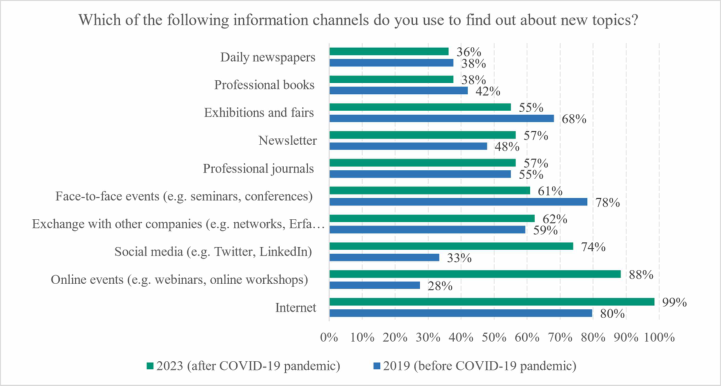
CHANGED INFORMATION CHANNELS For applied science, the transfer of knowledge from research to practice is of vital importance. To ensure that research results reach practitioners, know- ing their preferred information channels is crucial. The COVID-19 pandemic has drastically changed the way people access new information. This is also shown by the results presented in Figure 1.
Figure 1: Relative distribution of the use of various channels for obtaining information (N = 69).
The results show that the use of various information channels has changed, in some cases quite significantly. The Mann-Whitney U test showed no significant differences in the responses between SMEs and larger organiza- tions. While before COVID-19 only 80% of respondents used the Internet to obtain information, in 2023 it is used by almost all respondents with 99%. Online events also received a dramatic increase (from 28% to 88 %), while face-to-face events (78% before COVID-19 and 61% after the COVID-19
228 Gorovoj and Mueller
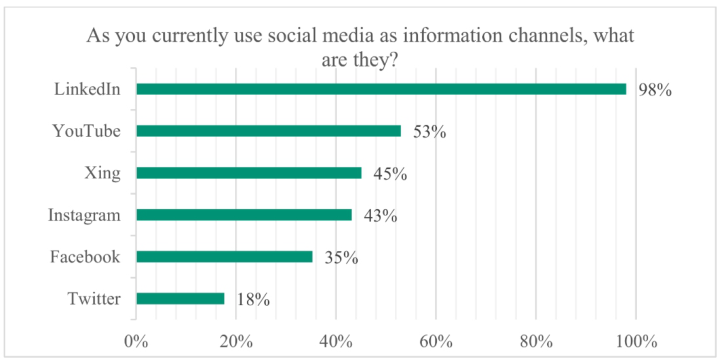
pandemic), as well as exhibitions and fairs (78 % before COVID-19 and 61% after COVID-19 pandemic), suffered a significant decrease. During the same period, the use of social media to obtain information more than doubled from 33 % to 74%. Those respondents who indicated that they cur- rently use social media as a source of information were then asked to indicate which platforms they use for this purpose. From the results (Figure 2), it is clear that with 98% of N = 51 respondents, almost all use LinkedIn as an information channel, while YouTube is used by about one in two (53%). In contrast, Xing (45%), a German-based LinkedIn competitor, Instagram (43%), and Facebook (35%) are used by less than half of the respondents. Of the six social media networks, Twitter (or more recently X) is used the least for information gathering (18%). Also, in this case, the Mann- Whitney U test showed no significant differences between SMEs and large organizations.
Figure 2: Distribution of the use of various social media channels for obtaining information (N = 51).
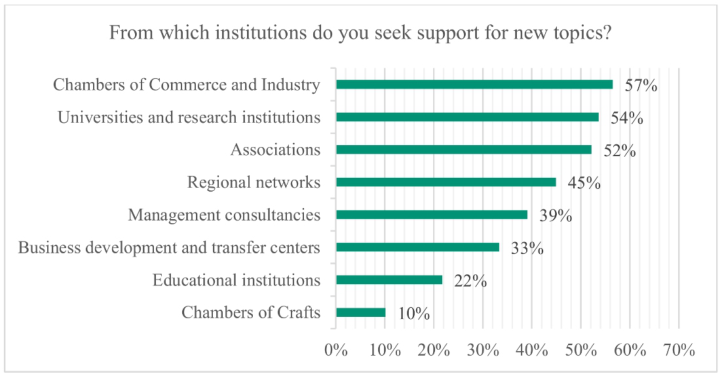
Alongside social media as a source of information, a closer look at the networks and institutions used by the organizations as information service providers is also of interest. To that end, survey participants were asked to answer the question “From which institutions do you seek support for new topics?”. Participants could indicate from a list of different institutions from which they seek support on new topics. Furthermore, they were able to name institutions that were not included on the list.
The results (N = 69) in Figure 3 show that more than every second respon- dent organization seeks support on new topics from Chambers of Commerce and Industry (57%), universities and research institutions (54%) as well as associations (52%). 45% of respondents receive support from regional net- works, while 39% receive support from management consultancies. Every third respondent organization (33%) seeks support from business develop- ment and transfer centers. Educational institutions (22%) and Chambers of Crafts (10%) are less popular, according to feedback. A calculated Mann- Whitney U test again suggests that there are no significant differences between SMEs and large organizations in the sample.
Understanding Challenges and Facilitating Knowledge Transfer for Service Innovation 229
Figure 3: Overview of the frequencies of responses to the question “from which institutions do you seek support for new topics?” (N = 69).
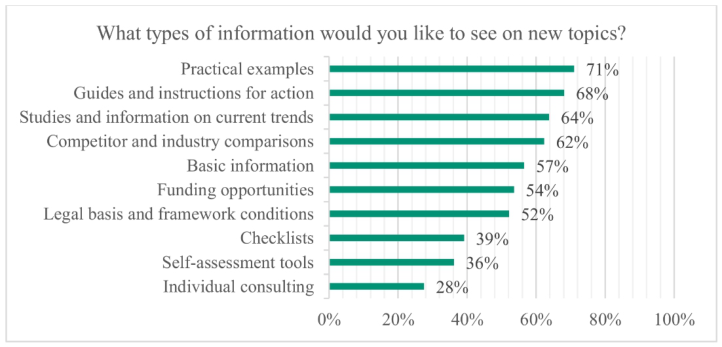
INFORMATION WITH PRACTICAL RELEVANCE IS PREFERRED To efficiently and effectively present research findings, applied science as an information service provider must understand not only how their customers acquire information, but also their desired information types. For this purpose, respondents were asked, “What types of information would you like to see on new topics?”. The desired types of informa- tion could be selected from a list of various options. In the “Other” field, the participants also had the opportunity to complete the answer option on an individual basis. The results (N = 69) can be seen in Figure 4.
Figure 4: Overview of the frequencies in the selection of the desired information types (N = 69).
230 Gorovoj and Mueller
Accordingly, the respondents most desire practical examples (71%) as an information type, followed by guides and instructions for action (68%). Likewise, studies and information on current trends (64%) as well as com- petitor and industry comparisons (62%) meet with predominantly great interest. More than every second respondent wants basic information on new topics (57%), information about funding opportunities (54%), and legal basis and framework conditions (52%). Less popular are checklists (39%), self-assessment tools (36%), and individual consulting (28%).
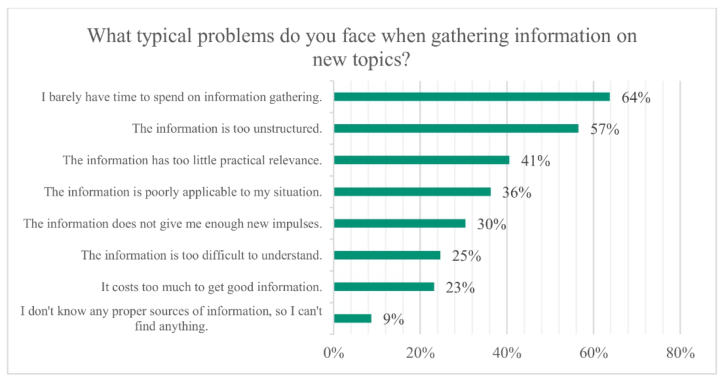
TIME AS A CRITICAL FACTOR IN INFORMATION GATHERING As mentioned before, not only is knowledge of customer needs important for service design, but service providers should also be aware of any problems or obstacles customers may encounter in service delivery. Therefore, respon- dents were asked about their typical problems in obtaining information on new topics. Similar to the question before, they could choose the most rel- evant ones for them from a list of given answer options. They could add a response option in the “others” field. As in the previous questions, the num- ber of possible answers was not limited. The results (N = 69) can be seen in Figure 5. The lack of time to gather information is the most frequently mentioned problem (64%). 57% of the respondents also criticize the lack of structure of information, while 41% complain about the lack of practical rel- evance. 36% of respondents complain about the lack of practical relevance of the information and 30% believe that the information does not give them any new impulses. Barely one in four feel that the information is difficult to understand (25%), while 23% see the cost of obtaining good information as a problem. Very few (9%) report that they do not know of suitable sources of information. The Mann-Whitney U test showed no significant differences in responses between SMEs and larger organizations.
Figure 5: Overview of the frequencies of the mentioned problems in obtaining information (N = 69).
Understanding Challenges and Facilitating Knowledge Transfer for Service Innovation 231
RECOMMENDATIONS Technological transformation is leading to numerous changes in the way work is conducted and information is exchanged. As the results show, the information channels through which organizations obtain information about new topics have changed, in part drastically. The application-oriented scien- tific institutions as information service providers for these organizations must respond to the wishes and problems of their customers, to provide them with the required information in a targeted and efficient manner. The following recommendations for the provision of information can thus be formulated from the results.
1. Be aware of the challenges and issues your customers are facing:
Digital transformation, labor shortage, and climate change and sustainability are the three most cited challenges for German service- providing organizations. 2. Serve your customers’ information channels - Internet first: After the COVID-19 pandemic, online information channels are favored. Almost every respondent uses the Internet as a source of infor- mation. Online events and social media are highly popular as well. More than half of the survey participants exchange information on new top- ics with other companies, attend face-to-face events, read professional journals and newsletters, and visit exhibitions and fairs. Only a good third use professional books and daily newspapers to find out about new topics. 3. Keep it short and simple - with a high practical relevance:
The majority of respondents complain about having too little time to gather information and that the information they receive is too unstruc- tured. Information service providers should take this into account and prepare their information offering in such a way that it is easy to find, understandable, and can be absorbed quickly. The information should also have a high practical relevance. 4. Cooperate with other information service providers: The organizations surveyed seek support from various information service providers. By cooperating with other institutions, information can be distributed more widely and thus reach more users.
A USE CASE The digital transformation poses numerous challenges and is changing the range of services offered by many companies. The use of new technological developments and digital tools still has a great potential for value creation in brick-and-mortar retail, for example. However, smaller businesses in par- ticular have to overcome numerous challenges, such as a lack of resources (Meiren & Khan, 2023), and frequently rely on external support. To remain competitive, the service offering should constantly be adapted to cus- tomer requirements. For instance, the COVID-19 pandemic has influenced the shopping behavior of numerous people (Grimmer, 2022). In addition, younger generations are expecting more and more digital services (Kemmer et al., 2023).
232 Gorovoj and Mueller
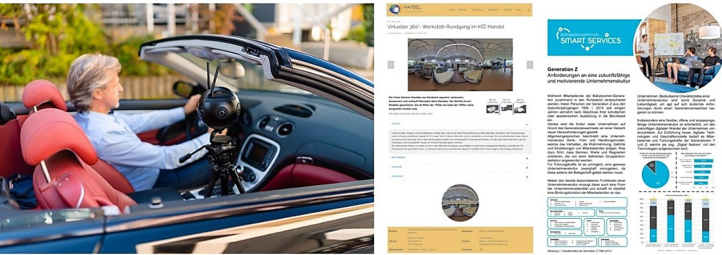
Following technological innovations, a small company specializing in the dealership, maintenance, and repair of classic automotive vehicles is using 360-degree footage to expand its range of services and increase efficiency. In addition to a 360-degree tour of the sales and workshop areas, the com- pany is working with partners on a virtual test drive (Figure 6, left). After all, test drives carried out together with customers cost time that is not avail- able elsewhere, e.g. for repairs. According to retailers, “test drive tourism”, where customers are only interested in a test drive but have no intention of buying, is also a problem. Here, a virtual test drive can provide a solution. For this purpose, a 360-degree camera is fixed on the passenger seat and connected to the Internet via a mobile 5G modem. Interested customers can follow the test drive via a live YouTube stream, e.g., using a virtual reality headset. Communication with the driver is possible via chat or a separate audio connection.
To inform a large number of SMEs in a targeted manner about such and other service innovations, a multi-channel and multi-format approach is being pursued in the two projects “Innovative Retail” and “Smart Ser- vices Competence Center”. To this end, the practical examples of innovative companies are presented in brief form on the project homepages as so-called “courage makers” (Figure 6, center). Knowledge nuggets” (Figure 6, right) are another format. Here, the most important information on a particular topic is presented incrementally in easy-to-understand language in a compact form so that it can be absorbed quickly. To serve the preferred information channels of potential users, practice-relevant video podcasts are published on YouTube, LinkedIn, and Instagram. Online and offline events as well as net- works and collaborations with other information service providers are also used to promote innovation diffusion across a wide range of industries.
Figure 6: Virtual test drive (left), example for courage maker (middle), example for knowledge nugget (right).
APPENDIX
To preserve the anonymity of the respondents, the survey did not explicitly ask about the services offered by the companies. Instead, 38% of participants stated that the use of technology in their service offering is high to very high (“medium”: 35%), while 57% say that the use of personnel is high to very high (“medium”: 19%).
Understanding Challenges and Facilitating Knowledge Transfer for Service Innovation 233
ACKNOWLEDGMENT
This work has been funded by the German Federal Ministry of Education and Research (BMBF) through the Project “ProTraFo_2025 (No. 16WIT020B).
The authors would also like to acknowledge the Ministry of Economic Affairs, Labor and Tourism Baden-Wuerttemberg for partly funding this work within the Projects “Handel innovativ”and “Kompetenzzentrum Smart Services”.
REFERENCES
Bolwin, L., Kempermann, H., & Klink, H. (2023). Innovative Milieus 2023: Die Innovationsfähigkeit der deutschen Unternehmen in Zeiten des Umbruchs (1. Auflage). Verlag Bertelsmann Stiftung. Commission Recommendation of 6 May 2003 concerning the definition of
micro, small and medium-sized enterprises, Official Journal of the Euro- pean Union, L 124, 20 May 2003 (2003). https://eur-lex.europa.eu/legal- content/EN/TXT/?uri=celex:32003H0361 Dienes, C., Ivens, S., Nielen, S., Wolter, H.-J., & Nüse, L. (2019). Produktivität von kleinen und mittleren Unternehmen in Deutschland. https://doi.org/10.11586/ 2022025 Feibleman, J. K. (1961). Pure Science, Applied Science, Technology, Engineering: An
Attempt at Definitions. Technology and Culture, 2(4), 305–317. https://doi.org/ 10.2307/3100886 Grimmer, L. (2022). Lessons from the COVID19 pandemic: The case of retail and consumer service firms. Journal of Retailing and Consumer Services, 68, 103012. https://doi.org/10.1016/j.jretconser.2022.103012 Kemmer, J., Schweiger, S., & Taubert, J. (2023). Studie zu den Anforderungen und
Erwartungen der Generation Z an den Einzelhandel. https://doi.org/10.24406/pu blica-1390 Löher, J., Brink, S., Becker, F., Icks, A., Schneck, S., & Schröder, C. (2022). Digitalisierungsprozesse von KMU im Verarbeitenden Gewerbe - Folgebefragung. IfM-Materialien (No.291). Bonn. https://hdl.handle.net/10419/249920 Meiren, T., Friedrich, M., Gorovoj, A., & Schiller, C. (2022). Smart Services als Erfol-
gsfaktor für Dienstleister. In Smart Services: Mit digitalen Dienstleistungen in die Zukunft (1. Auflage, pp. 9–17). LOG_X Verlag. Meiren, T., Friedrich, M., & Schiller, C. (2021). Smart Services. Mit digital unterstützten Dienstleistungen in die Zukunft. https://doi.org/10.24406/PUBLICA-FH G-301164 Meiren, T., & Khan, I. (2023). New digital ways of creating value in retail. In AHFE
International, The Human Side of Service Engineering. AHFE International. https://doi.org/10.54941/ahfe1003135 Schröder, C. (2015). Auf dem Weg zur vernetzten Wertschöpfung - Existiert eine Digitalisierungslücke im deutschen Mittelstand? https://doi.org/10.13140/RG.2. 1.2982.1609
LISTED IN THE AHFE DIGITAL BOOKSTORE CATALOGUE
Explore the complete digital volume
Application of Emerging Technologies
Read this individual research paper free through the original publisher, or explore the full digital proceedings book.
ISBN 978-1-958651-91-9
Explore this ISBN in the AHFE Bookstore ↗Listed in the July 2026 bookstore catalogue; search by ISBN to confirm current availability · Digital book purchase optional