Zhang Jifa, Wang Hongrui, Liu Yiwen, Lin Yinyin, Huang Zile (2023). Effects of Diabetic Sole Design with Auxetic Structure on Reducing Plantar Peak Pressure. In: Human-Centered Design and User Experience. AHFE Open Access, vol. 114, pp. 79–83. https://doi.org/10.54941/ahfe1004224
By 2035, the global prevalence of diabetes is estimated to reach 532 million. Foot ulcers, as a complication of diabetes, are particularly important to prevent in diabetic patients by regulating plantar pressure. Inspired by the mechanical properties of auxetic materials, a auxetic diabetic shoe was designed. The study utilized finite element analysis to compare the mechanical properties of the 3D auxetic lattice midsole with the traditional hexagonal lattice midsole, including peak pressure, peak displacement, stress energy, and viscous energy dissipation. The analysis of the mechanical properties of the auxetic structure provides valuable insights for the design of diabetic footwear soles.
Compared to diabetic shoes with conventional PU foam heel pads, heel pads with an auxetic re-entrant honeycomb structure have significantly lower peak contact forces and average pressures on the heel (Leung, Yick, Sun, Chow, & Ng, 2022). Seats with auxetic structures can reduce contact stresses between the human body and the seat, making them more comfortable than regu- lar seats (Jasi´nska, Janus-MIchalska, & Smardzewski, 2012). The auxetic properties of auxetic materials allows for an even distribution of stress, mak- ing them an excellent choice for cushioning to prevent injuries in elderly or disabled people (Yang, Vora, & Chang, 2018). Auxetic materials reduce impact peak acceleration by 6 times compared to typical foams when sub- jected to a rigid hemisphere impact (Allen et al., 2015). Numerous studies have shown the potential of auxetic materials for sports protection (Allen et al., 2015; Duncan et al., 2018). Han et al., (2022) designed auxetic materi- als that not only improve energy-absorbing properties but also have excellent
lightweight characteristics. Michalski and Strek (2019) revealed that the re- entrant auxetic structure has higher fatigue strength than the non-auxetic honeycomb structure through finite element analysis. Compared with con- ventional honeycomb structures, Lang et al., (2023) found that re-entrant honeycomb structures have better load-bearing performance and energy absorption capacity. Because of the unusual advantages of compression and cushioning, lightweight, and fatigue resistance, this kind of structural mate- rial is potentially valuable in footwear design, especially in diabetic footwear design.
Considering that the sole is often used as a solid component in the con- struction of the entire shoe, designers can optimize the pressure-reducing and cushioning properties of the entire shoe by adjusting the design of the sole in order to create a shoe that prevents diabetic foot ulcers or assists in ulcer healing. Auxestic structures have been shown to have excellent properties in various applications. However, the ability to optimize plantar pressure in shoe sole design has yet to be adequately investigated.
METHODOLOGY
In order to achieve the objective of this research, experiment employed the 3D re-entrant hexagonal honeycomb lattice structure proposed by Evans (1994) and designed a shoe sole (a) for diabetic foot patients. Additionally, shoe sole (b) with traditional hexagonal honeycomb structure was designed as the control group for the experimental study. The model of the shoe soles were built by Rhino 3D modelling software and the grasshopper parametric design plugin.
According to the mathematical model proposed by Gibson and Ashby, the elastic modulus of the 3D re-entrant honeycomb structure is significantly influenced by the diameter of lattice ribs. To minimize additional confound- ing factors, the thickness of the lattice ribs was controlled in both sole design schemes employing the two types of lattices. To ensure that the density of the sole material had a uniform influence on sole performance across the 3D spatial extent of the lattice, the lattice was uniformly arranged. Each sole fea- tured a longitudinal arrangement of 2 unit cells of the lattice. The weights of sole (a) and sole (b) were 148g and 107g respectively.
The study utilized Abaqus finite element analysis software to construct a coupled model of the foot, sole, and ground. The experiment simulated the interaction forces and effects between the sole and the foot during walk- ing. The analysis encompassed aspects such as peak pressure magnitude and distribution, maximum displacement and distribution, as well as energy dissi- pation. During the finite element analysis process, walking was characterized by five gait events (heel strike, early stance, midstance, late stance, and toe- off) (Moayedi, Arshi, Salehi, Akrami, & Naemi, 2021). Based on a global coordinate system fixed on the ground, three angles (α, β, γ ) representing the foot during each of these five stance events were introduced to represent the gait pattern within a gait cycle. According to research of Moayedi et al., (2021), The 3D foot orientation angles (α, β, γ ) are given in Table 1.
Effects of Diabetic Sole Design With Auxetic Structure 81
Table 1. Material properties and element types of different parts of the model.
Table available in the original PDF paper.
Toe off
Heel strike
Early stance
Mid- stance
Late stance Roll(α)
(Rotation around x axis) 10.82 9.49 6.21 3.04 7.59 Pitch(β)
(Rotation around x axis) 5.58 −2.13 −3.26 −6.81 −34.00 Yaw(γ )
(Rotation around x axis) 16.08 14.01 13.23 13.76 14.07
RESULTS AND DISCUSSION
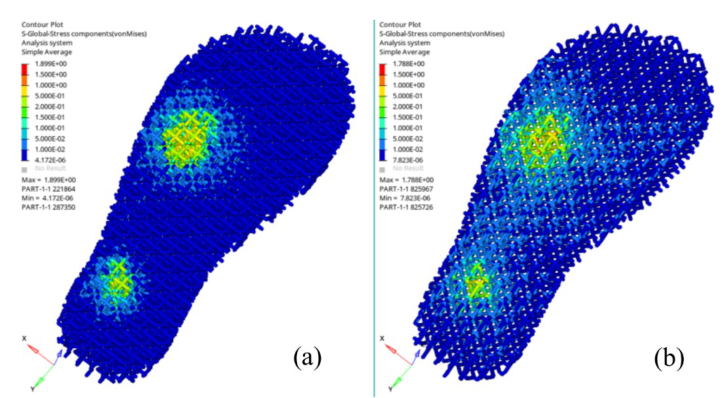
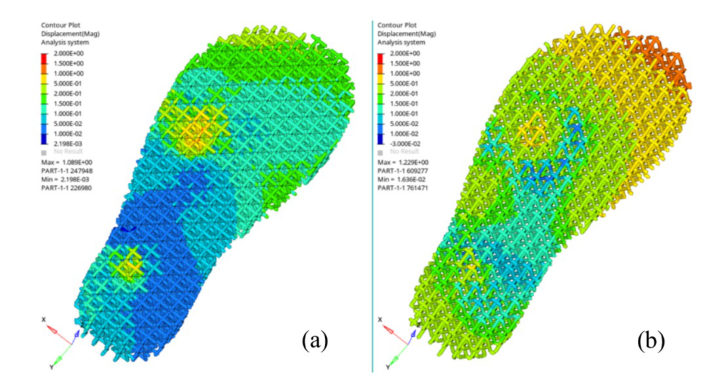
The impact forces representing walking were applied to two different shoe sole structures, and the stress and displacement distribution results are shown in Figure 1 and Figure 2, respectively. By observation, it can be noted that the highest pressure peaks during the walking process are located at the heel and forefoot. This signifies that both of these regions are high-pressure peak areas.
According to Figure 1, the stress peak for insole (a) is 1.9 MPa, and for insole (b), it is 1.8 MPa. The analysis results indicate that the stress peaks for both are approximately equal. However, insole (b) has a mass of 41g less than insole (a). Given that the stress peaks are similar, it suggests that the structural design of insole (a) is considered more effective in reducing plantar pressure. According to Figure 2, the deformation peak for insole (a) is 1.1 mm, while for insole (b), it is 1.22 mm. Due to the lower mass and thus lower equivalent density of insole (b), the deformation peak is slightly higher.
Figure 1: Maximum stress distributions of midsoles with auxetic structure (a) and traditional hexagonal structure (b).
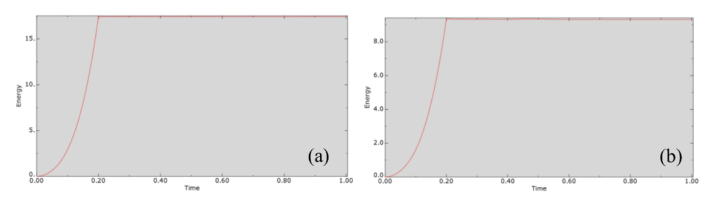
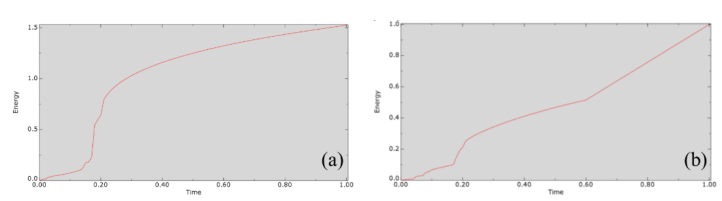
The variations in losses over time were analyzed as Figure 3 and Figure 4. According to these results, the highest energy loss is associated with insole (a). Due to its auxetic structure, insole (a) absorbs more energy, with the highest strain energy and viscous energy losses. In other words, insole (a) dissipates a
greater amount of energy, enabling it to absorb more energy. Greater energy absorption by the insole can help reduce the impact of physical activity on the feet of diabetic patients, thereby minimizing potential injuries.
Figure 2: Maximum displacements of midsoles with auxetic structure (a) and tradi- tional hexagonal structure (b).Figure 3: Strain energy comparison between midsoles with auxetic structure (a) and traditional hexagonal structure (b).Figure 4: Viscosity dissipation comparison between midsoles with auxetic structure (a) and traditional hexagonal structure (b).
Effects of Diabetic Sole Design With Auxetic Structure 83
CONCLUSION
The study employed a 3D-printed linear viscoelastic material for simu- lating walking. The innovation lies in comparing the mechanical differ- ences between the auxetic structure and traditional honeycomb structures. Through this research process, it was determined how internal pattern designs in shoe midsoles can cater to the needs of specific user groups. The study explored the impact of different internal pattern structures on plantar pressure for shoe soles with the same volume. This provides valuable insights for optimizing the mechanical performance of shoe soles designs.
However, this study still has certain limitations. It was challenging to con- trol the quality of the shoe soles during the design process, and the quality of the experimental group and the control group was not well controlled. This is an aspect that needs further refinement in future research. Based on the comparison of sole design and mechanical performance, this study brings new innovations to the field of custom 3D-printed footwear.
ACKNOWLEDGMENT
This research is supported by Guangdong Provincial Education and Science Planning Project (Project number: 2022GXJK184).
REFERENCES
Allen, T., Shepherd, J., Hewage, T., Senior, T., Foster, L., & Alderson, A. (2015). Lowkinetic energy impact response of auxetic and conventional open-cell polyurethane foams. physica status solidi (b), 252(7), 1631–1639. Duncan, O., Shepherd, T., Moroney, C., Foster, L., Venkatraman, P. D., Winwood, K., ... Alderson, A. (2018). Review of auxetic materials for sports appli- cations: Expanding options in comfort and protection. Applied Sciences, 8(6), 941. Han, D., Ren, X., Zhang, Y., Zhang, X. Y., Zhang, X. G., Luo, C., & Xie, Y. M.
(2022). Lightweight auxetic metamaterials: Design and characteristic study. Composite Structures, 293, 115706. Jasi´nska, D., Janus-MIchalska, M. g., & Smardzewski, J. (2012). A study on the design of auxetic structure of seat skeleton. Mechanics and Control, 31(2), 72–76. Lang, J. P., Jiang, W., Teng, X. C., Zhang, X. G., Han, D., Hao, J.,... Qin, Q. H. (2023).
Assembled mechanical metamaterials with transformable shape and auxeticity. Construction and Building Materials, 378, 131181. Leung, M. S.-h., Yick, K.-l., Sun, Y., Chow, L., & Ng, S.-p. (2022). 3D printed auxetic heel pads for patients with diabetic mellitus. Computers in Biology and Medicine, 146, 105582. Michalski, J., & Strek, T. (2019). Fatigue life of auxetic re-entrant honeycomb struc-
ture. Paper presented at the Advances in Manufacturing II: Volume 4-Mechanical Engineering. Moayedi, M., Arshi, A., Salehi, M., Akrami, M., & Naemi, R. (2021). Associations between changes in loading pattern, deformity, and internal stresses at the foot with hammer toe during walking; a finite element approach. Computers in Biology and Medicine, 135, 104598. Yang, C., Vora, H. D., & Chang, Y. (2018). Behavior of auxetic structures under
compression and impact forces. Smart materials and structures, 27(2), 025012.
LISTED IN THE AHFE DIGITAL BOOKSTORE CATALOGUE
Explore the complete digital volume
Human-Centered Design and User Experience
Read this individual research paper free through the original publisher, or explore the full digital proceedings book.
ISBN 978-1-958651-90-2
Explore this ISBN in the AHFE Bookstore ↗Listed in the July 2026 bookstore catalogue; search by ISBN to confirm current availability · Digital book purchase optional