Valeria Bopp-bertenbreiter, Doreen Engelhardt, Lena Rittger, Athina Kalmbach, Harald Widlroither, Matthias Peissner (2023). From Technologies to Positive User Experiences in Cars – Phase I: Developing a Human-Centered Technology Profile as a Starting Point for Innovative Solutions. In: Human-Centered Design and User Experience. AHFE Open Access, vol. 114, pp. 658–668. https://doi.org/10.54941/ahfe1004286
Publisher statistics will load when you open Metrics.
AHFE OPEN ACCESS OPEN ACCESS CONFERENCE PROCEEDINGS PAPER
From Technologies to Positive User Experiences in Cars – Phase I: Developing a Human-Centered Technology Profile as a Starting Point for Innovative Solutions
Information on novel interaction technologies is still being stored in a rather disorganized manner in many companies today, therefore, a more systematic approach is needed. Existing methods for standardized description of technologies focus the technological development approach and neglect human-centricity. To address this gap, the authors propose the Human-Centered Technology Profile (HCTP) that combines traditional Technology Management components with a human-centered perspective. The HCTP involves four steps, including conventional technology profile development, analyses of technical as well as user-described functions, classifying the technology concerning its user perceptibility, and sketching three possible scenarios for “technology futures”. The HCTP was applied and evaluated for three technologies in the automotive industry and applied research. Results demonstrate the method's fundamental applicability and highlight optimization potentials as perceived by participating technology experts. The discussion focuses on the HCTP’s optimization potentials and what to change in the next iteration.
Effectively managing information about (novel) technologies within organi- zations poses a challenge (Stelzer and Brecht, 2014), as such information often exists in a highly unstructured manner, e.g., e-mails, presentations etc. (Schuh et al., 2021). Furthermore, integrating a user-centered perspective early on is crucial to develop for positive user experiences (PUX) (Rittger and Schrader, 2022). In the automotive industry, an emphasis on PUX often
From Technologies to Positive User Experiences in Cars – Phase I 659
only emerges in later stages of product development (evaluation studies) or is omitted entirely when the start of production date intensifies pressure on timelines and resources. Thus, even User Experience (UX) teams fall back into technology-centered development (Frison and Riener, 2022).
Also, technology experts are used to a technological view and need guid- ance to switch to a PUX perspective (Rittger and Schrader, 2022). Therefore, establishing a systematic process is necessary to support technology experts in prioritizing PUX. In this paper, we detail Phase I of the Tech4PUX approach (Bopp-Bertenbreiter et al., 24.07.2022). Phase I prioritizes a human- and PUX-perspective for further development of existing technological solutions and acknowledges the technology push-viewpoint so well-known to engi- neers. For the approach to be most effective, first functional prototypes for the analysed technology should exist.
Related Work: Approaches for Standardized Description of Technologies In the following section, we give a brief overview on different approaches from traditional Technology Management to describe a technology in a standardized way and analyse them regarding our goal of a human- centered technology description. Existing methods for standardized descrip- tion of novel technologies like the Technology Readiness Level, Technology Portfolios, and Technology Roadmaps (Stelzer and Brecht, 2014; Schuh et al., 2021) emphasize technological perspectives and neglect the users’ viewpoint.
A Technology Portfolio is an instrument to identify and describe a tech- nology’s attractiveness for a company and the company’s resource strength regarding the technology. The applicants of the technology portfolio first identify technologies of interest, then determine their attractiveness (accep- tance, potential for further development, range of possible applications, compatibility) and the resource strength (technical level of control, poten- tials, (re)action speed, patents). Then the future technology portfolio is estimated. In a last step, strategy recommendations are being estimated to reach the desired situation (Pfeiffer and Dögl, 1997). As this instrument focusses on strategic development without regarding the user, this work does not incorporate it in its solution approach. If resources allow it, however, a technology portfolio can be applied along our Human-centered Technology Profile.
Another instrument for standardized technology description are technol- ogy profiles. They include the technology’s name(s) and its group, a summary of the operation principle as text and image, the technology’s strengths and weaknesses – n general and related to a specific application case, outlines possible application scenarios and resources related to the technology, such as contacts and technology providers (Wellensiek et al., 2011). For our pur- pose, the advantage of the technology profile lies in its efficient summary of technology-related information but is neglecting the user’s point of view. We chose to use a technology profile as the basis of our work and augmented it with components that focus the user’s point of view.
A different possibility of describing a technology, i.e., its maturity, in a standardized way is a technology readiness level. The widely used Nasa Technology Readiness Scale (TRS) distinguishes technology maturity from Level 1– “Basic principles observed and reported”to Level 9 – “flight proven through successful mission operations” (Mankins, 06.04.1995). While the TRS levels might not be applicable in the automotive sector, we incorporated an indicator of technology readiness of practical relevance in the automotive context: production readiness.
In traditional Technology Management, there are initial approaches towards a more user-centered technology development. For example, Bauer et al. (2019) transferred future application scenarios for the technology of automated driving, which they created using the classic scenario technique, into a virtual reality. Different users then experienced these scenarios and rated their user acceptance.
Approaches for Human-Centered Description of Technologies To our knowledge, literature on human-centered description of technologies is currently scarce. A literature review conducted in the SCOPUS database in July 2023 using the query “human-centered OR user-centered AND technol- ogy AND description OR profile” on article title, abstracts and keywords yielded only a few relevant results: Excluded literature described user- centered design conducted for specific technologies or application domains rather than universally applicable, human-centered descriptions or classifica- tion taxonomies of technologies.
A promising approach we found during our literature search is Aug- stein and Neumayr’s (2019) human-centered taxonomy of input and output devices and modalities, as it enables a systematic, human-centered description of the information channels of technical systems with humans. The taxonomy is based on human perception’s functional ranges rather than the technical possibilities of devices. We extend the human-centered taxonomy to tech- nologies and to include the processing of information based on the model of human information processing (Wickens and Carswell, 2021). The taxonomy is further used to identify sensory input or feedback channels the analyzed technologies is currently missing, to address possible support technologies needed for a wholesome interaction with the technology early on in product development.
To address the gap identified in Technology Management – a human- centered, but standardized description of technologies to enable inno- vative and user-centered solutions – we propose the Human-Centered Technology Profile (HCTP) that combines traditional technology pro- files with a human-centered perspective right from the beginning. To achieve this, we leverage components from conventional Technology Management approaches and augment them with user-centered elements. This approach considers developers’ and stakeholders’ habituation to a technology-centered perspective; however, a user-centered viewpoint should be adopted as early as possible even in a technology-push driven development.
From Technologies to Positive User Experiences in Cars – Phase I 661
METHOD: DEVELOPING THE HUMAN-CENTERED TECHNOLOGY PROFILE The HCTP aims at providing a user-centered, standardized, communicable description of an emerging interaction technology. The input for the HCTP consists of the unstandardized knowledge of the respective experts on the analysed technology. Therefore, the HCTP is designed to fulfil four goals: 1) document the unstandardized knowledge on the basics of the technology in a standardized way, 2) describe the technology in a way that is understandable for laypersons/users, 3) identify which human sensory channels the technol- ogy addresses – in an efficient way, and 4) document possible technological development paths of the technology for the next 5–10 years as well as its probable production readiness.
The objectives are specifically implemented through four methodological steps, which are designed to be applicable in a half-day workshop to account for the required resource efficiency in practice. The systematic Tech4PUX process, which’s first phase is presented in this paper, should be moderated by UX experts. Experts for the respective technology – for technological development as well as application – should take part in the workshops as participants only, allowing them to focus on documenting their knowledge on the technology. If possible, external technology experts, such as repre- sentatives from academia and technology-focused companies, can also be invited. However, this might not always be possible due to resource restric- tions and confidentiality. UX experts, on the other hand, are particularly suited to guide their technological colleagues through a human-centered technology description, due to UX experts’ familiarity with the human- centered perspective and workshop experience. As moderators, UX experts should continuously refocus their participants’ attention on the users’ per- spective. This serves as a first step towards technological implementation that focus PUX.
The result of conducting the HCTP is a standardized documentation on the technology with a focus on the users’ perspective.
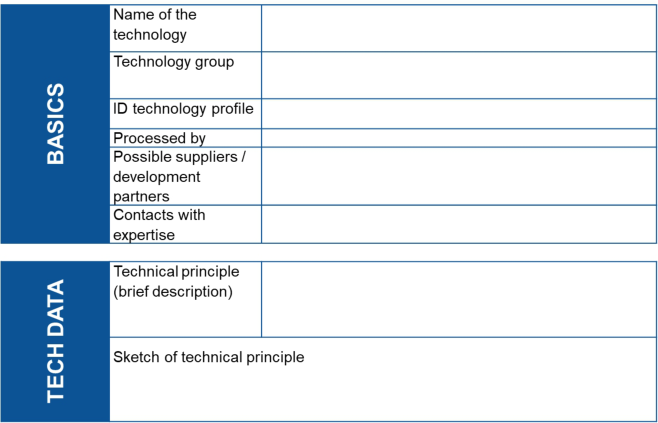
HCTP Step 1 – Standardized Documentation of Technology Information The aim of this step is to document the known information about the analysed technology in a compact and standardized way for a uniform Tech- nology Management. According to literature (see above), various forms of representation exist for this purpose; we use a technology profile as it com- pactly summarizes the most relevant information about a technology in one document (Wellensiek et al., 2011).
The standardized document allows experts to efficiently compare different technologies on different aspects (technological, application-related, strate- gic, and in our case user-centered knowledge). In addition, it represents a standard method of Technology Management and is therefore familiar to different stakeholders (management, technology experts, application, and procurement experts).
Figure 1: Snippet of the standardized documentation of technology information / step 1 of the human-centered technology profile, based on Wellensiek et al. (2011).
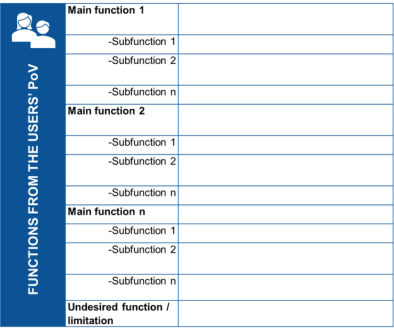
HCTP Step 2 – Description of Technology as Functions The HCTP also includes two templates for function analyses – technological and user functions. This step is based on the function analysis described in a German engineering guideline (Verein Deutscher Ingenieure, Januar 2019). The function analyses, especially the one from the users’ point of view (PoV), are motivated by the desire to ensure a comprehensive understanding of the technology and its capabilities and limitations among laypersons / users. This understanding is crucial for the methodological phases that ensue after the HCTP, where users, technology, and UX experts collaborate to explore poten- tials for positive user experiences with the technology (Bopp-Bertenbreiter et al., 24.07.2022).
For the function analyses, the technology is described at the functional level by identifying and hierarchically organizing the functions of the technology and describing them as noun-verb combinations. The first function analysis is done from the technical experts’ point of view, as technical expert often fall back into familiar, technological descriptions (Rittger and Schrader, 2022). With the technical perspective made explicit, the procedure then moves on to the second function analysis. The moderator asks the technical experts to change their perspective to those of the users and to describe what users expe- rience with / from the technology. The experts are then asked to describe the users’ possible perceptions of the technology in form of technology functions such as “representing objects in real 3D” for the digital holography. Uncon- ventional questions such as “What does the user see/hear/feel/smell/taste of the technology?” or even “How would you explain what the technol- ogy does to your grandma?” guides them along the process. The results are reported using the templates (see Figure 2 for function analysis from users’ PoV).
HCTP Step 3 – Classifying User Perceptibility
From Technologies to Positive User Experiences in Cars – Phase I 663
Figure 2: Template for the function analysis from the users’ point of view (PoV), based on a German engineering guideline (Verein Deutscher Ingenieure, Januar 2019).
After describing basic information and functions of the technology, user per- ceptibility of the technology is classified to document the sensory channels of users that are targeted by the analysed technology and can be actively used by users for perception or communication. Our goal is twofold: a) to ensure that users can indeed perceive the technology, laying the ground for positive user experiences, and b) to identify any missing links in the inter- action process. For example, if a technology only provides output to the user, but requires a second supporting technology to perceive any input from the user.
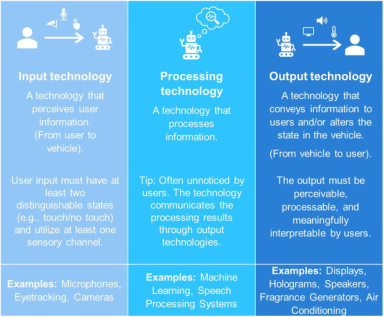
To reach these goals, we adapted the human-centered taxonomy of input and output modalities (Augstein and Neumayr, 2019). Their taxonomy can be transferred to an often-used model of human information processing (Wickens and Carswell, 2021), so that technologies may be roughly cate- gorized into three main categories (see Figure 3). Note that technologies may cover more than one category of the classification.
Figure 3: Scheme for rough classification of technologies, based on definitions in Augstein and Neumayr (2019) with adaptions based on Wickens and Carswell (2021).
After the initial rough classification of the technology, a more detailed categorization is performed to determine which sensory channels of human perception are targeted by the technology. The technology experts use the taxonomy adapted from Augstein and Neumayr (2019) a tool and sim- ply mark the sensory channels that are addressed by the technology. The adapted taxonomy consists of a visual representation of the human sensory system, classified into input and output channels, supported by definitions and examples for each sensory channel, e.g., for the visual sensory channel:
Input: Technologies with the ability to perceive changes in their envi- ronment through computer vision functions (adapted from Augstein and Neumayr, 2019). Examples include: EyeTracking, Leap Motion, customized camera tracking systems in the vehicle.
Output: Technologies with the ability to modify their optical output (adapted from Augstein and Neumayr, 2019). Examples include: Displays, smart glass, light systems in the vehicle.
The results of this step are recorded in the standardized technology description to ensure efficient management of technology knowledge.
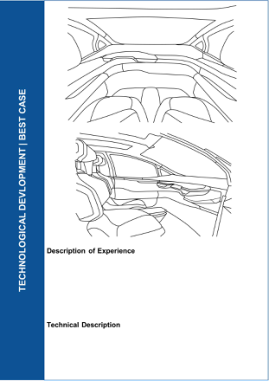
HCTP Step 4 – Technological Futures In the last step of the HCTP, possible technological developments of the tech- nology are sketched. We assume that the maturity level of a technology has an influence on the user experience, therefore, we included this step to show the range of possible technological development. First, the experts assess and report the expected development time until series maturity, then different technological development paths are documented. The observation period includes the next 5–10 years from the analysis point in time. For this pur- pose, this work provides templates based on the scenario technique method (see, e.g., Gausemeier et al., 2007). For efficiency, the templates do not repre- sent a complete scenario technique but rather enable the technology experts to formalize their knowledge.
Figure 4: Template for documenting a technology future in prose and sketch, best case example.
From Technologies to Positive User Experiences in Cars – Phase I 665
In addition to documenting expert knowledge at the observation time, this step makes it easier for decision-makers to understand different development paths and their consequences for the UX the technology may provide in the future. Based on their expertise, the technology experts first describe the key factors influencing the technical development of the technology (procedure based on Gausemeier et al., 2007). Key factors may include technical fac- tors, political decisions or the availability of resources needed to produce a technology or enabling components (see Gausemeier et al., 2007 for a comprehensive list of possible key factors). After listing the key factors, the technology experts describe the parameters and properties of the analysed technology that are likely influenced due to technological development or are particularly strongly influenced by the key factors.
The technology experts then describe three possible future scenarios for the technology:
The best-case scenario describes the best possible technological devel- opment of the analysis object, i.e., when all key factors influence the parameters in the best way imaginable.
The base-case scenario describes a realistic or probable technological development from the experts’ perspective, i.e., when the key factors influ- ence the parameters on an average basis and the technology develops “as expected.”
The worst-case scenario describes the worst possible technological devel- opment, i.e., when all key factors influence the parameters in the worst possible way, or the technology does not develop further.
The experts document each of the three technological futures in a generic vehicle interior in text and sketch (see Figure 4). The resulting HCTP is a human-centered documentation of all the knowledge about the technology that is available to the technology experts of the company at the time of analysis.
RESULTS FROM FIRST EVALUATION A mixed-methods approach was chosen to elicit optimization potentials in 2.5 hour-long workshops. The HCTP was applied and evaluated in real-world industrial settings with five experts for three different interaction technologies: digital 3D holog- raphy (e.g., described in Häussler et al., 2017), a display technology (not described due to confidentiality), and the ProTable projection technology (Bues et al., 2018). The experts were recruited based on their unique expertise the respective technology through the author’s extended personal network in automotive industry and academia.
For data analysis, we only report qualitative data, as we expect it to provide the most useful information for optimization. We cluster the qualitative data according to the underlying themes.
All experts reported that they would require more time to fill out the HCTP, ranging from extra times of 15 minutes to 1–2 hours.
Technology experts appreciated the following strengths of the HCTP: structured template, guided procedure, centralization of information on the technology, standardization for technology comparison, good basic idea.
The following weaknesses were identified: difficulty in subdividing tech- nical functions in the function analysis, switching between example HCTP and instruction, lack of clarity in definitions/instruction, too much input.
Additional information to be included in the HCTP included a develop- ment cost estimation, possible Start of Production dates, a technology roadmap with milestones, videos on the technology, and development partners.
From the technology experts’ point of view, none of the information in the HCTP was redundant.
Further comments incorporated the inclusion of examples for the different methodological steps as comments into the HCTP, possible infeasibility of completing the HCTP at project onset due to the emergence of new infor- mation during development, the unsuitability of using Microsoft Word for drawing the technology’s future scenarios, and the idea to embed the HCTP into a database or program.
DISCUSSION
Results demonstrate the fundamental applicability of the method and high- light optimization potentials as perceived by the technology experts. We discuss strengths that should be maintained and identify areas for potential optimization for the next iteration of the method: The structured template, guided procedure, centralization of information on the technology, standard- ization for technology comparison, and good basic idea were all noted as strengths of the HCTP.
One area for improvement is the amount of time required to fill out the HCTP. This issue could be addressed by streamlining the process, providing additional guidance, or simply planning for a longer workshop to complete the HCTP. Other optimization potentials include the difficulty with techni- cal subfunctions in the function analysis, switching between example HCTP and instruction, lack of clarity in definitions/instruction, and too much input. These issues could be addressed by providing clearer instructions and retest- ing understandability with the experts, and possibly implementing the HCTP in an application, so that additional examples can be provided as tool tips or drop-down information.
Additional information that could be included in the HCTP includes a development cost estimation, possible Start of Production dates, a technology roadmap with milestones, and videos on the technology, and development partners. Although not made explicit in the open questions, the experts asked whether the HCTP’s design was final during the evaluation, implying the need for a more sophisticated design.
We plan to address these optimization potentials in the next iteration of the HCTP and re-evaluating the improved version with experts for other technologies.
From Technologies to Positive User Experiences in Cars – Phase I 667
Furthermore, our evaluation was restricted in the sense that we applied the HCTP for only three technologies with a limited number of technological experts. However, as companies often only have 1–2 experts for a specific technology, the evaluation was conducted under realistic industrial circum- stances. Nevertheless, we plan to apply and evaluate the HCTP Version 2.0 with experts for other technologies, including speech recognition systems and other non-visual technologies, to ensure suitability of the HCTP for various interaction technologies.
CONCLUSION
We motivated the need for a human-centered, standardized technology doc- umentation as a starting point for innovative solutions. After reviewing the existing literature, we adapted components from Technology Management and Human-Computer Interaction to create the Human-Centered Technol- ogy Profile (HCTP). The HCTP’s application and evaluation with experts for three interaction technologies was promising and allowed us to gain insights into potentials for future optimization of the HCTP.
ACKNOWLEDGMENT
The authors would like to express their heartfelt gratitude to the technol- ogy experts who have generously contributed their time and expertise as the pioneer users of the HCTP. Your feedback is invaluable in the iterative optimization of the HCTP.
REFERENCES
Augstein, Mirjam and Neumayr, Thomas, 2019). A Human-Centered Taxonomy of Interaction Modalities and Devices, Interacting with Computers, Volume 31, No. 1, pp. 27–58. Bauer, Wilhelm, Braun, Steffen, Ruess, Patrick and Schaufler, Claudius, 2019).
Mobility-in-Disruption: Vorgehensmodell für nutzerzentrierte Technologievo- rausschau im Bereich urbaner Mobilität bis 2049, in: Gausemeier, Jürgen, Bauer, Wilhelm and Dumitrescu, Roman, eds. Vorausschau und Technologieplanung: 15. Symposium für Vorausschau und Technologieplanung : 21. und 22. November 2019, Berlin, Heinz Nixdorf Institut Universität Paderborn, Paderborn, 11–25. Bopp-Bertenbreiter, Valeria, Engelhardt, Doreen, Rittger, Lena and Pottin, Denise, 24.07.2022). Tech4UX - An Approach to Systematically Assess the Potential of a Technology for Positive User Experience. New York, USA. Bues, Matthias, Wingert, Benjamin and Riedel, Oliver, 2018). VD1: a technical
approach to a hybrid 2D and 3D desktop environment, in: 2018 IEEE 11th Work- shop on Software Engineering and Architectures for Real-time Interactive Systems (SEARIS), IEEE, pp. 1–7. Frison, Anna-Katharina and Riener, Andreas, 2022). The “DAUX Framework”: A Need-Centered Development Approach to Promote Positive User Experience in the Development of Driving Automation, in: Riener, Andreas, Myounghoon, J. and Alvarez, Ignacio, eds. User Experience Design in the Era of Automated Driving, Springer International Publishing, pp. 237–271. Gausemeier, Jürgen, Stoll, Karsten and Wenzelmann, Christoph, 2007). Szenario-
Technik und Wissensmanagement in der strategischen Planung, in: Gausemeier,
Jürgen, ed. Vorausschau und Technologieplanung. 3. Symposium für Vorausschau und Technologieplanung., Heinz Nixdorf Institut, Paderborn, pp. 3–29. Häussler, R., Gritsai, Y., Zschau, E., Missbach, R., Sahm, H., Stock, M. and Stolle, H., 2017). Large real-time holographic 3D displays: enabling components and results, Applied optics, Volume 56, No. 13, F45-F52. Mankins, John C., 06.04.1995) Technology readiness levels: A White Paper. Pfeiffer, W. and Dögl, R., 1997). Das Technologie-Portfolio-Konzept zur Beherrschung der Schnittstelle Technik und Unternehmensstrategie, in: Hahn, Dietger and Taylor, Bernard, eds. Strategische Unternehmungsplanung / Strate- gische Unternehmungsführung, Physica-Verlag HD, Heidelberg, pp. 407–435. Rittger, Lena and Schrader, Thorsten, 2022). Novel experiences and human centered
development in the vehicle, in: Riener, Andreas, Myounghoon, J. and Alvarez, Ignacio, eds. User Experience Design in the Era of Automated Driving, Springer International Publishing. Schuh, Günther, Boßmeyer, Hans-Jürgen and Brälking, André, 2021). Data-Driven Technology Management Supported by Artificial Intelligence Solutions. Stelzer, Birgit and Brecht, Leo, 2014). Technologiemanagement: eine Bestandsauf-
nahme der organisationalen Umsetzung in Unternehmen. Universität Ulm. Open Access Repositorium der Universität Ulm und Technischen Hochschule Ulm.: Verein Deutscher Ingenieure, Januar 2019). Funktionenanalyse - Grundlagen und Methode, 03.100.40, VDI 2803 Blatt 1Beuth Verlag GmbH. Berlin: https://www. beuth.de/de/technische-regel/vdi-2803-blatt-1/296563038. Wellensiek, Markus, Schuh, Günther, Hacker, Patrick A. and Saxler, Jörg, 2011).
Technologiefrüherkennung, in: Schuh, Günther and Klappert, Sascha, eds. Tech- nologiemanagement, Springer Berlin Heidelberg, Berlin, Heidelberg. Wickens, Christopher D. and Carswell, C. M., 2021). INFORMATION PROCESS- ING, in: Salvendy, Gavriel and Karwowski, Waldemar, eds. HANDBOOK OF HUMAN FACTORS AND ERGONOMICS, Wiley, pp. 114–158.
LISTED IN THE AHFE DIGITAL BOOKSTORE CATALOGUE
Explore the complete digital volume
Human-Centered Design and User Experience
Read this individual research paper free through the original publisher, or explore the full digital proceedings book.
ISBN 978-1-958651-90-2
Explore this ISBN in the AHFE Bookstore ↗Listed in the July 2026 bookstore catalogue; search by ISBN to confirm current availability · Digital book purchase optional