Benjamin Strenge, Thomas Schack (2023). Towards Agile Worth-Oriented Systems Engineering for Future (AWOSE 4F) – Considering Sustainability Goals and Issues in Development Processes. In: Human-Centered Design and User Experience. AHFE Open Access, vol. 114, pp. 338–348. https://doi.org/10.54941/ahfe1004252
Neurocognition and Action Research Group, Center for Cognitive Interaction, Technology CITEC, Bielefeld University, Inspiration 1, 33619 Bielefeld, Germany ↗
The Agile Worth-Oriented Systems Engineering (AWOSE) approach is a flexibly applicable methodology to identify and assess potential ethical issues with respect to a (socio-)technical system and systematically incorporate them in a corresponding agile development process. Originally, AWOSE used the model for the ethical evaluation of socio-technical arrangements (MEESTAR), which refers to ethical dimensions exclusively focused on the direct needs of human stakeholders, and fuzzily demanded to extend these with environment- and nature-related aspects. This part of the methodology was meant to merely safeguard against potential harm, whereas an independent set of “worth elements” describing the intended positive outcomes of the system’s usage was pursued as the primary goals of development. Both potential ethical issues and intended worth were then integrated into so-called Worth Maps and explicitly connected to associated system features and components. The Worth Maps then facilitated appropriate design decisions during agile development of the system.As a proposed advancement and tentative successor, AWOSE for Future (AWOSE 4F) strives to concretize the consideration of non-human life and emphasize its interdependence with human requirements based on the Sustainable Development Goals (SDGs) defined by the United Nations.Previous research on sustainability in the context of software and other information and communication technology-based system development commonly distinguished between “green IT” or “software sustainability”, i.e., making technical systems themselves greener, and “green by IT” or “sustainability by software”, i.e., using technical systems as tools to encourage sustainable action. AWOSE 4F can potentially address both of these, depending on the placement of SDGs within Worth Maps. Using SDGs to extend or replace the "ethical dimensions" of MEESTAR should ensure that the system itself is made sufficiently sustainable, whereas establishing SDGs as “intended worth" would foster encouragement of sustainable actions or decisions through the system. In principle, AWOSE 4F could be used in the research and development of a broad range of different upcoming technical systems. Setting SDGs as intended worth appears especially promising for the creation of future cognitive assistance systems that shall help human users select and execute sustainable (micro) actions in daily life, as well as for making appropriate long-term strategic decisions.
Towards Agile Worth-Oriented Systems Engineering for Future (AWOSE 4F) 339
INTRODUCTION
The fastest possible transition towards a sustainable society to mitigate cli- mate change and preserve a habitable planet is arguably the greatest, most urgent and important of all challenges that humanity currently faces, and the tremendous magnitude of the imminent threats calls for immediate and serious efforts and engagement of every living person within their respective capabilities.
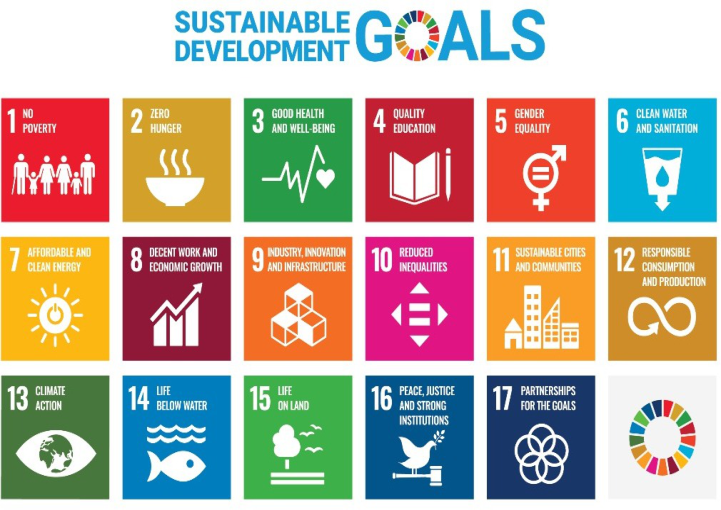
The term “sustainability” has historically been defined in various differ- ent ways (Becker et al., 2015; Bambazek et al., 2022), but nowadays, based on a definition in the so-called Brundtland Report published by the United Nations (WCED, 1987), sustainability is commonly understood as meeting the needs of the present without compromising the ability of future genera- tions to meet their own needs. In 2015, all of the 193 current member states of the Unites Nations unanimously voted to establish seventeen so-called Sus- tainable Development Goals (SDGs) to supersede the previous Millennium Development Goals. The seventeen SDGs are illustrated in Figure 1.
None of these SDGs explicitly mentions information and communica- tion technology (ICT), and the officially proposed ICT indicators for the SDGs are basically limited to counting the number of people that have ICT skills and internet and mobile network access, e.g. to reach them in the case of natural disasters and catastrophes (which is expected to happen with increased frequency due to climate change), and the collection of electronic waste. However, also in 2015, the Karlskrona Manifesto for Sustainability Design has been established “to create a common ground and a point of reference” by stating “key issues, goals, values and principles” related to software and sustainability (Becker et al., 2015, p. 467). The Karlskrona Manifesto has been cited in hundreds of scientific works so far. For example, Tjoa and Tjoa (2016, p. 11) claimed that in “Volkswagen-like-cases”, refer- ring to how the German car manufacturer had intentionally programmed some of its engines to activate emissions controls only during regulatory lab testing while emitting substantially more nitrogen oxides during real-world driving, “the Karlskrona Manifesto as a compliance-guideline for Software Engineers would have prevented such a disaster.” Several researchers have suggested to distinguish between the goals of a) making ICT systems them- selves more sustainable and b) improving sustainability through ICT. For example, Kern, Naumann and Dick (2015) distinguished between ‘Green (in) IT’ (ways to make ICT itself greener) and ‘Green by IT’ (possibilities to encourage environmental-friendly movements by ICT). In a similar vein, Calero, Moraga and García (2022, p. 41) claimed that “to make software itself sustainable [...] can be named software sustainability (SOS) and its goal is to achieve what can be termed as “Sustainability IN Software” and” “software as part of sustainability (SAPOS)” considers software as a new dimension of sustainability, including the interaction of software with the other dimensions on sustainability”, adding that ““Sustainability BY Soft- ware” refers to where software is a tool that is used to achieve sustainability within any context”. These aspects are not completely independent from each other though, since Mahmoud and Ahmad (2013, p. 55) recognized
340 Strenge and Schack
that although “ICT recently has been trying to find efficient solutions for the environment, it is not clear whether energy and resource savings by ICT will exceed its resource consumption.”
Figure 1: The United Nations’ sustainable development goals (SDGs).
Numerous researchers have looked into possibilities for integrating dif- ferent sustainability considerations in ICT development, and most notably the number of publications on requirements engineering approaches towards sustainability increased over the past years (Bambazek, Groher and Seyff, 2023). An overview of methods, techniques, processes and tools that have been discussed in the context of sustainability dimensions in requirements engineering was provided by Garscha (2021). Note that all of the endeav- ors discussed here understand sustainable development as defined by the Brundtland Report and should not be confused with the unrelated problem of maintaining a sustainable development pace during the implementation of technical systems, which has been investigated in some other research works (e.g. Therrien and LeBel, 2009). Shenoy and Eeratta (2011) provided some guidance concerning good practices related to sustainability in each phase of the traditional Software Development Life Cycle, such as “avoid throw-away prototyping” during requirements analysis, “avoid resource intensive APIs” in implementation, and “minimize installation size” in deployment. Moises de Souza (2023, p. 38) noted that since 2008, “the focus of sustainability in IT has been dedicated to environmental aspects and mainly covering energy efficiency, energy performance, cloud, and data center energy consumption practices”. This focus on energy demands as a part of requirements engineer- ing appears to be prevalent among large swathes of the research landscape.
Towards Agile Worth-Oriented Systems Engineering for Future (AWOSE 4F) 341
For example, Mahmoud and Ahmad (2013) proposed a “Green Require- ments Engineering Process”based on risk analysis related to energy efficiency. Verdejo Espinosa et al. (2021, p. 12) discussed the interrelations of IoT sys- tems, public health, and energy efficiency, but noted there was hardly any explicit association to the SDGs in IoT development so far. The sole consider- ation of electric energy consumption may fall short of the actual requirements to create sustainable systems though, especially given that vast amounts of electric energy could be produced exclusively from renewable resources in the near future (see Wang et al., 2021, for an overview about modern tech- nologies and approaches for achieving carbon neutrality). Therefore, several scientists and practitioners asked for a more systematic and holistic incor- poration of sustainability in ICT system development (e.g., Tjoa and Tjoa, 2016; Lavanya, 2020; Eckstein and Melo, 2021; Bambazek, Groher and Seyff, 2022). However, apart from an overly narrow focus on power con- sumption, little research has been done on how to integrate sustainability considerations in agile system development processes like XP (Beck, 2000) or Scrum (Schwaber, 1997), which nowadays constitute the predominant software engineering practice (Bambazek, Groher and Seyff, 2022). After analyzing different companies in case studies, Eckstein and Melo (2021, p. 235) found that “most of these are concentrating on using agile devel- opment and sustainability yet, without the focus on leveraging the one with the other”, but argued that due to the core principles of agile development, such as transparency, cross-functional teams integrating different perspec- tives and continuously inspecting and adapting while learning from deliveries, “an agile approach indeed promotes (or can promote) sustainable develop- ment” (p. 227). Both Garscha (2021), continued by Bambazek, Groher and Seyff (2022, 2023), and Moises de Souza (2023) reported on their ongoing research endeavors aiming to develop a sustainability-aware Scrum frame- work and understand how social sustainability approaches can be integrated into the context of agile software development, respectively, but to the best of our knowledge did not propose any specific sustainability-related agile methodology or process model yet.
TOWARDS AGILE WORTH-ORIENTED SYSTEMS ENGINEERING FOR FUTURE In the following, we shall outline our own approach for incorporating ethical aspects in agile development processes, the Agile Worth-Oriented Systems Engineering methodology, and discuss how it could be adjusted to embrace SDGs.
Basics of the Original Methodology The foundations of the Agile Worth-Oriented Systems Engineering (AWOSE) methodology were first presented by Strenge and Schack (2018) at the 9th International Conference on Applied Human Factors and Ergonomics (AHFE) and subsequently described in a detailed article (Strenge and Schack, 2020). AWOSE consists of two interconnected parts: First, a method for identifying potential ethical issues related to a contemplated (socio-)technical
342 Strenge and Schack
system and assessing their severity. Second, a set of approaches and artifacts to facilitate that the decision-making during agile development of the system takes these ethical issues properly into consideration.
In practice, the first part consists of interdisciplinary workshops with different project stakeholders and team members. Based on the model for the ethical evaluation of socio-technical arrangements (MEESTAR) by Manzeschke et al. (2015), the group discusses and gathers possible issues with respect to a predefined set of ethical dimensions (e.g., safety, justice, and privacy) and then rates each issue’s severity on an ordinal scale with four levels from “completely harmless” to “should be opposed from an ethical viewpoint”. This first part focuses exclusively on potential negative aspects and is meant to safeguard against harm. The basic AWOSE methodology ini- tially adopted MEESTAR’s seven ethical dimensions as its default set, which were originally devised by Manzeschke et al. (2015) in the context of age- appropriate assisting systems. When defining AWOSE, we already noted that these dimensions focus exclusively on ethical concerns related to the imme- diate wellbeing of human stakeholders, disregarding other lifeforms such as plants and animals, as well as any long-term effects influencing the planet’s ecosystem. Consequently, we claimed that the analyses should be broadened to include nature-related implications (Strenge and Schack, 2020), but did not provide any specific modification or approach to realize this.
The second part of AWOSE is based on the worth-centred development (WCD) approaches by Cockton (2008, 2012). The concept of “worth” com- prises any positive outcomes of system usage that motivate users and other stakeholders to invest time, money, energy, or effort to buy, use, or main- tain the system. Concurrently to analyses of ethical issues (AWOSE’s first part), different methods like brainstorming, laddering and sentence comple- tion are used to determine the intended worth of the system alongside the associated (quantitative) project goals. Each potential ethical issue and all worth elements are then transferred into the methodology’s central artifact, a special diagram called Worth Map. During the subsequent agile devel- opment process, system features, components and qualities are iteratively added and connected to the existing elements of the project’s Worth Map. This explicit and traceable association between technical components, the features they implement or possess, the resulting qualities of the system, and possibly entailed ethical issues, as well as realized worth, supports the proper prioritization of features and the decision between different system design alternatives and means for technical implementation by product own- ers or on-site customers for each iteration of the development process (e.g., an upcoming sprint in Scrum). For a more elaborated explanation of the methodology and a related agile process model, please refer to Strenge and Schack (2020).
Incorporating Sustainability Goals and Issues The AWOSE methodology offers different opportunities to incorporate sus- tainability aspects by referring to SDGs. As mentioned before, scholarship commonly distinguishes between a) making ICT systems themselves more
Towards Agile Worth-Oriented Systems Engineering for Future (AWOSE 4F) 343
sustainable and b) improving sustainability through technical systems (e.g. Kern, Naumann and Dick, 2015). A modified AWOSE methodology could potentially address both. We coined the resulting approach “Agile Worth- Oriented Systems Engineering for Future” (AWOSE 4F) in reference to the need to consider nature as a basic element of our life and our future, as well as with regard to the Fridays for Future movement and supporting organizations like the Scientists for Future.
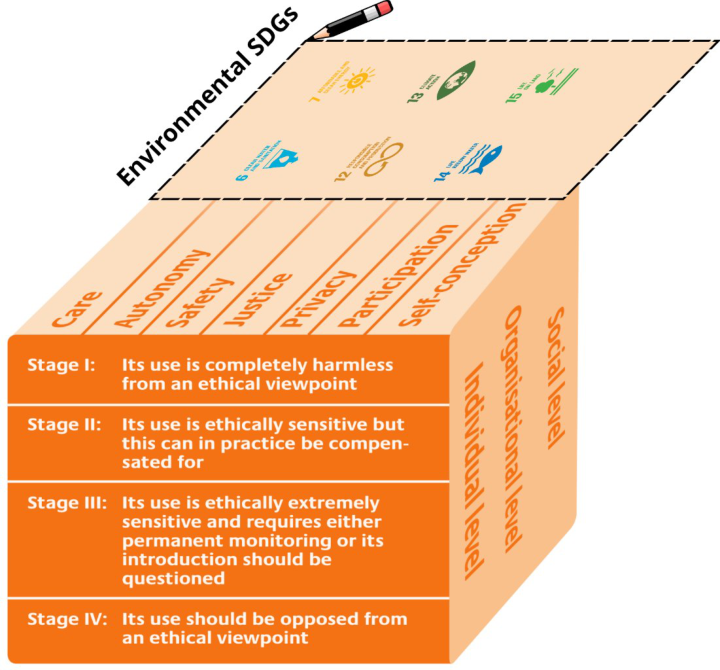
Figure 2: The model for the ethical evaluation of socio-technical arrangements (MEESTAR; Manzeschke et al., 2015) extended with environmental SDGs.
On the one hand, SDGs can be used to extend or replace the default eth- ical dimensions of MEESTAR. This should ensure that the resulting system itself is devised and made in a sustainable way and has acceptable usage and maintenance properties in terms of sustainability aspects. To this end, it seems necessary to predetermine a suitable and workable subset of SDGs as “ethi- cal dimensions”, because too many dimensions would probably overcharge the conduction of “MEESTAR-style” workshops and make them inefficient. We propose limiting the set of (additional) dimensions to the “environmental SDGs” in order to prevent an overexploitation of limited natural resources
344 Strenge and Schack
and similar critical sustainability concerns. According to classifications by different researchers, this includes at least the SDGs 6, 7, 13, 14 and 15 (Jones et al., 2017; Wu et al., 2018; König, Suwala and Delargy, 2021), arguably also SDG 12 (Jones et al., 2017; Wu et al., 2018), and possibly even SDG 11 (Jones et al., 2017). These SDGs represent the bare minimum of existential risks to safeguard against. Figure 2 illustrates a corresponding extension of the original MEESTAR representation.
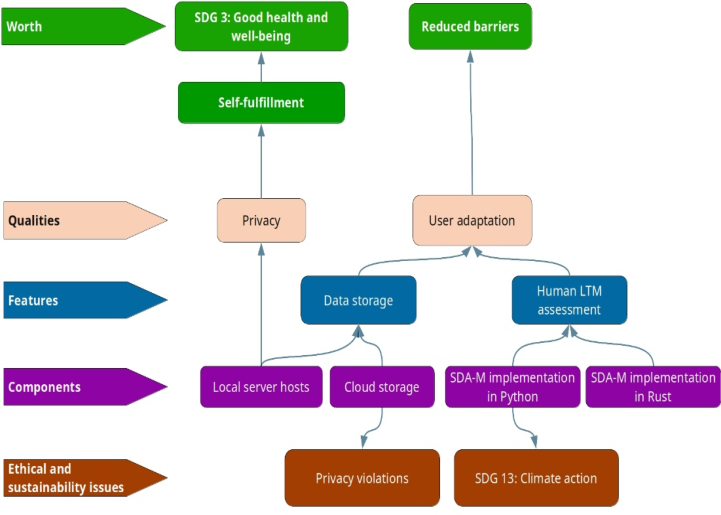
Figure 3: Fictitious worth map sketch for a hypothetical cognitive assistance sys- tem illustrating how different means for data storage may create or avoid privacy issues and how the programming language choice for implementation may impact climate (assuming Python to be less energy efficient compared to Rust as suggested by Pereira et al., 2021).
On the other hand, deliberately establishing arbitrary further SDGs as intended worth can foster the creation of systems that actively improve vari- ous other aspects of sustainability. This may include concrete humanitarian, social or economic sustainability aspects, as well as more abstract facets. However, well-grounded decision making undoubtedly benefits most from associating system design to specific goals that should ideally be quantifiable and measurable with feasible tools. Such a comprehensive incorporation of sustainability aspects as requirements, goals and evaluation metrics has also been suggested by Eckstein and Melo (2021): “Using Scrum as an example, sustainability or rather energy consumption needs to be considered dur- ing backlog refinement, sprint planning, by the definition of done, as well as monitored through tests”. Figure 3 showcases a fictitious Worth Map example with SDGs as worth elements.
Towards Agile Worth-Oriented Systems Engineering for Future (AWOSE 4F) 345
Concerning the roles within the development team, AWOSE suggested to establish the role of “worth designer”, who assumes similar responsibilities as usability engineers or interaction designers but with a focus on ethical issues and worth. In AWOSE 4F, this role must comprise additional sustainability competencies or include external consultation.
DISCUSSION
Implementing sustainable development goals poses a highly challenging task, because it “requires approaching wicked problems, i.e. complex, non- linear, dynamic challenges in situations of insufficient resources, incomplete information, emerging risks and threats, and fast changing environments” (Eckstein and Melo, 2021, p. 227). These properties indeed suggest that an agile approach like our adjusted AWOSE methodology could be well suited to tackle the challenges of sustainable development. Therefore, it appears worthwhile to conduct a preliminary methodical assessment of the AWOSE 4F approach based on related ideas, requirements and proposals in the existing literature.
A rich source of information from practitioners’ point of view has been provided by Bambazek, Groher and Seyff (2022), who conducted a survey study among 46 IT practitioners. The outcomes help assess the expectable applicability of AWOSE 4F. Generally, their respondents “see high potential for considering the sustainability impacts of software systems within Scrum” and consider “sustainability assessment as a team effort (together with the customer) ideally performed during product backlog refinement” (p. 13). Interestingly, a vast majority of IT practitioners also considered usability as having a strong effect on a system’s sustainability. Furthermore, “respon- dents agreed that the product owner [and/or the clients] should assess the impacts of the backlog items for all the sustainability dimensions except for the technical one [whereas] the newly introduced role of a sustainability expert should primarily assess the impacts on the environmental, social, and individual dimensions but not as much on the economic and technical dimen- sions”(p. 17 f.). This seems to fit well with AWOSE 4F’s approach to establish Worth Designers with both usability and sustainability competencies as con- sultants for the product owners / customers who decide on system features and components. Finally, the respondents “also stated that the impacts of the product increment should be visible anytime” (p. 20), which in AWOSE 4F is enabled by the project’s Worth Map through the connection of currently implemented components to sustainability-related worth elements and issues.
In the context of intelligent systems and IoT applications, Verdejo Espinosa et al. (2021, p. 27) proposed to develop “a protocol or work methodol- ogy in which any research [...] would pursue a goal or objective within the framework given by the SDGs”. AWOSE 4F constitutes such a methodol- ogy by setting SDGs as the system’s intended worth. AWOSE’s concept of “worth” also matches the broadened understanding of “value” that Eckstein and Melo (2021) demanded: “At the core of [the] very first principle [of the Agile Manifesto] is continuous learning by focusing constantly on the cus- tomer. [...] Broadening the perspective, and looking at this principle through
346 Strenge and Schack
a sustainability lens, that is taking also the environmental and social aspect into account, shifts also the meaning of “valuable” software. The value is not only defined by the economic benefit for the customer but also by the social and environmental improvements.”
We suggest to refer explicitly to the SDGs in AWOSE 4F, because they represent a globally recognized consensus on what constitutes sustainability. Also, Tjoa and Tjoa (2016, p. 3) appealed “to all professionals, scientists and IT-professional and their organization to take a holistic approach for all ICT-activities and projects to always include and monitor the effects of their work on the SDGs” and “ICT-managers should handle SDG-requirements with equal importance to all other quality criteria within their software development process”.
Some authors may disagree with our proposal to limit the “ethical dimen- sions” added to the MEESTAR analyses to the subset of environmental SDGs though. For instance, Garscha (2021, p. 466) claimed that “considering all dimensions of sustainability is very important insofar, as that an improvement of sustainability in one dimension should not be achieved at the cost of a loss of sustainability in other dimensions”. We tend to disagree with that, as envi- ronmental sustainability is the mandatory foundation for any “higher-level” (economic, social, etc.) types of sustainability, although the latter could still deliberately be included as intended worth in AWOSE 4F. Bambazek, Gro- her and Seyff (2023) also found that most previous publications focus on the environmental dimension of sustainability.
The bipartite consideration of SDGs as ethical issues (environmental SDGs) and as intended worth (arbitrary SDGs) is also in line with the prin- ciples followed by the Global Enabling Sustainability Initiative (GeSI), who “identified seven SDGs [...] as being focused on protecting the environment while looking to ensure ‘that other goals are achieved without breaching the planet’s ability to regenerate for future generations.’” (Jones et al., 2017, p.7).
Prospectively, AWOSE 4F may also integrate other established approaches for sustainability from fellow researchers. For instance, Basmer, Kehrer and Penzenstadler (2021) described that in their Sustainability Awareness Framework (SusAF) analysis results are captured in one or more so-called Sustainability Awareness Diagrams (SusADs; e.g. Penzenstadler et al., 2019), which visualize key effect chains. These effect chains in SusADs have some conceptual similarity to the means-end chains in Worth Maps when used to indicate impacts of system elements and features on sustainability aspects. Essentially, SusAD effect chains could be incorporated into Worth Map ele- ments and associations. In doing so, the information about the elements’ association to SusAF’s five different sustainability dimensions and the order (timescale) of effects (as visualized in SusADs) would be lost, but arguably, this information appears less important for the purpose of prioritization and decision making in agile development processes anyway.
Overall, the methodical approaches proposed for AWOSE 4F appear to match a broad range of requirements and considerations stated in previ- ous work from other researchers in this direction surprisingly well. Empiric evidence from actual development projects will be required to validate this proposition.
Towards Agile Worth-Oriented Systems Engineering for Future (AWOSE 4F) 347
CONCLUSION
The AWOSE methodology lends itself to an extension that refers to SDGs for analyzing and incorporating sustainability goals and issues during agile development processes. Based on a preliminary literature-based appraisal, the methodical approaches proposed in this paper appear promising, but need to prove their applicability and effectiveness in a broad range of actual research and development projects to create different upcoming technical systems. In order to improve sustainability through future systems, we suggest that it appears especially promising to devise cognitive assistance systems that shall help human users to select and execute more sustainable (micro) actions in daily life, as well as for making appropriate long-term strategic decisions.
REFERENCES
Bambazek, P., Groher, I., & Seyff, N. (2022). Sustainability in Agile Software Development: A Survey Study among Practitioners. In 2022 International Conference on ICT for Sustainability (ICT4S) (pp. 13–23). IEEE. Bambazek, P., Groher, I., & Seyff, N. (2023). Requirements engineering for sustain-
able software systems: a systematic mapping study. Requirements Engineering, 28, 481–505. Basmer, M., Kehrer, T., & Penzenstadler, B. (2021). Susaf welcomes susapp: Tool support for the sustainability awareness framework. In 2021 IEEE 29th International Requirements Engineering Conference (RE) (pp. 418-419). IEEE. Beck, K. (2000). Extreme programming explained: Embrace change. Boston:
Addison-Wesley. Becker, C., Chitchyan, R., Duboc, L., Easterbrook, S., Penzenstadler, B., Seyff, N., & Venters, C. C. (2015, May). Sustainability design and software: The Karlskrona Manifesto. In 2015 IEEE/ACM 37th IEEE International Conference on Software Engineering (Vol. 2, pp. 467–476). IEEE. Calero, C., Moraga, M. Á., & García, F. (2022). Software, Sustainability, and UN
Sustainable Development Goals. IT professional, 24(1), 41–48. Cockton, G. (2008). Designing worth--connecting preferred means to desired ends.
interactions, 15(4), 54–57. Cockton, G. (2012). Making designing worth worth designing. In ACM SIGCHI conference on human factors in computing systems (CHI’12). New York: ACM. Eckstein, J., & de O. Melo, C. (2021). Sustainability: delivering agility’s promise. In
C. Calero, M. Á. Moraga, & M. Piattini (eds) Software Sustainability, 215–241. Cham: Springer. Garscha, P. (2021). From Sustainability in Requirements Engineering to a Sustainability-Aware Scrum Framework. In 2021 IEEE 29th International Requirements Engineering Conference (RE) (pp. 462–467). IEEE. Jones, P., Wynn, M., Hillier, D., & Comfort, D. (2017). The sustainable development goals and information and communication technologies. Indonesian Journal of Sustainability Accounting and Management, 1(1), 1-15. Kern, E., Naumann, S., Dick, M. (2015). Processes for Green and Sustainable Soft-
ware Engineering. In C. Calero & M. Piattini (eds) Green in Software Engineering. Cham: Springer. https://doi.org/10.1007/978-3-319-08581-4_3 König, J., Suwala, L., & Delargy, C. (2021). Helix Models of Innovation and Sustainable Development Goals. In: W. Leal Filho et al. (eds) Industry, Innova- tion and Infrastructure. Encyclopedia of the UN Sustainable Development Goals (pp. 473–488). Cham: Springer.
348 Strenge and Schack
Lavanya, R. (2020). GREEN SCRUM MODEL: Implementation of Scrum in Green and Sustainable Software Engineering. International Research Journal of Engineering and Technology (IRJET), 7(11). Mahmoud, S. S., & Ahmad, I. (2013). A green model for sustainable software engi-
neering. International Journal of Software Engineering and Its Applications, 7(4), 55–74. Manzeschke, A., Weber, K., Rother, E., & Fangerau, H. (2015). Ethical questions in the area of age appropriate assisting systems. German Federal Ministry of Education and Research, VDI/VDE Innovation+ Technik GmbH. Moises de Souza, A. C. (2023). Social Sustainability Approaches for a Sustainable
Software Product. ACM SIGSOFT Software Engineering Notes, 48(1), 38–43. Partnership on Measuring ICT for Development (2015). Joint proposal of ICT indicators for the Sustainable Development Goal (SDG) indicator framework, pre- sented at the Expert Group Meeting on the Indicator Framework for the Post-2015 Development Agenda, New York, 25–26 February 2015. Penzenstadler, B., Mara, A., Nam, S., & Budzinski, B. (2019). Exploratory case study
on sustainability awareness with a startup for business models. In Proceedings of the 6th International Conference on ICT for Sustainability (ICT4S 2019) (pp.1–7). CEUR-WS. Pereira, R., Couto, M., Ribeiro, F., Rua, R., Cunha, J., Fernandes, J. P., & Saraiva, J. (2021). Ranking programming languages by energy efficiency. Science of Computer Programming, 205, 102609. Schwaber, K. (1997). SCRUM Development Process. In J. Sutherland, C. Casanave,
J. Miller, P. Patel, & G. Hollowell (Eds.), Business object design and implementa- tion. New York: Springer. Shenoy, S. S., & Eeratta, R. (2011). Green software development model: An approach towards sustainable software development. In 2011 Annual IEEE India Conference (pp. 1–6). IEEE. Strenge, B., & Schack, T. (2018). Agile Worth-Oriented Systems Engineering. A
Methodology for Incorporating Ethical Aspects in Development Processes. Pre- sented at the 9th International Conference on Applied Human Factors and Ergonomics (AHFE 2018), Orlando, Florida, USA. Strenge, B., & Schack, T. (2020). AWOSE - A Process Model for Incorporating Ethical Analyses in Agile Systems Engineering. Science and Engineering Ethics, 26(2), 851–870. doi: 10.1007/s11948-019-00133-z. Therrien, I., & LeBel, E. (2009, August). From anarchy to sustainable development:
Scrum in less than ideal conditions. In 2009 Agile Conference (pp. 289–294). IEEE. Tjoa, A. M., & Tjoa, S. (2016). The role of ICT to achieve the UN sustainable development goals (SDG). In ICT for Promoting Human Development and Protecting the Environment: 6th IFIP World Information Technology Forum, WITFOR 2016, San José, Costa Rica, September 12–14, 2016, Proceedings 6 (pp. 3–13). Springer International Publishing. Verdejo Espinosa, Á., Lopez, J. L., Mata Mata, F., & Estevez, M. E. (2021). Applica-
tion of IoT in healthcare: keys to implementation of the sustainable development goals. Sensors, 21(7), 2330. Wang, F. et al. (2021). Technologies and perspectives for achieving carbon neutrality.
The Innovation, 2(4). WCED (1987). Report of the World Commission on Environment and Development: Our Common Future. Oxford University Press. Wu, J., Guo, S., Huang, H., Liu, W., & Xiang, Y. (2018). Information and commu-
nications technologies for sustainable development goals: state-of-the-art, needs and perspectives. IEEE Communications Surveys & Tutorials, 20(3), 2389–2406.
LISTED IN THE AHFE DIGITAL BOOKSTORE CATALOGUE
Explore the complete digital volume
Human-Centered Design and User Experience
Read this individual research paper free through the original publisher, or explore the full digital proceedings book.
ISBN 978-1-958651-90-2
Explore this ISBN in the AHFE Bookstore ↗Listed in the July 2026 bookstore catalogue; search by ISBN to confirm current availability · Digital book purchase optional