Raiden Santos, Paula Alexandra Silva, Waleed Zuberi, Philipp Jordan (2023). A Survey of Beliefs and Attitudes toward Artificial Intelligence — Practical Implications and Fictional Depictions. In: Artificial Intelligence, Social Computing and Wearable Technologies. AHFE Open Access, vol. 113, pp. 38–48. https://doi.org/10.54941/ahfe1004177
The relationship between science fiction (sci-fi) and Artificial Intelligence (AI) is a continuing topic of interest in academia and society, especially with the recent, rapid, real-world advances in AI research and application, most notably the emergence of generative chatbots (e.g. ChatGPT, Bard or Sydney). For this reason, we present a survey of an opportunistic sample and self-assessment of n=121 respondents regarding beliefs, perceptions, and impacts of AI as experienced in the real world, as well as depicted in sci-fi media. The results of our 17-item survey show that the majority of our respondents indicate a strong familiarity with the term AI and a lesser degree of acquaintance with AI-related technical terms and concepts (e.g., Neural Networks). In addition, participants express in a total of 255 qualitative comments a broad range of opinions and beliefs about ‘what AI is’ and ‘what AI will do’, describing AI at times as a 'marketing buzzword' and in other instances ‘as a tool to help humanity’. When asked if AI will either have an overall positive or negative impact on the respondents' lives, the majority (58%) comments that AI will indeed be overall beneficial, however, participants frequently express at the same time a contradicting view assessing both, the future opportunities and legitimate threats of AI.
In early 2023, Artificial Intelligence (AI) officially became ‘mainstream’. Open AI’s natural language Chatbot Generative Pre-trained Transformer (Chat-GPT) exploded to over one million users in a mere 5 days accord- ing to Statista (Ahmed, 2023). To put that into perspective, Facebook took 10 months and Netflix an entire three and a half years to reach this feat. Alongside this rapid and unprecedented growth, the potentials and chal- lenges of AI have become apparent and real in various domains of modern society. A prime example of this paradigm change is located in education, where students rely increasingly on Chat-GPT to aid them in their school- work. For instance, Cardiff University (Wild, 2023) identified 14,443 visits to Chat-GPT using the University’s Wifi network in January 2023; in the preceding month, December 2022, there had been zero.
A Survey of Beliefs and Attitudes Toward Artificial Intelligence 39
Beyond education, AI is being adopted into politics (Sanders & Schneier 2023), security (Carullo, 2023), and healthcare (Rajpurkar et al., 2023) because of its adaptability and powerful computational power. Despite the multitude of benefits that new forms of AI may offer, issues of ethics begin to arise, notably, the danger AI presents to society (Stein-Perlman et al., 2022, Roose, 2023). Some believe that due to AI’s efficiency at certain tasks, it will begin to replace human jobs. On the more extreme side, others believe that without proper regulation AI will become a danger to humankind. The technological singularity is not an uncommon trope in pop- ular sci-fi franchises. The Terminator (1984), The Matrix (1999) and the Black Mirror (2011) franchises routinely depict speculative scenarios, in which AI typically grows out of — or outgrows — human control. These speculative depictions may well be used as blueprints of the concerns that many people face today. For these reasons, we explore the linkage of sci- fi and contemporary technological development via the following research questions: RQ1: To what extent does Science-Fiction affect people’s views toward AI? RQ2: What impact do people believe AI will have on their future lives?
BACKGROUND
The Impact of Sci-Fi on Public Perceptions Towards AI Hermann (2023) examined the dramatic and metaphoric portrayals of AI in modern films such as A.I., I, Robot (2004), and Ex Machina (2015) and concluded that most representations of AI were heavily dramatized for the sake of entertainment and were not representative of the “...actual state and possibilities of the technology” (Hermann, 2023). The author con- cludes that inaccurate portrayals of AI may mislead the general public’s and policy maker’s understanding of the actual technical capabilities and lim- itations of this emerging technology. This finding is important as it may lead to uncertainty about AI, consequently resulting in a lack of utilization of AI.
Nader et al., (2022) support the notion of sci-fi influencing people’s views toward AI through the use of an online survey. The authors received a total of 1,222 responses in a nationwide survey, which asked questions related to participants’ knowledge of sci-fi, the future of AI, and portrayals of AI in sci-fi. Among other findings, the authors identified “a signifi- cant relationship between people’s beliefs about AI in entertainment media and their beliefs about AI in reality” (Nader et al., 2022), which high- lights the connection between sci-fi and how people perceive AI in the real world.
Looking to Sci-Fi to Explore AI Ethics Sci-fi also often inspires as to what a future society may look like, there- fore, sci-fi can be an effective and engaging way of teaching ethical issues related to AI, as well as computing in general. Burton, Goldsmith & Mattei (2018), as well as Jordan and Silva (2019), highlighted the benefits of using
sci-fi to teach computing ethics and develop 4C Skills. Beyond being utilized as an instructional tool for teaching students computing ethics, sci-fi can be used by policymakers to anticipate and address ethical issues related to AI.
Hudson, Finn & Wylie (2023) conducted 13-hour-long interviews with experts, technologists, and sci-fi writers to identify and discuss themes of sci- fi and technology policy likely to become actual technology implementations. The authors show the potential of sci-fi as a tool to explore the possibilities and potential futures of AI, technology & society and provide a case of how sci-fi may influence people’s ideas, beliefs, and thoughts toward this new technology.
METHOD
We designed, piloted, and disseminated an online survey using Google Forms, which was open for responses from Jan 19—Feb 14, 2023. The survey con- sisted of a total of 17 qualitative and quantitative questions, split into 4 main sections: 1) demographics, 2) perceived knowledge of sci-fi, 3) perceived knowledge of AI, and 4) the connection knowledge between AI and sci-fi. The survey utilized a mix of Likert-scale, multiple-choice, and open-ended ques- tions. All demographic and open-ended questions were optional. A preamble informed participants that their responses would not be shared with others and would only be used for the study. The survey can be accessed here for reference: https://bit.ly/Scifi-Survey.
Section 1 of the survey assessed basic demographics, such as gender and racial identity, age, and level of education. Section 2 surveyed participants on their perceived knowledge of sci-fi. Participants were asked Likert-scale questions, on a scale of 1-5, related to how often they engage in sci-fi as well as their knowledge of various genres of sci-fi. Brief descriptions of selected sci-fi genres were provided as a reference (for example Steampunk or Space Opera).
Section 3 assessed participants’ knowledge of AI and related concepts and research domains, i.p., Machine Learning, Computer Vision, Neu- ral Networks, and Natural Language Processing. We included open-ended, follow-up questions that asked participants to explain what AI meant to them. The last questions of section 3 asked participants if they believe AI would either, have i) a positive, ii) a negative, or iii) a neutral impact in their future life. A follow-up, open-ended question asked participants to clarify the earlier statement on the impact of AI (positive, negative, little/none) and thus served as a qualifying response.
Section 4 surveyed participants’ experiences concerning the relationship between AI and sci-fi. In order to directly answer our research question, we asked respondents, “On a scale of 1-5, with 1 = Not influenced and 5 = Extremely influenced, has sci-fi influenced your views toward AI?” This question targeted the relationship between how sci-fi might affect people’s perceptions of AI. We paired this scale-type question with another open- ended, qualifying, optional question, permitting participants to voluntarily elaborate on their prior response.
A Survey of Beliefs and Attitudes Toward Artificial Intelligence 41
Table 1. List of sci-fisubgenres.
Table available in the original PDF paper.
Subgenre Alien Invasion Dystopian Society Military Conflict Space Opera Steampunk
Table 2. List of types of sci-fimedia.
Table available in the original PDF paper.
Type of media Sci-Fi Books Sci-Fi Movies Sci-Fi Shows Sci-Fi Video Games Sci-Fi Card/Board Games
Sampling Approach We initially chose Reddit (www.reddit.com), an online forum discussion web- site, because of its unique structure of organizing topics into “subreddits” as well as its potential for survey studies (see e.g., Guitterz (2018)). We tar- geted specific subreddits related to sci-fi and AI to maximize participation (e.g., r/artificialIntelligence, r/sciencefiction, r/scifi,) in addition to r/sample- size, a subreddit of more than 203,000 Redditors dedicated to aiding survey research.
Due to a weak response rate in the first 2 weeks of the survey, potentially due to a lack of incentives, the research team decided to snowball the survey using their personal networks. These efforts included but were not limited to calls for participation via mailing lists, Slack messages, as well Facebook and LinkedIn.
RESULTS
From Jan 19—Feb 14, 2023, the survey received a total of 121 responses, which included a total of 255 qualitative comments. Next, we report on the key findings.
Section 1 — Key Demographics Out of the 121 participants who responded, 118 disclosed their demographic information including gender and racial identity, age, and education level. It is worth noting that most of the demographic information collected was primarily used to contextualize a participant’s qualitative comments.
Table 3 shows that the majority of respondents were in later adulthood at the time of responding to the survey, with 99 (84.9%) being at least 26 years of age. Table 4 shows that responses were evenly split between self-identified men and women. We note that 6 participants identified as
nonbinary, 4 participants did choose to not disclose and 3 participants did not provide any answer.
Table 3. Responses to q1: age.
Table available in the original PDF paper.
Age Count 20–25 14 26–35 37 36–45 32 45+ 30
Table 4. Responses to q2: gender identity.
Table available in the original PDF paper.
Gender Identity Count Man 54 Woman 54 Total 108
Table 5 shows that 71.9% of the sample identified as White or Caucasian, 9.9% identified as Asian, 9.1% identified as Hispanic, Latino or Spanish Ori- gin, 1.7% identified as Black or African American, and the rest (not shown) identified as mixed Origin. Table 6 shows the level of education of the sample by completed degree: 41 respondents indicated to have been awarded a doc- torate, 34 indicated to have received a master’s degree, respectively 29 had a bachelor’s degree.
Table 5. Responses to q3: racial identity.
Table available in the original PDF paper.
Racial Identity Count White/Caucasian 87 Asian 12 Hispanic or Latino 11 Total 110
Section 2 — Perceived Knowledge of Science Fiction
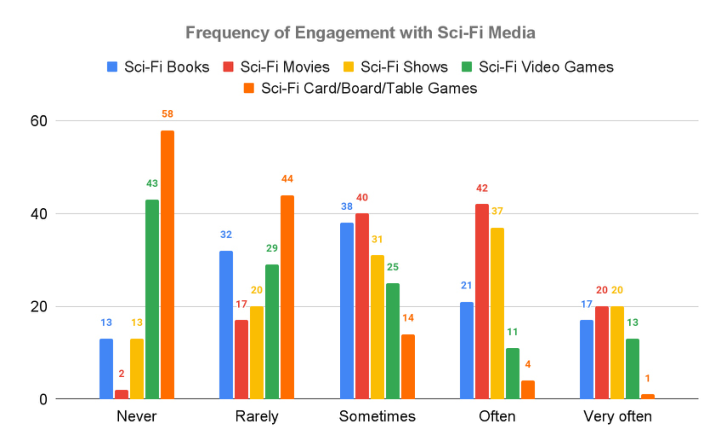
Figure 1 shows that the majority of respondents engage often or very often with sci-fi movies and sci-fi shows, with a total of 62 and 57 respondents respectively. Sci-fi card-, board- and table games represent the media least interacted with as only 5 respondents indicated engaging with them often or very often. Overall most participants indicated at least one medium of sci-fi often or very often.
A Survey of Beliefs and Attitudes Toward Artificial Intelligence 43
Figure 1: Frequency of engagement with sci-fimedia.
Section 3 — Perceived Knowledge of AI & Future Impact
Table 7 illustrates that the survey respondents were most familiar with AI in general (Q.10), as measured by an average familiarity of 3.78 across the dataset. The second most familiar concept was Machine Learning (Q.11.1, 3.55), followed by Natural Language Processing (Q.11.2, 3.4) and Deep Learning (Q. 11.13, 3.2). Neural Networks (Q.11.4) and Computer Vision (Q.11.5) were the least familiar concept with an average familiarity of 3.0. These results suggest that people in our sample seem to be more familiar with the concept of AI in general, and less familiar with related concepts relevant to AI.
Table 7. Average familiarity with artificial intelligence and subtopics.
Table available in the original PDF paper.
Concept Average Familiarity Q.10: Artificial Intelligence 3.78 Q.11.1: Machine Learning 3.55 Q.11.2: Natural Language Processing 3.4 Q.11.3: Deep Learning 3.2 Q.11.4: Neural Networks 3.0 Q.11.5: Computer Vision 3.0 A follow-up open-ended question was included that invited respondents to explain what “Artificial Intelligence means to them”. For this question, a total of 97 comments were received. While the response length varied, a common theme in the understanding of AI could be deduced:
Most comments discussed AI as a process of feeding computer data to make predictions, to recognize patterns, and to mimic — or potentially even to replace — human thought. For example, a man aged between 26–35 with a doctorate in engineering explained that AI is the “ability of a
computer/machine to recognize patterns and make predictions based on the learned patterns (e.g., user preferences, photo tagging, etc.) or to generate new patterns (text, images, etc.).”
Table 8 shows that most respondents (n = 71, 58.7%) believed that AI would end up having a positive impact on their lives.
Table 8. Responses to q9: how do you feel artificial intelligence will impact your life.
For example, a man aged between 36–45 years, with a bachelor’s in physics mentioned that “automatization generally removes some areas of human activity because they are better handled by machines while opening others by creating tools that enable them. We see it as a positive process, development of mankind, an extension of biological evolution.”
On the other hand, some respondents (n = 33, 27.3%) believe that AI will be harmful. For example, a woman, aged between 20–25 with a bachelor’s in English commented: “I think it will have a negative effect because it will allow humans to have even more not to think for themselves or have the emotional intelligence or even to fully develop their critical thinking skills.” It is worth noting that most of the respondents, who indicated that AI would have either “Little” or “No” impact in the prior question did so because it was the closest to both a positive and negative impact option, as stated in the qualitative feedback.
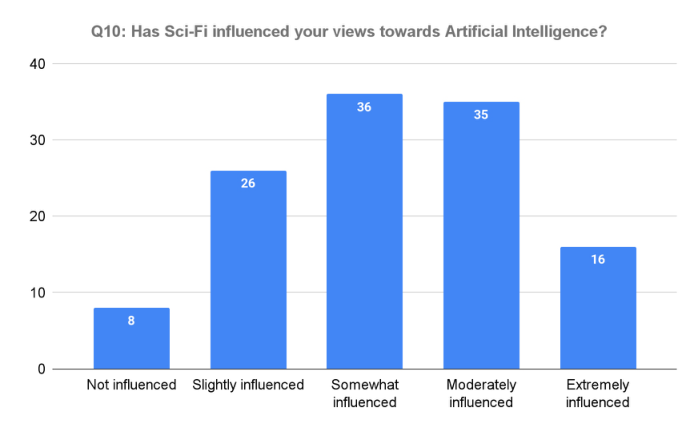
Section 4 —The Effect of Science Fiction on Perceptions Towards AI The final section of the survey consisted of 2 questions. First, participants were asked if sci-fi has influenced their views toward AI via a 5-point Lik- ert scale measure. Figure 2 shows that n = 113 of 121 respondents believed that sci-fi had some influence over their perceptions of AI, with the remain- ing n = 8 participants indicating that it had not influenced their views towards AI.
While 16 respondents believe it has extremely influenced their perceptions towards AI, the majority believed that sci-fi had only slightly, somewhat, or, moderately influenced their perceptions of AI.
The second, open-ended follow-up question invited respondents to share more information on their thoughts about the connection between sci-fi and AI. After the review of 57 comments, a common theme among the responses was that sci-fi is often helpful in imaging and developing technology for the future.
A Survey of Beliefs and Attitudes Toward Artificial Intelligence 45
Figure 2: Perceived influence of sci-fion participants’ views on AI.
For example, a woman aged between 36–45 with a doctorate in anthropol- ogy remarked, “I think there’s definitely a feedback loop between sci-fi and the development of AI (and the development of new tech in general). Sci-fi often inspires people to try to develop new technologies, and the development of new technologies can inspire new waves of sci-fi producers.”
DISCUSSION
The Influence of Sci-Fi Over AI Based on the results of the presented 17-item survey, we conclude that sci-fi has a modest impact on people’s perception of AI.This finding is supported by the small percentages of respondents who believed that sci-fi had either “not influenced” (n = 8, 6,6%) or “extremely influenced” (n = 16, 13,2%) their views on AI, see Figure 2. This finding suggests that, for most respondents (n = 97, 80%), sci-fi did indeed influence their perceptions of AI to some degree and extent.
The finding that sci-fi has a modest impact on our sample’s perception of AI can be further contextualized by an analysis of the qualitative comments that respondents left. For example, an aerospace engineering student aged between 20–25 claimed that “[...] portrayals of AI are generally quite differ- ent from the real thing, and are rarely helpful in understanding it.” This view cautions the sole reliance on sci-fi as a means to better understand current AI, and at the same time, fosters the notion of its potential use as a source of inspiration.
To illustrate this claim, a non-binary respondent aged between 26–35 with a master’s in communications pointed out that “...science fiction helps us imagine a future with AI in it, which gives us a way to think about new uses, or ethical issues that we need to consider.” Be that as it may, upon a review of the 57 open-ended comments provided addressing the sci-fi—AI link, we
find evidence that gives rise to the significance of other factors, among those an individual’s education, age, or media coverage, all of which may play a significant role in shaping one’s view toward AI and our socio-technological future, beyond sci-fi.
Common Themes Among the Future of AI After examining 110 qualitative comments on how participants perceive AI’s future impact on their future lives, three common themes emerge stating an overall detrimental, that is negative, impact, discussed below:
First, the effect of capitalism and human greed may lead to AI systems that prioritize economic gain over environmental and human well-being. To exemplify, a woman aged between 36–45 with a doctorate in Political Science stated that AI will have an overall negative impact “because AI technolo- gies are being developed within capitalism, rather than within a system that prioritizes human well-being (and the well-being of our non-human rela- tions).” Viewing AI from this critical, socio-economic point of view leads to the quintessential recognition that AI is to be developed with ethical con- siderations in mind so that the technology is accessible, fair, and beneficial — to everyone.
Second, AI may exacerbate existing inequalities in society, illustrated by a PhD-educated male, aged between 36-45, stating that “the way AI is prac- ticed currently is intimately tied to capital and capitalism and its various comorbidities, and it is mostly used to entrench and worsen existing hier- archies and inequalities, e.g., by supplanting, alienating, casualizing and atomizing labor, or by way of objectivity-washing existing biases and catego- rizations through learning and perpetuating them from data into normative and descriptive systems.”
Third, the increasing dependency on AI may decrease our critical think- ing, creativity, and problem-solving skills, as mentioned by a woman, aged between 20–25 with a bachelor’s in Philosophy, who said that “it is concern- ing to see the level of increasing AI dependency - this applies to human users, governments, and businesses in general. Will we still remember to read books and think for ourselves without relying on summaries generated by Chat- GPT? Will we retain our ability to make critical judgments without falling back to some aspects of automated decisions?”
As AI continues to advance and make our lives seemingly easier by offload- ing menial, cognitive tasks, it appears that exactly this outsourcing of human cognition is a vital concern in our survey sample. Many comments discuss the importance of preserving independent thought, including humans’ ability to critically and rationally observe, reason, and evaluate our everly complex world.
Limitations First, we concede that the initial recruitment approach via Reddit yielded an ineffective response rate, which lead to the decision to snowball the survey. As a result of promoting participation via the authors’ personal networks & professional communities, opportunities for bias might have been introduced.
A Survey of Beliefs and Attitudes Toward Artificial Intelligence 47
Second, the analysis via simple, descriptive statistics, in lieu of any correlation analysis or inferential statistics, might limit the generalizability of the results.
Third, we acknowledge limitations related to the structure of certain ques- tions. For example, we did intentionally force respondents to ‘choose a side’ as to whether AI would have a positive, negative, or neutral impact on their life, not offering a positive and negative, or mixed, response option. This lim- itation was likely addressed via the optional, follow-up question, in which 19 respondents indicated that AI would indeed have two-sided impacts on their future lives. Lastly, we concur that the analysis of the open-ended comments was selective, and not based on a qualitative content analysis.
Implications and Future Work The results of this research can better inform sci-fi creators of the impacts of their work and how it may influence people’s perceptions of the future of AI. As apparent from the data, most individuals are at least somewhat influenced by what they see in sci-fi. Therefore, it is important that the creators consider the social and ethical implications of AI in their work. For example, if AI in sci-fi continues to be portrayed in a negative, dystopian context, it may increase the public’s fear and mistrust of AI in the real world. On the other hand, if AI is portrayed as a beneficial tool and addition to humanity it could make the adoption of it into society easier and more positive.
Our results also show that the perceived understanding of what ‘AI means’ and ‘what impact AI might have’ encompasses a spectrum of assessments, assumptions, and beliefs, both of positive and negative nature. This speaks to the ongoing and rapid evolution of the field, including the uncertainty of this emerging and nascent technology for society, as found in our survey data.
Future researchers exploring this topic may benefit by exploring how dif- ferent genres in sci-fi affect people’s perceptions of AI. An example of this may be comparing utopian versus dystopian examples and how strongly they influence someone’s views towards technology.
REFERENCES
Ahmed, A. (2023, January 27). ChatGPT achieved one million users in record time - revolutionizing time-saving in various fields. Digital Information World. Retrieved April 28, 2023, from https://www.digitalinformationworld.com/2023/ 01/chat-gpt -achieved-one-million-users-in.html. Burton, E., Goldsmith, J., & Mattei, N. (2018). How to teach computer
ethics through science fiction. Communications of the ACM, 61(8), 54–64. https://doi.org/10.1145/3154485. Carullo, M. (2023, March 15). How will CHATGPT-4 affect cybersecurity? Nozomi Networks. Retrieved April 28, 2023, from https://www.nozominetworks.com/ blog/how-will-chatgpt-affect-cybersecurity/. Gutierrez, J. A. W. (2018). Students Evaluate Music Theory Courses: A Reddit Com-
munity Survey. College Music Symposium, 58(2). https://doi.org/10.18177/sym. 2018.58.sr.11391. Hermann, I. (2021). Artificial Intelligence in fiction: Between narratives and metaphors. AI & SOCIETY, 38(1), 319–329. https://doi.org/10.1007/s00146- 021-01299-6.
Hudson, A. D., Finn, E., & Wylie, R. (2021). What can science fiction tell us about the future of Artificial Intelligence Policy? AI & SOCIETY, 38(1), 197–211. https://doi.org/10.1007/s00146-021-01273-2. Jordan, P., Silva, P. A. (2021). Science Fiction—An Untapped Opportunity in
HCI Research and Education. In: Soares, M. M., Rosenzweig, E., Marcus, A. (eds) Design, User Experience, and Usability: UX Research and Design. HCII 2021. Lecture Notes in Computer Science (), vol 12779. Springer, Cham. https://doi.org/10.1007/978-3-030-78221-4_3. Nader, K., Toprac, P., Scott, S., & Baker, S. (2022). Public understand- ing of artificial intelligence through entertainment media. AI & SOCIETY. https://doi.org/10.1007/s00146-022-01427-w. Rajpurkar, P., Chen, E., Banerjee, O. et al. AI in health and medicine. Nat Med 28, 31–38 (2022). https://doi.org/10.1038/s41591-021-01614-0. Roose, K. (2023, February 16). Bing’s A. I. Chat: ‘I want to be alive’. The New
York Times. Retrieved April 28, 2023, from https://www.nytimes.com/2023/02/ 16/technology/bing-chatbot-transcript.html. Sanders, N. E., & Schneier, B. (2023, January 15). How CHATGPT hijacks democracy. The New York Times. Retrieved April 28, 2023, from https://www.nytimes. com/2023/01/15/opinion/ai-chatgpt-lobbying-democracy.html. Stein-Perlman, Z., Weinstein-Raun, B., & Grace, K. (2022, September 27). 2022
expert survey on progress in AI. AI Impacts. Retrieved April 29, 2023, from https://aiimpacts.org/2022-expert-survey-on-progress-in-ai/. Wild, B. (2023, April 9). CHATGPT: Cardiff students admit using AI on essays.
BBC News. Retrieved April 28, 2023, from https://www.bbc.com/news/uk-wales- 65167321.
LISTED IN THE AHFE DIGITAL BOOKSTORE CATALOGUE
Explore the complete digital volume
Artificial Intelligence, Social Computing and Wearable Technologies
Read this individual research paper free through the original publisher, or explore the full digital proceedings book.
ISBN 978-1-958651-89-6
Explore this ISBN in the AHFE Bookstore ↗Listed in the July 2026 bookstore catalogue; search by ISBN to confirm current availability · Digital book purchase optional