Dominique Bohrmann, Moritz Gobbert, Ericson Hoelzchen, Ditty Mathew, Ralph Bergmann, Thomas Ellwart, Ingo Timm, Benjamin Weyers (2023). FlexiTeams – An Interactive Visual Representation of AI-based Knowledge to Reorganize Operational Teams in Crises. In: Artificial Intelligence, Social Computing and Wearable Technologies. AHFE Open Access, vol. 113, pp. 195–204. https://doi.org/10.54941/ahfe1004192
Crises, such as the COVID-19 pandemic, pose unprecedented challenges for governmental or healthcare organizations as well as for the entire industry and the service sector. For instance, shifts in business areas due to increased infection control regulations led to overburdened or underchallenged units within the organizations. Thus, the flexible and highly dynamic adaptation of work processes and team organizations to the changed conditions are essential for maintaining the economic and social infrastructure. The requirements for such a reorganization are constantly changing due to the parallel process of gaining knowledge about the actual risk factors in the spread of the pandemic and require an agile reorientation, which is associated with great effort and uncertainty.For this reason, we present the FlexiTeams framework that supports decision makers to manage staff allocation and workflow organization in the context of such time-sensitive situations using conversational artificial intelligence and agent-based simulation. Agent-based modeling and simulation are established in many disciplines as a new tool for the analysis of complex systems. In social simulation, agent-based models are often used to analyze emergent effects e.g., as phenomena of social contagion. In cognitive social simulation, mechanisms of sociology and psychology are combined to generate cognitive decision-making behavior within an agent as well as group dynamic behavior between agents. This allows the study of complex socio-digital systems in which humans and (semi-)autonomous information systems cooperate in knowledge-intensive processes. However, in a crisis situation such as the COVID-19 pandemic or severe weather disasters, it is necessary not only to capture specifications of a team or to evaluate their efficiency, it is rather important to react to current situations. Indeed, it is of special interest to assemble the available work force accordingly, which may be seconded from other tasks. The flexible allocation of resources depending on a current situation is an important field of research in Distributed Artificial Intelligence (DAI). DAI deals with systems of (partially) autonomous decision makers, so-called software agents, whose behavior are largely determined by situational decision-making, negotiation and coordination during the runtime of the system. In addition to the agent-based approach, the comprehensive knowledge representation of process-oriented case-based reasoning (POCBR) is well suited for the modeling and processing of experiential knowledge about team constellations and work processes with the aim to make suggestions for adjustments in the sense of reorganizations.One major success factor to benefit in time-critical situations from the provided guidance and suggestions is to keep the human in the loop regarding both, the AI’s decisions and its simulation’s results. Thus, one part of the framework is to design a suitable interface to enable users to understand and revise the AI’s results. In this paper, we introduce the general framework, discuss its novelty and present an initial demo prototype showcasing some UI design concepts relevant to this context. For instance, an overarching dashboard is designed to represent resources, profiles, and key performance indicators (KPIs) comprising economic, social, and health status.
The COVID-19 pandemic serves as a prime example of a crisis that affects social life and confronts the entire society with unforeseen challenges. For instance, increased infection control regulations led to overburdened or under-challenged units within business organizations. To maintain the eco- nomic and social infrastructure, a highly dynamic, flexible adaptation of work processes is necessary. This, however, is accompanied with high complexity and low time budget in decision-making (Filip, et al., 2022; Ares Castro-Conde, et al., 2021; OECD, 2021). Therefore, we introduce
the FlexiTeams framework, which assists decision makers in these kinds of situations. To be more specific, the framework supports decisions regard- ing the flexible (re-)allocation of team members and corresponding work processes. Thus, our framework follows the trend of using Artificial Intelli- gence (AI) in the context of Industry 4.0 which—generally speaking—offers great potential for companies and institutions. Another use case for flexible reallocation of team members—and thus Flexi Teams—are environmen- tal disasters, whose occurrence is, driven by global warming, expected to increase. In order to tackle these challenging situations, it is necessary to strengthen and improve the company’s flexibility and adaptivity, especially in terms of business resilience (Schwab, 2017; Park, 2016; Bai, et al., 2020; Fox, 1986; Yao, 2017).
The pilot of FlexiTeams was developed following interviews with vari- ous organizations. Based on these, an initial use case of surgery planning in hospitals has been chosen. In this context, prioritization of treatments is one main challenge that arises during pandemic situations. In addition, staff absences and short-term illnesses complicates the course of parallel oper- ations. Here, experience-based knowledge of Process-Oriented Case-Based Reasoning (POCBR) comes into play, which helps decision makers to handle unforeseen situations based on past experience. In addition to incremental modifications, such as the reallocation of personnel, changing the sequence of processes or the parallelization of them, there are also structural issues to be tackled. For example, at a certain threshold of staff deficit, sections of the hospital and, thus, some types of operation may no longer be feasible. Thus, by merging different hospital sections, a higher overall performance could be achieved. Answers to corresponding questions—such as which sections are involved, when is it necessary or reasonable to merge, and which combina- tion is to be favored—are provided by the scenario-based approach that will be explained in more detail in the upcoming sections. Both, the experienced- based and scenario-based approach are capable of creating new proposals that have not yet occurred in the past.
The FlexiTeams framework uses existing data on personnel, resources and organizational processes, in combination with cognitive science and indus- trial psychology findings, to optimize decisions regarding workflows and team allocation. The framework is supplemented by experiences from com- parable issues in previous crises. To be more specific, FlexiTeams uses both, POCBR methods, as well as agent-based simulation, to attain its result. Thus, it features a hybrid AI approach. In more detail, within the FlexiTeams project, AI methods will be used to identify decision proposals, make them transparent, and evaluate alternatives. While the larger part of this paper pro- ceeds to introduce the general FlexiTeams framework itself, we also want to focus on the Human Computer Interaction (HCI) perspective in the context of this hybrid AI approach and further present an explorative UI prototype which works in this setting.
THEORY The handling of the COVID-19 pandemic shows that even well-established and highly standardized work processes can be affected by exogenous events.
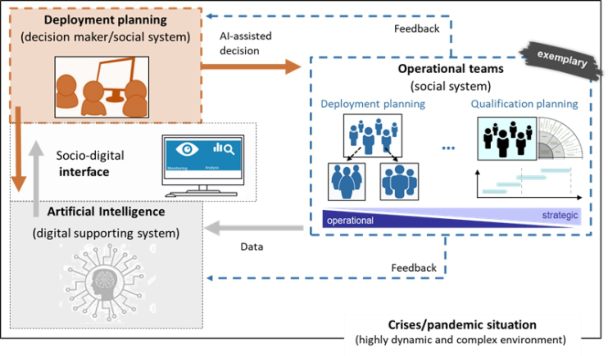
FlexiTeams – An Interactive Visual Representation of AI-Based Knowledge 197 AI methods offer far-reaching possibilities for dealing with such situations by using experience-based complex data. Especially in highly dynamic decision- making situations, it is expected that the use of AI methods shows great advantage to the current status quo (Meyer, et al., 2014; Gonzalez, 2022; Leitão, et al., 2022). The aforementioned FlexiTeams project makes an essential contribution to this, as the current work will precisely address the formation of teams in highly variable pandemic situations and their manage- ment. In fact, to support the organization in mastering the crises in the best possible way, the digital system must follow an interdisciplinary develop- ment process embedded in a human-centric design approach. With reference to Figure 1, it is shown that the FlexiTeams project is characterized by four essential components. Firstly, there is the group of the decision-makers who are responsible for the team allocation. Secondly, there is the deployment team, which acts as the executive part at the location of the event. Next, the composition of the team is to be supplemented by a digital, AI-based decision support system. Finally, the interface between the decision-makers and the AI is the last crucial part in closing the information loop within the machine learning process. The contribution of different disciplines as well as their interaction will be discussed in the following. In fact, initially, the digital assistance system and its basic methodology will be described followed by its interactive visual representation.
Figure 1: FlexiTeams components.
Interactive Experience-Based Reorganization An essential source of knowledge for the reorganization of teams and, further- more, the adaption of work processes is both the past experience of human decision makers and the accumulated shared knowledge collected from sev- eral decisions made by employees of the organization. Indeed, knowledge management techniques have the potential to effectively acquire and com- pile such valuable knowledge in organizations and make it accessible, for instance to the decision-makers. In addition, the AI methodology of so-called
Case-Based Reasoning (CBR) (Riesbeck & Schank, 1989) facilitates the pro- cessing of experience-based problem-solving. More precisely, CBR solves a task using prior experiential knowledge and adapts the experience-based solution to the prevailing scenario of the task being solved. This approach includes not only the process but also the context in which the decision is made in and its effects. Especially the comprehensive knowledge repre- sentation of POCBR (Minor, et al., 2014) is well suited for the modeling and processing of experiential knowledge about team constellations and work processes with the aim to make suggestions for adjustments in the sense of reorganizations. In (Mathew, et al., 2022), the authors present how POCBR can be applied to flexibly and dynamically organize team and work processes to be prepared for crises like COVID-19. Conversa- tional POCBR methods (Zeyen, et al., 2017) allow to include human in the loop for an interactive experience-based reorganization, but most of them are limited to minimalistic user interactions in the sense of simple question-answer chains (Hillig & Müller, 2020). However, by combining these approaches with methods from the research area of HCI, completely new possibilities arise for designing experience-based models as interac- tive systems that enable cooperative solution finding in a dialogue between humans and machines. Especially in the area of reorganization of teams and work processes, it is expected that a deeper understanding of the experience- based decision proposals can be achieved by the human decision maker through appropriate visualization of these processes as well as their effects gained through simulation. On this basis, better decisions, efficient decision- making processes, and a high acceptance of such supporting tools shall be enabled.
In order to successfully adapt to new situations, team psychology empha- sizes the importance of an interactive reflection of experiences and solutions between team members (Ellwart, et al., 2015). Related to the FlexiTeams framework, integrating AI-based agents as technology for reflecting and evaluating experiences and solutions of team allocation enables teams to develop new perspectives by combining CBR-based AI-representations with team cognitions (Schilling, et al., 2023).
Nonetheless, we have to consider that even “classical”interaction between humans and AI systems is difficult to design. In (Yang, et al., 2020), the authors point out several challenges—such as capability uncertainty and out- put complexity—when designing human-AI interaction. While it may be possible to tackle capability uncertainty by designing small, clearly defined AI systems, the problem to “predict” possible erroneous outcomes remains. Xu et al. discuss similar problems—the AI delivers unique and/or unex- pected results, which can be a challenge in designing human-AI interaction. They also mention different problems that arise when designing related interactions—such as trust, privacy and fairness (Xu, et al., 2023). Further in (Harper, 2019), the author discusses that interaction is some kind of grammar and it is necessary to find the “right one” to represent human-AI interaction. They also emphasize the importance of collaboration between human users and AI.
FlexiTeams – An Interactive Visual Representation of AI-Based Knowledge 199
Cognitive Social Simulation and Distributed Artificial Intelligence Agent-based modeling and simulation are established in many disciplines as a tool for the analysis of complex systems (Wilensky & Rand, 2015). In social simulation, agent-based models are often used to analyze emergent effects e.g., as phenomena of social contagion (Berndt, et al., 2018). In cognitive social simulation, mechanisms of sociology and psychology are combined to generate cognitive decision-making behavior within an agent as well as group dynamic behavior between agents. This allows the study of complex socio-digital systems in which humans and (semi-)autonomous information systems cooperate in knowledge-intensive processes. However, in a crisis sit- uation such as the COVID-19 pandemic or severe weather disasters, it is necessary not only to capture specifications of a team or to evaluate their efficiency, it is rather important to react to current situations. Indeed, it is of special interest to assemble the available work force accordingly, which may be seconded from other tasks. The flexible allocation of resources depend- ing on a current situation is an important field of research in Distributed Artificial Intelligence (DAI) (Ferber & Weiss, 1999). DAI deals with systems of (partially) autonomous decision makers, so-called software agents, whose behavior are largely determined by situational decision-making, negotiation and coordination during the runtime of the system. In fact, agent technology is an essential element for coordination tasks in Industry 4.0.
Both aspects are combined in the FlexiTeams project: Cognitive social simulation is used to model and simulate processes and the workforce and then evaluate them in terms of efficiency and resilience, while DAI methods are used to implement intelligent, autonomously acting, interacting software agents. This provides the basis for reconfiguring teams and flexibly adapt- ing tasks, processes and roles. Next, these constitutions are then simulated in different scenarios to evaluate their performance. Experiences about possible team configurations as well as their success will be stored and considered on a technical level by means of “Conversational Process-oriented Case-Based Reasoning”, which represents an important interface in the area of “Inter- active Experience-Based Reorganization”. In fact, the simulation is to be prepared in such a way that the people affected and the responsible decision- makers not only visualize the calculated team configuration, but can also compare and evaluate it with their own variants.
Interactive Visual Representation of AI-Based Knowledge As already outlined before, when using digital AI systems to support work processes and decisions in critical emergency situations, as in the case of the COVID-19 pandemic, special care is required in the development of a human- centered user interfaces and the interactive visual representation of the AI recommendations provided by the digital system. The user interface needs to be easy to understand, user-friendly and most important deliver the suit- able kind of information that is required for the specific use case. The visual presentation must be comprehensible and avoid misleading interpretation of the content, which becomes especially important as soon as humans interact with artificial intelligence systems in time-critical situations. The main focus is on the assistance and information offered by the intelligent system, which
must be presented and interactively prepared in such a way that human users can understand the suggestion, evaluate it meaningfully, and use it for their specific problem.
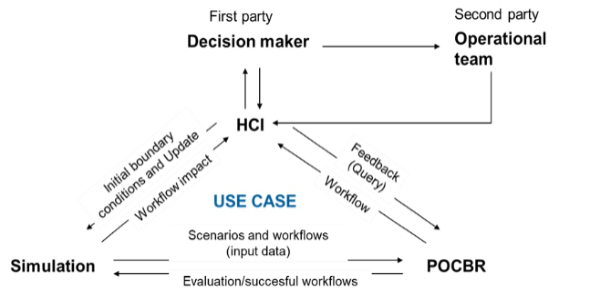
Figure 2: Refined representation of the framework.
This is particularly mandatory when the ensuing decisions, such as the composition of teams, are critical for the resulting consequences for individ- uals or even the entire population. For this purpose, methods of user-centered development from HCI research can be usefully applied. As outlined in Figure 2, the FlexiTeams framework is highly networked, while the use case builds the central part that, for instance, shapes the user interface. In conse- quence, it is important to develop and empirically evaluate different aspects of CBR and cognitive social simulation in the context of the visual representa- tion of the generated data. Corresponding decision-making processes will be considered and subsequently embedded into the digital system and analyzed in coordination with the developed AI results.
UI PROTOTYPE In this section, we outline a first UI prototype that eases the previously men- tioned challenges. The underlying AI methods suggest workflows (of teams and work processes), which can be modified by the user. The adaption is then interpreted as a new query and included in the feedback loop of POCBR to get a refined suggestion. In addition, we incorporate agent-based simulation into the interface. This helps to further refine the AI output and give the user an explicit prediction of how given parameters and constraints affect differ- ent Key Performance Indicators (KPIs)—e.g., economic viability (Mathew, et al., 2022).
Since the FlexiTeams framework deals currently with staff allocation in the context of surgeries, the in- and output workflows are rather inflexible. In most cases, we cannot change the order of steps inside the workflow (“a sur- geon cannot perform surgery if the patient is not anesthetized beforehand”). The POCBR system is implemented using the ProCAKE framework, and the multi-agent-based simulation is implemented using NetLogo (Bergmann, et al., 2019; Wilensky, n.d.).
FlexiTeams – An Interactive Visual Representation of AI-Based Knowledge 201
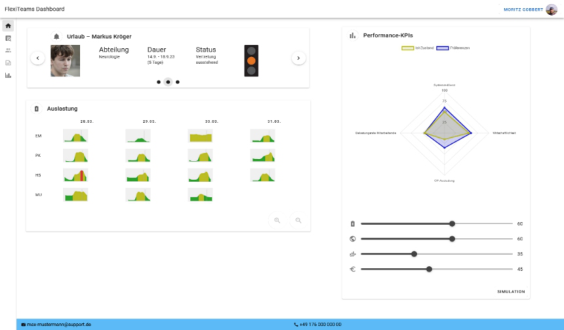
Figure 3: Dashboard view.
The overarching dashboard is designed as landing page, which shows all relevant information in a clearly laid out manner (cf. Figure 3). On the right- hand side, we outline the main KPI set, which is based on previous interviews. Specifically, resilience, economic viability, room capacity and staff stress level are essential information for describing the surgery performance level. Each of these KPIs has two values, the target and the actual status. While the tar- get value is defined by the user via sliders, the actual status is captured by simulation and real-life data.
On the left-hand side, one particular KPI is drilled down to show specifics and anomalies. Besides displaying the KPIs, the dashboard also shows rel- evant announcements—e.g., a staff member’s planned vacation or more short-term announcements like sick notes.
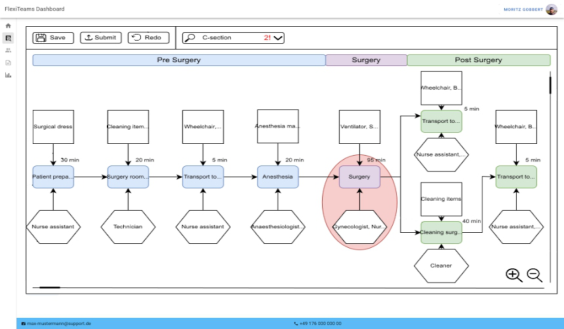
Figure 4: Display of a hypothetical surgery workflow—indicating a problem in the “Surgery” step.
Another part of the framework displays workflows (cf. Figure 4) and is used to query the AI system (and also to further converse with it). Inter- nally there is a large case base of successful surgery workflows in different variations, which the POCBR methods access. The user can initially query
a workflow via name. If there is a workflow with the same name in the case base, the user gets this workflow as a graph including staff (and resource) assignments. The user can then modify the workflow and/or staff and resource assignments or “re-query”with different parameters (e.g., num- ber of available staff members of a specific role or parallelize a sequential workflow). When being satisfied, the user can accept the workflow.
As mentioned previously, surgeries are rather inflexible and we cannot change the order of tasks. Though we can tell the underlying AI system that we prefer serial or parallel tasks—which influences the output. Further, we can convey to the AI that specific staff members, which are currently assigned to a workflow, are not available. The system than outputs another workflow which respects this information. This is of special interest when many work- flows and processes are executed in parallel and interactions between the surgeries occur.
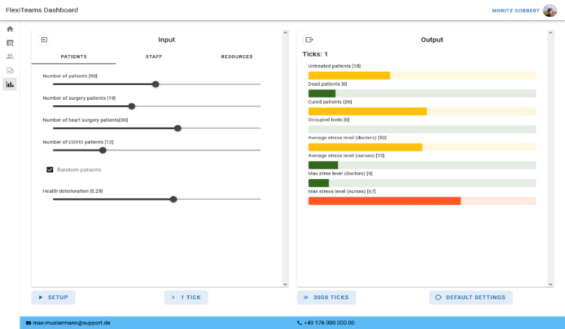
A third layer of the framework is an interface to control the simulation— i.e., modifying the input parameters and looking at the simulation’s output (cf. Figure 5). In our prototype, a simulation using NetLogo runs in the background and the UI only controls the input parameters and shows the output values. On principle, the user could via the NetLogo interface directly though it is more consistent with the rest of the interface, if the simulation is implemented in the entire UI framework.
Figure 5: Simulation interface.
CONCLUSION AND OUTLOOK The FlexiTeams framework, as presented in this paper, combines the ben- efits of process-oriented case-based reasoning and agent-based simulation while integrating the user into the decision process. This hybrid AI approach keeps the human in the loop, stimulates knowledge reflection in decision- making groups, and can be allocated to the research area of conversational AI. In the course of this paper, we outlined the reason for this framework and explained why highly flexible adaptions can be necessary and beneficial. Fur- thermore, we discussed its merits, novelty, and uniqueness and have shown how a prototype interface could look like.
FlexiTeams – An Interactive Visual Representation of AI-Based Knowledge 203 Next, user studies and evaluation of the framework and its UI is planned. Future work could also encompass different use cases, apart from the med- ical/surgery context. Examples would be comparably dynamic and risk susceptible uses cases such as staff allocation in nursing services or public transport. In addition, it might be possible to extend the FlexiTeams approach to processes that are not staff-related. Another research area is the usage of AR and/or VR to improve the usability and “conversationality” of the framework. Display of location sensitive information to improve the inter- face or usage of biological features as feedback for the AI could enhance the experience.
REFERENCES
Ares Castro-Conde, B., López Mouriño, V. M., Sanz Falque, I. & López Castro, J., 2021. COVID 19 and the new challenges in health management: The pilot experience of the Internal Medicine Department of a Regional hospital. Journal of Healthcare Quality Research, 36(1), pp. 54–55. Bai, C., Dallasega, P., Orzes, G. & Sarkis, J., 2020. Industry 4.0 technologies
assessment: A sustainability perspective. International Journal of Production Economics, Volume 229. Bergmann, R. et al., 2019. ProCAKE: A Process-Oriented Case-Based Reasoning Framework. Otzenhausen, s.n., pp. 156–161. Berndt, J. O., Rodermund, S. C. & Timm, I. J., 2018. Socital Contagion of Fertility:
An Agent-Based Simulation Study. Gothenburg, s.n. Ellwart, T., Happ, C., Gurtner, A. & Rack, O., 2015. Managing information overload in virtual teams: Effects of a structured online team adaptation on cognition and performance. European Journal of Work and Organizational Psychology, 24(5), pp. 812–826. Ferber, J. & Weiss, G., 1999. Multi-Agent Systems: An Introduction to Distributed
Artificial Intelligence. Boston: Addison-Wesley. Filip, R. et al., 2022. Global Challenges to Public Health Care Systems during the COVID-19 Pandemic: A Review of Pandemic Measures and Problems. Journal of Personalized Medicine, 12(8). Fox, M. S., 1986. Industrial Applications of Artificial Intelligence. Robotics, 2(4),
pp. 301–311. Gonzalez, C., 2022. Learning and Dynamic Decision Making. Topics in Cognitive Science, 14(1), pp. 14–30. Harper, R. H. R., 2019. The Role of HCI in the Age of AI. International Journal of
Human-Computer Interaction, 35(15), pp. 1331–1344. Hillig, S. & Müller, R., 2020. How do conversational case-based reasoning systems interact with their users: a literature review.. Behaviour & Information Technology, Volume 40, pp. 1544–1563. Leitão, D., Saleiro, P., Figueiredo, M. A. T. & Bizarro, P., 2022. Human-AI Col-
laboration in Decision-Making: Beyond Learning to Defer. Computing Research Repository (CoRR), Volume abs/2206.13202. Mathew, D. et al., 2022. FlexiTeam: Flexible Team and Work Organization using Process-Oriented. Nancy, s.n. Meyer, G. et al., 2014. A Machine Learning Approach to Improving Dynamic
Decision Making. Information Systems Research, Volume 25, pp. 239–263. Minor, M., Montani, S. & Recio-García, J. A., 2014. Process-oriented case-based reasoning. Information Systems, Volume 40, pp. 103–105.
OECD, 2021. The territorial impact of COVID-19: Managing the crisis and recovery across levels of government. OECD Policy Responses to Coronavirus (COVID-19). Park, H.-A., 2016. Are We Ready for the Fourth Industrial Revolution?. Yearbook
of Medical Informatics, Volume 1, pp. 1–3. Riesbeck, C. K. & Schank, R. C., 1989. Inside Case-Based Reasoning. Hillsdale, NJ: Lawrence Erlbaum Associates. Schilling, T., Ellwart, T. & Mueller, R., 2023. Context matters: Varying prefer-
ences for decision-support levels by artificial intelligence in personnel planning. Katowice, Poland, s.n. Schwab, K., 2017. The Fourth Industrial Revolution. s.l.: Crown. Wilensky, U., n.d. NetLogo Home Page. [Online] Available at: https://ccl.northwestern.edu/netlogo/index.shtml\ [Accessed 08 08 2023]. Wilensky, U. & Rand, W., 2015. An Introduction to Agent-Based Modeling: Mod-
eling Natural, Social, and Engineered Complex Systems with NetLogo. s.l.: MIT Press. Xu, W., Dainoff, M. J., Ge, L. & Gao, Z., 2023. Transitioning to Human Interaction with AI Systems: New Challenges and Opportunities for HCI Profession- als to Enable Human-Centered AI. International Journal of Human-Computer Interaction, 39(3), pp. 494–518. Yang, Q., Steinfeld, A., Rosé, C. & Zimmermann, J., 2020. Re-examining Whether,
Why, and How Human-AI Interaction Is Uniquely Difficult to Design. Honolulu, ACM. Yao, M., 2017. 4 Unique Challenges Of Industrial Artificial Intelligence. [Online] Available at: https://www.forbes.com/sites/mariyayao/2017/04/14/unique-challen ges-of-industrial-artificial-intelligence-general-electric\ [Accessed 10 08 2023]. Zeyen, C., Müller, G. & Bergmann, R., 2017. Conversational Process-Oriented Case-
Based Reasoning. Trondheim, s.n.
LISTED IN THE AHFE DIGITAL BOOKSTORE CATALOGUE
Explore the complete digital volume
Artificial Intelligence, Social Computing and Wearable Technologies
Read this individual research paper free through the original publisher, or explore the full digital proceedings book.
ISBN 978-1-958651-89-6
Explore this ISBN in the AHFE Bookstore ↗Listed in the July 2026 bookstore catalogue; search by ISBN to confirm current availability · Digital book purchase optional