Ziqian Liu, Qin Zhao, Yiting Chen, Yujia Feng, Xinyi Yao (2023). Design and Research of Modular Monitoring and Disinfecting Connection Cabin in the Perspective of "Resilient City". In: Usability and User Experience. AHFE Open Access, vol. 110, pp. 92–101. https://doi.org/10.54941/ahfe1003181
The global outbreak of the Coronavirus has exposed the problems of lagging construction of supporting facilities and emergency response systems when cities face sudden disturbances. The project aims to improve public health care safety from the perspective of "resilient cities" and to find out the feasibility of public epidemic prevention products. The research focused on the 4R attributes of resilient cities. Based on user scenarios, we took over 200 samples through questionnaires and interviews, with questions on behavioral movement, human-machine interaction and system process experience, and obtained pain points as: "efficiency", including time, strain; "safety ", including the extermination strength; "convenient", including operation process tediousness; "sentiment", including information symmetry; "staff fatigue" and other issues, and through interviews to further refine the process of staff experience. Summarizing the pain points to design functional modules for temperature measurement, triage guidance, special situation emergency handling notification, etc. Based on the task and environmental scenarios, we carried out field observation of different places and emergency handling methods, thus interpreting epidemic and disaster prevention policies to classify the places. Aiming at multi-layer scenarios and functions, the product is positioned at the front-end control of cross-infection to realize early detection, triage, disinfection and treatment. In order to facilitate the transportation and maintenance, our design is based on "cabin", including the L-shaped modular main cabin, which is preferentially positioned in the 1 and 2 level shelters. Emergency cabin, which can be unfolded into bigger space for rest if necessary. The isolation cabin, which is put away when idle and can be expanded to serve as an isolated area for users when there's user status exception. The material disinfection cabin at the entrance is suitable for tertiary scenarios such as communities where entry speed is lower. The belongings travel with users in the main cabin, and users can enter and exit the place through this connecting cabin after completing the process such as hands and shoes disinfection, and body temperature detection at the corner, which enhances users' sense of security, usability in terms of user experience. Based on research, our design is more technically and functionally competitive, focusing on the urban users' experience. Our study can realize front-end control of contagion and timely dispatch during major and secondary disasters, and can utilize the space with modular design to enhance resilience and realize common governance of public areas.
Design and Research of Modular Monitoring and Disinfecting Connection Cabin 93
INTRODUCTION
Research Background The Changes in the Concept Resilience Throughout the recent five decades, resilience as a concept has gone through the conversion from engineering resilience to ecological resilience, then to social-ecological system resilience (SESR), which is also known as evolutio- nary resilience. Calling it so goes along with the complex adaptive theory, which views it as a circular evolutionary process without a certain stress, while emphasizes its continuity and sustainability (Li, Hu, 2021).
A resilient city, namely a city with SESR, can better muddle through the strikes of disasters, functioning properly during and recovering swiftly after. It is generally believed that the qualities of city resilience fall into 4Rs: robustness, rapidity, redundancy and resourcefulness.
Exploration of Resilient City Construction at Home and Abroad America, Britain, Japan and some countries have gradually discovered their own identity in constructing urban resilience due to their early start. Macro- scopically, leading countries have laws to guard urban resilience; while micro- scopically, the passive prevention has evolved into the proactive response to disasters. In this sense, improving the capacity of the social-ecological system has become the top priority in building resilience (Tian, Zhang, 2021).
Many cities in China have already achieved practical results in this realm, i.e. Beijing incorporated the concept of “resilient city” in the overall urban planning, and Shanghai established an urban management system with the “community life circle” as a basic unit (Tian, Zhang, 2021). However, by dint of the late start, much of China’s urban resilience construction remains to be discovered. Current research mostly focuses on certain emergencies, and pays insufficient attention to sudden uncertain risks. The outbreak of the Covid in 2020 has brought great challenges to the allocation of medical facilities, urban information management and community services, exposing deficiencies in the public health system.
Current Status of Public Health Products Public health products are directly related to public health. Alleviating the pressure on the public health system is also the growing focus of facilities and equipment in the construction of resilient cities. By the purposes, the products on the market can be roughly categorized into four categories (see Table 1) (Zhang, 2022).
Project Significance Based on the analysis of existing products, much of the design, in its initial stage, has failed to take user experience and feasibility into full consideration. Our project takes “resilient city” as the perspective, seeking the feasibility of the disinfection product design of public epidemic prevention. In an outlook to realize common governance of public areas, we hope that in the face
Table 1. Categories of public health products.
Table available in the original PDF paper.
Categories Products Sanitation and disinfection Sanitation cars, sterilization, induction sanitizer, etc. Identification Non-contact temperature detector, etc. Isolation and protection Masks, protective clothing, isolation goggles, etc. Comprehensive systems Facial identification & temperature detection all-in-ones, etc.
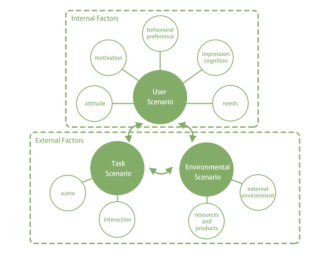
Figure 1: Relationship between user, environmental and task scenario.
of future major and secondary disasters, the front-end control of infectious diseases and disaster dispatch can be realized in a timely manner.
DEVELOPING FIRST-HAND RESEARCH AND DESIGN METHODOLOGY TO SUPPORT SYSTEMATIC DESIGN Research Purpose and Methodology
Donald Norman proposed that design should focus on how things work, how they are controlled, and the nature of the interaction between people and technology. Therefore, we set the research alongside with the 4Rs of the “resilient city”. We have employed the questionnaire method, interview method and field observation method to design a modular connection with the function of monitoring disinfection and sterilization, and draw user beha- vior preferences, contacts, and pain points in the system from user scenarios, task scenarios, and environmental scenarios to comprehensively verify the user experience and usability.
Research Content Research on Population At present, epidemic control is a huge challenge for cities, which may have a profound and extensive psychological impact on people (Lima, 2020). A total of 18 questions were set in the questionnaire. Based on interviewees’ sati- sfaction of their current experience, preliminary general modules and place difference modules were summarized from over 200 samples. The relati- onship between time efficiency, process complexity, user feedback and user experience are obtained through user acceptance.
Design and Research of Modular Monitoring and Disinfecting Connection Cabin 95
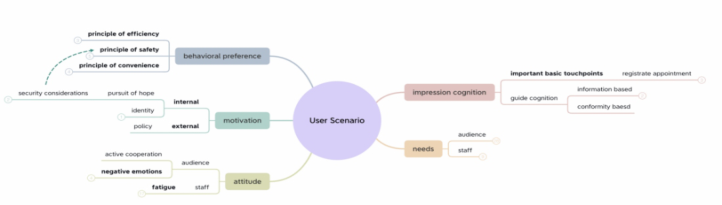
Figure 2: User scenario.
Among them, the user experience follows the principles of efficiency, safety and convenience. The deficiencies include: long queue time for entering and leaving indoor places, which may cause gathering and thus increasing the risk of infection; complicated identity check process; poor adaptability of special groups to intelligent equipment; untimely site cleaning, disinfection and sterilization; gaps in guidance, crowd management and information acquisition.
In the second round of research, according to the systematic user research method of Persona proposed by Alan Cooper, we set our research target at the general public, volunteers and medical personnel. From 5 aspects as behavior preference, motivation, impression, attitude and demand, the user experience insight is carried out to understand the process of entering and exiting public places and the need to face unexpected events, so as to make up for the gaps in behavioral particularities.
By setting up the model on the existing (2022) Chinese policies, we have landed at the potential demand for “guiding cognition”. The questions are set on the basis of the route of entering and leaving public facilities, human- machine interaction and system process experience, the pain points of user’s “demand” level are as follows: Efficiency; Safety; Convenience; Emotion; Staff fatigue.
From the survey data, we found that the design points presented a logical scatter pattern, namely, functions and scenarios can be classified and clo- sely related, so in the third round of survey, we included the environmental scenario.
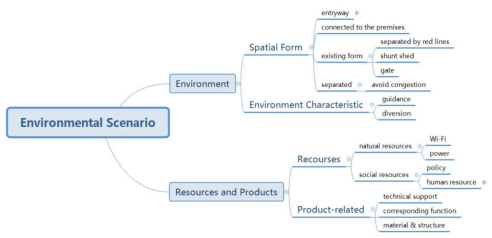
Scenario-Oriented Research Through field observation and online research, the contents involved in the scenario are disassembled into: Environment, Resources & Products. The results of environmental research impact the user experience brought by our product form decisively. The environment involved in the design is quite dif- ferent from each other, which requires the product form to have adaptability and versatility.
Technical and Practical Oriented Research Globalization will accelerate the construction of digital society, including patient identification systems, medical record files and statistics, and the use
Figure 3: User environmental scenario.Table 2. Scene grading table.
Table available in the original PDF paper.
Level Senarios Features 1 Entrances/exits of mobile cabin hospitals Highly infectious Crowded Chaotic 2 Entrances/exits of temporary PCR sites
High risks of viral infection Heavy flow of people Fixed moving direction 3 Entrances/exits of neighbourhoods
Daily life oriented Changeable situation Unstable flow of people 4 Entrances/exits of medical and PCR facilities
Functional Peaks of resident flow Focus on efficiency
Suscpetible crowd; Risks of multi-infection within strains of virus Irritable crowd Complex environment 5 Facilities for culture, commerce, education, entertainment, etc.
of digital medical images (MarceloDionisio, 2023). The project, on one hand, can rely on the data and analysis and computing capabilities of the basic layer of smart medical in the digital wave to share the data in series. On the other, it can respond to emergency medical treatment and material support, to guard city resilience in both a timely manner and responds to emergency.
To combine project with practice it’s also necessary to carry out task sce- nario analysis, classify and summarize occurrence scenarios, bring the user experience into the service process, and verify the availability of interaction methods.
We intend to design public epidemic prevention products with originality and innovation. The adopted sterilization methods of common products in the market are basically space-oriented, leaving problems such as sterilization time-lag and poor pertinence, thus making it less likely to effectively reduce risks.
Design and Research of Modular Monitoring and Disinfecting Connection Cabin 97
Research Results The general public and medical staff will suffer different levels of anxiety when facing the content related to the epidemic (Nicola Montemurro, 2020). Therefore, our goal also focuses on providing a sense of city security under the epidemic.
Cities lack all-time source blocking sterilization products in public places. The design can fill the missing pieces in pandemic prevention, sterilization and emergency response in public places. In face of multi-level scenarios and functional requirements, we will adopt modular thinking to design and cater to specific scenarios in a reasonable and flexible manner.
SUPPORTIVE FRAMEWORK FOR DESIGN AND MODELING Based on the concept of “resilient city”, through design empowerment, the modular connection cabin caters to different levels of scenarios. It can com- plete the main functions of monitor and sterilization of materials at different levels, isolation of abnormal individuals and supply of emergency materi- als;. According to different scenarios, modular splicing is carried out, while considering the practicality and landing of connection, transportation and maintenance.
Design Positioning Scene Positioning The project scenario is positioned at the entrance and exit of public pla- ces. The travel process and touchpoints of them in general and emergency situations are analyzed, and the 5-level division of scenarios is obtained.
User Positioning Considering the user experience and usability, the project takes people who enter and leave public places as the main users. After investigation, the pain points are summarized as 4 aspects: “efficiency”, including long tra- vel time and low efficiency of network identification; “safety”, including lack of management order, lack of safe distance, and insufficient disinfection; “convenience”, including complicated operation process; “sentiment”, inclu- ding low tolerance for emergencies and opaque information. At the same time, users also include the staff at the entrance. The analysis shows that their pain points are mainly “fatigue”, including repetitive operations and emergency response.
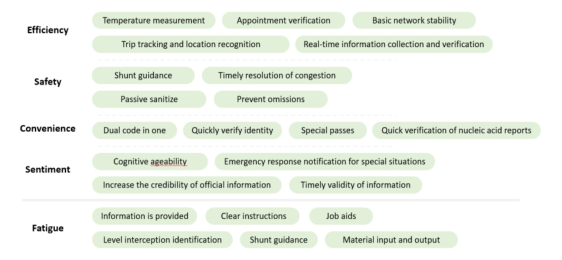
Function Positioning Get function list (see figure 4) through user pain points, and the product module is further obtained, which is divided into basic modules: disinfection and sterilization module, temperature measurement module, information verification module, etc;. And location differentiation modules: reservation verification module, guidance module, etc.
Combined with functional modules, aiming at achieving user experience and usability, the structure is positioned with long-term stability based on
Figure 4: Function list.
basic functions such as temperature measurement; positioning flexibility is based on modular functions in different places; the semi-closed cabin stru- cture is obtained according to the separation needs of doctors and patients and the user’s psychological needs; and it is set as a space compressible combination according to the transportable requirements.
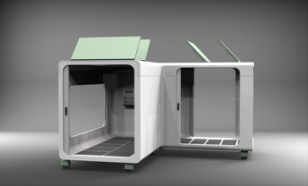
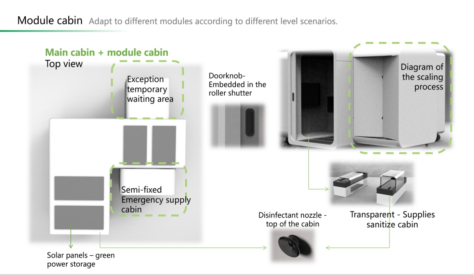
Design Scheme Overall Introduction In order to facilitate the transportation and maintenance of the product, the product is based on the cabin, including the L-shaped modular main cabin, which is preferentially positioned at the first and second level refuge.
Emergency rest cabin, which can store emergency supplies and expand when necessary to obtain more rest space.
Isolation cabin, which is folded up when it is idle, can be expanded as isolation area in case of abnormal temperature or other specified indicators.
The material disinfection and sterilization module at the entrance is appli- cable to 3rd-level scenarios such as communities, where users have low access speed.
Personal belongings will travel with users in the main cabin at the same time. After completing the designated links of hand disinfection and ste- rilization, shoe sole disinfection and sterilization, vein identification and temperature detection at the corner, users can enter and exit the site through the connection cabin, increasing user’s sense of security and usability in terms of user experience.
Introduction of Technology The ultrasonic atomization sterilization technology is used at the entrance of the cabin to carry out environmental disinfection, effectively killing bacteria or viruses. The cabin floor uses ultraviolet disinfection technology to disin- fect the user’s shoe soles, and uses specially designed UVC-band ultraviolet light irradiation to destroy the molecular structure of DNA or RNA in the microbial body cells to achieve the effect of sterilization. At the corner, the non-contact palmar vein recognition technology is used when necessary. The cabin is equipped with solar panels and power generation floor to convert
Design and Research of Modular Monitoring and Disinfecting Connection Cabin 99
Figure 5: The L-shaped module main cabin.Figure 6: Module cabins and their functions.
the kinetic energy generated by users into electrical energy, and storage. The whole cabin adopts the IoT to collect information through sensors, global positioning system and other technologies to facilitate the unified scheduling and distribution of materials, equipment and personnel (Abougreen, 2021).
Operation Process The user enters the cabin, with his personal belongings disintected in the other cabin as he walks forward. When arriving at the corner, the user needs to stop for a while to carry out hand disinfection and sterilization and temperature detection, and the ultraviolet ray with inclined angle at the bottom will also disinfect shoe soles. After that, the user can enter the public place through the other door. When necessary, enter the isolation cabin. In case of emergencies, the user can go to the expended rest area for rest and get emergency supplies.
CONCLUSION
Product Ecological View in the Post-Epidemic Era The topic of “development” and “reconstruction” under the COVID-19 trig- gered the public to think about the new direction of urban governance. As an effective carrier to improve human life, the product can prevent the lag of sup- porting facilities construction and alleviate the vacancy of urban emergency system in the face of “high uncertainty” and “low predictability” changes.
Based on the perspective of “resilient city”, Modular Monitoring and Disinfecting Connection Cabin: A. In terms of function, it focuses on “sterilization”to realize the front-end control of contagion and reduce the disasters caused by chaos and gatherings.
B. In terms of structure, it’s characterized by “modularization”, and implete different degrees of disinfection and sterilization in public places of different levels, so as to plan resources more reasonably and reduce consumption.
C. In terms of user experience, considering that the public is prone to generate anxiety, tension and other negative emotions, so on the behavio- ral dynamic line, the functional structure combination and overall service process of different regions are designed to improve the user’s sense of security.
D. In addition, the cabin is convenient for overall scheduling, serving as a disaster response space with modular features.
Social User Experience The product is closely related to social background and users from design to landing. Different urban groups are considered to reflect the inclusive design.
Considering the growing elderly population brought by social aging as a group of users, we grasp the active concept of population aging - “health, participation, security”. We emphasize their behavioral and psychological characteristics, needs and experience with an effective service system.
Feasibility and Development Opportunities At present, the standardized monitoring disinfection and sterilization mar- ket remains to be further exploited, so our design has broad application prospects, and has great advantages as first entry.
A. Development opportunities of medical digitalization The introduction and implementation of the medical prevention and treatment policy has brought huge investment opportunities for the indu- stry, including medical equipment. Product automation can reduce human demand in equipment operation, reduce the impact of subjective factors, and improve the use accuracy.
B. Community model development opportunities The product can be combined with the “unitary life circle” in urban con- struction. Based on the urban spatial scope, we can integrate more convenient and interactive experience elements for different user groups, incorporate the value of people into the product ecological view.
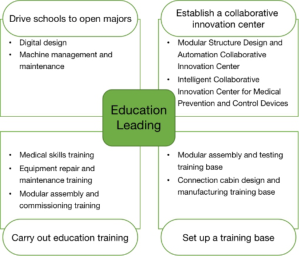
Social Benefits In terms of social life, education and employment, it can bring positive bene- fits, ensure public health safety, and promote orderly development of social security and urban governance.
This research can timely realize the front-end control and disaster sch- eduling of infectious diseases when major and secondary disasters occur
Design and Research of Modular Monitoring and Disinfecting Connection Cabin 101
Figure 7: Social benefits.
in the future;. As a disaster response space, it can use modular features to enhance urban resilience and achieve common governance of public areas.
ACKNOWLEDGMENT
We would like to express our special thanks to our teacher (Li Xu) as well as AHFE who gave us the golden opportunity to do this wonderful project on the topic, which also helped us in doing a lot of research and we came to know about so many new things. Secondly we would also like to thank our team mates who finalize this project together within the limited time frame.
REFERENCES
Abougreen, Arij Naser. (2021) Big Medical Data Analytics Under Internet of Things [CH] Internet of Things. pp. 25–44. Cooke Philip. (2022) Beyond the Smart or Resilient City: In Search of Sustainability
in the Sojan Thirdspace †[J]. Sustainability Volume 15, Issue 1. p. 145. Li Tian & Liying Zhang. (2021). Research on City Resilience Theory and its Practical Achievements. (eds.) High Quality Development Oriented Space Management: Proceedings of 2021 Chinese City Overall Planning Annual Banquet: 01 City Safety and Planning against Disasters. pp. 103–113. Lima et al. (2020) The emotional impact of Coronavirus 2019-nCoV (new Corona-
virus disease) [J]. Psychiatry Res Volume 287. p. 112915. Marcelo Dionisio et al. (2023) The role of digital transformation in improving the efficacy of healthcare: A systematic review [J]. The Journal of High Technology Management Research Volume 34. Issue 1. Nicola Montemurro. (2020) The emotional impact of COVID-19: From medical staff
to common people [J]. Brain, Behavior, and Immunity Volume 87. pp. 23–24. Wanqi Zhang. (2022). Public Health Product Design from the Perspective of the Pandemic (Master’s Thesis, Qingdao University of Technology). Zhigang Li & Zhouwei Hu. (2021). Research on City Resilience: Theory, Experience
and References. Famous Cities in China [J]. Volume 35, Issue 11, pp. 1–12.
LISTED IN THE AHFE DIGITAL BOOKSTORE CATALOGUE
Explore the complete digital volume
Usability and User Experience
Read this individual research paper free through the original publisher, or explore the full digital proceedings book.
ISBN 978-1-958651-86-5
Explore this ISBN in the AHFE Bookstore ↗Listed in the July 2026 bookstore catalogue; search by ISBN to confirm current availability · Digital book purchase optional