Yi Hsien Tsai, Ching I Chen, Meng-Cong Zheng (2023). Usability Evaluation of Self-Service Ticketing Kiosks in Cinemas. In: Usability and User Experience. AHFE Open Access, vol. 110, pp. 309–318. https://doi.org/10.54941/ahfe1003204
Self-service systems have flourished in recent years; to make it easier for consumers to purchase tickets, cinema operators introduced self-service ticketing kiosks. The performance of the operator interface and the amount of time spent affect the user's propensity to utilize the self-service ticketing kiosk at the Cinema. In the initial observation, most individuals prefer to purchase tickets at the traditional counter rather than the self-service option. This study used an experimental task, SUS, QUIS, and participant's feedback questionnaire, to determine why self-service ticketing kiosks are not meeting users' needs. The study identified cognitive disparities in the ticketing process of the existing self-service kiosks in Cinema and a lack of substantial status presentation and transparent organization in the ticketing interface. It leads inexperienced users to misunderstandings and operational blunders. This study's conclusions can serve as a foundation for the future optimization of self-service ticketing kiosks in cinemas. The results showed that the participants had problems with the faulty operation of the interface of all three cinemas. (1) When purchasing tickets, two cinemas popped up with a "confirm membership status" prompt, which made many participants hesitant and confused. (2)Order corrections problems, including the lack of a "back to the previous step" function, causing the participants to be unable to correct wrong purchases and need to cancel the entire order to purchase again. (3) All three cinemas had unclear information on the seat selection page. 73.3% of the participants felt that the presentation was not straightforward. Includes no seat numbers, alphabetical presentation of row numbers, and no indication of seat status. (4) 43.33% of participants stated that the existing self-service ticketing kiosks at the three cinemas are less convenient and time-efficient than purchasing tickets at the counter, so they prefer to buy tickets at the counter. Moreover, the SUS scale of the kiosk in the three cinemas were 62.5 (D level),56 (F level), and 54.5 (F level), respectively; neither of them could meet the operational requirements. The results of this study provide us with an understanding of the current user behavior and evaluation of the self-service ticketing interface at the Cinema, which could be used to improve the user experience in the future, allowing users to have a better experience during the ticketing process.
Self-service ticketing kiosks are gradually replacing traditional counter servi- ces (Siebenhandl et al., 2013). The self-service technology helps the customer get things done quicker, saving a lot of time and effort (Bejoy et al., 2020). The creation of this technology delivers a dependable and quick service, low- ers waiting time, and improves the ticketing experience. Self-service ticketing technology has been on the rise for years, extending to fast-food restaurants, cinemas, entertainment venues, banks, and retail establishments. According to “GRAND VIEW RESEARCH” Report, the global self-service kiosk mar- ket size is estimated at US$27.48 billion in 2021 and is expected to grow at a compound annual growth rate (CAGR) of 6.5% from 2022 to 2028.
Consequently, cinemas are placing a greater emphasis on self-service tech- nologies. Cinemas use kiosks to view details of movie shows and use various payment methods to reserve tickets. They allowed customers to place orders and pay quickly instead of standing in long lines at the counter (Bejoy et al., 2020). In 2011, Japan introduction of self-service ticketing devices in cinemas to alleviate crowd congestion and personnel costs (Fukuichi et al.,
2020). Moreover, Premium-X Cinemas in Malaysia converted its operations to entirely self-service cinemas in 2013 with self-service kiosks (Chang, 2015).
Cinema is one of the most popular outdoor cultural activities, influenced by modern society, economy, and culture (Rajouria et al., 2015). As the ticketing kiosk reaches a wide range of people, its ease of use is vital to the user experience. The kiosk interface design becomes essential because it helps the user classify the kiosk’s functional qualities; the design also impacts the efficiency and efficacy of the uses decision-making (Galdolage, 2021). Furth- ermore, self-service kiosks are not as often used as personal interfaces, which causes consumers to be more cognitively taxed when operating self-service kiosks (Aceves et al., 2019). As a result, the self-service kiosk interface must be simple to grasp and navigate, particularly for first-time customers.
To provide consumers a convenient way to purchase tickets and reduce queues at the counter, cinema operators have introduced self-service kio- sks as an important ticketing channel. Ticketing kiosks are frequently near the ticket counter or the cinema entrance. The self-service ticketing kiosks provide touch screens, barcode scanners, credit card sensors, and ticket prin- ting to assist consumers in purchasing, allocating, and picking up tickets on their own, minimizing wait times and errors when interacting with coun- ter employees. Despite this, preliminary findings indicate that the number of people purchasing tickets at the counter remains more significant than that of self-service ticketing kiosks.
This study aims to examine the interface design of self-service ticketing kiosks in representative Taiwanese cinema chains. By observing their ope- ration, we seek to gain insights into user perceptions and interactions with different self-service ticketing systems. We will use the assessment results as a foundation for optimization, design suggestions, and validation.
METHODS
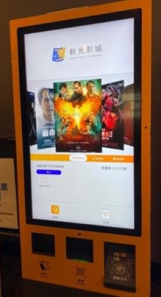
This study assessed the user-friendliness of self-service ticketing kiosks from three representative Taiwanese cinema chains: Cinema A, Cinema B, and Cinema C (see Figure 1). The study included 30 participants, all of whom had never used the interface of the experimental sample, ranging in age from 19 to 29. Participants were invited to perform five operation tasks; the assessment steps included: (1) Purchase tickets: select a specific movie and showtime, pick seats and tickets; (2) Modify and edit order: edit the order and change the show, seats, and tickets; (3) Confirm order details and complete checkout: please double-check the information, read out the movie name, showtime, seat number, and the amount, and lastly complete the pay- ment transaction; (4) Reserve tickets for the following day: pre-order the ticket, choose the movie, and select the seats; (5) Scan to pick up a reserva- tion ticket: scan the barcode or QR code to pick up a reservation ticket. To better understand the participants behaved while using the kiosk. The entire operation process would be recorded.
The experiment was carried out in four steps: (1) The participants must provide basic personal information. (2) After explaining the experimental
Usability Evaluation of Self-Service Ticketing Kiosks in Cinemas 311
Figure 1: Self-service ticketing kiosks of cinema A, B, and C.
tasks, the participants were instructed to complete the tasks in the requi- red order and document the process of executing the tasks. (3) Completing the five tasks, participants were asked to complete the System Usability Scale (SUS), Questionnaire for User Interface Satisfaction (QUIS), and par- ticipants’ feedback questionnaire to determine the user’s satisfaction with the self-service ticketing kiosk interface and the participant feedback questi- onnaires. (4) Lastly, through semi-structured interviews, understanding the user’s evaluation of the interface and its strengths and limitations will serve as a benchmark for future design improvement.
RESULT
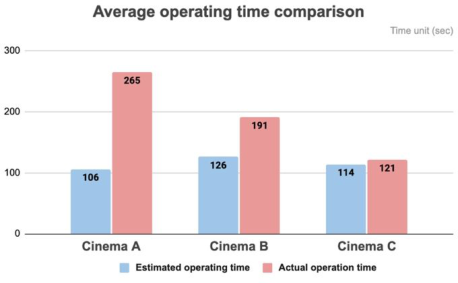
Variation in the Participants’ Pre- and Post-Task Time Estimations Based on the results, it was determined that the average time participants spent doing the actual operation task exceeded the average time projected before the test. The estimated operation average time for Cinema A was 156 seconds, but the average operating time was 265 seconds. The estimated ope- ration average time for Cinema B was 126 seconds, but the actual average operating time was 194 seconds. The estimated average time for Cinema C was 114 seconds, but the average operating time was 121 seconds (see Figure 2).
Time Performance There was a substantial variation in operating time performance between the three Cinemas for Task 1, “Purchase tickets,” Task 2, “Modify and edit order,” Task 4, and “Reserve tickets for the following day, Task 5, “Scan to pick up a reservation ticket (see Table 1). “For Task 1, there was a statistically significant difference (F = 6.134, p = 0.006 <0.05), with Cinema A having the longest mean time to operate (M = 102.90, SD = 72.94), Cinema B having the second longest mean time to operate (M = 66.5, SD = 20.43), and Cinema C having the shortest mean time to operate (M = 34, SD = 8.52). According to the study, Cinema A will display the preview seat button after
Figure 2: Comparison of estimated time and actual operation time of the three cinemas.Table 1. Three cinema operational task time performance of ANOVA test results.
Table available in the original PDF paper.
Cinema A Cinema B
Cinema C F P
Task Time Performance
M (SD) M (SD)
M (SD) 6.134** 0.006
102.90 (72.94)
66.50 (20.43)
34.00 (8.52)
1. Purchase tickets
65.628*** 0.000
59.80 (5.07)
39.90 (7.37)
28.20 (6.05)
2. Modify and edit the order
1.353 0.275
27.60 (7.40)
33.90 (10.06)
34.30 (12.53)
3. Confirm order details and complete checkout
5.369* 0.011
27.60 (7.40)
37.90 (6.31)
23.50 (11.83)
4. Reserve tickets for the following day
6.714** 0.004
36.90 (32.00)
12.70 (8.71)
7.10 (4.61)
5. Scan to pick up a reservation ticket
Note: * <.05; ** <.01; *** <.001
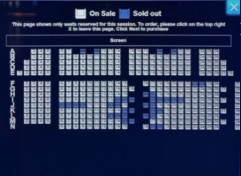
the participants tap the showtime, which 90% of participants mistakenly identify as the seat selection button (see Figure 3).
The “preview seat” call-to-action is too prominent, and the layout is too similar to the seat selection page. This can lead to operational errors and confusion for participants, who may not know how to navigate away from the page after clicking on it.
For Task 2, “Modify and edit order,” there was a significant difference (F = 65.628, p = 0.000 <0.001) in operating time performance among Cine- mas A and C. Cinema A had the worst performance (M = 59.80, SD = 5.07), while Cinema C had the best (M = 28.20, SD = 6.05).
Compared to the other cinemas, Cinema C had the shortest ticket purch- asing process with fewer steps, leading to less time spent. However, the downside is that participants cannot edit their orders and must cancel the entire purchase if a mistake is made. In contrast, Cinema A’s ticket purchasing
Usability Evaluation of Self-Service Ticketing Kiosks in Cinemas 313
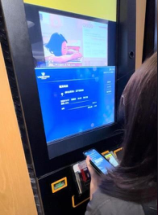
Figure 3: A Cinema’s preview seat map (left), and seat selection page (right).Figure 4: Cinema’s A (left), and B (right) code scan confirmation page.
process includes an additional step for confirming membership and purcha- sing food, which cannot be skipped and is required for every ticket purchase or modification. As a result, this extra step results in the longest time spent at Cinema A.
In Task 4, “Reserve tickets for the following day,” there was a significant difference (F = 5.369, p = 0.011 <0.05), with Cinema C having a shorter step and fewer movies and showtimes than Cinema A and Cinema B. Therefore, it performed better in terms of time. Cinema C did the best in Task 5, “Scan to pick up a reservation ticket” (F = 6.714, p = 0.004 < .01). Cinema C (M = 7.1, SD = 4.61) prints the tickets as soon as the barcode is scanned. However, following the interview, most participants preferred to have the confirmation screen of information at the end before they could pick up their tickets (see Figure 4).
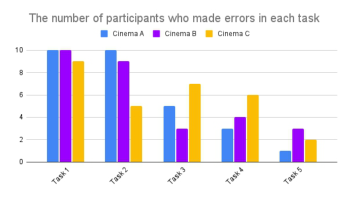
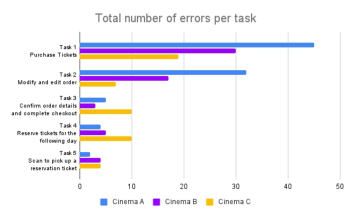
Number of Errors According to the operation test results (see Figures 5 and 6), Cinema A has a significant percentage of errors, followed by Cinema B, and Cinema C has the lowest. Cinema A had 88 errors, Cinema B had 59 errors, and Cinema C had 50 errors. In Task 1, there is a significant difference between Cinema A and Cinema C (F = 3.788, p = 0.035 <0.05), with Cinema A having the highest number of errors at 45 times, Cinema B at 30 times, and Cinema C at 19 times. The reason for the highest number of errors in Cinema A is that it has an additional preview seat page, which is easily mistaken for the seat selection page. This operation is repeated multiple times, resulting in 24 errors. The second-highest number of errors is in Cinema B, mainly due to unclear picture prompts. Participants stated that the barcode sensing
Figure 5: The number of participants who made errors in each task.Figure 6: Total number of errors per task.Figure 7: Cinema B, (left) credit card operation prompt, (right) member identification confirmation.
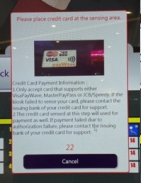
area also appeared in the credit card sensing prompt image, so they were misled and caused operational errors. Six participants used credit cards to scan barcodes in the sensing area, causing ten errors. Next is the member confirmation page, where five participants were confused and clicked to use the member option, resulting in 5 operational errors (see Figure 7).
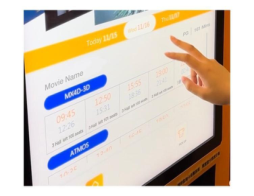
Among the three cinemas, Cinema C has the lowest error rate. However, movie showtimes are arranged vertically by theater format (ATOMS, Regular, and IMAX), not by time. This can be confusing and has led to 14 errors made by 7 participants when purchasing tickets. The lack of time-based order makes it easy to make mistakes when searching for showtimes. Additionally, general tickets are not listed first, which is another reason for the increase in errors (see Figure 8).
There were significant differences between Cinema A and C in Task 2 (F = 6.497, p = 0.005 <0.01). The total number of errors was 32 for
Usability Evaluation of Self-Service Ticketing Kiosks in Cinemas 315
Figure 8: Cinema C ticket type classification.Figure 9: Cinema A’s seat selection operation error question prompt.
Cinema A, 17 for Cinema B, and 7 for Cinema C. This task involves editing orders, which includes changing showtimes. However, the option to select showtimes is located in an earlier step, so to edit an order, participants must first navigate back to that page to make changes. However, orders for movie Cinema A and B can only be changed linearly, meaning participants must navigate back page by page and can only change one page at a time. This process is cumbersome, and participants tend to change options on the page they first see. However, if an order is edited during this process, the system will not remember the changes, leading to the problem of duplicate operati- ons and increasing the number of errors. Cinema A had 22 errors in selecting showtimes, ticket types, and seating, while Cinema B had 13 errors.
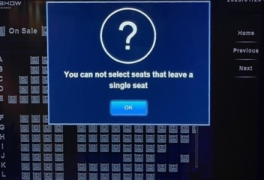
Additionally, the seat selection at Cinema A can only be adjacent without leaving a space. If the wrong seat is selected, the interface will display a que- stion mark with a plain text explanation, which confuses the participants and leads to repeated mistakes (see Figure 9).
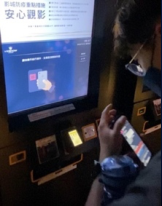
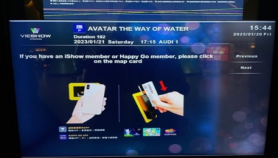
In Task 3, All participants from the three cinemas missed some informa- tion on the confirmation page. Specifically, five participants in Cinema A, three in Cinema B, and five in Cinema C missed purchase detail information. According to the interview results, participants mentioned that certain details were not well-integrated, leading to easy overlook. Task 4 is similar to Tasks 1 and 2, resulting in similar errors due to the comparable task flow. In Task 5, barcode scanning errors occurred for all three cinemas. Although parti- cipants from Cinema A made fewer mistakes, they took longer to complete the task. Participants noted that the illustration for the operation prompt did not resemble the hardware equipment, making it challenging to follow the instructions provided on the page (see Figure 10).
Figure 10: The scan operation prompt is unclear.Figure 11: QUIS comparison of three cinemas.
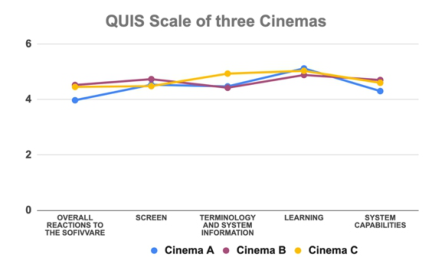
SUS & QUIS According to the SUS results, the overall scores for Cinema A (M = 56.00, SD = 16.47), Cinema B (M = 54.5, SD = 11.47), and Cinema C (M = 62.5, SD = 19.58). are all significantly low and do not meet the usability standard. Both Cinemas A and B got F grades, while Cinema C got a D grade. There is no significant difference in the QUIS results, with all three cinemas having an average score of 4. This indicates that participants had similar overall sati- sfaction and no clear preference for any particular cinema. However, Cinema C outperformed the other two cinemas in the aspect of “TERMINOLOGY AND SYSTEM INFORMATION” (see Figure 11). Despite this, Cinema C’s SUS score still falls below the passing standard.
This implies that the self-service ticketing interfaces of the three cinemas do not fully meet the operational requirements of the participants, and there is an opportunity for improvement.
DISCUSSION
This study found that in comparing the three cinemas, Cinema C performed the best. Compared to Cinema A and B, Cinema C’s ticketing process is sim- pler. It omits stages not directly related to ticket purchasing, such as member confirmation and purchasing food pages, reducing the time required to com- plete the ticketing process. However, since Cinema C cannot return to the previous stage, participants who make operational errors must cancel the
Usability Evaluation of Self-Service Ticketing Kiosks in Cinemas 317
Figure 12: Three Cinema’s select seat page.Figure 13: Cinema A’s member confirmation page (left), and meal selection (right).
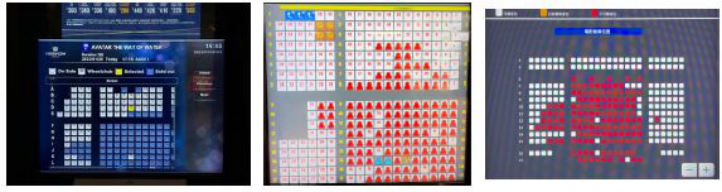
entire order and start over. In addition, we found that participants need to take time to compare or identify the seat selection pages of the three cinemas. The labels and meanings of the seat statuses of the three cinemas are unclear (see Figure 12). Cinema A and B’s seat maps focus only on some areas rather than an overview of all seats, making it easy for most participants to overlook available seats on the left and right sides.
Additionally, Cinema B lacked seat status indicators, and the interface color scheme was too chaotic. Users of Cinema C found the seat selection grid too small and difficult to click, with no seat numbers for easy refere- nce. Furthermore, some participants would prefer the cinema to have more accurate proportions and a seat map that was closer to the actual seating arrangement. Participant feedback questionnaires indicated that 73.3% of the participants found it difficult to choose seats.
Another finding is that the usability of cinema ticket kiosks is closely rela- ted to the ticketing process and interface presentation. At cinema A, the ticketing process includes pages for member confirmation and food sele- ction, increasing operation time and error rates (see Figure 13). As food sales and member confirmation are common and important functions of cinemas, future designs must consider how to incorporate these functions without making the user feel the operation is complicated. Some participants sug- gested that the member ID confirmation and food selection stages should be placed on the first page so that they can be selected at the beginning of the operation to prevent duplicates in the subsequent ticketing process. Accor- ding to the survey, 43.33% of participants found the current self-service ticket kiosks in all three cinemas to be less convenient and more time-consuming than buying tickets at the counter. Consequently, they prefer to purchase tickets at the counter.
CONCLUSION
This study investigates several factors that affect the user experience of self-service ticket kiosks, such as operation prompts, order modifications, the ticket purchase process, seat selection, and ticket categorization. If the operation prompts are unclear, order modifications are difficult, or ticket categorization is confusing, users may feel frustrated or make mistakes, thereby reducing their willingness to use the kiosk. To enhance the user experience, the interface should be easy to use, the operation prompts and ticket information should be clear, and reasonable processes and modification methods should be provided.
REFERENCES
Aceves Gutierrez, L. C., Martin Gutierrez, J., & Del Rio Guerra, M. S. (2019). Having a Smarter City through Digital Urban Interfaces: An Evaluation Method. Applied Sciences, 9(17), 3498. https://doi.org/10.3390/app9173498 Bejoy, J. M., Raj.p, A. C., & P, R. (2022). Recent Advances In Stu- dies Of Self Service Technology For The Development Of Interactive Kiosk Services. International Journal of Scientific & Engineering Research, 11(6), 707. https://www.citefactor.org/journal/pdf/Recent-Advances-In-Studies-Of-Sel f-Service-Technology-For-The-Development-Of-Interactive-Kiosk-Services.pdf Fukuichi, A., Taguchi, K., & Genji, S. (2020). Direct Observation of Purchasing
Behavior in a Cinema Complex in Japan : Age Group Analyses. Kansai University Psychological Research, 11, 39–47. http://hdl.handle.net/10112/00019967 Chang, M. (2015). Perceived Factors Influencing the Acceptance and Adoption of Self-Service Technology. Master Dissertation/Thesis, University, University Tunku Abdul, 1. https://eprints.utar.edu.my/1621/1/MBA-2015-1007187-1.pdf Galdolage, Sandamali. (2021). Customer Choice of Self-Service Kiosks in Service
Transactions. 1. 123–170. Luis C. Aceves Gutierrez, Jorge Martin Gutierrez and Marta Gutierrez, L. carlos aceves. (n.d.). Self-Service Kiosk Market Size & Share Report.
GRAND VIEW RESEARCH. https://www.grandviewresearch.com/industry-ana lysis/self-service-kiosk-market-report K. Siebenhandl, G. Schreder, M. Smuc, E. Mayr and M. Nagl, “A User-Centered Design Approach to Self-Service Ticket Vending Machines,” in IEEE Transactions on Professional Communication, vol. 56, no. 2, pp. 138–159, June 2013, doi: 10.1109/TPC.2013.2257213. Rajouria, R., Yadav, V., Mishra, R., & Jain, S. (2015). Online Cinema Ticket Booking
System. International Journal of Modern Engineering & Management Research, 3(1), 54. https://ijmemr.org/Publication/V3I1/IJMEMR-V3I1-009.pdf
LISTED IN THE AHFE DIGITAL BOOKSTORE CATALOGUE
Explore the complete digital volume
Usability and User Experience
Read this individual research paper free through the original publisher, or explore the full digital proceedings book.
ISBN 978-1-958651-86-5
Explore this ISBN in the AHFE Bookstore ↗Listed in the July 2026 bookstore catalogue; search by ISBN to confirm current availability · Digital book purchase optional