Mohamed Mokdad, Bouhafs Mebarki, Mourad Semmani, Shaikha Aljunaidi (2023). Women weaving traditional carpets in Algeria: The ergonomics of weaving posture. In: Social and Occupational Ergonomics. AHFE Open Access, vol. 106, pp. 20–28. https://doi.org/10.54941/ahfe1003962
In Algeria and many other developing countries, many women do domestic work (weaving, cleaning, washing, ironing, cooking, caring, children the elderly, and persons with disabilities, etc.) in their homes. From domestic work, we refer to carpet weaving. This work is done in most Algerian cities. It is a job that women do at home. They do it while sitting for hours. Researchers show that domestic work require great effort. In addition, it is tiring and strenuous and may have negative effects on body. In this research, the focus will be on carpet weaving in the Southwestern Algeria (the Fatis carpet). Fatis carpet is named after the Fatis Palace (town), located in Tinrkuk area, in the province of Timimoun. (Algeria).This research, aims is to answer the following questions:1.What is the posture adopted while weaving the Fatis carpet?2.What are the body parts where may feel pain at work?3.Are there differences between the highly experienced (10 years and more) and the less experienced (05 years and less) knitters?Method: Researchers used the descriptive survey method, where they observe the Fatis woman as she makes the carpet, and after observing her for a sufficient period, she is presented with a set of questions (the PLIBEL questionnaire) to answer. The sample was (12) women with a mean age of 32.83 years, and an SD of 10.83 years. Tools: Data was collected through observation and PLIBEL Form (questionnaire).Results: This research aims to answer the following questions:1.What is the posture adopted while weaving the Fatis carpet? It has been found that women adopt the sitting crossed-legged working posture while knitting the carpet. The majority of women sit in the workstation for hours. They change it when they leave the work. 2.What are the body parts where may feel pain at work? It has been found that all parts of the body specified in the PLIBEL form (neck/shoulders and upper part of back; Elbows, forearms, and hands; feet; knees and hips; low back) are affected. However, the extent of the impact varied. The knees and hips were affected more than the rest of the other regions.3.Are there differences between the highly experienced (10 years and more) and the less experienced (05 years and less) knitters? It turns out that those with less experience suffer less than those with more experience.Discussion: The results will be discussed in light of the principles of cultural ergonomics. In various situations, it is necessary to resolve the contradiction that appears between the principles of ergonomics and what people are accustomed to and what they carry in terms of social trends by virtue of the societies and cultures to which they belong.Conclusion: This research shed light on the work of women in the textile industry. It was found that women adopt a work posture that needs discussion. It is a research that contributes to the development of social and cultural ergonomics
Carpet industry started since antiquity. Humans invented the carpet to make the floor comfortable for a person to walk, sit and sleep on, especially in times of extreme cold. Usually, the carpet is made of sheep’s wool, and camel’s lint.
The carpet is made manually, as well as mechanically. It is considered a pro- fession for numerous women in developing countries, where it is considered a source of livelihood for many families.
In Algeria, the carpet industry is mainly a feminist industry. Women make it from the stage in which it is an idea to the stage of its final form. Among the most famous carpets in Algeria, is the Fatis carpet. It is named after the Fatis Palace (village), which is located in the municipality of Tinrkuk, in the province of Timimoun. Fatis carpet consists of two symmetrical sections, each containing a decorated hall. In the middle, there are vertical stripes decorated with different geometric shapes. The major colour used in the carpet is red.
Women Weaving Traditional Carpets in Algeria: The Ergonomics of Weaving Posture 21
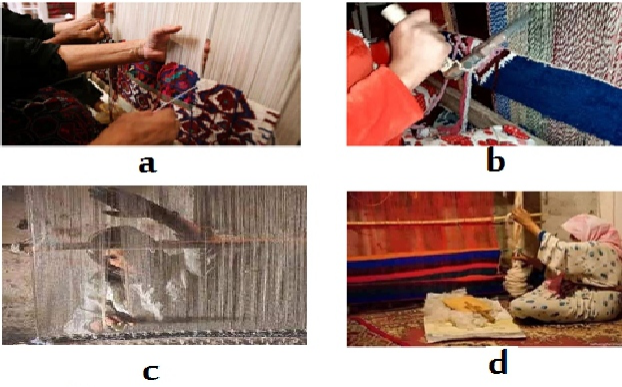
Figure 1: Showing different carpet weaving tasks involving sitting cross-legged posture and upper-limbs work activities.
The carpet contains simple geometric shapes and designs such as date palms and camels that represent the manifestations of life in the region.
The work of women in making carpets at home is considered domestic work. Researchers show that domestic work is not what is believed to be light work, but rather it is often tiring and hard work (Mebarki and Davies 1990; Anis, et al. 2021). This study aims to shed light on the traditional work of women who weave carpets in Algeria. The researchers try to answer from the ergonomic point of view research questions to design an effective work environment in col- laboration with the main stakeholders of the traditional carpet industry. At this stage of the project, the following questions are raised:
1. What are the characteristics of the carpet weavers’ body posture? 2. What are the characteristics of the posture of the upper extremities? 3. What are the body parts where women may feel pain at work?
METHODOLOGY
Method
Researchers used the sample survey method, which enables them to obtain results that can be generalized to the community of women working in the carpet industry in Algeria.
Sample The number of the research participants was (32) women working in carpet weaving in the city of Fatis, in the province of Timimoun. The demographic characteristics of the participants are shown in Table (1).
Table 1. Demographic characteristics of sample (N = 32 women).
Table available in the original PDF paper.
Index Information Age Mean= 32.83 years SD= 10.83 years Work experience Mean = 13.91 years SD= 04.83 years Social status Married = 26 Divorced and divorced =6 Educational status Primary (read and write)= 29 Intermediary= 03
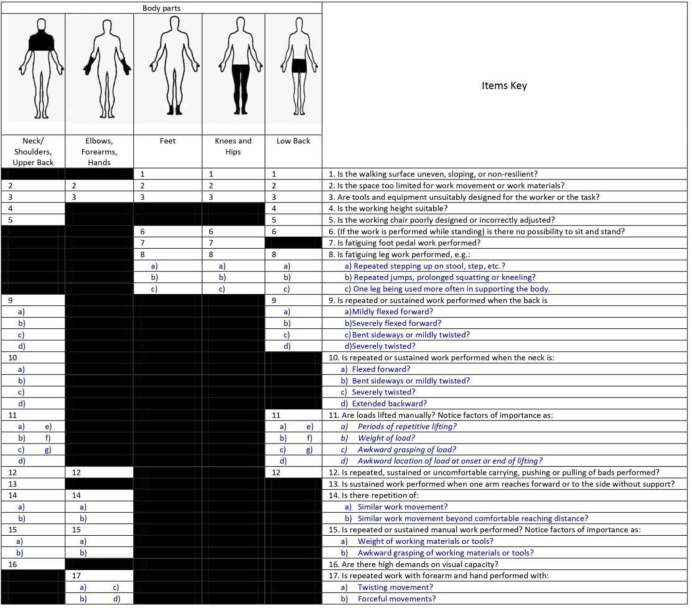
Tools To collect research data, researchers used the BLIBEL (Plan for Identifie- ring av Belastningsfaktorer) questionnaire (Figure 2). According to Andreas, & Johanssons, (2018), methods to evaluate working postures are of three categories: questionnaires, observation methods, and technical measurement methods. PLIBEL questionnaire is one of the observation methods. Many researchers have used it (Ng, et al. 2016; Isler, et al. 2018) and recommended it for similar situations.
Procedures To keep with the customs and traditions of the south-western region of Alge- ria, female assistants had to be trained to fill out the PLIBEL checklist, while
Figure 2: The PLIBEL checklist (adapted from kemmlert, 1995).
Women Weaving Traditional Carpets in Algeria: The Ergonomics of Weaving Posture 23
women were weaving carpets in the Fatis region. Their training took five days, during which they received a full explanation of how to use the che- cklist. It took an average of 10 minutes to fill out the checklists as directed by Malchaire, et al. (2011).
RESULTS AND DISCUSSION
This research aims to answer the following questions:
What Are the Characteristics of the Carpet Weavers’ Body Posture?
It has been found that women adopt the floor sitting cross-legged working posture while knitting the carpet (see Figure 1). The majority of women sit in the workstation for hours. The Fatisian woman does not adopt this posture when weaving the carpet, but also in the preparatory tasks for the weaving process. She adopts it in the preparation of the raw material (wool, lint, hair), in spinning wool, lint and hair. Moreover, she adopts it when doing the weaving process. Thus, the floor sitting cross-legged posture is a condi- tion inherent in most of housekeeping tasks, but mainly in the manufacture of textiles, including carpet weaving. It is worth noting that the Algerian woman sits in this posture for extended periods, sometimes up to three consecu- tive hours. They have been accustomed since childhood to sit crossed-legged (Noro, et al. 2006).
Karasik, et al. (2015) claim that sitting is influenced by culture. Rese- archers divide the cross-legged sitting posture into two types, namely: the cross-legged sitting posture on chair and the cross-legged sitting posture on floor. Karkousha, et al. (2021) found that the torso became more relaxed in a cross-legged sitting posture on chair than in an erect posture, and this rela- xation was more pronounced in people with lower back pain. Furthermore, Moon, et al. (2018) found that the cross-legged sitting posture on chair signi- ficantly altered the alignment of the spine with the pelvis compared to the standing posture. However, concerning the cross-legged sitting posture on floor, Watanabe, et al. (2010), indicated that the simultaneous contraction of trunk muscles during squatting can lead to correct flexion of the chest and lumbar spine, effectively stabilize the lumbar pelvic region, and reduce focal pressure on passive structures (bones, ligaments, joint capsules). Fur- ther, Bae, et al. (2012) found that when sitting on the floor, the complete lumbar lordosis is relatively low; it is often due to decreased lordosis at L4-5 and L5-S1 levels. In lower lumbar fusion, adjacent hyperflexion is expected when sitting on the floor. Also, Nagrajan, & D’Souza, (2017) found that sitting cross-legged on the ground was the preferred type of sitting for the majority of respondents. In addition, Kohli, et al. (2019) found that sitting cross-legged on the ground plays an important role in health and longevity. It is also an integral part of Eastern and Asian culture. Jung, et al. (2020) found that the torso became more relaxed in a cross-legged posture than in an erect posture, and this relaxation was more pronounced in people with lower back pain. On the other hand, Moon, et al. (2018) found that sitting on a chair and cross-legged significantly altered the alignment of the spine
with the pelvis compared to the standing posture. Besides, Omidian, & Omi- dian, (2011) advice doctors who deal with individuals who have the habit of sitting on their legs to take into account the possibility of ankle exposure to health problems such as psoriasis, eczema, and keratosis of the skin due to the friction of the skin in this area with the ground while sitting.
What Are the Characteristics of the Posture of the Upper Extremities?
The upper limbs of women working in weaving carpets adopt a variety of working postures. Some of them are coming above heart level, causing stress and musculo-skeletal disorders (MSDs) for women (see Figure 1: a, b, c, d). Some women stated that they do not sleep at night except with difficulty due to the large amount of pain in the shoulders and in the wrist areas in par- ticular. The main reason may be stretching and constantly reaching above heart level (Haslegrave, 1994). Discomfort and pain can also be attributed to the non-ergonomically designed work tools (Chao et al. 2000). The rela- tionship between poor design of work tools and MSDs has been proven by many researchers (Naeini, et al. 2014; Bairwa, et al. 2022). Among the tools, we mention the weaving combs, and the knives.
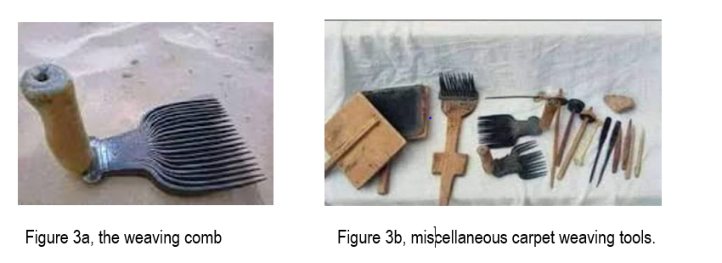
The weaving combs. It was found that the combs used by women are simi- lar in design and shape. They consist of two parts, the rake and the handle. The rake which connects to the handle vertically is a set of teeth (about 30) arranged horizontally. The handle is kept inside a wooden pole. The total weight of the entire comb ranges between 450 and 550 grams (Figure 3a). It is used to arrange and bundle knots on the pile threads in the carpet. The comb is stroked from top to bottom along the threads of the carpet to keep the knots in place. Despite the fact that the posture the hand adopts at wea- ving work is ergonomically healthy (the horizontal line that runs from the forearm to the palm of the hand is a straight line), however, using this tool daily and for a long period of time causes stress and joint pain in the hand, especially in the wrist area (Boyles, et al. 2003).
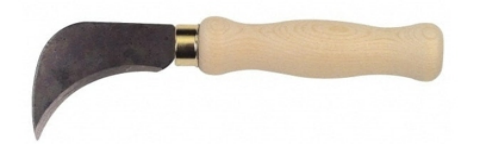
The knives. It was found that women, while cutting the woollen threads, use different types of small, sharp knives that facilitate the knitting process. Even though the verities, the preferred type is a small knife that has a short blade with a curved point and handle (Figure 4).
Figure 3: Weaving tools.
Women Weaving Traditional Carpets in Algeria: The Ergonomics of Weaving Posture 25
Figure 4: The knife for cutting the woollen threads.
From an ergonomics point of view, the design of knife varieties used, is poor. The blade is straight to the handle. Fogleman, et al. (1993) came to a conclusion that: “In general, the traditional straight knife was the worst tool under any condition”. On the other hand, Benktzon, (1993) came up with the conclusion that the design of hand tools including knives according to ergo- nomic principles makes the tools suitable for the largest number of users, and makes them happy to use them. In this context, Pramchoo, et al. (2018) show that the ergonomically designed rubber tapping knife in the forests of Thailand contributed significantly to reducing MSDs. They changed its initial shape, in which the handle and blade were in a straight line, to the impro- ved shape, in which the handle is attached at an obtuse angle to the blade. In addition to knife handle design, researchers highlighted another critical variable in reducing MSDs among knife users, which is blade sharpness. In this context, Claudon, & Marsot, (2006) found that sharp knife blade leads to less MSDs. Similarly, McGorry, et al. (2005) and Hajad, & Sirindhorn, (2016) found that the sharpness of the knife blade was the most important factor in reducing the force exerted by the worker to do the work.
What Are the Body Parts Where Women May Feel Pain at Work?
The results of the PLIBEL checklist are shown in Table (2).
The checklist shows that all respondents complain of pain in the neck, shoulder, and upper back, in the elbows, forearms, hands and wrist, in the knees and hips, and in the low back areas. The checklist also shows that 70% of the respondents suffer from pain in the feet.
Women working in weaving carpets complain of pain in the neck, shoul- ders and upper back. This may be due to two things: First, the nature of the work in weaving the carpet, which includes the use of hands extensively during knitting, for example in tying the knots with each other and hitting them with a knitting comb to fix them with each other, and in pushing and pulling the wool threads, and in wrapping the finished carpet.
Table 2. PLIBEL checklist results for Fatis women weaving carpets.
Table available in the original PDF paper.
Low Back
Feet Knees & Hips
Body area Neck, Shoulder, & Upper back
Elbows, Forearms, Hands & wrist
% of complaints 100 100 70 100 100
Secondly, sitting in crossed-legged posture for a long time. It has already been mentioned that the women weave the carpet while sitting in a cross- legged sitting posture. They may be accustomed to this posture, but it must be noted the amount of static work is high. Since the inception of the ergo- nomics, ergonomists have pointed out the danger of static work and the problems it causes for the performer (Tuttle, & Horvath, 1957; Chapman, & Elliott, 1988). It is necessary to point out that the woman who weaves in a sitting posture does not sit still all the time, but moves right and left during the weaving process. She also raises and lowers her hands. The posture of the two legs also changes from time to time. She may put the right leg on top of the left. Then she changes where she lays the left over the right. These changes make working women feel comfortable.
These findings are similar to those of Motamedzade, & Moghimbeigi, (2013) and Thongsuk, & Geater, (2021) who found that the areas of the body in which the respondents suffer from pain are the buttocks first, fol- lowed by the lower back. The areas of the neck, shoulders and upper back were less injured than the areas of the buttocks and lower back.
LIMITATIONS OF THE STUDY The limitations of this study might include on the first hand, the small number of subjects and lack of comparison with a large-scale age- and sex-matched subjects. On the other hand, uncomfortable/ painful working postures are mainly the consequences of bad design of tasks, work methods and work tools. The latter i.e. carpet weaving tools, like the weaving combs, the knives, the weaving loom, the heddle rods etc. are still traditionally handmade, their design needs an ergonomics evaluation to determine the norms and characte- ristics which should be incorporated in each tool as to be safe and healthy for use.
In an attempt to overcome this limitation, and to elucidate all aspect of traditional work, a planned large-scale ergonomics study is underway with the collaboration of all stakeholders in the traditional handicraft in the south- western Algeria.
CONCLUSION
This research dealt with the issue of women working in weaving carpets in the village of Fatis in the province of Timimoun (southwest Algeria). It was found that women work in a sitting cross-legged posture sometime for long periods. Women were found to be exposed to MSDs in various parts of the body. This working posture, given that it is done in a way that includes a lot of static work, causes MSDs. And that this housing work is an integral part of knitting carpets.
It is true that ergonomics has long been concerned with static work and working postures. Further, ergonomic research has achieved remarkable successes in the field of measuring work posture. The result was the emer- gence of multiple methods of measurement. However, those working in jobs that force them to adopt bad non-conventional work postures are still waiting
Women Weaving Traditional Carpets in Algeria: The Ergonomics of Weaving Posture 27
for procedures and programs that will help them get rid of these bad postures and avoid MSDs. One of these exits may be to think carefully about sticking to a heritage that causes many MSDs.
ACKNOWLEDGMENT
The authors would like to acknowledge the Fatis families who supplied the researchers with information to enable this research to come to life.
REFERENCES
Andreas, G. W. J., & Johanssons, E. (2018). Observational methods for assessing ergonomic risks for work-related musculoskeletal disorders. A scoping review. Revista Ciencias de la Salud, 16(SPE), 8–38. Anis, F., Zaheer, A., & Rowson, J. (2021). Evaluating and Managing MSDs in
Domestic Tasks through Ergonomics. Journal of Engineering Research. 11, 1–15 Bae, J. S., Jang, J. S., Lee, S. H., & Kim, J. U. (2012). A comparison study on the change in lumbar lordosis when standing, sitting on a chair, and sitting on the floor in normal individuals. Journal of Korean Neurosurgical Society, 51(1), 20–23. Bairwa, R. C., Meena, M. L., Dangayach, G. S., & Jain, R. (2022). Prevalence of
Musculoskeletal Disorders among the Agricultural Workers: A Review. In Inter- national Conference of the Indian Society of Ergonomics (pp.439–446). Springer, Cham. Benktzon, M. (1993). Designing for our future selves: the Swedish experience. Applied ergonomics, 24(1), 19–27. Boyles, J. L., Yearout, R. D., & Rys, M. J. (2003). Ergonomic scissors for hairdres-
sing. International Journal of Industrial Ergonomics, 32(3), 199-207. Chao, A., Kumar, A. J., Nagarajarao, K., & You, H. (2000). An ergonomic evaluation of cleco pliers. In Proceedings of the Human Factors and Ergonomics Society... Annual Meeting (Vol. 4, p. 441). Sage Publications Ltd. Chapman, J. H., & Elliott, P. W. R. (1988). Cardiovascular effects of static and
dynamic exercise. European journal of applied physiology and occupational physiology, 58(1), 152–157. Claudon, L., & Marsot, J. (2006). Effect of knife sharpness on upper limb biomechanical stresses—a laboratory study. International journal of industrial ergonomics, 36(3), 239–246. Fogleman, M. T., Freivalds, A., & Goldberg, J. H. (1993). An ergonomic evalua-
tion of knives for two poultry cutting tasks. International Journal of Industrial Ergonomics, 11(3), 257–265. Hajad, M., & Sirindhorn, S. R. (2016, August). Alternative meat slicing knife design to reduce operator cutting force. In Proceedings of the 2nd Interna- tional Symposium on Agricultural and Biosystem Engineering, Pathumthani, Thailand (pp. 9–11). Haslegrave, C. M. (1994). What do we mean by a ‘working posture’?. Ergono-
mics, 37(4), 781–799. Isler, M., Küçük, M., & Guner, M. (2018). Ergonomic assessment of working postures in clothing sector with scientific observation methods. International journal of clothing science and technology, 30(6), 757–771. Jung, K. S., Jung, J. H., & In, T. S. (2020). The effects of cross-legged sitting on the
trunk and pelvic angles and gluteal pressure in people with and without low back pain. International Journal of Environmental Research and Public Health, 17(13), 4621.
Karasik, L. B., Tamis-LeMonda, C. S., Adolph, K. E., & Bornstein, M. H. (2015). Places and postures: A cross-cultural comparison of sitting in 5-month-olds. Journal of Cross-Cultural Psychology, 46(8), 1023–1038. Karkousha, R. N., Mohamed, A. R., & Ibrahim, A. H. (2021). Cross-legged sit-
ting posture effect on lumbar proprioception in young adults: a cross-sectional study. Bulletin of Faculty of Physical Therapy, 26(1), 1–5. Kemmlert, K. (1995). A method assigned for the identification of ergonomic hazards—PLIBEL. Applied Ergonomics, 26(3), 199–211. Kohli, P., Patel, P., Waybase, H., Gore, S., & Nadkarni, S. (2019). The value of
cross-legged sitting: Virtue or vice for health. A review from sports medicine, physiology and yoga. Implications in joint arthroplasty. International Journal of Orthopaedics, 5(3), 607–610. Malchaire, J., Gauthy, R., Piette, A., & Strambi, F. (2011). Classification de méthodes d’évaluation et/ou de prévention des risques de troubles musculosquelettiques. Bruxelles, ETUI. McGorry, R. W., Dowd, P. C., & Dempsey, P. G. (2005). A technique for field
measurement of knife sharpness. Applied ergonomics, 36(5), 635–640. Mebarki, B., & Davies, B. T. (1990). Anthropometry of Algerian women. Ergonomics, 33(12), 1537–1547. Moon, M. S., Lee, H., Kim, S. T., Kim, S. J., Kim, M. S., & Kim, D. S. (2018). Spinope-
lvic orientation on radiographs in various body postures: upright standing, chair sitting, Japanese style kneel sitting, and Korean style cross-legged sitting. Clinics in orthopedic surgery, 10(3), 322–327. Motamedzade, M., & Moghimbeigi, A. (2013). Musculoskeletal disorders among female carpet weavers in Iran. Ergonomics, 56(6), 1049–1049. Naeini, H. S., Karuppiah, K., Tamrin, S. B., & Dalal, K. (2014). Ergonomics in
agriculture: an approach in prevention of work-related musculoskeletal disorders (WMSDs). Journal of Agriculture and Environmental Sciences, 3(2), 33–51. Nagrajan, A., & D’Souza, S. A.(2017). Using the newly developed floor-sitting movement analysis proforma to study the effect of age and activity on floor-sitting in indian adults. Journal of cross-cultural gerontology, 32(1), 71–93. Ng, P. K., Jee, K., & Yee Lim, S. (2016). Development of ergonomics guidelines for
improved sitting postures in the classroom among Malaysian University students. American Journal of Applied Sciences, 13, 907-912. Noro, K., Lueder, R., Yamada, S., Fujimaki, G., Oyama, H., & Hashidate, Y. (2006, October). Revisiting sitting cross-cultural aspects of seating. In Proceedings of the Human Factors and Ergonomics Society Annual Meeting (Vol. 50, No. 7, pp. 814–819). Sage CA: Los Angeles, CA: SAGE Publications. Omidian, M., & Omidian, E. (2011). Callosity of ankles among people with the
habit of sitting with crossed legs: a cosmetic problem. Dermatology Reports, 3(2), 1–2. Pramchoo, W., Geater, A. F., Harris-Adamson, C., & Tangtrakulwanich, B. (2018).
Ergonomic rubber tapping knife relieves symptoms of carpal tunnel syndrome among rubber tappers. International Journal of Industrial Ergonomics, 68, 65–72. Thongsuk, W., & Geater, A. F. (2021). Work-related discomfort among floor-sitting sedge weavers: a cross-sectional survey. International Journal of Occupational Safety and Ergonomics, 27(2), 523–534. Tuttle, W. W., & Horvath, S. M. (1957). Comparison of effects of static and dyna-
mic work on blood pressure and heart rate. Journal of Applied Physiology, 10(2), 294–296. Watanabe Susumu, Kenichi Kobara, Yosuke Yoshimura, Hiroshi Osaka and Hiroshi Ishida (2014), Influence of trunk muscle co-contraction on spinal curvature during sitting. Journal of Back and Musculoskeletal Rehabilitation 27 (2014) 55–61 55.
LISTED IN THE AHFE DIGITAL BOOKSTORE CATALOGUE
Explore the complete digital volume
Social and Occupational Ergonomics
Read this individual research paper free through the original publisher, or explore the full digital proceedings book.
ISBN 978-1-958651-82-7
Explore this ISBN in the AHFE Bookstore ↗Listed in the July 2026 bookstore catalogue; search by ISBN to confirm current availability · Digital book purchase optional