Xu Yang, Xin Sun, Dandan Xie (2023). The application of brand Narrative Theory to brand building in Creative cities: A case study of Nanjing. In: Human Factors, Business Management and Society. AHFE Open Access, vol. 97, pp. 303–312. https://doi.org/10.54941/ahfe1003907
From the perspective of brand narrative theory, this study takes the city brand of Nanjing as an example to conduct a survey of online information, comprehensive use of big data collection, social network analysis and other methods to explore the internal characteristics of the brand of Nanjing City of Literature, build a visual knowledge map of big data, and clarify the overall narrative characteristics of the brand building achievements of Nanjing City of Literature at current period. In order to summarize and analyze the direction of the brand narrative strategy of Nanjing City of Literature, and finally put forward the strategy of applying narrative strategy to the construction of local city cultural brand, which provides a reference for basic research and decision-making basis for relevant policy formulation and research.
There is a view that storytelling is an important method for building and promoting city brands in the digital media era (Qin, 2020). At present, netw- ork is an important way for people to obtain information. The core channel of brand communication is to establish an effective communication mecha- nism, and narrative is the “meta way” to establish brand and people (Wang, 2022). Homo narrans (or story-telling animals) (Fisher, 1985). Therefore, the essence of brand is narrative communication with consumers and stakehol- ders. Similarly, the city brand also aims at establishing a narrative mechanism for brand communication, which will create consensus and connect the core value of the city brand with the public through the narrative form.
Relying on the abundant historical and cultural resources in Nanjing, the construction of a literary capital will be helpful for Nanjing to shape more distinctive city cultural character and develop more vigorous literary industry, however at present, there are still some deficiencies in the brand constru- ction of Nanjing Literature Capital (Luan, 2021). In particular, Nanjing City of Literature lacks the narrative association, and the unified image design
and overall publicity planning in terms of external image generation and dissemination (Liu, 2020). How to bring the brand value of “City of Litera- ture” into full play? Further, how to reveal the cultural influence of Nanjing, and foster culture to become an important character for the city to pro- mote to the outside world? One of the key points is the need to “Create memorable stories that resonate with the audience” in urban branding (Ryu et al., 2018). Therefore, in order to strengthen the understanding of Nan- jing Literature Capital, we need to reasonably define the core elements of the brand narrative of Nanjing Literature Capital, and build an effective path for the brand communication, this study aims to explore the characteristics and important content of Nanjing Literature Capital based on the existing objective basis of the construction through big data analysis and other rese- arch methods, and therefore put forward narrative suggestions for the brand construction. The research provides basic data and decision-making basis for policy formulation and future research direction.
LITERATURE REVIEW ON BRAND NARRATIVE AND CREATIVE CITY Brand Narrative and Storytelling
Narrative meanes that the storyteller re-appears for a specific or a series of generalized stories or events to the audience, and these stories are linked by the changes of time and space that have causal relationship with each other (Kim, 2006). Narrative is the process of constructing and updating the cogni- tive model in the brain, and it is also a tool that can generate new meanings, this can help people find symbols and communication resources of meaning in the complex world (Herman, 2003). The developed narrative help people develop sense making, experience, evaluation and emotional appraisal (Esca- las, 1998). Narration is passed down in a specific carrier process. Through the interactive process, the audience is actively involved and explained to under- stand and complete the unexpressed part. In addition, through the visual connection process of words or images, the audience is aroused to be curious and interested, and the content remains in the audience’s memory for a long time (Kim, 2006).
Stories are highly flexible in the media environment, therefore the meaning of the word “media-creative”indicates, that it is important to actively use the characteristics of media in brand marketing to design creative advertisements. The most representative field is the storytelling marketing. Storytelling mar- keting is defined as adding stories to the brand, arousing people’s attention and interest, and promoting sales (Kim et al., 2013). Brand narrative help consumers find the key points in the complex information exchange, and realize the controllable, efficient and easy-to-understand facts in the brand communication, and let consumers form the recognition of brand values, and even produce the emotional connection with the brand (Wang, 2022). Therefore, in brand narrative, the process on how to build a good story has become a hot topic of research. On the one hand, it is reflected in the standard of a good brand story, and on the other hand, it is reflected in how to tell a good brand story. The details are as follows: (1) The theme is reflected in the core concept of the brand and consumer values (Wang et al., 2011). (2) At
The Application of Brand Narrative Theory of Brand Building 305
the level of story content, it needs to have such characteristics as authenti- city, effectiveness, commonality, commitment (Wang et al., 2011), creativity, openness, and unity (Wang, 2022). (3) At the level of storytelling, we should always focus on the core story prototype (Wang et al., 2011). Different media approaches or methods can be adopted (Kim et al., 2013) and the story world can be appropriately extended (Bertetti, 2014).
One of the important issues of City Brand is to build the city brand image, specifically through the brand strategy to establish regional characteristics and differentiated stories to improve the city image (Lee et al., 2013). The city brand story is the text expression of the city personality expression, which can reflect the unique positioning and cultural characteristics of the city and can cause the public’s unique association with the city brand or the content presentation of the differentiated plot (An and Yu, 2019). On the one hand, the city storytelling is in line with the external publicity of the city image, and on the other hand, the innovative city brand story is more convenient for effective dissemination (He and Chen, 2018). Borrowing from the brand narrative theory, the city brand narrative needs to have a complete story, recognizable roles, slogans that reflect the core values of the brand, a visual symbol system that can be communicated, as well as a media choice and a way to display the narrative performance of city brand (Bai and Su, 2020). The city brand narrative should first focus on the core value of the city brand or a clear theme, that is, the unique cultural value of the city or the unique connotation and identification of the city brand positioning (He and Chen, 2018). Secondly, in the era of mass media, concrete city imagination is formed based on media narrative and sensory experience (Pan, 2022), which needs to be realized through different media channels. Finally, we should return to the evaluation of the effect of city brand narrative, analyze the changes of city brand before and after the narrative, and provide optimization basis for brand positioning and storytelling (Qin, 2020).
Characteristics of Literature City The City of Literature is a category of the Creative Cities Network project launched by the UNESCO, aiming at promoting the sustainable development of cities by highlighting creative and cultural industries (Dai et al., 2019). The certification conditions for the “City of Literature” emphasize the develo- pment and enrichment of all literature-related industries in a human-centered city with developed literature industry, that is, with human activities as the main body. It is particularly noteworthy that the literature industry inclu- des not only books and publishing, but also activities related to literature, such as drama, poetry and related communication activities, which are also important indicators of the City of Literature (Ge and Liu, 2014).
Currently, there are 42 literary capitals recognized by the UNESCO (as of December 2021). Various cities have shown diversified characteristics in their practical attempts to build a literary capital (Ge and Liu, 2014), which is due to the differences in social, economic and cultural aspects of each city. Howe- ver, by summarizing the development process of many cities of literature, we can gain useful experience and deepen our understanding of the connotation
and characteristics of the city of literature, and help us put forward some feasible ideas and plans, especially in accelerating the construction of urban culture and improving the level of urban culture (Zhu and Su, 2020) The exi- sting studies on the characteristics of the capital of literature are summarized as follows (See Table 1).
Nanjing “City of Literature” Nanjing has a history of nearly 500 years as the capital of China’s six dyna- sties, and has an ancient literary tradition (NESCO, 2020). Nanjing is a literary city with a “long history and prosperous culture”. It is not only the starting place for Chinese literature to become independent and self- conscious, but also an important place for Chinese literature to enter the world (Jiang, 2022). Nanjing’s modern and contemporary literature indu- stry and cultural industry are among the most developed in the country. The government attach importance to the construction of cultural infra- structure and promotes the “going out” of multi-level culture (See Table 2). Nanjing’s nationwide reading is leading the country, and its emphasis on lite- rature inclusive services and rich higher education resources have become an important driving force for Nanjing to become the capital of literature (Liu, 2018).
Table 1. Studies about characteristics of Literature City.
Table available in the original PDF paper.
Study/Year Findings Hospers, 2003 In such “soft” cities, culture and science flourish in a certain group. The creative revolution is like “talent magnet”, which allows outsiders to see cities as places where they can freely display their talents. Ge and Liu, 2014 Literature plays an important role in promoting the development of urban public culture; Secondly, literature plays an important role in the cultivation of the city’s cultural originality; Thirdly, literature has become a key component of urban development strategy and an indispensable organic component in the development of creative economy. Zhu, 2017 The City of Literature includes “hard” requirements (such as publishing institutions and literary venues), “soft” creation (such as literary atmosphere and activity promotion), and “hidden” content (such as literary characteristics and resource accumulation). Gao, 2019 The development of the City of Literature is divided into four types: 1) the integrated development of literary heritage; 2) the creative leading of literary industry; 3) the promotion of literary education; 4) the pluralistic integration of literary communication. Moon, 2021 Take Matsuyama as an example, integrate the scene of literature into the city, and purposely consolidate the place as a literary city.
The Application of Brand Narrative Theory of Brand Building 307
Table 2. Nanjing “City of Literature” activity summary.
Table available in the original PDF paper.
Category Details Publishing agency Nanjing Press, Yilin Press, Jiangsu Guji Press, Jiangsu Fine Arts Press, Jiangsu Phoenix Children’s Publishing house[translate], Jiangsu Education Publishing House[translate], Nanjing Audio and Video Publishing House[translate] et al. Literature education project
“Nanjing in Literature” Brand Creative Activity[translate], Nanjing Literature and Art Festival, International Literature Reading Activity[translate] et al. Drama/Poetry Jiangsu Province Arts Group Co., Ltd (Beijing opera, Kunqu Opera, modern drama, Wuxi opera, nationalities orchestra), Nanjing Performing Arts Group et al. Literary communicative activity
2019 International Literature Forum, Read on the Lake: the Dragon Boat Festival special event, Audio Reading Base for Disabled Readers, CCTV Documentary “Literary Hometowns”, “One City, One Postcard” Exhibition of UNESCO Cities of Literature,Nanjing International Writers’ Residency Program, Nanjing World Poetry Day Celebration, 2019 International Youth Forum on Creativity and Heritage Along the Silk Roads et al. Library/Cultural center
Various literary and artistic associations
Nanjing Library, Jinling Library, Jiangsu Provincial Cultural Museum, Jiangsu Art Museum, Nanjing Museum, Nanjing Folk Museum, Jiangsu Centre for the performing art, Librairie Avant-grade et al. Translation/publication More than 10000 literary works related to Nanjing Literary promotion Other 51 colleges and universities, cultural landscape, etc
MATERIALS AND METHODS OF REASERCH Reviewing the achievements of the construction of Nanjing as the capital of literature, we can gain some understanding of its characteristics. Howe- ver, the connotation of Nanjing City of Literature involves a wide range of contents. How to perceive and control it in an overall way has become the focus and difficulty of the study. The 5G big data era provides new ideas and effective data to solve such problems. Therefore, in order to achieve the purpose of this study, this study selected online public data for big data col- lection and text mining. First, determine the keywords and time frame for data collection. In order to maximize the collection of relevant information about the literary capital of Nanjing, the search keyword is set as “the lite- rary capital of Nanjing”. The time-frame is from November 1, 2019, after Nanjing was selected as the UNESCO literary capital, to December 1, 2022, before this study. Secondly, the data collection of this study is mainly for official and public news reports that can be collected. The main collection platforms include Baidu News and People’s Daily, which have a high usage
Table 3. Framework of the data analysis process.
Table available in the original PDF paper.
Category Details Keywords Nanjing City of Literature Date 2019.11.01-2022.12.01 Data Processing Textom, COOC, Ucinet Analysis Method Word Frequency Analysis, Social Network Analysis Collection platform Baidu News, People.cn
rate of Chinese people. Thirdly, the data collection tool is Big data analysis solution Textom (See Table 3), which uses embedded software to convert all data into text format, filter and clean the text vocabulary. Finally, in order to further understand the connotation relationship in the obtained text, import the data into Ucient and its embedded visualization software to conduct Word Frequency Analysis and Social Network Analysis on the results (Liang, 2022).
RESULTS ABOUT CHARACTERISTICS OF NANJING LITERATURE CITY General Description
The overall data collection include 1544 pieces of data, 543 pieces of Baidu News and 1010 pieces of People’s Daily News. The 1544 pieces of colle- cted data were cleaned and refined. First, separate and refine the title and the original text. Secondly, duplicate content shall be non-repetitive, and the non-repetitive standard is the duplication of content. Finally, set the analysis language to Chinese. Finally, 1081 pieces of original data were used for text processing.
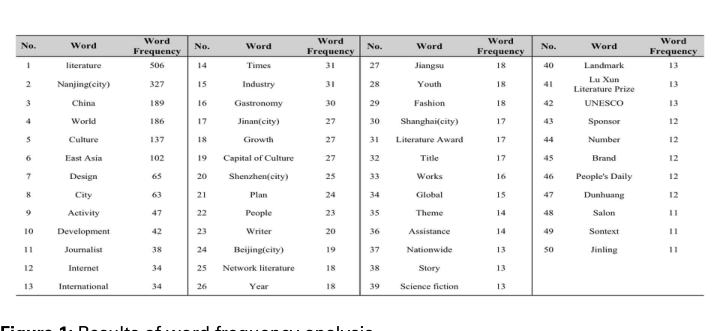
Word Frequency Analysis Text processing was carried out for 1081 original data, mainly for word segmentation processing of large segments of text obtained, to obtain words with meaning in sentence structure, and to make statistics on the occurrence rate of each word. In this process, 2178 valid words were obtained. Then, the word frequency of the obtained effective words were counted, and 68 words are obtained with the frequency of more than 10 times. Since this study focuses on discovering the characteristics of Nanjing Literature Capi- tal, it retained the nouns and words related to the characteristics of Nanjing Literature Capital, excluded the verbs, meaningless bytes, numerals, and so on, and finally obtained the results as shown in Figure 1 after combining the words with similar meanings.
First of all, the words that appear for many times are literature, Nanjing, China, the world, culture and East Asia. From this, we can find that Nan- jing City of Literature is an international project, and the key words related to it are closely related to the region and literature. Secondly, in the high- frequency words from the 7th to the 24th, there are multiple contents related to the capital of Nanjing literature. For example, words such as design, con- struction, industry and food are key words related to the capital of literature.
The Application of Brand Narrative Theory of Brand Building 309
Figure 1: Results of word frequency analysis.
The vocabulary of activities, times, cultural capital, development, planning, writers and so on are closely related to the construction of the capital of lite- rature itself, reflecting the behaviors, contents and elements that are close to the connotation of the capital of literature. In addition, there are also names of cities, such as Jinan, Shenzhen and Beijing, which show the close commu- nication and relationship between cities in the construction of the capital of literature. Thirdly, from the 25th to 46th words, we can find that these words explain the relationship with Nanjing City of Literature from more angles. Basically, it can be divided into the following categories. The first category is related to literature itself, such as online literature, literary awards, works, science fiction, stories, etc., which reflects the relationship between literature and the city itself. The second category is related to the activities of the capital of literature, such as fashion, global, theme, assistance, landmarks, etc., refle- cting various activities in the process of building the capital of literature. The third category is other words related to urban construction, such as brand, number, title, etc. These elements explain the specific behavior of the city of literature and urban construction in more detail.
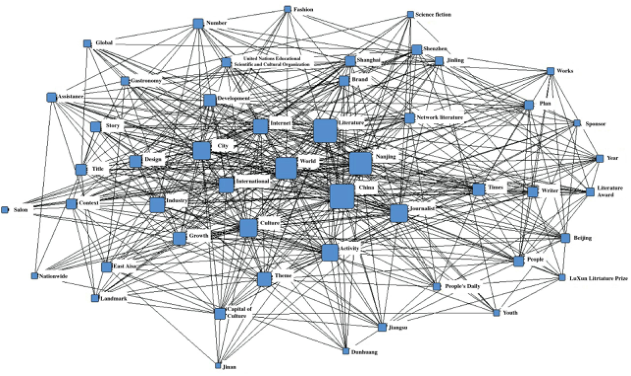
Social Network Analysis On the basis of high-frequency word statistical analysis of the collected data, and in order to understand the relationship between the key words, the social semantic network analysis of 50 words were based on co-word analysis was carried out. It can be seen from Figure 1 that the keywords “Nanjing”, “Lite- rature”, “China”, “World”and so on are located at the center of the network, and the network as a whole shows the characteristics of centralized gath- ering and relatively scattered outside (See Figure 2). The keywords at the core represent the core features of Nanjing’s “capital of literature”, among which “Nanjing”, “literature”, “China”and “the world”are the most closely related, which is also the main feature visible in relevant reports and public information. The sub-core part includes “culture”, “city”, “international”, “network”, “industry”, “activity”, “design” and other contents. This part is a further expansion on the basis of the core key words, to strengthen the specific interpretation of the connotation of Nanjing City of Literature. The
Figure 2: Semantic network map of Nanjing City of Literature.
relationship between the sub-core part and the peripheral part is composed of the remaining keywords. There is a correlation between the keywords, but the density of links is lower than that of the central area (Qi and Zhang, 2020).
DISCUSSION
In conclusion, based on the analysis of big data, the characteristics of Nan- jing City of Literature are based on Nanjing’s native land, taking literature as the core, and attaching importance to a connected whole of communica- tion with the world. Therefore, this paper puts forward the core idea that the brand building of Nanjing City of Literature can realize the continu- ous development of brand narrative process by basing on Nanjing literature gene, paying attention to international communication and deepening the integration of multiple aspects.
Also, based on Nanjing literature it is an important basis for building urban brand narrative. Specifically, in the process of brand construction, the core characteristics, differentiated performance and advantageous resources of Nanjing Literature Capital should be expressed in tangible or intangible ways on the basis of full understanding. Therefore, it is necessary to construct the interrelationship among the elements of Nanjing literature gene. On the one hand, the local literature resources of Nanjing should be fully tapped, and on the other hand, it is necessary to further re-create and develop the literature gene.
Secondly, we pay attention to the dynamic narrative path of international communication. Narration is a process of building and updating cognitive models, and a process of enhancing participation and understanding. Especi- ally in urban brands, the participation and openness of narration are reflected in the need to build cultural stories that are acceptable to the public. It can form a narrative process through internal and external communication, gain recognition, generate consensus, and enhance attention to the target group.
The Application of Brand Narrative Theory of Brand Building 311
Thirdly, we should form a deeply rooted and integrated system. The cultu- ral gene of the city is the core of the city brand, also the actual transformation process can not lack the superposition of all resources. Taking Nanjing City of Literature as an example, we can find that cooperation with different cities or industries is a very common form in the narrative process of creating a new image of the city. In addition, there are also cases of publicizing urban nar- rative through different communication methods. Therefore, in combination with the core characteristics and value connotation of Nanjing City of Lite- rature, through cooperation and form innovation, we attach importance to the refinement and effectiveness of the communication content, and present the brand story of Nanjing City of Literature in a more attractive way, which will arouse public recognition and resonance.
Narrative is an important point of view to build the competitiveness of urban brands.Through integrating urban resources and building narrative communication with consumers, the core values of urban brands are effe- ctively connected with the public. This study takes the brand construction of Nanjing City of Literature as an example, collects relevant text data of Nanjing City of Literature through big data, clarifies the general characteri- stics of Nanjing City of Literature in brand construction at this stage, puts forward the narrative direction and suggestions of Nanjing City of Literature brand, and provides basic research and decision-making basis for relevant policy formulation and research. In the progress of this research, we focu- sed on selecting text materials from public reports. In future research, we can further expand the scope of research, select information sources under different media and channels, and explore a more comprehensive and in- depth brand narrative mechanism of Nanjing City of Literature through comparative analysis of similarities and differences.
ACKNOWLEDGMENT
This research was supported by the JiangSu Provincial Double-Innovation Doctor Program 2022 and Key Program of the National Social Science Fund of China (22AC003).
REFERENCES
An, Q. and Yu, Y. Y. (2019). Small narration and storytelling: a new perspective of urban brand communication. Research on Transmission Compete- nce.2019(3.01):219. Bai, Z. R. and Su, S. M. (2020). Brand Nattative and Communication Orientation of
National Intangible Cultural Heritage in the Context of New Media. Journal of Hubei Minzu University (Philosophy and Social Sciences). 2020(38.04): 128–135. Bertetti, P. (2014). Conan the Barbarian: Transmedia Adventures of a Pulp Hero.
In: Transmedia Archaeology: Storytelling in the Borderlines of Science Fiction, Comics and Pulp Magazines. London: Palgrave Pivot. 2014: 15–38. Dai, J. C., et al. Inspiration from the Capital of World Literature to the Capital of China. Culture Journal. 2019(02): 24–29. Escalas, J. E. (1998). ADVERTISING NARRATIVES: What are they and how do
they work? in Representing Consumers: Voices, Views and Visions, London: Routledge, 1998.
Fisher, W. R. (1985). The Narrative Paradigm: An Elaboration. Communication Monographs, 1985(52), 347–367. Ge, H. B. and Liu, W. D. (2014). Inspiration from the world Capital of Literature.
Exploration and Free Views. 2014(12): 78–81. Gao, X. (2019). A Study on Interactive Relationship Between Literature and Creative City. Journal of Lingnan Normal University. 2019(40.02):40-48+53. Herman, D. (2003). Narrative Theory and the Cognitive Sciences. Stanford: CSLI
Press, 2003. He, C. H and Chen, D. L (2018). Exploring the storytelling model in the international communication of city brands. International Communications. 2018(06), 23–26. Hospers, G. J. (2003). Creative cities: Breeding places in the knowledge economy.
Know Techn Pol.2003(16): 143–162. Jiang, H. L. (2022). One Hundred Years of Nanjing Literature History: On the DNA Double Helix of “Nanjing Literature”and “Nanjing Literature”. Modern Chinese Culture and Literature. 2022(01): 28–32. Kim, C. R. (2006). A Study on the Narrative of Visual Brand Identity. Journal of
Korea Design Forum, 2006(14), 137–147. Kim, Y. H., et al. (2013). The Impact of Fictionality and Quality of Brand Story on Brand-Consumer Relationship, Immersion, and Attitude toward Brand Storytel- ling. Journal of Public Relations, 2013(03), 235–277. Lee, G. D. and Lee, J. H. (2013). A Study of Storytelling Based on The City’s Cultural
Factors. A Journal of Brand Design Association of Korea. 11(2). 105–114. Luan, K. Y. (2021). Take Advantage of “The City of Literature” to Promote the Construction of Nanjing City Cultural Brand. Journal of Urban Studies, 2021(03), 83–86. Liu, R. (2018). Strategic Choice of Chinese Cities Joining into Creative City Network.
China Opening Journal. 2018(01): 65–68. Liang, J. C., et al. (2022). Storytelling about Guangzhou Red Culture Brand. Library Tribune. 2022. Moon, S. H. (2021). History of Literary City Haito Matsuyama. The Japanese
Modern Association of Korea. 2021(71): 133–152. Pan, J. (2022). Media operation: the link between urban narrative and urban image. Exploration and Free Views. 10(2022): 29–31. Qin, Z. C. (2020). Research on the Narrative of the “Millennium Canal” National
Culture and tourism Brand. Hundred Schools in Arts, 36(05), 42–49. Qie, H. T. and Zhang, Z. J. (2020). Research on Quantitative Evaluation of Science and Technology Innovation Policy in China Based on Text Mining. Global Science, Technology and Economy Outlook. 2020, 35(06): 53–60. Ryu, K., et al. (2018). Compelling brand storytelling for luxury hotels. International
Journal of Hospitality Management, 2018(74), 22–29. UNESCO Creative Cities Network (no date). Website: https://en.unesco.org/creativecities/. UNESCO (2020). UNESCO Creative Cities Network for sustainable develo-
pment. Website: https://unesdoc.unesco.org/ark:/48223/pf0000375210/. Wang, F. (2022). Brand Narrative. Beijing: China Renmin University Press. Wang, T., et al. (2011). Storytelling Build a brand: Brand narrative theory of constructing and spreading stories. Journal of Management World, 03(2011): 112–123. Yuan, S. G. (2005). Brand narrative: Effective ways to enhance brand value.
Detergent & Cosmetics. 07(2005): 25–30. Zhu, Y. D (2017). Generality and Individuality: A Comparison of the Construction Models of “World Literature City”. Peony. 2017(03): 71–73. Zhu, Y. N. and Su, X. J. (2020). Research on the Historical Origin and Construction
Path of the “City of Literature”. China Ancient City. 2020(06): 63–69.
LISTED IN THE AHFE DIGITAL BOOKSTORE CATALOGUE
Explore the complete digital volume
Human Factors, Business Management and Society
Read this individual research paper free through the original publisher, or explore the full digital proceedings book.
ISBN 978-1-958651-73-5
Explore this ISBN in the AHFE Bookstore ↗Listed in the July 2026 bookstore catalogue; search by ISBN to confirm current availability · Digital book purchase optional