In this study, we performed a demonstration experiment to determine a highly visible light emission pattern while feeling that the stimulus is suppressed using sensory evaluation. We performed sensory evaluation of stimulus intensity and visibility of simple blinking that repeats on and off and fade-in/fade-out blinking that gradually brightens and fades to investigate the trade-off relationship between stimulus adaptation and arousal. In the experiment, we compared the light-emitting blocks that are constantly lit, simple blinking, and fade-in/fade-out blinking and clarified the relationship of the blinking stimulus with visibility. In this experiment, subjects underwent the sensory evaluation for three types of environmental illuminance (20 lx, 50 lx, and 100 lx) and were asked to evaluate the strength of stimulation, visibility, and discomfort of each blinking pattern using normal light as a reference. When the surrounding illuminance was low (20 lx), the overall evaluation value was higher because the fade-in/fade-out flashing was less stimulating and easier to find. Conversely, when the ambient illuminance was high (50 lx), simple blinking was more stimulating and easier to find, and the overall evaluation value was higher. Although it was a simple blinking, it seemed that the visibility for the visually impaired had been secured. Moreover, in the case of 100 lx, the difference in the illuminance between the surroundings and the light-emitting block was small; therefore, finding the light-emitting block in both simple blinking and fade-in/fade-out blinking was difficult, and the overall evaluation value was very low. It was found that simple or fade-in/fade-out blinking is selected depending on the ambient illuminance. By installing light-emitting blocks that blink in an optimal blinking pattern at the entrance of a crosswalk, it is expected that the blinking will be effective in guiding the visually impaired while considering pedestrians and the surrounding environment.
MATERIALS AND METHOD In this study, a demonstration experiment was conducted to search for a highly visible light emission pattern while feeling that the stimulus is sup- pressed using sensory evaluation. The trade-off relationship between stimulus adaptation and arousal by sensory evaluation of stimulus intensity and
Stimulation and Visibility of Flashing Lights With Different Illuminance 63
visibility of simple blinking that repeats on and off and fade-in/fade-out blin- king that gradually brightens and fades gradually was investigated. Various blinking patterns for the blinking of the light-emitting block were adopted, and an experiment on the visual recognition distance of the light-emitting block by subjects was conducted to verify the effectiveness for pedestrians. The light-emitting blocks that are constantly lit, the simple blinking, and the fade-in/fade-out blinking were compared, and the relationship between the blinking stimulus and the visibility was clarified. This visual distance experi- ment verified the effectiveness of fade-in/fade-out blinking that can suppress stimulation while securing visual distance.
In this experiment, a sensory evaluation was described for three types of environmental illuminance (20, 50, and 100 lx). Subjects were asked to eva- luate the stimulus strength, visibility, and discomfort of each blinking pattern, using normal light as a reference. When the surrounding illuminance was low (20 lx), the overall evaluation value was higher because the fade-in/fade-out flashing was less stimulating and easier to find. When the surrounding illu- minance was high (50 lx), simple blinking was more stimulating and easier to find, and the overall evaluation value was higher. Although it is a simple blinking, the visibility for people with visual impairment has been secured. When the surrounding illuminance was 100 lx, the difference in the illumi- nance of the surroundings against the illuminance of the light-emitting block was small, the light-emitting block in both simple blinking and fade-in/fade- out blinking was difficult to find, and the overall evaluation value was very low. Simple blinking or fade-in/fade-out blinking was selected based on the surrounding illuminance.
By installing light-emitting blocks that blink in an optimal blinking pat- tern at the entrance of a crosswalk, it was expected that the blinking would be effective in guiding people with visual impairment while considering pede- strians and the surrounding environment (Stoelzel et al., 2015; Abolafia et al., 2011; Keller et al., 2017).
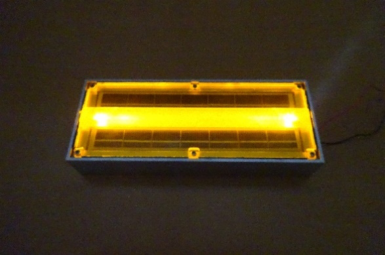
Experiment Method We conducted experiments (Ikeda et al., 2013) to verify the effectiveness of the developed light-emitting block (Figure 1) and used it with normal ligh- ting. Assuming an actual road environment, we also conducted a verification experiment (Ikeda et al., 2015) on the visibility of the light-emitting blocks when the lighting of the surrounding shops is in the background. By verifying the visibility by changing the height of the white luminous plate to simulate the light source of the surrounding shops, it was found that the visibility was affected by the luminous plate in the back. Additionally, we conducted a veri- fication experiment (Nagahama et al., 2016) of light-emitting blocks installed at the entrance of an actual crosswalk. We developed a blinking light that improves visibility while suppressing stimulation caused by blinking light to distinguish between the two. Focusing on arousal and adaptation to human stimuli, we confirmed in a previous study (Okada et al., 2017) that there is a pattern of awakening even though the stimulus is suppressed, depending on the difference in the blinking cycle and the light emission time.
Figure 1: LED block.
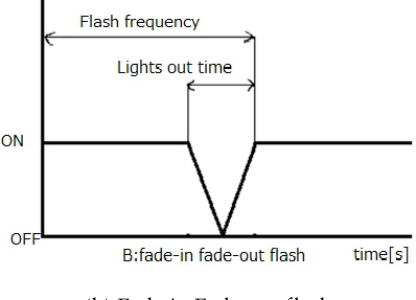
Blinking Pattern In this experiment, various blinking patterns were prepared (Figure 2, Table 1). We performed various blinking patterns with a period of 2-3.5s. The blinking parameters included the blinking period, turn-off time, and blinking method. A is an ON-OFF blinking method, which is called simple blinking. B is a blinking method in which the light gradually becomes darker, and when the light is completely extinguished, it gradually brightens again, which is cal- led fade-in/fade-out blinking. The flashing parameters included the blinking cycle, turn-off time, and blinking method.
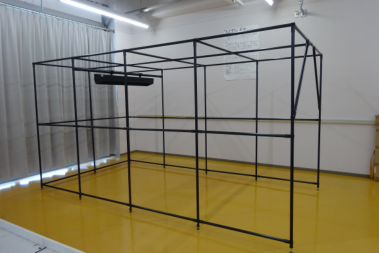
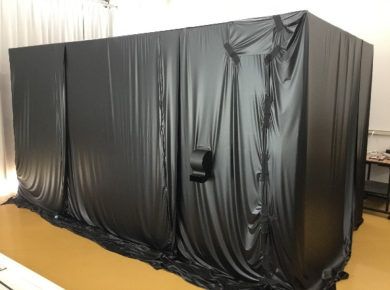
Outline of the Experiment A flashing light was presented to the subjects, and sensory evaluation of the stimulus at the time of the flashing light was performed. The frame was cove- red with a curtain with a shielding rate of 100%. The volume was 2 m high, 2 m wide, and 4 m deep. A dimmable LED line border light was used to illuminate the experimental darkroom (Figure 3, 4). It maintained 20 lx at a viewing distance of 2 m.
The outline of the experiment is as follows: +Subjects: 16 healthy subjects. +Brightness of experiment environment: 20, 50, and 100 lx (assuming brightness under street lights at night). +Number of blinking patterns: 12 types (patterns are shown in Table 1). +Blinking patterns randomly presented to the subjects. +Viewing distance: 2 m.
Experimental Procedure The experimental procedure was as follows:
1) Subjects were adapted to the brightness of the laboratory with the set illuminance (20, 50, and 100 lx). 2) Constant light was presented as a standard stimulus to compare with the flashing stimulus. Then, a flashing light was presented for 30 s. 3) Subjects evaluated the stimulus strength, visibility, and discomfort of the flashing light compared to normal light on a 9-point scale from -4 to +4. 4) Twelve patterns of blinking light were randomly presented.
Stimulation and Visibility of Flashing Lights With Different Illuminance 65
(a) Simple flash
(b) Fade-in Fade-out flash
Figure 2: Blinking pattern.Table 1. Combination of blinking or ON-OFF patterns.
5) Goggles were worn for sighted and pseudo-amblyopia subjects, and each pattern was performed once. 6) The above procedure was repeated for 3 types of illuminance: 20, 50, and 100 lx.
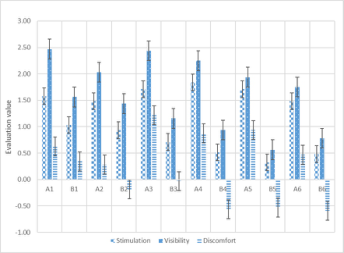
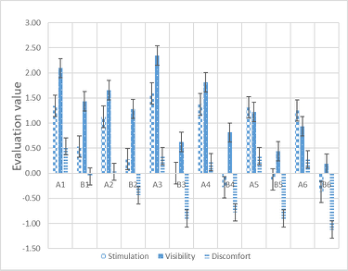
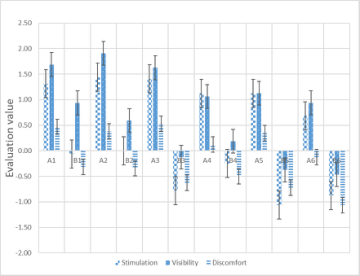
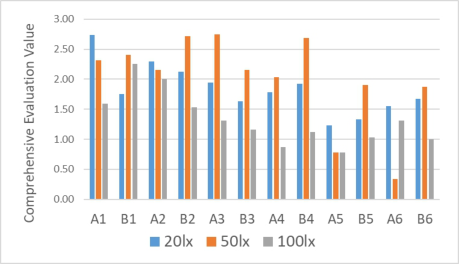
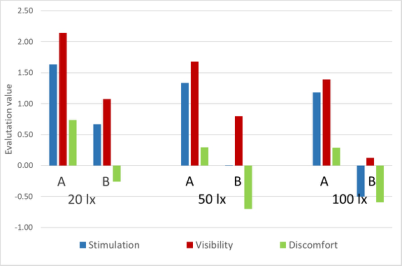
Each of the 12 blinking light patterns was measured once for the sighted subjects and once for the pseudo-amblyopia subjects, and the illuminance was measured for each of the 16 subjects. The average value of the stimulus intensity, visibility, and discomfort of each blinking pattern was calculated at 20, 50, and 100 lx (Figures 5, 6, and 7). The total evaluation value of simple blinking and fade-in/fade-out blinking is shown in Figure 8. In the comprehensive evaluation formula, the value of light stimulus intensity and discomfort was negative, and that of visibility was positive. It was a double value, as shown in formula (1): Comprehensive Evaluation Value = Visibility × 2 −Stimulation − Discomfort (1)
The differences between A pattern of simple blinking and B pattern of fade-in/fade-out blinking for sighted and pseudo-amblyopia subjects at an illuminance of 20, 50, and 100 lx are shown in Tables 2, 3, and 4.
This experiment aimed to find the optimal blinking method for assisting people with low vision. Although it is desirable to support people with low vision with stronger visibility, if flickering blinking is introduced, it may cause discomfort to healthy people around them. Therefore, the B pattern, which is a fade-in/fade-out blinking, was desired as much as possible. Additionally, by
Stimulation and Visibility of Flashing Lights With Different Illuminance 67
Figure 5: Results of sensory evaluation of each pattern at 20 lx.Figure 6: Results of sensory evaluation of each pattern at 50 lx.Figure 7: Results of sensory evaluation of each pattern at 100 lx.
summarizing the results of the sensory evaluation in a graph, various things were found, although the amount of data was still small.
When the surrounding illuminance was low (20 lx), the fade-in/fade-out blinking was easier to find because of less light stimulus, the total evaluation value was higher, and blinking patterns B2 and B4 were considered particu- larly suitable. However, when the surrounding illuminance was high (50 lx), the simple blinking was more visible, and the overall evaluation value was
Figure 8: Comprehensive evaluation value.Table 2. Difference between evaluation values of A and B at 20 lx.
Table available in the original PDF paper.
Stimulation Visibility Discomfort A 1.63 2.15 0.73 B 0.67 1.07 −0.26 B/A (%) 40.79 50.00 −35.46
A: simple flash B: fade-in fade-out flash
Table 3. Difference between evaluation values of A and B at 50 lx.
Table available in the original PDF paper.
Stimulation Visibility Discomfort A 1.33 1.68 0.29 B 0.01 0.80 −0.70 B/A (%) 0.39 47.52 −241.07
Table 4. Difference between evaluation values of A and B at 100 lx.
Table available in the original PDF paper.
Stimulation Visibility Discomfort A 1.18 1.39 0.29 B 0.51 0.13 −0.59 B/A (%) −42.73 8.99 −207.27
higher, although there was some light stimulation. Particularly, although the blinking patterns A1 and A3 were simple blinking, they were considered sui- table considering the visibility for people with visual impairment. However, regarding the overall evaluation value, blinking patterns B2 and B4 were con- sidered suitable because they were less stimulating and easier to find. When the surrounding illuminance was 100 lx, the difference between the illumina- nce of the surrounding illuminance and the illuminance of the light-emitting block was small, so it was difficult to find the light-emitting block for both simple blinking and fade-in/fade-out blinking. The average value became very low (Figure 9).
The ratio of fade-in/fade-out blinking (pattern B) to simple blinking (pat- tern A) decreased for all items of light stimulus intensity, visibility, and
Stimulation and Visibility of Flashing Lights With Different Illuminance 69
Figure 9: Difference in evaluation value due to changes in illuminance.
discomfort, as shown in Tables 5, 6, and 7. Particularly, it was noted that the brighter the surrounding illuminance is, the larger it becomes.
CONCLUSION
This experiment helped find the optimal blinking method for assisting peo- ple with visual impairment. Although it is desirable to support people with low vision with higher visibility, we found that the visibility and discomfort of flashing lights change depending on the ambient illumination. By instal- ling light-emitting blocks that blink in an optimal blinking pattern at the entrance of a crosswalk, it is expected that the blinking will be effective in guiding people with visual impairment while considering pedestrians and the surrounding environment.
ACKNOWLEDGMENT
This research is being carried out with the support of JSPS Grant-in-Aid for Scientific Research (C) (General) 20K12736. We would like to express our gratitude here.
REFERENCES
Andreas J. Keller, Rachael Houlton, Björn M. Kampa, Nicholas A. Lesica, Thomas D. Mrsic-Flogel, Georg B. Keller and Fritjof Helmchen, Stimulus Relevance Modulates Contrast Adaptation in Visual Cortex, eLife, Vol. 6, pp. 1–12, 2017. Carl R. Stoelzel, Joseph M. Huff, Yulia Bereshpolova, Jun Zhuang, Xiaojuan
Hei, Jose-Manuel Alonso and Harvey A. Swadlow, Hour-Long Adaptation in the Awake Early Visual System, Journal of Neurophysiology, Vol. 114, No. 2, pp. 1172–1182, 2015. Hideaki Nagahama, Tomoyuki Inagaki, Norihiro Ikeda, Kazuya Takahashi, Kiyohito Takeuchi, Hiroshi Ogino, Katsuya Sato, Shin-ichi Ito and Shoichiro Fujisawa, Proof Experiment of LED Block Equipped with Projections to Locate Travel Direction for Blind and Vision Impaired Persons, Proceedings of the AHFE2016 International Conference on Human Factors in Transportation, pp. 159–169, Orlando, Jul. 2016.
Juan M. Abolafia, R. Vergara, M. M. Arnold, R. Reig and M. V. Sanchez-Vives, Cortical Auditory Adaptation in the Awake Rat and the Role of Potassium Currents, Cerebral Cortex, Vol. 21, No. 5, pp. 977–990, 2011. Norihiro Ikeda, Kazuya sTakahashi, Tomoyuki Inagaki, Katsuya Sato, Shin-ichi Ito,
Motohiro Seiyama, Kiyohito Takeuchi, Hiroshi Ogino and Shoichiro Fujisawa, Visibility of LED Blocks Mounted on Crosswalk Boundaries for Low Visual Capa- city, Assistive Technology, Studies in Health Technology and Informatics (Studies in Health Technology and Informatics), Vol. 217, pp. 512–517, 2015. Norihiro Ikeda, Kazuya Takahashi, Genji Yamamoto, Yuki Kimura, Shin-ichi Ito, Katsuya Sato and Shoichiro Fujisawa, Verification of LED Blocks Used at Cros- swalk Entrances for Persons with Visually Impairment, Assistive Technology Research Series, Vol. 33, pp. 982–987, 2013. Tomohiro Okada, Takashi Miyamoto, Shin-ichi Ito, Katsuya Sato, Norihiro Ikeda,
Osamu Sueda and Shoichiro Fujisawa, Research on Blinking-Luminescence Travel Support for Visually Impaired Persons, Proceedings of the AHFE 2017 Internatio- nal Conference on Human Factors in Transportation, Los Angeles, pp. 319–324, Jul. 2017.
LISTED IN THE AHFE DIGITAL BOOKSTORE CATALOGUE
Explore the complete digital volume
Human Factors in Accessibility and Assistive Technology
Read this individual research paper free through the original publisher, or explore the full digital proceedings book.
ISBN 978-1-958651-63-6
Explore this ISBN in the AHFE Bookstore ↗Listed in the July 2026 bookstore catalogue; search by ISBN to confirm current availability · Digital book purchase optional