Francesco Lolli, Antonio Maria Coruzzolo, Platao Gonçalves Terra Neto, Miguel Afonso Sellitto, Rita Gamberini (2023). Key Enabling Technologies and Concepts for the Human-Centric Industrial Revolution. In: Human Factors and Wearable Technologies. AHFE Open Access, vol. 85, pp. 36–46. https://doi.org/10.54941/ahfe1003625
1 Department of Sciences and Methods for Engineering, University of Modena and Reggio Emilia, Via Amendola 2, 42122– Reggio Emilia, Italy ↗
2 Graduate Program in Production Systems Engineering, Universidade do Vale do Rio dos Sinos, Unisinos Avenue 950, 93022-000 – São Leopoldo, RS, Brazil ↗
Recently, a new Industrial Revolution has been conceptualized, this is coined with the term “Industry 5.0”. In fact, the rapid development of information and operational technologies enabled the creation of a new human-centric industrial paradigm. In this paper, we collect the necessities to go beyond Industry 4.0, the key technologies enabling Industry 5.0, its concepts, goals and provide an Industry 5.0 map that links all these concepts together. The provided map can be used by practitioners to have a clear vision of Industry 5.0 and to take into account all its objectives, enabling technologies and Industry 4.0 gaps while applying it. The researchers also present further research agenda and roadmap for the development of Industry 5.0.
The first Industrial Revolution that humanity has experienced started back in the 1780’s and its related to the production of power from steam, water and fossil fuels (Popkova et al., 2019). While Industry 2.0 took place in the 1870’s with two concepts at its fundamentals: electrical power and assembly line production (Huberman et al., 2017). The third Industrial Revolution exploited the concept of partial automation in the 1970’s with the help of electronics and Information Technology (IT). Industry 4.0 developed from 2010’s and was conceptualized by the seminar report of the seminal report of the Industry 4.0 working group sponsored by the German Federal Ministry of Education and Research (Kagermann et al., 2013). The goals of Industry 4.0 are to achieve a higher level of operational efficiency and productivity, as well as a higher level of automation while maximizing productivity and achieve mass production using emerging technologies creating the concept of smart manufacturing (Vogel-Heuser & Hess, 2016). In fact, manufacturers are subject to an ever-changing market demand and competing in such an environment is challenging.
Key Enabling Technologies and Concepts for the Human-Centric Industrial Revolution 37
Some of the main objectives of Industry 4.0 are (Shafiq et al., 2016):
Provide IT-enabled mass customization of manufactured products.
Make automatic and flexible adaptation of the production chain.
Track parts and products.
Facilitating communication among parts products, and machines.
Application of human-machine interaction (HMI)
Achieving IoT-enabled production optimization in smart factories.
Providing new types of services and business models of interaction in the value chain.
These objectives are pursued exploiting the key enabling technologies of Industry 4.0 (Roblek et al., 2016):
Cloud computing.
Mobile computing.
Big data.
IoT.
CFS.
Additive Manufacturing.
For a full review on the theme of Industry 4.0 we suggest the survey of Lu (Lu, 2017). In this paper, the researchers intend to give an overview of key enabling technologies and concepts beyond the last industrial revolution named Industry 5.0. For the scope we will start by investigating the main reason and needs why Industry 5.0 took place than we will describe the main technologies that support the revolutions as well as its objective. Lastly, we will propose a map for Industry 5.0 that link its concepts, technologies and objectives as well as some suggestions for its development.
BEYOND INDUSTRY 4.0 After investigating the literature, three necessities go beyond Industry 4.0. The first one is related to the co-working of human and machine called “human robot co-working”, the second is about resilience and the last one regards sustainability (Demir, Döven, et al., 2019). These points converge in trying to equilibrate the relation between machines and humans in contrast with Industry 4.0 where machines were the principal focus trying to minimize human work in the so called “machine-centered” or full-automation princi- ple (Coronado et al., 2022). First point describes the lack of consideration in Industry 4.0 about human even if it was related to using smart devices and connected machine. In fact, the optimization of processes under Indu- stry 4.0 often ignores the human cost related to the process optimization. In this light Industry 5.0 bring back workers to factory floors trying to mix machines accuracy with human creativity with the main goals of increasing process efficiency (Nahavandi, 2019). If Industry 4.0 was about full automa- tion Industry 5.0 is about the synergy of humans and automated machines (Alves et al., 2023). The second necessity to go beyond Industry 4.0 is concer- ned with resilience. Resilience in terms of Industry is described as the capacity of a firm to adapt to, be alert to, and quickly respond to changes related to
supply chain disruption (Vanany et al., 2021) (Ambulkar et al., 2015). These are features not necessarily included in Industry 4.0 where technologies were created to be intelligent but not flexible or adaptable (X. Xu et al., 2021). This lack of flexibility and adaptability emerged in particular under the Covid 19 disruption where companies were forced to change their business model in a short time (e.g. food industries forced to follow new guidelines of the Food and Agriculture Organization (FAO) and World Health Organization (WHO) (WHO, 2020) resulting in high financial losses for those company who were not able to be sufficiently resilient (Yu et al., 2022). The last point to go beyond Industry 4.0 is the environmental sustainability (Kasinathan et al., 2022). In fact, even if Industry 4.0 improves indirectly some aspects of environmental sustainability by increasing process efficiency and reducing emissions (Ching et al., 2022) it remains focused on the profit-centricity eco- nomic models. While Industry 5.0 is expected to be a transformative model build on Industry 4.0 technologies, experience and on Covid 19 disruption which value is a sustainable development and aims to create a hyper con- nected and data driven industrial ecosystem (Javaid et al., 2020). Under the sustainable view we find the concept of bio-economy (Demir, Turan, et al., 2019) that was formalized by the European Commission in (European Com- mission, 2018) and regards the production of renewable biological resources and the conversion of these resources and waste streams into value-added products (Demir, Döven, et al., 2019). Those three pillars – Human-centered, Resilience and Sustainability – are considered in literature as the key elements to establish Industry 5.0 (Ivanov, 2022) which helps propose discussions about continuing industries’ development. In addition these three pillars are being considered now as a next step not only for the Industry but also for the society development in what has been called Society 5.0 (Leng et al., 2022). Society 5.0 is a Japanese definition and can be described as a proposal that considers all technologies’ progress through Industry 4.0 to get a wellbeing to human life (De Felice et al., 2021).
TECHNOLOGIES AND CONCEPTS FOR INDUSTRY 5.0 In a seminal report of European Commission coming from a workshop with technology leaders in EU six different technology concepts were identified (Müller, 2020):
1. Human-centric solutions and human-machine-interaction. 2. Bio-inspired technologies and smart materials. 3. Real time-based digital twins and simulation. 4. Cyber safe data transmission, storage, and analysis technologies. 5. Artificial Intelligence (AI). 6. Technologies for energy efficiency and trustworthy autonomy.
The first concept illustrates all the technologies in order to individualize the interaction between humans and machines trying to combine human innova- tion with machine efficiency (Adel, 2022). Among these technologies we can find:
Key Enabling Technologies and Concepts for the Human-Centric Industrial Revolution 39
Human intention recognition as well as gesture and speech recognition. These technologies are needed to create an interconnected system made of humans and machines. There are already Artificial Intelligence model trained to recognize humans gesture based on sensors input as done with RGB, RGB-D and skeleton data (Coruzzolo et al., 2022) but also intention as done in (Li et al., 2020) or with ECG as reviewed in (Bi et al., 2019).
Collaborative (Cobots) and assistive robots designed to support humans’ activity. There are already applications for both Cobots related to indu- strial activity reviewed in (Javaid et al., 2022) and Cobots designed for Social Assistive Robotics (Ghi¸t˘a et al., 2020).
Virtual or augmented reality to enhance the interaction between humans and machine but also with educational purposes (Rojas-Sánchez et al., 2022) and medical ones (Z. Liu et al., 2022).
Technologies that enhance the human physical capabilities as exoskeleton (Proud et al., 2020).
Technologies that enhance the human cognitive capabilities as decision support system based on AI (Sgarbossa et al., 2021) (Lolli et al., 2022).
The second concept is more related to technological features that can be integrated into existing technologies or products such as: production of raw materials from waste (Costa & Ribeiro, 2020), biosensors (Karimi-Maleh et al., 2021) and adaptive ergonomics (Kim et al., 2019). While the third concept comprehend all the technologies that enhance the creation of a digital twin of the various production processes present to optimize production, tests new production processes or products in a digital way e to leverage the risk involved in the operations. Some technologies for the scope are:
Simulations based methods to create the Digital Twin: Discrete Event Simulation (DES) and/or Agent-Based Simulation (ABS) (dos Santos et al., 2021).
Multi scale dynamic modelling (Quaranta et al., 2020).
Intelligent maintenance systems embedded with predictive/proactive/pre- ventive maintenance strategies and coupled with fast on site production methods such as 3D printing (Lolli et al., 2022).
The fourth concept is related to data and all the other concepts rely on this. In fact, under Industry 5.0 Big Data needs to be stored efficiently with a high cybersecurity that has to be scalable and guaranteeing the data interopera- bility (Müller, 2020). This fourth concept has been termed by some authors in Big Data and characterized by customizations and forecast possibilities (Leng et al., 2022), Blockchain characterized by its decentralization and tran- sparency management and Edge Computing characterized by its security and interoperability (Maddikunta et al., 2022). The fifth concept is related to AI. In fact, even if AI was also an enabling technology of Industry 4.0 in this revolution has to take a human centric perspective to overcome some of its actual limitations. Some of these empowerments include:
Person centric AI: development of models that seek the human mach- ine synergies by considering humans-in-the-loop of the learning process (Rožanec et al., 2022).
Informed machine learning: development of models that comprehend in the learning process some a priori knowledge that can come from physics (M. Liu et al., 2020) or from experts judgment (Vonrueden et al., 2019).
Secure and energy efficient AI.
The sixth concept is the energy efficiency since all the mentioned techno- logies need a large amount of energy to operate. In this light in order to reach an emission neutrality some of the possible strategies include:
High integration of renewable energy.
Hydrogen as a clean source of energy (Abe et al., 2019).
Power-to-X technologies: able to convert a renewable energy source into an energy source that can be readily stored e.g. Hydrogen (Hermesmann et al., 2021).
Low energy data transmission and storage.
Besides these six options, zero-defect manufacturing, Metaverse, Hologra- phy, 6G and Internet of Everything has been proposed as options to enable Industry 5.0.
Goals of Industry 5.0 In this brief section, we want to summarize the main goals of Industry 5.0 that obviously are strictly related to its three pillars already discussed. In fact, those three key elements - human-centered, sustainability and resilience - aligned with community necessities can be treated as the main objectives of Industry 5.0 Huang discussed about these three goals in Industry 5.0 inclu- ding society necessities, clarifying that the human centered objective is about providing well-being to communities through technologies (Huang et al., 2022). Following this objective, the technologies previously reviewed have to be not only smart, but Super Smart and very resilient being capable of a per- sonal customization, of individualizing according to specific necessity (Leng et al., 2022) and able to be adjustable to adversities, optimizing the process and saving time and resources. Finally, the last objective is described as tur- ning into a Lean Society/Industry, promoting sustainability. This last topic appears mandatory mainly because of United Nations Sustainable Develo- pment Goals to 2030 and it is an opportunity to achieve, trough cooperation between industry and society a commitment to being more responsible with world resources. Finally, pursuing these three goals and combining them, can help to convert Industry 4.0 technologic focused into a space where organi- zations, Managers, Technologies and Performances can be improved (Ivanov, 2022).
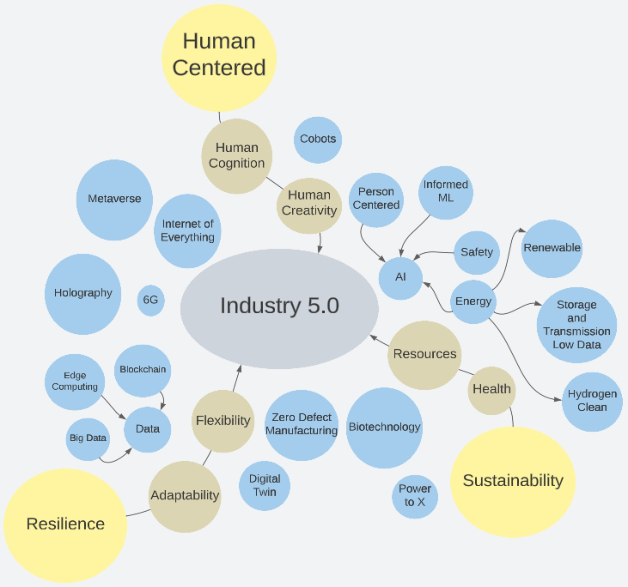
MAP OF INDUSTRY 5.0 Considering the above-mentioned goals, Industry 4.0 is still missing the ena- bling technologies proposals, a map of Industry 5.0 is presented in Figure 1. To stablish Industry 5.0 three objectives were presented here in yellow: resi- lience, sustainability and human centered. Each objective intends to fulfill Industry 4.0 gaps bringing it owns characteristics and worries, showed in
Key Enabling Technologies and Concepts for the Human-Centric Industrial Revolution 41
Figure 1: Industry 5.0 map.
brown and connected by arrows. Therefore, proposing flexibility and ada- ptability helps to compound Industry 5.0 through resilience. The same way, human cognition and creativity helps enhance the human centered Industry 5.0 and finally considers the use of resources, its consequences and wor- ries about human health will provide sustainability, covering and completing Industry 5.0 main vision. These hiatuses presented above can be overcoming trough technologies, presented in blue. Even there are six main technolo- gies described in the text - Biotechnology, energy, digital twin, data, AI and Cobots - here another were added: zero defect manufacturing, Holography, 6G, Metaverse, and Internet of Everything and data branches - which are indicated by arrows. To present these enabling technologies, no one can be related to a goal, mainly because all of them can help in all objectives. So that, each one is disposed by its similarity as, for example, cobots are more related to human centered or biotechnologies are closer to sustainability.
The presented map shown in Figure 1 help practitioners develop a clear vision of Industry 5.0 and to take into account all its objectives, enabling technologies and Industry 4.0 gaps while applying it. In fact, even if the concept of Industry 5.0 is new, some research has been presented following the main points described in the presented map. For example, (Battini et al., 2022) propose an Industry 5.0 research for the ergonomic risks illustrating the necessity of all goals in an experiment for the job tasks as assembly and
packaging submitted at different vibrations, sounds or automatic machines. During this research, authors discovered that allying humans’ necessities and personalizing data based on its characteristics, like age, gender or experie- nce, results in workers more resilient to the tasks and environments more sustainable and health.
CONCLUSION
In this paper we presented a review of concepts and key enabling techno- logies of Industry 5.0. We started with the reason behind this revolution by assessing the necessities to go beyond Industry 4.0. Then we identify the main technologies that support Industry 5.0, their main concepts and features as well as Industry 5.0 main goals. We summarize all of these findings in a map of Industry 5.0 that provide a clear vision of this revolution to practitioners to follow in their application of Industry 5.0 in order to account for all its objectives, technologies and motivation, as we demonstrate with an example from literature. In addition, being Industry 5.0, a new concept is important to spread it and this one of the scopes of this paper. Further research agenda in this direction include specific sector of applications framework as the general one proposed by (Ivanov, 2022) but specified in order to give sector specific guidelines for application of Industry 5.0 and field-based suggestions.
REFERENCES
Abe, J. O., Popoola, A. P. I., Ajenifuja, E., & Popoola, O. M. (2019). Hydrogen energy, economy and storage: Review and recommendation. International Journal of Hydrogen Energy, 44(29), 15072–15086. https://doi.org/10.1016/J. IJHY- DENE.2019.04.068 Adel, A. (2022). Future of industry 5.0 in society: human-centric solutions, challenges
and prospective research areas. Journal of Cloud Computing 2022 11:1, 11(1), 1–15. https://doi.org/10.1186/S13677-022-00314-5 Alves, J., Lima, T. M., & Gaspar, P. D. (2023). Is Industry 5.0 a Human-Centred Approach? A Systematic Review. Processes 2023, Vol. 11, Page 193, 11(1), 193. https://doi.org/10.3390/PR11010193 Ambulkar, S., Blackhurst, J., & Grawe, S. (2015). Firm’s resilience to supply chain
disruptions: Scale development and empirical examination. Journal of Operations Management, 33–34(1), 111–122. https://doi.org/10.1016/J. JOM.2014.11.002 Battini, D., Berti, N., Finco, S., Zennaro, I., & Das, A. (2022). Tow- ards industry 5.0: A multi-objective job rotation model for an inclusive workforce. International Journal of Production Economics, 250, 108619. https://doi.org/10.1016/J. IJPE.2022.108619 Bi, L., Feleke, A., & Guan, C. (2019). A review on EMG-based motor intention prediction of continuous human upper limb motion for human- robot collaboration. Biomedical Signal Processing and Control, 51, 113–127. https://doi.org/10.1016/J. BSPC.2019.02.011 Ching, N.T., Ghobakhloo, M., Iranmanesh, M., Maroufkhani, P., & Asadi, S.(2022).
Industry 4.0 applications for sustainable manufacturing: A systematic literature review and a roadmap to sustainable development. Journal of Cleaner Production, 334, 130133. https://doi.org/10.1016/J. JCLEPRO.2021.130133
Key Enabling Technologies and Concepts for the Human-Centric Industrial Revolution 43
Coronado, E., Kiyokawa, T., Ricardez, G. A. G., Ramirez-Alpizar, I. G., Venture, G., & Yamanobe, N. (2022). Evaluating quality in human-robot interaction: A systematic search and classification of performance and human-centered factors, measures and metrics towards an industry 5.0. Journal of Manufacturing Systems, 63, 392–410. https://doi.org/10.1016/J. JMSY.2022.04.007 Coruzzolo, A. M., Lolli, F., Amicosante, N., Kumar, H., Thupaki, P., & Agarwal,
S. (2022). Comparing semiautomatic Rapid Upper Limb Assessments (RULA): Azure Kinect versus RGB-based machine vision algorithm. Physical Ergonomics and Human Factors, 63(63), 54–61. https://doi.org/10.54941/AHFE1002596 Costa, F. N., & Ribeiro, D. V. (2020). Reduction in CO2 emissions during production of cement, with partial replacement of traditional raw materials by civil construction waste (CCW). Journal of Cleaner Production, 276, 123302. https://doi.org/10.1016/J. JCLEPRO.2020.123302 Da Xu, L., & Li Da Xu, C. (2020). The contribution of systems science to Industry
4.0. Systems Research and Behavioral Science, 37(4), 618–631. https://doi.org/10. 1002/SRES.2705 De Felice, F., Travaglioni, M., & Petrillo, A. (2021). Innovation trajectories for a society 5.0. Data, 6(11). https://doi.org/10.3390/data6110115 Demir, K. A., Döven, G., & Sezen, B. (2019). Industry 5.0 and Human-
Robot Co-working. Procedia Computer Science, 158, 688–695. https://doi.org/10.1016/J. PROCS.2019.09.104 Demir, K. A., Turan, B., Onel, T., Ekin, T., & Demir, S. (2019). Ambient Intelligence in Business Environments and Internet of Things Transformation Guidelines. 39– 67. https://doi.org/10.1007/978-3-030-04173-1_3 dos Santos, C. H., Montevechi, J. A. B., de Queiroz, J. A., de Carvalho
Miranda, R., & Leal, F. (2021). Decision support in productive processes through DES and ABS in the Digital Twin era: a systematic literature review. Https://Doi. Org/10.1080/00207543.2021.1898691, 60(8), 2662–2681. https: //doi.org/10.1080/00207543.2021.1898691 European Commission. (2018). Bioeconomy: the European way to use our natural resources. Action plan 2018. 1–26. https://doi.org/10.2777/79401 Ghi¸t˘a, A. ¸Stefania, Gavril, A. F., Nan, M., Hoteit, B., Awada, I. A., Sorici, A., Mocanu,
I. G., & Florea, A. M. (2020). The AMIRO Social Robotics Framework: Deploy- ment and Evaluation on the Pepper Robot. Sensors 2020, Vol. 20, Page 7271, 20(24), 7271. https://doi.org/10.3390/S20247271 Hermesmann, M., Grübel, K., Scherotzki, L., & Müller, T. E. (2021). Promising pathways: The geographic and energetic potential of power-to-x technologies based on regeneratively obtained hydrogen. Renewable and Sustainable Energy Reviews, 138. https://doi.org/10.1016/J. RSER.2020.110644 Huberman, M., Meissner, C. M., & Oosterlinck, K. (2017). Technology and Geo-
graphy in the Second Industrial Revolution: New Evidence from the Margins of Trade. The Journal of Economic History, 77(1), 39–89. https://doi.org/10.1017/ S0022050717000018 Imoize, A. L., Adedeji, O., Tandiya, N., & Shetty, S. (2021). 6G Enabled Smart Infrastructure for Sustainable Society: Opportunities, Challenges, and Research Roadmap. Sensors 2021, Vol. 21, Page 1709, 21(5), 1709. https://doi.org/10. 3390/S21051709 Ivanov, D. (2022). The Industry 5.0 framework: viability-based integration of the
resilience, sustainability, and human-centricity perspectives. International Jour- nal of Production Research, September. https://doi.org/10.1080/00207543.2022. 2118892
Javaid, M., Haleem, A., Singh, R. P., Rab, S., & Suman, R. (2022). Significant applications of Cobots in the field of manufacturing. Cognitive Robotics, 2, 222–233. https://doi.org/10.1016/J. COGR.2022.10.001 Javaid, M., Haleem, A., Singh, R. P., Ul Haq, M. I., Raina, A., & Suman, R. (2020). Industry 5.0: Potential Applications in COVID-19. Https://Doi. Org/10.1142/S2424862220500220, 5(4), 507–530. https://doi.org/ 10.1142/S2424862220500220 Kagermann, H., Wahlster, W., & Helbig, J. (2013). Securing the future of German
manufacturing industry: Recommendations for implementing the strategic initi- ative INDUSTRIE 4.0. Final Report of the Industrie 4.0 Working Group, April, 1–84. Karimi-Maleh, H., Orooji, Y., Karimi, F., Alizadeh, M., Baghayeri, M., Rouhi, J., Tajik, S., Beitollahi, H., Agarwal, S., Gupta, V. K., Rajendran, S., Ayati, A., Fu, L., Sanati, A. L., Tanhaei, B., Sen, F., shabani-nooshabadi, M., Asrami, P. N., & Al-Othman, A. (2021). A critical review on the use of potentiometric based biosensors for biomarkers detection. Biosensors and Bioelectronics, 184, 113252. https://doi.org/10.1016/J. BIOS.2021.113252 Kasinathan, P., Pugazhendhi, R., Elavarasan, R. M., Ramachandaramurthy, V. K.,
Ramanathan, V., Subramanian, S., Kumar, S., Nandhagopal, K., Raghavan, R. R. V., Rangasamy, S., Devendiran, R., & Alsharif, M. H. (2022). Realization of Sustainable Development Goals with Disruptive Technologies by Integrating Indu- stry 5.0, Society 5.0, Smart Cities and Villages. Sustainability 2022, Vol. 14, Page 15258, 14(22), 15258. https://doi.org/10.3390/SU142215258 Kim, W., Lorenzini, M., Balatti, P., Nguyen, P. D. H., Pattacini, U., Tikhanoff, V., Peternel, L., Fantacci, C., Natale, L., Metta, G., & Ajoudani, A. (2019). Adaptable Workstations for Human-Robot Collaboration: A Reconfigurable Framework for Improving Worker Ergonomics and Productivity. IEEE Robotics and Automation Magazine, 26(3), 14–26. https://doi.org/10.1109/MRA.2018.2890460 Leng, J., Sha, W., Wang, B., Zheng, P., Zhuang, C., Liu, Q., Wuest, T., Mourtzis, D., &
Wang, L. (2022). Industry 5.0: Prospect and retrospect. Journal of Manufacturing Systems, 65(August), 279–295. https://doi.org/10.1016/j.jmsy.2022.09.017 Li, S., Zhang, L., & Diao, X. (2020). Deep-Learning-Based Human Intention Prediction Using RGB Images and Optical Flow. Journal of Intelligent and Robo- tic Systems: Theory and Applications, 97(1), 95–107. https://doi.org/10.1007/ S10846-019-01049-3/METRICS Liu, M., Liang, L., & Sun, W. (2020). A generic physics-informed neu- ral network-based constitutive model for soft biological tissues. Com- puter Methods in Applied Mechanics and Engineering, 372, 113402. https://doi.org/10.1016/J. CMA.2020.113402 Liu, Z., Ren, L., Xiao, C., Zhang, K., & Demian, P. (2022). Virtual Reality Aided
Therapy towards Health 4.0: A Two-Decade Bibliometric Analysis. International Journal of Environmental Research and Public Health 2022, Vol. 19, Page 1525, 19(3), 1525. https://doi.org/10.3390/IJERPH19031525 Lolli, F., Coruzzolo, A. M., Peron, M., & Sgarbossa, F. (2022). Age-based preventive maintenance with multiple printing options. International Journal of Production Economics, 243, 108339. https://doi.org/10.1016/j.ijpe.2021.108339 Longo, F., Padovano, A., & Umbrello, S. (2020). Value-oriented and ethical tech-
nology engineering in industry 5.0: A human-centric perspective for the design of the factory of the future. Applied Sciences (Switzerland), 10(12), 1–25. https: //doi.org/10.3390/APP10124182
Key Enabling Technologies and Concepts for the Human-Centric Industrial Revolution 45
Lu, Y. (2017). Industry 4.0: A survey on technologies, applications and open research issues. In Journal of Industrial Information Integration (Vol. 6, pp. 1–10). Elsevier B. V. https://doi.org/10.1016/j.jii.2017.04.005 Maddikunta, P. K. R., Pham, Q. V., B, P., Deepa, N., Dev, K., Gadekallu, T. R., Ruby,
R., & Liyanage, M. (2022). Industry 5.0: A survey on enabling technologies and potential applications. Journal of Industrial Information Integration, 26, 100257. https://doi.org/10.1016/J. JII.2021.100257 Müller, J. (2020). Enabling Technologies for Industry 5.0 Results of a workshop with Europe’s technology leaders. https://doi.org/10.2777/082634 Nahavandi, S. (2019). Industry 5.0-a human-centric solution. Sustainability (Swit-
zerland), 11(16), 4371. https://doi.org/10.3390/su11164371 Popkova, E. G., Ragulina, Y. V., & Bogoviz, A. V. (2019). Fundamental differences of transition to industry 4.0 from previous industrial revolutions. Studies in Systems, Decision and Control, 169, 21–29. https://doi.org/10.1007/978-3-319-94310-7_ 3/COVER Proud, J. K., Lai, D. T. H., Mudie, K. L., Carstairs, G. L., Billing, D. C., Garofolini,
A., & Begg, R. K. (2020). Exoskeleton Application to Military Manual Handling Tasks. Https://Doi. Org/10.1177/0018720820957467, 64(3), 527–554. https://do i.org/10.1177/0018720820957467 Quaranta, G., Formica, G., Machado, J. T., Lacarbonara, W., & Masri, S. F.
(2020). Understanding COVID-19 nonlinear multi-scale dynamic spreading in Italy. Nonlinear Dynamics, 101(3), 1583–1619. https://doi.org/10.1007/S11071- 020-05902-1/FIGURES/31 Roblek, V., Meško, M., & Krapež, A. (2016). A Complex View of Industry 4.0. Https://Doi. Org/10.1177/2158244016653987, 6(2). https://doi.org/10. 1177/2158244016653987 Rojas-Sánchez, M. A., Palos-Sánchez, P. R., & Folgado-Fernández, J. A. (2022).
Systematic literature review and bibliometric analysis on virtual reality and edu- cation. Education and Information Technologies 2022, 1–38. https://doi.org/10. 1007/S10639-022-11167-5 Rožanec, J. M., Novalija, I., Zajec, P., Kenda, K., Tavakoli Ghinani, H., Suh, S., Veliou, E., Papamartzivanos, D., Giannetsos, T., Menesidou, S. A., Alonso, R., Cauli, N., Meloni, A., Recupero, D. R., Kyriazis, D., Sofianidis, G., Theodoropou- los, S., Fortuna, B., Mladeni´c, D., & Soldatos, J. (2022). Human-Centric Artificial Intelligence Architecture for Industry 5.0 Applications. International Journal of Production Research, 1–26. https://doi.org/10.48550/arxiv.2203.10794 Sgarbossa, F., Peron, M., Lolli, F., & Balugani, E. (2021). Conventional or additive
manufacturing for spare parts management: An extensive comparison for Pois- son demand. International Journal of Production Economics, 233(June 2020), 107993. https://doi.org/10.1016/j.ijpe.2020.107993 Shafiq, S. I., Sanin, C., Szczerbicki, E., & Toro, C. (2016). Vir- tual Engineering Factory: Creating Experience Base for Industry 4.0. Https://Doi. Org/10.1080/01969722.2016.1128762, 47(1–2), 32–47. https://doi.org/10.1080/01969722.2016.1128762 Shi, Z., Xie, Y., Xue, W., Chen, Y., Fu, L., & Xu, X. (2020). Smart factory in Industry 4.0. Systems Research and Behavioral Science, 37(4), 607–617. https://doi.org/10. 1002/SRES.2704 Vanany, I., Ali, M. H., Tan, K. H., Kumar, A., & Siswanto, N. (2021). A Supply
Chain Resilience Capability Framework and Process for Mitigating the COVID- 19 Pandemic Disruption. IEEE Transactions on Engineering Management. https: //doi.org/10.1109/TEM.2021.3116068
Vogel-Heuser, B., & Hess, D. (2016). Guest Editorial Industry 4.0-Prerequisites and Visions. IEEE Transactions on Automation Science and Engineering, 13(2), 411– 413. https://doi.org/10.1109/TASE.2016.2523639 Vonrueden, L., Mayer, S., Beckh, K., Georgiev, B., Giesselbach, S., Heese, R., Kirsch,
B., Walczak, M., Pfrommer, J., Pick, A., Ramamurthy, R., Garcke, J., Bauckh- age, C., & Schuecker, J. (2019). Informed Machine Learning -- A Taxonomy and Survey of Integrating Knowledge into Learning Systems. IEEE Transactions on Knowledge and Data Engineering. https://doi.org/10.1109/tkde.2021.3079836 WHO. (2020). COVID-19 and Food Safety: Guidance for food businesses: Interim guidance. In COVID-19 and Food Safety: Guidance for food businesses: Interim guidance. https://doi.org/10.4060/ca8660en Yu, Z., Razzaq, A., Rehman, A., Shah, A., Jameel, K., & Mor, R. S. (2022). Disru-
ption in global supply chain and socio-economic shocks: a lesson from COVID-19 for sustainable production and consumption. Operations Management Research, 15(1–2), 233–248. https://doi.org/10.1007/S12063-021-00179-Y/FIGURES/9
LISTED IN THE AHFE DIGITAL BOOKSTORE CATALOGUE
Explore the complete digital volume
Human Factors and Wearable Technologies
Read this individual research paper free through the original publisher, or explore the full digital proceedings book.
ISBN 978-1-958651-61-2
Explore this ISBN in the AHFE Bookstore ↗Listed in the July 2026 bookstore catalogue; search by ISBN to confirm current availability · Digital book purchase optional