Hao Jhe Li, Johan Chang (2023). Analysis of the Handle Cross-section Design of Cordless Drill Screwdriver. In: Ergonomics In Design. AHFE Open Access, vol. 77, pp. 870–879. https://doi.org/10.54941/ahfe1003941
The "cordless drill screwdriver" is a widely utilized and versatile tool in the field of power tools. However, power tools generate a certain amount of torque force transmitted to the hands during operation. While the human wrist joint can absorb a certain degree of torque force, the torque generated by power tools during handheld operation is significant, leading to deviations in wrist posture and forearm rotation, which also impose muscular load. Previous studies have proposed diameter recommendations for cylindrical handle designs to enhance performance and reduce the risk of muscle load. It has been suggested in past research that the diameter of a circular handle affects grip strength, and recent studies have used hand handles scanned with magnetic resonance imaging to increase the contact area between the hand and the handle, improving grip contact force and comfort. It is evident that the size and form of the handle significantly impact the operator's grip strength, efficiency, and subjective perception. Building upon this, this study aims to explore the drill-driver configurations that reduce reverse torque. We will collect and compile various handle cross-sectional designs of cordless drill screwdrivers available on the market, using an affinity diagram to categorize the existing handle cross-sectional designs. The results reveal a total of six major handle cross-sectional designs in the market. Furthermore, the grip postures corresponding to these six-handle cross-sectional designs will be discussed, and future experiments can be conducted to investigate the impact of these six-handle cross-sectional designs on grip strength.
Research Motivation The global rise of the Maker culture has led to an increase in the community of amateur woodworking enthusiasts. However, using machinery and tools for woodworking still poses risks and the likelihood of injuries. Research has also shown that injuries are more common among hobby-related woo- dworking enthusiasts than among professional woodworkers (Loisel et al., 2014). In the field of woodworking or crafts, electric drills are commonly used as auxiliary tools. Electric drills have a wide range of applications, including drill drivers for general use, impact drivers for screw locking, and drill pres- ses for drilling holes. “Electric drill” and “drill driver” are commonly used in
Analysis of the Handle Cross-Section Design of Cordless Drill Screwdriver 871
DIY projects as well as construction work. They are versatile and frequently used power tools, suitable for making large furniture to small objects, with drill drivers being particularly suitable for tasks with a wide range of operati- ons (Takahashi, 2016). This study focuses on the frequently used and widely applicable “cordless drill Screwdriver” in woodworking tasks to investigate operational issues related to cordless drill Screwdriver.
In addition to the repetitive strain injuries caused by the “fixed posture” of tool usage, there are also dangers associated with the torque produced by electric drills. When users grip the drill handle and operate the rotating screw for fastening, the fastener tends to suddenly stop, but the drill tool and the operator’s hand and wrist continue to rotate, causing a torque in the opposite direction to the wrist (referred to as reverse torque in this study). Prolonged use can result in injuries to the Triangular Fibrocartilage Complex (TFCC) of the wrist (Medical Multimedia Group, 2003). Deviations in wrist posture or forearm rotation can also lead to a decrease in grip strength (Terrell & Purswell, 1976). However, previous research on handheld electric drills has mainly focused on cumulative repetitive hand injuries, with less emphasis on the indirect injuries caused by the slipping of the tool due to reverse torque. Therefore, attention should be paid to the design and research of drill drivers that can reduce reverse torque.
Research Objectives Work posture, tool characteristics, and joint hardness all influence the grip strength, upper limb muscle activities, and tool torque load experie- nced by operators (J. H. Lin et al., 2007). Previous studies have provided diameter recommendations for cylindrical handle designs to improve perfor- mance and reduce the risk of muscle loading (Harih & Dolšak, 2014). The experimental results of McDowell et al. (2012) also demonstrate that the diameter of a cylindrical handle directly affects grip strength and pushing force.
However, the existing drill driver handles on the market exhibit a vari- ety of cross-sectional shapes, often deviating from simple cylindrical handle designs. Modern research has also attempted to develop new methods, such as using magnetic resonance imaging (MRI) scans of hand models, to iden- tify optimal hand positions for grip strength. The results indicate that handle shape significantly influences subjective comfort ratings (Harih & Dolšak, 2013). However, there is limited research on whether hand-shaped handle designs can reduce the torque load.
Therefore, to explore which cross-sectional designs of drill driver hand- les on the market can effectively reduce torque load and bridge the gap between theoretical research and available products, this study will analyze the existing cross-sectional designs of drill driver handles on the market. It will attempt to infer the relationship between handle cross-sectional design and grip performance, and investigate key handle shapes that may affect the reduction of torque load. The aim is to provide references for future design and research of drill drivers that can effectively reduce reverse torque.
872 Li and Chang
Literature Review
Analysis of Existing Cordless Drill Screwdriver First, an analysis of existing cordless drill Screwdriver will be conducted to understand the current trends in drill driver handle designs. Table 1 will be compiled based on information gathered from the official websites of major and well-known drill driver manufacturers in the market. The samples selected for analysis will include drill drivers that have drilling capabilities, screw locking functions, and torque adjustment features (gear clutch system). The selection criteria will consider the manufacturing country, weight of the device, handle form, and hand grip posture for discussion.
In ideal conditions, the weight of a power drill tool should allow the wor- ker to operate it with one hand. The weight of the tool depends on the context of use: 2.3 kg is suitable for operating power tools at heights far from the body or above the shoulders, while 0.4 kg is suitable for precision operati- ons, providing lightweight and easy control (e.g., assembly lines) (Hand Tool Ergonomics - Tool Design, October 1, 2015). Analysis of collected samples reveals that existing cordless drill drivers fall within the weight range of 2.3 kg to 0.4 kg, approximately 1.5 kg +/- 0.4 kg. Currently available electric drill Screwdriver on the market can meet the needs of users for both remote operations away from the body and close-up precise work, thereby enhancing the versatility of electric drills.
Analyzing the various types of handles on the market, it is found that most electric drills have T-shaped handles or pistol-grip handles. The cross- sectional shape of the handles varies, and the gripping postures are also different. The stability of the grip and its ability to reduce torque loads can be further explored.
Influence of Handle Cross-Sectional Shape on Users A smaller diameter cylindrical handle leads to higher surface pressure on the hand grip. As the diameter of the cylindrical handle increases, the contact force decreases (Welcome et al., 2004). Larger-sized handles (48 mm diame- ter) generate the highest peak pressure at the base of the fingers, while smaller handles (30 mm diameter) result in higher contact forces, indicating a more even distribution of pressure on the smaller handle (Aldien et al., 2005). Addi- tionally, a better application of wrist rotational torque force is achieved on the smaller handle (Dianat et al., 2017).
(McDowell et al., 2012) conducted tests using cylindrical handles with diameters of 50 mm, 40 mm, and 30 mm, and found that the diameter of the handle directly affects the grip force and pushing force. (Harih & Dolšak, 2014) provided diameter recommendations for cylindrical handle designs to improve performance, avoid discomfort, and reduce the risk of cumulative trauma disorders. (Shih & Wang, 1996) suggested that the optimal diameter for a circular handle is between 37 mm and 50 mm.
In addition, research has also utilized magnetic resonance imaging scans to develop a new method for simulating the optimal gripping posture. The results showed that the shape of the handle significantly affects the sub- jective comfort ratings. Almost all subjective comfort ratings reached the
Analysis of the Handle Cross-Section Design of Cordless Drill Screwdriver 873
Table 1. Analysis of existing cordless drill Screwdriver in the market.
Table available in the original PDF paper.
Continued
874 Li and Chang
Table 1. Continued.
Table available in the original PDF paper.
predicted indicators, with the magnetic resonance imaging handle being rated as more comfortable than the cylindrical handle. This indicates that handle shapes based on the optimal power grip posture can improve subjective com- fort ratings and maximize performance by increasing the contact area of the handle, resulting in an increase of over 25% (Harih & Dolšak, 2013).
Analysis of the Handle Cross-Section Design of Cordless Drill Screwdriver 875
Previous literature often discusses cylindrical handles and explores the optimal dimensions to reduce pressure. Using magnetic resonance imaging scans, handles have been shown to increase subjective comfort and maxi- mize performance. It can be inferred that there is a significant correlation between palm length, handle size, and gripping ability, with hand size and the contact area of the handle being factors that influence gripping efficiency.
Human Grip-Related Abilities When operating an impact-type electric drill, the total pressure in the hand increases with the increase in feed force, and the highest pressure is observed at the base of the fingers (Björing et al., 2002). Grip strength increases with torque, and grip strength decreases with increased pre-torque and pushing force (Fennigkoh et al., 1999). It can be inferred that during the operation of an electric drill, the base of the fingers will be the critical position for maintaining the stability of the drill.
In grip strength testing that examines the strength of different fingers, the contributions of the thumb, index finger, middle finger, ring finger, and little finger to grip strength are 17%, 22%, 31%, and 29%, respectively. The middle finger is the most significant factor for grip strength, followed by the combination of the ring finger and little finger (Cha et al., 2014).
In summary, the base of the fingers supports the tool, while the ring finger and little finger provide grip strength. Therefore, further exploration can be conducted on the relationship between the handle designs of cordless drill drivers on the market and the position of the base of the fingers and fingers. This may help infer the relationship between handle designs and maintaining grip stability, in order to identify the most supportive design for maximizing grip strength.
RESEARCH METHODS Research Methods and Content:
(a) Collection of existing product handles (drills): Collection, analysis, and compilation of existing product handles. Uti- lizing Wikipedia and searching with the keyword “Power tool manufa- cturers” to identify electric tool manufacturers, and then selecting and collecting products with cordless drill driver functionality from each manufacturer.
(b) Affinity Diagram (KJ Method): Collecting drill driver handles available on the market and printing them as A7-sized cards based on the side view cross-sectional shape of the handle. Three product designers were invited to conduct an Affinity Dia- gram (KJ Method) to categorize and summarize the drill driver handle designs.
876 Li and Chang
RESULTS
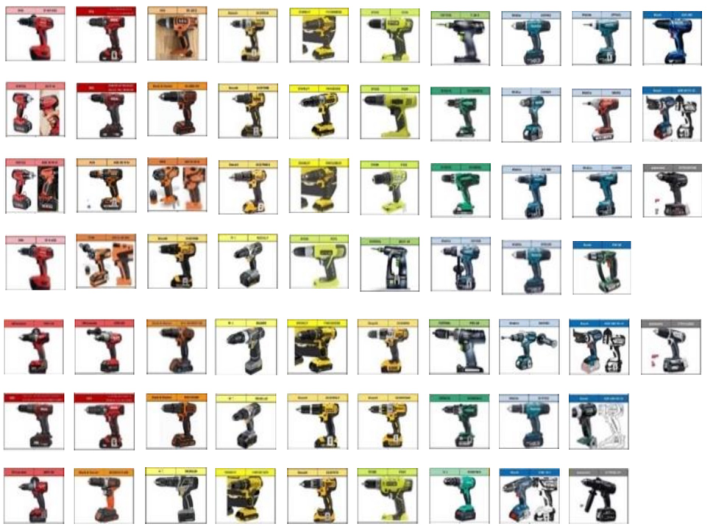
Collection of Existing Cordless Drill Screwdriver Handles The collection of cordless drill Screwdriver handles in this study was limited to those commonly used by professional users with a battery voltage of 18 volts. The collection scope included Taiwan, the Asian region, the European region, and the American region. A total of 67 available cordless drill Scre- wdriver and impact driver styles on the market were collected in this study, starting from September 2, 2019, as shown in Figure 1.
Figure 1: Collection of existing cordless drill Screwdriver handles on the market.
This study also printed the collected drill handles on A7-sized cards, as shown in Figure 1. The study was conducted on September 19, 2019, at National Taipei University of Technology. Three product design experts were invited to perform the Affinity Diagram (KJ method) to summarize the cross-sectional shapes. The backgrounds of the experts are presented in Table 2. The goal of the summarization was to discuss and categorize the cross-sectional areas of the drill handles, specifically the front upper, front lower, rear upper, and rear lower sections. The experts spent a total of approximately 4.5 hours on the summarization process.
Summarization of Drill Handle Designs Using Affinity Diagram In this study, three experts were invited to perform the Affinity Diagram (KJ method) to summarize the T-shaped handle designs of various drill brands
Analysis of the Handle Cross-Section Design of Cordless Drill Screwdriver 877
Table 2. Background information of product design experts.
Table available in the original PDF paper.
Expert Title Seniority Ms. Zheng expert Product designer 5 years Mr. Huang expert Product designer 6 years Mr. Li expert Product designer 8 years
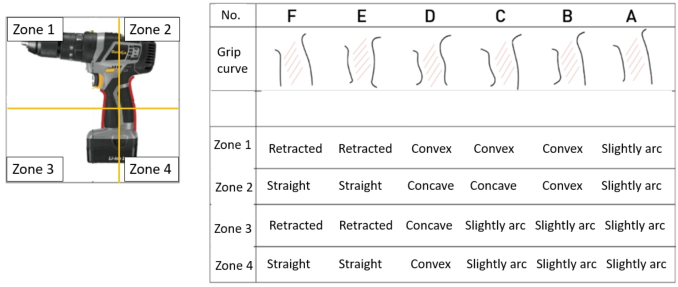
available on the market. After three rounds of discussion and summariza- tion, a total of six cross-sectional handle designs were identified, along with corresponding explanations of the handle curve. These findings are presented in Figure 2.
Figure 2: Six types of drill handle cross-sectional designs.
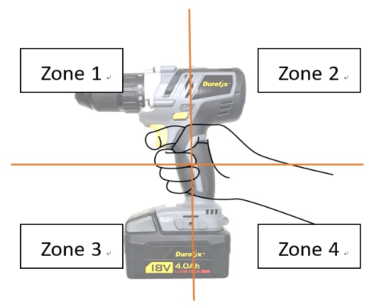
DISCUSSION & CONCLUSION This study employed the Affinity Diagram Method (KJ method) to iden- tify six types of handle cross-sectional designs, classified into four quadrants as shown in Figure 3. The results revealed subtle differences among the six handle cross-sectional designs, suggesting that slight variations in hand gestu- res may occur during gripping operations. Previous research has indicated that in grip strength tests involving different finger strengths, the contributi- ons of the thumb, index finger, middle finger, ring finger, and little finger to grip strength were found to be 17%, 22%, 31%, and 29%, respectively. The middle finger was identified as the most important factor for grip strength, followed by the combination of the ring finger and little finger (Cha et al., 2014). Among the six identified handle cross-sectional designs, slight differences were found in the gripping positions and shapes of the ring finger and little finger. Assuming a handle design for resisting torsional forces, it is inferred that quadrant region three of the handle cross-section is one of the important factors in grip strength, corresponding to the positioning of the ring finger and little finger. Additionally, during drilling operations with the power drill, the webbing between the thumb and index finger experiences the highest
878 Li and Chang
Figure 3: Quadrant regions of handle cross-sectional designs.
pressure (Björing et al., 2002). It is inferred that quadrant region two of the handle cross-section is an important factor in providing stable grip support.
Therefore, it may be possible to deduce the relationship between fingers and handle designs, as well as the positioning of the handle in the webbing between the thumb and index finger, to find optimal support for maximum grip strength. Future research will further explore the influence of the six handle cross-sectional designs on grip strength through experiments.
REFERENCES
Aldien, Y., Welcome, D., Rakheja, S., Dong, R., & Boileau, P. E. (2005). Contact pressure distribution at hand–handle interface: role of hand forces and handle size. International Journal of Industrial Ergonomics, 35(3), 267–286. Björing, G., Johansson, L., & Hägg, G. M. (2002). Surface pressure in the hand
when holding a drilling machine under different drilling conditions. International Journal of Industrial Ergonomics, 29, 255–261. Cha, S. M., Shin, H. D., Kim, K. C., & Park, J. W. (2014). Comparison of Grip Strength Among 6 Grip Methods. The Journal of Hand Surgery, 39(11), 2277–2284. Dianat, I., Rahimi, S., Nedaei, M., Asghari Jafarabadi, M., & Oskouei, A. E. (2017).
Effects of tool handle dimension and workpiece orientation and size on wrist ulnar/radial torque strength, usability and discomfort in a wrench task. Applied Ergonomics, 59(Part A), 422–430. Fennigkoh, L., Garg, A., & Barbara, H. (1999). Mediating effects of wrist reaction torque on grip force production. International Journal of Industrial Ergonomics, 23(4), 293–306. Harih, G., & Dolšak, B. (2013). Tool-handle design based on a digital human hand
model. International Journal of Industrial Ergonomics, 43(4), 288–295. Harih, G., & Dolšak, B. (2014). Comparison of subjective comfort ratings between anatomically shaped and cylindrical handles. Applied Ergonomics, 45(4), 943–954. Hajime Takahashi. (2016). Mastering Power Drilling with Illustrations: Taiwan
Donghan Co., Ltd.
Analysis of the Handle Cross-Section Design of Cordless Drill Screwdriver 879
Hand Tool Ergonomics - Tool Design. ( October 1, 2015). Canadian Centre for Occupational Health and Safety (CCOHS) Retrieved from https://www.ccohs.ca /oshanswers/ergonomics/handtools/tooldesign.html Loisel, F., Bonin, S., Jeunet, L., Pauchot, J., Tropet, Y., & Obert, L. (2014). Woodw-
orking injuries: A comparative study of work-related and hobby-related accidents. Chirurgie de la Main, 33(5), 325–329. Lin, J. H., McGorry, R. W., Chang, C. C., & Dempsey, P. G. (2007). Effects of user experience, working posture and joint hardness on powered nutrunner torque reactions. Ergonomics, 50(6), 859–876. McDowell, T. W., Wimer, B. M., Welcome, D. E., Warren, C., & Dong, R. G. (2012).
Effects of handle size and shape on measured grip strength. International Journal of Industrial Ergonomics, 42(2), 199–205. Medical Multimedia Group, L. (2003). A Patient’s Guide to Triangular Fibrocartilage Complex (TFCC) Injuries. Shih, Y.-C., & Wang, M.-J. J. (1996). Hand/tool interface effects on human torque
capacity. International Journal of Industrial Ergonomics, 18(2), 205–213. Terrell, R., & Purswell, J. L. (1976). The Influence of Forearm and Wrist Orientation on Static Grip Strength as a Design Criterion for Hand Tools. Proceedings of the Human Factors Society Annual Meeting, 20(1), 28–32. Welcome, D., Rakheja, S., Dong, R., Wu, J. Z., & Schopper, A. W. (2004). An inve-
stigation on the relationship between grip, push and contact forces applied to a tool handle. International Journal of Industrial Ergonomics, 34(6), 507–518.
LISTED IN THE AHFE DIGITAL BOOKSTORE CATALOGUE
Explore the complete digital volume
Ergonomics In Design
Read this individual research paper free through the original publisher, or explore the full digital proceedings book.
ISBN 978-1-958651-53-7
Explore this ISBN in the AHFE Bookstore ↗Listed in the July 2026 bookstore catalogue; search by ISBN to confirm current availability · Digital book purchase optional