Gabriela G. Reyes-Zárate, Eduardo Caballero Montes, Jorge A. Gonzalez-Mendivil, Uziel Hernández Espejo (2023). Comparison in virtual reality based on efficiency for product assembly. In: Human Interaction and Emerging Technologies (IHIET-AI 2023): Artificial Intelligence and Future Applications. AHFE Open Access, vol. 70, pp. 180–185. https://doi.org/10.54941/ahfe1002942
Virtual Reality technology (VR) can be used for manufacturing training within a reduced space to allow trainees to manipulate objects in a simulated environment. Based on the information obtained from this recreation exercise, the production planning team can implement the proper adjustments prior to the beginning of an assembly. During a Project Evaluation and Management course, five students from Tecnologico de Monterrey created a VR space with pieces for assembly in a laboratory, designed with the previous user experience from the students. The main objective of this study was to test the effectiveness of a drill pump assembly process to analyze the assembly time. The study included 44 third-year undergraduate engineering students, 22 females. After the VR study, a statistical test was performed to analyze the results, which indicated that the group of students reduced the cycle time by 67% after two times compared to the first tryout. In addition, no significant differences were observed in the assembly time between the male and female students.
Innovation is a competitive advantage to be successful in applying new technologies. VR technology was used about 50 years ago with different har- dware (Slater & Sanchez-Vives, 2016) Students need a practical experience in higher education. Because of the complexity of being in a company for a process, an option is to develop a VR environment for a student to have this experience (Ewert D. et al., 2013). Several applications of Virtual Reality have been used for student learning. Working with these interaction methods constitutes a substantial area for students. In this direction, the effect of VR environments on students’ learning was examined. Creating a sense of pre- sence to learn how a product can be assembled allows the person learn the steps to practice. Assembly planning is an essential tool for manufacturing in order to properly design a production line based on several factors. Students from our University defined an assembly plan by 3D modelling the compo- nents in SolidWorks. The classic validation of an assembly simulation in done in a monitor screen which usually does not allow for a proper review of the assembly positions. Nowadays most of the applications related to working operations in an industrial environment are based on a virtual product design. In the design of the production, parts need to be placed in the correct position,
Comparison in Virtual Reality Based on Efficiency for Product Assembly 181
and consider the sequence of each component in the assembly (Seth et al., 2011). Most work-related applications in industrial settings are based on vir- tual product design (Wolfartsberger Josef, 2019). In this preliminary study, the CAD components drawn were a part for the environment development in VR. The next step was the VR technology involved. The level of characte- ristics to display represents a critical factor for their usability and degree of the sense of immersion. One category for visualization is the head-mounted device (HMD)(Berni & Borgianni, 2020). The Oculus Quest was selected for the study, with controllers without cables to move freely in the assigned area for the study. The virtual reality can improve the effectiveness of learning. Some environments were created in previous years, but modern developments can achieve student motivation. Two essential benefits are that environment provides a means to the student experience and increases engagement and motivation (Vergara et al., 2019).
SimLab VRStudio10 was used for this study to create the environment. Founded in 2007, SimLab Soft was dedicated to developing 3D and VR software that was easy to use, ensuring that it always provided the right tools to reach the goals of creating VR environments. SimLab VR plat- form transforms any 3D model into an interactive VR experience, and files from SolidWorks CAD formats are used to create the environment (SimLab Soft, 2023). This study aims to compare the efficiency of product assem- bly with Virtual Reality. The time to perform a task can be lesser when the person is trained in virtual Reality than when using a traditional method (Gonzalez-Mendivil et al., 2020). This work presents an analysis of the third- year engineering bachelor students assembling a drill pump using a virtual interactive environment and measuring the time when they do this assembly. Another analysis was done between female and male students doing the same assembly.
METHODOLOGY
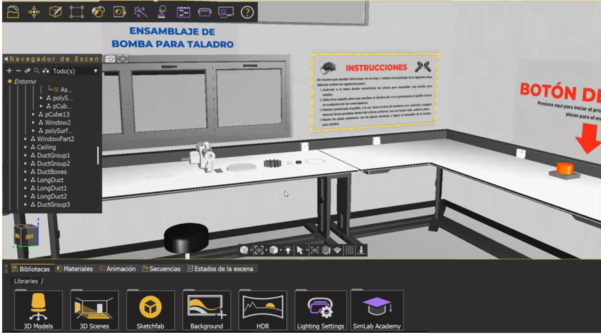
The study was divided into two phases. First, five students designed the vir- tual environment to assemble a drill pump. They used an Oculus Quest VR for a person to learn the steps to assemble a product. This program allows completing the training process related to the assembly of a product to ensure the correct position of the components. The drawings were developed using SolidWorks CAD software. For this project, the five students took a virtual course with Model Pro and learned how to use SimLab VRStudio10, SimLab VR Viewer, and SimLab Admin. Then they developed the program in SimLab to create the scenario (see Figure 1).
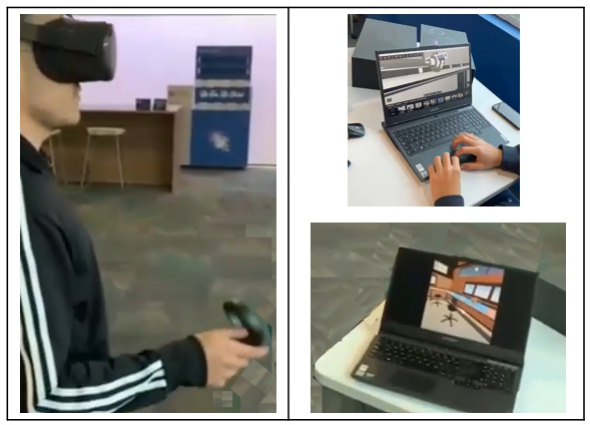
When the program was finished, a series of different tests were done. One part was to see the scenario that the students did and correspond to the assem- bly of the product in a workstation. The order was essential because each piece has a sequence in an assembly. The software can visualize the scenario and movements in the computer that the user sees with the Oculus. Another student during the test sees if the pieces correspond to the objective for the assembly with VR. The wireless controller’s tracking of hand movements
Figure 1: Scenario and parts for the assembly created by students.Figure 2: Tests with the VR environment (left side), visualization of the movements in the computer, and parts for the assembly (right side).
and buttons allows interaction with the objects in the VR environment. (see figure 2).
The second phase was the assembly study. A bachelor’s group of engi- neering students was selected. Students had to use the VR environment for this task. Forty-four students (22 female) did the assembly of the drill pump twice. The study used a place in the university previously assigned, and the test was done in the morning. Each student tried the first time, and the view of the environment was followed to observe the position of the pieces and the time he or she used for the assembly. Then students repeated the task. When the students’ test was finished, Minitab software was used for the statistical analysis.
Comparison in Virtual Reality Based on Efficiency for Product Assembly 183
Table 1. P-Value for the first study.
Table available in the original PDF paper.
T Value DF p-value
11.74 48 0.000
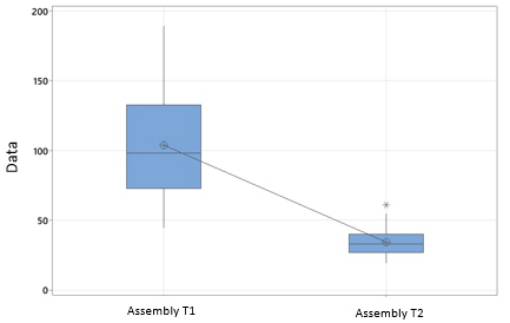
Figure 3: Box plot for the first and second VR assembly time.
RESULTS
A statistical test Two sample t for the Mean (t-Student test) was done. The first question to answer was: Is an improvement in the efficiency of an assem- bly product using a VR environment? To know this, the time it takes the student to finish the assembly of the drill pump was registered. T1 was the first try, and T2 was the second try students did the assembly.
Case 1: Comparison of the first and the second registered time of all students.
H0: µT1 = µT2 H1: µT1̸ = µT2 On Table 1 are the results generated by Minitab for the first study. In Figure 3 is the first statistical comparison of the time to finish the assembly of the drill pump VR environment.
There is a statistically significant change in the average time. In addition, students learned how to assemble the drill pump with the VR environment reducing the time to perform the task.
The second question to answer was: Is the time for the assembly the same for female and male students? To measure this, the time for the second assem- bly was used. F was the try for female students, and M was the time for male students.
Case 2: Comparison of the second registered time T2 of female and male students.
Equation reproduced from the original PDF.Table 2. P-Value for the second study.
Table available in the original PDF paper.
T Value DF p-value
0.76 41 0.451
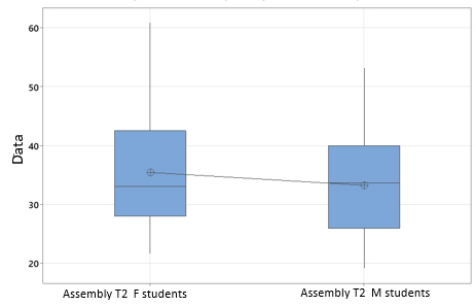
Figure 4: Box plot for the female and male students during second VR assembly time.
Figure 4 has the second statistical analysis. There is no evidence that the assembly time is different between female and male students. All with a 95% confidence level.
Virtual reality in educational scenarios where it has been implemented has positively impacted the student learning experience (Fabris et al., 2019). The study reflects the learning improvements with the use of VR to assem- ble a drill pump. One important argument is that VR adds value when individuals can interact in ways that they couldn’t have in real-world set- tings (Kosmas et al., 2021). The learning process of an assembly can be a challenge and an opportunity in Higher Education. There is a growing trend of research on virtual environments in remote collaborative design (Zhang et al., 2020).
CONCLUSION
The study contributes to the use of VR technology for a built environment and can be used in Higher Education to promote applications for the indu- stry. Virtual reality learning environments can be used to perform tasks like assembling parts of a product. The design process includes all the steps to develop the scenario for the purpose that has been defined. This study used a series of steps to train individuals with a learning experience through VR. In the findings, students showed better task performance for assembling a drill pump. Another situation revealed that female and male students have the same skills doing the same task. Future VR scenarios will be developed in new environments for training.
Comparison in Virtual Reality Based on Efficiency for Product Assembly 185
ACKNOWLEDGMENT
The authors would like to acknowledge the financial support of Writing Lab, Institute for the Future of Education, Tecnologico de Monterrey, Mexico, in the production of this work. We would also like to acknowledge the support of Model Pro, who trained the students using the SimLab program.
REFERENCES
Berni, A., & Borgianni, Y. (2020). Applications of virtual reality in engineering and product design: Why, what, how, when and where. In Electronics (Switzerland) (Vol. 9, Issue 7, pp. 1–29). MDPI AG. https://doi.org/10.3390/electronics9071064 Ewert D., Schuster K., Johannson D., Schillberg D., & Jeschke S. (2013). Intensifying
learner’s experience by incorporating the virtual theatre into engineering edu- cation. IEEE Global Engineering Education Conference, EDUCON, 207–212. https://doi.org/10.1109/EduCon.2013.6530107 Fabris, C. P., Rathner, J. A., Fong, A. Y., & Sevigny, C. P. (2019). Virtual Reality in Higher Education. International Journal of Innovation in Science and Mathematics Education, 27(8), 69–80. Gonzalez-Mendivil, J. A., Rodriguez-Paz, M. X., Zamora-Hernandez, I., &
Caballero-Montes, E. (2020). Virtual Reality Environments as a Strategy to Improve Processes Productivity. ACM International Conference Proceeding Series, 161–164. https://doi.org/10.1145/3436756.3437039 Kosmas, P., Makridou, E., Pirkkalainen, H., Torro, O., & Vrasidas, C. (2021, November 25). Opportunities, challenges, and training needs in the use of VR in higher education and SMEs: The case of Cyprus and Finland. ACM International Conference Proceeding Series. https://doi.org/10.1145/3489410.3489430 Seth, A., Vance, J. M., & Oliver, J. H. (2011). Virtual reality for assembly meth-
ods prototyping: A review. Virtual Reality, 15(1), 5–20. https://doi.org/10.1007/ s10055-009-0153-y SimLab Soft. (2023). VR Software for Business and Education. https://www.simlab -soft.com/ Slater, M., & Sanchez-Vives, M. v. (2016). Enhancing our lives with immersive virtual
reality. In Frontiers Robotics AI (Vol. 3, Issue DEC). Frontiers Media S.A. https: //doi.org/10.3389/frobt.2016.00074 Vergara, D., Extremera, J., Rubio, M. P., & Dávila, L. P. (2019). Meaningful learning through virtual reality learning environments: A case study in materi- als engineering. Applied Sciences (Switzerland), 9(21). https://doi.org/10.3390/ap p9214625 Wolfartsberger Josef. (2019). Analyzing the potential of Virtual Reality for enginee-
ring design review. Automation in Construction, 104, 27–37. https://doi.org/https: //doi.org/10.1016/j.autcon.2019.03.018. Zhang, Y., Liu, H., Kang, S. C., & Al-Hussein, M. (2020). Virtual reality applications for the built environment: Research trends and opportunities. In Automation in Construction (Vol. 118). Elsevier B.V. https://doi.org/10.1016/j.autcon.2020. 103311
LISTED IN THE AHFE DIGITAL BOOKSTORE CATALOGUE
Explore the complete digital volume
Human Interaction and Emerging Technologies (IHIET-AI 2023): Artificial Intelligence and Future Applications
Read this individual research paper free through the original publisher, or explore the full digital proceedings book.
ISBN 978-1-958651-46-9
Explore this ISBN in the AHFE Bookstore ↗Listed in the July 2026 bookstore catalogue; search by ISBN to confirm current availability · Digital book purchase optional