Felix Miesen, Leon Urbas, Susanne Narciss (2023). How to support and integrate operators in CPPS: Insights from competency modelling for adapt and exchange scenarios. In: Intelligent Human Systems Integration (IHSI 2023): Integrating People and Intelligent Systems. AHFE Open Access, vol. 69, pp. 550–560. https://doi.org/10.54941/ahfe1002876
Cyber-physical production systems (CPPS) with its high automation and digitalization levels are capable of executing most tasks automatically. Further, their architecture allows for system changes in rather short times spans. Thus, operators facing these challenging features of CPPS have fewer chances to consolidate their competencies or to build a proper mental model. However, operators must be able to step in whenever automation reaches its limits. For a successful manual intervention, operators need to be integrated and supported in the best ways possible. This paper presents a competency model with ten competencies assigned to three clusters for adapt and exchange scenarios for CPPS in process industry. Approaches for integrating operators and designing assistance strategies can be derived from this model. Further, the model itself and the approaches are discussed.
Future socio-technical working systems in Industry 4.0 settings, also known as cyber-physical production systems (CPPS; Lasi et al., 2014; Wang et al., 2015), will meet the demands for smaller batch sizes and individualized products by shorter development periods (Bieringer et al., 2013; Huber, 2018). Compromising high levels of automation, digitalization, and a modu- lar architecture allowing for re-configurations in short time spans (Tonelli et al., 2021; VDI/VDE-Gesellschaft Mess- und Automatisierungstechnik, 2013; Wang et al., 2015), CPPS will change the way human operators will work in and with these systems (Hirsch-Kreinsen, 2014). CPPS perform most tasks automatically without human intervention as capabilities of automated functions increase (Müller et al., 2017). Thus, CPPS hardly offer operators chances to manually work with them. From a human factors perspective, this might lead to negative consequences like the loss of competencies as descri- bed in the Ironies of Automation (Bainbridge, 1983), the inability to take
How to Support and Integrate Operators in CPPS 551
over manual control of an automated system due to the Out of the Loop- Unfamiliarity (Endsley & Kiris, 1995), or the inability to build a proper mental model. However, operators must be able to step in whenever neces- sary and therefore stay competent for performance and safety reasons. Thus, new forms of interaction and cooperation between operator and CPPS are required. Most likely, technological advances of CPPS like Artificial Intelli- gence or the Internet of Things can be used to integrate countermeasures, e.g., adaptive operator assistance for smart learning. These countermeasu- res aim at enhancing human-machine interaction and cooperation to ensure system performance and safety, but also to facilitate the development and maintenance of competencies. A prerequisite for designing and integrating such countermeasures and enhancing human-machine interaction is the task and situation-specific definition of operator requirements, i.e., competency modelling. This paper presents a competency model for mastering demands of CPPS given the example of adapt and exchange scenarios in modular process plants.
MODULAR PROCESS PLANTS Modular process plants are examples of CPPS in process industry and are considered as multiproduct small-scale plants. Through modularization, they allow for flexible production possibilities (Bieringer et al., 2013). The hierarchical architecture of modular process plants as described in the stan- dard VDI 2776 (Verein deutscher Ingenieure e.V., 2020) includes process equipment assemblies (PEAs), functional equipment assemblies (FEAs), and components. PEAs are reusable parts of a modular process plant that cover specific process steps. Further, PEAs consist of one or multiple FEAs, which allow for intramodular adaptations. Components are the lowest unit of a modular process plant architecture and are subparts of PEAs and FEAs. Besi- des having an architecture allowing for re-configurations in rather short time spans in order to meet demands of volatile markets (Baldea et al., 2017; Bieringer et al., 2013; DECHEMA e.V., 2016; Lier et al., 2016), core chara- cteristics of modular process plants further include high levels of automation and digitalization (Lasi et al., 2014; Urbas et al., 2012). Thus, modular pro- cess plants execute most routine tasks and even well-defined non-routine tasks without human intervention (Müller et al., 2017). When automation and digitalization reach their limits (e.g., considering new boundary conditi- ons for safe and efficient production), the operator must step in and actively engage in the process. This includes, e.g., exchanging PEAs, FEAs, and / or adapting process parameters to master situations requiring manual control (Müller & Urbas, 2020).
COMPETENCIES Although being used frequently, a single definition of competencies is lacking due to divergent application contexts (Stevens, 2012). However, different definitions and conceptualizations of competencies (for an overview, see Prifti, 2019) share mutual characteristics: The term competency refers to
using intended actions to achieve a desired result in a specific task context. Based on this definition, it is also possible to point out further important and interacting characteristics of competencies. Competencies and performance are distinct constructs (Chomsky, 1965), with competencies being not mea- surable. However, high competency levels qualify for good performance (Le Deist & Winterton, 2005). Within the field of human factors, competencies often refer to Rasmussen’s (1983) framework distinguishing skill-based, rule- based, and knowledge-based behavior. These are hierarchical, but interacting levels increasing in their conceptual and abstraction level. While skill-based behavior does not require conscious attention for actions, rule-based beha- vior describes more demanding situations in which established strategies can be applied in order to execute actions and thus master tasks. To the extent that strategies cannot be applied, knowledge-based behavior is required to derive new strategies. Performance on the level of knowledge-based behavior depends on the mental representation of a given situation, and on deriving conclusions for actions from this mental model.
Acquisition, Decay, and Maintenance of Competencies The acquisition of competencies is a complex process in which new know- ledge and skills are integrated into existing ones (Bourne & Healy, 2012). Besides this integration, it is in general important to retain and transfer knowledge and skills to a variety of contexts as instructional and appli- cation setting might differ from each other (Bourne & Healy, 2012). The acquisition of competencies takes place in multiple settings, including sch- ool education or workplace learning. The latter is emphasized within this paper due to the relevance for operators of modular process plants. Work- place learning encompasses formal as well as informal learning processes and aims at enhancing performance and learning in organizational contexts (Malloch et al., 2011; Manuti et al., 2015). Formal learning processes are, e.g., structured trainings. In contrast, informal processes include learning at and through work (Malloch et al., 2011). This means experience is gained or new knowledge is acquired when facing new tasks at work and reflecting about undertaken actions to solve these tasks (Manuti et al., 2015). Compete- ncies decay when not being used or retrieved frequently (Arthur et al., 1998). Within automated working contexts, there are several interacting factors influencing the decay of competencies. High levels of automation provide infrequent opportunities for practice for the operator as in the normal mode of operation many functions and tasks are automated (Bainbridge, 1983; Manzey, 2012). As a consequence, the operator’s manual handling performa- nce (an indicator of competency) decreases. Further, high levels of automation require the operator to monitor parameters and thus maintain attention over a long period of time, which humans are hardly capable of (Bainbridge, 1983; Lee & Seppelt, 2012). The operator consequently will have a rather low situation awareness, i.e., having only limited knowledge of what hap- pens, why it happens, and how it will possibly develop (Endsley, 1995). This also leads to an inadequate mental model of the automated working con- text as opportunities to practice and therefore to update the mental model
How to Support and Integrate Operators in CPPS 553
are lacking (Bainbridge, 1983; Lee & Seppelt, 2012; Manzey, 2012). As they support the understanding of system functioning, adequate mental models are a prerequisite for good performance (Gentner, 2002; Kluge, 2014). How- ever, countermeasures can mitigate the decay of competencies. These include, e.g., (refresher) trainings aiming at providing frequent opportunities for pra- ctice or ecological interface design. With refresher trainings, seldom-used competencies required for non-routine situations are trained (e.g., start-up procedures in process control; Kluge & Frank, 2014). Design issues on inter- face level focus on enhancing the operator’s understanding of the plant, e.g., by the representation aiding framework ecological interface design. It creates a transparent visualization of abstract functions, relations, and system boun- daries in a given working context (Jamieson & Vicente, 2001). Thereby, the interface can support the operator in building a mental model for decision making in socio-technical working contexts.
Relevance of Assessing Competencies in Modular Process Plants With its increasing levels of automation and complexity due to their chan- geability, modular process plants put new demands on operators. To avoid detrimental effects caused by the core characteristics of modular process plants, their design must put the human back into the loop in order to remain manageable for operators (VDI/VDE-Gesellschaft Mess- und Auto- matisierungstechnik, 2013). Based on conducive design principles (Kessler et al., 2022; Ziegler & Urbas, 2015), modular process plants should incor- porate measures for operators to maintain competencies, e.g., assistance that facilitates smart learning. However, due to their varying competency levels, it is not very likely that all operators profit from such assistance in the same way. Research on learning and instruction has shown different effects of instructional activities on learners with divergent levels of expertise and prior knowledge, which is commonly known as the expertise reversal effect (Kalyuga et al., 2003). Among other reasons, for learners with high prior knowledge (i.e., experts) this effect is caused by redundant information that needs to be processed and identified, which creates additional work load on limited working memory resources. In order to avoid the expertise reversal effect when providing operator assistance for maintaining competencies, it is important to determine the required competencies beforehand and consider them already in design phases. By doing so, it is possible to align the provided assistance with the individual competency levels and thus allow for adaptive operator assistance enabling learning processes.
Prior Research on Competencies in Industry 4.0 Settings Prior research has taken a general perspective and has not been applied to specific use cases. For instance, Letmathe and Schinner (2017) developed a competency model for cyber-physical systems. It indicates the demands and situations three different operator roles in cyber-physical systems will face. For each demand, the lowest and highest characteristics of the compe- tency levels are defined along a continuum, e.g., for the task content (ranging
from routine tasks to previously unknown tasks). Prifti et al. (2017) presen- ted a competency model for computer science, engineering, and information system professionals in Industry 4.0. Based on literature search and focus groups, they elaborated 8 categories with 20 competency dimensions and 69 competencies. Competencies are further assigned to one or more of the three professional groups.
COMPETENCY MODEL DEVELOPMENT Competency modelling describes the process of defining a person’s know- ledge and skills for successfully performing a given task (Stevens, 2012). Competency models distinguish several competency levels from low to high proficiency levels and provide for each level behavioral anchors (Campion et al., 2011; Stevens, 2012). The process of competency modelling inclu- des (a) the definition of superordinate competency fields, (b) the assignment of individual competencies to the competency fields, and (c) the description of behavioral anchors to differentiate between competency levels (Campion et al., 2011; Stevens, 2012). The following sections describe the process of developing the competency model for adapt and exchange scenarios, including an additional step of designing scenarios as task content.
Step 1: Overall Assessment of Operator Competencies For a first assessment of operator competencies required in modular process plants, expert interviews (n = 4) inspired by the framework of cognitive work analysis (Roth & Bisantz, 2013) were conducted. Results were validated by additional experts (n = 19) in a subsequent online survey. For both parts, par- ticipants had to have expertise in modularization in process industry. Results reveal in total n = 30 competencies required for operators in modular process plants, which were assigned to the categories knowledge (n = 9), technical (n = 9), and non-technical skills (n = 12). However, the identified compe- tencies were on a rather general level, e.g., mathematical skills. The expert interviews further revealed tasks operators face in modular process plants, e.g., adapting parameters or exchanging PEAs. Results from this first step were used for scenario design in the second step.
Step 2: Scenario Design As the scenarios were designed for experimental purposes, researchers from process engineering and psychology developed them in an iterative process. In order to ensure external validity, the scenarios are based on a chemical neu- tralization process, in which the chemical compounds acids and bases (also known as alkalis) are considered (Zumdahl & DeCoste, 2017). These com- pounds differ in their pH values, which describe the acidity of any solution. The aim of mixing acids and bases in a neutralization process is to reach a pH value of 7 out of a scale ranging from 0 (acidic) to 14 (basic). Four scenarios were developed with the common task to increase the throughput and thus the production of the neutral product. To do so, the operator has to decide whether to adapt parameters and / or exchange PEAs and thus has to engage in problem solving processes. For exchanging PEAs, the operator is provided
How to Support and Integrate Operators in CPPS 555
with four PEAs within each scenario. These PEAs have the following chara- cteristics: One PEA is not suitable for the process due to an insufficient fit of the parameter temperature. Another PEA might fit the process in general, but does not show any benefit regarding the parameter that causes a bot- tleneck for increasing the production. The remaining two PEAs are suitable to solve the problem. The scenarios further differ in their complexity being assigned to one of the levels low, medium, or high complexity. To cope with higher complexity means to engage on a higher cognitive level, e.g., by consi- dering additional interdependencies. In order to master the demands of more complex scenarios, a higher competency level is required.
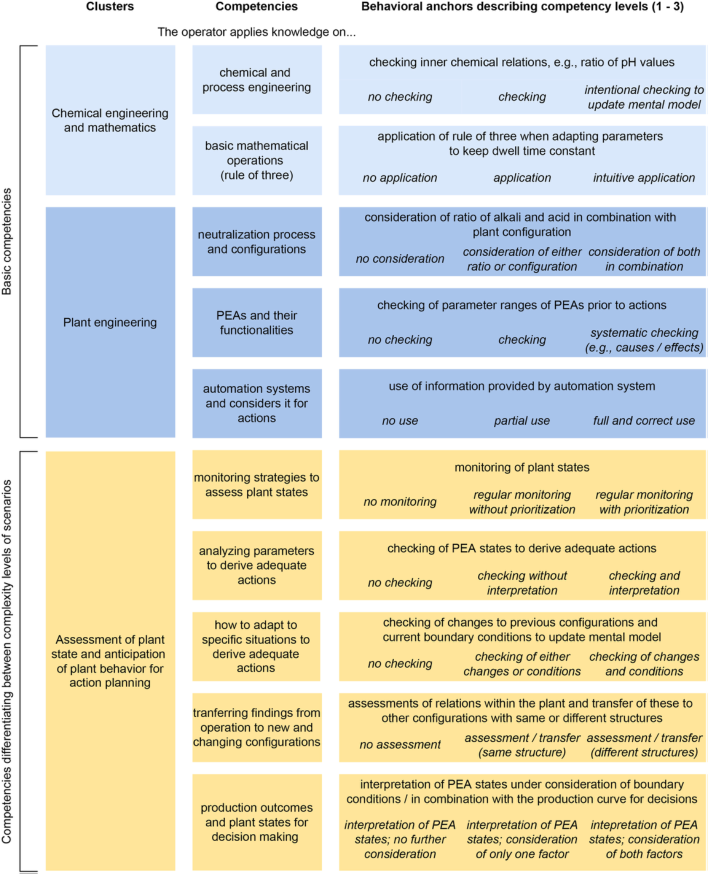
Step 3: Assigning Competencies / Behavioral Anchors to Scenarios In order to develop the competency model, the overall competencies assessed in the first step were assigned to the developed scenarios. For this, compete- ncies from the expert interviews were extracted and the general wording of those competencies has been specified to match the application context of a neutralization process defined in the scenarios. This means, e.g., the compe- tency mathematical skills was adapted to The operator applies knowledge on basic mathematical operations (rule of three). Further, three competency clu- sters were created from the competencies. Last, step 3 included the definition of behavioral anchors on three levels with regard to the application context.
COMPETENCY MODEL
Figure 1 presents the final competency model for adapt and exchange sce- narios in modular process plants. The final competency model includes ten competencies, which are assigned to one of three competency clusters. These competency clusters are (1) chemical engineering and mathematics, (2) plant engineering, and (3) assessment of plant state and anticipation of plant behavior for action planning. The first two clusters are considered as core competencies for mastering adapt and exchange scenarios as they represent the basic understanding of the domain and the modular process plant. Accor- dingly, operators must have competency level 3 in these two clusters to master the scenarios, whereas competencies in the third cluster distinguish between complexity levels of the scenarios, i.e., operators with competency level 1 likely master scenarios with low, but not with high complexity.
DISCUSSION
This paper presents a hierarchical competency model describing three levels of proficiency for adapt and exchange scenarios in modular process plants based on a chemical neutralization process. Taking into account own prior work such as expert interviews and the design of scenarios, a total of ten competencies were identified and further described by behavioral anchors for three different competency levels. In addition, these competencies are assigned to one of three clusters distinguishing between basic competencies (chemical engineering and mathematics and plant engineering) and those that allow a differentiation for levels of complexity by means of the competency
Figure 1: Competency model for adapt and exchange scenarios in modular process plants.
levels (assessment of plant state and anticipation of plant behavior for action planning). Whereas past researchers have focused on a broader approach for developing competency models (e.g., Letmathe & Schinner, 2017; Prifti et al., 2017), this paper has presented a competency model for a specific use case: adapt and exchange scenarios in modular process plants. However, the development of this competency model also started with a general and ove- rall assessment of competencies. So, past and current competency models do not mutually contradict each other. Rather, commonalities can be identified that describe the future work in Industry 4.0 settings, e.g., operators will face mainly non-routine tasks that require problem solving strategies and
How to Support and Integrate Operators in CPPS 557
adaptability to new contexts. Thus, this paper builds on prior research and supports it by taking a scenario and task related perspective.
Limitations So far, the present competency model was not empirically validated. How- ever, this is related to the fact that competence modeling is future-oriented (Campion et al., 2011; Stevens, 2012). To ensure validity, a clear metho- dological approach was used for developing the competency model: First, expert interviews were conducted and second, results were validated by further experts. Therefore, the competency model is based on a theoreti- cal foundation and the whole development process was accompanied by interdisciplinary researchers covering relevant disciplines.
Theoretical and Practical Implications Accordingly, the developed competency model can provide several starting points for considering the interaction and cooperation between human and machine for system and assistance design. More specific, it offers the basis for investigating the highly relevant issues of how and under what assistance conditions competencies can be maintained, and / or developed further. The competency model reveals, e.g., the importance of knowledge on cause-effect structures and inner relations. This refers to mental models (Gentner, 2002) and the importance of adequate mental models for system control was alre- ady emphasized from a technical perspective (VDI/VDE-Gesellschaft Mess- und Automatisierungstechnik, 2013). A possibility might be to make these underlying structures and relations visible in order to enhance the operator’s understanding of the modular process plant. Further, human-machine inte- raction can aim at keeping the human in the loop. Within research, distinct approaches are discussed, e.g., ecological interface design illustrating possible constraints (Ellerbroek et al., 2013) or adaptive automation and task alloca- tion (Kaber et al., 2001; Manzey, 2012). Within this context, the competency model provides the starting point for assessing individual competency levels, which is a crucial factor for the design of adaptive assistance. Without clear indicators on the respective competency level, it is hardly possible to decide on suitable assistance strategies or task allocations. Further, it allows to tailor, e.g., additional information, tasks, and assistance to the current competency level in a way that it promotes the development to higher competency levels. In combination with the technologies incorporated in modular process plants, the competency model thus contributes to establish an adaptive way of opera- tor assistance and human-machine interaction. This increases the fit between human and machine in order to keep the human in the loop, e.g. after periods of non-use or depending on human states.
CONCLUSION AND OUTLOOK The present research contributes to a growing body of evidence suggesting that working environments in Industry 4.0 and thus the required compete- ncies for operators will change. This paper presents a competency model for adapt and exchange scenarios in modular process plants as an example of
CPPS. Based on the competency model, it is possible to draw conclusions for human-machine interaction and operator assistance design. However, expe- rimental validation of these assumptions is required to draw more precise conclusions for system design.
ACKNOWLEDGMENT
Funded by the Deutsche Forschungsgemeinschaft (DFG, German Research Foundation) – 319919706/RTG2323.
REFERENCES
Arthur, W., Bennett, W., Stanush, P. L., & McNelly, T. L. (1998). Factors that influence skill decay and retention: A quantitative review and analysis. Human Performance, 11(1), 57–101. https://doi.org/10.1207/s15327043hup1101_3 Bainbridge, L. (1983). Ironies of Automation. Automatica, 19(6), 775–779. Baldea, M., Edgar, T. F., Stanley, B. L., & Kiss, A. A. (2017). Modular Manufa-
cturing Processes: Status, Challenges, and Opportunities. AIChE Journal, 63(10), 4262–4272. https://doi.org/10.1002/aic.15872 Bieringer, T., Buchholz, S., & Kockmann, N. (2013). Future Production Concepts in the Chemical Industry: Modular - Small-Scale - Continuous. Chemical Enginee- ring and Technology, 36(6), 900–910. https://doi.org/10.1002/ceat.201200631 Bourne, L. E. J., & Healy, A. F. (2012). Introduction: Training and its Cognitive
Underpinnings. In A. F. Healy & L. E. J. Bourne (Eds.), Training Cognition. Opti- mizing Efficiency, Durability, and Generalizability (1st ed., pp. 1–12). Psychology Press. Campion, M. A., Fink, A. A., Ruggerberg, B. J., Carr, L., Phillips, G. M., & Odman, R. B. (2011). Doing competencies well: Best practices in compete- ncy modeling. Personnel Psychology, 64(1), 225–262. https://doi.org/10.1111/j. 1744–6570.2010.01207.x Chomsky, N. (1965). Aspects of the Theory of Syntax. MIT Press. DECHEMA e.V. (2016). Modular Plants. Flexible chemical production by modula-
rization and standardization - status quo and future trends. Ellerbroek, J., Brantegem, K. C. R., van Paassen, R., de Gelder, N., & Mulder, M. (2013). Experimental Evaluation of a Coplanar Airborne Separation Display. IEEE Transactions on Human-Machine Systems, 43(3), 290–301. Endsley, M. R. (1995). Toward a Theory of Situation Awareness in Dynamic Systems.
Human Factors, 37(1), 32–64. https://doi.org/10.1518/001872095779049543 Endsley, M. R., & Kiris, E. O. (1995). The Out-of-the-Loop Performance Problem and Level of Control in Automation. Human Factors, 37(2), 381–394. https://doi.org/10.1518/001872095779064555 Gentner, D. (2002). Mental Models, Psychology of. In N. J. Smelster & P. B.
Bates (Eds.), International Encyclopedia of the Social and Behavioral Scie- nces (pp. 9683–9687). Elsevier Science. https://doi.org/10.1016/B0-08-043076- 7/01487-X Hirsch-Kreinsen, H. (2014). Wandel von Produktionsarbeit – “Industrie 4.0.” WSI Mitteilungen, 6, 421–429. Huber, W. (2018). Industrie 4.0 kompakt – Wie Technologien unsere Wirtschaft und
unsere Unternehmen verändern. Springer Vieweg. https://doi.org/10.1007/978-3- 658-20799-1
How to Support and Integrate Operators in CPPS 559
Jamieson, G. A., & Vicente, K. J. (2001). Ecological interface design for petrochemical applications: Supporting operator adaptation, continuous learning, and distributed, collaborative work. Computers and Chemical Engineering, 25(7–8), 1055–1074. https://doi.org/10.1016/S0098-1354(01)00678-0 Kaber, D. B., Riley, J. M., Tan, K.-W., & Endsley, M. R. (2001). On the Design of
Adaptive Automation for Complex Systems. International Journal of Cognitive Ergonomics, 5(1), 37–57. https://doi.org/10.1207/s15327566ijce0501_3 Kalyuga, S., Ayres, P., Chandler, P., & Sweller, J. (2003). The expertise reversal effect. Educational Psychologist, 38(1), 23–31. https://doi.org/10.1207/S15326985EP3801_4 Kessler, F., Lorenz, S., Miesen, F., Miesner, J., Pelzer, F., Satkowski, M., Klose, A., & Urbas, L. (2022). Conducive Design as an Iterative Process for Engineering CPPS. Human Aspects of Advanced Manufacturing, 66, 13–20. https://doi.org/doi.org/10.54941/ahfe1002683 Kluge, A. (2014). The Acquisition of Knowledge and Skills for Taskw- ork and Teamwork to Control Complex Technical Systems. Springer. https://doi.org/10.1007/978-94-007-5049-4 Kluge, A., & Frank, B. (2014). Counteracting skill decay: four refresher interventions
and their effect on skill and knowledge retention in a simulated process control task retention in a simulated process control task. Ergonomics, 57(2), 175–190. https://doi.org/10.1080/00140139.2013.869357 Lasi, H., Fettke, P., Kemper, H. G., Feld, T., & Hoffmann, M. (2014). Industry 4.0. Business and Information Systems Engineering, 6(4), 239–242. https://doi.org/10.1007/s12599-014-0334-4 Le Deist, F. D., & Winterton, J. (2005). What is compete- nce? Human Resource Development International, 8(1), 27–46. https://doi.org/10.1080/1367886042000338227 Lee, J. D., & Seppelt, B. D. (2012). Human Factors and Ergonomics in Automation Design. In G. Salvendy (Ed.), Handbook of Human Factors and Ergonomics (4th ed., pp. 1615–1642). John Wiley & Sons, Inc. https://doi.org/10.1002/9781118131350.ch59 Letmathe, P., & Schinner, M. (2017). Competence Management in the Age of Cyber Physical Systems. In S. Jeschke, C. Brecher, H. Song, & D. B. Rawat (Eds.), Indu- strial Internet of Things - Cybermanufacturing Systems (pp. 595–614). Springer. https://doi.org/10.1007/978-3-319-42559-7_25 Lier, S., Wörsdörfer, D., & Grünewald, M. (2016). Transformable Production Conce-
pts: Flexible, Mobile, Decentralized, Modular, Fast. ChemBioEng Reviews, 3(1), 16–25. https://doi.org/10.1002/cben.201500027 Malloch, M., Cairns, L., Evans, K., & O’Connor, B. N. (Eds.). (2011). The SAGE handbook of workplace learning. SAGE. Manuti, A., Pastore, S., Scardigno, A. F., Giancaspro, M. L., & Morci- ano, D. (2015). Formal and informal learning in the workplace: A resea- rch review. International Journal of Training and Development, 19(1), 1–17. https://doi.org/10.1111/ijtd.12044 Manzey, D. (2012). Systemgestaltung und Automatisierung. In P. Badke-Schaub, G.
Hofinger, & K. Lauche (Eds.), Human Factors: Psychologie sicheren Handelns in Risikobranchen (pp. 333–352). Springer. https://doi.org/doi.org/10.1007/978- 3-642-19886-1_19 Müller, R., Narciss, S., & Urbas, L. (2017). Interfacing cyber-physical production systems with human decision makers. In H. Song, D. B. Rawar, S. Jeschke, & C. Brecher (Eds.), Cyber-Physical Systems (pp. 145–160). Academic Press. https://doi.org/10.1016/B978-0-12-803801-7. 00010–9
Müller, R., & Urbas, L. (2020). Adapt or Exchange: Making changes within or between contexts in a modular plant scenario. Journal of Dynamic Decision Making, 6, 1–20. https://doi.org/https://doi.org/10.11588/jddm.2020.1.69326 Prifti, L. (2019). Professional Qualification in “Industrie 4.0”: Building a Compete-
ncy Model and Competency-Based Curriculum. Technische Universität München. Prifti, L., Knigge, M., Kienegger, H., & Krcmar, H. (2017). A Competency Model for “Industrie 4.0” Employees. Proceedings Der 13. Internationalen Tagung Wirtschaftsinformatik (WI 2017), 46–60. Rasmussen, J. (1983). Skills, Rules, and Knowledge; Signals, Signs and Symbols,
and Other Distinctions in Human Performance Models. IEEE Transactions on Systems, Man, and Cybernetics, 13(3), 257–266. Roth, E. M., & Bisantz, A. M. (2013). Cognitive Work Analysis. In J. D. Lee & A.
Kirlik (Eds.), The Oxford Handbook of Cognitive Engineering. Oxford University Press. https://doi.org/10.1093/oxfordhb/9780199757183.013.0015 Stevens, G. W. (2012). A Critical Review of the Science and Practice of Competency Modeling. Human Resource Development Review, 12(1), 86–107. https://doi.org/10.1177/1534484312456690 Tonelli, F., Demartini, M., Pacella, M., & Lala, R. (2021). Cyber-physical systems
(CPS) in supply chain management: From foundations to practical implementa- tion. Procedia CIRP, 99, 598–603. https://doi.org/10.1016/j.procir.2021.03.080 Urbas, L., Bleuel, S., Jäger, T., Schmitz, S., Evertz, L., & Nekolla, T. (2012). Automatisierung von Prozessmodulen. Atp Edition - Automatisierungstechnische Praxis, 54(1–2), 44–53. https://doi.org/10.17560/atp.v54i01-02.203 VDI/VDE-Gesellschaft Mess- und Automatisierungstechnik. (2013). Cyber-Physical
Systems: Chancen und Nutzen aus Sicht der Automation. Verein deutscher Ingenieure e.V. (2020). Modulare Anlagen: Grundlagen und Planung modularer Anlagen (VDI 2776-1). Wang, L., Törngren, M., & Onori, M. (2015). Current status and advancement of
cyber-physical systems in manufacturing. Journal of Manufacturing Systems, 37, 517–527. https://doi.org/10.1016/j.jmsy.2015.04.008 Ziegler, J., & Urbas, L. (2015). Förderliches Gestalten komplexer Mensch-Maschine- Systeme: Eine disziplinenübergreifende Herausforderung. In GfA e.V. (Ed.), Arbeitswissenschaft mit Interdisziplinarität und Methodenvielfalt. GfA-Press. Zumdahl, S. S., & DeCoste, D. J. (2017). Chemical Principles (8th ed.). Cengage
Learning.
LISTED IN THE AHFE DIGITAL BOOKSTORE CATALOGUE
Explore the complete digital volume
Intelligent Human Systems Integration (IHSI 2023): Integrating People and Intelligent Systems
Read this individual research paper free through the original publisher, or explore the full digital proceedings book.
ISBN 978-1-958651-45-2
Explore this ISBN in the AHFE Bookstore ↗Listed in the July 2026 bookstore catalogue; search by ISBN to confirm current availability · Digital book purchase optional