Luis Serpa-Andrade, Luis Guerrero, Silvana Maldonado Merchan (2022). Methodology Based On Avatars for Therapeutic Interventions in Children With Autism Spectrum Disorder And Auditory Hypersensitivity. In: Human Interaction & Emerging Technologies (IHIET 2022): Artificial Intelligence & Future Applications. AHFE Open Access, vol. 68, pp. 760–765. https://doi.org/10.54941/ahfe1002803
Research Group on Artificial Intelligence and Assistive Technologies – GIIATa Universidad Politécnica Salesiana, Cuenca, Ecuador; Research Group on Applied Embedded Hardware – GIHEA, Universidad Politécnica Salesiana, Cuenca, Ecuador ↗
The proposal calls a methodology based on avatars for therapeutic interventions in children with autism spectrum disorder and auditory hypersensitivity. Its objective is to know how the use of technology through avatars promotes social skills and allows intervention of behavioral needs in children with ASD to propose a methodology using AVATAR based on the traditional methodology. On the other hand, it will also allow knowing if the auditory hypersensitivity of people with ASD can be intervened through the use of this strategy. Noise hypersensitivity is a common symptom of autism spectrum disorder (ASD). ASD is characterized as one of the neurodevelopmental disorders with social deficiency, restricted and repetitive behaviors during early and progressive development. The methodology of this proposal is based on an experimental observational study of cases and controls where cases of auditory hypersensitivity were detected in children diagnosed with autism spectrum disorder and in neurotypical children.
According to the World Health Organization - WHO, autism spectrum disor- der (ASD) is a group of diverse conditions. The characteristics of autism can be detected in early childhood, but autism is often not diagnosed until much later, 1 in 160 children suffer from ASD, depending on the degree of difficulty of the disorder, one can speak of autonomy or a be independent, so children with ASD must be accompanied by measures in the community and social sphere to achieve greater accessibility, exclusivity, and support.
The purpose of this research is to know how auditory hypersensitivity affe- cts children with ASD since this disorder is a very frequent condition that appears in childhood and lasts throughout the life of the human being, on the other hand, this research also seeks to explain the strategies work and
Methodology Based on Avatars for Therapeutic Interventions in Children 761
intervene in the classroom when children are exposed to different noises in the environment and it is more tolerable and friendly with their sound rece- ption system, in order to facilitate the adaptation of the teacher with the rest of the environment.
So auditory hypersensitivity in children with ASD becomes a challenge to work on their adaptation. At the school level, auditory hypersensitivity in a child with ASD manifests a special sensitivity, both to hear and to create and understand the world through sound. Each person has different chan- nels to know the world and relate to it, but when there is difficulty in social interaction and communication, its rehabilitation becomes more complex to understand sound, a platform based on Avatars is proposed for interventions according to the traditional methodologies used.
RELATED WORKS The auditory system is one of the primary senses of the human being, its importance is in the ability to capture sound and understand it, through hea- ring language is acquired, which is essential to develop communication and interaction with the environment, any alteration in this sense, it generates a temporary or total delay in the individual’s capacity for interaction and learning with the environment (Kossowski et al., 2014).
In the first years of life, hearing is a fundamental aspect of a child’s social, emotional, and cognitive development. Even a slight or partial loss of hearing can affect a child’s ability to speak and understand language, through hearing the child develops socially, interprets sound and understands it, and then expresses it through articulation or by words. Any hobby at the audiological level interferes and can affect overall development (François, 2019).
In childhood today, one of the most frequent conditions is autism spectrum disorder ASD, a term that was described by Leo Kanner in 1943. This disor- der consists of an inability to acquire social and emotional skills during early development that translates progressively in varying degrees of social adju- stment disability. The etiology is multifactorial and includes functional and structural neurological abnormalities, some of them with a presumed genetic origin (Reynoso et al., 2017).
In their study, (Stefanelli et al., 2020) mention that ASD is characterized by a continuous alteration in communication with different levels of severity, the disorder also manifests stereotyped behaviors, and disturbances such as sensory hypersensitivity, according to the DSM-5 these are the most common manifestations, of the same author auditory sensory disorders in ASD have two variants, the first is aimed at improving the understanding of the mecha- nisms of temporal listening and speech perception in noise; the second is for the analysis of the response to a certain acoustic stimulus, characterized by a disproportionate behavior due to its manifestations.
An intolerance characterizes auditory hypersensitivity to most of the every- day sounds that surround the person, in the case of children with ASD, this sensitivity becomes like overstimulation of sounds, including pain, discom- fort, need to cover up the ears, and anxiety behaviors, therefore, it is of the
utmost importance to try to adapt sound tolerance strategies through sensory integration (Londero & Bouccara, 2019).
At an educational level, children with ASD show a special sensitivity, both to hear and to create and understand the world through sound. Each child has different channels to discover the world and relate to it, so sensory integration and strategies in the classroom will be of great help to adapt to the acoustic environments of the school (Vindrola Paseta, 2016).
Traditionally, social skills training for children with ASD is done face- to-face with the therapist. However, promising results have recently been observed with the use of technological supports for behavioral intervention and social skills deficits through computer programs, avatars and therapeutic robots. These technological tools have changed the perspective compared to traditional therapies, positive behavioral and psychological changes, showing that their use promises the generation of efficient and functional therapeutic interventions (Soares et al., 2021).
METHODOLOGY
The purpose of the proposal is to identify auditory hypersensitivity in children with autism spectrum disorder through audiological examinations, for the selection of the participants of the experiment, later an experimental protocol based on avatars will be designed for therapeutic intervention in children with autism spectrum disorder and Auditory hypersensitivity. Finally, the propo- sed methodology is evaluated through therapeutic sessions in children with autism spectrum disorder and Hearing Hypersensitivity in the DESAFIOS comprehensive center, for the validation of the proposal.
Auditory hypersensitivity is one of the most well-known hearing symptoms in ASD and has been widely discussed in the international literature, the cur- rent prevalence of hyperacusis in the population with ASD is between 37 and 45% and one of the possible causes may be the dysfunction of the acoustic reflex, which is very common in children with ASD (Williams et al., 2021). This experimental and observational study compares the auditory profile of individuals with ASD with neurotypical individuals, of similar sex and chro- nological age, the hearing of the groups was normal and without alteration of the middle ear. The results of the present study showed that individuals with ASD have a high prevalence of auditory hypersensitivity.
Most of the studies reporting the presence of auditory hypersensitivity in ASD were based solely on interviews with parents or guardians or with the same individuals diagnosed with ASD or on the observation of behavioral reactions to sound stimulation (Fodstad et al., 2021). While in the present study, auditory hypersensitivity was observed through thresholds of annoya- nce to sound, where it is shown that children with ASD do present mild and moderate hyperacusis. The literature also states that auditory hypersensiti- vity tends to be more marked in childhood and decreases in late childhood or early adolescence (Danesh et al., 2021).
In the responses obtained by the LDL test, it was found that many indi- viduals from the CG did not have discomfort, that is, they did not report
Methodology Based on Avatars for Therapeutic Interventions in Children 763
feeling discomfort, even with sounds at the maximum intensity of the equi- pment (120dBHL), unlike the individuals from the EG, where the sounds of less intensity than 120dBHL already caused a feeling of discomfort. Even in the CG that presented discomfort to intense sounds, it was found that they were more tolerant to these sounds compared to the individuals of the EG with a statistically significant difference.
Hyperacusis was found in 25% of individuals and was of moderate degree in most cases. This prevalence was lower compared to previous studies, which reported a prevalence of more than 77% (Maenner, 2020), but it is statisti- cally significant considering the sample size. It is also worth mentioning that, throughout the evaluation, many patients showed fear of being exposed to sounds that caused them discomfort; Before starting each trial, patients were told that their individual comfort threshold would be respected. Thus, alth- ough hyperacusis was found in 25% of cases, the present study confirmed that people with ASD have significant hearing sensitivity that goes beyond the level found in the general population.
Some possible hypotheses to explain auditory hypersensitivity in ASD are based on genetics, the absence of the STX1A gene is capable of affecting serotonin levels. One study linked auditory hypersensitivity to dysfunction of 5-hydroxytryptamine (5-HT), or serotonin, which is a neurotransmitter that appears to play a role in modulating hearing gain and determines the importance of sound, because 5 receptors have been found HT in the cochlear nuclei as well as in the inferior colliculus (Lindsey, 2014). Despite this finding, this association is still unclear in the literature and further studies are needed to test this theory (Baguley, 2003).
Recently, a study found that people with ASD and severe hyperacusis had a medial olivocochlear reflex (MOC) twice as strong as people with ASD and mild hyperacusis or neurotypical development. Therefore, these authors sug- gested that the MOC reflex can be used to estimate hyperacusis in children with ASD, who do not always respond accurately to behavioral assessment (Wilson et al., 2017). Further studies are needed to assess the association between the absence of acoustic reflexes (mainly contralateral) and the pre- sence of hyperacusis in order to better understand the physiological processes that trigger hyperacusis. This section coincides with this study where the stapedial reflexes were present in all the individuals of the investigation, pos- sibly the size of the sample is not enough to delimit and corroborate with the literature.
The high lifetime prevalence of hyperacusis in people with ASD highlights the need for further research on sound tolerance in this population and the development of services or interventions to reduce the burden of this common symptom (Williams et al., 2021).
CONCLUSION
Auditory hypersensitivity was found in individuals with ASD, less tolera- nce to high-intensity sound was found, with a reduced discomfort threshold compared to typically developing individuals.
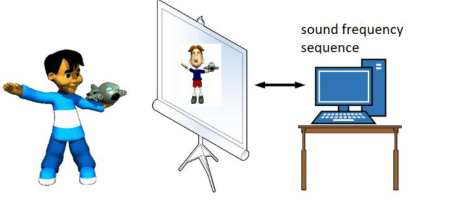
Figure 1: Interaction with AVATAR.
Auditory hypersensitivity is extremely common in individuals with ASD, with higher prevalence rates than most major mental disorders that com- monly co-exist with autism.
Knowledge of the evaluation and treatment of disorders of decreased sound tolerance within the ASD population is growing in permanent changes.
The use of AVATAR aims to modify the behavior of children to the tolera- nce of sound distractors in the middle of a session while evaluating the center of attention and behavior with the interaction.
In future lines, a plot is proposed that allows the use of an adapted platform with AVATAR for direct interaction, quantitatively measuring its center of attention and behavior in sensory alteration, specifically of sound, when there is a threshold higher than that which it supports.
REFERENCES
Baguley, D. M. (2003). Hyperacusis. Journal of the Royal Society of Medicine, 96(12), 582–585. Danesh, A. A., Howery, S., Aazh, H., Kaf, W., & Eshraghi, A. A. (2021). Hype-
racusis in Autism Spectrum Disorders. Audiology Research, 11(4), 547–556. https://doi.org/10.3390/audiolres11040049 Fodstad, J. C., Kerswill, S. A., Kirsch, A. C., Lagges, A., & Schmidt, J. (2021). Assessment and Treatment of Noise Hypersensitivity in a Teenager with Autism Spe- ctrum Disorder: A Case Study. Journal of Autism and Developmental Disorders, 51(6), 1811–1822. https://doi.org/10.1007/s10803-020-04650-w François, M. (2019). Detección precoz de la sordera en la infancia. EMC - Otorrino-
laringología, 48(3), 1–10. https://doi.org/10.1016/S1632-3475(19)42481-8 Kossowski, M., Pons, Y., Ukkola-Pons, E., Le Page, P., & Raynal, M. (2014). Hipoacusias fluctuantes. EMC - Otorrinolaringología, 43(2), 1–9. https://doi.org/10. 1016/S1632-3475(14)66709-6 Lindsey, H. (2014). Help for Hyperacusis: Treatments Turn Down Discomfort. The
Hearing Journal, 67(8), 22. https://doi.org/10.1097/01.HJ.0000453391.20357.f7 Londero, A., & Bouccara, D. (2019). Hiperacusia. EMC - Otorrinolaringología, 48(3), 1–8. https://doi.org/10.1016/S1632-3475(19)42482-X Maenner, M. J. (2020). Prevalence of Autism Spectrum Disorder Among Chil-
dren Aged 8 Years—Autism and Developmental Disabilities Monitoring Netw- ork, 11 Sites, United States, 2016. MMWR. Surveillance Summaries, 69. https://doi.org/10.15585/mmwr.ss6904a1
Methodology Based on Avatars for Therapeutic Interventions in Children 765
Reynoso, C., Rangel, M. J., & Melgar, V. (2017). [Autism spectrum disorder: Etiological, diagnostic and therapeutic aspects]. Revista Medica Del Instituto Mexicano Del Seguro Social, 55(2), 214–222. Soares, E. E., Bausback, K., Beard, C. L., Higinbotham, M., Bunge, E. L., &
Gengoux, G. W. (2021). Social Skills Training for Autism Spectrum Disorder: A Meta-analysis of In-person and Technological Interventions. Journal of Techno- logy in Behavioral Science, 6(1), 166–180. https://doi.org/10.1007/s41347-020- 00177-0 Stefanelli, A. C. G. F., Zanchetta, S., & Furtado, E. F. (2020). Hiper-responsividade auditiva no transtorno do espectro autista, terminologias e mecanismos fisiológi- cos envolvidos: Revisão sistemática. CoDAS, 32. https://doi.org/10.1590/2317- 1782/20192018287 Trastornos del espectro autista. (s. f.). Recuperado 23 de julio de 2021, de
https://www.who.int/es/news-room/fact-sheets/detail/autism-spectrum-disorders Vindrola Paseta, S. (2016). Percepción visual y auditiva en escolares con autismo en Lima Metropolitana: Un estudio de casos. Pontificia Universidad Católica del Perú. https://repositorio.pucp.edu.pe/index/handle/123456789/152951 Williams, Z. J., Suzman, E., & Woynaroski, T. G. (2021). Prevalence of Decreased
Sound Tolerance (Hyperacusis) in Individuals With Autism Spectrum Disorder: A Meta-Analysis. Ear & Hearing, Publish Ahead of Print. https://doi.org/10.1097/ AUD.0000000000001005 Wilson, U. S., Sadler, K. M., Hancock, K. E., Guinan, J. J., & Lichtenhan, J. T. (2017).
Efferent inhibition strength is a physiological correlate of hyperacusis in children with autism spectrum disorder. Journal of Neurophysiology, 118(2), 1164–1172. https://doi.org/10.1152/jn.00142.2017
Read this individual research paper free through the original publisher, or explore the full digital proceedings book.
ISBN 978-1-958651-44-5
Explore this ISBN in the AHFE Bookstore ↗Listed in the July 2026 bookstore catalogue; search by ISBN to confirm current availability · Digital book purchase optional